
CLASSIFICATION OF EARTH MOVEMENT All types of earth
- Slides: 32
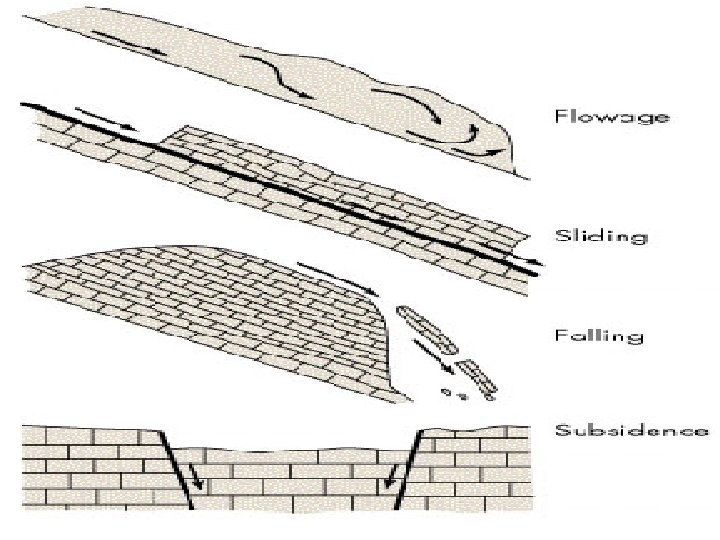
CLASSIFICATION OF EARTH MOVEMENT All types of earth movements may be classified as i) Earth flows ii) Landslides iii) Subsidence Mainly based on the type of movement which the displaced mass has suffered i. e whether flowage or failure on a shearing surface
• In earth flows, the movement is distributed throughout the displaced mass • In landslides, the movement is confined to a definite shearing plane or zone • In subsidence the movement is vertically downwards
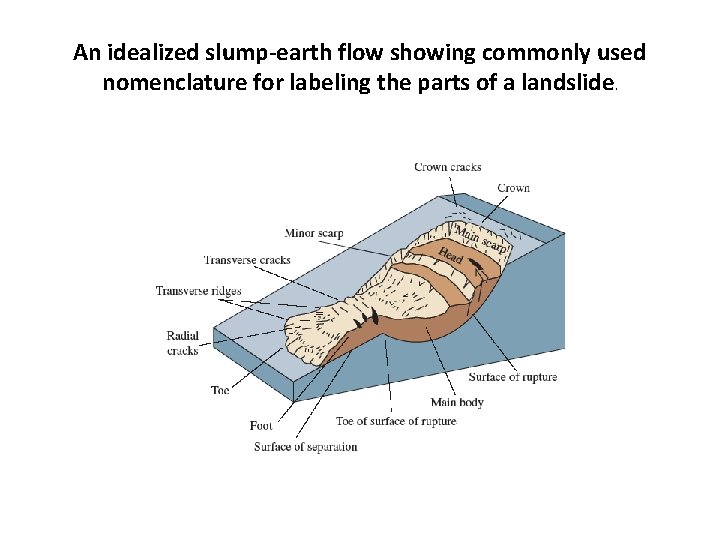
An idealized slump-earth flow showing commonly used nomenclature for labeling the parts of a landslide.
• Further classification is based on the rate of movement and types of materials involved.
EARTH FLOWS v Soilfluction v Creep v Rapid flows
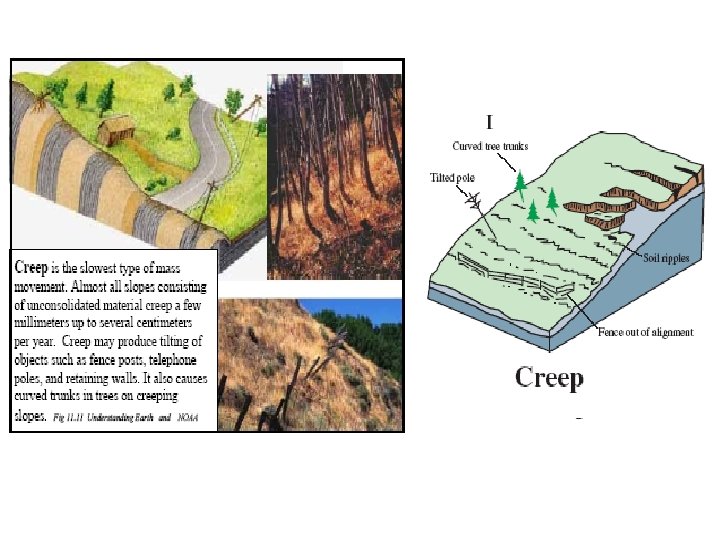
Solifluction – Downward movement of wet soil along the slopes under the influence of gravity. Creep –extremely slow downward movement of dry surfacial matter
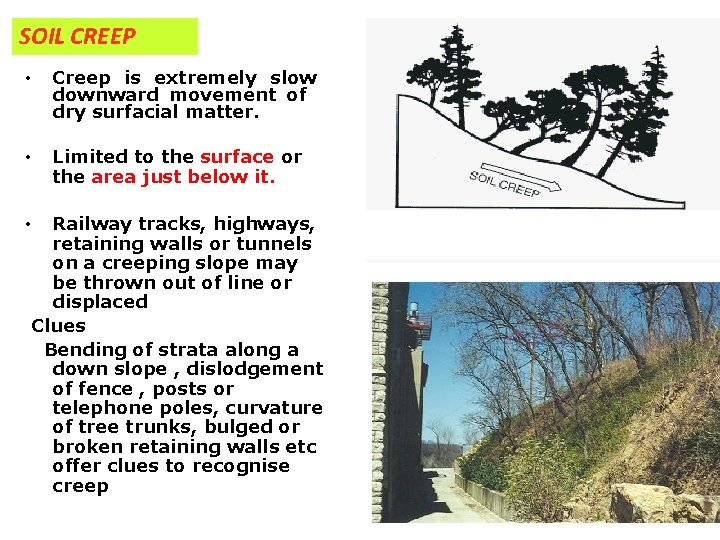
SOIL CREEP • Creep is extremely slow downward movement of dry surfacial matter. • Limited to the surface or the area just below it. Railway tracks, highways, retaining walls or tunnels on a creeping slope may be thrown out of line or displaced Clues Bending of strata along a down slope , dislodgement of fence , posts or telephone poles, curvature of tree trunks, bulged or broken retaining walls etc offer clues to recognise creep •
Rapid flows • Similar to creep • differ with respect to the speed and depth of the material involved • Rapid earth flows involving considerable depth • Generally accompany heavy rains
LANDSLIDES Mass of earth or rock moves along a definite zone or surface (a) Debris slides (b) Rock slides (c) Rock falls
Debris slides • Failure of unconsolidated material on a surface of rupture • Represent readjustment of the slope of the ground • Common along steep sides of rivers, lakes etc • Occur on any slope where internal resistance to shear is reduced below a safe limit • Debris slides of small magnitude are called slumps • Slump is often accompanied by complementary bulges at the toe
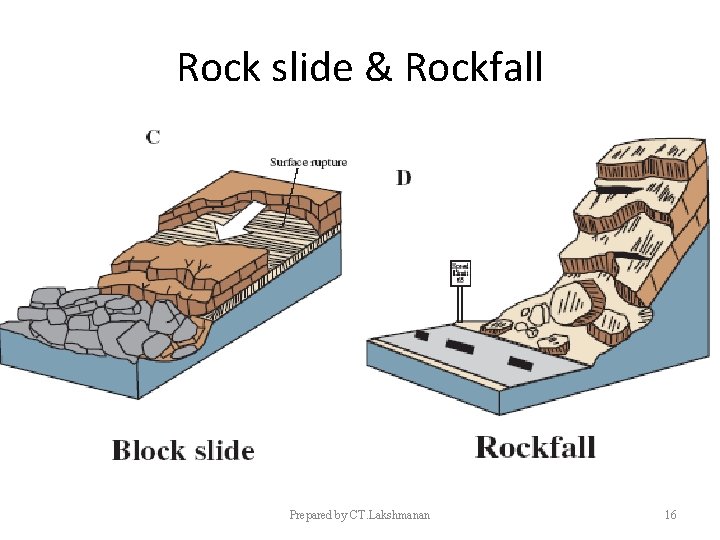
Rock slides • movement of essentially consolidated material which mainly consists of recently detached bedrock
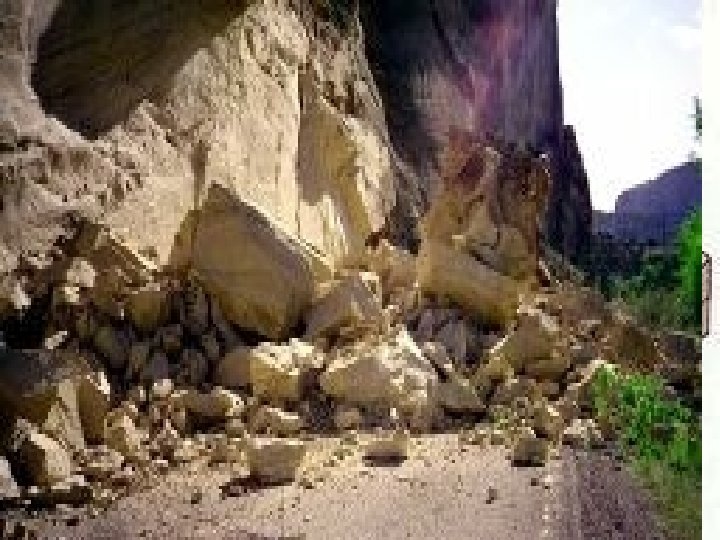
Rock falls • Blocks of rocks of varying sizes suddenly crashing downwards along steep slopes. • Common along steep shorelines and in the higher mountain regions during the rainy season.
Rock slide & Rockfall Prepared by CT. Lakshmanan 16
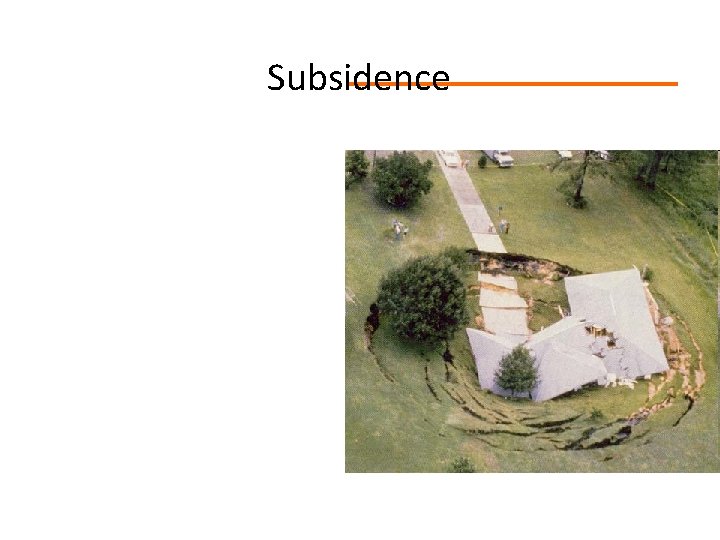
Subsidence • Represents the downward movement of the surface • Due to plastic outflow of underlying strata, due to compaction of underlying material or due to collapse
Subsidence
1) Subsidence due to plastic outflow Beneath heavy loads, plastic layers or layers which become plastic due to disturbance may be squeezed outwards, allowing surface settlement or subsidence. e. g clay may be extruded from beneath structure.
2) Subsidence due to compaction q sediments often become compact because of load q excessive pumping out of water and the withdrawal of oil from the ground also cause subsidence.
3) Subsidence due to collapse -In regions where extensive underground mining has removed a large volume of material, the weight of overlying rock may cause collapse and subsidence - may also happen when underground formations are leached by subsurface water
CAUSES OF LANDSLIDES A) Internal causes B ) Immediate causes • Internal causes create favourable or suitable conditions for landslides occurrence • their role is just short of actual slip • Immediate causes play the role of overcoming the frictional resistance of inertia by providing necessary energy in the form of a sudden jerk, for the actual occurrence of landslides
- any loose material if piled up shall have a natural slope of about 35 degrees called the angle of repose - any steeper slope is unstable and results in slippage along the sides - such an unstable situation also results when the material is saturated with water. The presence of water reduces the intergranular cohesion or friction.
INTERNAL CAUSES a) Effect of slope – steeper slopes are prone to land slips of loose overburden due to greater gravity influence - gentle slopes are not prone to such land slips because in such cases, loose overburden encounters greater frictional resistance and hence any possible slip is prevented
b) Effect of water 1) Presence of water greatly r educesthe intergranular cohesion of the particles of loose ground. This weakens the ground and makes it prone to landslide occurrence. Frequent landslide soon after rainfall supports this observation.
2) On hill slopes –water on percolation through the overlying soil may flow down as a film or thin sheet of water above the underlying hard rocks. It acts as a lubricating medium between the two. It also induces movement in the overlying loose material along its own direction of flow.
3) Along hill slopes, rainwater while percolating down , carries with it fine clay and silty material which may form a thin band at the interface of loose overlying material and underlying hard rocks. In the presence of water the clayey matter becomes very plastic and may form a slippery base.
4) Along steep slopes, the presence of water in the intergranular spaces of loose , unconsolidated weathered material adds to the weight, thereby increasing the influence of gravity which in turn promotes landslide occurrence. 5) Water is a powerful solvent - Water causes decomposition of minerals - Also leaches out soluble salts of rocks -This reduces the compaction or cohesion of the rock body and makes a weak mass
6) In regions of snowline, water frequently changes its state of occurrence - by frost action leads to the disintegration of rocks in the form of frost wedging and frost heaving and enhances landslides due to action of gravity.
QUESTIONS 1. Explain the different types of earth flows and landslides. 2. Differentiate between subsidence and landslides. 3. Discuss the different ways in which the stability of the loose ground is affected by the presence of water.
1. Enumerate with neat sketches the suitability of the geological structures given below for the construction of a dam: (a) Beds with steep upstream dip. (b) Beds with gentle downstream dip. 2. Discuss the effect of the following types of geological structures on the stability of a dam. (a) Horizontal strata (b) Beds with gentle upstream dip.
3 Discuss in detail the effect of the structural features mentioned below on the stability of a dam. (a) Beds with deep downstream dip (b) Beds with vertical beds (c) Beds which are folded.