
Classification of double jersey weft knitting machines Double
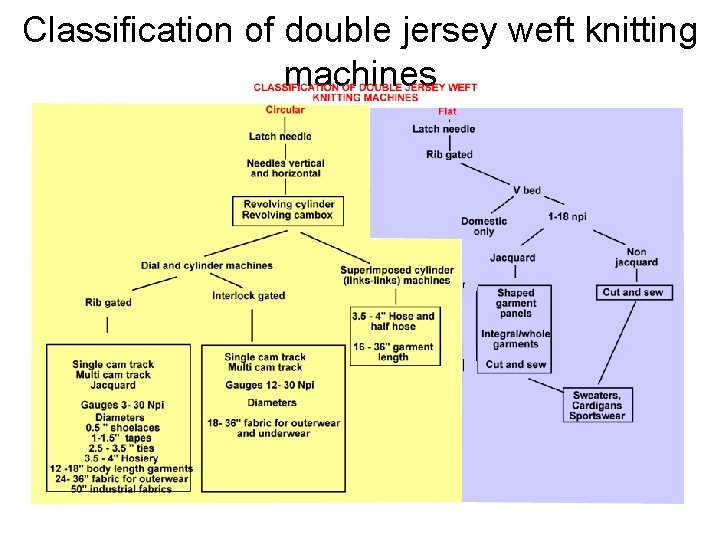
Classification of double jersey weft knitting machines
Double jersey weft knitting machines 双面针织机分类 Weft knitting machines can have two sets of needles. These are called double jersey machines Weft knitted fabrics produced on machines with two sets of needles are called double jersey fabrics Double jersey machines have 2 set of needles and knit double jersey fabrics
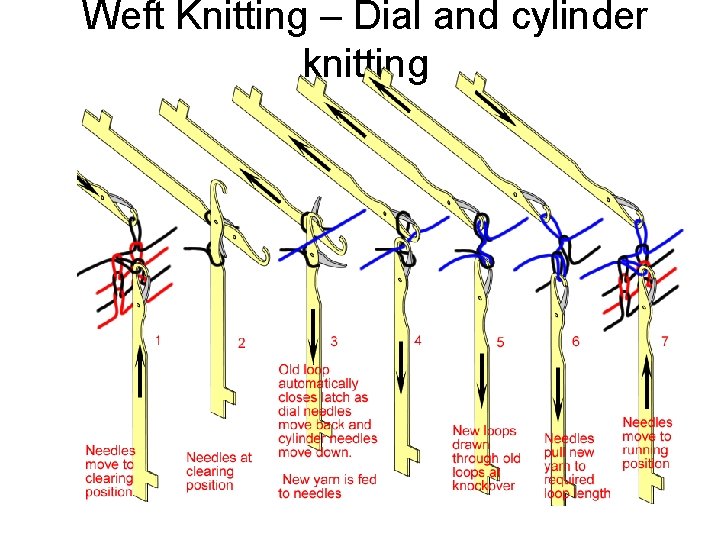
Weft Knitting – Dial and cylinder knitting
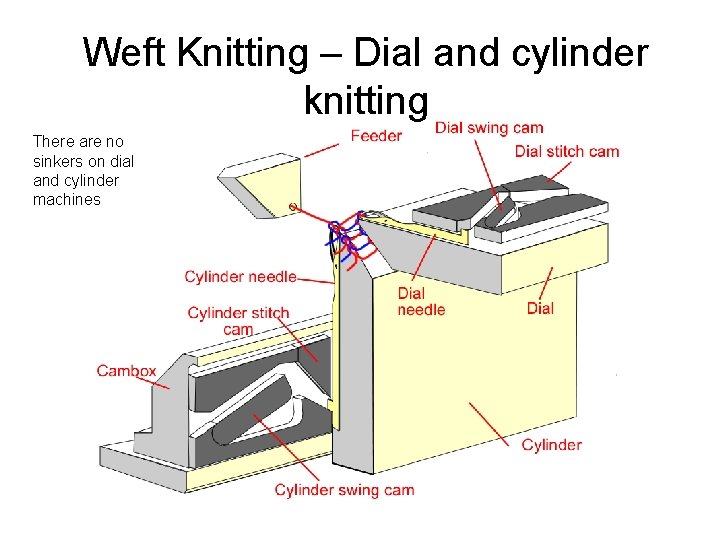
Weft Knitting – Dial and cylinder knitting There are no sinkers on dial and cylinder machines
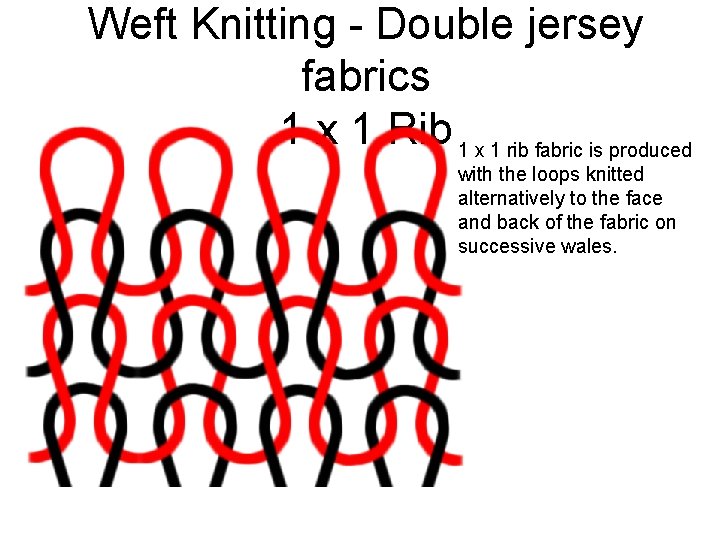
Weft Knitting - Double jersey fabrics 1 x 1 Rib 1 x 1 rib fabric is produced with the loops knitted alternatively to the face and back of the fabric on successive wales.
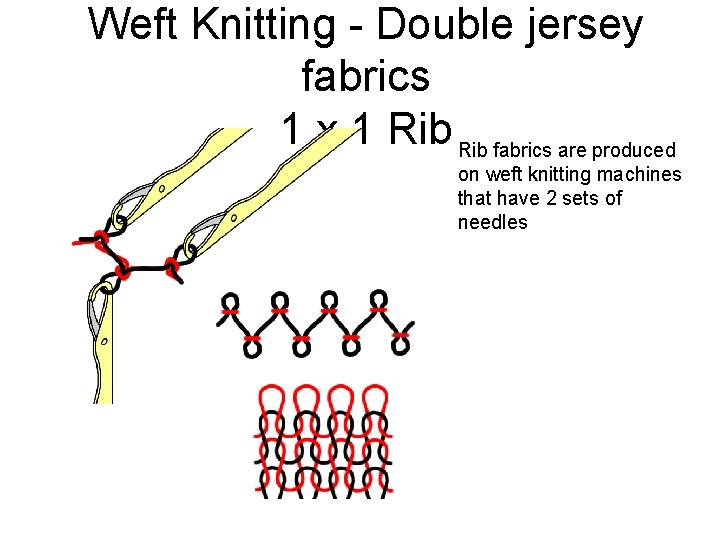
Weft Knitting - Double jersey fabrics 1 x 1 Rib fabrics are produced on weft knitting machines that have 2 sets of needles
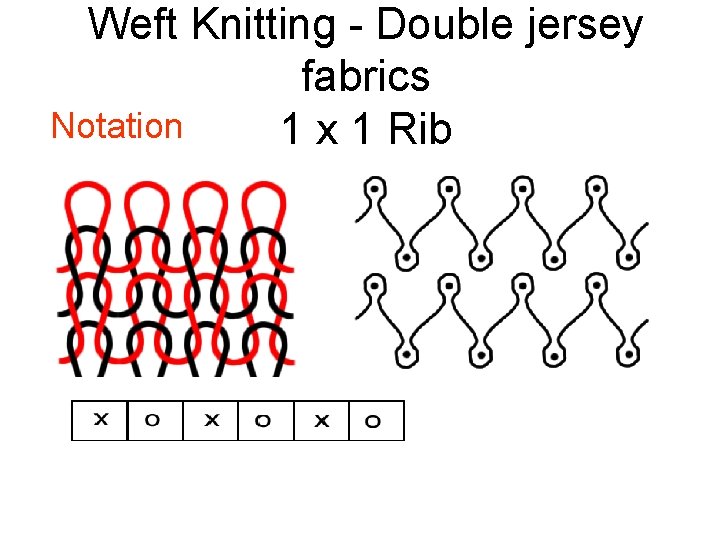
Weft Knitting - Double jersey fabrics Notation 1 x 1 Rib

Weft Knitting - Gating Rib or Alternate Gating Interlock Gating
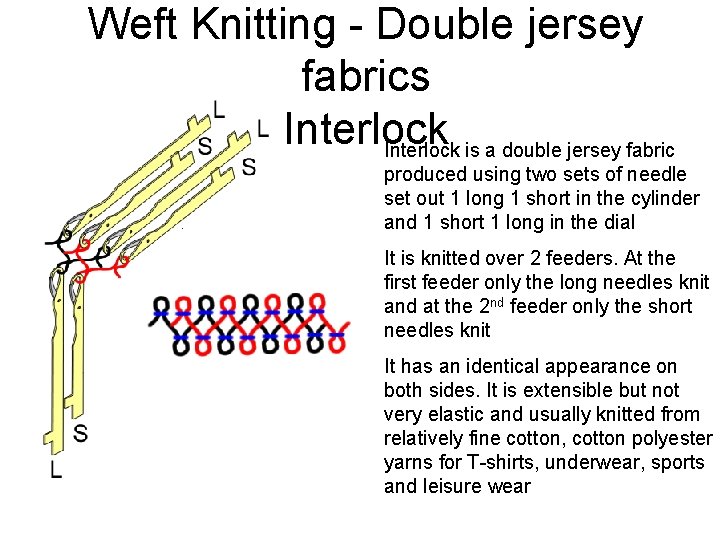
Weft Knitting - Double jersey fabrics Interlock is a double jersey fabric produced using two sets of needle set out 1 long 1 short in the cylinder and 1 short 1 long in the dial It is knitted over 2 feeders. At the first feeder only the long needles knit and at the 2 nd feeder only the short needles knit It has an identical appearance on both sides. It is extensible but not very elastic and usually knitted from relatively fine cotton, cotton polyester yarns for T-shirts, underwear, sports and leisure wear
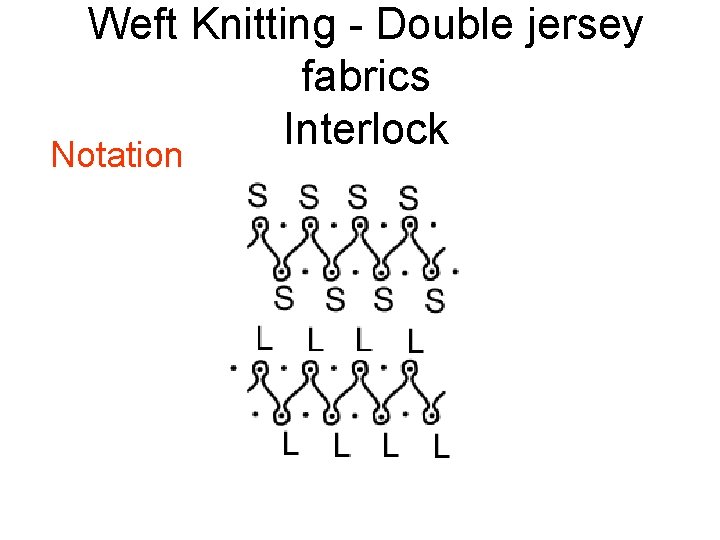
Weft Knitting - Double jersey fabrics Interlock Notation
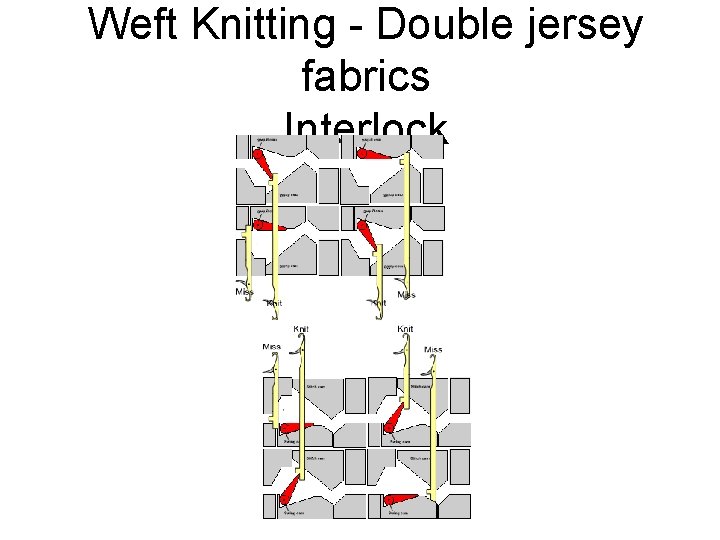
Weft Knitting - Double jersey fabrics Interlock
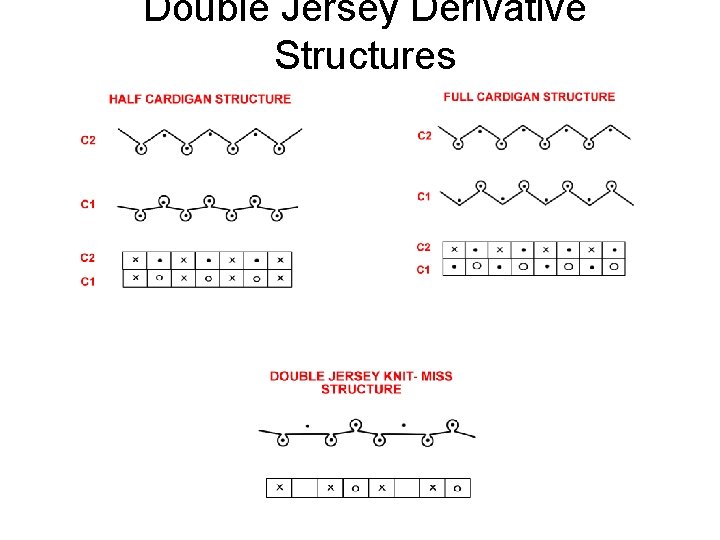
Double Jersey Derivative Structures
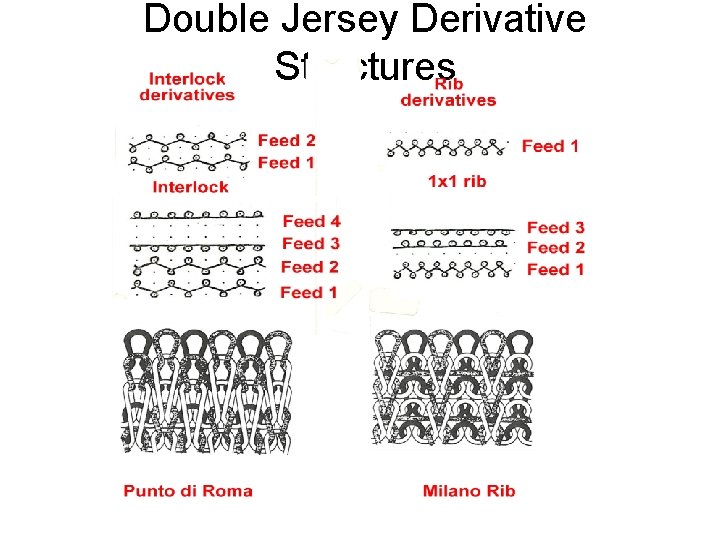
Double Jersey Derivative Structures
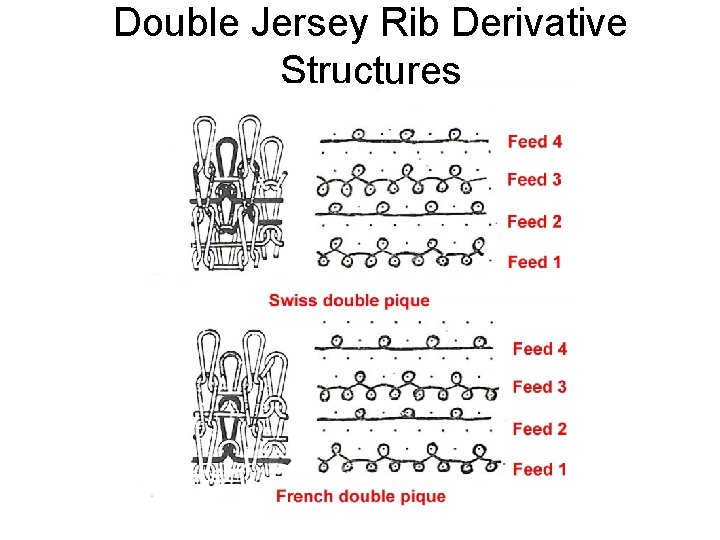
Double Jersey Rib Derivative Structures
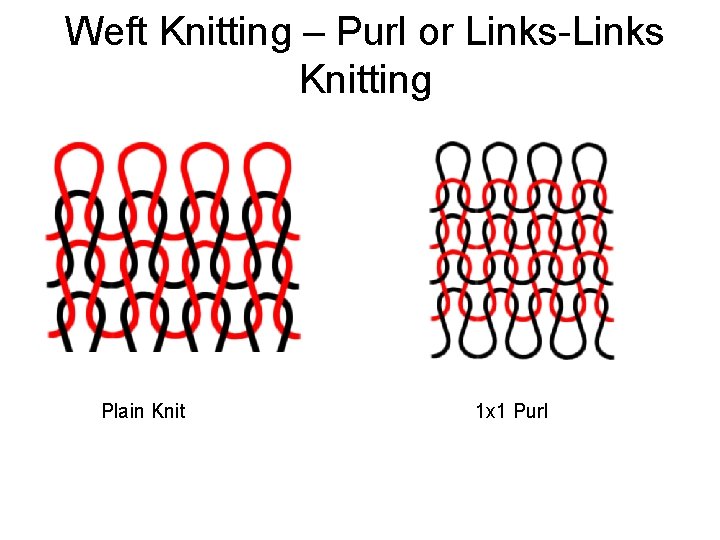
Weft Knitting – Purl or Links-Links Knitting Plain Knit 1 x 1 Purl
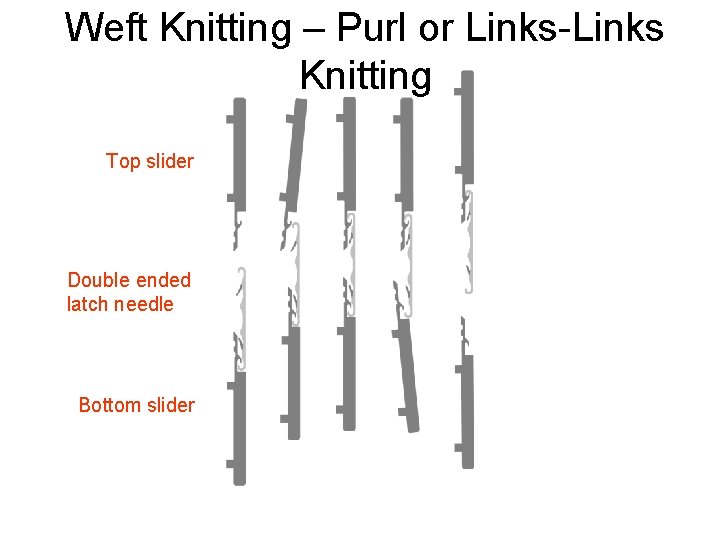
Weft Knitting – Purl or Links-Links Knitting Top slider Double ended latch needle Bottom slider

Weft Knitting – 1 x 1 Purl Notation
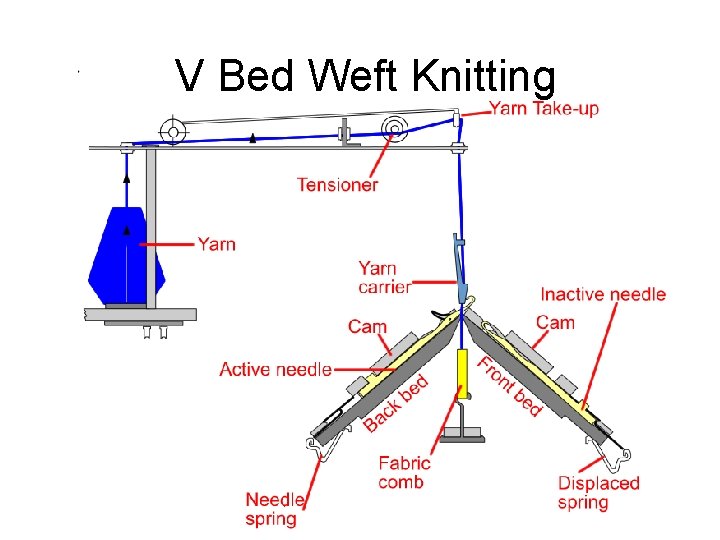
V Bed Weft Knitting

Loop Transfer
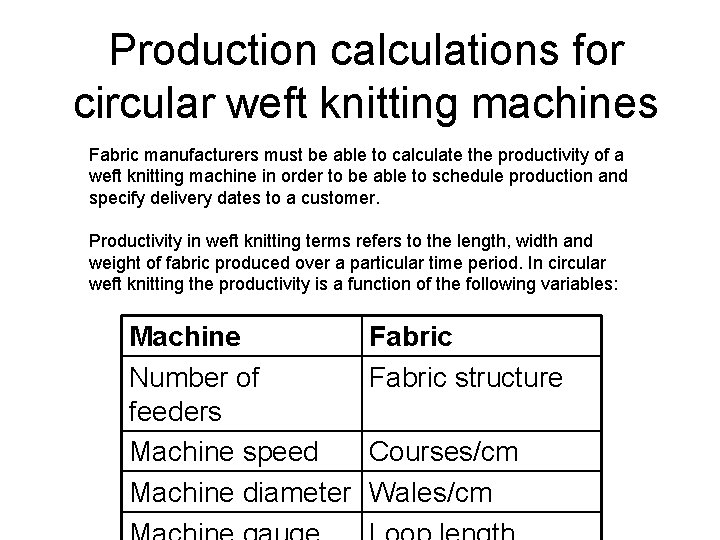
Production calculations for circular weft knitting machines Fabric manufacturers must be able to calculate the productivity of a weft knitting machine in order to be able to schedule production and specify delivery dates to a customer. Productivity in weft knitting terms refers to the length, width and weight of fabric produced over a particular time period. In circular weft knitting the productivity is a function of the following variables: Machine Number of feeders Machine speed Machine diameter Fabric structure Courses/cm Wales/cm
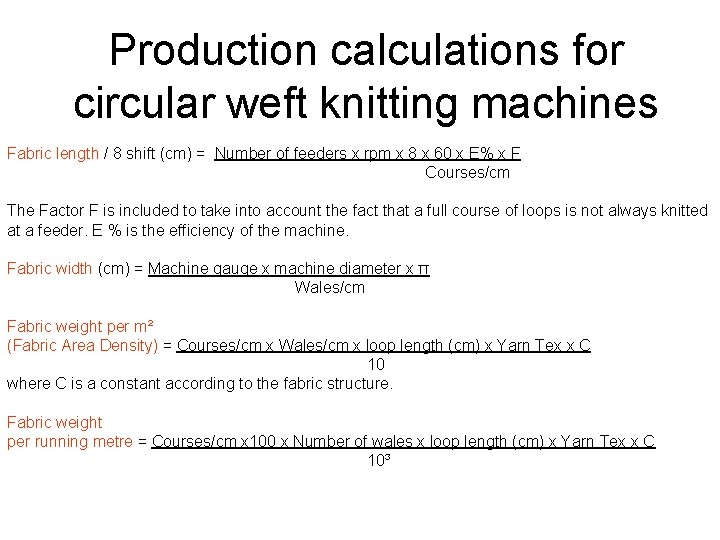
Production calculations for circular weft knitting machines Fabric length / 8 shift (cm) = Number of feeders x rpm x 8 x 60 x E% x F Courses/cm The Factor F is included to take into account the fact that a full course of loops is not always knitted at a feeder. E % is the efficiency of the machine. Fabric width (cm) = Machine gauge x machine diameter x π Wales/cm Fabric weight per m² (Fabric Area Density) = Courses/cm x Wales/cm x loop length (cm) x Yarn Tex x C 10 where C is a constant according to the fabric structure. Fabric weight per running metre = Courses/cm x 100 x Number of wales x loop length (cm) x Yarn Tex x C 10³
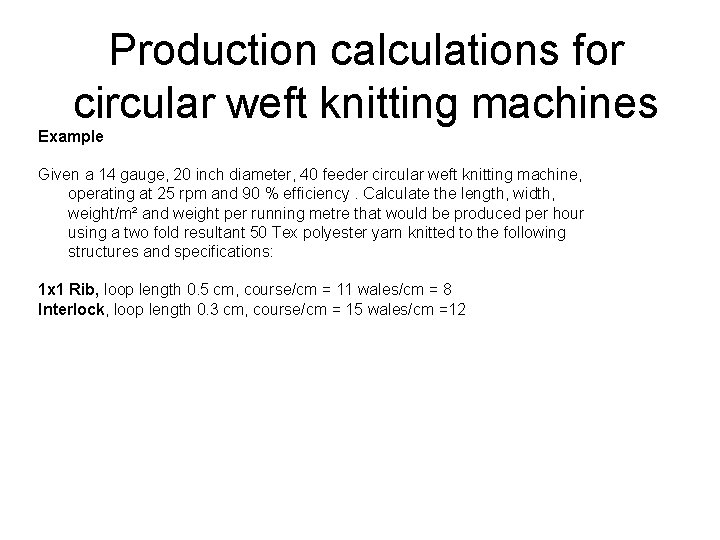
Production calculations for circular weft knitting machines Example Given a 14 gauge, 20 inch diameter, 40 feeder circular weft knitting machine, operating at 25 rpm and 90 % efficiency. Calculate the length, width, weight/m² and weight per running metre that would be produced per hour using a two fold resultant 50 Tex polyester yarn knitted to the following structures and specifications: 1 x 1 Rib, loop length 0. 5 cm, course/cm = 11 wales/cm = 8 Interlock, loop length 0. 3 cm, course/cm = 15 wales/cm =12
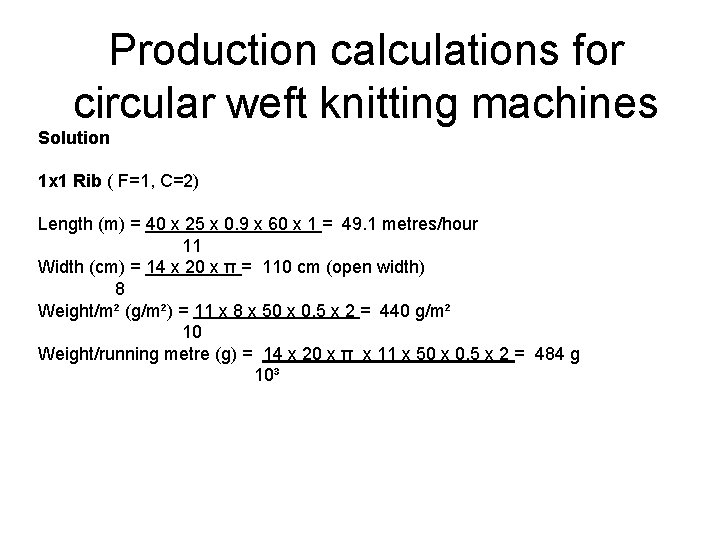
Production calculations for circular weft knitting machines Solution 1 x 1 Rib ( F=1, C=2) Length (m) = 40 x 25 x 0. 9 x 60 x 1 = 49. 1 metres/hour 11 Width (cm) = 14 x 20 x π = 110 cm (open width) 8 Weight/m² (g/m²) = 11 x 8 x 50 x 0. 5 x 2 = 440 g/m² 10 Weight/running metre (g) = 14 x 20 x π x 11 x 50 x 0. 5 x 2 = 484 g 10³
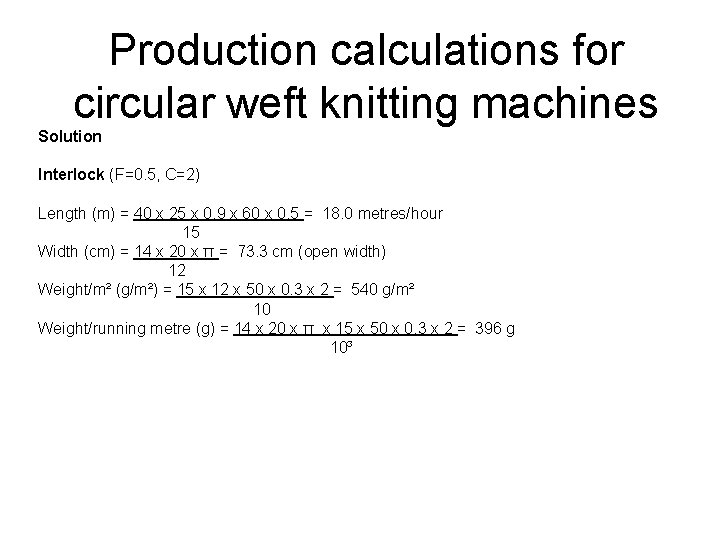
Production calculations for circular weft knitting machines Solution Interlock (F=0. 5, C=2) Length (m) = 40 x 25 x 0. 9 x 60 x 0. 5 = 18. 0 metres/hour 15 Width (cm) = 14 x 20 x π = 73. 3 cm (open width) 12 Weight/m² (g/m²) = 15 x 12 x 50 x 0. 3 x 2 = 540 g/m² 10 Weight/running metre (g) = 14 x 20 x π x 15 x 50 x 0. 3 x 2 = 396 g 10³
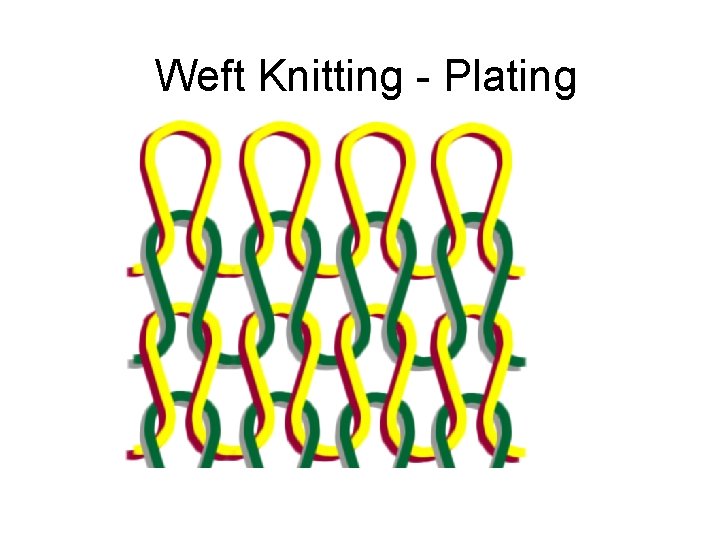
Weft Knitting - Plating
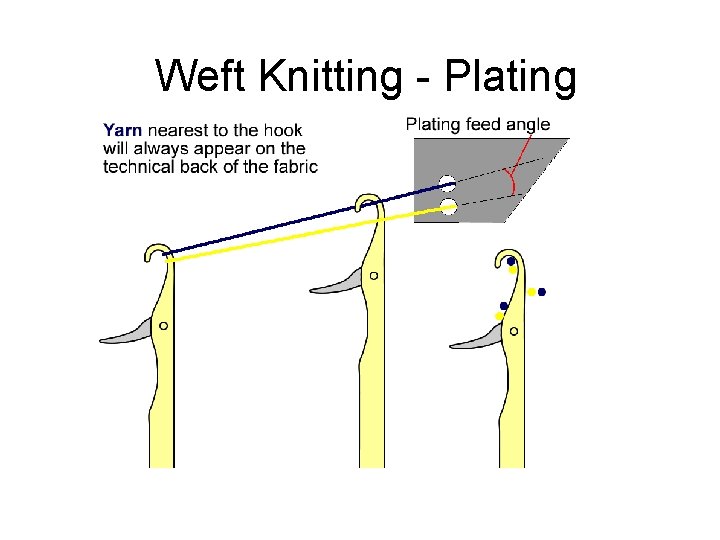
Weft Knitting - Plating
- Slides: 26