
Classification of Diseases Disease Any condition that causes



- Slides: 50
Classification of Diseases
Disease Any condition that causes the systems of a plant or animal to not function properly.
How diseases occur n n Sporadic: isolated incident in a single animal Enzootic: disease occurs repeatedly in a particular locality (within 30 -mile radius) Epizootic: disease that effects a large number of animals in a short period of time in a particular area (larger area than enzootic) Example = entire state Panzootic: disease that spreads rapidly over a very large area and effects many animals in a short period of time (foot & mouth disease)
Noninfectious Diseases n Injuries n Poisons/chemicals n Poor nutrition n Birth defects n Other things not caused by an organism living within the animal
Infectious diseases n Caused by other living microorganisms (called pathogens) that invade the animal’s body n Usually contagious diseases that the animal can pass to another animal
3 Types of infectious pathogens n. Bacteria n. Viruses n. Protozoa
Bacteria n Live in a wide range of conditions n Live on and in the bodies of all animals n Many can be harmful n Invade the cells of an animal’s body
Parasitic bacteria n. May harm the animal by feeding off the body cells or secreting a material known as a toxin
Toxin n. A poison that destroys the cells
Harmful bacteria n When large numbers invade, the animal becomes ill n Type and form of the illness depends on the type of bacteria that invades the animal
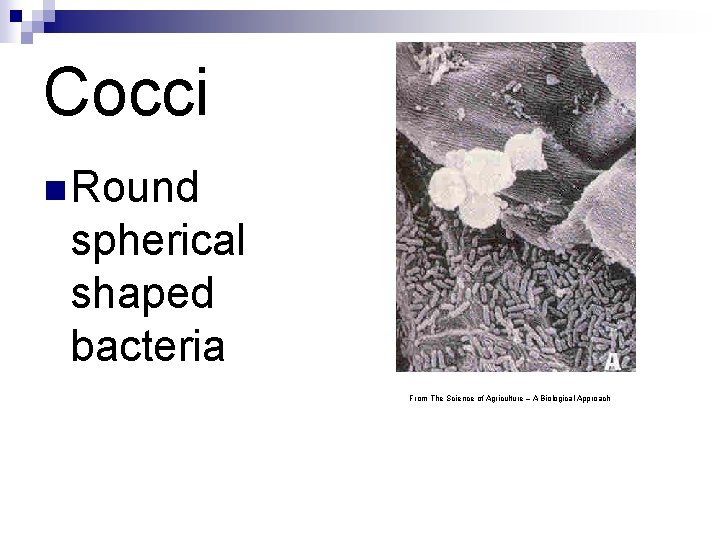
Cocci n Round spherical shaped bacteria From The Science of Agriculture – A Biological Approach
Cocci n Staphylococci: cocci bunched together like grapes ¨ Cause n diseases like mastitis in cattle Steptococci: cocci are strung together like a chain ¨ Causes disease like distemper and meningitis
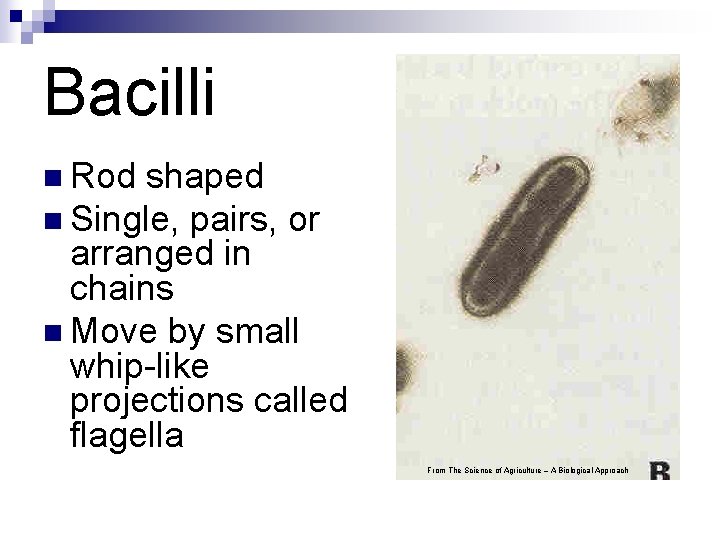
Bacilli n Rod shaped n Single, pairs, or arranged in chains n Move by small whip-like projections called flagella From The Science of Agriculture – A Biological Approach
Bacilli n. Cause some of the most dreaded livestock diseases: ¨Anthrax ¨Blackleg ¨Tuberculosis
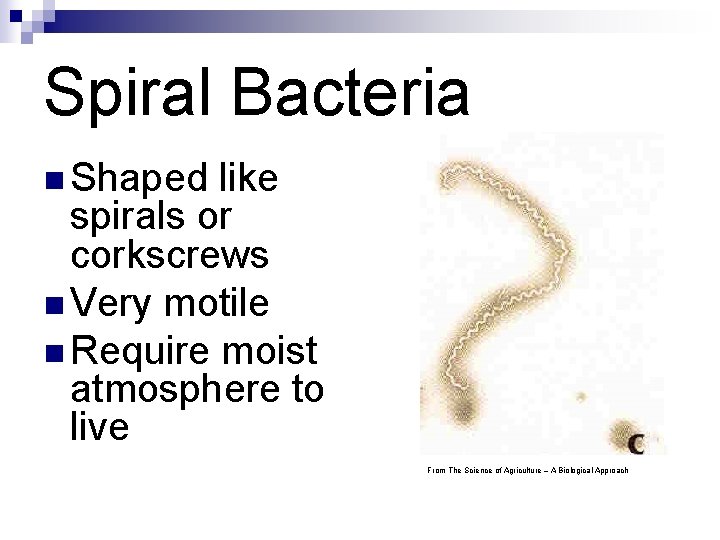
Spiral Bacteria n Shaped like spirals or corkscrews n Very motile n Require moist atmosphere to live From The Science of Agriculture – A Biological Approach
Spirilla n. Live very well in the reproductive tracts of animals n. Leptospirosis n. Vibrosis and spirochetosis
Viruses n. Have characteristics of both living and nonliving material n. Are on the borderline between living and non living
Viruses n. Made up of some of the material found in cells but are not cells because they do not have a nucleus or other cell parts.
Viruses n Do not grow and cannot reproduce outside a living cell n Once inside a living cell, virus reproduces using energy and materials in the invaded cell
Viruses n. Harm cells by causing them to burst during reproduction n. And by using material that the cell needs to function properly
Virus n. Viral diseases cause the animal to be sick by preventing certain cells in the body from functioning properly
Virus n. More difficult to treat than bacterial diseases n. Antibiotics are not effective against viral infections
Viral diseases n. Foot and mouth disease n. Influenza n. Hog cholera n. Pseudorabies
Viral diseases n. Best means of dealing with them is prevention
Protozoa n Microorganism that cause disease n Single-celled organisms that are often parasitic n Trichomoniasis n Coccidiosis
Antibiotics n Useful in controlling bacteria – not viruses n Are drugs that originate from living sources n Usually those living sources are molds and fungi
Penicillin n. First founded in 1928 n. Many forms are now produced n. Very effective against bacterial infection
The immune system n. Several lines of defense in fighting disease n. Physical barriers that keep pathogens out
The immune system n. Mucous membranes secrete viscous water substance that trap and destroy bacteria and viruses
The immune system n. Nostrils are lined with hairs that attract particles that harbor germs before they can enter the body
The immune system n. Digestive and respiratory systems – greatest avenue for entry n. Some disease germs can live in the soil for many years –Anthrax 20 years
nd 2 line of defense n Blood cells n White and Red n Red – carry oxygen and other nutrients to other body cellsfuel truck
White Blood Cells n Are produced in the bone marrow n Circulate throughout the body to get rid of dead and worn-out cells—trash truck
Phagocytes n White blood cells that intercept and destroy pathogenssoldiers n Also migrate to certain organs and remain there to intercept pathogens
Phagocytes n Release chemicals that can induce the production of more white blood cells to help fight disease
Phagocytes n An elevated WBC count indicates that there are disease organisms present in the animal’s body and a large number of phagocytes have been produced to combat them
Lymphocytes n Lymph glands that produce certain WBCs n These cells react to foreign substances by releasing chemicals that kill the pathogen or inactivate the foreign substance
Antigens n Substances that cause the release of chemicals n May be viruses, bacteria, toxins, or other substances
Antibodies n The chemicals released by the lymphocytes
nd 2 Immune Response n Lymphocytes become memory cell and are ready to release the antibody if the antigen enters the body at a later time
nd 2 Immune Response n Response occurs much more quickly n Lasts longer than primary response
Immunity n Means that an animal is protected from catching a certain disease n Animal’s body is capable of producing enough antibodies fast enough to neutralize the disease
Immunity n Animals are born with some immunity n Colostrum is rich in antibodies n Serve the new animal until its own immune system can take over
Immunity n Active or passive n Active–animal is more or less permanently immune n Passive–animal is only temporarily immune
Immunity n As the animal is exposed to more antigens, antibodies build up within the animal. n Naturally acquired active immunity results from the animal actually contracting the disease and recovering
Artificial Active n Induced by injecting antigens into the animal n Causes phagocytes to react without making the animal seriously ill
Edward Jenner n Late 1700 s n Began vaccination process n Smallpox and cowpox n Collected material from sores of people with cowpox
Edward Jenner n Injected healthy people with material n Became mildly ill with cowpox n Then were immune
Louis Pasteur n Developed several vaccines following Jenner’s lead
Vaccines n Live n Killed or weakened strain n Both stimulate production of antibodies n Killed–less dangerous than live vaccine