
CLASSIFICATION OF BIODIVERSITY 5 3 CLASSIFICATION For centuries
CLASSIFICATION OF BIODIVERSITY 5. 3
CLASSIFICATION • For centuries, humans have been attempting to classify the various species on Earth in order to learn more about the species and their evolutionary history. • Classification attempts to group more related species together.
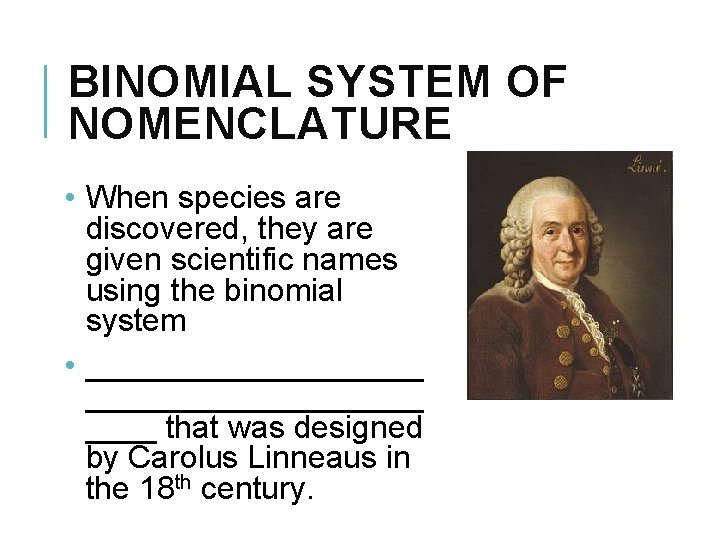
BINOMIAL SYSTEM OF NOMENCLATURE • When species are discovered, they are given scientific names using the binomial system • ___________________ that was designed by Carolus Linneaus in the 18 th century.
BINOMIAL NOMENCLATURE • Biologists all over the world use the binomial system of names for species as a universal naming system to identify a species rather than the many common or local names. • Names have been agreed and developed at a series of congresses. ü International Botanical Congress (IBC) ü International Zoological Congress (IZC)
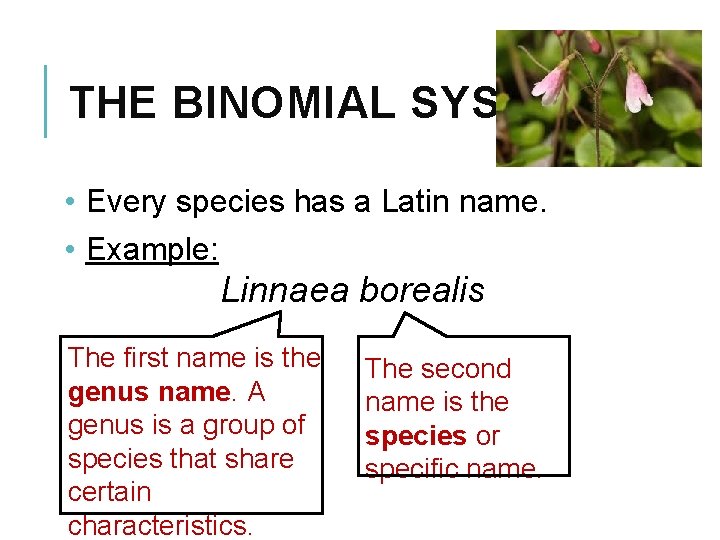
THE BINOMIAL SYSTEM • Every species has a Latin name. • Example: Linnaea borealis The first name is the genus name. A genus is a group of species that share certain characteristics. The second name is the species or specific name.
BINOMIAL NOMENCLATURE RULES 1. The genus name begins with an uppercase (capital) letter and the species name with a lower-case (small) letter 2. In typed or printed text, name is shown in italics 3. After a binomial name has been used once in a piece of text, it can be abbreviated to the initial letter of the genus name with the full species name, for example: L. borealis
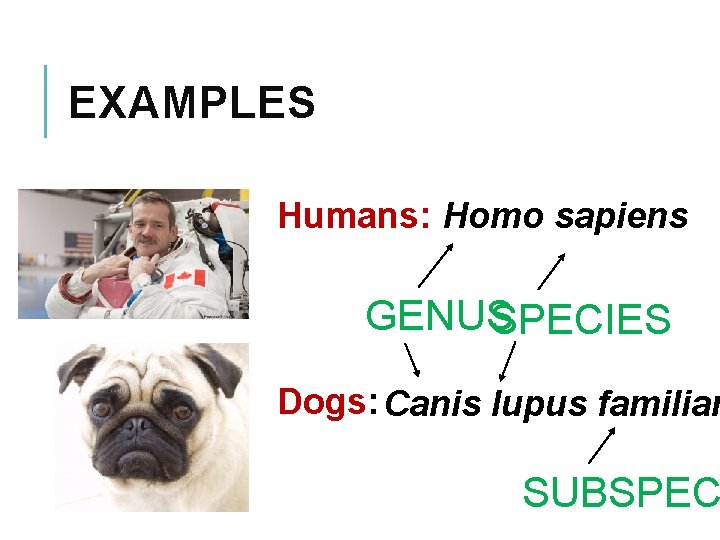
EXAMPLES Humans: Homo sapiens GENUS SPECIES Dogs: Canis lupus familiar SUBSPEC
• Linnaeus’ system was largely based on morphology and is not the best way to classify organisms. • (Modern methods use evolutionary relationships to classify organisms) • However, Linnaeus’ system is still the basis of how we name organisms today.
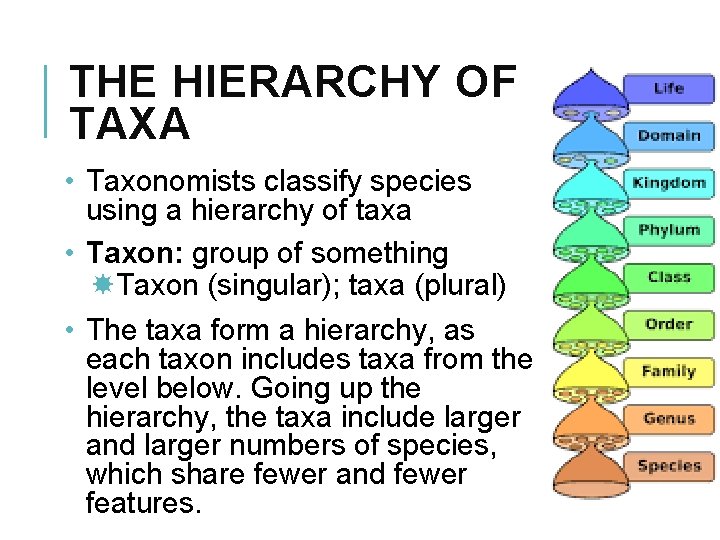
THE HIERARCHY OF TAXA • Taxonomists classify species using a hierarchy of taxa • Taxon: group of something Taxon (singular); taxa (plural) • The taxa form a hierarchy, as each taxon includes taxa from the level below. Going up the hierarchy, the taxa include larger and larger numbers of species, which share fewer and fewer features.
THE THREE DOMAINS • Traditional classification systems have recognized 2 major categories of organisms, based on cell types: ____________ and ____________. • Think back to Topic 1 in grade 11. Do you remember the difference?
THE THREE DOMAINS • This classification is now regarded as inappropriate because the prokaryotes have been found to be very diverse. • Most classification systems now recognize three major categories or domains: ________ (bacteria) ________ (archaean) _________ (eukaryotes)
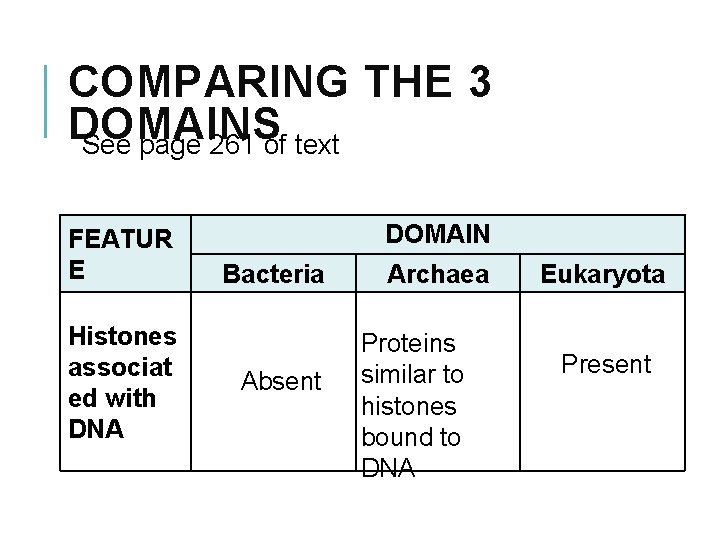
COMPARING THE 3 DOMAINS See page 261 of text FEATUR E Histones associat ed with DNA DOMAIN Bacteria Absent Archaea Proteins similar to histones bound to DNA Eukaryota Present
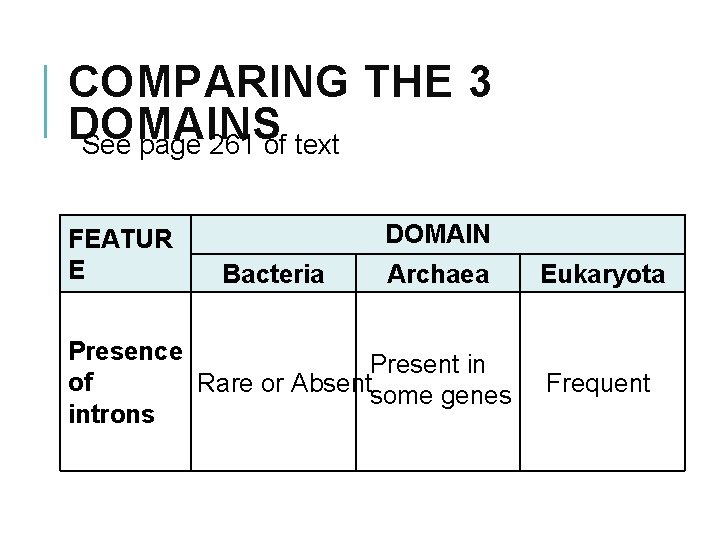
COMPARING THE 3 DOMAINS See page 261 of text FEATUR E DOMAIN Bacteria Archaea Presence Present in of Rare or Absentsome genes introns Eukaryota Frequent
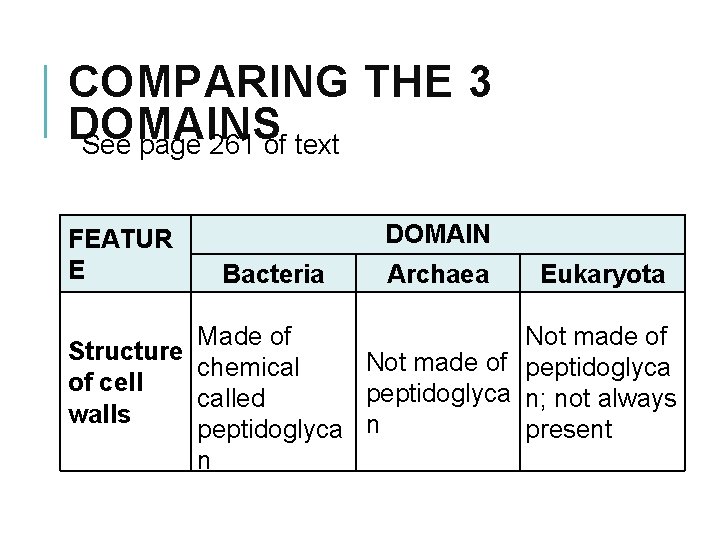
COMPARING THE 3 DOMAINS See page 261 of text FEATUR E DOMAIN Bacteria Archaea Made of Structure Not made of chemical of cell peptidoglyca called walls peptidoglyca n n Eukaryota Not made of peptidoglyca n; not always present
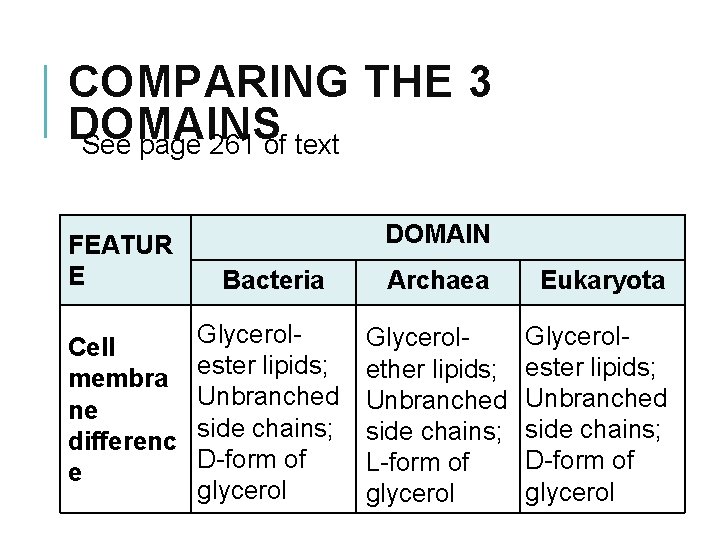
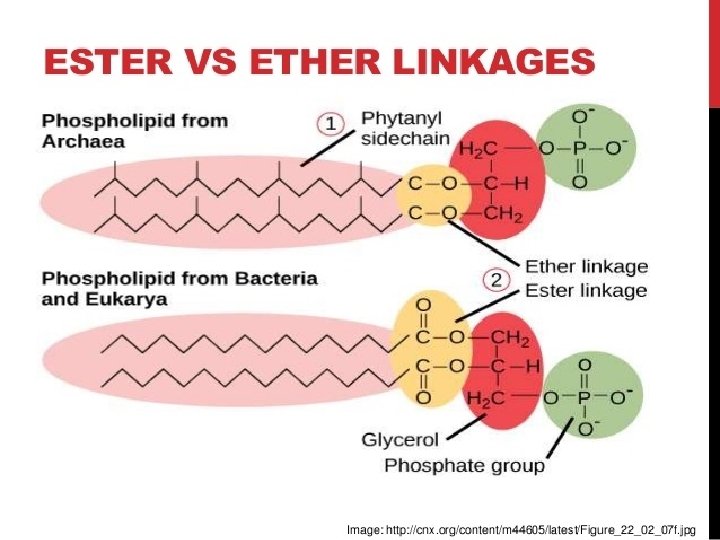
COMPARING THE 3 DOMAINS See page 261 of text FEATUR E DOMAIN Bacteria Glycerol. Cell ester lipids; membra Unbranched ne side chains; differenc D-form of e glycerol Archaea Eukaryota Glycerolether lipids; Unbranched side chains; L-form of glycerol Glycerolester lipids; Unbranched side chains; D-form of glycerol
ARCHAEANS… • Found in a broad range of habitats: Ocean surface Deep ocean sediments Oil deposits below the Earth’s surface High salt concentrations High temperatures • Example: methanogens, which live in the intestines of cattle and produce methane as a waste product.
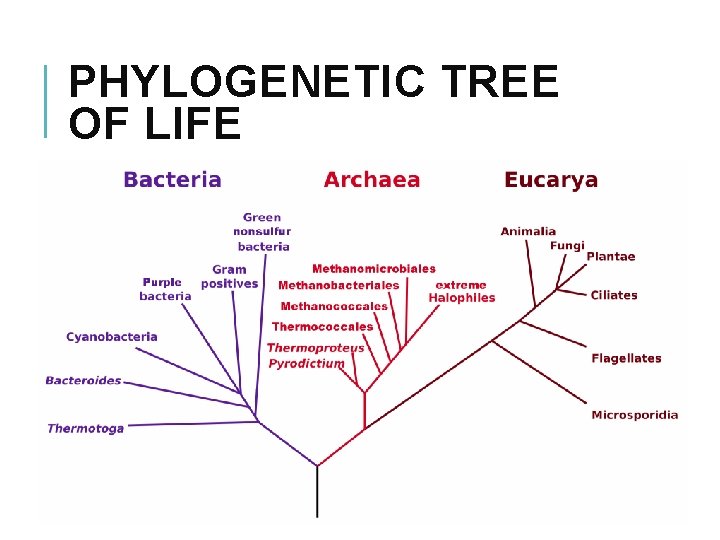
PHYLOGENETIC TREE OF LIFE
TO WHICH DOMAIN DO VIRUSES BELONG? • Viruses are not classified in any of the three domains of life. • Although they have genes coding for proteins using the same genetic code as living organisms, they have too few of the characteristics of life to be regarded as living organisms.
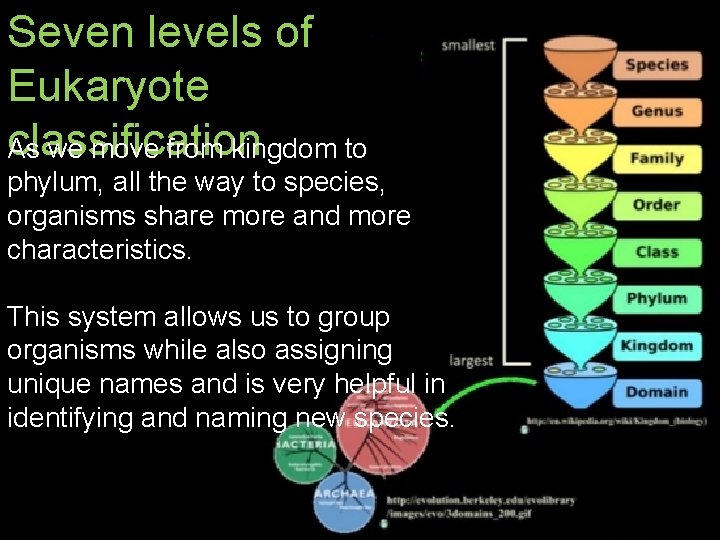
Seven levels of Eukaryote classification As we move from kingdom to phylum, all the way to species, organisms share more and more characteristics. This system allows us to group organisms while also assigning unique names and is very helpful in identifying and naming new species.
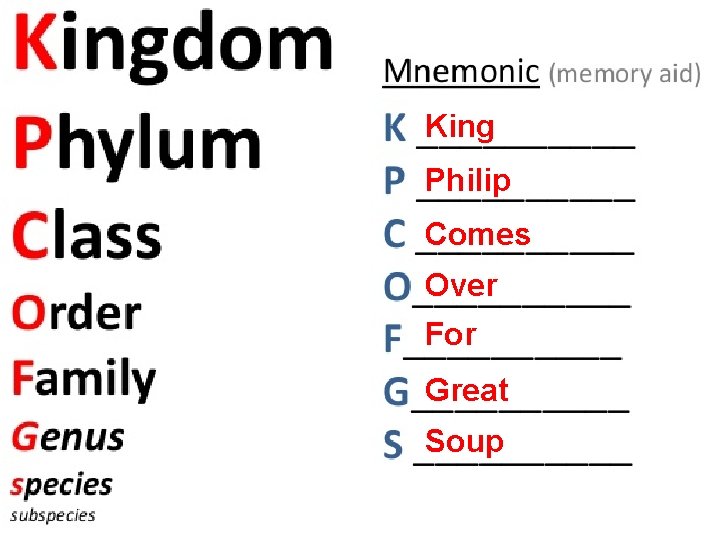
King Philip Comes Over For Great Soup
KINGDOMS • Kingdoms are the broadest category • Originally, there were only 2 Kingdoms: Plants and Animals • Today, we have identified 5
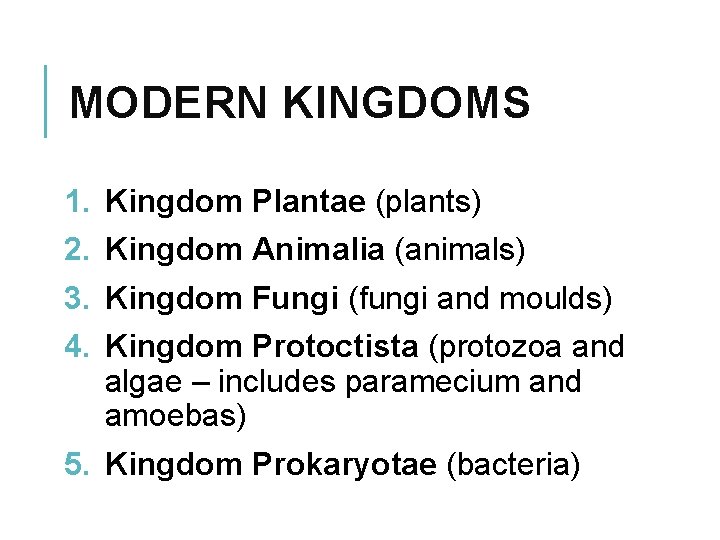
MODERN KINGDOMS 1. 2. 3. 4. Kingdom Plantae (plants) Kingdom Animalia (animals) Kingdom Fungi (fungi and moulds) Kingdom Protoctista (protozoa and algae – includes paramecium and amoebas) 5. Kingdom Prokaryotae (bacteria)
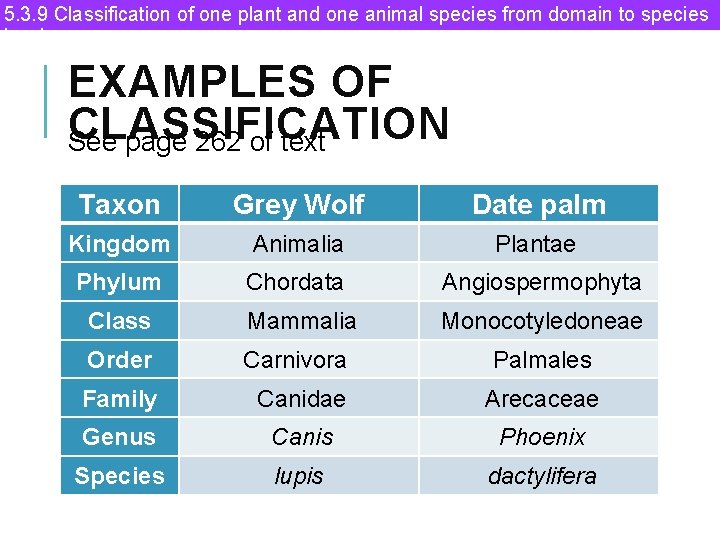
5. 3. 9 Classification of one plant and one animal species from domain to species level. EXAMPLES OF CLASSIFICATION See page 262 of text Taxon Grey Wolf Date palm Kingdom Animalia Plantae Phylum Chordata Angiospermophyta Class Mammalia Monocotyledoneae Order Carnivora Palmales Family Canidae Arecaceae Genus Canis Phoenix Species lupis dactylifera
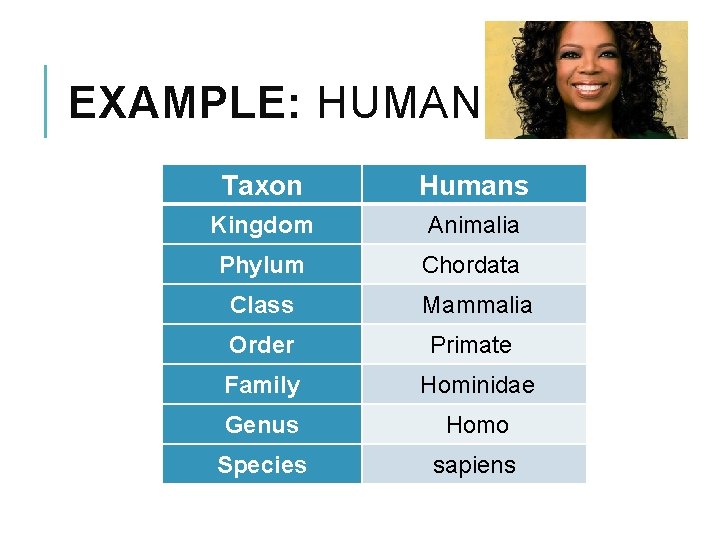
EXAMPLE: HUMANS Taxon Humans Kingdom Animalia Phylum Chordata Class Mammalia Order Primate Family Hominidae Genus Homo Species sapiens
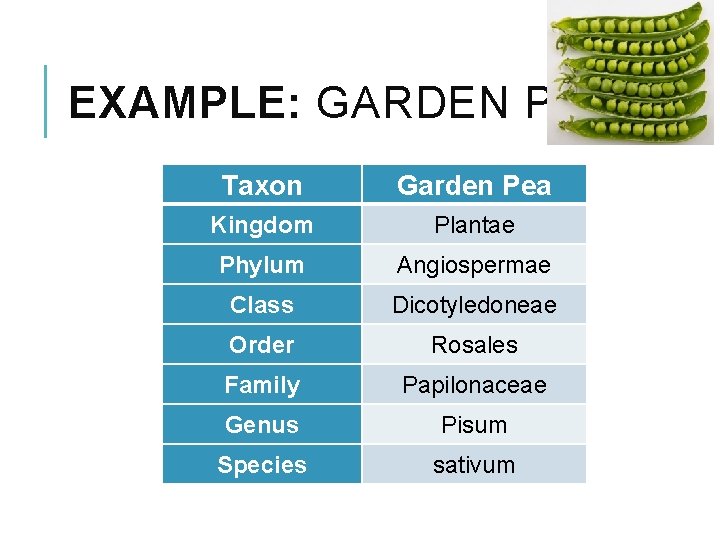
EXAMPLE: GARDEN PEA Taxon Garden Pea Kingdom Plantae Phylum Angiospermae Class Dicotyledoneae Order Rosales Family Papilonaceae Genus Pisum Species sativum
NATURAL CLASSIFICATION • In a natural classification, the genus and accompanying higher taxa consist of all the species that have evolved from one common ancestral species. • Because of the common ancestor, we can expect the members of a natural group to share many characteristics.
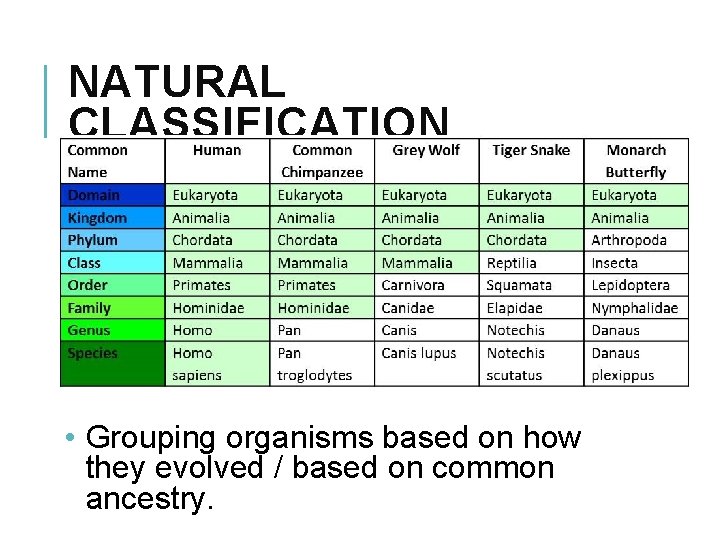
NATURAL CLASSIFICATION • Grouping organisms based on how they evolved / based on common ancestry.
UNNATURAL/ARTIFICIAL CLASSIFICATION • Grouping organisms by common characteristics despite evolutionary descent.
NATURAL VS ARTIFICIAL CLASSIFICATION • Plants and fungi were once classified together because they both have cell walls, but this is an artificial classification as their cell walls evolved separately and molecular research shows that they are no more similar to each other than to animals.
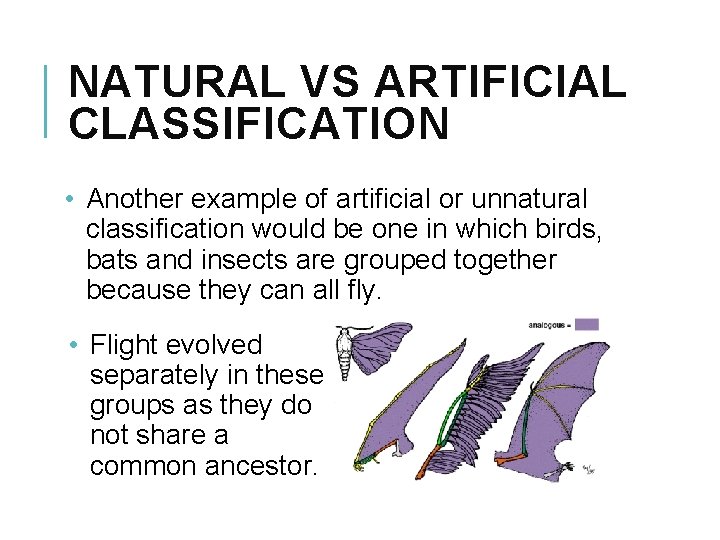
NATURAL VS ARTIFICIAL CLASSIFICATION • Another example of artificial or unnatural classification would be one in which birds, bats and insects are grouped together because they can all fly. • Flight evolved separately in these groups as they do not share a common ancestor.
REVIEWING CLASSIFICATION • Sometimes taxonomists reclassify species when new evidence shows that a previous taxon contains species that have evolved from different ancestral species. • The new evidence is usually DNA sequencing.
REVIEWING CLASSIFICATION • Dogs and Wolves had long been classified as separate species, but in 2005, scientists re-classified dogs and wolves into the same species (lupus). Dogs remain grouped in a separate subspecies, though (familiaris). • Scientists are currently debating whether chimps should be reclassified into the Genus Homo alongside humans since they are more similar to humans than apes…
ADVANTAGES OF NATURAL CLASSIFICATION 1. It makes it easier to identify species. Unknown species can first be placed into a kingdom and then into increasingly specific taxa (phylum, order, etc. ) 2. Because natural classification is based around common evolutionary ancestors, characteristics are shared. This allows biologists to predict properties of similarlyclassified organisms (i. e. if one member of a plant genus produces an antibiotic compound, other plants in that genus might be expected to produce related compounds)
KINGDOM PLANTAE • All plants are found in one kingdom. • During the life cycle of a plant, male and female gametes develop and fuse to form a zygote, which will develop into an embryo. • The way in which this embryo develops depends on the type of plant it is.
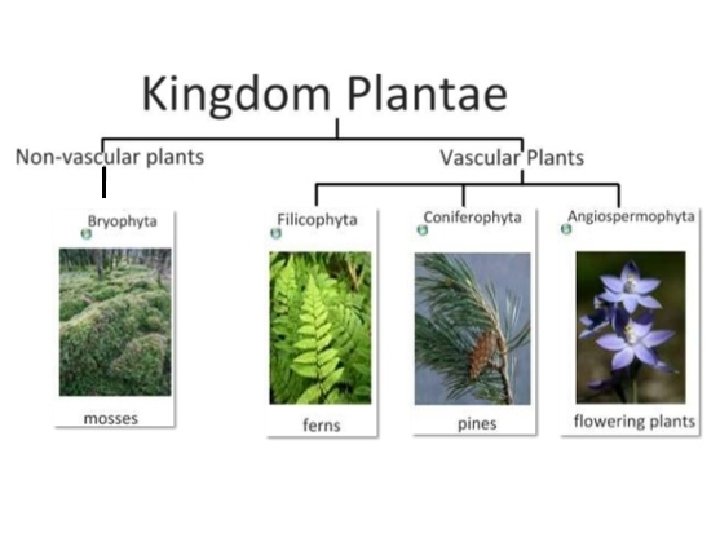
5. 3. 10 External recognition features of bryophytes, filicinophytes, coniferophytes, and angiospermophytes. See page 266 of text KINGDOM PLANTAE • The different types of plants are put into phylum. Most plants are in one of four phyla, but there are other smaller phyla. 1. Bryophyta: mosses, liverworts, hornworts 2. Filicinophyta: ferns 3. Coniferophyta: conifers 4. Angiospermophyta: flowering plants
BRYOPHYTA • Mosses and liverworts • Small terrestrial plants that do not have true roots, stems or leaves (but may have similar structures) • Leaf-like structures arranged in a spiral • Usually live in clusters
FILICINOPHYTA • • Ferns Have true leaves New leaves unroll Have an underground creeping stem (called a rhizome)
CONIFEROPHYTA • Conifers • Woody plants, with a single wooden trunk and side branches • Leaves are long thin needles and dark green • Produce seeds in cones
ANGIOSPERMOPHYTA • Angiosperms / Flowering plants • Have flowers • Seeds are in ovaries which become the fruit • Leaves usually as a leaf blade and a leaf stalk, with veins visible on the lower surface
KINGDOM ANIMALIA • Animals are divided up into over 30 phyla, based on their characteristics. • Distinguish between the following (six) phyla of invertebrate animals, using simple external recognition features. See page 267 of text
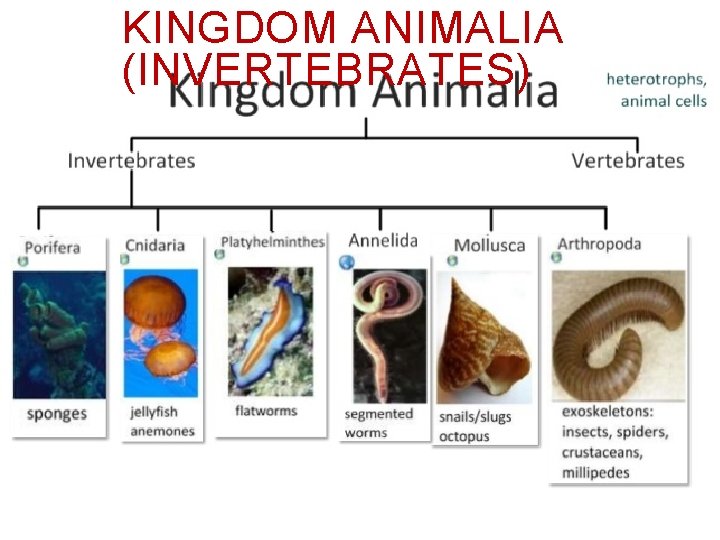
KINGDOM ANIMALIA (INVERTEBRATES)
PORIFERA • Sponges • Most primitive animals with a simple body • Live in water • Do not move around • No mouth, but have small holes through which water is pumped into body and filtered for food before
CNIDARIA • • Jellyfish and sea anemones Have stinging cells Radially symmetrical Have a gastro-vascular cavity (a hollow space in the centre of the body) with only one opening to the cavity • Often have tentacles around the
PLATHYELMINTHES • Flatworms • Soft flattened body with a definite head region • Bilateral symmetry • Gastro-vascular cavity • Usually one opening to cavity • Live in water or damp environments • Can be free-living or parasitic
ANNELIDA • • Worms and leeches Bodies of ring-like segments Have a mouth and anus Live in water or moist soil May be free living or parasitic No legs Bristles form body which help them move
MOLLUSCA • Snails, squids, clams, slugs • Soft unsegmented bodies • May have a shell
ARTHROPODA • Animals with jointed legs like insects, arachnids, crustaceans • Exoskeleton made of chitin (a polysaccharide) • Segmented body • Appendages to each segment • At least 3 pairs of legs • May be free living or parasitic
5. 3. 12 Recognition of features of birds, mammals, amphibians, reptiles, and fish. KINGDOM ANIMALIA: VERTEBRATES • Vertebrate animals are animals with a backbone or spinal column composed of vertebrae. • All these animals are in the phyla Chordata and the subphyla Vertebrata. • There are 5 major classes of chordates. • You need to recognize the features of birds, mammals, amphibians, reptiles, and fish. See page 268 of text
BIRDS • • Skin with feathers made of keratin 2 legs, 2 wings Females lay eggs with shells Maintain constant body temperatures
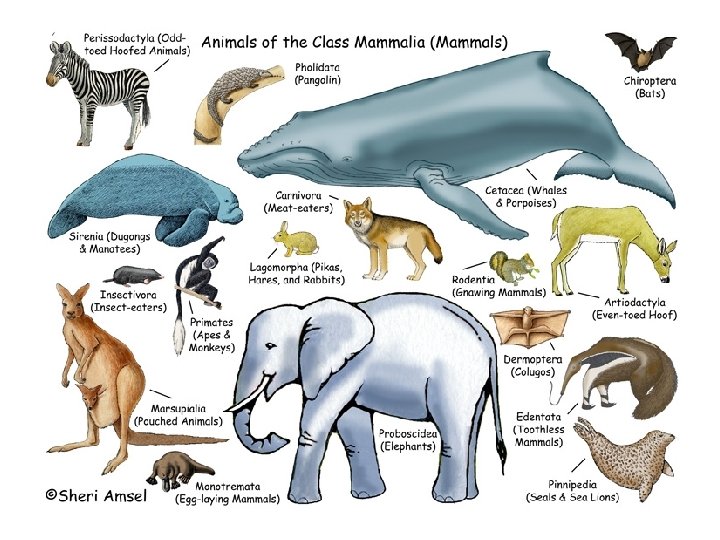
MAMMALS • Skins with follicles with hair made of keratin • Lungs with alveoli, ventilated used ribs and diaphragm • Most give birth to live young and all feed young with milk rom mammary glands • Maintain constant body temperature
AMPHIBIANS • Soft moist skins permeable to water and gases • Simple lungs with small folds and moist skin for gas exchange • 4 legs as an adult • Larval stages lives in water and as al adult usually lives on land • Do not maintain constant body temp
REPTILES • Impermeable skin covered in scales of keratin • Lungs with extensive folding to increase the surface area • Female lay eggs with soft shells • Do not maintain constant body temp
FISH • Scales which are bony plates in the skin • Gills • No limbs • Remain in water throughout their life cycle • Do not maintain constant body temp
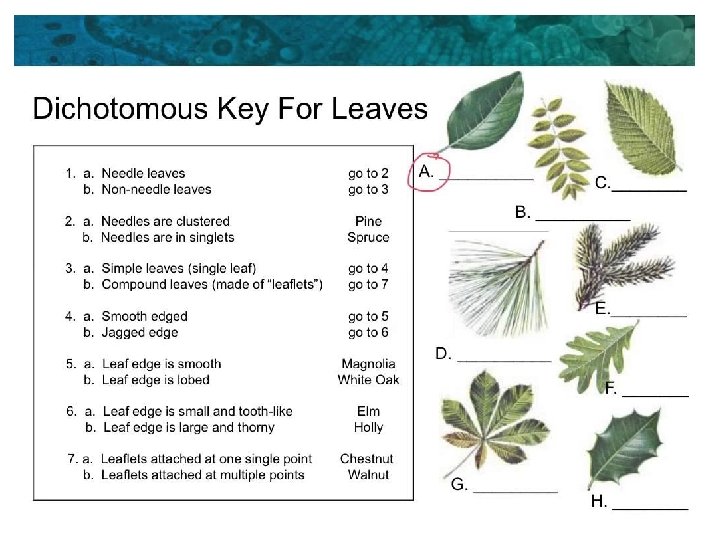
DICHOTOMOUS KEYS • Apply and design a key for a group of up to eight organisms • Keys are most commonly used to identify plants, insects, and birds. • You need to be able to construct a dichotomous key on page. 265
- Slides: 58