
Classification of anatomy 12 systems Group 10602 a







- Slides: 16
Classification of anatomy -12 systems Group 10602 a Medicine 10602 a Lee. Geon. Woo
Korea’s History The history of Korea or Korean history has been developed mainly on the Korea peninsula , Manchuria , Maritime Territory since the Paleolithic period , and broadly in East Asia. This document mainly describes the history of Korea before liberation. Periodization of Korea history of the Paleolithic era , from the Neolithic , Bronze Age , Iron Age , separated by prehistoric and Gojoseon after the establishment of the Proto-Three Kingdoms of Korea , the Three Kingdoms period , North-South States Period , Later Three Kingdoms to the ancient , considering the age of the Middle Ages , the Joseon Dynasty in modern times , empire since the establishment is divided into modern and contemporary, including up to today.
Ossa; Systema skeletale Кістки; Система скелета The Skeletal System : Consisted of bones, cartilage, ligaments and tendons and accounts for about 20 percent of the body weight. Function • supports the body • facilitates movement • produces blood cells • stores and releases minerals and fat Major organs • Skull • spinal column • shoulder girdle • pelvic girdle • ribs and sternum • Upper and lower limbs • Etc. Кости; Система скелета Bones; Skeletal system
Juncturae; Systema articulare Function • responsible for movement • stability Major organs • Joints • Cartilage З’єднання; Система з’єднань Соединения; Система соединений Joints; Articular system
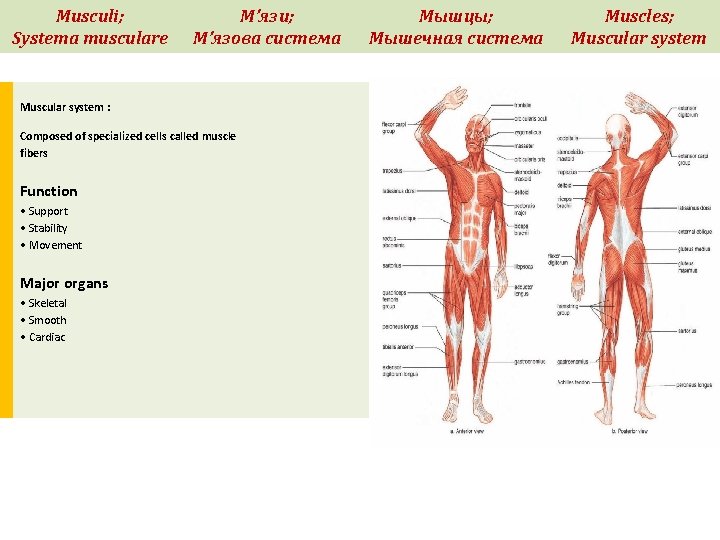
Musculi; Systema musculare М’язи; М’язова система Muscular system : Composed of specialized cells called muscle fibers Function • Support • Stability • Movement Major organs • Skeletal • Smooth • Cardiac Мышцы; Мышечная система Muscles; Muscular system
Systema digestorium Травна система Digestive system : Including the digestive tract and its accessory organs Function • Ingestion of food • Secretion of fluids and digestive enzymes • Mixing and movement of food wastes through the body • Digestion of food into smaller pieces • Absorption of nutrients • Excretion of wastes Major organs • Skeletal • Smooth • Cardiac Пищеварительная система Alimentary system
Systema respiratorium Дихальна система The Respiratory System : It works with the circulatory system to provide this oxygen and to remove the waste products of metabolism. It also helps to regulate p. H of the blood. Function • Gas Exchange - oxygen and carbon dioxide • Breathing - movement of air • Sound Production • Olfactory Assistance - sense of smell • Protection Major organs • Nose • Mouth • Throat (pharynx) • Voice box (larynx) • Windpipe (trachea) • Large airways (bronchi) • Lungs • Etc. Дыхательная система Respiratory system
Systema urinarium Сечова система The Urinary system : Maintaining the volume and composition of body fluids within normal limits Function • Remove waste products and medicines from the body • Balance the body’s fluids • Balance a variety of electrolytes • Release hormone to control blood pressure • Release a hormone to control red blood cell production • Help with bone health by controlling calcium and phosphorus Major organs • Kidneys • Ureters • Blandder • Urethra • Etc. Мочевая система Urinary system
Systemata genitalia Статеві системи Function • produce and deposit sperm • produce egg cells • protect and nourish the offspring until birth Major organs • Vagina • Uterus • Fallopian tubes • Cervix • Ovary • Etc. Половые системы Genital systems
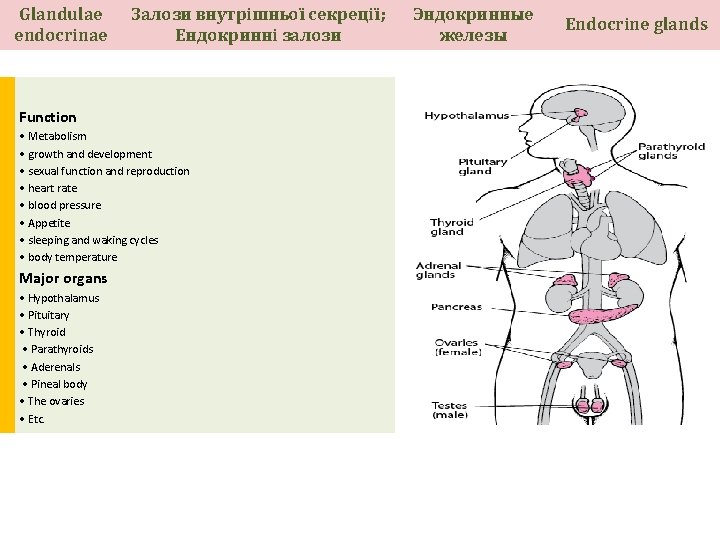
Glandulae endocrinae Залози внутрішньої секреції; Ендокринні залози Function • Metabolism • growth and development • sexual function and reproduction • heart rate • blood pressure • Appetite • sleeping and waking cycles • body temperature Major organs • Hypothalamus • Pituitary • Thyroid • Parathyroids • Aderenals • Pineal body • The ovaries • Etc. Эндокринные железы Endocrine glands
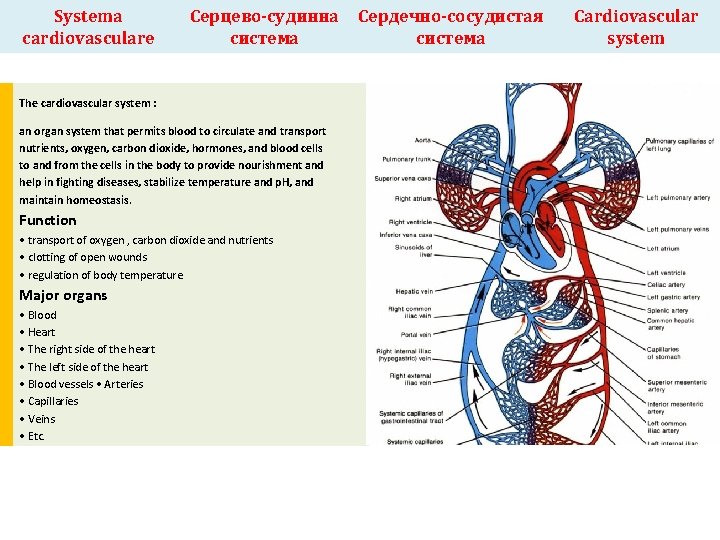
Systema cardiovasculare Серцево-судинна система The cardiovascular system : an organ system that permits blood to circulate and transport nutrients, oxygen, carbon dioxide, hormones, and blood cells to and from the cells in the body to provide nourishment and help in fighting diseases, stabilize temperature and p. H, and maintain homeostasis. Function • transport of oxygen , carbon dioxide and nutrients • clotting of open wounds • regulation of body temperature Major organs • Blood • Heart • The right side of the heart • The left side of the heart • Blood vessels • Arteries • Capillaries • Veins • Etc. Сердечно-сосудистая система Cardiovascular system
Systema lymphoideum Лімфатична система Function • Protecting your body from illness - causing invaders • Maintaining body fluid levels • Absorbing digestive tract fats • Removing cellular waste Major organs • The spleen • Thymus • Tonsils • Etc. Лимфоидная система Lymphoid system
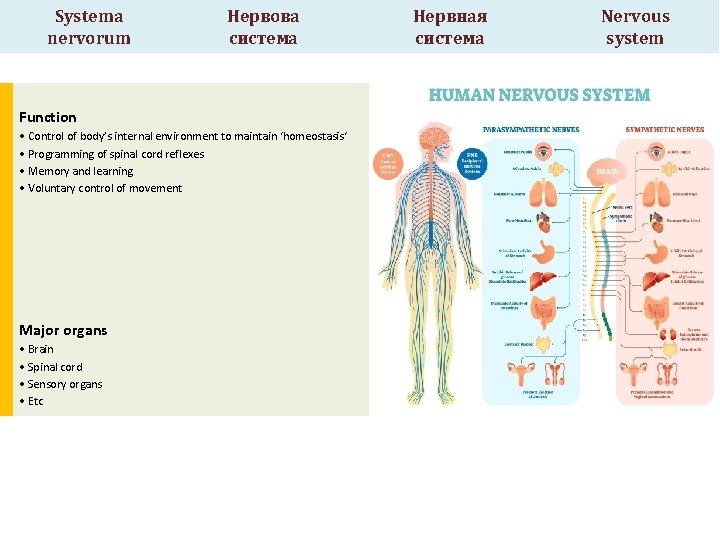
Systema nervorum Нервова система Function • Control of body’s internal environment to maintain ‘homeostasis‘ • Programming of spinal cord reflexes • Memory and learning • Voluntary control of movement Major organs • Brain • Spinal cord • Sensory organs • Etc Нервная система Nervous system
Organa sensuum Function and Major organs • Eyes (for seeing) • Nose (for smelling) • Tongue (for tasting) • Ears (for hearing) • Skin (for touching or feeling) Органи чуття Органы чувств Sense organs
Anatomia systemica Systemic anatomy 1. OSSA; SYSTEMA SKELETALE BONES; SKELETAL SYSTEM MUSCULOSKELETAL APPARATUS 2. JUNCTURAE; SYSTEMA ARTICULARE 3. MUSCULI; SYSTEMA MUSCULARE JOINTS; ARTICULAR SYSTEM MUSCLES; MUSCULAR SYSTEM 4. SYSTEMA DIGESTORIUM ALIMENTARY SYSTEM 5. SYSTEMA RESPIRATORIUM RESPIRATORY SYSTEM SPLANCHNOLOGY 6. SYSTEMA URINARIUM URINARY SYSTEM 7. SYSTEMATA GENITALIA (F/M) GENITAL SYSTEMS (F/M) 8. GLANDULAE ENDOCRINE GLANDS 9. SYSTEMA CARDIOVASCULARE 10. SYSTEMA LYMPHOIDEUM 11. SYSTEMA NERVORUM (PC+PP) 12. ORGANA SENSUUM HEART+VESSELS (BLOOD AND LYMPHATIC VESSELS) CENTRAL AND PERIPHERAL NERVOUS SYSTEMS SENSITIVE SYSTEM CARDIOVASCULAR SYSTEM LYMPHOID SYSTEM NERVOUS SYSTEM (CNS+PNS) SENSE ORGANS ANATOMY = LOVE! ANATOMY - IT'S FORCE OF NATURE! kovalchuk@anatom. ua