
CLASSIFICATION OBJECTIVES 1 2 3 4 5 Explain

CLASSIFICATION
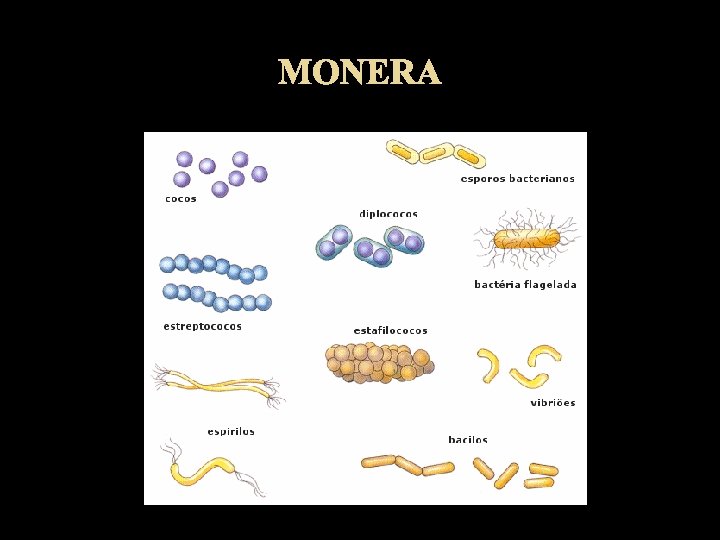
OBJECTIVES 1. 2. 3. 4. 5. Explain the term “taxonomy” Explain the necessity for classifying living things Identify the scientist that developed the current classification scheme Identify the 5 kingdoms Describe each kingdom in terms of: a. b. c. d. Presence of a distinct nucleus (prokaryote or eukaryote) Type of nutrition (heterotroph or autotroph) Cellular plan (uni- or multicellular) Examples of representative organisms (identify by name or picture)
OBJECTIVES List the 7 classification categories (KPCOFGS) (King Philip Came Over From Germany Saturday) 7. Define the term “species” 8. Explain what “binomial nomenclature” is, where it comes from, and how it is written 9. Know the scientific name of humans 10. Use a dichotomous key to identify organisms 6.
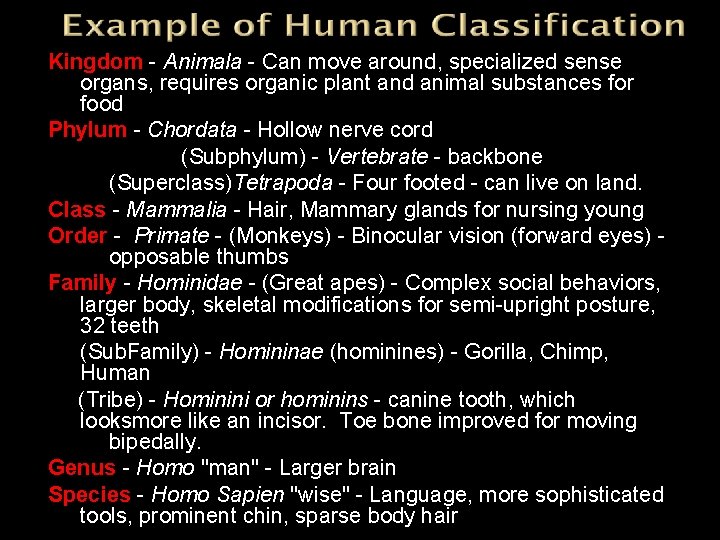
Kingdom - Animala - Can move around, specialized sense organs, requires organic plant and animal substances for food Phylum - Chordata - Hollow nerve cord (Subphylum) - Vertebrate - backbone (Superclass)Tetrapoda - Four footed - can live on land. Class - Mammalia - Hair, Mammary glands for nursing young Order - Primate - (Monkeys) - Binocular vision (forward eyes) opposable thumbs Family - Hominidae - (Great apes) - Complex social behaviors, larger body, skeletal modifications for semi-upright posture, 32 teeth (Sub. Family) - Homininae (hominines) - Gorilla, Chimp, Human (Tribe) - Hominini or hominins - canine tooth, which looksmore like an incisor. Toe bone improved for moving bipedally. Genus - Homo "man" - Larger brain Species - Homo Sapien "wise" - Language, more sophisticated tools, prominent chin, sparse body hair
5 KINGDOM CLASSIFICATION SYSTEM (some needed vocabulary) Prokaryote: cells with no nucleus Eukaryote: cells with a true nucleus Heterotroph: can not make their own food Autotroph: can make their own food Motile: has locomotion Non-motile: can not move around
5 KINGDOM CLASSIFICATION SYSTEM
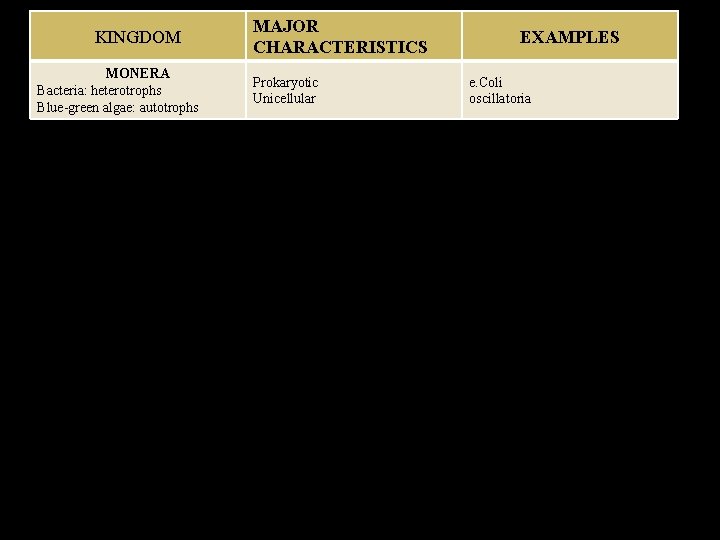
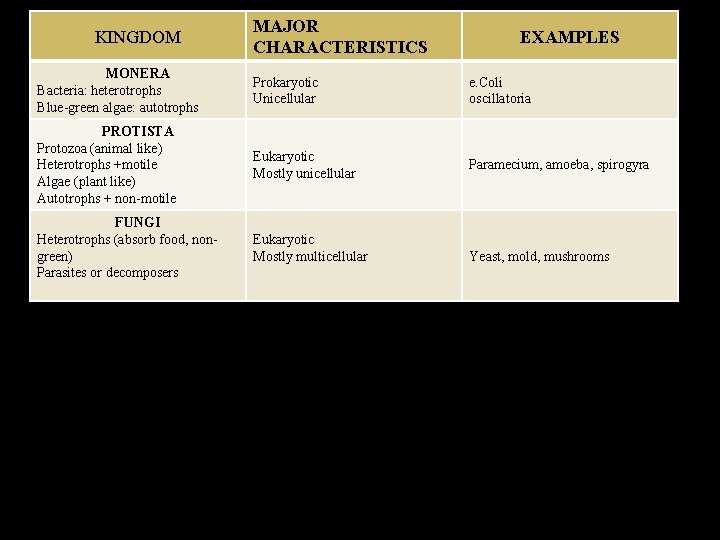
KINGDOM MONERA Bacteria: heterotrophs Blue-green algae: autotrophs MAJOR CHARACTERISTICS Prokaryotic Unicellular EXAMPLES e. Coli oscillatoria
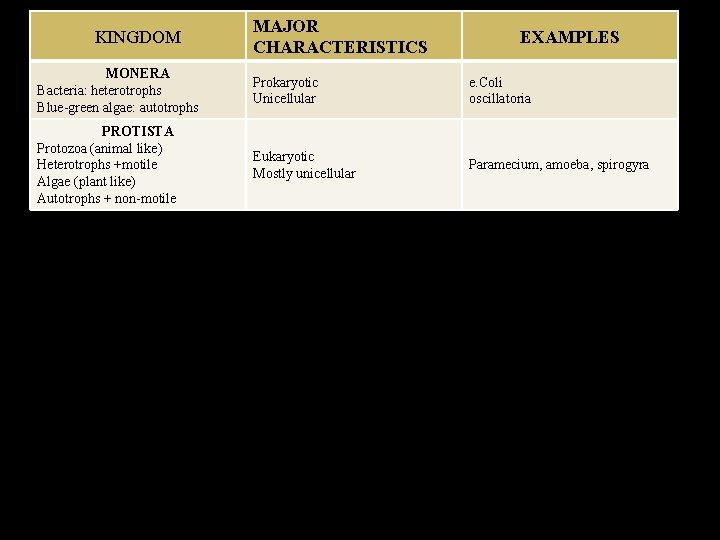
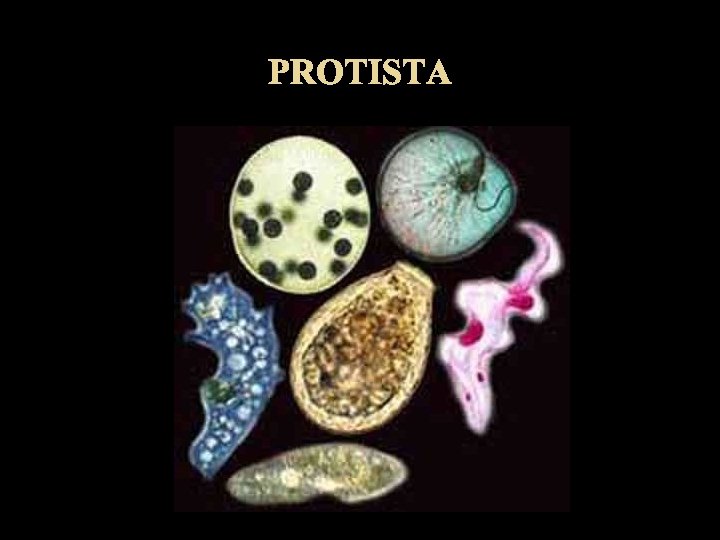
KINGDOM MAJOR CHARACTERISTICS EXAMPLES MONERA Bacteria: heterotrophs Blue-green algae: autotrophs Prokaryotic Unicellular e. Coli oscillatoria PROTISTA Protozoa (animal like) Heterotrophs +motile Algae (plant like) Autotrophs + non-motile Eukaryotic Mostly unicellular Paramecium, amoeba, spirogyra
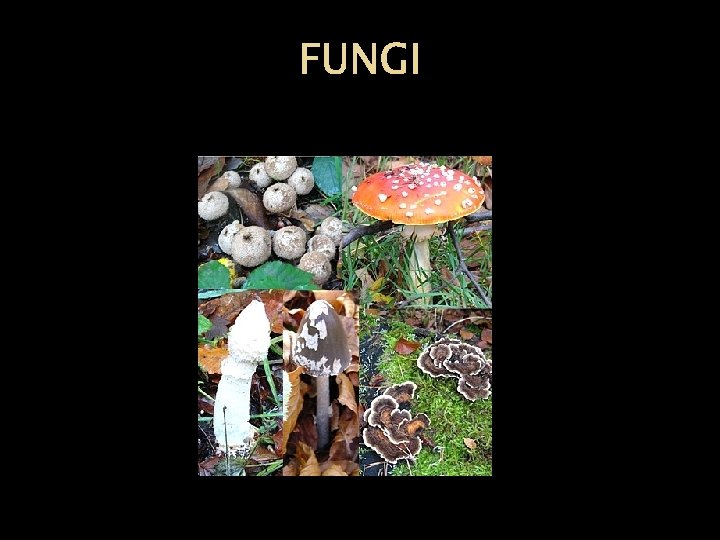
KINGDOM MAJOR CHARACTERISTICS EXAMPLES MONERA Bacteria: heterotrophs Blue-green algae: autotrophs Prokaryotic Unicellular e. Coli oscillatoria PROTISTA Protozoa (animal like) Heterotrophs +motile Algae (plant like) Autotrophs + non-motile Eukaryotic Mostly unicellular Paramecium, amoeba, spirogyra FUNGI Heterotrophs (absorb food, nongreen) Parasites or decomposers Eukaryotic Mostly multicellular Yeast, mold, mushrooms
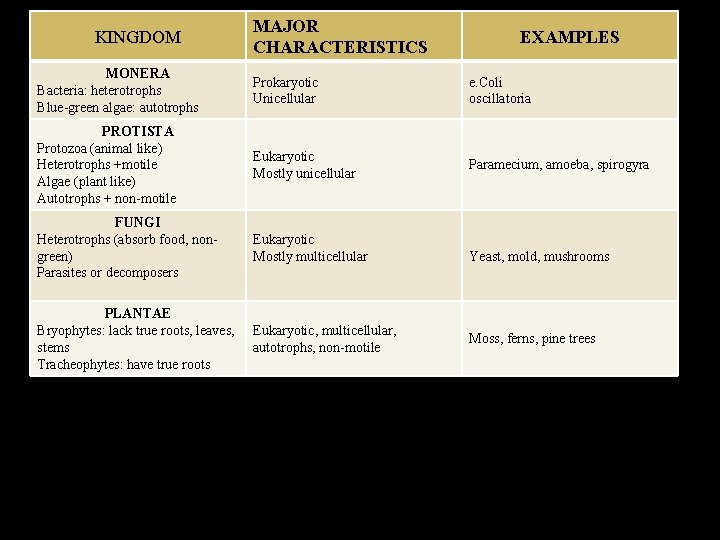
KINGDOM MAJOR CHARACTERISTICS EXAMPLES MONERA Bacteria: heterotrophs Blue-green algae: autotrophs Prokaryotic Unicellular e. Coli oscillatoria PROTISTA Protozoa (animal like) Heterotrophs +motile Algae (plant like) Autotrophs + non-motile Eukaryotic Mostly unicellular Paramecium, amoeba, spirogyra FUNGI Heterotrophs (absorb food, nongreen) Parasites or decomposers Eukaryotic Mostly multicellular PLANTAE Bryophytes: lack true roots, leaves, stems Tracheophytes: have true roots Eukaryotic, multicellular, autotrophs, non-motile Yeast, mold, mushrooms Moss, ferns, pine trees
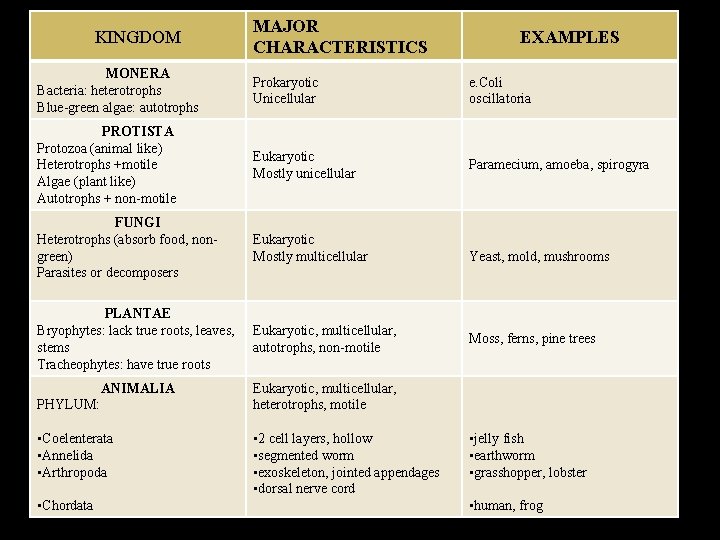
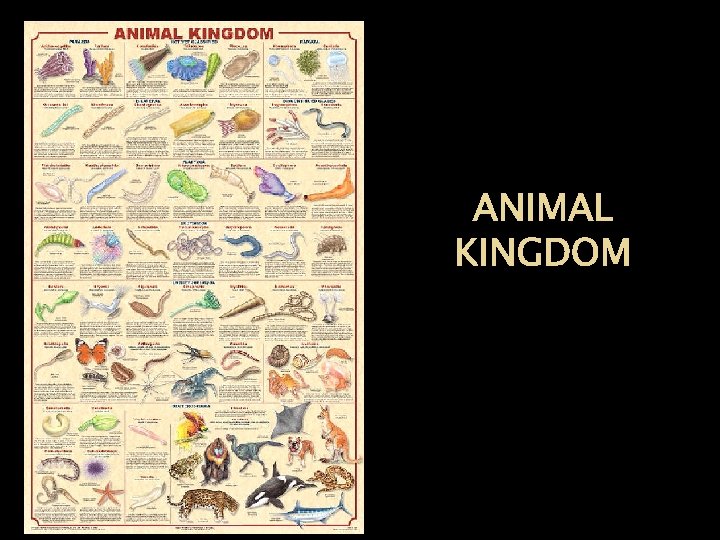
KINGDOM MAJOR CHARACTERISTICS EXAMPLES MONERA Bacteria: heterotrophs Blue-green algae: autotrophs Prokaryotic Unicellular e. Coli oscillatoria PROTISTA Protozoa (animal like) Heterotrophs +motile Algae (plant like) Autotrophs + non-motile Eukaryotic Mostly unicellular Paramecium, amoeba, spirogyra FUNGI Heterotrophs (absorb food, nongreen) Parasites or decomposers Eukaryotic Mostly multicellular PLANTAE Bryophytes: lack true roots, leaves, stems Tracheophytes: have true roots Eukaryotic, multicellular, autotrophs, non-motile ANIMALIA PHYLUM: • Coelenterata • Annelida • Arthropoda • Chordata Yeast, mold, mushrooms Moss, ferns, pine trees Eukaryotic, multicellular, heterotrophs, motile • 2 cell layers, hollow • segmented worm • exoskeleton, jointed appendages • dorsal nerve cord • jelly fish • earthworm • grasshopper, lobster • human, frog
CHARACTERISTICS OF THE FIVE KINGDOMS
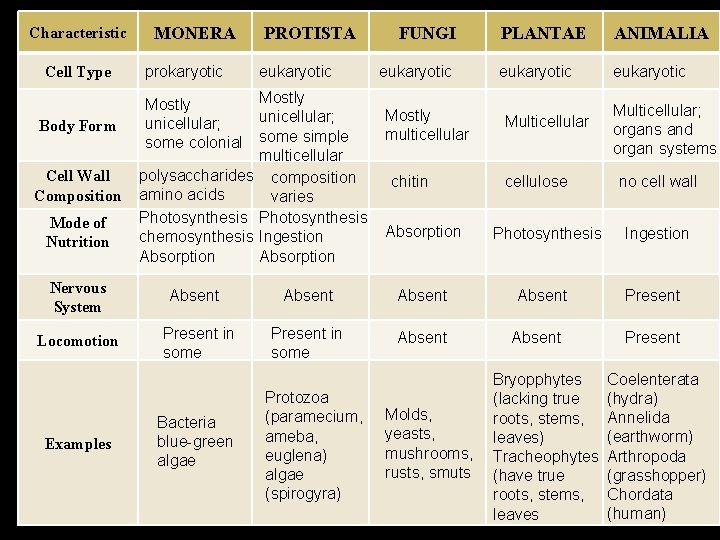
Characteristic Cell Type Body Form Cell Wall Composition Mode of Nutrition Nervous System Locomotion Examples MONERA prokaryotic PROTISTA eukaryotic Mostly unicellular; some simple multicellular polysaccharides composition amino acids varies Photosynthesis chemosynthesis Ingestion Absorption Mostly unicellular; some colonial Absent Present in some Bacteria blue-green algae FUNGI eukaryotic Mostly multicellular chitin Absorption Absent Present in some Absent Protozoa (paramecium, ameba, euglena) algae (spirogyra) Molds, yeasts, mushrooms, rusts, smuts PLANTAE ANIMALIA eukaryotic Multicellular cellulose Photosynthesis Absent Bryopphytes (lacking true roots, stems, leaves) Tracheophytes (have true roots, stems, leaves Multicellular; organs and organ systems no cell wall Ingestion Present Coelenterata (hydra) Annelida (earthworm) Arthropoda (grasshopper) Chordata (human)
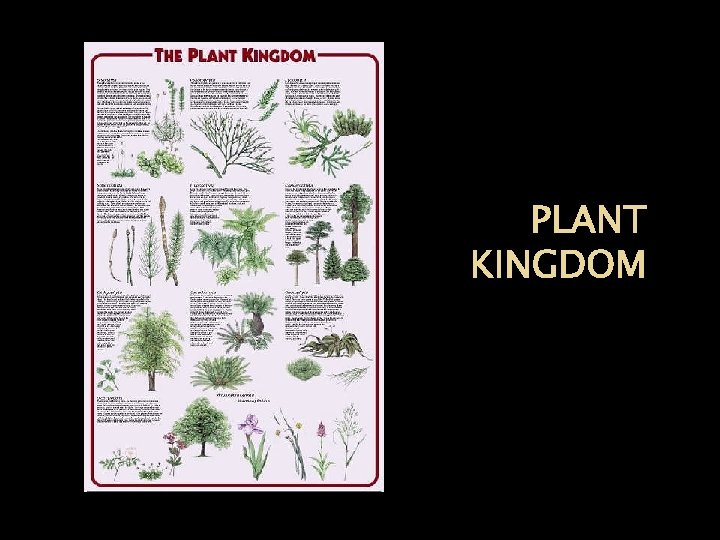
THE PLANT KINGDOM
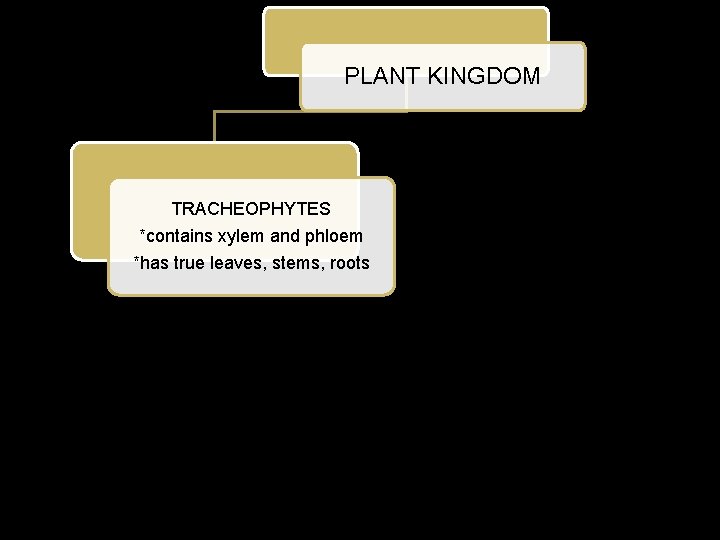
PLANT KINGDOM TRACHEOPHYTES *contains xylem and phloem *has true leaves, stems, roots
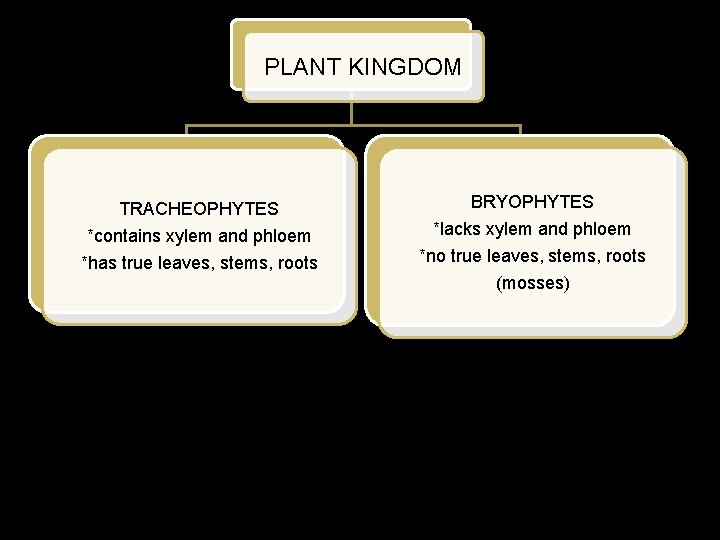
PLANT KINGDOM TRACHEOPHYTES *contains xylem and phloem *has true leaves, stems, roots BRYOPHYTES *lacks xylem and phloem *no true leaves, stems, roots (mosses)
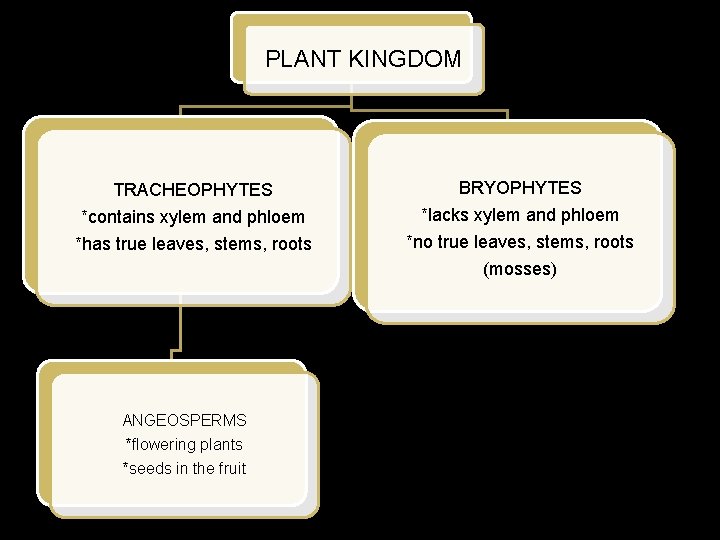
PLANT KINGDOM TRACHEOPHYTES *contains xylem and phloem *has true leaves, stems, roots ANGEOSPERMS *flowering plants *seeds in the fruit BRYOPHYTES *lacks xylem and phloem *no true leaves, stems, roots (mosses)
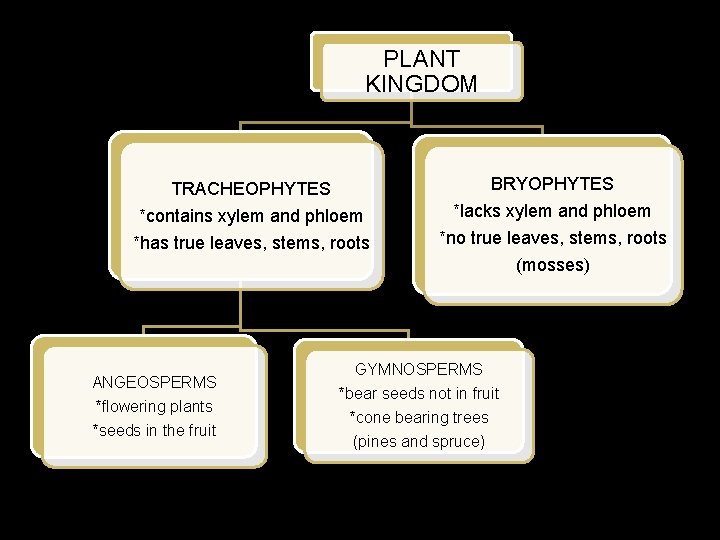
PLANT KINGDOM TRACHEOPHYTES BRYOPHYTES *contains xylem and phloem *has true leaves, stems, roots *lacks xylem and phloem *no true leaves, stems, roots (mosses) ANGEOSPERMS *flowering plants *seeds in the fruit GYMNOSPERMS *bear seeds not in fruit *cone bearing trees (pines and spruce)
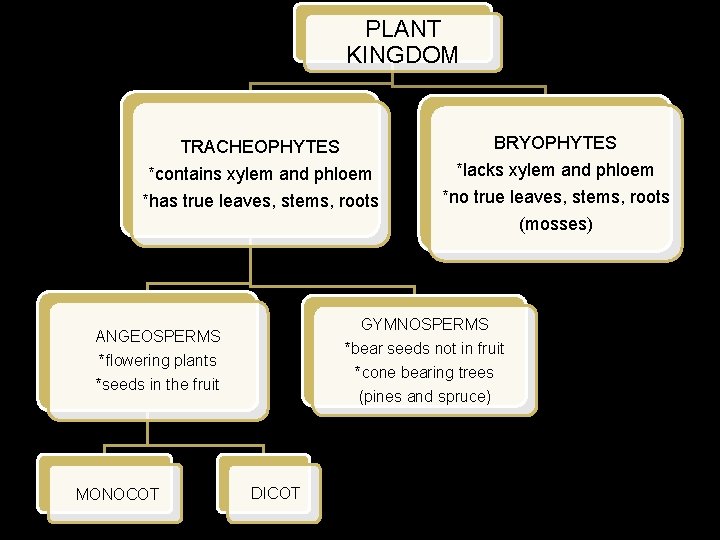
PLANT KINGDOM TRACHEOPHYTES BRYOPHYTES *contains xylem and phloem *has true leaves, stems, roots *lacks xylem and phloem *no true leaves, stems, roots (mosses) GYMNOSPERMS *bear seeds not in fruit ANGEOSPERMS *flowering plants *cone bearing trees (pines and spruce) *seeds in the fruit MONOCOT DICOT
COMPARE MONOCOT and DICOT PLANTS
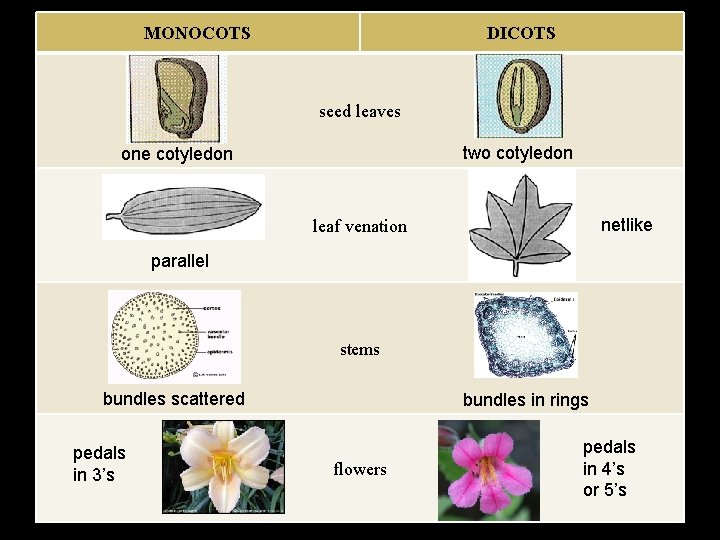
MONOCOTS DICOTS seed leaves two cotyledon one cotyledon netlike leaf venation parallel stems bundles scattered pedals in 3’s bundles in rings flowers pedals in 4’s or 5’s
- Slides: 26