
Classification NonScience Example of Classification n The item








- Slides: 29
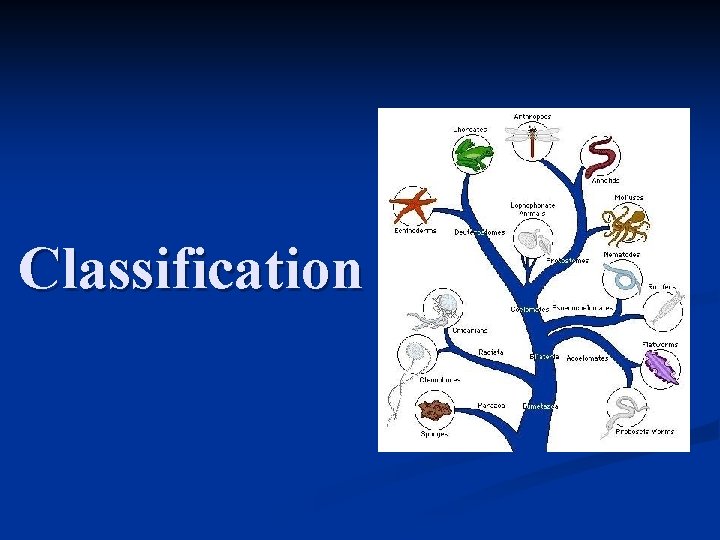
Classification
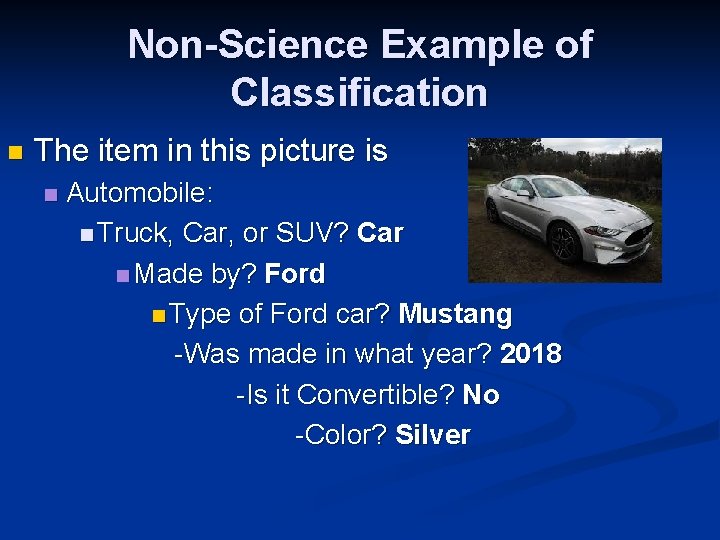
Non-Science Example of Classification n The item in this picture is n Automobile: n Truck, Car, or SUV? Car n Made by? Ford n Type of Ford car? Mustang -Was made in what year? 2018 -Is it Convertible? No -Color? Silver
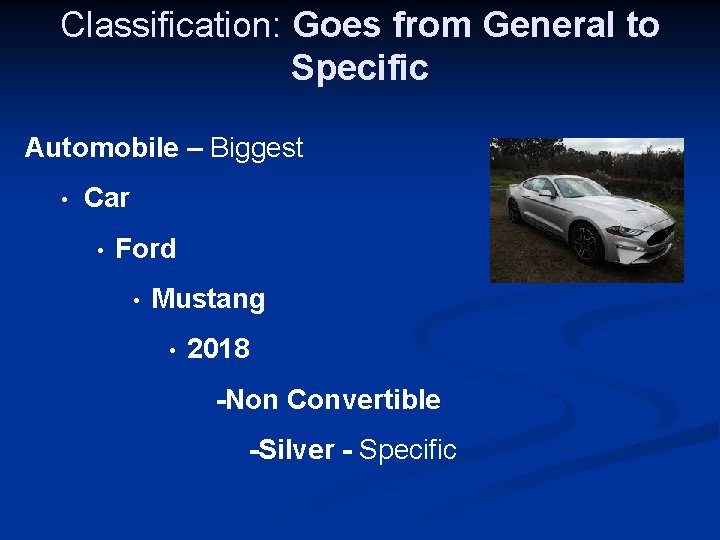
Classification: Goes from General to Specific Automobile – Biggest • Car • Ford • Mustang • 2018 -Non Convertible -Silver - Specific
Classification n Classify – to group things together based on similarities n Why Classify? n To make organisms easier to identify n To make organisms easier to compare n How do we classify? n Compare Traits – features or characteristics of an organisms n When dealing with living things, the science of classification is called Taxonomy.
Little Known Fact: There are over ___1. 5 Million_____; and more are discovered each year. n What do we classify? Somewhere between 2 and 100 million have yet to be discovered. n Why have we not found them? They live in environments that are difficult to deal with. n n Classification serves as an organization system for all the existing and new organisms
Early Classification – Aristotle 384322 B. C. n 2 Groups: Plants and Animals n Plants – Green, Non Mobile n Then he divided the plants by size: n Small – herbs/grasses n Medium - shrubs n Large - trees n Animals – Not Green, Mobile n Then he divided the animals by location: n Land n Air n Water
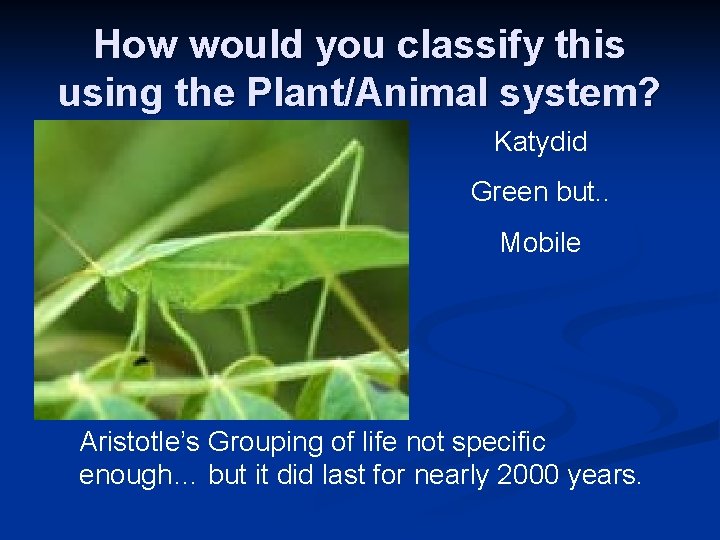
How would you classify this using the Plant/Animal system? Katydid Green but. . Mobile Aristotle’s Grouping of life not specific enough… but it did last for nearly 2000 years.
2 Kingdoms turns to 3 Kingdoms n Aristotle – 300 B. C. n n Linnaeus – 1758 A. D. n n 2 kingdoms – Plants and Animals Earnest Haeckel - 1866 3 kingdoms – Plantae, Animalia and Protista. n The Protists consisted bacteria, algae, fungi and protozoans. n
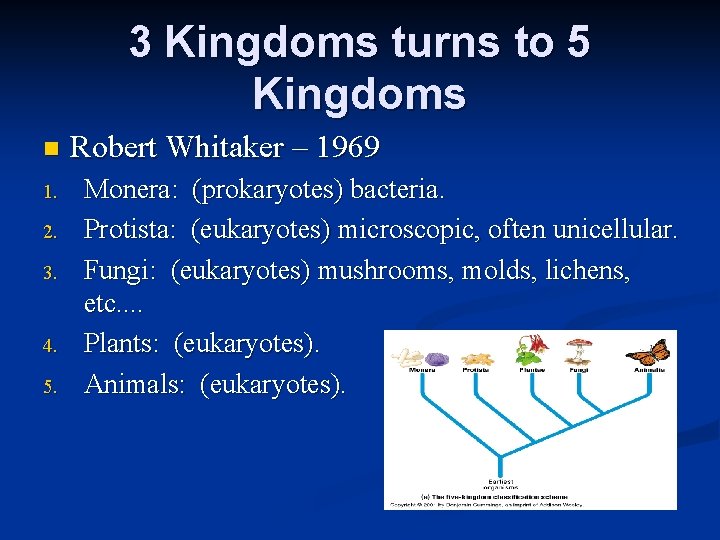
3 Kingdoms turns to 5 Kingdoms n 1. 2. 3. 4. 5. Robert Whitaker – 1969 Monera: (prokaryotes) bacteria. Protista: (eukaryotes) microscopic, often unicellular. Fungi: (eukaryotes) mushrooms, molds, lichens, etc. . Plants: (eukaryotes). Animals: (eukaryotes).
5 Kingdoms turns to 6 Kingdoms n 1. 2. 3. 4. 5. 6. Carl Woese – 1970 s Arhaebacteria: (prokaryotes) “ancient” bacteria. Eubacteria: (prokaryotes) “true” bacteria. Protista: (eukaryotes) microscopic, often unicellular. Fungi: (eukaryotes) mushrooms, molds, lichens, etc. . Plants: (eukaryotes). Animals: (eukaryotes).
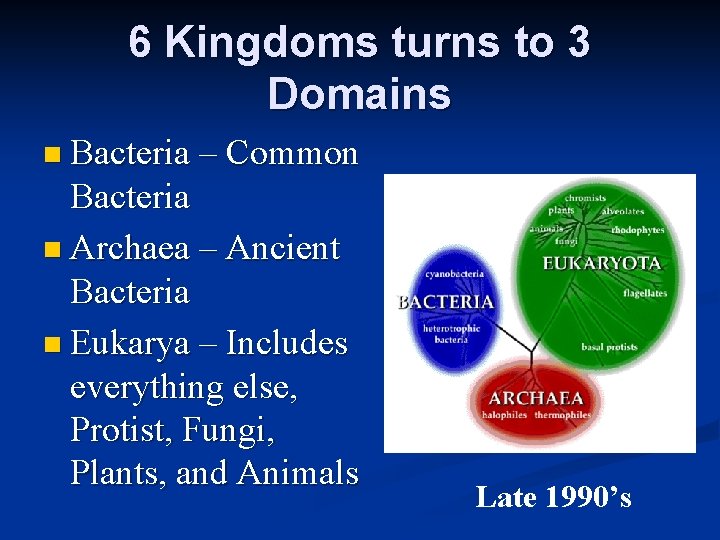
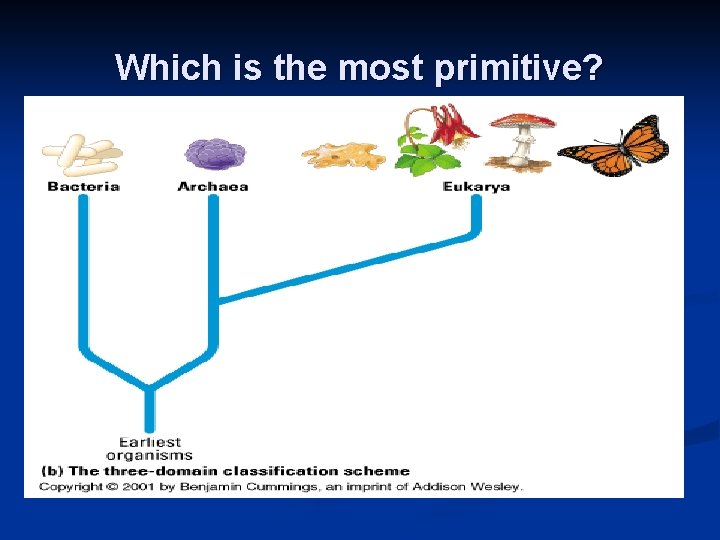
6 Kingdoms turns to 3 Domains n Bacteria – Common Bacteria n Archaea – Ancient Bacteria n Eukarya – Includes everything else, Protist, Fungi, Plants, and Animals Late 1990’s
Carlos Linnaeus Swedish Botanist that is now considered the “Father of Taxonomy (Classification). ” n Linneaus developed a classification system (1735) based only on structural features. n Different features = different species. n Same features = same species. n n The Linnaean system of classification was widely accepted by the early 19 th century (1800 s) and is still the basic framework for
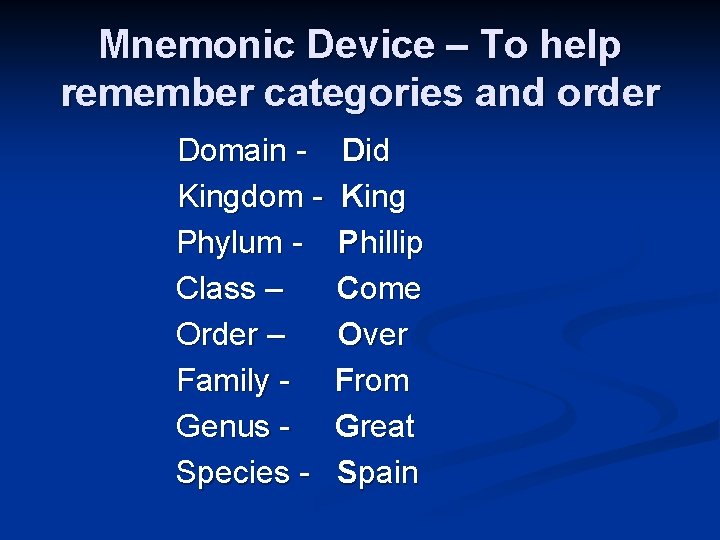
Linnaeus Divisions Still Used in Modern Classification 1. Kingdom – largest group We have now added 2. Phylum DOMAIN 3. Class which is bigger then 4. Order Kingdom 5. Family 6. Genus 7. Species (Most Closely Related)
Mnemonic Device – To help remember categories and order Domain Kingdom Phylum Class – Order – Family Genus Species - Did King Phillip Come Over From Great Spain
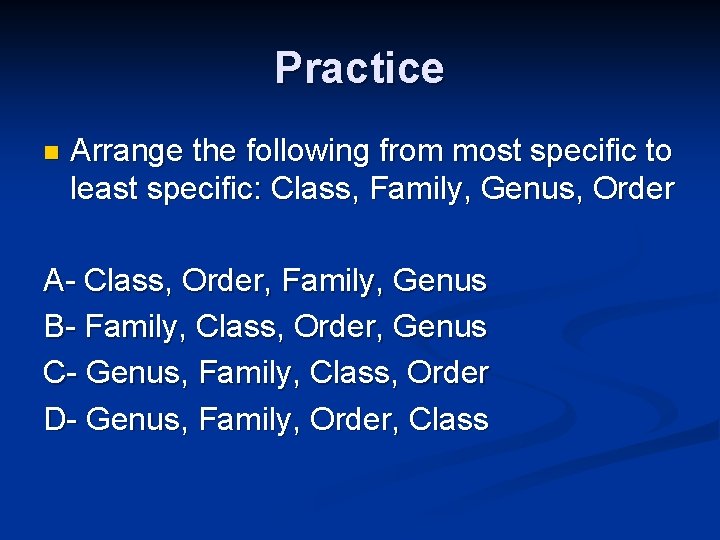
Practice n Arrange the following from most specific to least specific: Class, Family, Genus, Order A- Class, Order, Family, Genus B- Family, Class, Order, Genus C- Genus, Family, Class, Order D- Genus, Family, Order, Class
Taxons Within each category, a particular group is called a Taxon n Many Taxons for each category n Ex: Mammalia is the Taxon for the Class category in Humans n Ex: Homo is the Taxon for the Genus category in Humans n Carnivora is the Taxon for the Order category in Lions n
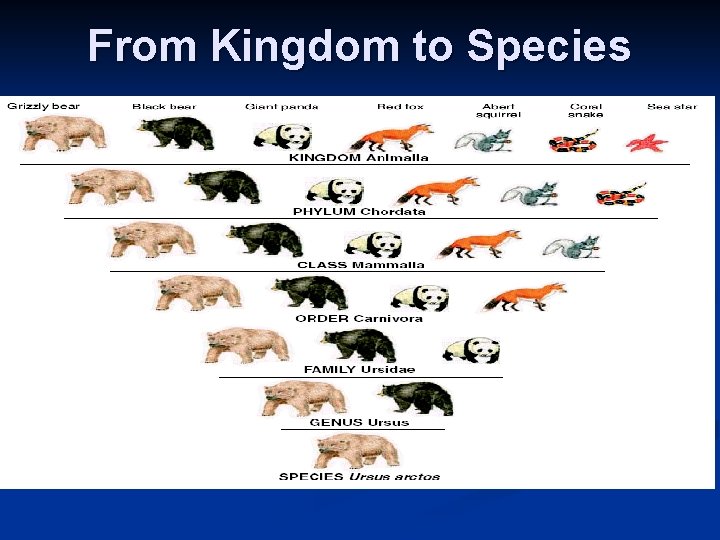
From Kingdom to Species
Example Classification n n Lion 1. Kingdom – Animalia (all Animals) 2. Phylum – Chordata (All vertebrate animals) n 3. Class – Mammalia (All Mammals – mammary glands) 4. Order – Carnivora (Meat eaters) 5. Family – Felidae (includes all Cats) 6. Genus – Panthera (Includes all roaring Cats) 7. Species – leo (Lions)
Which two animals are most closely related? At what taxon do they diverge?
Linnaeus Introduced Scientific Naming n Binomial Nomenclature is the 2 word scientific name of an organism n n Uses Genus and Species Genus is capitalized, not species, all italicized In writing the name, can’t italicize, so underline n Homo sapien (Genus and species of Human) n Panthera leo (Genus and species of Lion) Used Latin, which is understood by all scientists – n Felis concolor or Felis concolor
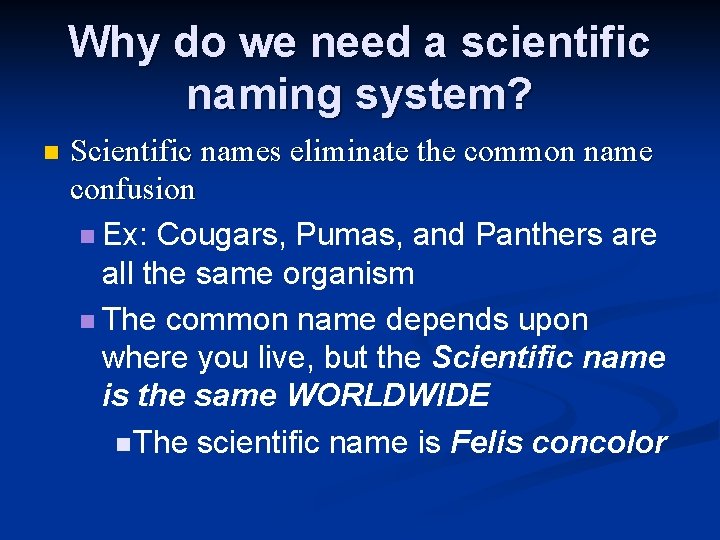
Why do we need a scientific naming system? n Scientific names eliminate the common name confusion n Ex: Cougars, Pumas, and Panthers are all the same organism n The common name depends upon where you live, but the Scientific name is the same WORLDWIDE n The scientific name is Felis concolor
What is the name of the Grey Wolf?
Practice Scientific name for…. Humans? Squirrel? Gorilla? Katydid?
Which scientific name is written correctly? A- Alces (moose) B- Canis rufus (wolf) C- pavo cristatus (peacock) D- torsiops Truncatus (bottle nosed dolphin)
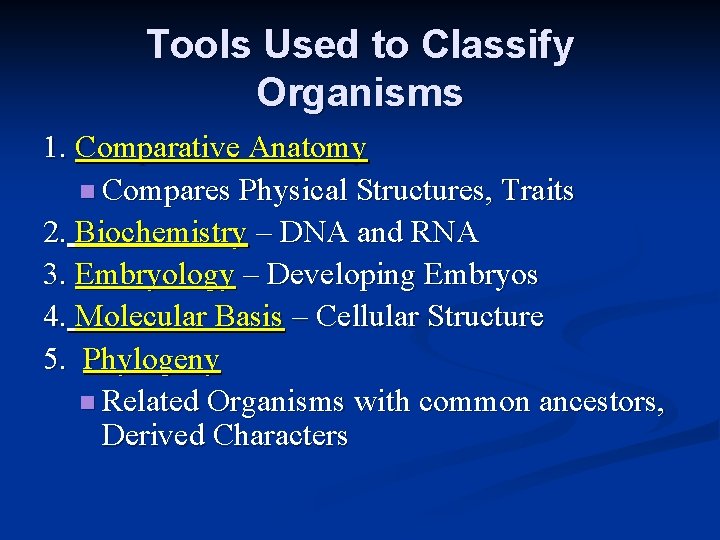
Tools Used to Classify Organisms 1. Comparative Anatomy n Compares Physical Structures, Traits 2. Biochemistry – DNA and RNA 3. Embryology – Developing Embryos 4. Molecular Basis – Cellular Structure 5. Phylogeny n Related Organisms with common ancestors, Derived Characters
What tool(s) could be used to separate a prokaryote and eukaryote? A- Comparative Anatomy n B- Biochemistry n C- Embryology n D- Molecular Basis n E- Phylogeny n
From Kingdom to Species What characteristics could be used to create this specific classification of organisms?
Which is the most primitive?
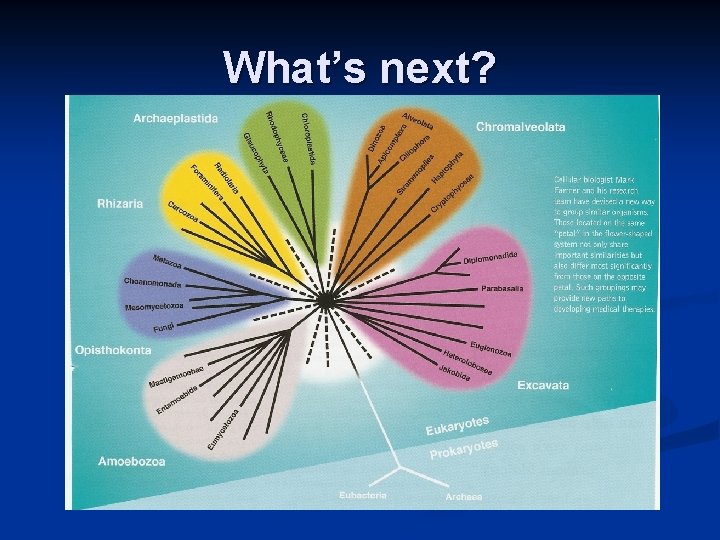
What’s next?