
Classification Neural Networks 1 Jeff Howbert Introduction to
Classification Neural Networks 1 Jeff Howbert Introduction to Machine Learning Winter 2012 1
Neural networks l Topics – Perceptrons structure u training u expressiveness u – Multilayer networks u possible structures – activation functions training with gradient descent and backpropagation u expressiveness u Jeff Howbert Introduction to Machine Learning Winter 2012 2
Connectionist models l Consider humans: – Neuron switching time ~ 0. 001 second – Number of neurons ~ 1010 – Connections per neuron ~ 104 -5 – Scene recognition time ~ 0. 1 second – 100 inference steps doesn’t seem like enough Massively parallel computation Jeff Howbert Introduction to Machine Learning Winter 2012 3
Neural networks l Properties: – Many neuron-like threshold switching units – Many weighted interconnections among units – Highly parallel, distributed process – Emphasis on tuning weights automatically Jeff Howbert Introduction to Machine Learning Winter 2012 4

Neural network application ALVINN: An Autonomous Land Vehicle In a Neural Network (Carnegie Mellon University Robotics Institute, 1989 -1997) ALVINN is a perception system which learns to control the NAVLAB vehicles by watching a person drive. ALVINN's architecture consists of a single hidden layer back-propagation network. The input layer of the network is a 30 x 32 unit two dimensional "retina" which receives input from the vehicles video camera. Each input unit is fully connected to a layer of five hidden units which are in turn fully connected to a layer of 30 output units. The output layer is a linear representation of the direction the vehicle should travel in order to keep the vehicle on the road. Jeff Howbert Introduction to Machine Learning Winter 2012 5
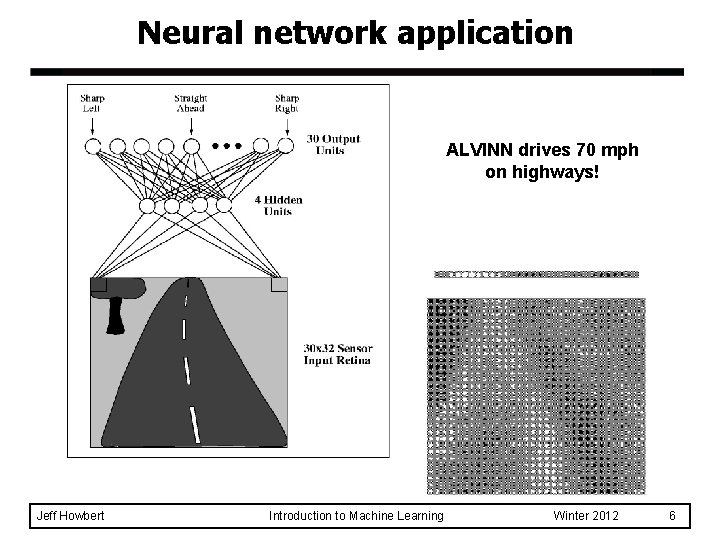
Neural network application ALVINN drives 70 mph on highways! Jeff Howbert Introduction to Machine Learning Winter 2012 6
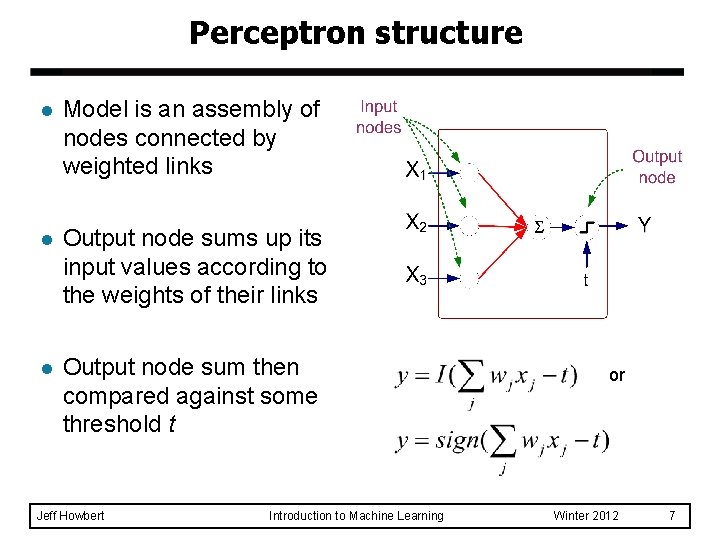
Perceptron structure l Model is an assembly of nodes connected by weighted links l Output node sums up its input values according to the weights of their links l Output node sum then compared against some threshold t Jeff Howbert Introduction to Machine Learning or Winter 2012 7
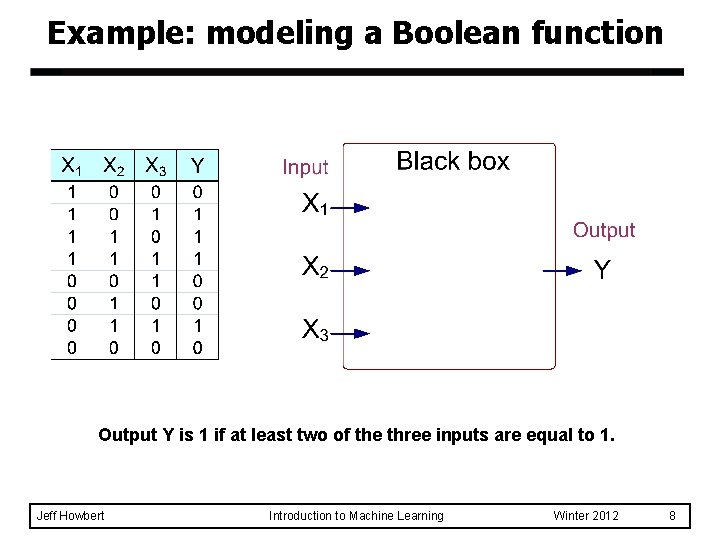
Example: modeling a Boolean function Output Y is 1 if at least two of the three inputs are equal to 1. Jeff Howbert Introduction to Machine Learning Winter 2012 8
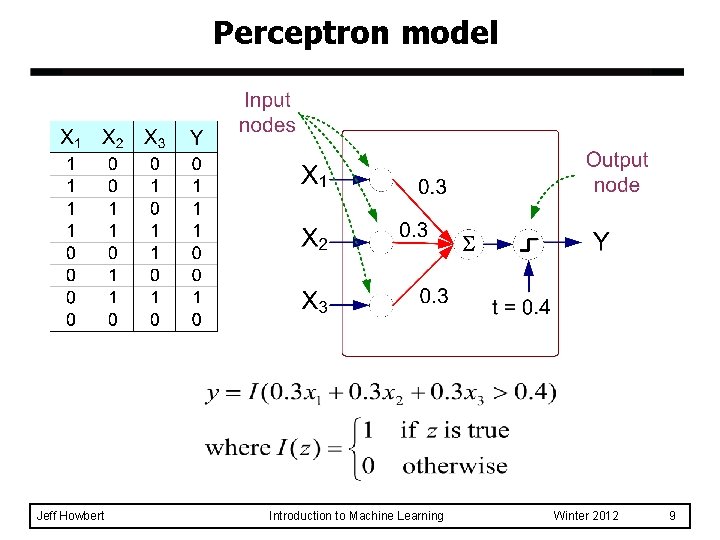
Perceptron model Jeff Howbert Introduction to Machine Learning Winter 2012 9
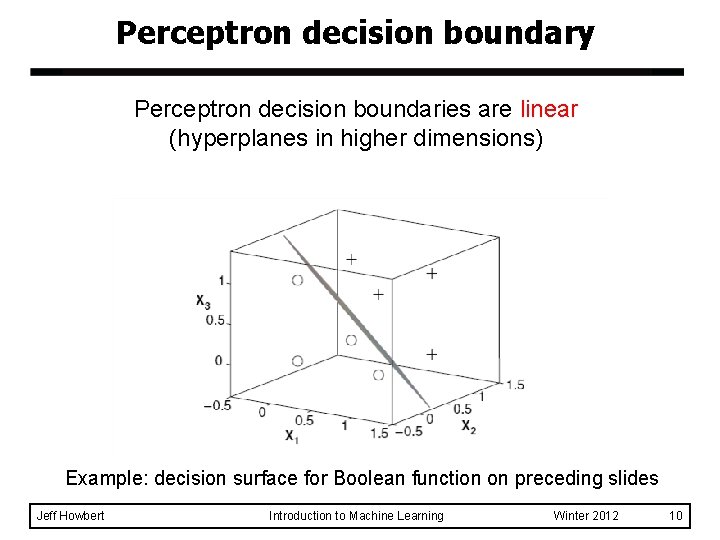
Perceptron decision boundary Perceptron decision boundaries are linear (hyperplanes in higher dimensions) Example: decision surface for Boolean function on preceding slides Jeff Howbert Introduction to Machine Learning Winter 2012 10
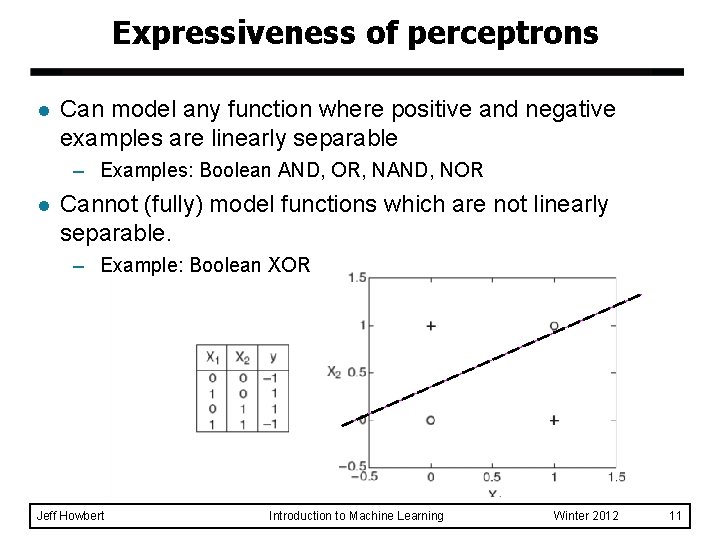
Expressiveness of perceptrons l Can model any function where positive and negative examples are linearly separable – Examples: Boolean AND, OR, NAND, NOR l Cannot (fully) model functions which are not linearly separable. – Example: Boolean XOR Jeff Howbert Introduction to Machine Learning Winter 2012 11
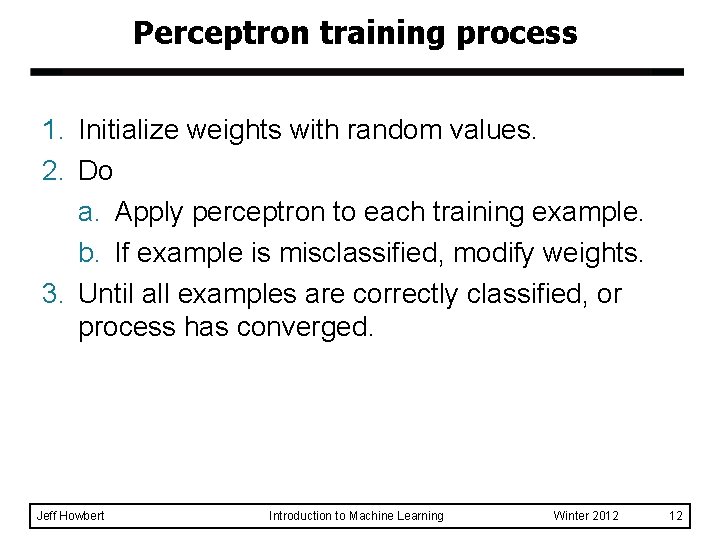
Perceptron training process 1. Initialize weights with random values. 2. Do a. Apply perceptron to each training example. b. If example is misclassified, modify weights. 3. Until all examples are correctly classified, or process has converged. Jeff Howbert Introduction to Machine Learning Winter 2012 12
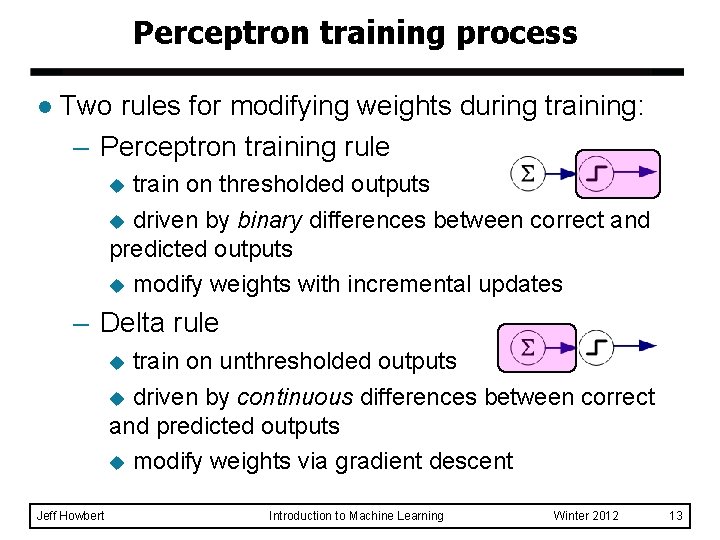
Perceptron training process l Two rules for modifying weights during training: – Perceptron training rule train on thresholded outputs u driven by binary differences between correct and predicted outputs u modify weights with incremental updates u – Delta rule train on unthresholded outputs u driven by continuous differences between correct and predicted outputs u modify weights via gradient descent u Jeff Howbert Introduction to Machine Learning Winter 2012 13
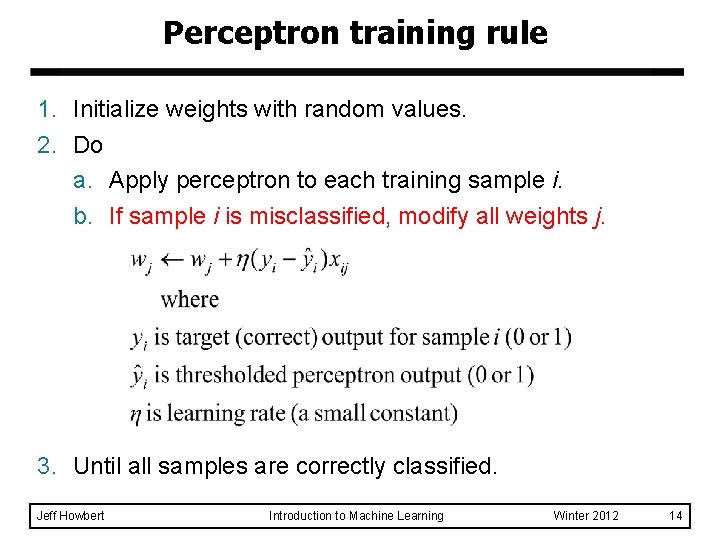
Perceptron training rule 1. Initialize weights with random values. 2. Do a. Apply perceptron to each training sample i. b. If sample i is misclassified, modify all weights j. 3. Until all samples are correctly classified. Jeff Howbert Introduction to Machine Learning Winter 2012 14
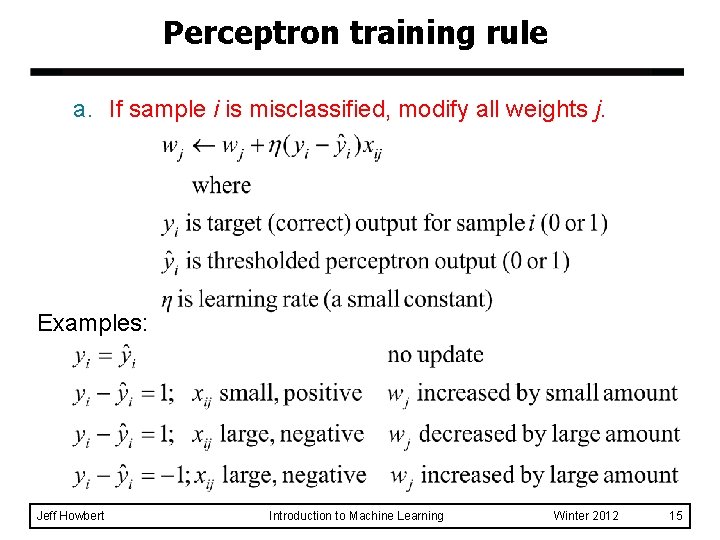
Perceptron training rule a. If sample i is misclassified, modify all weights j. Examples: Jeff Howbert Introduction to Machine Learning Winter 2012 15
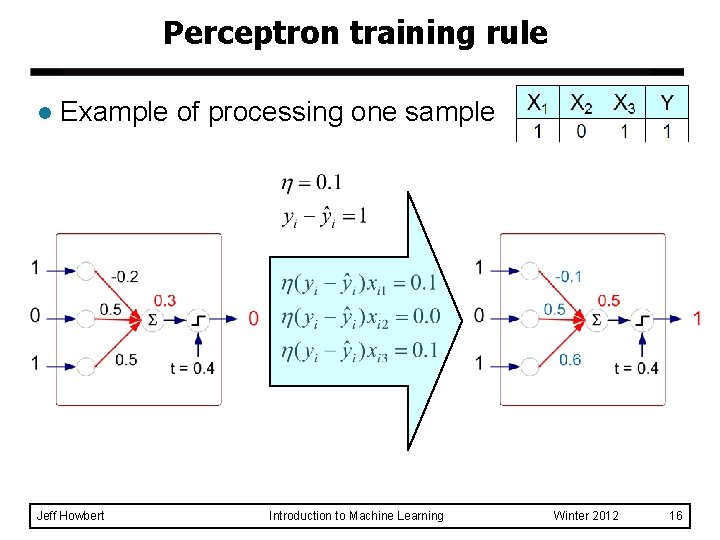
Perceptron training rule l Example of processing one sample Jeff Howbert Introduction to Machine Learning Winter 2012 16
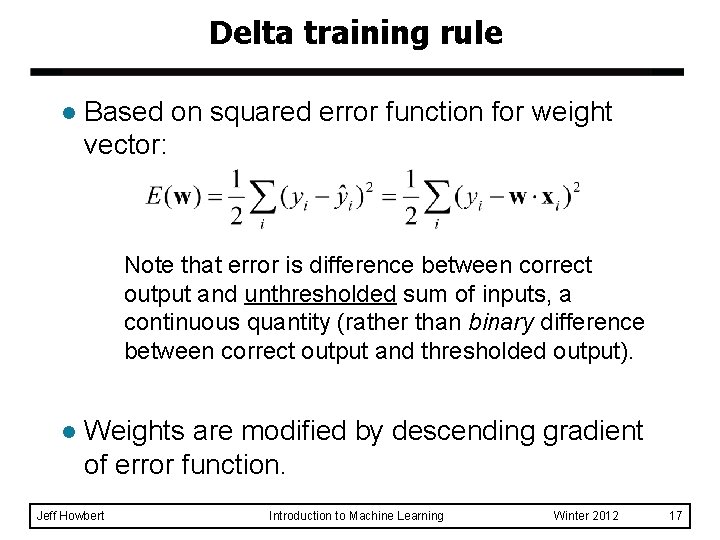
Delta training rule l Based on squared error function for weight vector: Note that error is difference between correct output and unthresholded sum of inputs, a continuous quantity (rather than binary difference between correct output and thresholded output). l Weights are modified by descending gradient of error function. Jeff Howbert Introduction to Machine Learning Winter 2012 17
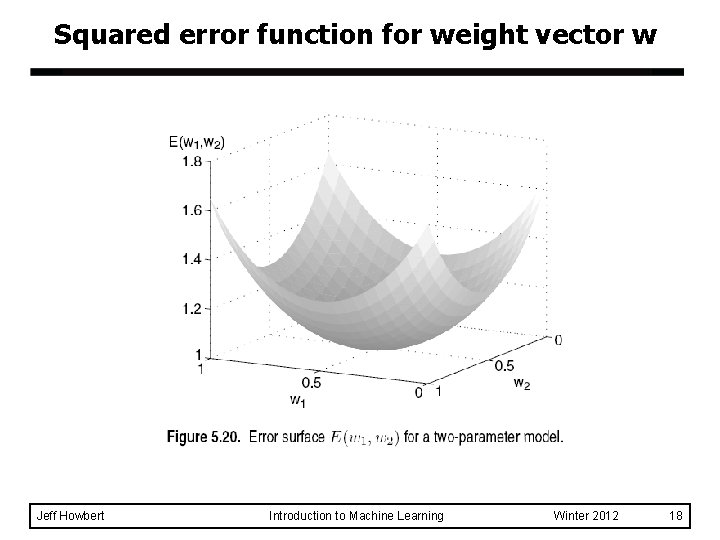
Squared error function for weight vector w Jeff Howbert Introduction to Machine Learning Winter 2012 18
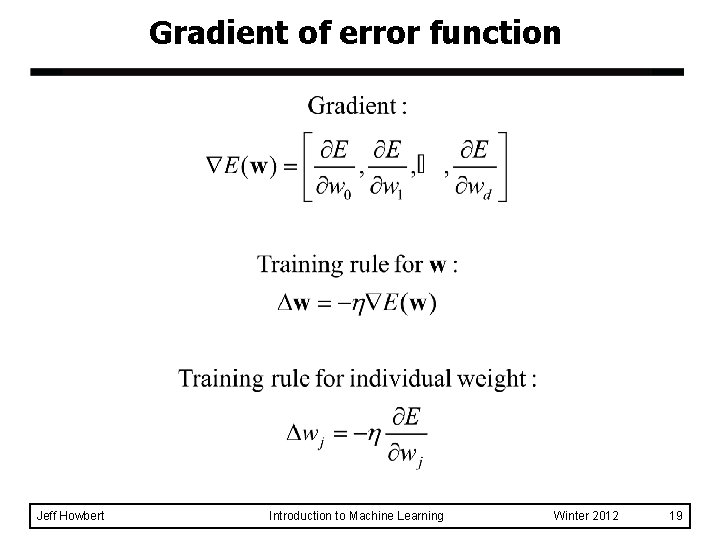
Gradient of error function Jeff Howbert Introduction to Machine Learning Winter 2012 19
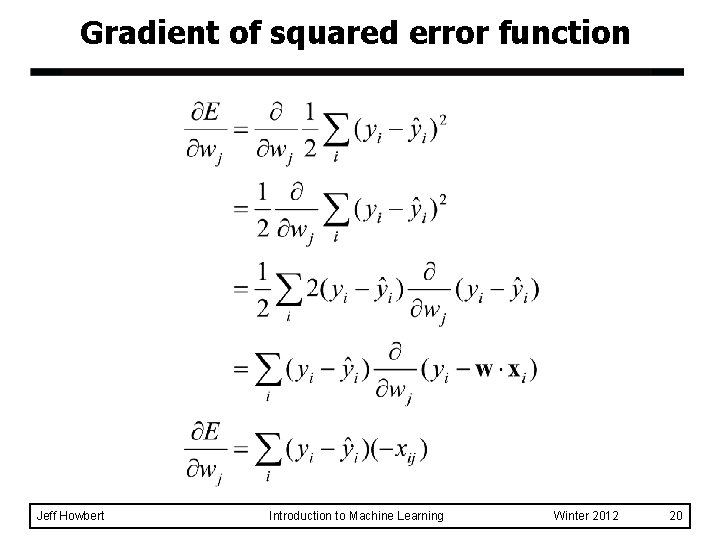
Gradient of squared error function Jeff Howbert Introduction to Machine Learning Winter 2012 20
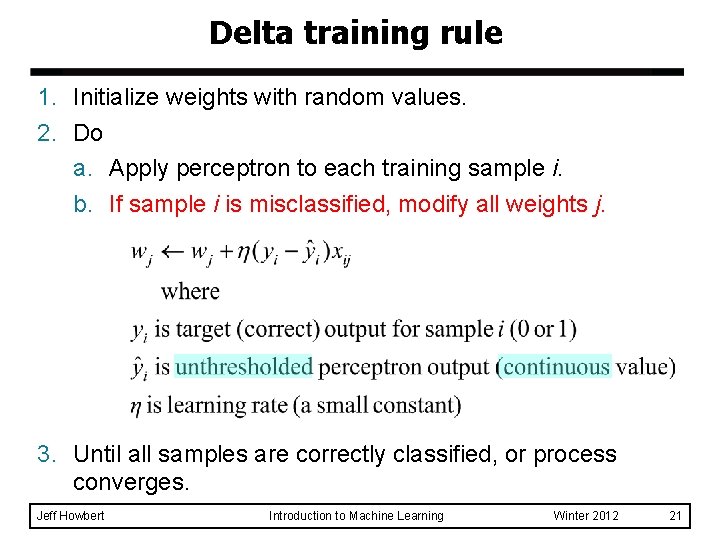
Delta training rule 1. Initialize weights with random values. 2. Do a. Apply perceptron to each training sample i. b. If sample i is misclassified, modify all weights j. 3. Until all samples are correctly classified, or process converges. Jeff Howbert Introduction to Machine Learning Winter 2012 21
Gradient descent: batch vs. incremental l Incremental mode (illustrated on preceding slides) – Compute error and weight updates for a single sample. – Apply updates to weights before processing next sample. l Batch mode – Compute errors and weight updates for a block of samples (maybe all samples). – Apply all updates simultaneously to weights. Jeff Howbert Introduction to Machine Learning Winter 2012 22
Perceptron training rule vs. delta rule l Perceptron training rule guaranteed to correctly classify all training samples if: – Samples are linearly separable. – Learning rate is sufficiently small. l Delta rule uses gradient descent. Guaranteed to converge to hypothesis with minimum squared error if: – Learning rate is sufficiently small. Even when: – Training data contains noise. – Training data not linearly separable. Jeff Howbert Introduction to Machine Learning Winter 2012 23
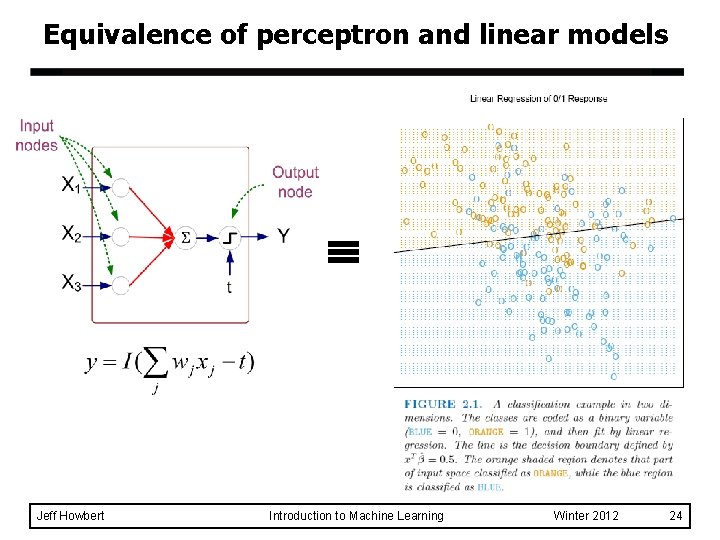
Equivalence of perceptron and linear models Jeff Howbert Introduction to Machine Learning Winter 2012 24
- Slides: 24