
Classification Nearest Neighbor Jeff Howbert Introduction to Machine
Classification Nearest Neighbor Jeff Howbert Introduction to Machine Learning Winter 2012 1
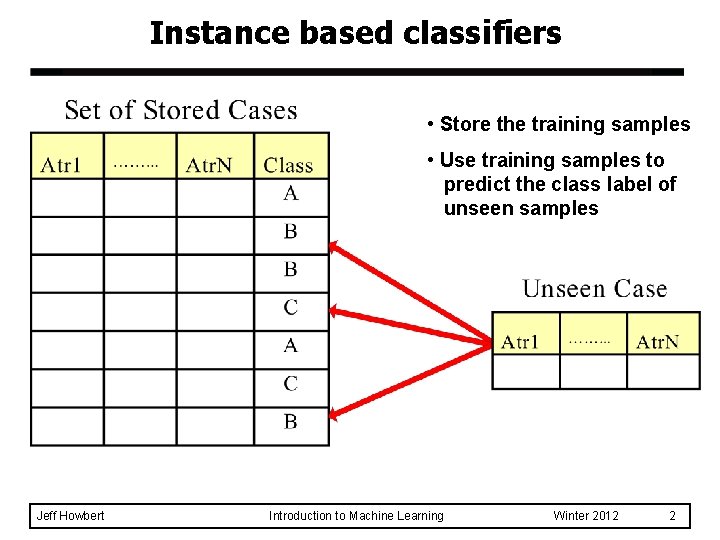
Instance based classifiers • Store the training samples • Use training samples to predict the class label of unseen samples Jeff Howbert Introduction to Machine Learning Winter 2012 2
Instance based classifiers l Examples: – Rote learner memorize entire training data u perform classification only if attributes of test sample match one of the training samples exactly u – Nearest neighbor use k “closest” samples (nearest neighbors) to perform classification u Jeff Howbert Introduction to Machine Learning Winter 2012 3
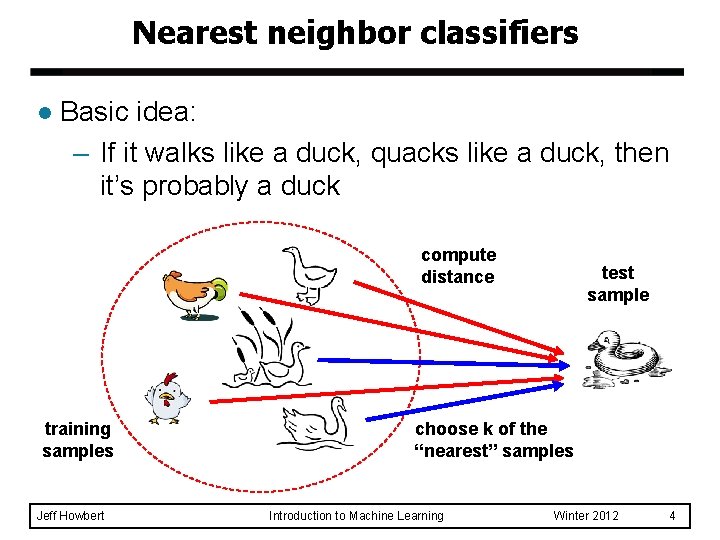
Nearest neighbor classifiers l Basic idea: – If it walks like a duck, quacks like a duck, then it’s probably a duck compute distance training samples Jeff Howbert test sample choose k of the “nearest” samples Introduction to Machine Learning Winter 2012 4
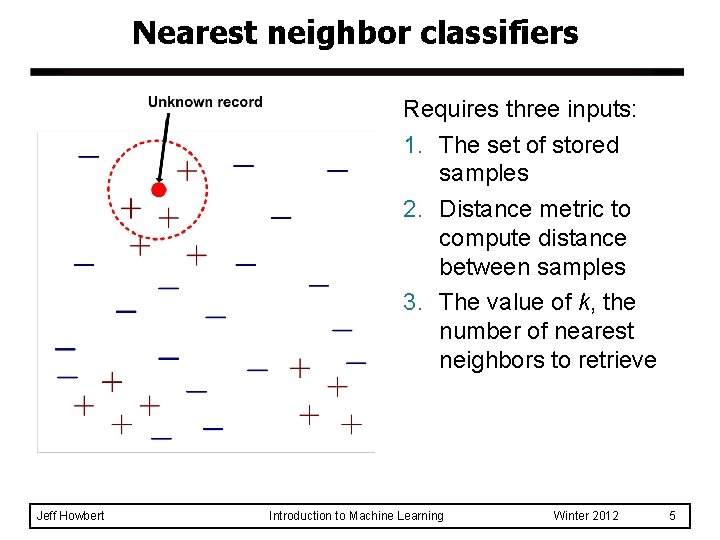
Nearest neighbor classifiers Requires three inputs: 1. The set of stored samples 2. Distance metric to compute distance between samples 3. The value of k, the number of nearest neighbors to retrieve Jeff Howbert Introduction to Machine Learning Winter 2012 5
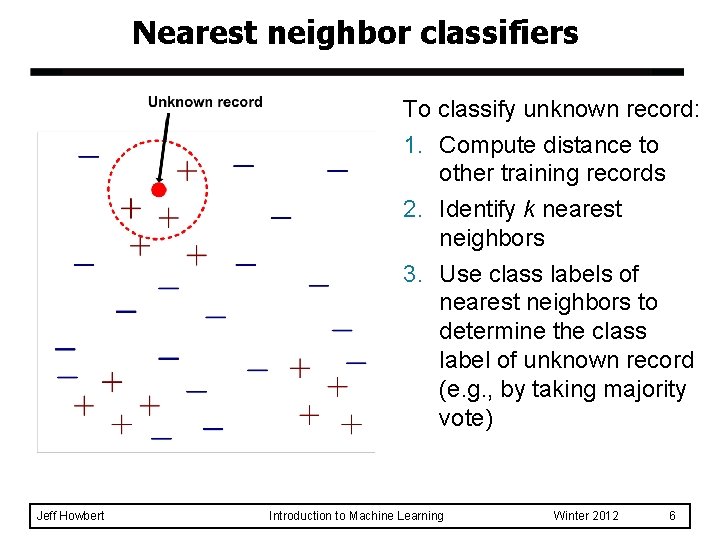
Nearest neighbor classifiers To classify unknown record: 1. Compute distance to other training records 2. Identify k nearest neighbors 3. Use class labels of nearest neighbors to determine the class label of unknown record (e. g. , by taking majority vote) Jeff Howbert Introduction to Machine Learning Winter 2012 6
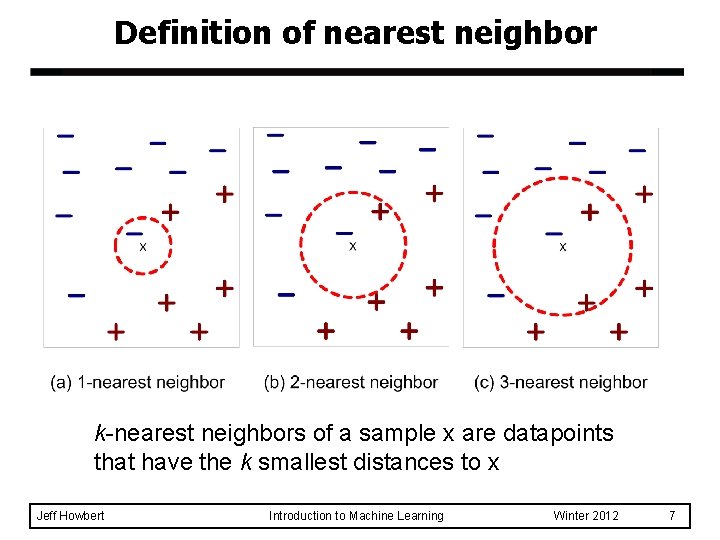
Definition of nearest neighbor k-nearest neighbors of a sample x are datapoints that have the k smallest distances to x Jeff Howbert Introduction to Machine Learning Winter 2012 7
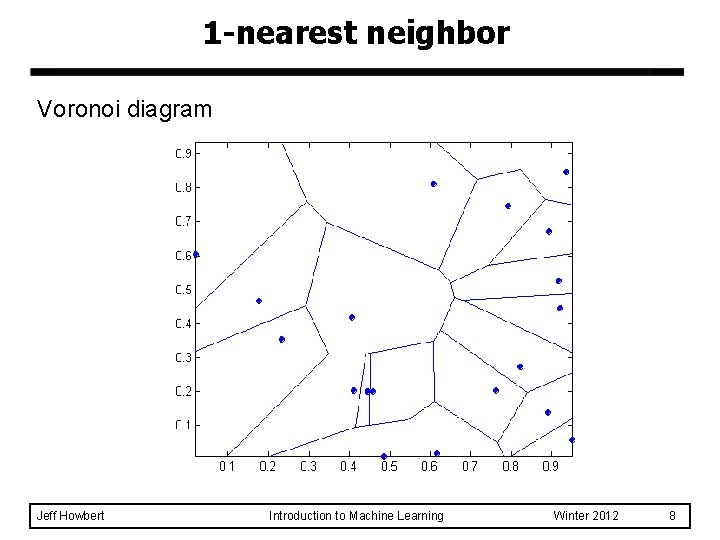
1 -nearest neighbor Voronoi diagram Jeff Howbert Introduction to Machine Learning Winter 2012 8
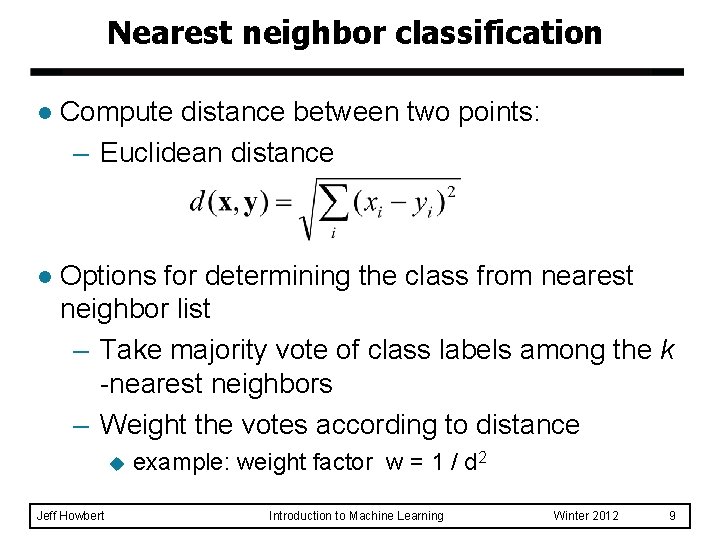
Nearest neighbor classification l Compute distance between two points: – Euclidean distance l Options for determining the class from nearest neighbor list – Take majority vote of class labels among the k -nearest neighbors – Weight the votes according to distance u Jeff Howbert example: weight factor w = 1 / d 2 Introduction to Machine Learning Winter 2012 9
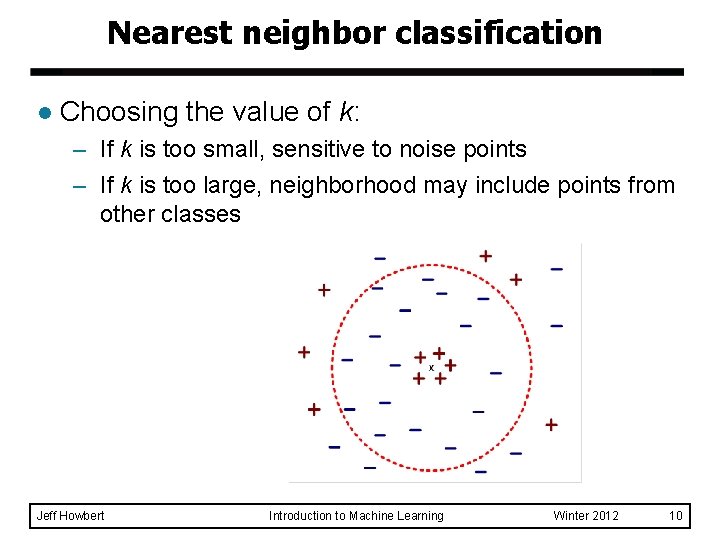
Nearest neighbor classification l Choosing the value of k: – If k is too small, sensitive to noise points – If k is too large, neighborhood may include points from other classes Jeff Howbert Introduction to Machine Learning Winter 2012 10
Nearest neighbor classification l Scaling issues – Attributes may have to be scaled to prevent distance measures from being dominated by one of the attributes – Example: height of a person may vary from 1. 5 m to 1. 8 m u weight of a person may vary from 90 lb to 300 lb u income of a person may vary from $10 K to $1 M u Jeff Howbert Introduction to Machine Learning Winter 2012 11
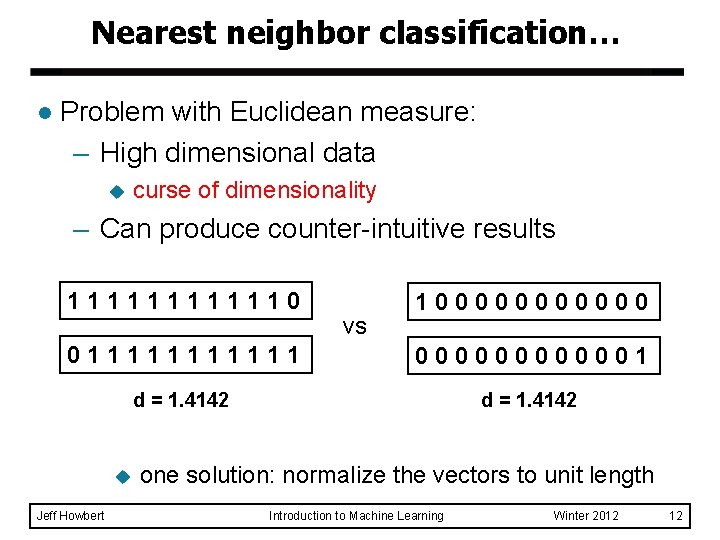
Nearest neighbor classification… l Problem with Euclidean measure: – High dimensional data u curse of dimensionality – Can produce counter-intuitive results 1111110 vs 1000000 0111111 0000001 d = 1. 4142 u Jeff Howbert one solution: normalize the vectors to unit length Introduction to Machine Learning Winter 2012 12
Nearest neighbor classification k-Nearest neighbor classifier is a lazy learner – Does not build model explicitly. – Unlike eager learners such as decision tree induction and rule-based systems. – Classifying unknown samples is relatively expensive. l k-Nearest neighbor classifier is a local model, vs. global model of linear classifiers. l Jeff Howbert Introduction to Machine Learning Winter 2012 13
Example: PEBLS l PEBLS: Parallel Examplar-Based Learning System (Cost & Salzberg) – Works with both continuous and nominal features u. For nominal features, distance between two nominal values is computed using modified value difference metric (MVDM) – Each sample is assigned a weight factor – Number of nearest neighbor, k = 1 Jeff Howbert Introduction to Machine Learning Winter 2012 14
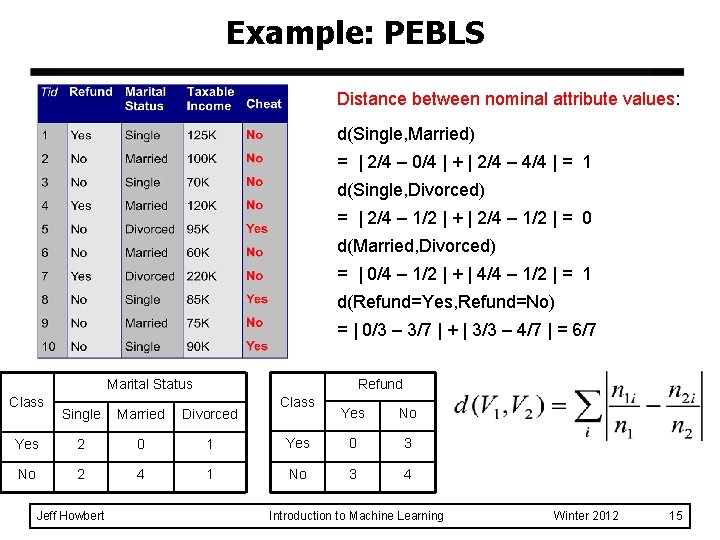
Example: PEBLS Distance between nominal attribute values: d(Single, Married) = | 2/4 – 0/4 | + | 2/4 – 4/4 | = 1 d(Single, Divorced) = | 2/4 – 1/2 | + | 2/4 – 1/2 | = 0 d(Married, Divorced) = | 0/4 – 1/2 | + | 4/4 – 1/2 | = 1 d(Refund=Yes, Refund=No) = | 0/3 – 3/7 | + | 3/3 – 4/7 | = 6/7 Marital Status Class Refund Single Married Divorced Yes 2 0 1 No 2 4 1 Jeff Howbert Class Yes No Yes 0 3 No 3 4 Introduction to Machine Learning Winter 2012 15
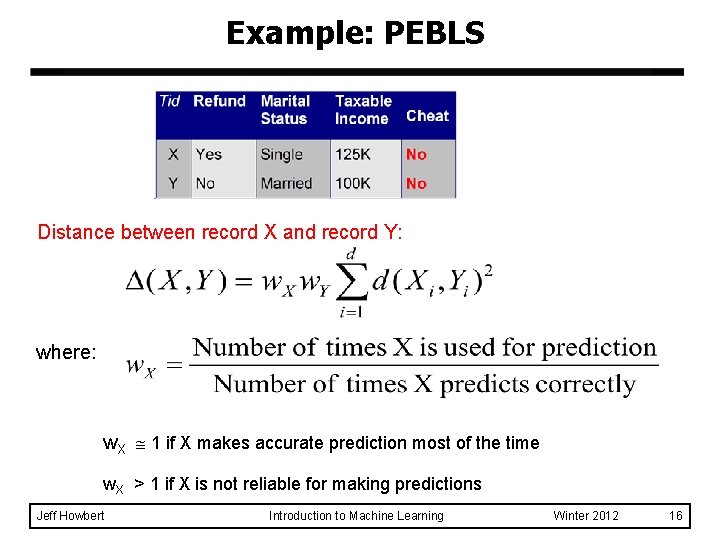
Example: PEBLS Distance between record X and record Y: where: w. X 1 if X makes accurate prediction most of the time w. X > 1 if X is not reliable for making predictions Jeff Howbert Introduction to Machine Learning Winter 2012 16
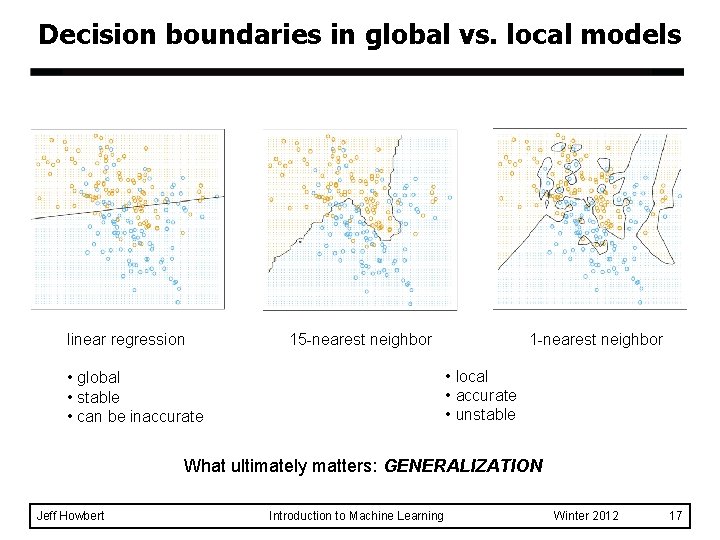
Decision boundaries in global vs. local models linear regression 15 -nearest neighbor 1 -nearest neighbor • local • accurate • unstable • global • stable • can be inaccurate What ultimately matters: GENERALIZATION Jeff Howbert Introduction to Machine Learning Winter 2012 17
- Slides: 17