
Classification How do we classify Make observations Choose
Classification
How do we classify? Make observations Choose defining characteristics Group by those characteristics Divide groups into subgroups by characteristics • Continue dividing until each is in its own group • •

Why do we classify? • Large numbers of objects get very confusing unless they are sorted (prevent confusion) • By grouping similar things we can predict patterns (patterns help us make predictions) • We can put definite limits on the area of study • It helps us discover and point out relationships between objects
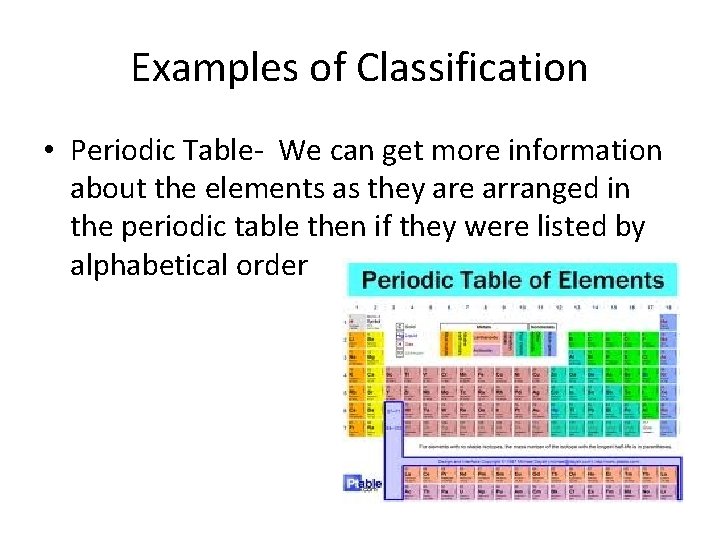
Examples of Classification • Periodic Table- We can get more information about the elements as they are arranged in the periodic table then if they were listed by alphabetical order
Classification of Organisms • Classification is the arrangement of organisms into orderly groups based on their similarities • Classification is also known as taxonomy • Taxonomists are scientists that identify & name organisms
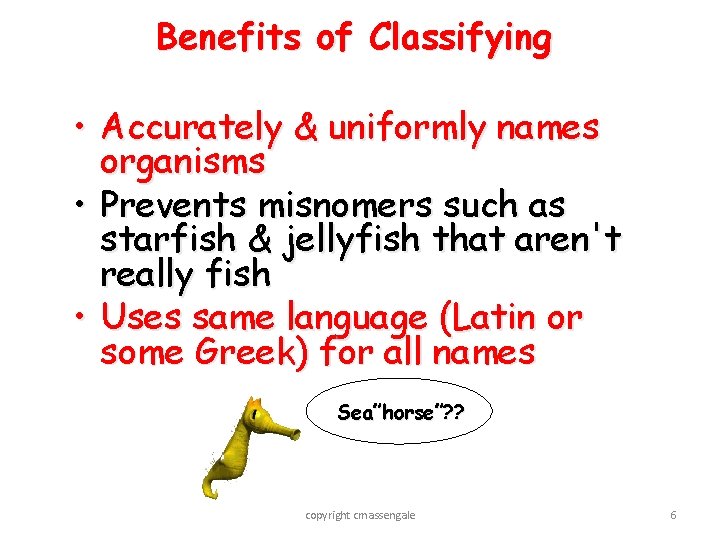
Benefits of Classifying • Accurately & uniformly names organisms • Prevents misnomers such as starfish & jellyfish that aren't really fish • Uses same language (Latin or some Greek) for all names Sea”horse”? ? copyright cmassengale 6
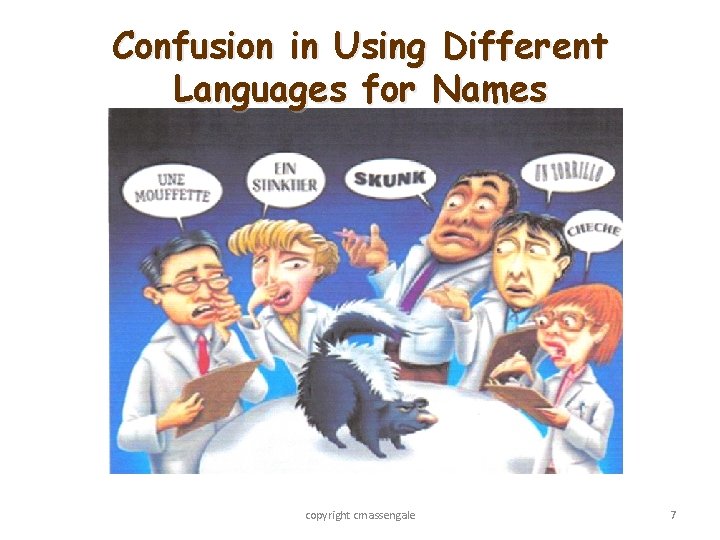
Confusion in Using Different Languages for Names copyright cmassengale 7
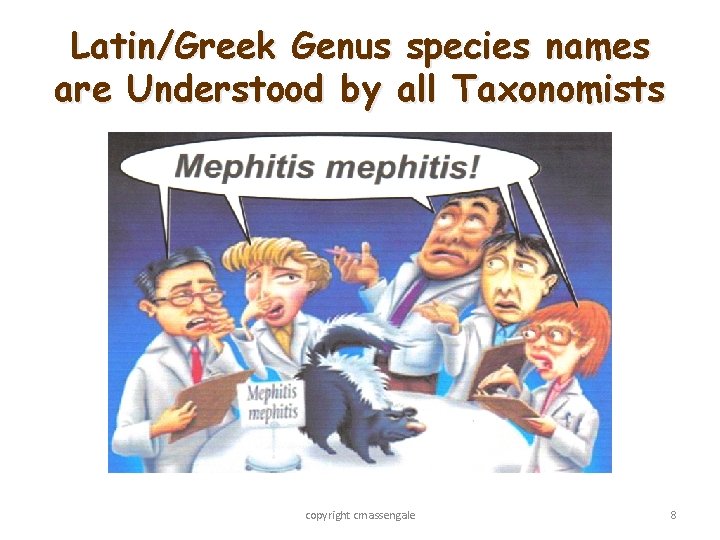
Latin/Greek Genus species names are Understood by all Taxonomists copyright cmassengale 8
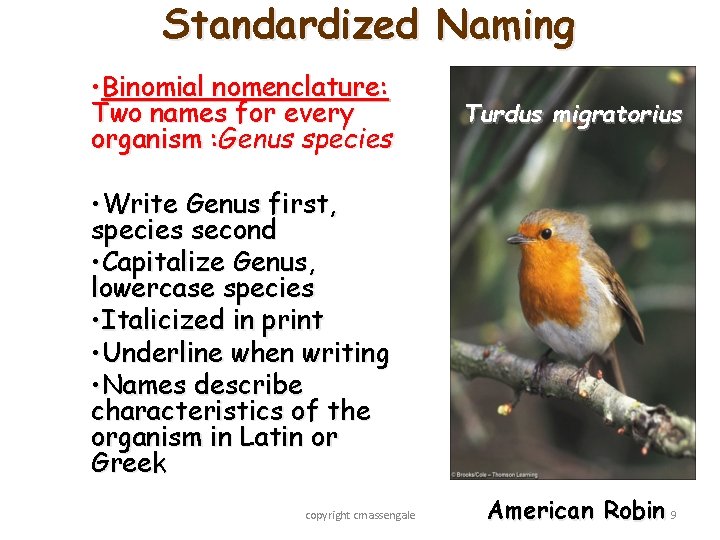
Standardized Naming • Binomial nomenclature: Two names for every organism : Genus species Turdus migratorius • Write Genus first, species second • Capitalize Genus, lowercase species • Italicized in print • Underline when writing • Names describe characteristics of the organism in Latin or Greek copyright cmassengale American Robin 9
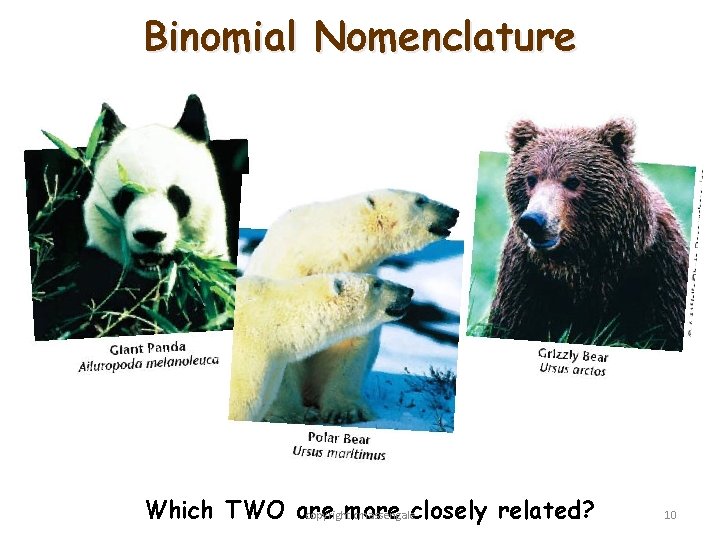
Binomial Nomenclature Which TWO are more copyright cmassengaleclosely related? 10

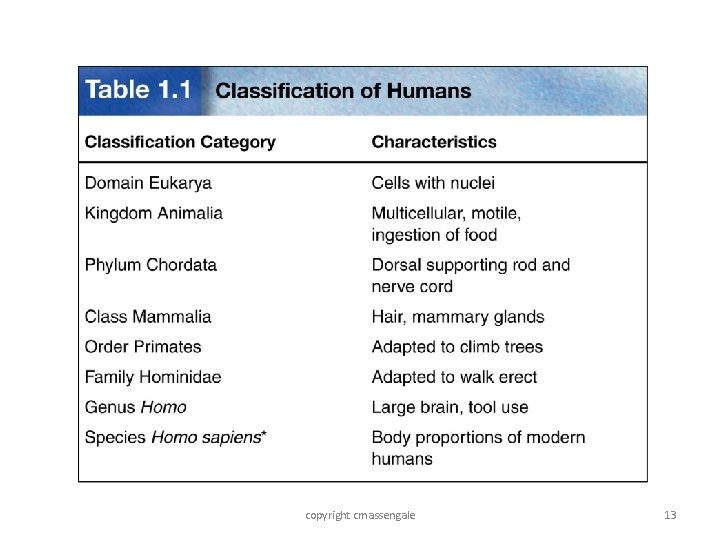
Classification Groups • Taxon ( taxa-plural) is a category into which related organisms are placed • There is a hierarchy of groups (taxa) from broadest to most specific • Kingdom, Phylum, Class, Order, Family, Genus, species • copyright cmassengale 11
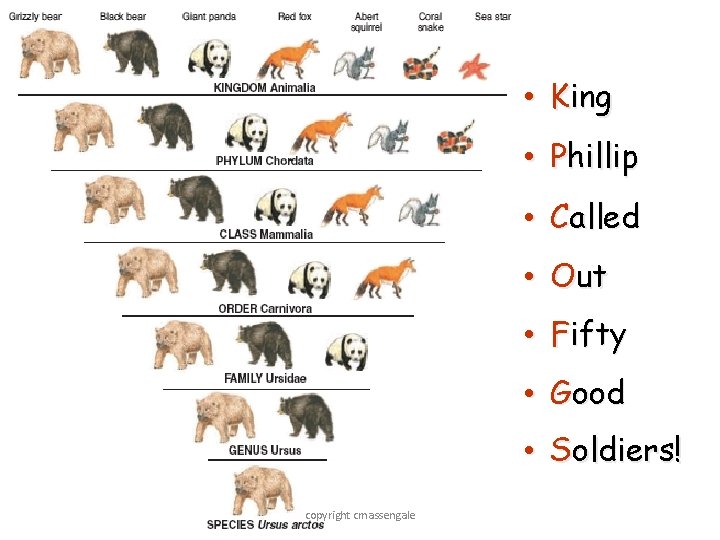
• King • Phillip • Called • Out • Fifty • Good • Soldiers! copyright cmassengale 12
copyright cmassengale 13
Taxons • Most genera contain a number of similar species • The genus Homo is an exception (its only living members are modern humans) • Classification is based on evolutionary relationships copyright cmassengale 14
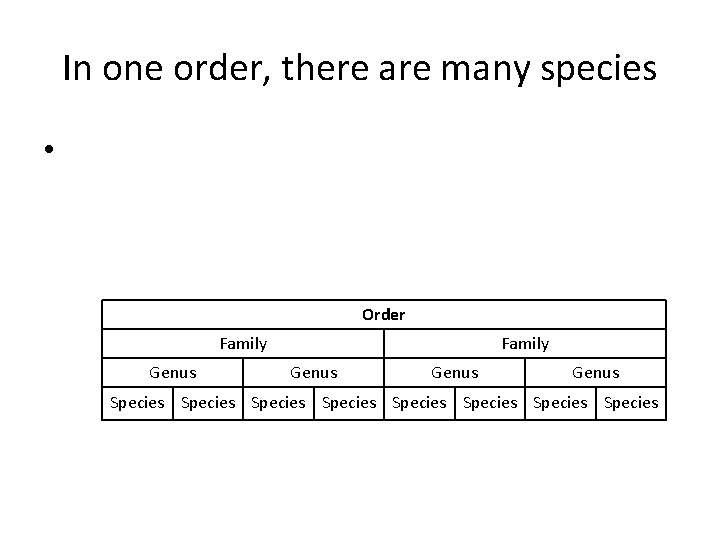
In one order, there are many species • Order Family Genus Species Species
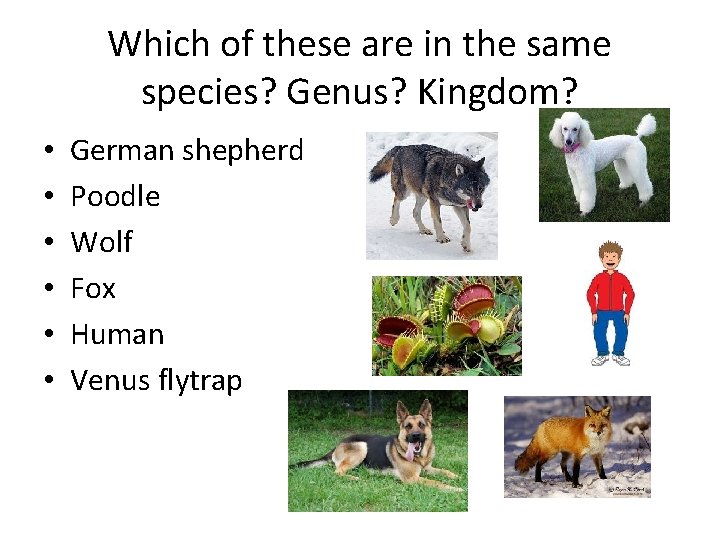
Which of these are in the same species? Genus? Kingdom? • • • German shepherd Poodle Wolf Fox Human Venus flytrap
Dichotomous Keying • Used to identify organisms • Characteristics given in pairs • Read both characteristics and either go to another set of characteristics OR identify the organism copyright cmassengale 17
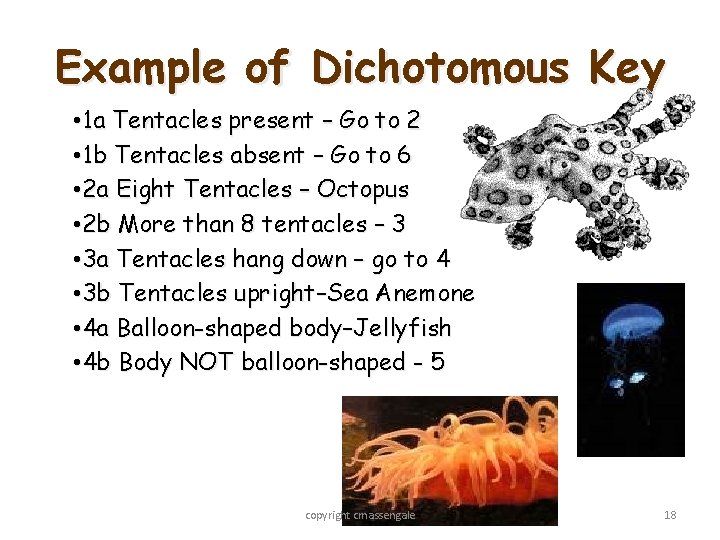
Example of Dichotomous Key • 1 a Tentacles present – Go to 2 • 1 b Tentacles absent – Go to 6 • 2 a Eight Tentacles – Octopus • 2 b More than 8 tentacles – 3 • 3 a Tentacles hang down – go to 4 • 3 b Tentacles upright–Sea Anemone • 4 a Balloon-shaped body–Jellyfish • 4 b Body NOT balloon-shaped - 5 copyright cmassengale 18
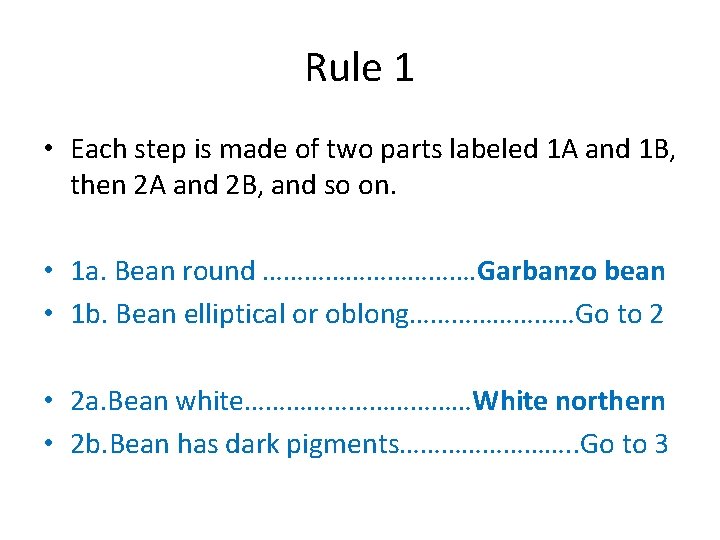
Rule 1 • Each step is made of two parts labeled 1 A and 1 B, then 2 A and 2 B, and so on. • 1 a. Bean round ……………. Garbanzo bean • 1 b. Bean elliptical or oblong…………Go to 2 • 2 a. Bean white………………White northern • 2 b. Bean has dark pigments…………. . Go to 3
Rule 2 • When you start a key, your first step is to try and break the objects into two groups about the same size
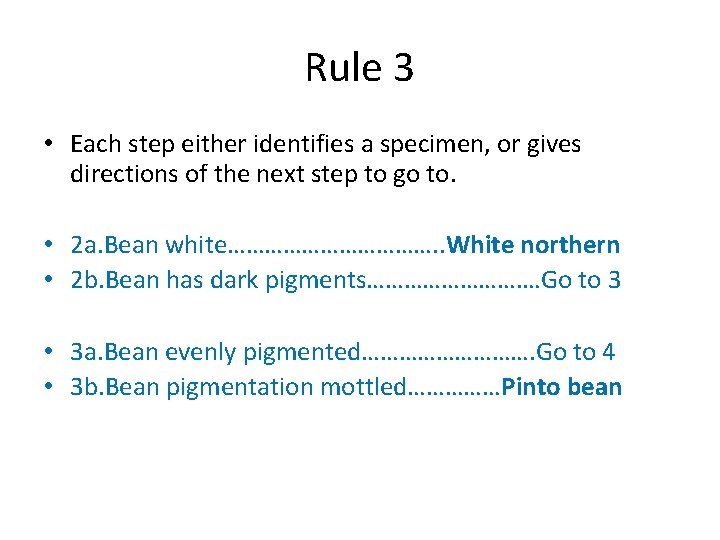
Rule 3 • Each step either identifies a specimen, or gives directions of the next step to go to. • 2 a. Bean white………………. . White northern • 2 b. Bean has dark pigments…………. …Go to 3 • 3 a. Bean evenly pigmented……………. Go to 4 • 3 b. Bean pigmentation mottled……………Pinto bean
Rule 4 • At each step you choose one of the choices, not both.
Rule 5 • When you are writing a set of choices, it is better to use a present/absent choice because it is more inclusive. • Use characteristics that are definite.

The end!
- Slides: 26