
Classification Finding Order in Diversity Why Classify Organisms
- Slides: 34
Classification
Finding Order in Diversity • Why Classify Organisms? ? – Biologists use classification systems to name organisms and group them in a logical order • Taxonomy: Scientists classify organisms and assign each organism a universally accepted name
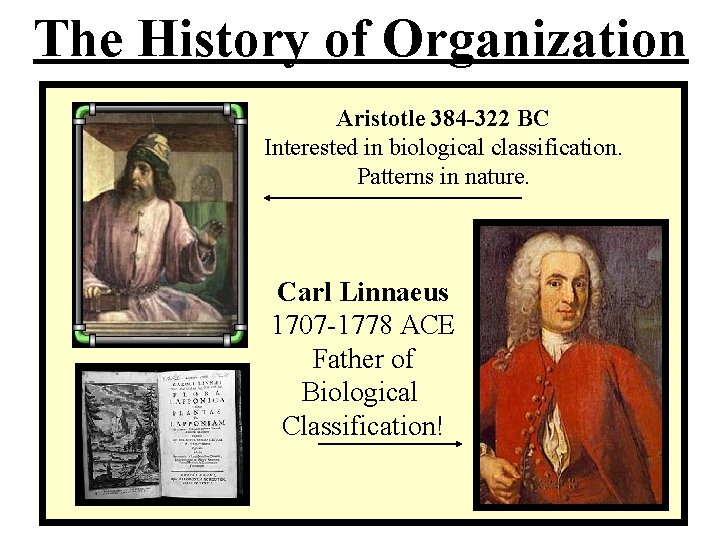
The History of Organization Aristotle 384 -322 BC Interested in biological classification. Patterns in nature. Carl Linnaeus 1707 -1778 ACE Father of Biological Classification!
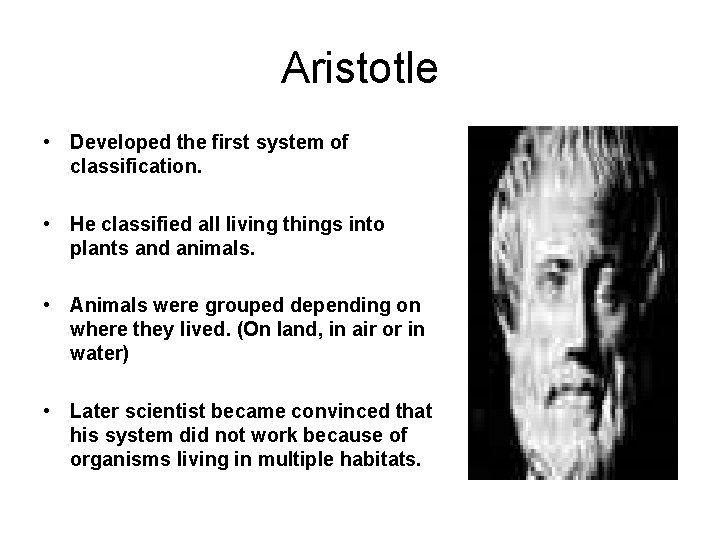
Aristotle • Developed the first system of classification. • He classified all living things into plants and animals. • Animals were grouped depending on where they lived. (On land, in air or in water) • Later scientist became convinced that his system did not work because of organisms living in multiple habitats.
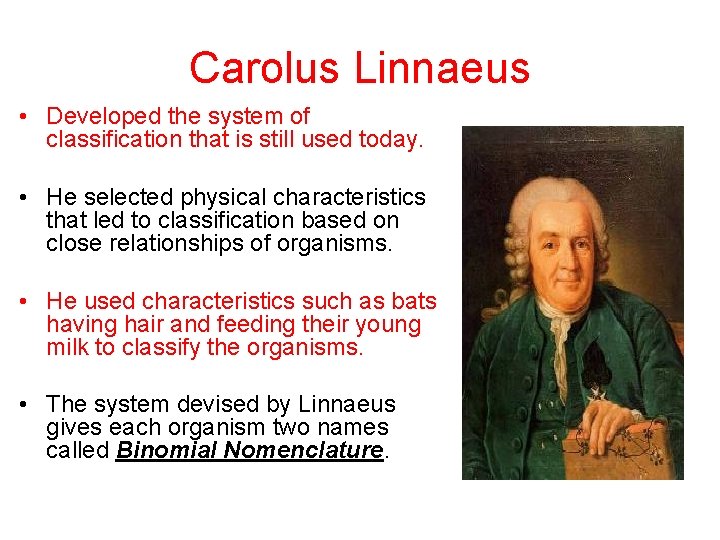
Carolus Linnaeus • Developed the system of classification that is still used today. • He selected physical characteristics that led to classification based on close relationships of organisms. • He used characteristics such as bats having hair and feeding their young milk to classify the organisms. • The system devised by Linnaeus gives each organism two names called Binomial Nomenclature.
Assigning Scientific Names • For many species, there are often regional differences in their common names – EX: Buzzard in the UK refers to a hawk, Buzzard in the US refers to a vulture • To eliminate such confusion, scientists agreed to use a single name for each species
Assigning Scientific Names • Binomial Nomenclature: Scientists assign each kind of organism a universally accepted name in the system – Two word system using the Genus and Species – Words are always written in italics – First word (Genus) is capitalized and second word (Species) is lowercase – Second word is a Latinized description of a particular trait – Developed by an 18 th C. Swedish botanist named Carolus Linnaeus • EX: Grizzly Bear = Ursus arctos
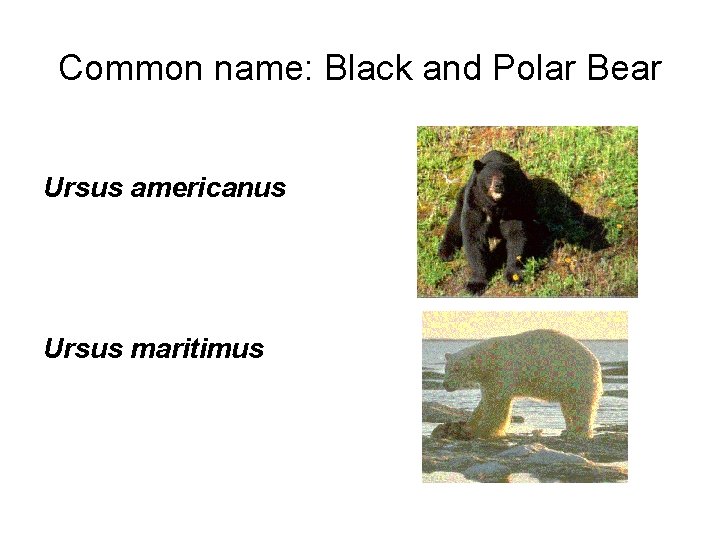
Assigning Scientific Names • Differences in Binomial Nomenclature: – 1 st part of scientific name is genus to which the organism belongs – A genus is composed of a number of closely related species – 2 nd part of scientific name is unique to the species within the genus • EX: Ursus arctos= Grizzly Bear, Ursus maritimus= Polar Bear • EX: Papio annubis and Papio cynocephalus do NOT belong to the same species since the species part of the name is different. However, they do belong to the same genus
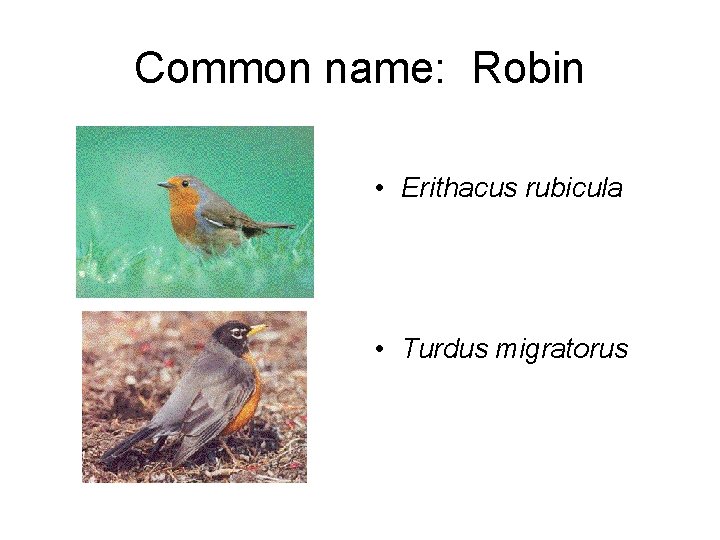
Common name: Robin • Erithacus rubicula • Turdus migratorus
Common name: Black and Polar Bear Ursus americanus Ursus maritimus
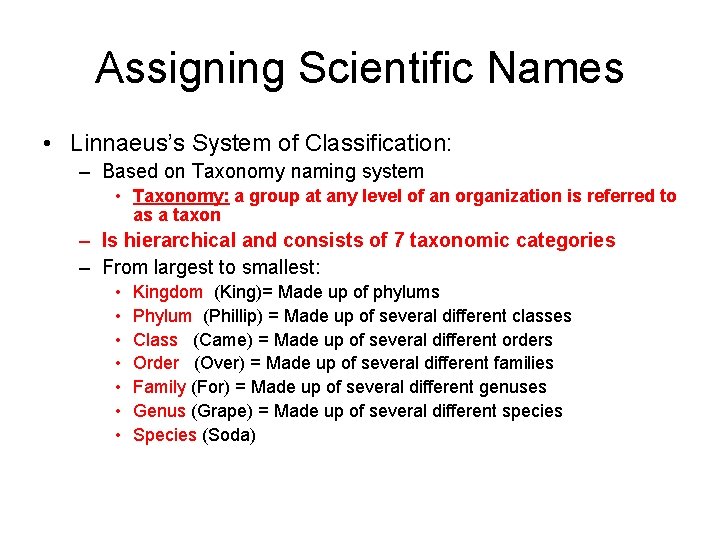
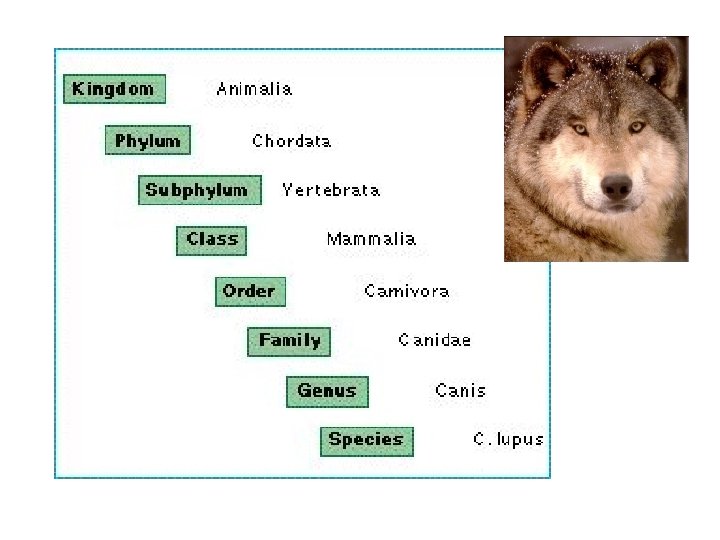
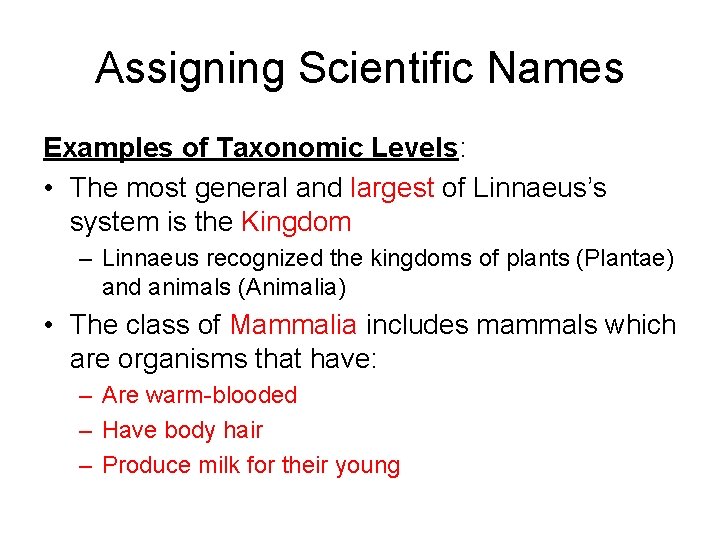
Assigning Scientific Names • Linnaeus’s System of Classification: – Based on Taxonomy naming system • Taxonomy: a group at any level of an organization is referred to as a taxon – Is hierarchical and consists of 7 taxonomic categories – From largest to smallest: • • Kingdom (King)= Made up of phylums Phylum (Phillip) = Made up of several different classes Class (Came) = Made up of several different orders Order (Over) = Made up of several different families Family (For) = Made up of several different genuses Genus (Grape) = Made up of several different species Species (Soda)
Assigning Scientific Names Examples of Taxonomic Levels: • The most general and largest of Linnaeus’s system is the Kingdom – Linnaeus recognized the kingdoms of plants (Plantae) and animals (Animalia) • The class of Mammalia includes mammals which are organisms that have: – Are warm-blooded – Have body hair – Produce milk for their young
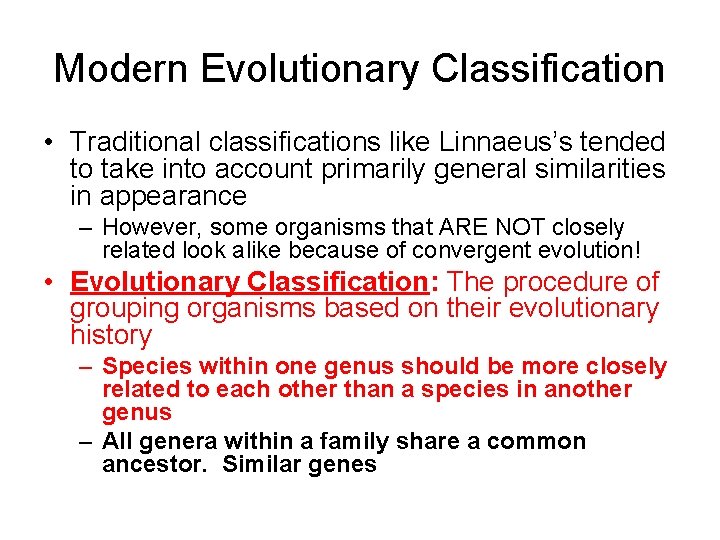
Modern Evolutionary Classification • Traditional classifications like Linnaeus’s tended to take into account primarily general similarities in appearance – However, some organisms that ARE NOT closely related look alike because of convergent evolution! • Evolutionary Classification: The procedure of grouping organisms based on their evolutionary history – Species within one genus should be more closely related to each other than a species in another genus – All genera within a family share a common ancestor. Similar genes
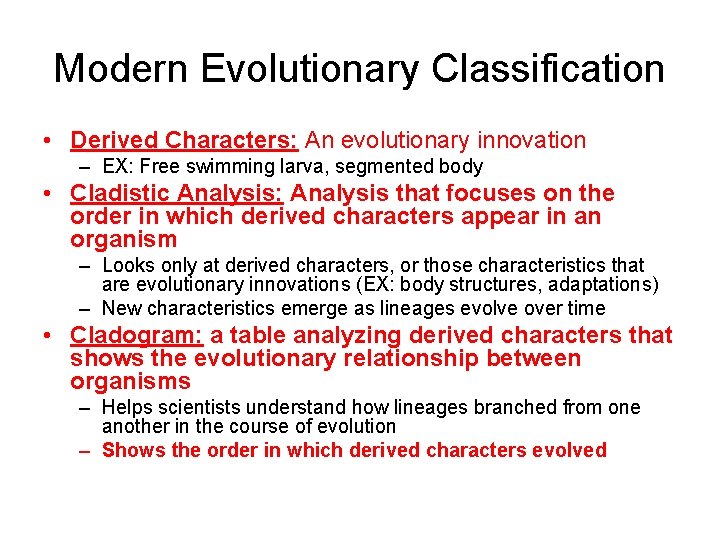
Modern Evolutionary Classification • Derived Characters: An evolutionary innovation – EX: Free swimming larva, segmented body • Cladistic Analysis: Analysis that focuses on the order in which derived characters appear in an organism – Looks only at derived characters, or those characteristics that are evolutionary innovations (EX: body structures, adaptations) – New characteristics emerge as lineages evolve over time • Cladogram: a table analyzing derived characters that shows the evolutionary relationship between organisms – Helps scientists understand how lineages branched from one another in the course of evolution – Shows the order in which derived characters evolved
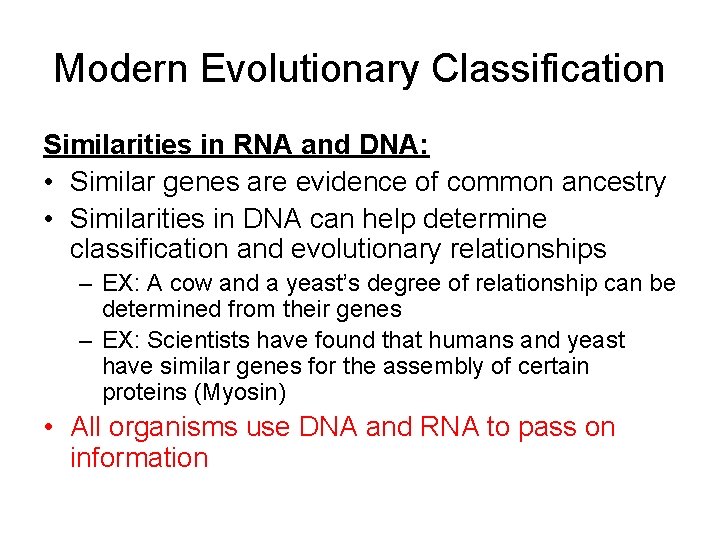
Modern Evolutionary Classification Similarities in RNA and DNA: • Similar genes are evidence of common ancestry • Similarities in DNA can help determine classification and evolutionary relationships – EX: A cow and a yeast’s degree of relationship can be determined from their genes – EX: Scientists have found that humans and yeast have similar genes for the assembly of certain proteins (Myosin) • All organisms use DNA and RNA to pass on information
Modern Evolutionary Classification Similarities in RNA and DNA Cont…: • DNA evidence can help show the evolutionary relationship between organisms and how species have changed – EX: Presence of similar genes in very dissimilar organisms implies that the organisms share a common ancestor like vultures and storks!
Kingdoms and Domains In the 1800’s scientists used a 3 kingdom classification system: – Animals, Plants, Protista – Scientists grouped organisms according to how long they have been evolving independently • Biologists knowledge of diversity of life continued to grow • We now know there are 6 Kingdoms: – Archaebacteria (used to be grouped as the Monera category) – Eubacteria (used to be grouped as the Monera category) – Protista (used to be grouped with Plants) – Fungi – Plantae – Animalia
Kingdoms and Domains The Three Domain System: • Modern analysis of evolutionary trees have given rise to a new taxonomic category– Domain • A domain is more inclusive and larger than a kingdom • There are 3 Domains: – Eukarya: includes kingdoms protist, fungi, plants, & animals – Archaea: includes kingdom Archaebacteria – Bacteria: Includes kingdom Eubacteria • The 3 domains are thought to have diverged from a common ancestor before the evolution of the main groups of eukaryotes • Recognizes fundamental differences between 2 groups of prokaryotes- Bacteria & Archaea
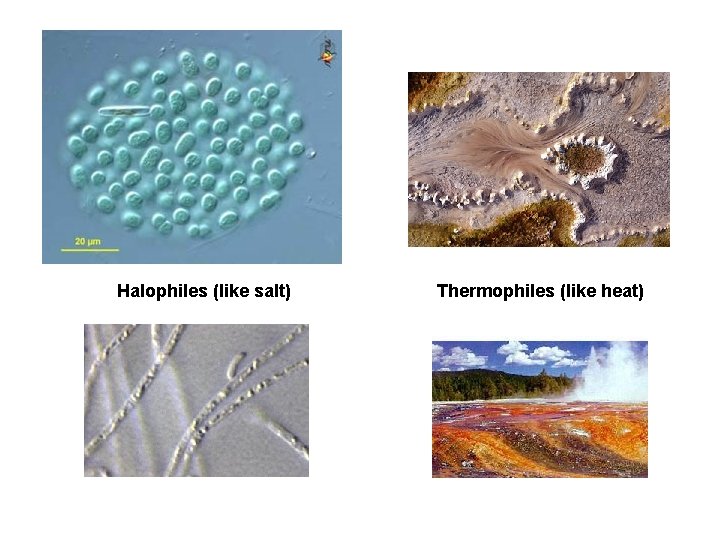
Kingdoms and Domains • Domain Archaea: – Kingdom Archaebacteria – Unicellular – Found in extreme environments– deep sea bacteria, make their own food (autotroph) using energy derived from minerals coming form; without oxygen. Also heterotrophs – Cell wall do not contain unusual lipids (peptidoglycan)
Halophiles (like salt) Thermophiles (like heat)
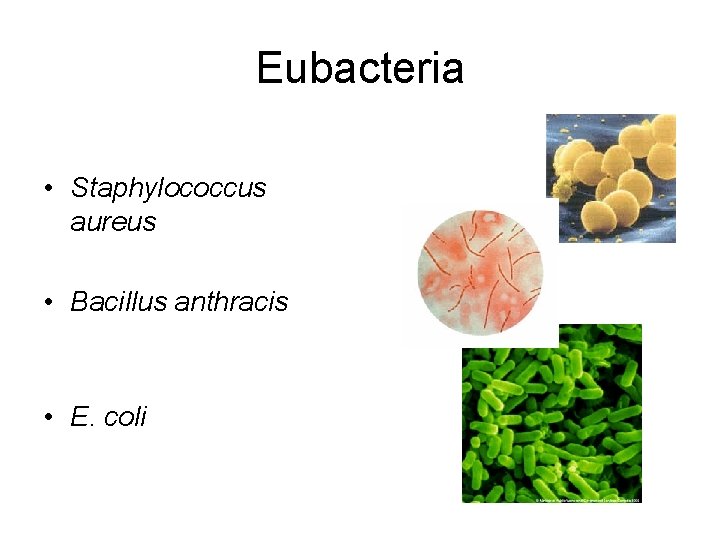
• Kingdoms and Domains • Domain Bacteria: • Kingdom Eubacteria • Unicellular • Heterotroph or autotroph • Cell walls are thick & rigid & contain lipid (peptidoglycan) • Come in 3 basic shapes --- cocci (spheres), bacilli (rod shaped), spirilla (corkscrew shape) Some need oxygen to survive & others do not
Eubacteria • Staphylococcus aureus • Bacillus anthracis • E. coli
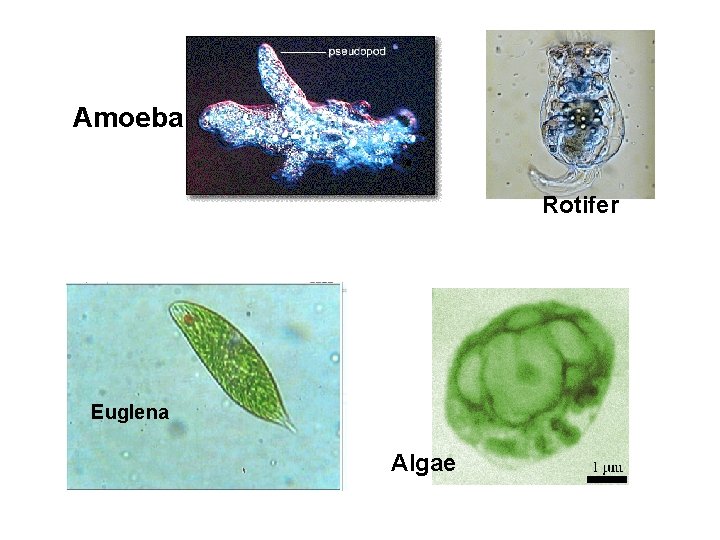
Kingdoms and Domains • Domain Eukarya: – Consists of all eukaryotes (cells with a nucleus) – Consists of the 4 kingdoms: • Protista: – organisms that cannot be classified as plants, animals, or fungi – Usually unicellular but some multicellular – Have chloroplasts (autotroph) or Heterotroph – Membrane-bound organelles – Cell wall of cellulose – Move by flagellum, cillia, or pseudopods – EX: Algae
Amoeba Rotifer Euglena Algae
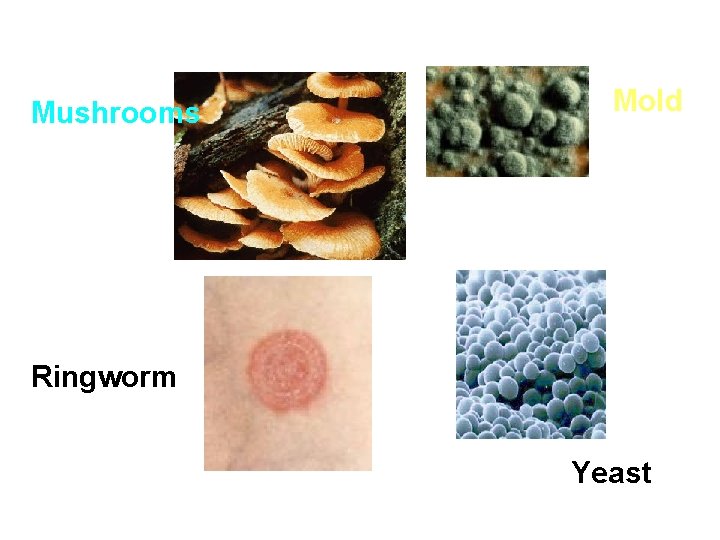
Kingdoms and Domains • Kingdom Fungi: – Heterotrophs that feed on dead or decaying matter. Do not contain chlorophyll – decomposers & recyclers – Can be single or multicelled – Cell walls contain chitin – Non-motile – Lack true roots, stems, & leaves – EX: Mushrooms & yeast
Mushrooms Mold Ringworm Yeast
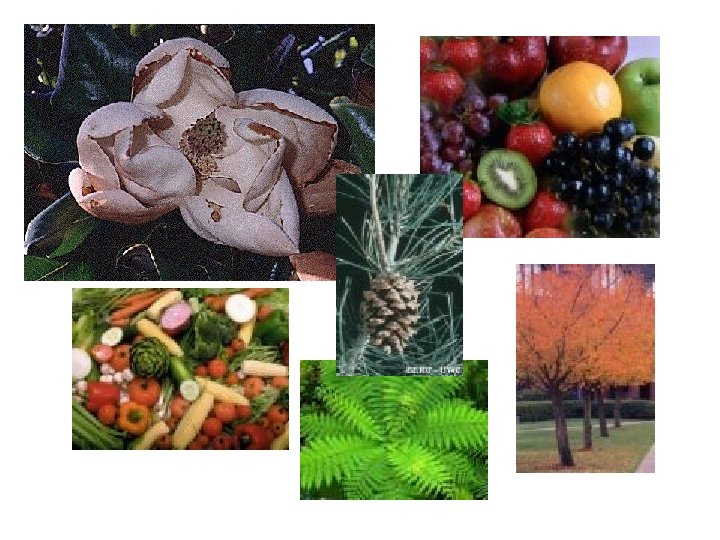
Kingdoms and Domains • • Kingdom Plantae: Photosynthetic autotrophs Multicellular Contain chlorophyll inside of chloroplasts Undergo photosynthesis Cell walls contain cellulose All plants that reproduce sexually EX: mosses, ferns, flowering plants, conebearing plants, etc…
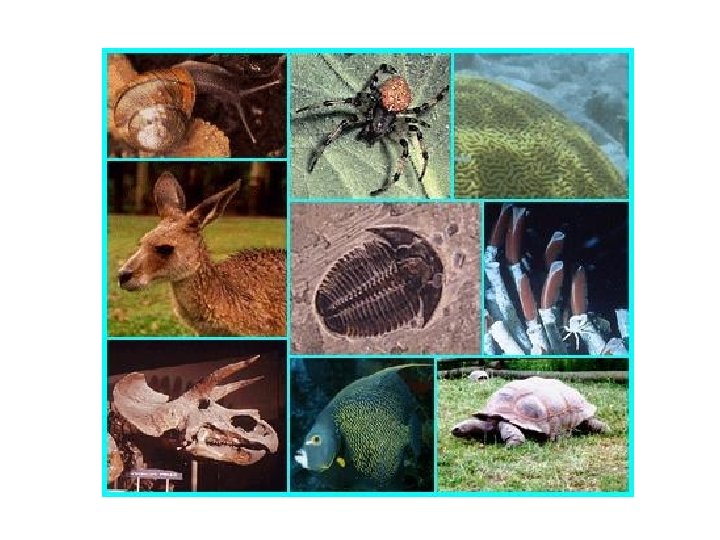
Kingdoms and Domains • Animalia: – Multicellular & heterotrophic – Cells contain a nucleus and membrane bound organelles – Show levels of organization including cell, tissue, organ, & system – Cells are specialized for particular functions – No cell walls or chloroplast – Can move about – EX: animals
What are Dichotomous Keys? • a method for determining the identity of something (like the name of a butterfly, a plant, a lichen, or a rock) by going through a series of choices that leads the user to the correct name of the item. • Dichotomous means "divided in two parts".
Using a dichotomous key At each step of the process of using the key, the user is given two choices; each alternative leads to another question until the item is identified. 1 a. If the leaves are flat…. go to question 4. 1 b. If the leaves are needle-like…. go to question 2. 2 a. Are the needles in a bunch? Go to question 5 2 b. Are they spread along the branch? “…pine tree Eventually, when enough questions have been answered, the identity of the tree is revealed.
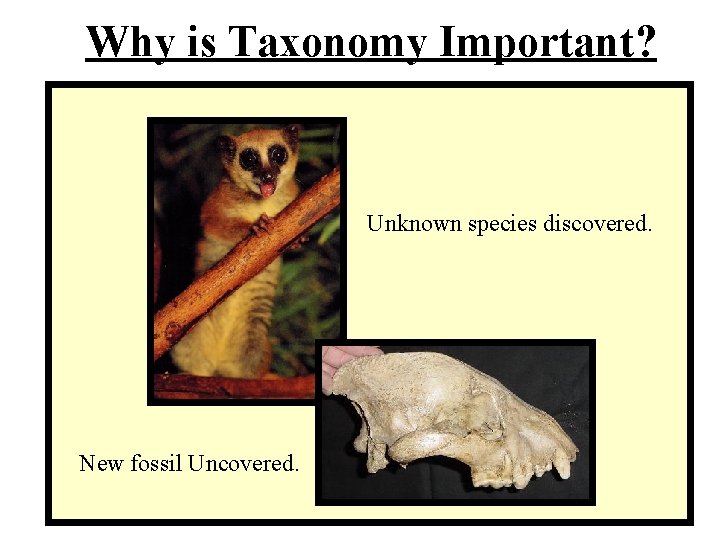
Why is Taxonomy Important? New Discoveries Unknown species discovered. Questions New fossil Uncovered. How can you answer these questions?