
Classification Finding Order in Diversity How living things
- Slides: 21
Classification • : Finding Order in Diversity • How living things are organized • Binominal Nomenclature • Linnaeus’s System of Classification • : Modern Evolutionary Classification • Evolutionary relationships • Cladistics • Comparing dissimilar organisms • : Kingdoms and Domains • 6 kingdoms of Life • 3 Domain system of classification
Finding Order In Diversity • What is a species? – A population of organisms that share similar characteristics and can interbreed freely • Biologists have identified 1. 5 million species, and they estimate 2 -100 million species have yet to be identified • Order out of chaos? • Classification – A system to name and group organisms in a logical order, used to study diversity of life • Taxonomy – Classifying organisms and giving them a universally accepted name
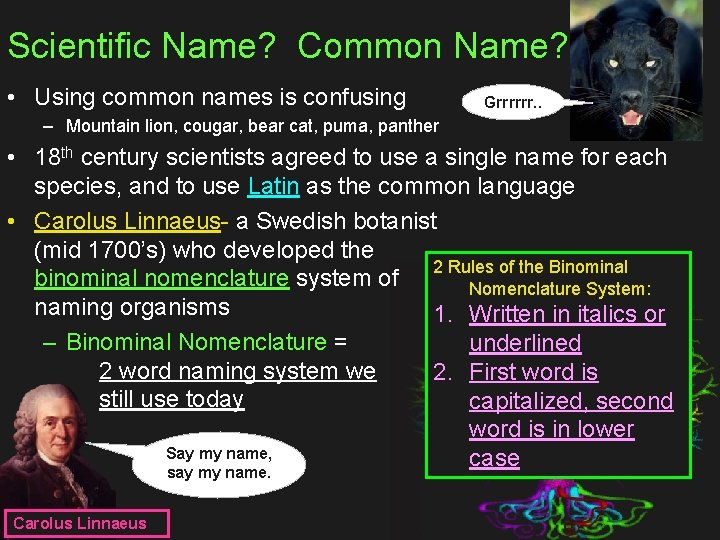
Scientific Name? Common Name? • Using common names is confusing Grrrrrr. . – Mountain lion, cougar, bear cat, puma, panther • 18 th century scientists agreed to use a single name for each species, and to use Latin as the common language • Carolus Linnaeus- a Swedish botanist (mid 1700’s) who developed the 2 Rules of the Binominal binominal nomenclature system of Nomenclature System: naming organisms 1. Written in italics or – Binominal Nomenclature = underlined 2 word naming system we 2. First word is still use today capitalized, second word is in lower Say my name, case say my name. Carolus Linnaeus
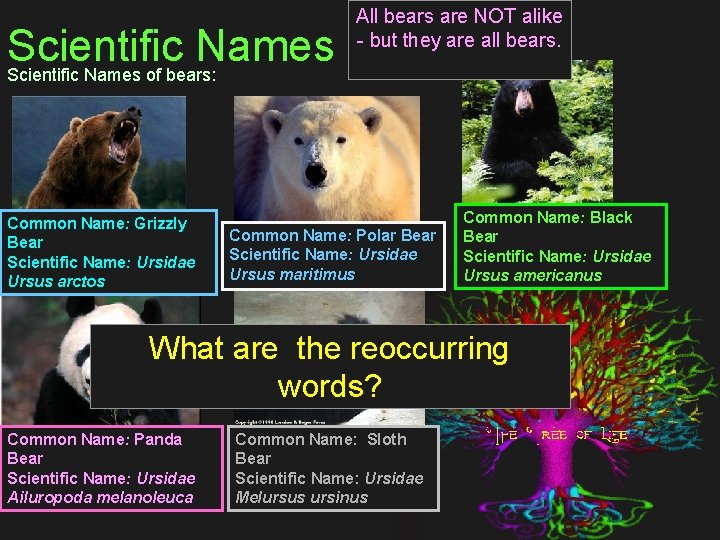
Scientific Names of bears: Common Name: Grizzly Bear Scientific Name: Ursidae Ursus arctos All bears are NOT alike - but they are all bears. Common Name: Polar Bear Scientific Name: Ursidae Ursus maritimus Common Name: Black Bear Scientific Name: Ursidae Ursus americanus What are the reoccurring words? Common Name: Panda Bear Scientific Name: Ursidae Ailuropoda melanoleuca Common Name: Sloth Bear Scientific Name: Ursidae Melursus ursinus
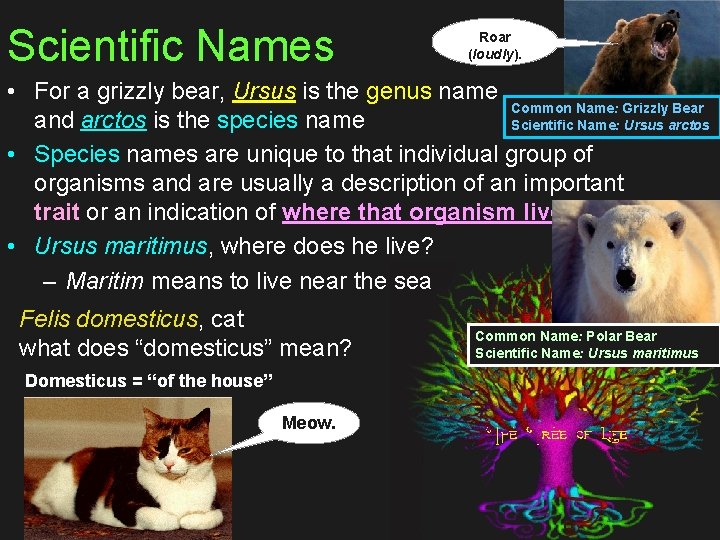
Scientific Names Roar (loudly). • For a grizzly bear, Ursus is the genus name Common Name: Grizzly Bear and arctos is the species name Scientific Name: Ursus arctos • Species names are unique to that individual group of organisms and are usually a description of an important trait or an indication of where that organism lives • Ursus maritimus, where does he live? – Maritim means to live near the sea Felis domesticus, cat what does “domesticus” mean? Domesticus = “of the house” Meow. Common Name: Polar Bear Scientific Name: Ursus maritimus
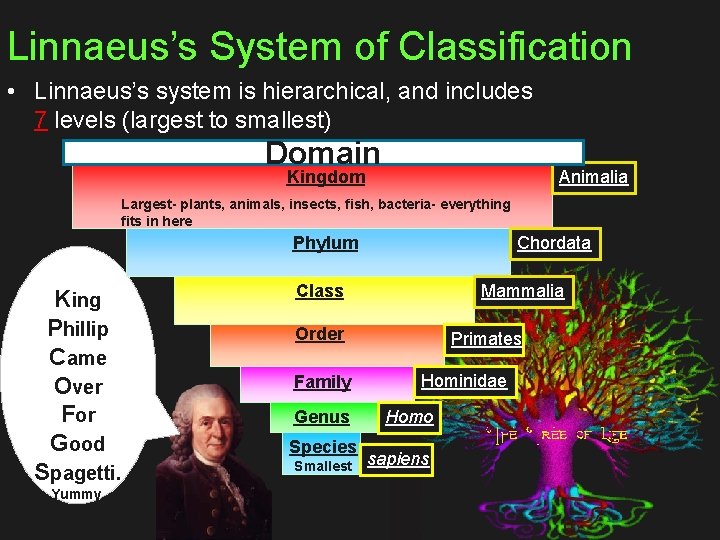
Linnaeus’s System of Classification • Linnaeus’s system is hierarchical, and includes 7 levels (largest to smallest) Domain Example: Humans Kingdom Animalia Largest- plants, animals, insects, fish, bacteria- everything fits in here Phylum King Phillip Came Over For Good Spagetti. Yummy. Chordata Class Mammalia Order Family Genus Species Smallest Primates Hominidae Homo sapiens
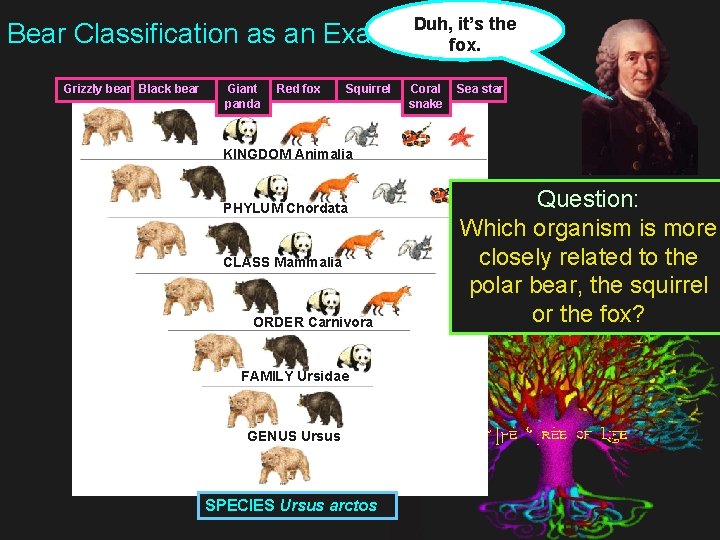
Duh, it’s the Bear Classification as an Example fox. Grizzly bear Black bear Giant panda Red fox Squirrel Coral snake Sea star KINGDOM Animalia PHYLUM Chordata CLASS Mammalia ORDER Carnivora FAMILY Ursidae GENUS Ursus SPECIES Ursus arctos Question: Which organism is more closely related to the polar bear, the squirrel or the fox?
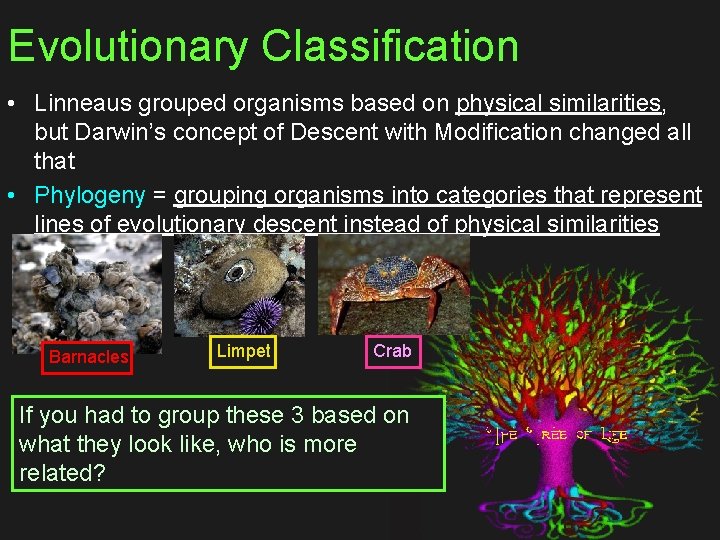
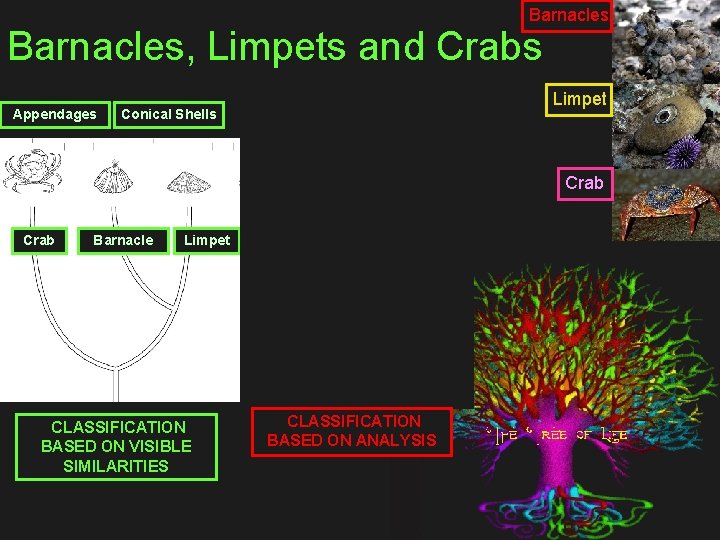
Evolutionary Classification • Linneaus grouped organisms based on physical similarities, but Darwin’s concept of Descent with Modification changed all that • Phylogeny = grouping organisms into categories that represent lines of evolutionary descent instead of physical similarities Barnacles Limpet Crab If you had to group these 3 based on what they look like, who is more related?
Barnacles, Limpets and Crabs Appendages Limpet Conical Shells Crab Barnacle Limpet CLASSIFICATION BASED ON VISIBLE SIMILARITIES Crab Barnacle Limpet CLASSIFICATION BASED ON ANALYSIS
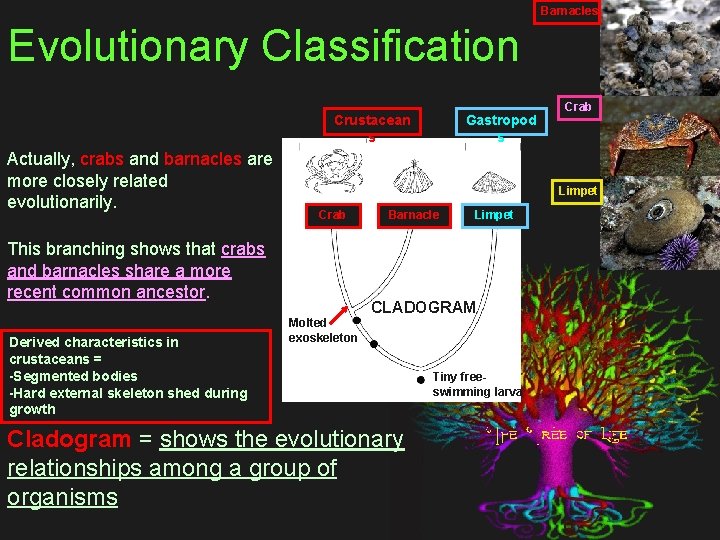
Barnacles Evolutionary Classification Crustacean s Actually, crabs and barnacles are more closely related evolutionarily. Limpet Crab This branching shows that crabs and barnacles share a more recent common ancestor. Derived characteristics in crustaceans = -Segmented bodies -Hard external skeleton shed during growth Gastropod s Crab Molted exoskeleton Barnacle Limpet CLADOGRAM Cladogram = shows the evolutionary relationships among a group of organisms Tiny freeswimming larva
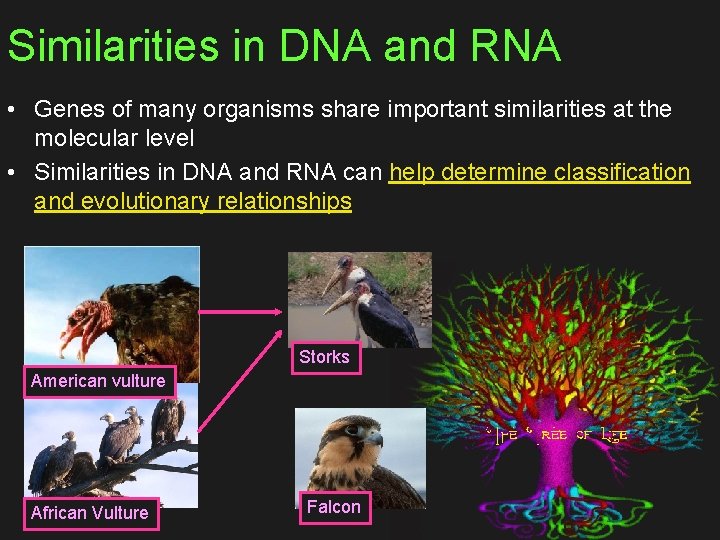
Similarities in DNA and RNA • Genes of many organisms share important similarities at the molecular level • Similarities in DNA and RNA can help determine classification and evolutionary relationships Storks American vulture African Vulture Falcon
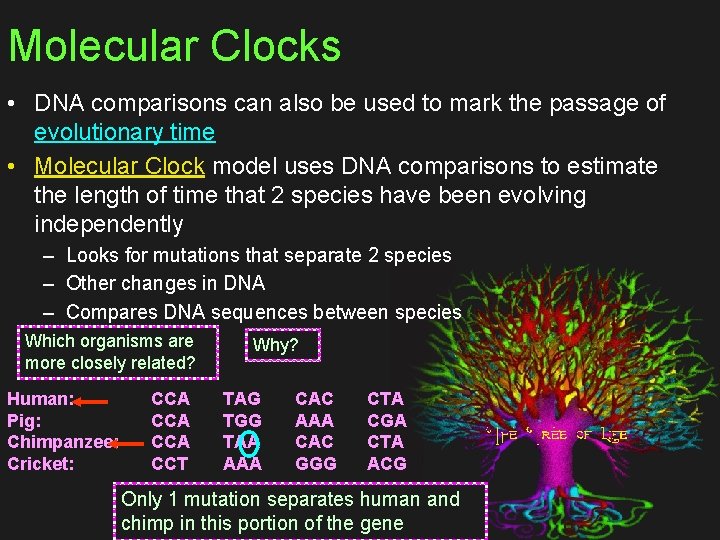
Molecular Clocks • DNA comparisons can also be used to mark the passage of evolutionary time • Molecular Clock model uses DNA comparisons to estimate the length of time that 2 species have been evolving independently – Looks for mutations that separate 2 species – Other changes in DNA – Compares DNA sequences between species Which organisms are more closely related? Human: Pig: Chimpanzee: Cricket: CCA CCA CCT Why? TAG TGG TAA AAA CAC GGG CTA CGA CTA ACG Only 1 mutation separates human and chimp in this portion of the gene
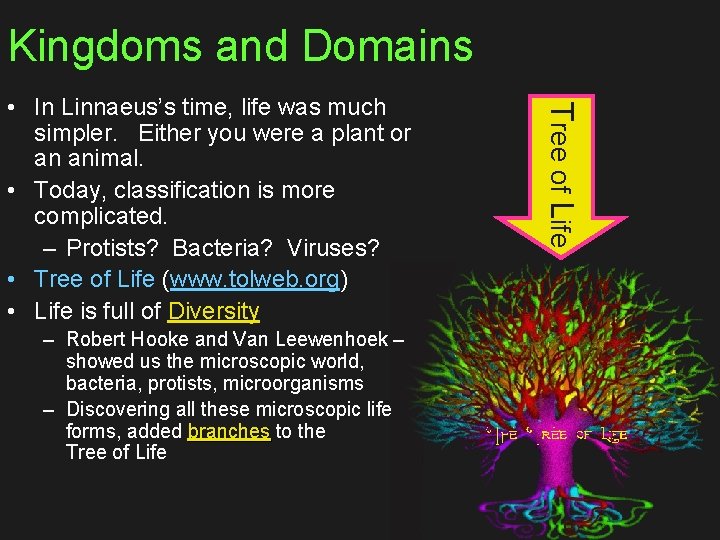
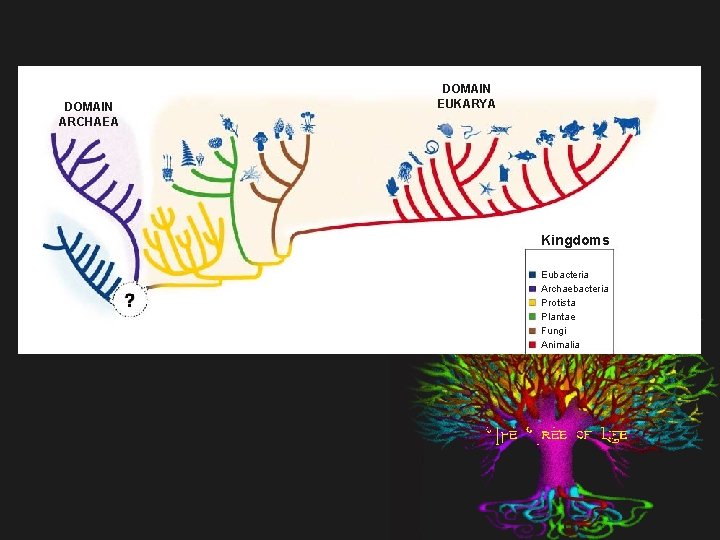
Kingdoms and Domains – Robert Hooke and Van Leewenhoek – showed us the microscopic world, bacteria, protists, microorganisms – Discovering all these microscopic life forms, added branches to the Tree of Life • In Linnaeus’s time, life was much simpler. Either you were a plant or an animal. • Today, classification is more complicated. – Protists? Bacteria? Viruses? • Tree of Life (www. tolweb. org) • Life is full of Diversity
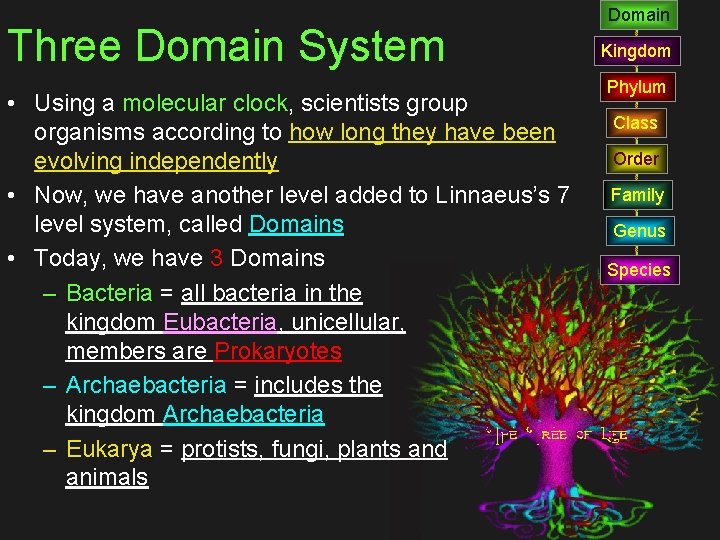
Three Domain System • Using a molecular clock, scientists group organisms according to how long they have been evolving independently • Now, we have another level added to Linnaeus’s 7 level system, called Domains • Today, we have 3 Domains – Bacteria = all bacteria in the kingdom Eubacteria, unicellular, members are Prokaryotes – Archaebacteria = includes the kingdom Archaebacteria – Eukarya = protists, fungi, plants and animals Domain Kingdom Phylum Class Order Family Genus Species
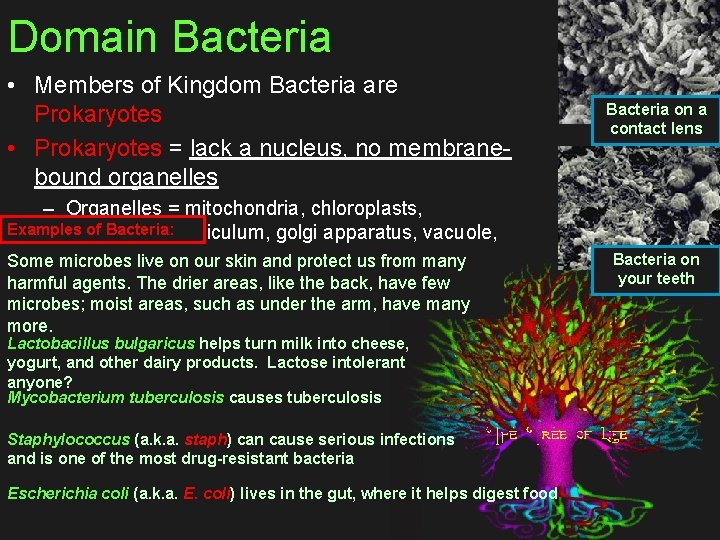
Domain Bacteria • Members of Kingdom Bacteria are Prokaryotes • Prokaryotes = lack a nucleus, no membranebound organelles – Organelles = mitochondria, chloroplasts, Examples of Bacteria: reticulum, golgi apparatus, vacuole, endoplasmic ribosome Some microbes live on our skin and protect us from many harmful agents. The drier areas, like the back, have few microbes; moist areas, such as under the arm, have many more. Lactobacillus bulgaricus helps turn milk into cheese, yogurt, and other dairy products. Lactose intolerant anyone? Mycobacterium tuberculosis causes tuberculosis Staphylococcus (a. k. a. staph) can cause serious infections and is one of the most drug-resistant bacteria Escherichia coli (a. k. a. E. coli) lives in the gut, where it helps digest food Bacteria on a contact lens Bacteria on your teeth
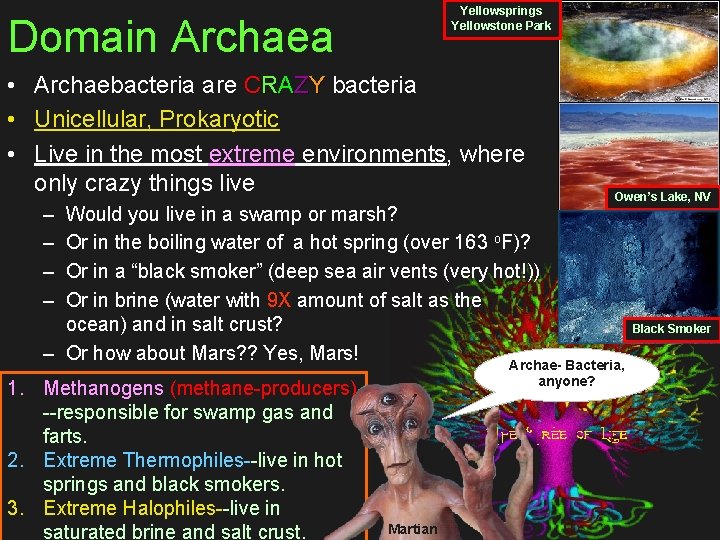
Yellowsprings Yellowstone Park Domain Archaea • Archaebacteria are CRAZY bacteria • Unicellular, Prokaryotic • Live in the most extreme environments, where only crazy things live Owen’s Lake, NV – – Would you live in a swamp or marsh? Or in the boiling water of a hot spring (over 163 o. F)? Or in a “black smoker” (deep sea air vents (very hot!)) Or in brine (water with 9 X amount of salt as the ocean) and in salt crust? – Or how about Mars? ? Yes, Mars! Archae- Bacteria, 1. Methanogens (methane-producers) --responsible for swamp gas and farts. 2. Extreme Thermophiles--live in hot springs and black smokers. 3. Extreme Halophiles--live in saturated brine and salt crust. anyone? Martian Black Smoker
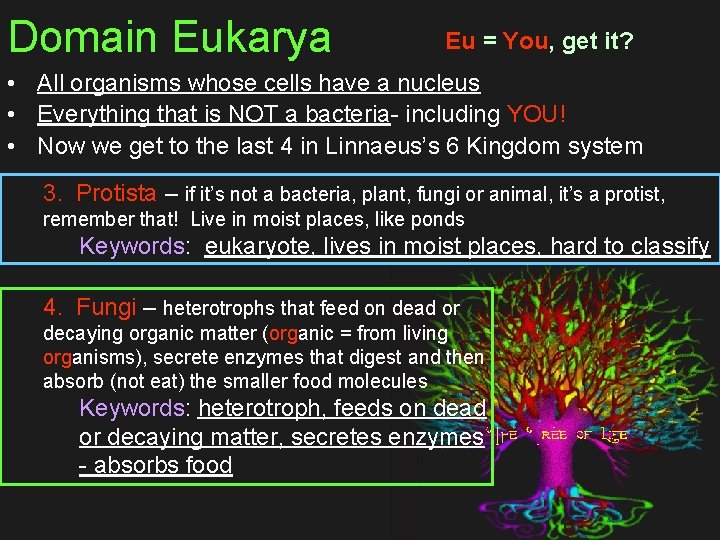
Domain Eukarya Eu = You, get it? • All organisms whose cells have a nucleus • Everything that is NOT a bacteria- including YOU! • Now we get to the last 4 in Linnaeus’s 6 Kingdom system 3. Protista – if it’s not a bacteria, plant, fungi or animal, it’s a protist, remember that! Live in moist places, like ponds Keywords: eukaryote, lives in moist places, hard to classify 4. Fungi – heterotrophs that feed on dead or decaying organic matter (organic = from living organisms), secrete enzymes that digest and then absorb (not eat) the smaller food molecules Keywords: heterotroph, feeds on dead or decaying matter, secretes enzymes - absorbs food
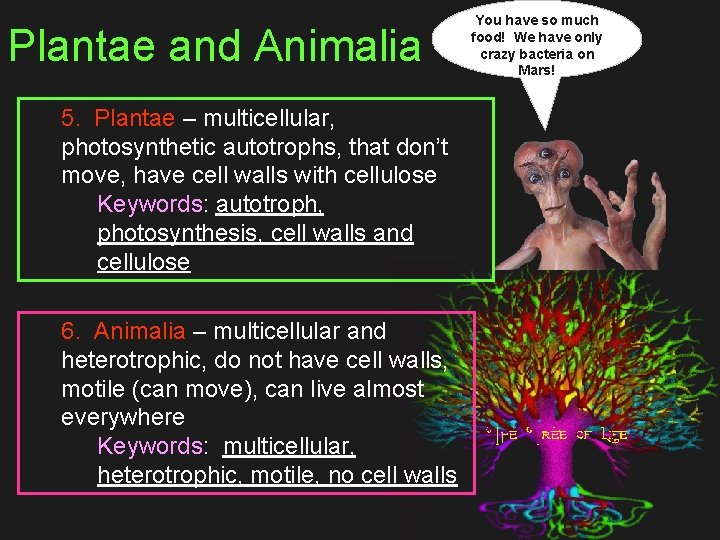
Plantae and Animalia 5. Plantae – multicellular, photosynthetic autotrophs, that don’t move, have cell walls with cellulose Keywords: autotroph, photosynthesis, cell walls and cellulose 6. Animalia – multicellular and heterotrophic, do not have cell walls, motile (can move), can live almost everywhere Keywords: multicellular, heterotrophic, motile, no cell walls You have so much food! We have only crazy bacteria on Mars!
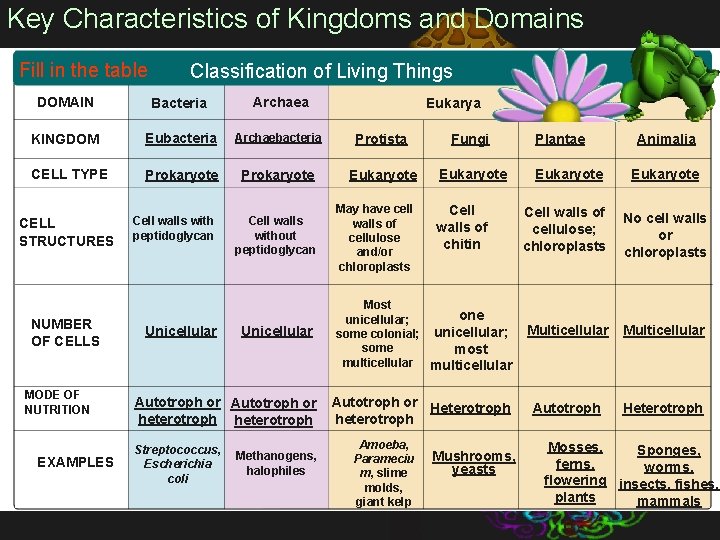
Key Characteristics of Kingdoms and Domains Fill in the table Classification of Living Things DOMAIN Bacteria Archaea KINGDOM Eubacteria Archaebacteria Protista Fungi CELL TYPE Prokaryote Eukaryote Cell walls with peptidoglycan Cell walls without peptidoglycan May have cell walls of cellulose and/or chloroplasts CELL STRUCTURES NUMBER OF CELLS MODE OF NUTRITION EXAMPLES Unicellular Autotroph or heterotroph Streptococcus, Escherichia coli Methanogens, halophiles Eukarya Cell walls of chitin Plantae Eukaryote Animalia Eukaryote Cell walls of cellulose; chloroplasts No cell walls or chloroplasts Most one unicellular; some colonial; unicellular; some most multicellular Multicellular Autotroph or Heterotroph heterotroph Autotroph Heterotroph Amoeba, Parameciu m, slime molds, giant kelp Mushrooms, yeasts Mosses, Sponges, ferns, worms, flowering insects, fishes, plants mammals
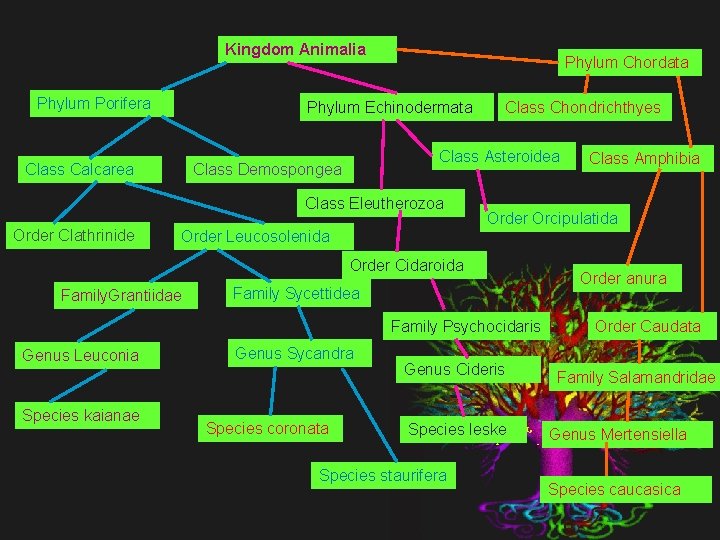
Kingdom Animalia Phylum Porifera Phylum Chordata Phylum Echinodermata Class Calcarea Class Asteroidea Class Demospongea Class Eleutherozoa Order Clathrinide Class Chondrichthyes Order Orcipulatida Order Leucosolenida Order Cidaroida Family. Grantiidae Family Sycettidea Family Psychocidaris Genus Leuconia Species kaianae Class Amphibia Genus Sycandra Species coronata Genus Cideris Species leske Species staurifera Order anura Order Caudata Family Salamandridae Genus Mertensiella Species caucasica
DOMAIN ARCHAEA DOMAIN EUKARYA Kingdoms Eubacteria Archaebacteria Protista Plantae Fungi Animalia