
Classification Feature Vectors Hello Do you want free
- Slides: 32
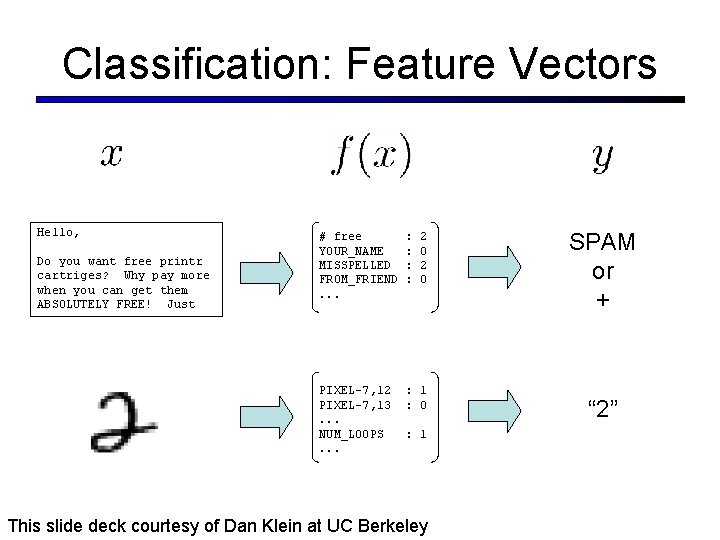
Classification: Feature Vectors Hello, Do you want free printr cartriges? Why pay more when you can get them ABSOLUTELY FREE! Just # free YOUR_NAME MISSPELLED FROM_FRIEND. . . : : 2 0 PIXEL-7, 12 PIXEL-7, 13. . . NUM_LOOPS. . . : 1 : 0 : 1 This slide deck courtesy of Dan Klein at UC Berkeley SPAM or + “ 2”
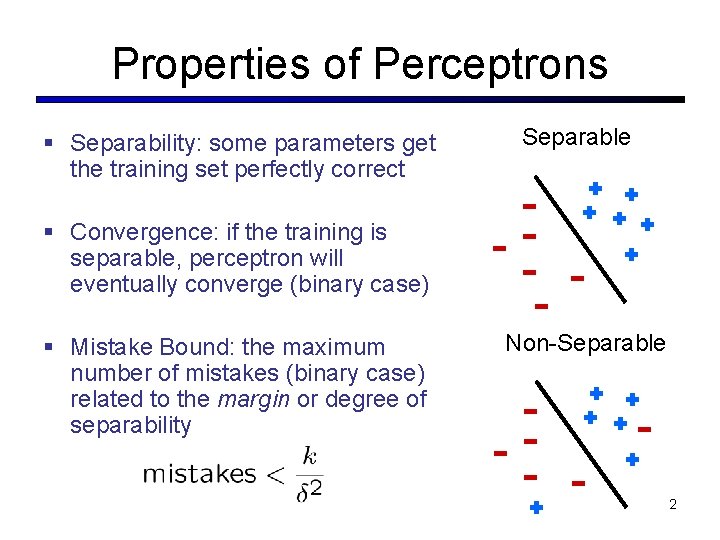
Properties of Perceptrons § Separability: some parameters get the training set perfectly correct Separable § Convergence: if the training is separable, perceptron will eventually converge (binary case) § Mistake Bound: the maximum number of mistakes (binary case) related to the margin or degree of separability Non-Separable 2
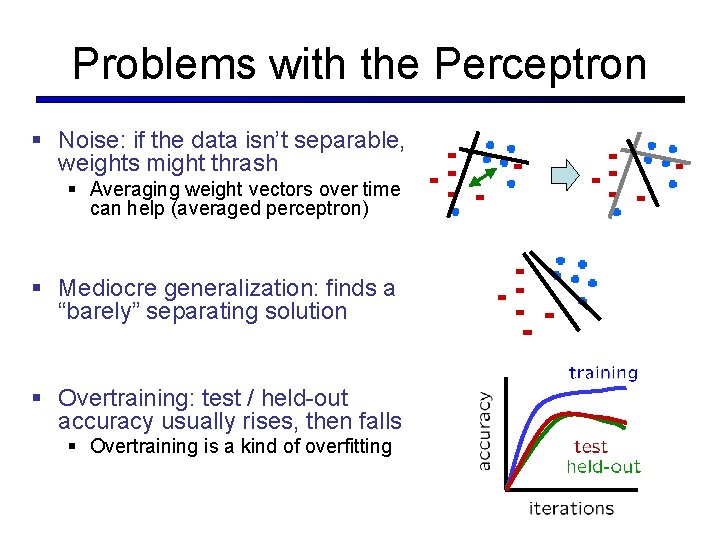
Problems with the Perceptron § Noise: if the data isn’t separable, weights might thrash § Averaging weight vectors over time can help (averaged perceptron) § Mediocre generalization: finds a “barely” separating solution § Overtraining: test / held-out accuracy usually rises, then falls § Overtraining is a kind of overfitting
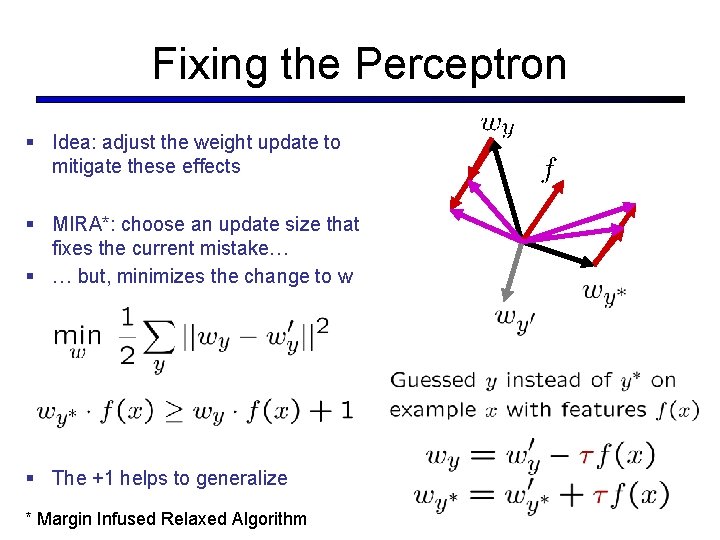
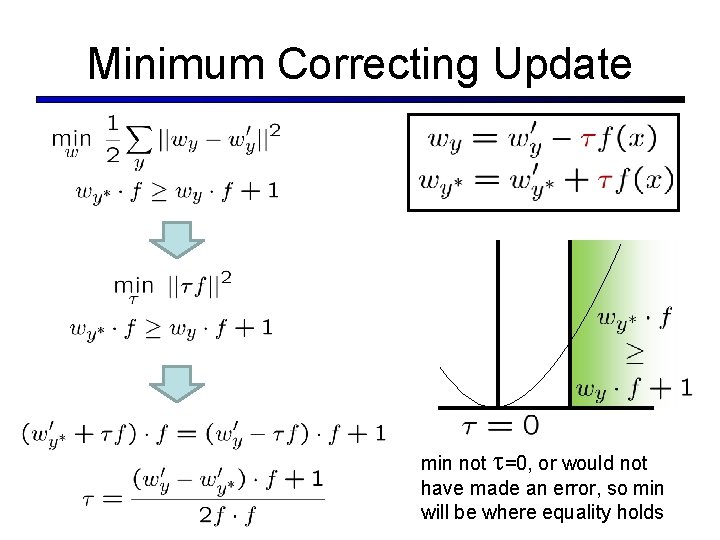
Fixing the Perceptron § Idea: adjust the weight update to mitigate these effects § MIRA*: choose an update size that fixes the current mistake… § … but, minimizes the change to w § The +1 helps to generalize * Margin Infused Relaxed Algorithm
Minimum Correcting Update min not =0, or would not have made an error, so min will be where equality holds
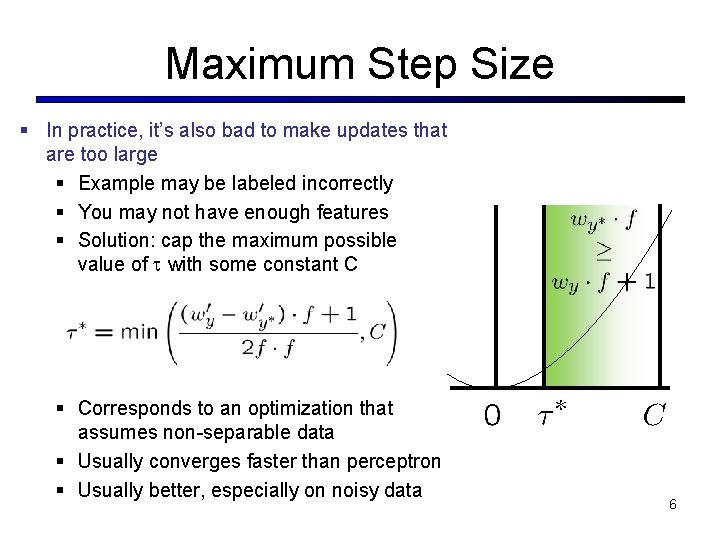
Maximum Step Size § In practice, it’s also bad to make updates that are too large § Example may be labeled incorrectly § You may not have enough features § Solution: cap the maximum possible value of with some constant C § Corresponds to an optimization that assumes non-separable data § Usually converges faster than perceptron § Usually better, especially on noisy data 6
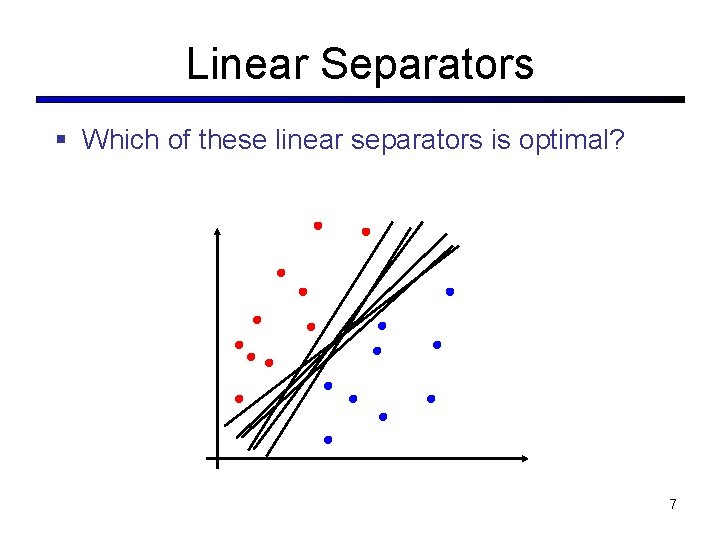
Linear Separators § Which of these linear separators is optimal? 7
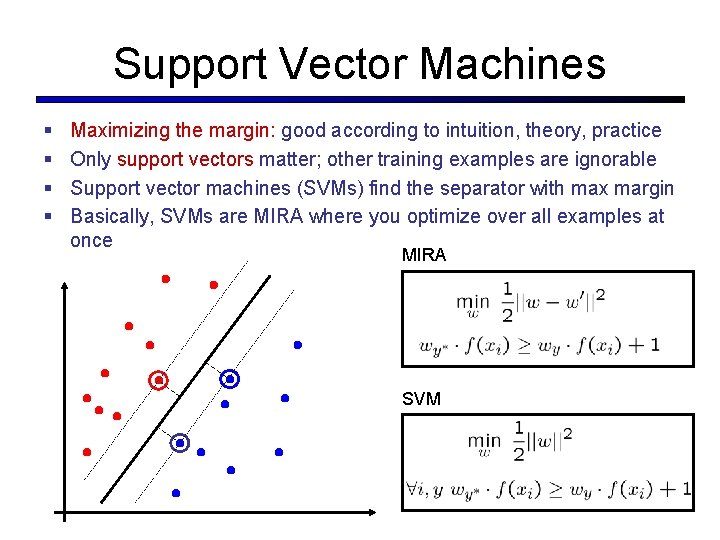
Support Vector Machines § § Maximizing the margin: good according to intuition, theory, practice Only support vectors matter; other training examples are ignorable Support vector machines (SVMs) find the separator with max margin Basically, SVMs are MIRA where you optimize over all examples at once MIRA SVM
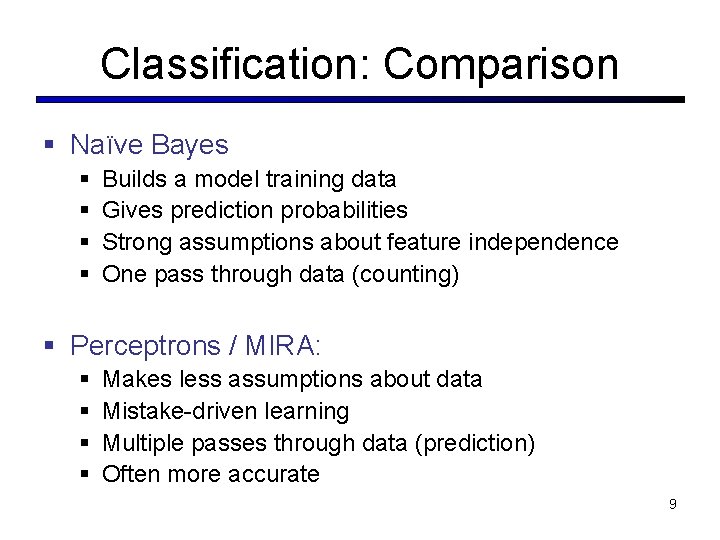
Classification: Comparison § Naïve Bayes § § Builds a model training data Gives prediction probabilities Strong assumptions about feature independence One pass through data (counting) § Perceptrons / MIRA: § § Makes less assumptions about data Mistake-driven learning Multiple passes through data (prediction) Often more accurate 9
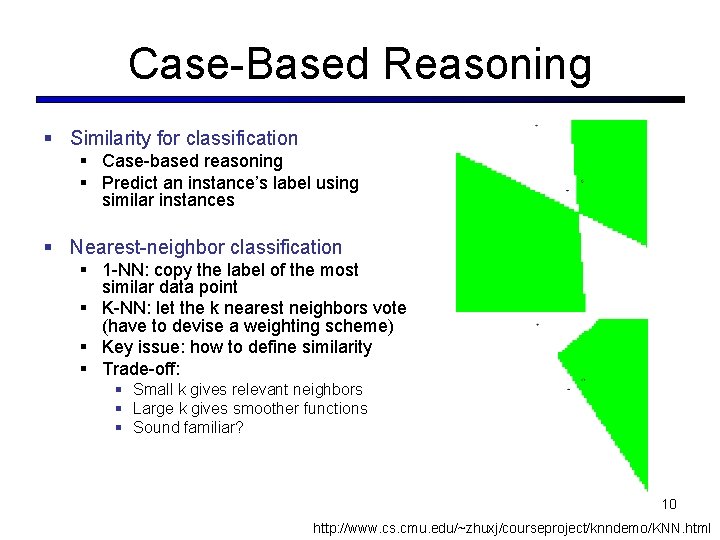
Case-Based Reasoning § Similarity for classification § Case-based reasoning § Predict an instance’s label using similar instances § Nearest-neighbor classification § 1 -NN: copy the label of the most similar data point § K-NN: let the k nearest neighbors vote (have to devise a weighting scheme) § Key issue: how to define similarity § Trade-off: § Small k gives relevant neighbors § Large k gives smoother functions § Sound familiar? 10 http: //www. cs. cmu. edu/~zhuxj/courseproject/knndemo/KNN. html
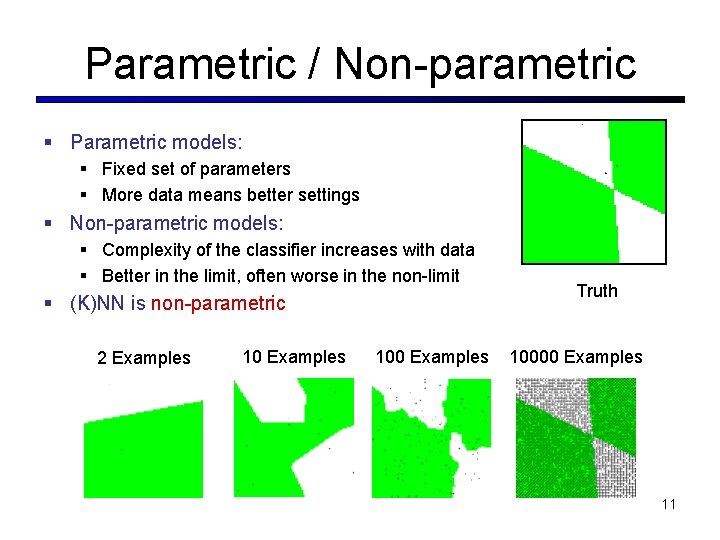
Parametric / Non-parametric § Parametric models: § Fixed set of parameters § More data means better settings § Non-parametric models: § Complexity of the classifier increases with data § Better in the limit, often worse in the non-limit § (K)NN is non-parametric 2 Examples 100 Examples Truth 10000 Examples 11
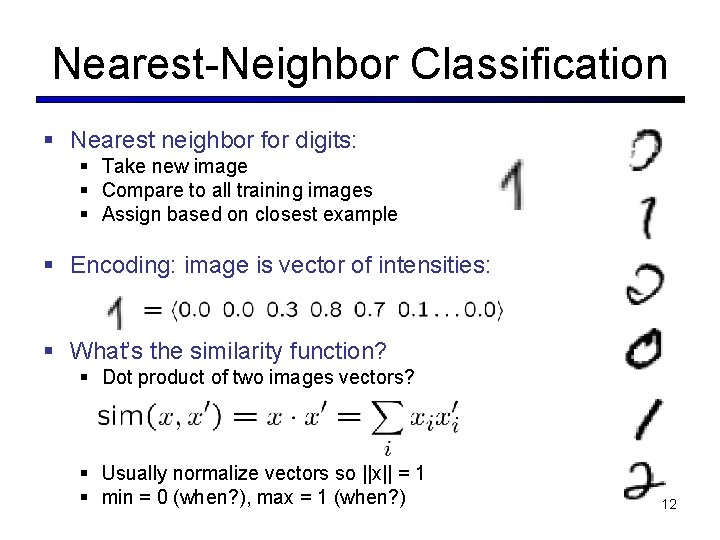
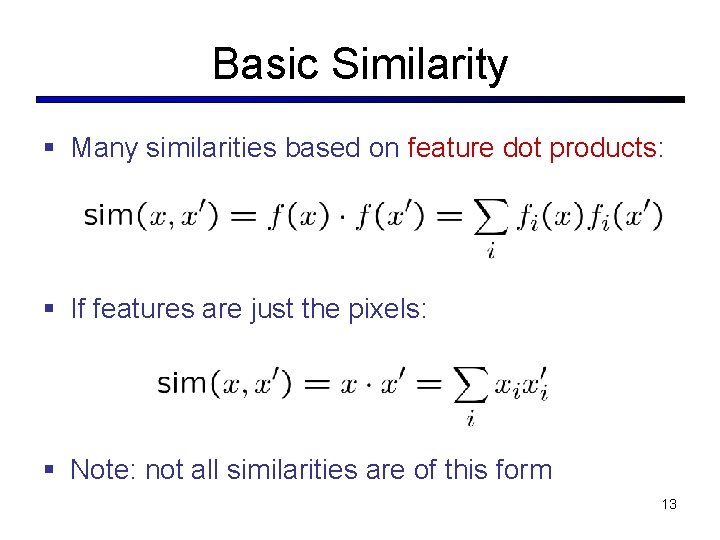
Nearest-Neighbor Classification § Nearest neighbor for digits: § Take new image § Compare to all training images § Assign based on closest example § Encoding: image is vector of intensities: § What’s the similarity function? § Dot product of two images vectors? § Usually normalize vectors so ||x|| = 1 § min = 0 (when? ), max = 1 (when? ) 12
Basic Similarity § Many similarities based on feature dot products: § If features are just the pixels: § Note: not all similarities are of this form 13
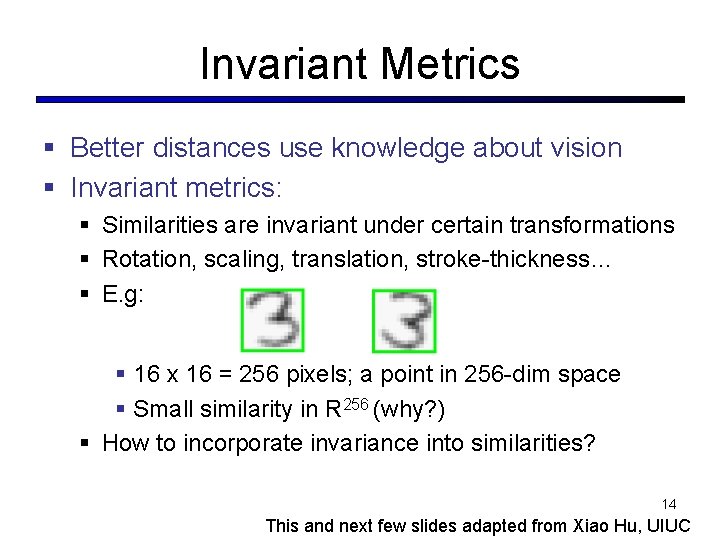
Invariant Metrics § Better distances use knowledge about vision § Invariant metrics: § Similarities are invariant under certain transformations § Rotation, scaling, translation, stroke-thickness… § E. g: § 16 x 16 = 256 pixels; a point in 256 -dim space § Small similarity in R 256 (why? ) § How to incorporate invariance into similarities? 14 This and next few slides adapted from Xiao Hu, UIUC
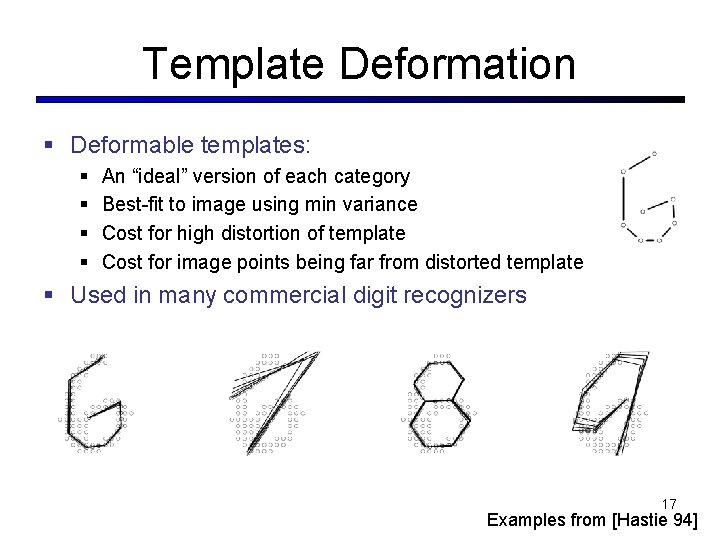
Template Deformation § Deformable templates: § § An “ideal” version of each category Best-fit to image using min variance Cost for high distortion of template Cost for image points being far from distorted template § Used in many commercial digit recognizers 17 Examples from [Hastie 94]
A Tale of Two Approaches… § Nearest neighbor-like approaches § Can use fancy similarity functions § Don’t actually get to do explicit learning § Perceptron-like approaches § Explicit training to reduce empirical error § Can’t use fancy similarity, only linear § Or can they? Let’s find out! 18
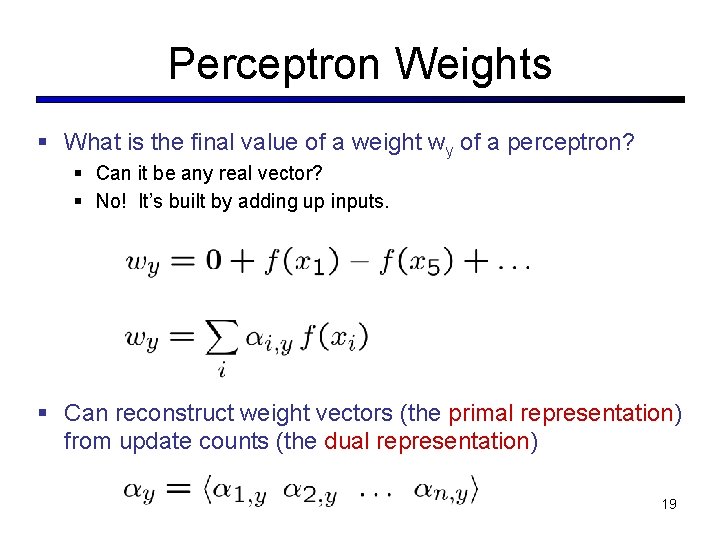
Perceptron Weights § What is the final value of a weight wy of a perceptron? § Can it be any real vector? § No! It’s built by adding up inputs. § Can reconstruct weight vectors (the primal representation) from update counts (the dual representation) 19
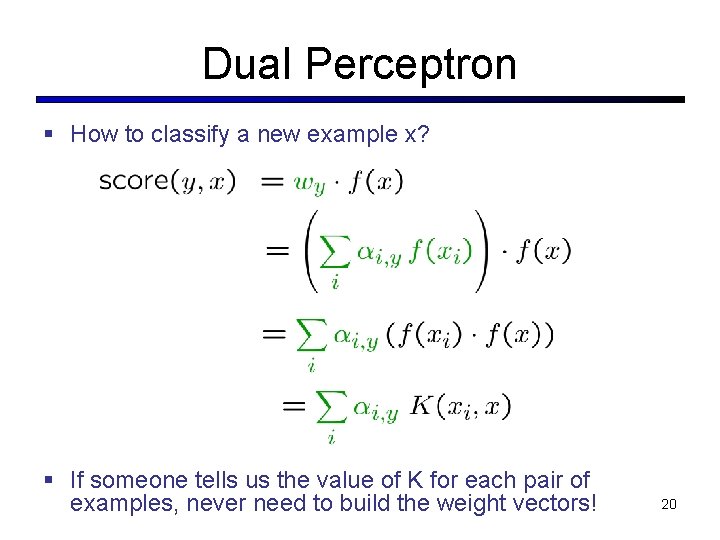
Dual Perceptron § How to classify a new example x? § If someone tells us the value of K for each pair of examples, never need to build the weight vectors! 20
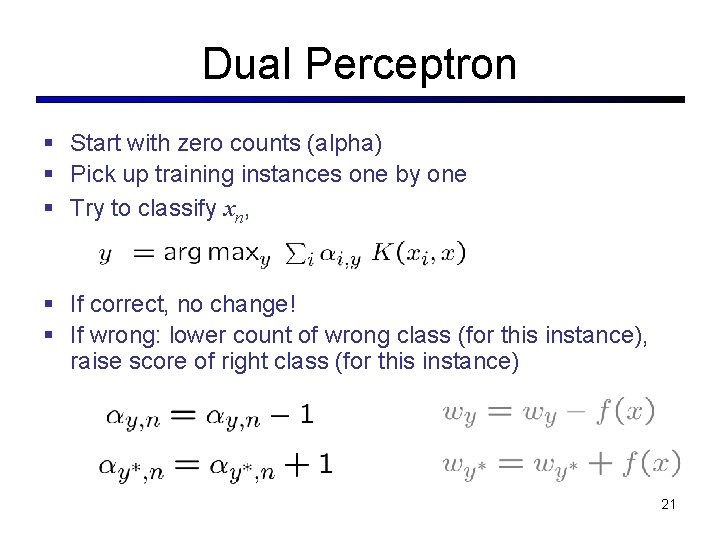
Dual Perceptron § Start with zero counts (alpha) § Pick up training instances one by one § Try to classify xn, § If correct, no change! § If wrong: lower count of wrong class (for this instance), raise score of right class (for this instance) 21
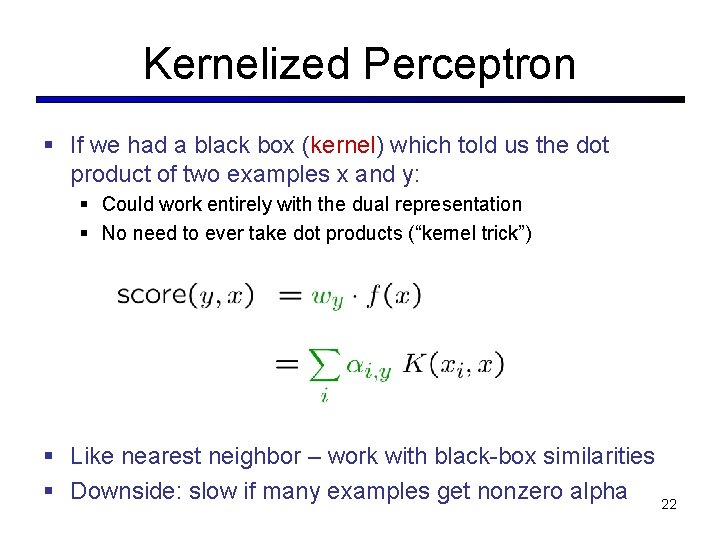
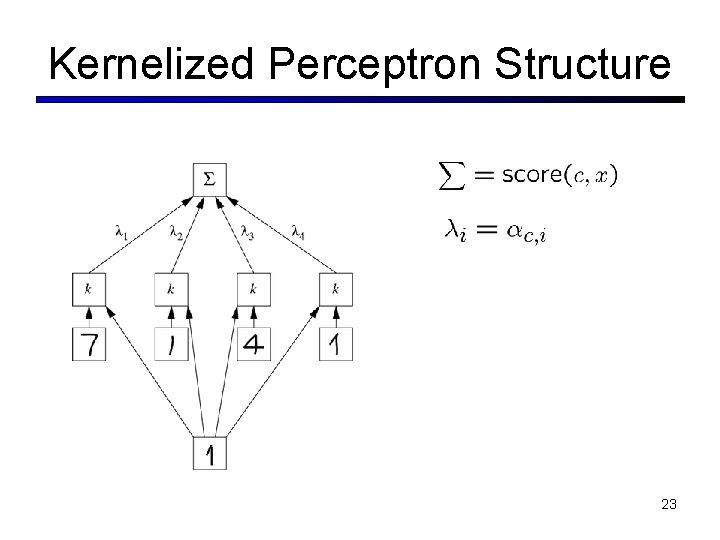
Kernelized Perceptron § If we had a black box (kernel) which told us the dot product of two examples x and y: § Could work entirely with the dual representation § No need to ever take dot products (“kernel trick”) § Like nearest neighbor – work with black-box similarities § Downside: slow if many examples get nonzero alpha 22
Kernelized Perceptron Structure 23
Kernels: Who Cares? § So far: a very strange way of doing a very simple calculation § “Kernel trick”: we can substitute any* similarity function in place of the dot product § Lets us learn new kinds of hypothesis * Fine print: if your kernel doesn’t satisfy certain technical requirements, lots of proofs break. E. g. convergence, mistake bounds. In practice, 24 illegal kernels sometimes work (but not always).
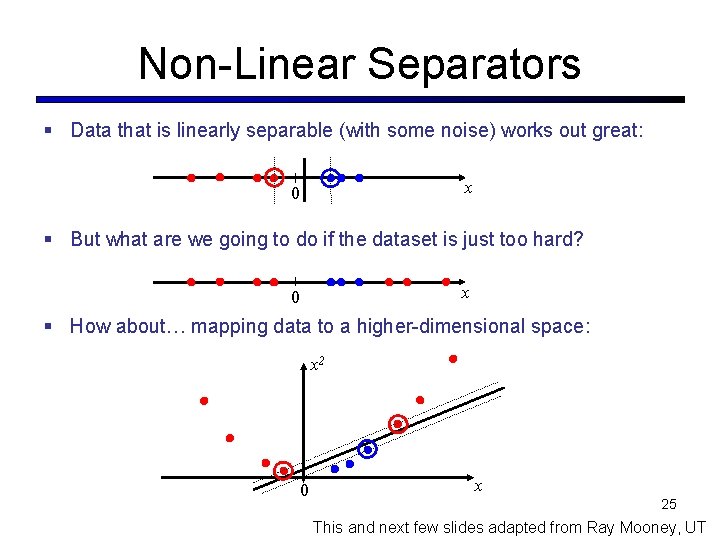
Non-Linear Separators § Data that is linearly separable (with some noise) works out great: x 0 § But what are we going to do if the dataset is just too hard? x 0 § How about… mapping data to a higher-dimensional space: x 2 0 x 25 This and next few slides adapted from Ray Mooney, UT
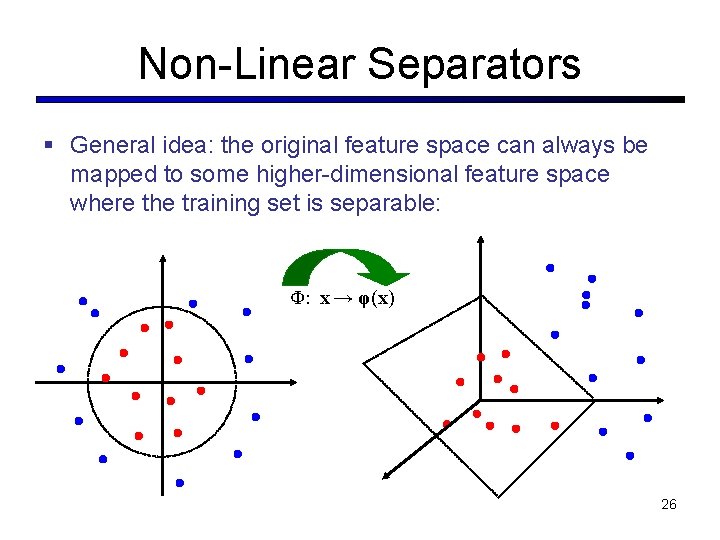
Non-Linear Separators § General idea: the original feature space can always be mapped to some higher-dimensional feature space where the training set is separable: Φ: x → φ(x) 26
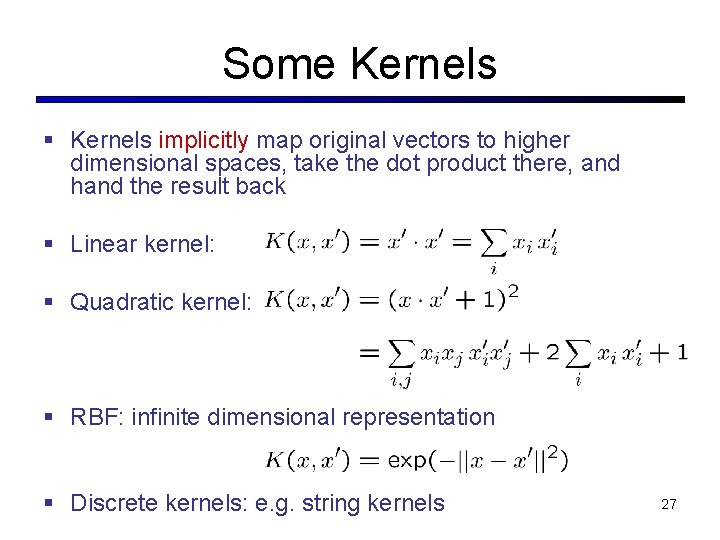
Some Kernels § Kernels implicitly map original vectors to higher dimensional spaces, take the dot product there, and hand the result back § Linear kernel: § Quadratic kernel: § RBF: infinite dimensional representation § Discrete kernels: e. g. string kernels 27
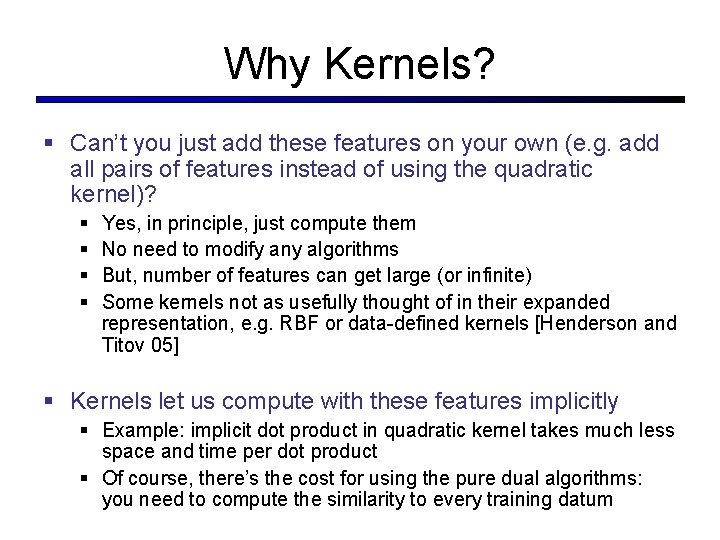
Why Kernels? § Can’t you just add these features on your own (e. g. add all pairs of features instead of using the quadratic kernel)? § § Yes, in principle, just compute them No need to modify any algorithms But, number of features can get large (or infinite) Some kernels not as usefully thought of in their expanded representation, e. g. RBF or data-defined kernels [Henderson and Titov 05] § Kernels let us compute with these features implicitly § Example: implicit dot product in quadratic kernel takes much less space and time per dot product § Of course, there’s the cost for using the pure dual algorithms: you need to compute the similarity to every training datum
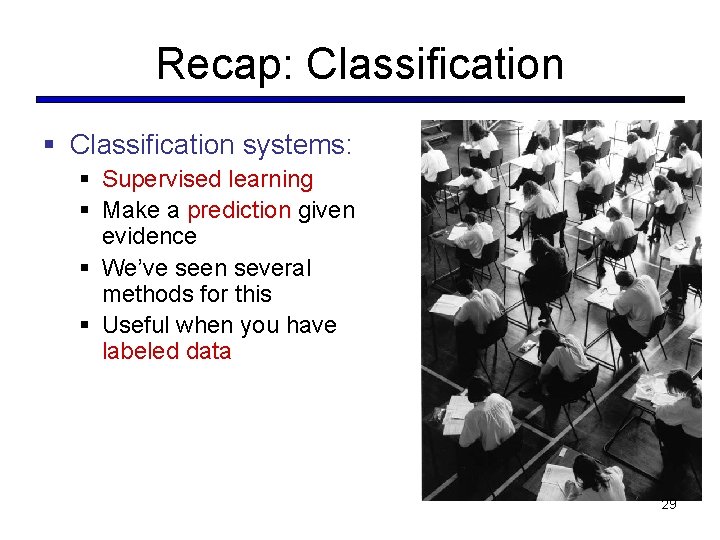
Recap: Classification § Classification systems: § Supervised learning § Make a prediction given evidence § We’ve seen several methods for this § Useful when you have labeled data 29
30
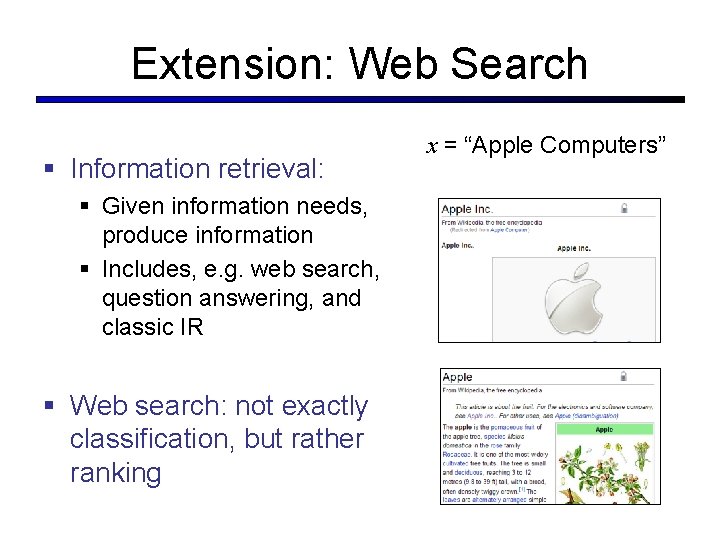
Extension: Web Search § Information retrieval: § Given information needs, produce information § Includes, e. g. web search, question answering, and classic IR § Web search: not exactly classification, but rather ranking x = “Apple Computers”
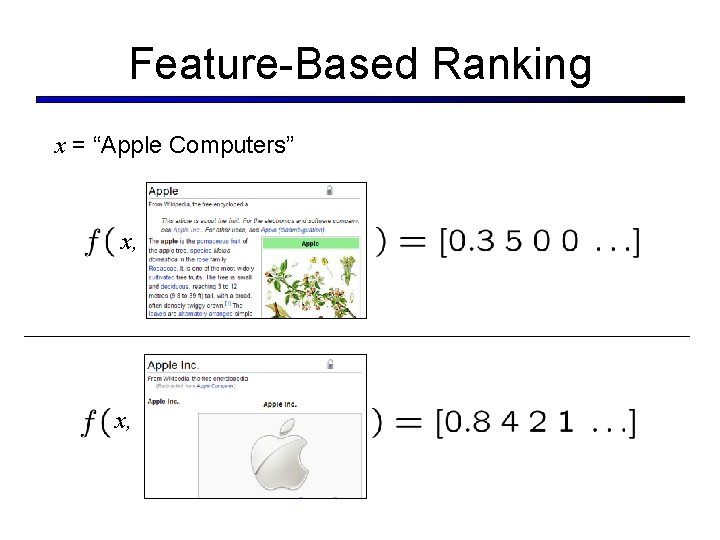
Feature-Based Ranking x = “Apple Computers” x,
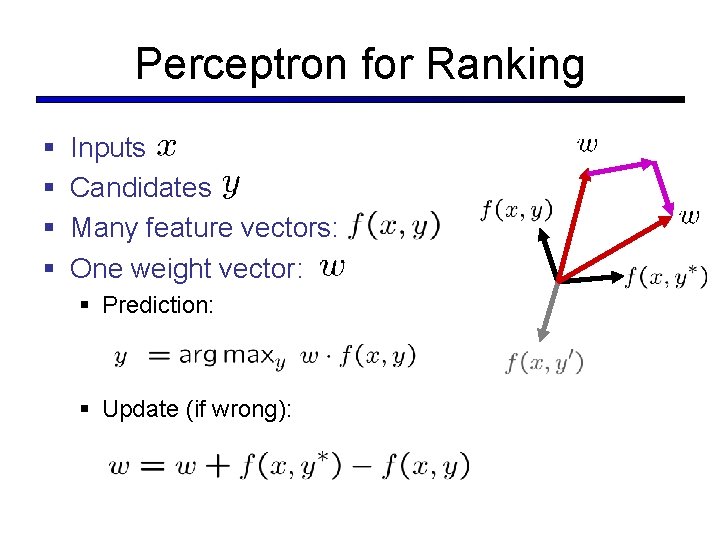
Perceptron for Ranking § § Inputs Candidates Many feature vectors: One weight vector: § Prediction: § Update (if wrong):
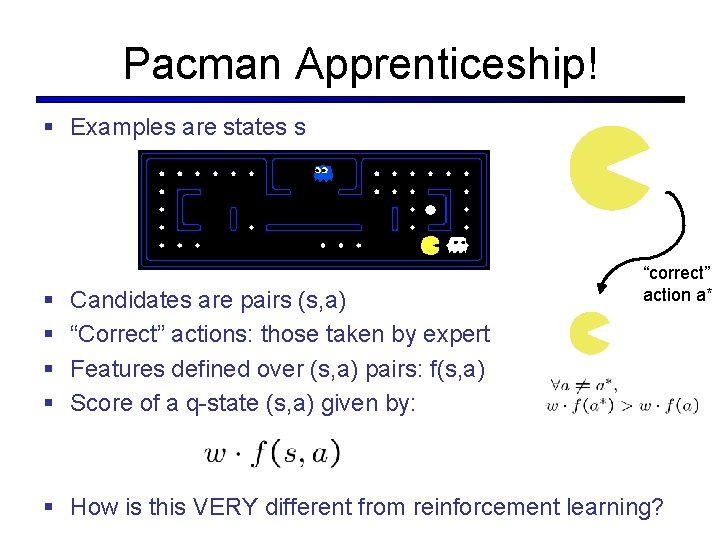
Pacman Apprenticeship! § Examples are states s § § Candidates are pairs (s, a) “Correct” actions: those taken by expert Features defined over (s, a) pairs: f(s, a) Score of a q-state (s, a) given by: “correct” action a* § How is this VERY different from reinforcement learning?