
CLASSIFICATION Definitions Classification grouping things according to similar
- Slides: 20
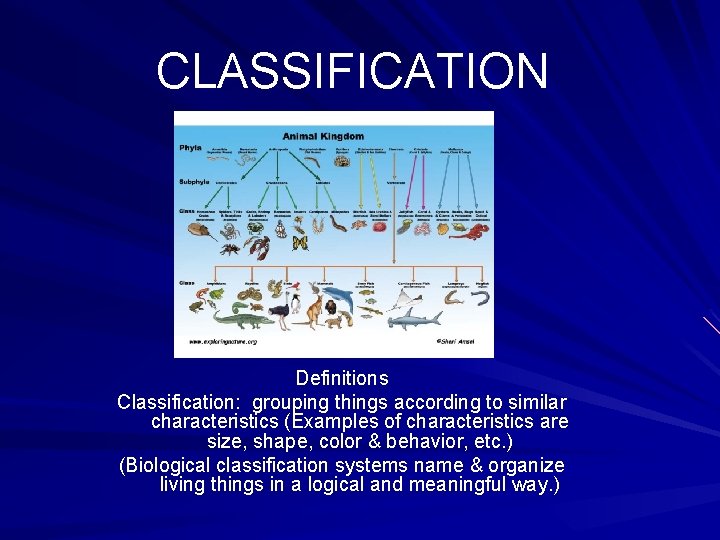
CLASSIFICATION Definitions Classification: grouping things according to similar characteristics (Examples of characteristics are size, shape, color & behavior, etc. ) (Biological classification systems name & organize living things in a logical and meaningful way. )
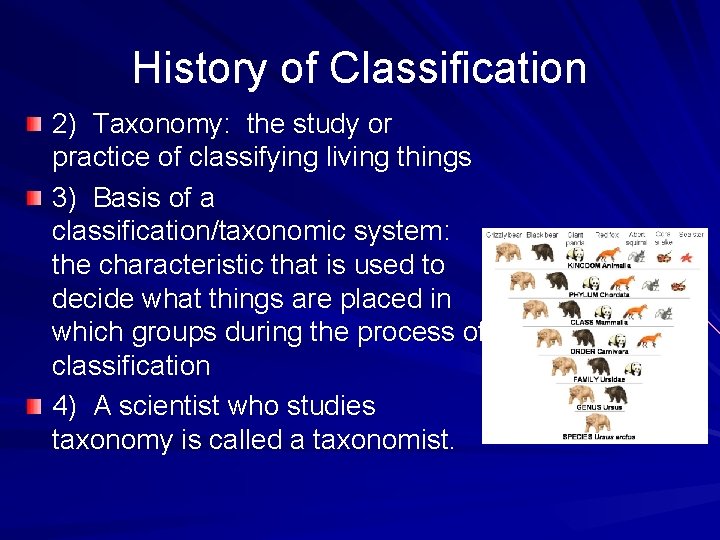
History of Classification 2) Taxonomy: the study or practice of classifying living things 3) Basis of a classification/taxonomic system: the characteristic that is used to decide what things are placed in which groups during the process of classification 4) A scientist who studies taxonomy is called a taxonomist.
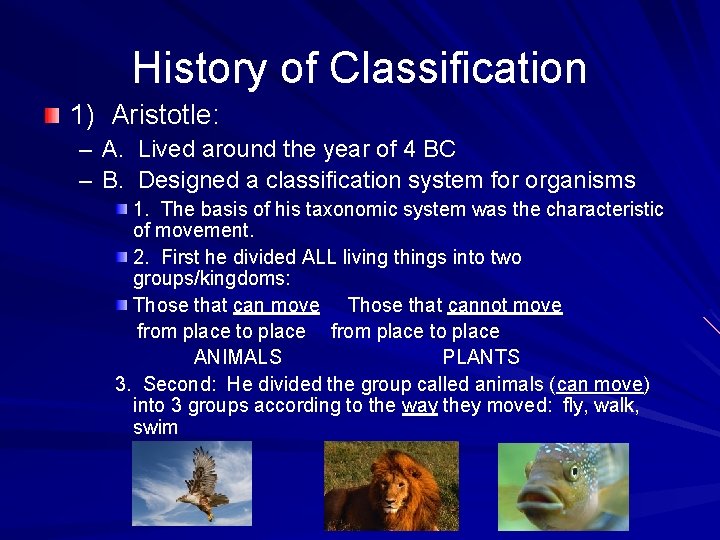
History of Classification 1) Aristotle: – A. Lived around the year of 4 BC – B. Designed a classification system for organisms 1. The basis of his taxonomic system was the characteristic of movement. 2. First he divided ALL living things into two groups/kingdoms: Those that can move Those that cannot move from place to place ANIMALS PLANTS 3. Second: He divided the group called animals (can move) into 3 groups according to the way they moved: fly, walk, swim
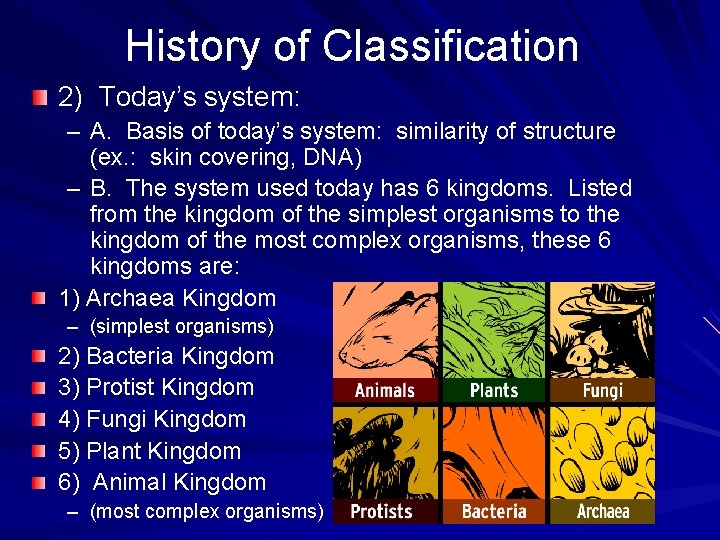
History of Classification 2) Today’s system: – A. Basis of today’s system: similarity of structure (ex. : skin covering, DNA) – B. The system used today has 6 kingdoms. Listed from the kingdom of the simplest organisms to the kingdom of the most complex organisms, these 6 kingdoms are: 1) Archaea Kingdom – (simplest organisms) 2) Bacteria Kingdom 3) Protist Kingdom 4) Fungi Kingdom 5) Plant Kingdom 6) Animal Kingdom – (most complex organisms)
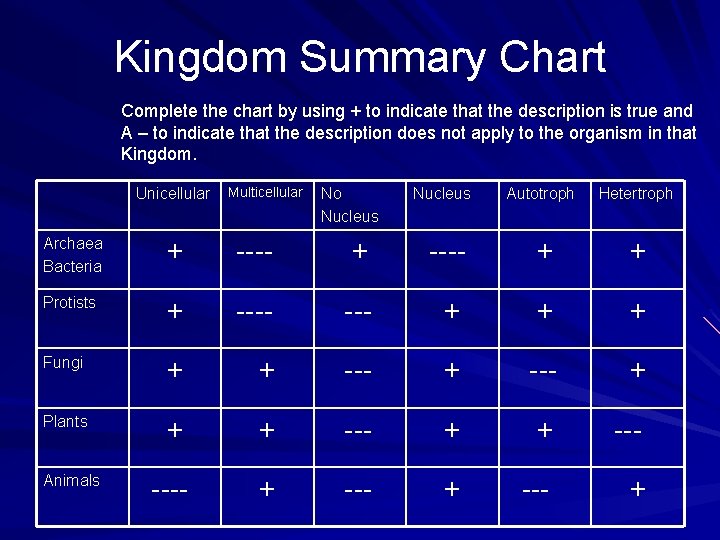
Classification – definitions – Part A 1) unicellular: made of one cell 2) multicellular: made of more than one cell 3) autotroph: an organism that gets its energy by making its food in its body 4) heterotroph: an organism that gets its energy by eating other organisms
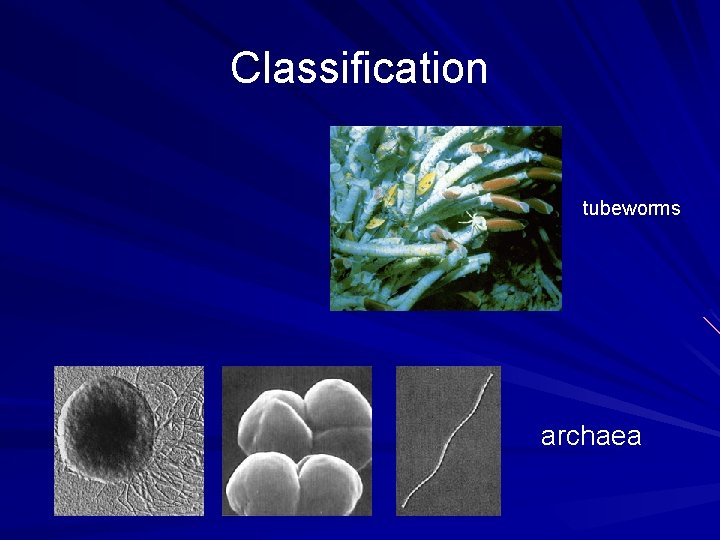
Classification tubeworms archaea
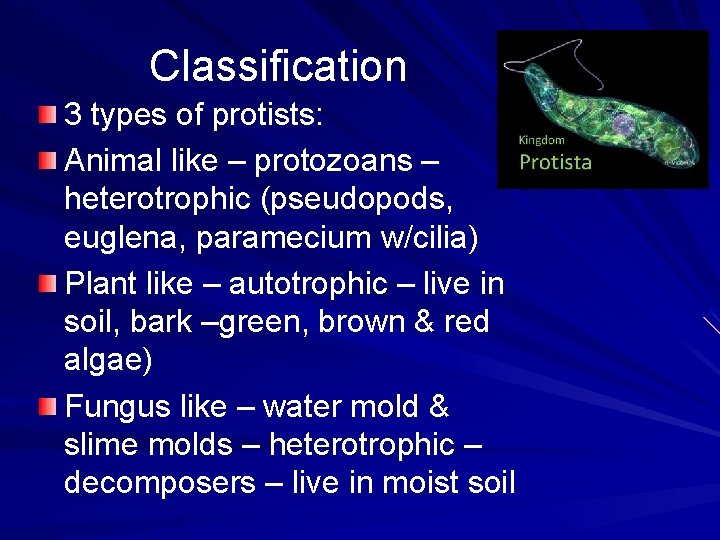
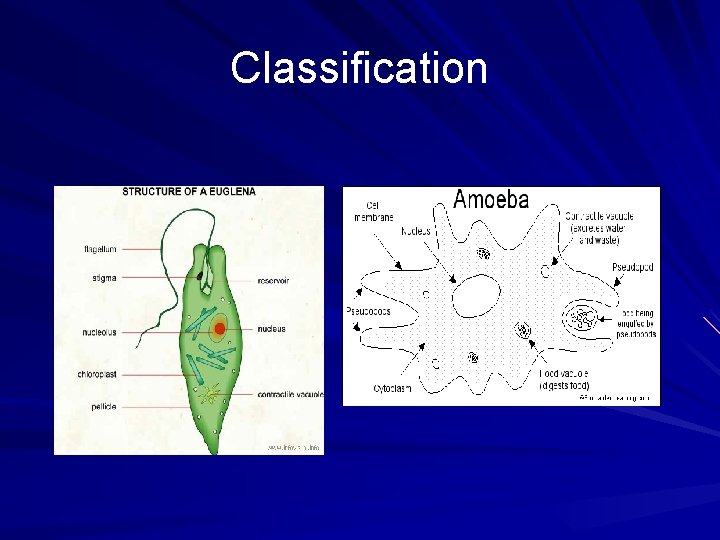
Classification 3 types of protists: Animal like – protozoans – heterotrophic (pseudopods, euglena, paramecium w/cilia) Plant like – autotrophic – live in soil, bark –green, brown & red algae) Fungus like – water mold & slime molds – heterotrophic – decomposers – live in moist soil
Classification
Kingdom Summary Chart Complete the chart by using + to indicate that the description is true and A – to indicate that the description does not apply to the organism in that Kingdom. Unicellular Multicellular No Nucleus Autotroph Hetertroph Archaea Bacteria + ---- + + Protists + ---- + + + Fungi + + --- + Plants + + --- ---- + Animals
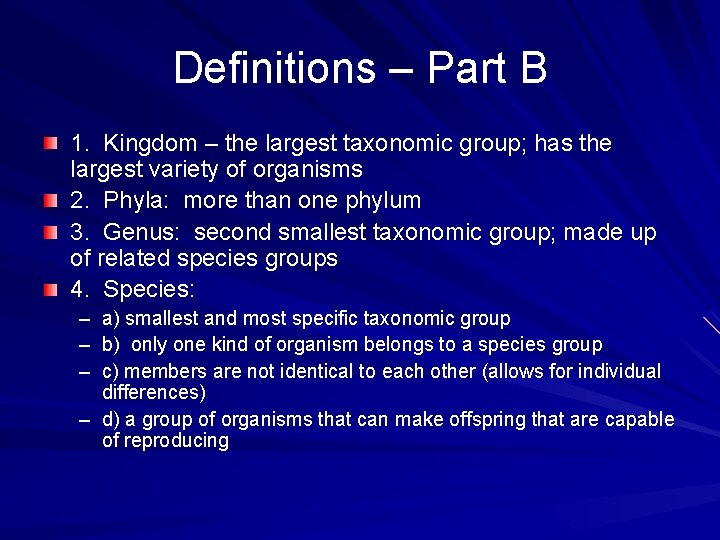
Definitions – Part B 1. Kingdom – the largest taxonomic group; has the largest variety of organisms 2. Phyla: more than one phylum 3. Genus: second smallest taxonomic group; made up of related species groups 4. Species: – a) smallest and most specific taxonomic group – b) only one kind of organism belongs to a species group – c) members are not identical to each other (allows for individual differences) – d) a group of organisms that can make offspring that are capable of reproducing
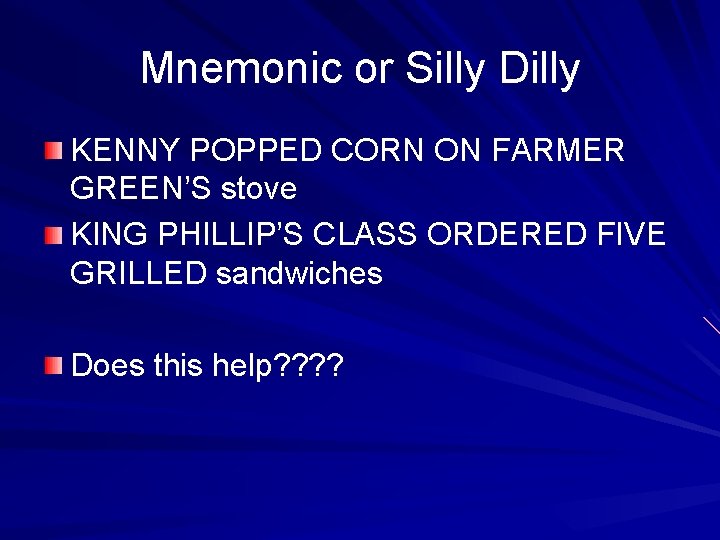
Mnemonic or Silly Dilly KENNY POPPED CORN ON FARMER GREEN’S stove KING PHILLIP’S CLASS ORDERED FIVE GRILLED sandwiches Does this help? ?
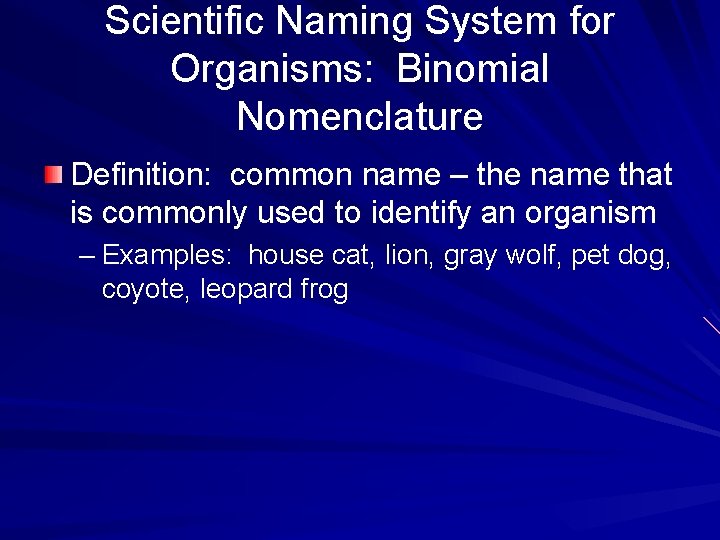
Scientific Naming System for Organisms: Binomial Nomenclature Definition: common name – the name that is commonly used to identify an organism – Examples: house cat, lion, gray wolf, pet dog, coyote, leopard frog
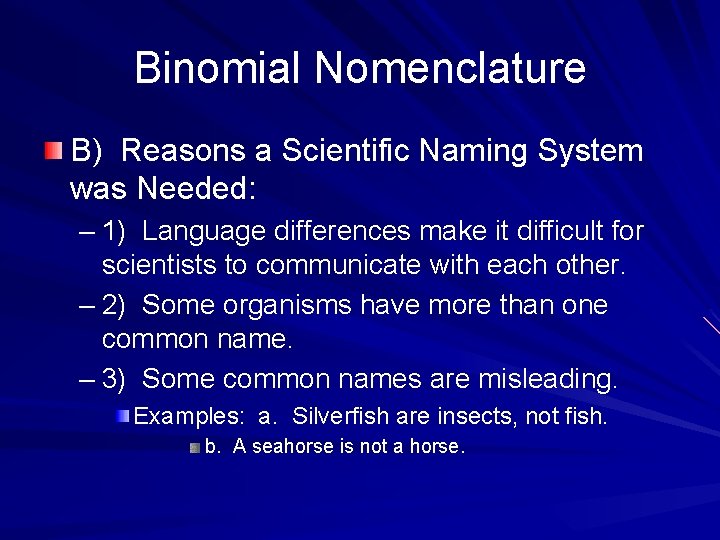
Binomial Nomenclature B) Reasons a Scientific Naming System was Needed: – 1) Language differences make it difficult for scientists to communicate with each other. – 2) Some organisms have more than one common name. – 3) Some common names are misleading. Examples: a. Silverfish are insects, not fish. b. A seahorse is not a horse.
Binomial Nomenclature C. Carolus Linnaeus – 1. Swedish scientist who lived in the 1700’s – 2. He designed the scientific naming system for organisms.
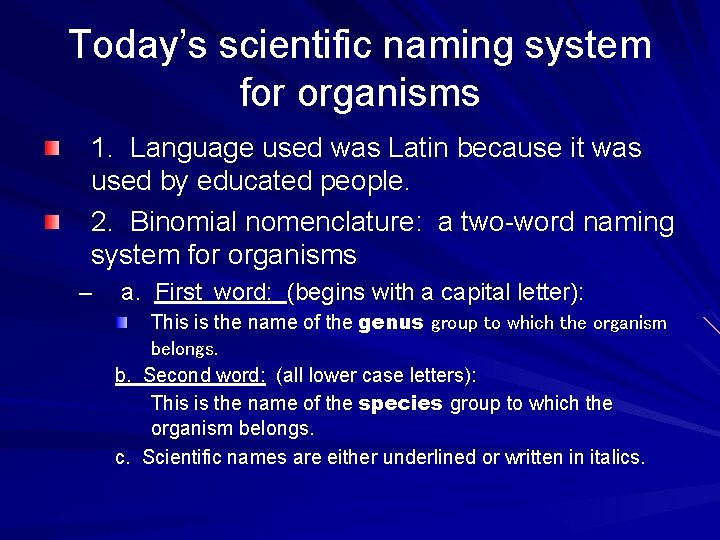
Today’s scientific naming system for organisms 1. Language used was Latin because it was used by educated people. 2. Binomial nomenclature: a two-word naming system for organisms – a. First word: (begins with a capital letter): This is the name of the genus group to which the organism belongs. b. Second word: (all lower case letters): This is the name of the species group to which the organism belongs. c. Scientific names are either underlined or written in italics.
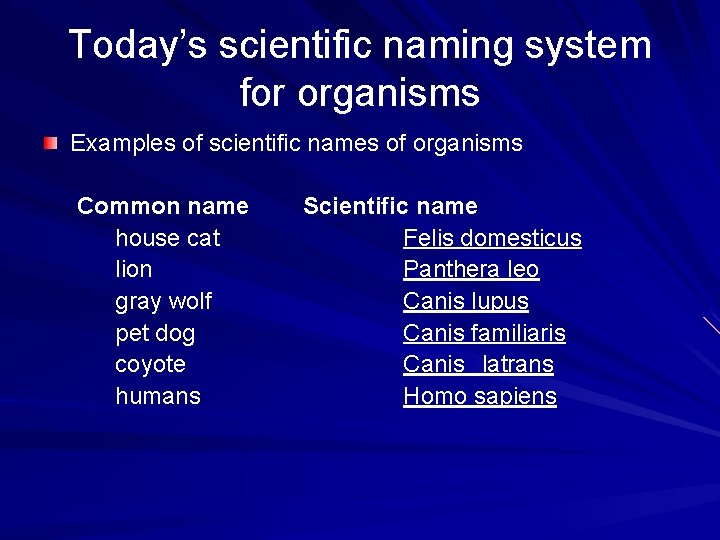
Today’s scientific naming system for organisms Examples of scientific names of organisms Common name house cat lion gray wolf pet dog coyote humans Scientific name Felis domesticus Panthera leo Canis lupus Canis familiaris Canis latrans Homo sapiens
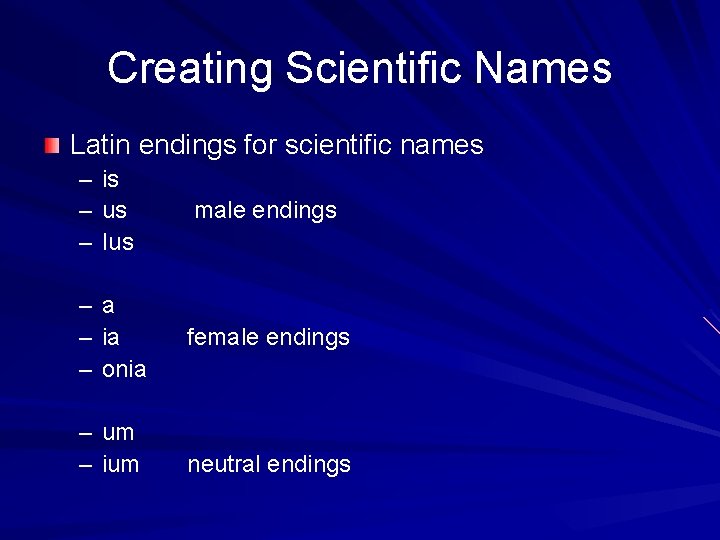
Creating Scientific Names Latin endings for scientific names – is – us – Ius male endings –a – ia – onia female endings – um – ium neutral endings
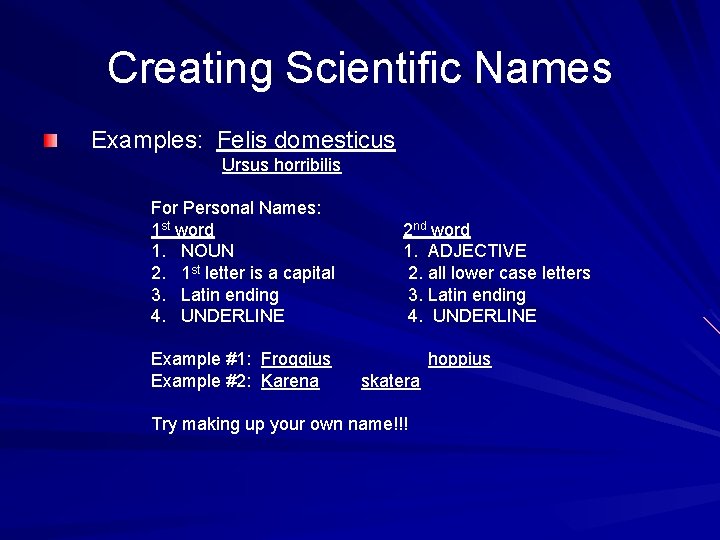
Creating Scientific Names Examples: Felis domesticus Ursus horribilis For Personal Names: 1 st word 1. NOUN 2. 1 st letter is a capital 3. Latin ending 4. UNDERLINE Example #1: Froggius Example #2: Karena 2 nd word 1. ADJECTIVE 2. all lower case letters 3. Latin ending 4. UNDERLINE hoppius skatera Try making up your own name!!!
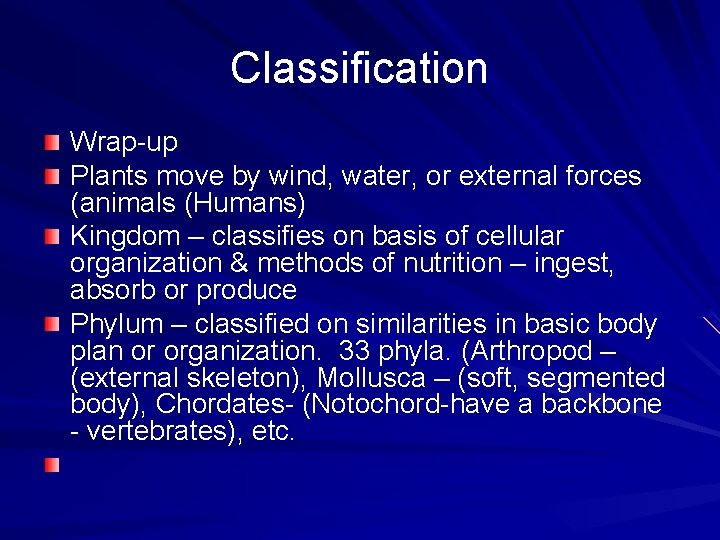
Classification Wrap-up Plants move by wind, water, or external forces (animals (Humans) Kingdom – classifies on basis of cellular organization & methods of nutrition – ingest, absorb or produce Phylum – classified on similarities in basic body plan or organization. 33 phyla. (Arthropod – (external skeleton), Mollusca – (soft, segmented body), Chordates- (Notochord-have a backbone - vertebrates), etc.
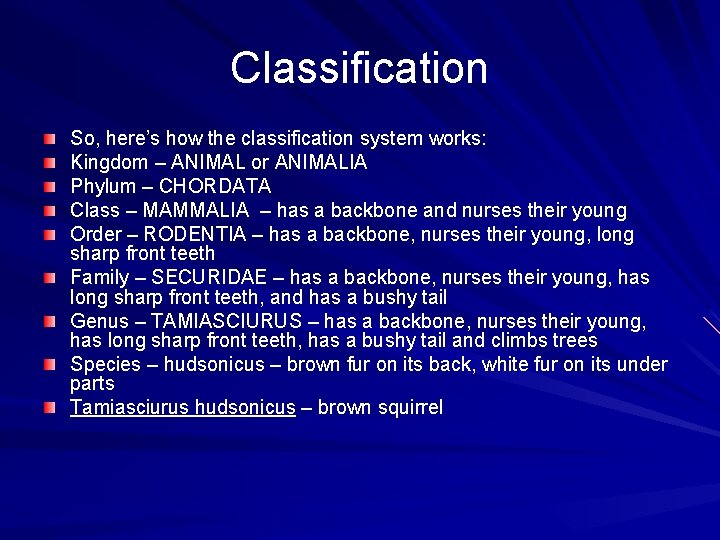
Classification So, here’s how the classification system works: Kingdom – ANIMAL or ANIMALIA Phylum – CHORDATA Class – MAMMALIA – has a backbone and nurses their young Order – RODENTIA – has a backbone, nurses their young, long sharp front teeth Family – SECURIDAE – has a backbone, nurses their young, has long sharp front teeth, and has a bushy tail Genus – TAMIASCIURUS – has a backbone, nurses their young, has long sharp front teeth, has a bushy tail and climbs trees Species – hudsonicus – brown fur on its back, white fur on its under parts Tamiasciurus hudsonicus – brown squirrel