
Classification by statistics A coherent beam of constant
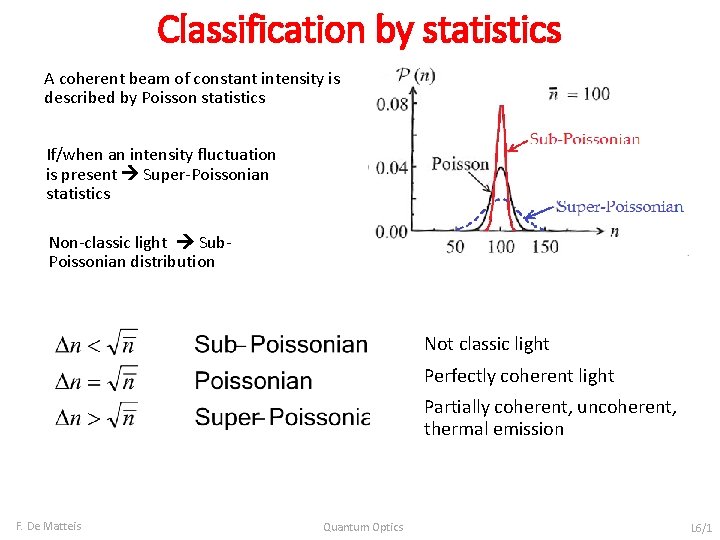
Classification by statistics A coherent beam of constant intensity is described by Poisson statistics If/when an intensity fluctuation is present Super-Poissonian statistics Non-classic light Sub. Poissonian distribution Not classic light Perfectly coherent light Partially coherent, uncoherent, thermal emission F. De Matteis Quantum Optics L 6/1
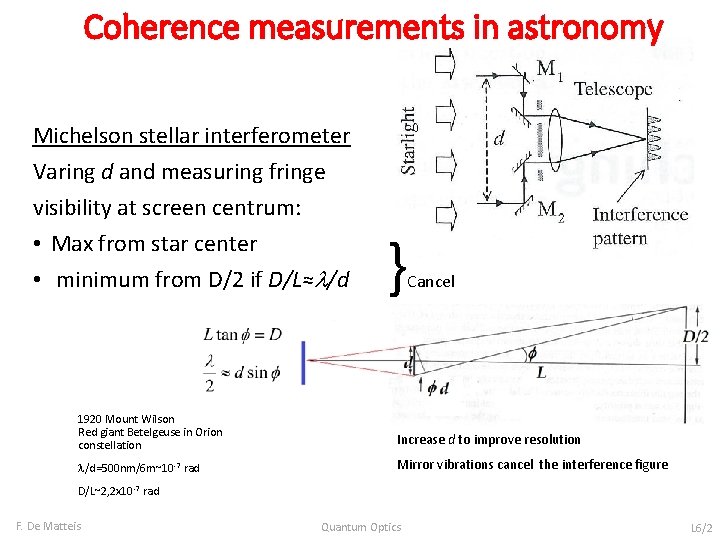
Coherence measurements in astronomy Michelson stellar interferometer Varing d and measuring fringe visibility at screen centrum: • Max from star center • minimum from D/2 if D/L≈l/d } Cancel 1920 Mount Wilson Red giant Betelgeuse in Orion constellation Increase d to improve resolution l/d=500 nm/6 m~10 -7 rad Mirror vibrations cancel the interference figure D/L~2, 2 x 10 -7 rad F. De Matteis Quantum Optics L 6/2
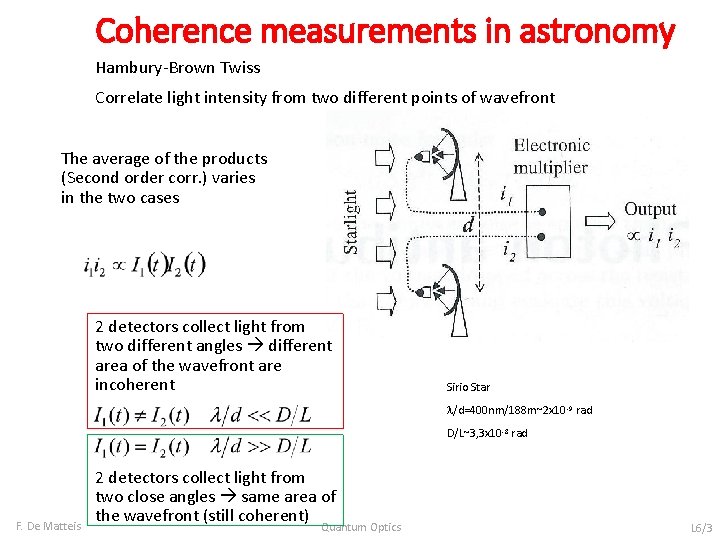
Coherence measurements in astronomy Hambury-Brown Twiss Correlate light intensity from two different points of wavefront The average of the products (Second order corr. ) varies in the two cases 2 detectors collect light from two different angles different area of the wavefront are incoherent Sirio Star l/d=400 nm/188 m~2 x 10 -9 rad D/L~3, 3 x 10 -8 rad F. De Matteis 2 detectors collect light from two close angles same area of the wavefront (still coherent) Quantum Optics L 6/3
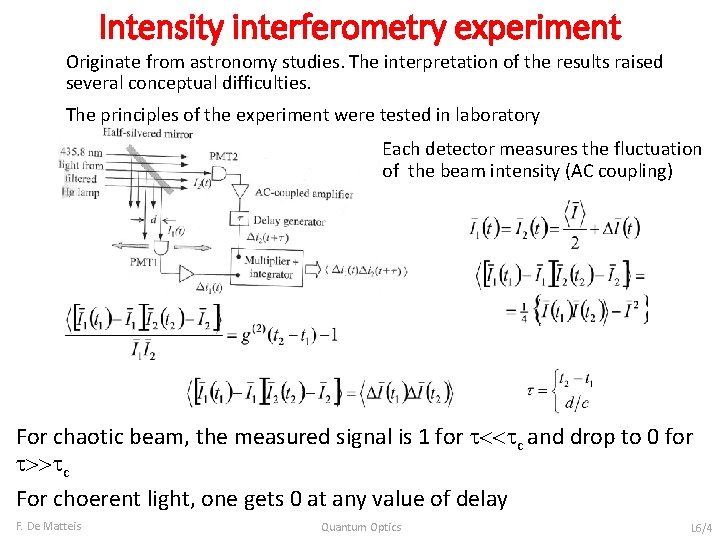
Intensity interferometry experiment Originate from astronomy studies. The interpretation of the results raised several conceptual difficulties. The principles of the experiment were tested in laboratory Each detector measures the fluctuation of the beam intensity (AC coupling) For chaotic beam, the measured signal is 1 for t<<tc and drop to 0 for t>>tc For choerent light, one gets 0 at any value of delay F. De Matteis Quantum Optics L 6/4
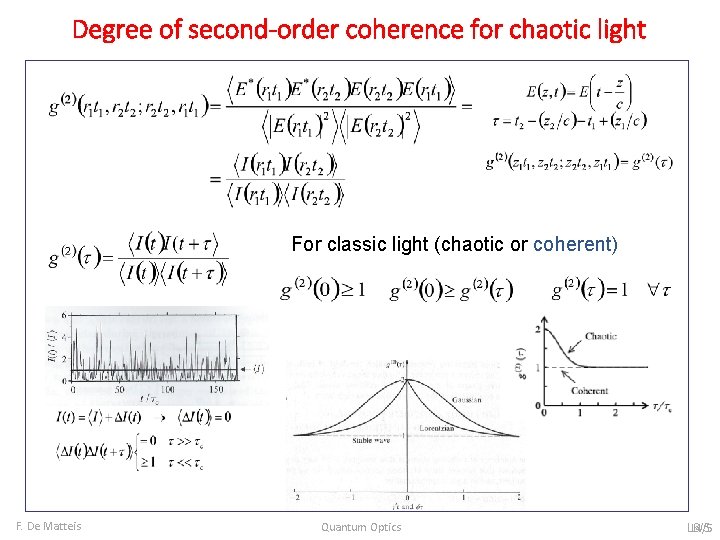
Degree of second-order coherence for chaotic light For classic light (chaotic or coherent) F. De Matteis Quantum Optics L 6/5 L 4/5
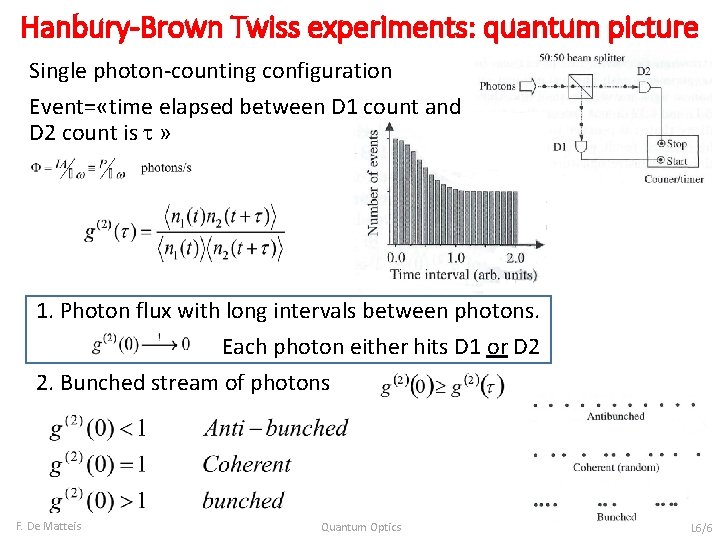
Hanbury-Brown Twiss experiments: quantum picture Single photon-counting configuration Event= «time elapsed between D 1 count and D 2 count is t » 1. Photon flux with long intervals between photons. Each photon either hits D 1 or D 2 2. Bunched stream of photons F. De Matteis Quantum Optics L 6/6
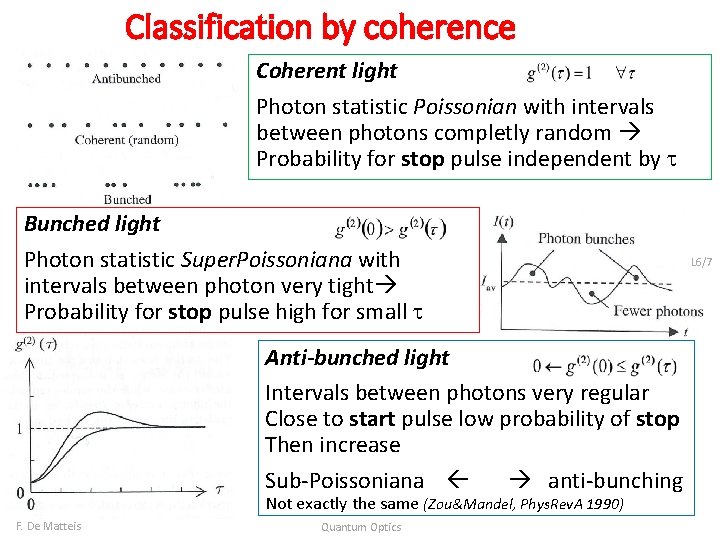
Classification by coherence Coherent light Photon statistic Poissonian with intervals between photons completly random Probability for stop pulse independent by t Bunched light Photon statistic Super. Poissoniana with intervals between photon very tight Probability for stop pulse high for small t Anti-bunched light Intervals between photons very regular Close to start pulse low probability of stop Then increase Sub-Poissoniana anti-bunching Not exactly the same (Zou&Mandel, Phys. Rev. A 1990) F. De Matteis Quantum Optics L 6/7
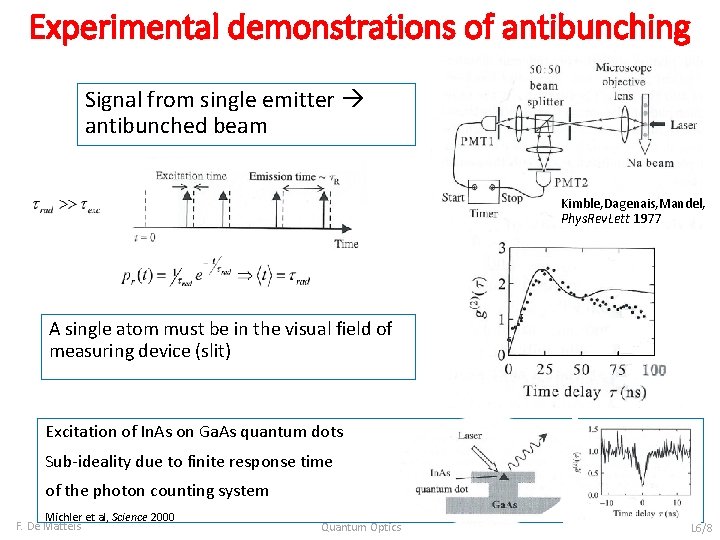
Experimental demonstrations of antibunching Signal from single emitter antibunched beam Kimble, Dagenais, Mandel, Phys. Rev. Lett 1977 A single atom must be in the visual field of measuring device (slit) Excitation of In. As on Ga. As quantum dots Sub-ideality due to finite response time of the photon counting system Michler et al, Science 2000 F. De Matteis Quantum Optics L 6/8
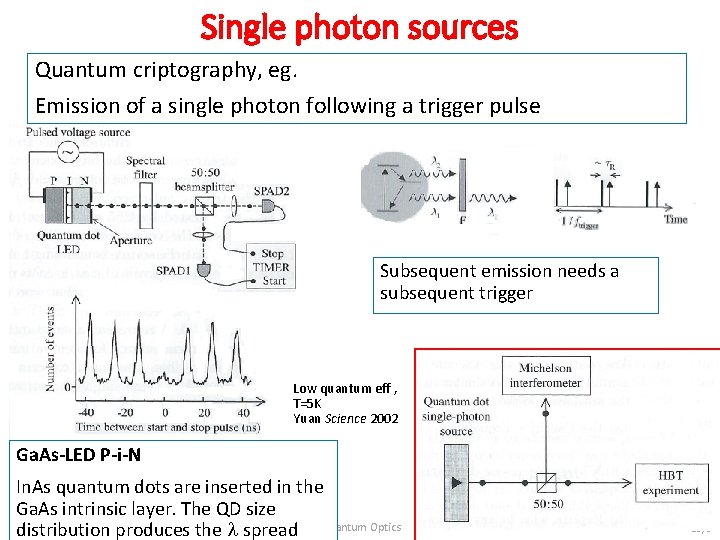
Single photon sources Quantum criptography, eg. Emission of a single photon following a trigger pulse Subsequent emission needs a subsequent trigger Low quantum eff , T=5 K Yuan Science 2002 Ga. As-LED P-i-N In. As quantum dots are inserted in the Ga. As intrinsic layer. The QD size F. De Matteis distribution produces the l spread Quantum Optics L 6/9
- Slides: 9