
Classification BIOLOGY Unit 2 1 Double Award Unit
Classification BIOLOGY Unit 2. 1 Double Award Unit 4. 1
Classifying Organisms It’s likely that there around 8. 7 million species of living organisms on earth! Only about 1. 8 million of these have been named. In order to make it easier to study organisms, scientists sort them into groups – this is called classification.

Why classify organisms? Scientists place similar organisms in the same group as a systematic approach helps in the understanding of the variety of living things, their trends and relationships. The classification system may be based on morphological features or DNA analysis.

The grouping system Kingdom The first group that organisms are placed into is a Kingdom. Examples are Animals and Plants can then be grouped into smaller groups - flowering and non-flowering Animals are grouped into vertebrates and invertebrates.

Classifying the Tiger Kingdom Animal Phylum Chordates (vertebrates) Class Mammal Order Carnivore Family Felidae Genus Panthera Species tigris

Scientific name In order to give an organism its scientific name, you take the name of its genus and its species e. g. with the tiger it is Panthera tigris. This is called the binomial system of naming organisms. The name appears in italics with the first letter of the genus written in a capital letter.
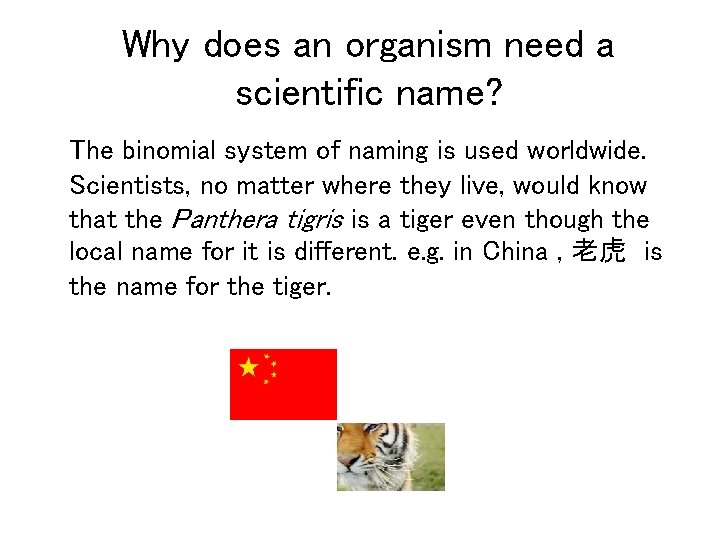
Why does an organism need a scientific name? The binomial system of naming is used worldwide. Scientists, no matter where they live, would know that the Panthera tigris is a tiger even though the local name for it is different. e. g. in China , 老虎 is the name for the tiger.

Why Latin? The names of the groups come from the Latin. This is because it was the scientist Carl von Linne (1707 1778) who established the binomial system of classification. He was so fond of the Latin language that he even changed his own name to Carolus Linnaeus. In those days, Latin was the main language for teaching science. The names have remained to this day.
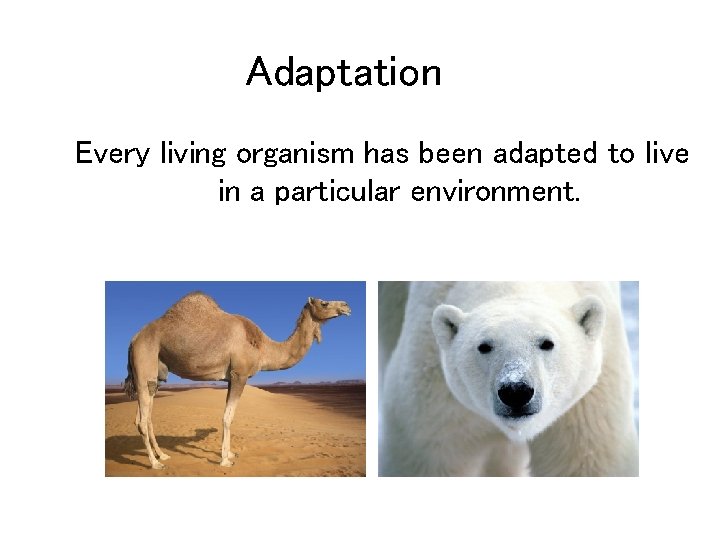
Adaptation Every living organism has been adapted to live in a particular environment.
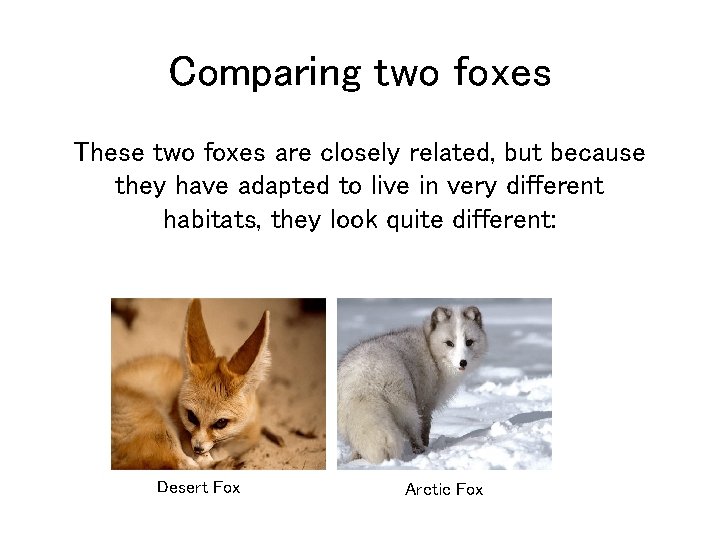
Comparing two foxes These two foxes are closely related, but because they have adapted to live in very different habitats, they look quite different: Desert Fox Arctic Fox
Differences between the foxes Size of the ear – a large surface area to the outer ear (pinna) allows heat to radiate from the body and a smaller outer ear retains as much heat as possible. Body fat and thick fur coat – this is more apparent in arctic animals that want to insulate their bodies as efficiently as possible. Colour – having fur that’s the same colour as the environment allows animals to blend into their background and become more difficult to see. This is called camouflage.
Plant Adaptation Plants are also adapted to live in their specific habitats. If a plant lives in a hot, arid (dry) habitat, then it must be very efficient at conserving water.
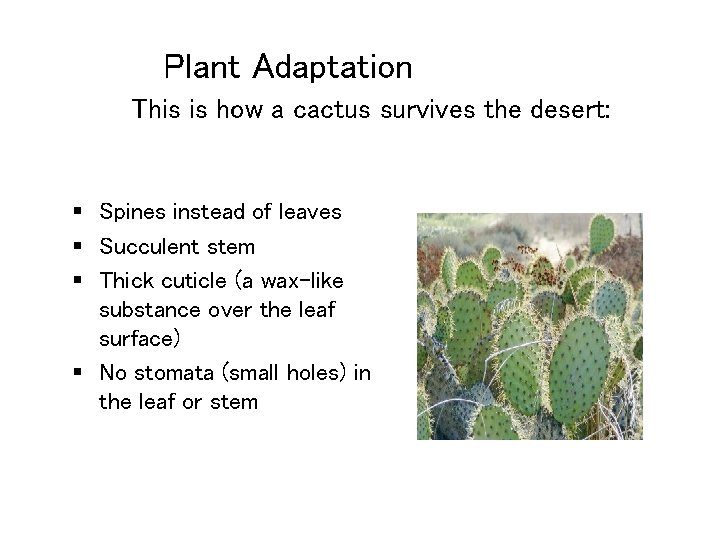
Plant Adaptation This is how a cactus survives the desert: § Spines instead of leaves § Succulent stem § Thick cuticle (a wax-like substance over the leaf surface) § No stomata (small holes) in the leaf or stem
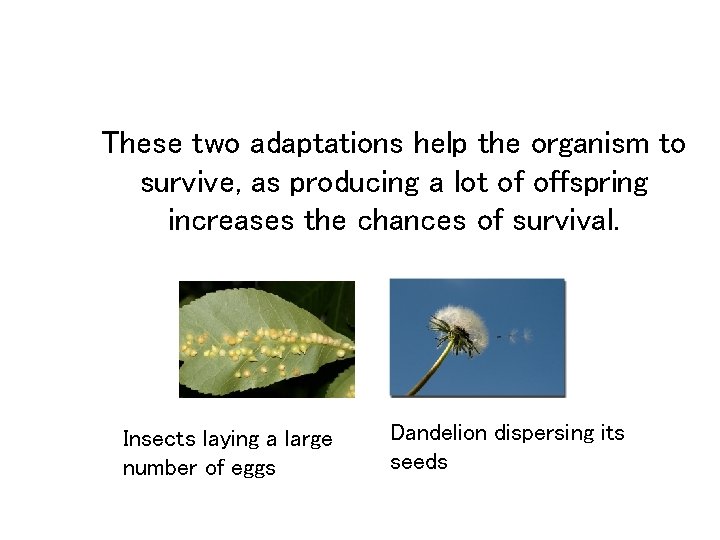
These two adaptations help the organism to survive, as producing a lot of offspring increases the chances of survival. Insects laying a large number of eggs Dandelion dispersing its seeds
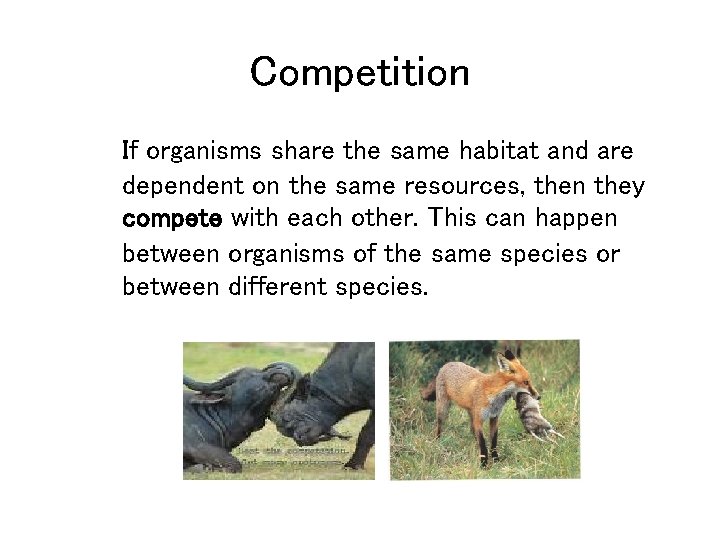
Competition If organisms share the same habitat and are dependent on the same resources, then they compete with each other. This can happen between organisms of the same species or between different species.
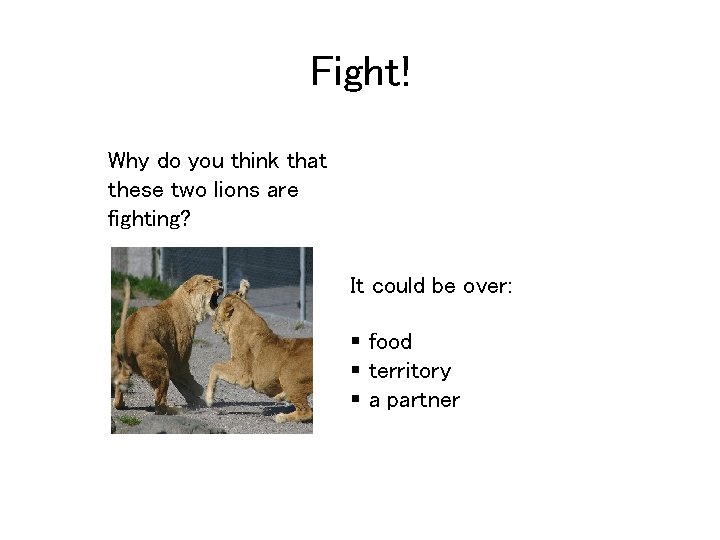
Fight! Why do you think that these two lions are fighting? It could be over: § food § territory § a partner
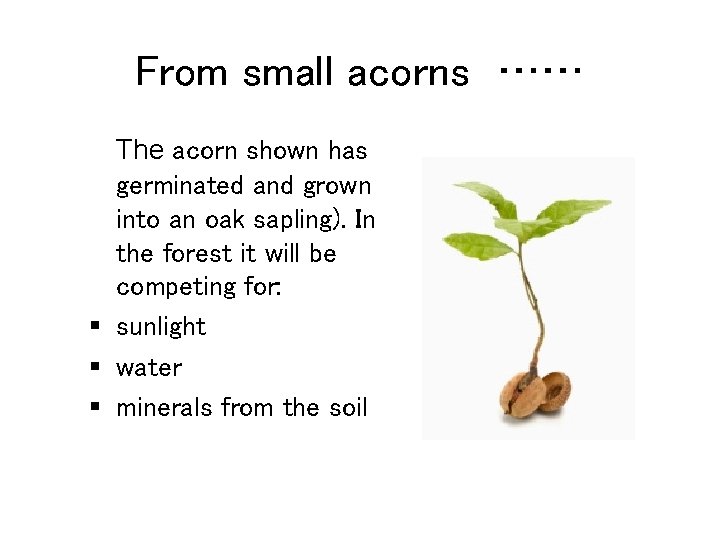
From small acorns …… The acorn shown has germinated and grown into an oak sapling). In the forest it will be competing for: § sunlight § water § minerals from the soil
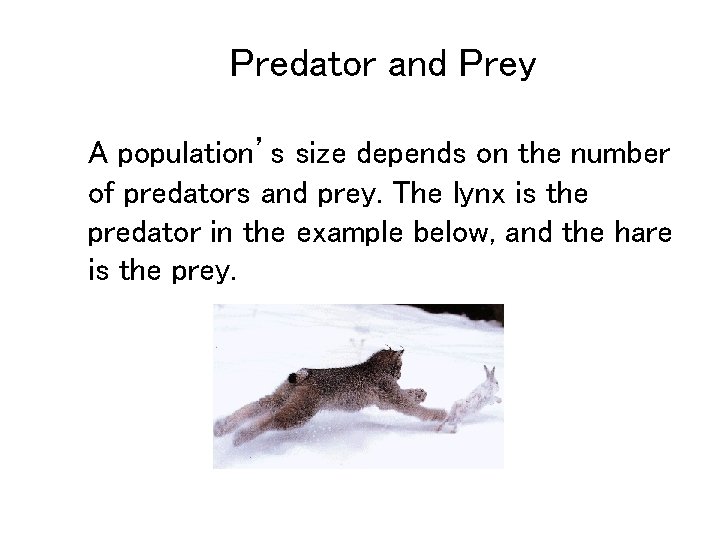
Predator and Prey A population’s size depends on the number of predators and prey. The lynx is the predator in the example below, and the hare is the prey.
§ if the population of hare increases, there will be more food for the lynx and their numbers increase. § As more hares are eaten, their population decreases. § The pattern of a predator’s population matches that of its prey, as can be seen in the following graph:
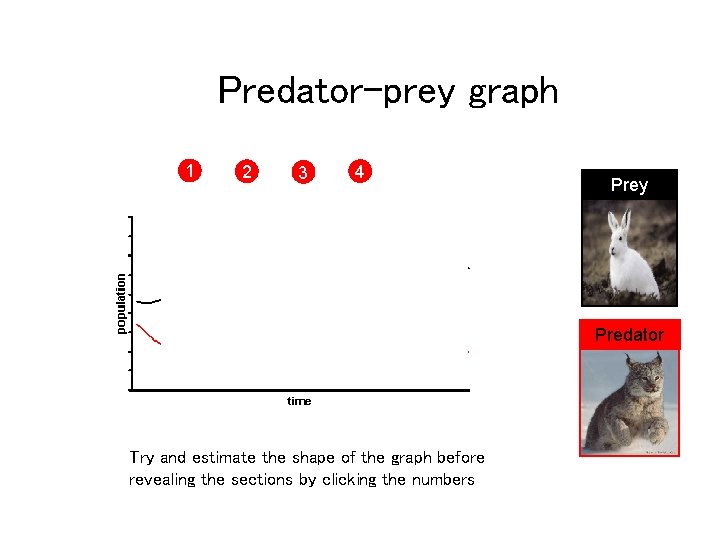
Predator-prey graph 1 2 3 4 Prey Predator Try and estimate the shape of the graph before revealing the sections by clicking the numbers
Other factors that affect population size Factors that affect the size of a population are: • Competition between species (interspecific) • Competition between members of the same species (intraspecific) • Predation • Pollution • Disease
- Slides: 21