
Classification and management of thoracolumbar fractures A summary
Classification and management of thoracolumbar fractures A summary Presenter’s name Arial 24 pt Meeting Arial 24 pt Presenter‘s title Arial 20 pt City, Month, Year Arial 20 pt
Learning outcomes • Apply an appropriate anatomical classification of thoracolumbar fractures to facilitate communication with colleagues and senior surgeons • Identify the morphology and mechanism of a thoracolumbar injury
Lecture outline • Assessment: examination and imaging • Review of classification systems • Strengths and weaknesses of classification systems • Recommendations for clinical use • Discuss management principles
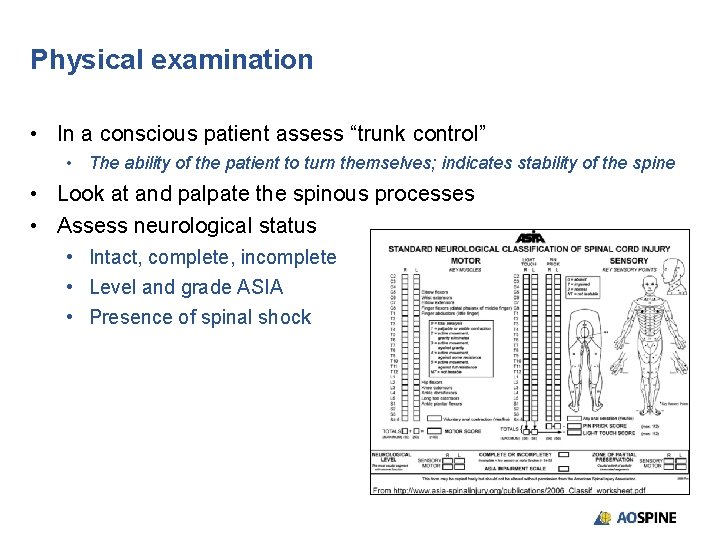
Physical examination • In a conscious patient assess “trunk control” • The ability of the patient to turn themselves; indicates stability of the spine • Look at and palpate the spinous processes • Assess neurological status • Intact, complete, incomplete • Level and grade ASIA • Presence of spinal shock
Imaging • X-rays: Obtain trauma series: AP and lateral • Look for: • • Alignment Spinous process position and alignment Pedicles Posterior vertebral wall Interspinous distance: PLC disruption Interpedicular distance: Burst fracture Vertebral body height Wedging and kyphosis
Imaging • CT and MRI when appropriate based on plain x-ray findings or clinical examination • May also be needed to rule out injuries in unconscious or uncooperative patients • Look for: • • • Alignment Comminution and extent of fracture Integrity of disc and ligamentous structures Canal compromise Neural/cord injury

Classification system Indicate severity Facilitate communication Classification system Enable consistency (research) Define morphology Guide treatment
Classification system Considerations • Mechanism of injury—distraction, compression, flexion, etc • Morphology—dislocation, burst, split, comminution, etc • Clinical situation and neurological impairment • Should assist the clinician in decision making regarding appropriate treatment • Must be easy to apply and reproducible • Must be clinically relevant
Classification system—evolution • Nicoll (1949) reported that the combination of anterior wedge fractures and posterior ligament disruption was “unstable”
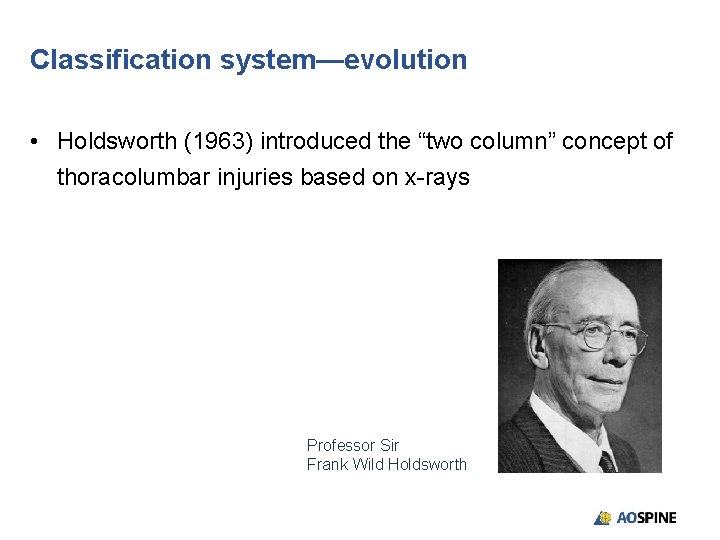
Classification system—evolution • Holdsworth (1963) introduced the “two column” concept of thoracolumbar injuries based on x-rays Professor Sir Frank Wild Holdsworth

Classification system—evolution • Holdsworth (1963) introduced the “two column” concept of thoracolumbar injuries based on x-rays Anterior vertebral column
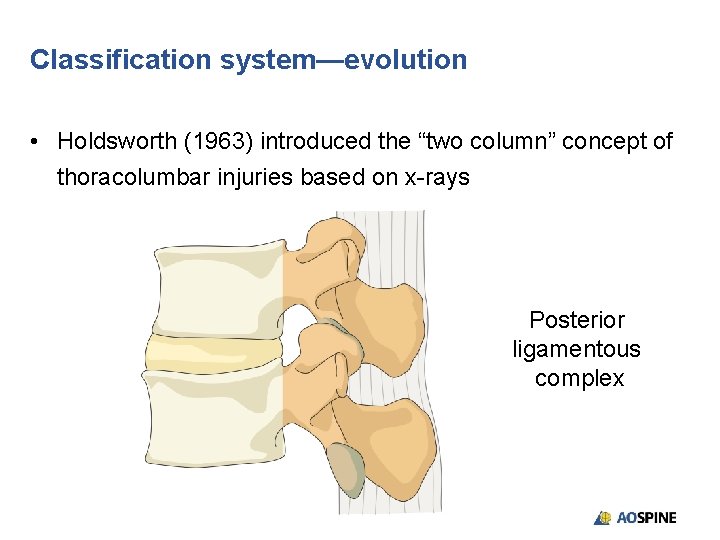
Classification system—evolution • Holdsworth (1963) introduced the “two column” concept of thoracolumbar injuries based on x-rays Posterior ligamentous complex

Classification system—evolution • Holdsworth (1963) introduced the “two column” concept of thoracolumbar injuries based on x-rays • He emphasized the importance of the mechanism of injury and integrity of the posterior ligament complex (PLC) in relation to the need for treatment and the clinical outcome

Classification system—evolution • With the advent of CT, Denis (1983) introduced the “three column” concept, relating to assessment of the integrity of the posterior vertebral body
Classification system—evolution • With the advent of CT, Denis (1983) introduced the “three column” concept, relating to assessment of the integrity of the posterior vertebral body • Separated injuries into minor and major groups • Compromise of two columns considered to be associated with an “unstable” fracture

Denis classification • Minor fractures: • Transverse process • Articular process • Pars interarticularis • Spinous process

Denis classification • Major fractures Compression Burst Seat-belt fracture Fracture-dislocation
Denis classification • Simple and was commonly used • Good intra- and interobserver reliability (κ=0. 6) • Does not take into consideration the integrity of the PLC • Not useful in clinical setting • Insufficient detail to indicate need, or approach, for surgical intervention
Classification system—evolution • Mc. Cormack et al (1994) load sharing classification • Primarily used to assess the integrity of anterior column and the need for anterior column reconstruction
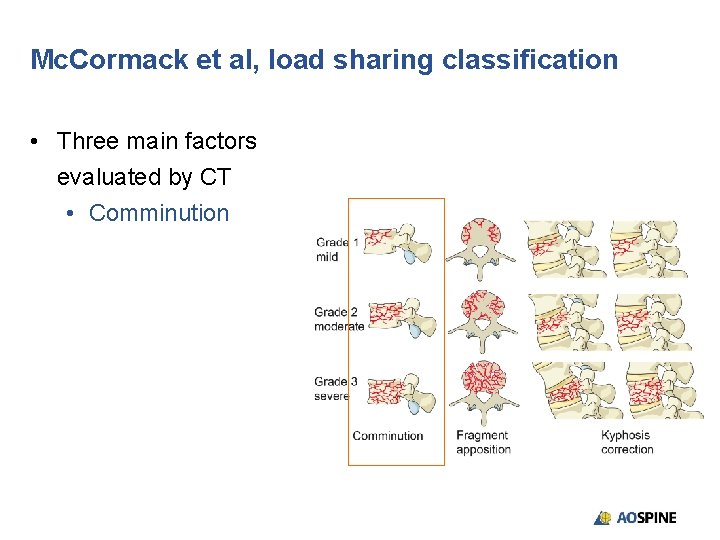
Mc. Cormack et al, load sharing classification • Three main factors evaluated by CT • Comminution
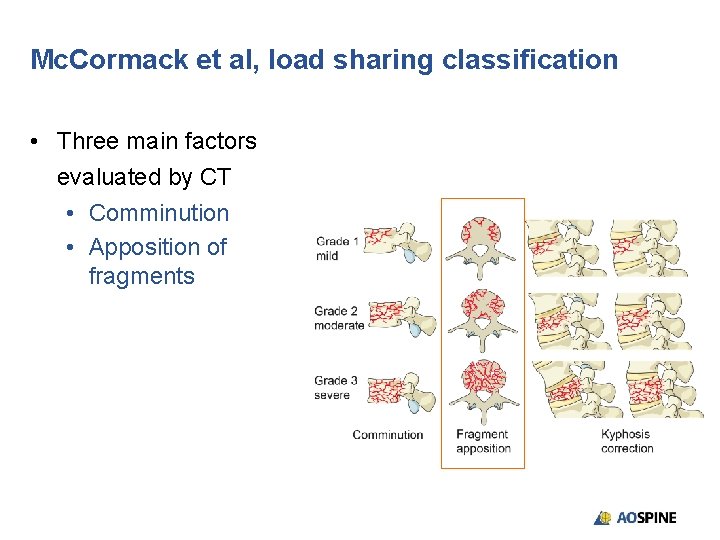
Mc. Cormack et al, load sharing classification • Three main factors evaluated by CT • Comminution • Apposition of fragments
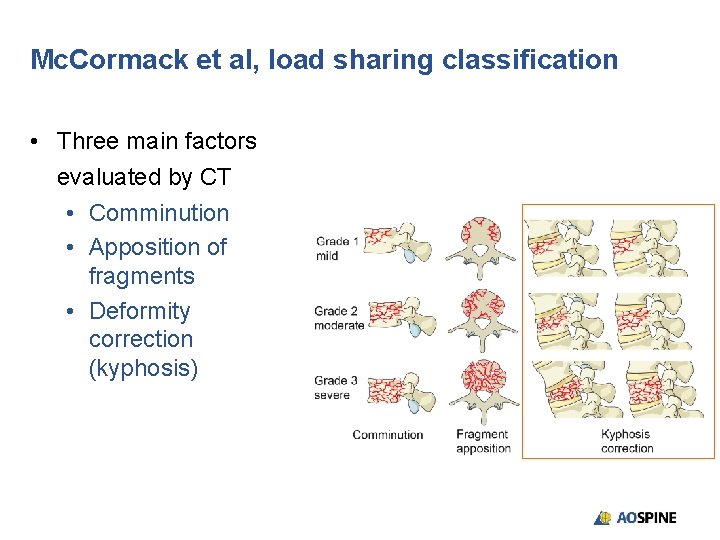
Mc. Cormack et al, load sharing classification • Three main factors evaluated by CT • Comminution • Apposition of fragments • Deformity correction (kyphosis)
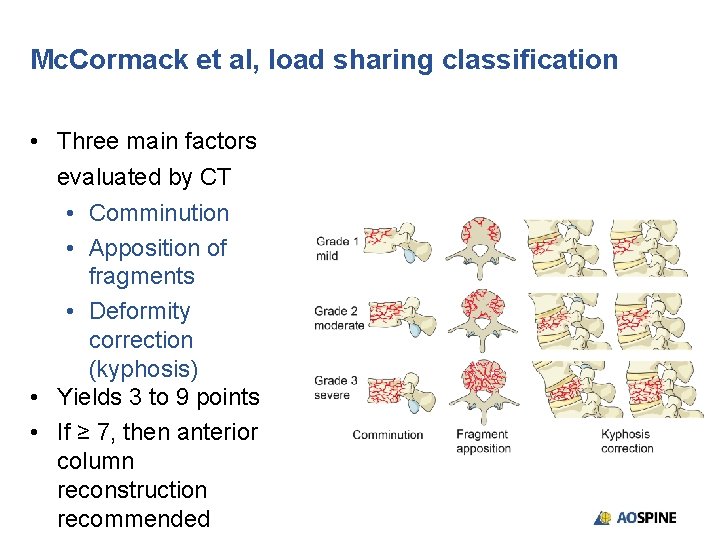
Mc. Cormack et al, load sharing classification • Three main factors evaluated by CT • Comminution • Apposition of fragments • Deformity correction (kyphosis) • Yields 3 to 9 points • If ≥ 7, then anterior column reconstruction recommended
Classification system—evolution • AO Classification also reported in 1994 • • Ranks injuries according to severity Predicts degrees of mechanical instability Indicates potential for neurological damage Facilitates management decisions
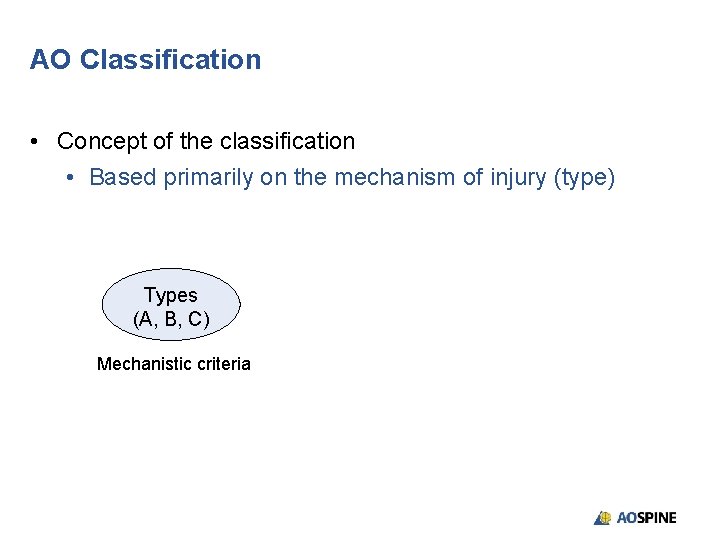
AO Classification • Concept of the classification • Based primarily on the mechanism of injury (type) Types (A, B, C) Mechanistic criteria
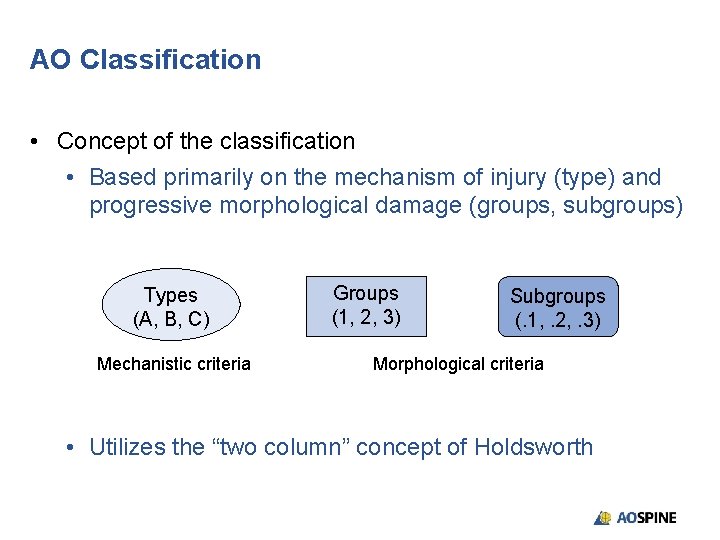
AO Classification • Concept of the classification • Based primarily on the mechanism of injury (type) and progressive morphological damage (groups, subgroups) Types (A, B, C) Mechanistic criteria Groups (1, 2, 3) Subgroups (. 1, . 2, . 3) Morphological criteria • Utilizes the “two column” concept of Holdsworth
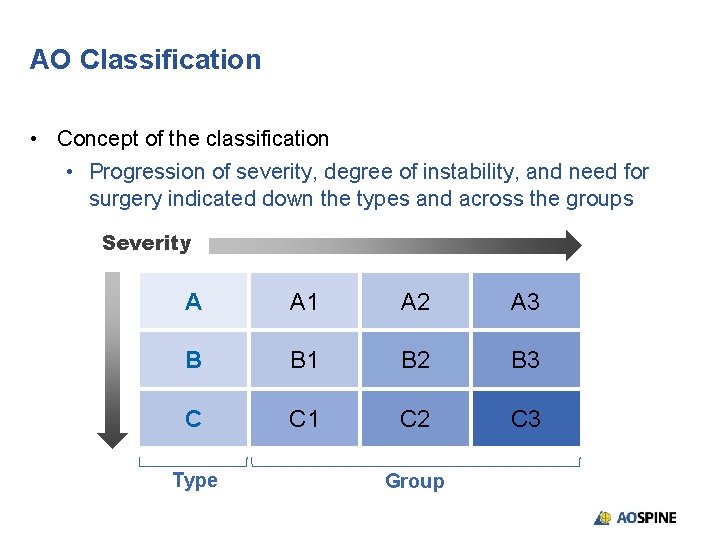
AO Classification • Concept of the classification • Progression of severity, degree of instability, and need for surgery indicated down the types and across the groups Severity A A 1 A 2 A 3 B B 1 B 2 B 3 C C 1 C 2 C 3 Type Group
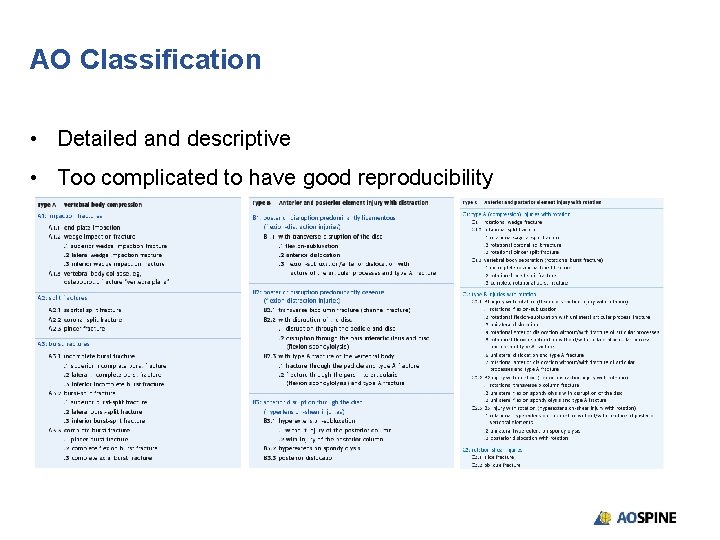
AO Classification • Detailed and descriptive • Too complicated to have good reproducibility
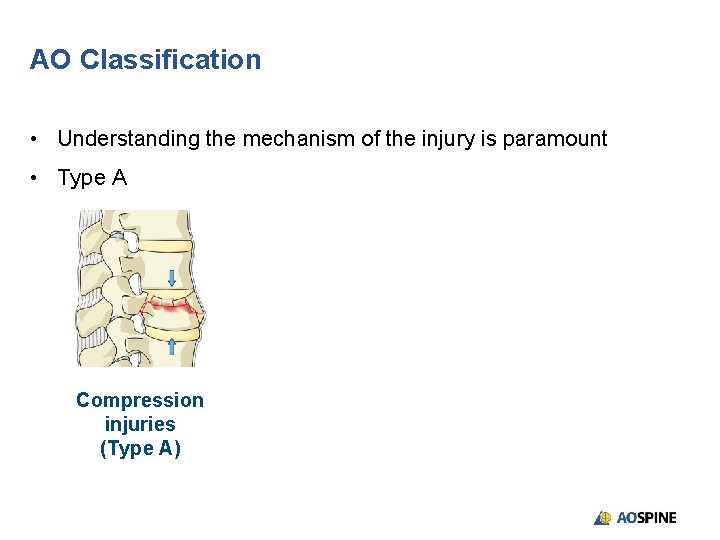
AO Classification • Understanding the mechanism of the injury is paramount • Type A Compression injuries (Type A)
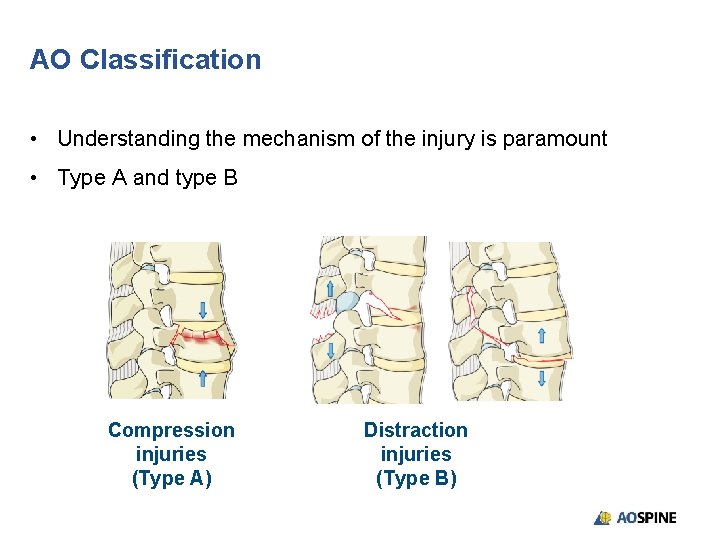
AO Classification • Understanding the mechanism of the injury is paramount • Type A and type B Compression injuries (Type A) Distraction injuries (Type B)
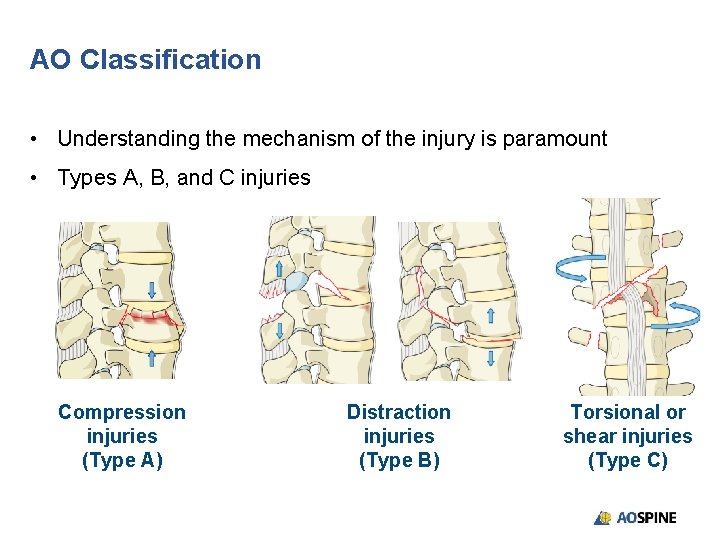
AO Classification • Understanding the mechanism of the injury is paramount • Types A, B, and C injuries Compression injuries (Type A) Distraction injuries (Type B) Torsional or shear injuries (Type C)
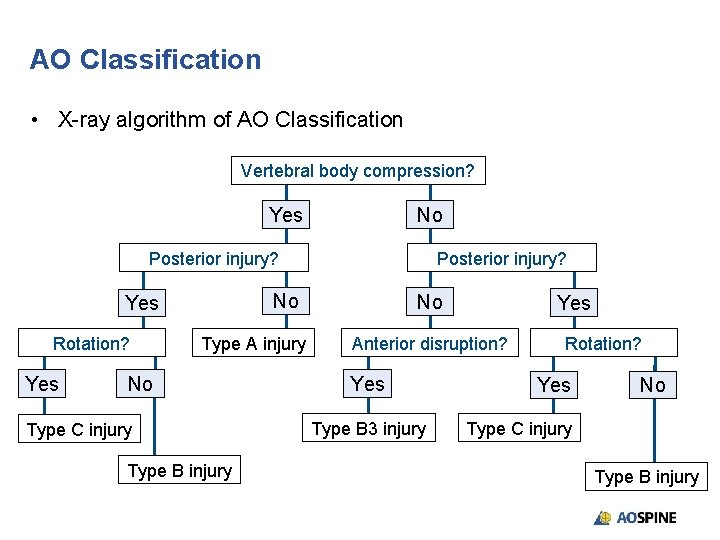
AO Classification • X-ray algorithm of AO Classification Vertebral body compression? No Yes Posterior injury? No Yes Rotation? Yes Posterior injury? Type A injury No Type C injury Type B injury No Yes Anterior disruption? Yes Type B 3 injury Rotation? Yes No Type C injury Type B injury
Classification system—evolution • Thoracolumbar Injury Classification and Injury Severity Score (TLISS and TLICS) (2008)
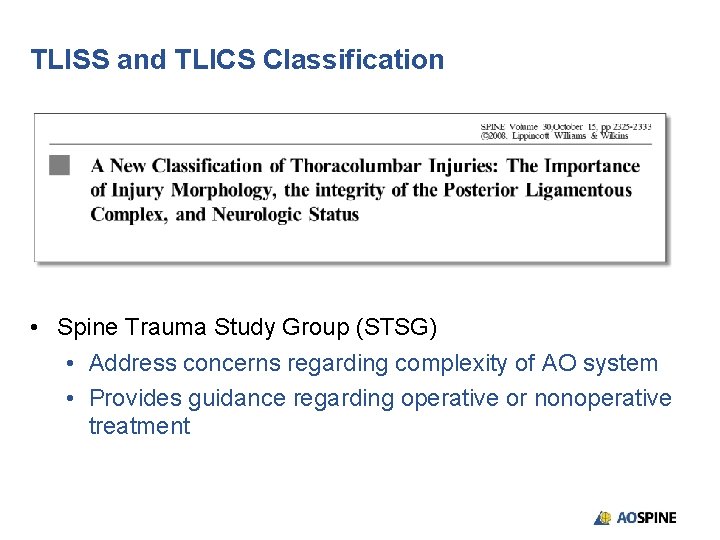
TLISS and TLICS Classification • Spine Trauma Study Group (STSG) • Address concerns regarding complexity of AO system • Provides guidance regarding operative or nonoperative treatment
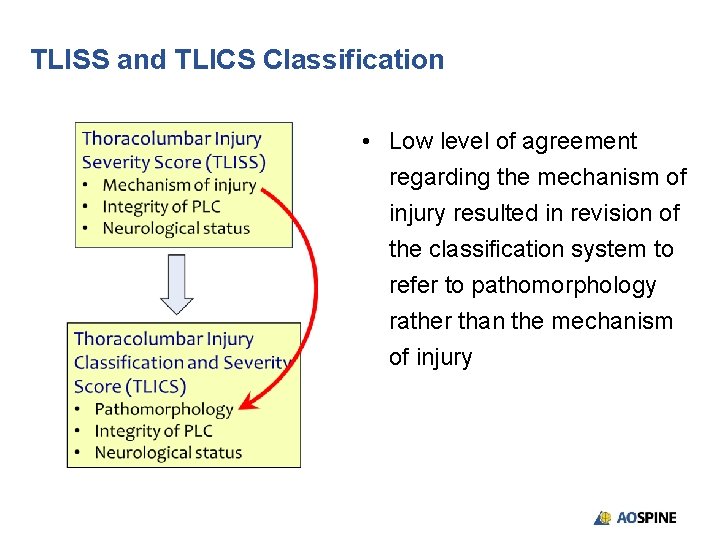
TLISS and TLICS Classification • Low level of agreement regarding the mechanism of injury resulted in revision of the classification system to refer to pathomorphology rather than the mechanism of injury
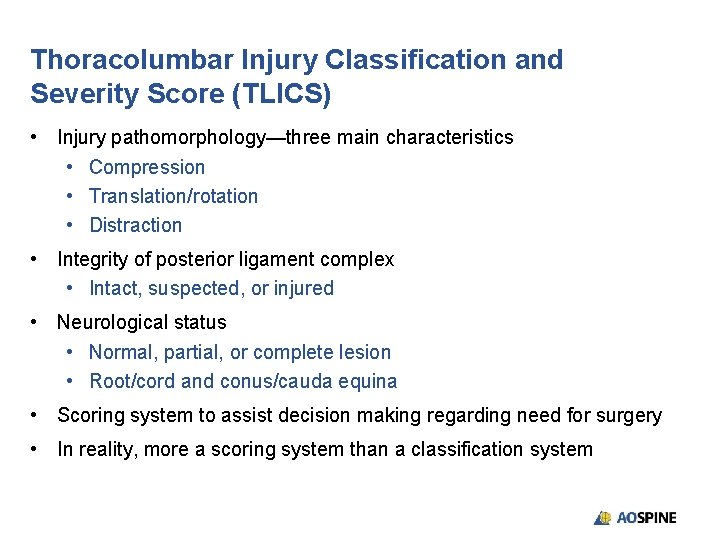
Thoracolumbar Injury Classification and Severity Score (TLICS) • Injury pathomorphology—three main characteristics • Compression • Translation/rotation • Distraction • Integrity of posterior ligament complex • Intact, suspected, or injured • Neurological status • Normal, partial, or complete lesion • Root/cord and conus/cauda equina • Scoring system to assist decision making regarding need for surgery • In reality, more a scoring system than a classification system

TLICS • Pathomorphology
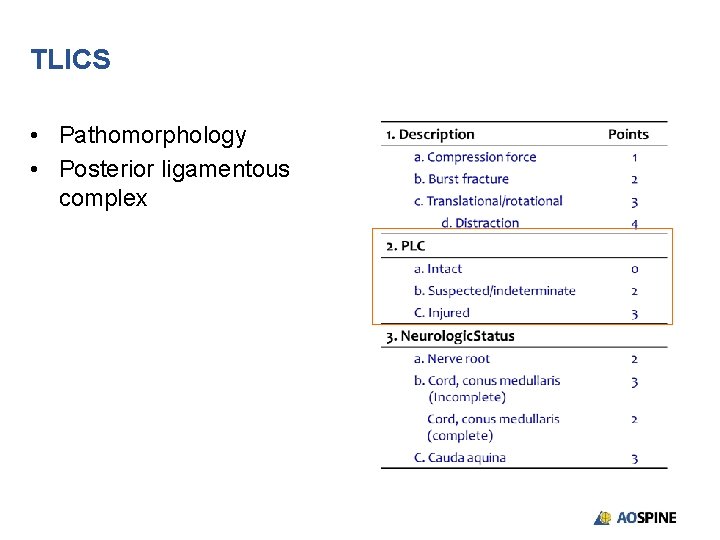
TLICS • Pathomorphology • Posterior ligamentous complex
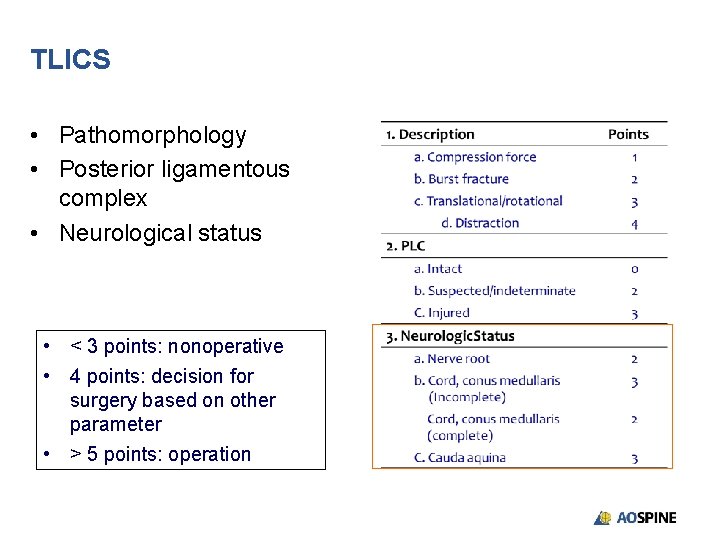
TLICS • Pathomorphology • Posterior ligamentous complex • Neurological status • < 3 points: nonoperative • 4 points: decision for surgery based on other parameter • > 5 points: operation
AOSpine Thoracolumbar Spine Injury Classification System
AOSpine Thoracolumbar Spine Injury Classification System • Brings together best features of AO Classification and TLICS • Morphological classification of the fracture • Grading system for neurological status • Incorporation of patient-specific clinical modifiers • Based on morphological classification analogous to AO System • Type A Compression injuries • Type B Failure of the posterior or anterior tension band without evidence of either gross translation or the potential for gross translation • Type C Failure of all elements leading to dislocation or displacement in any plane
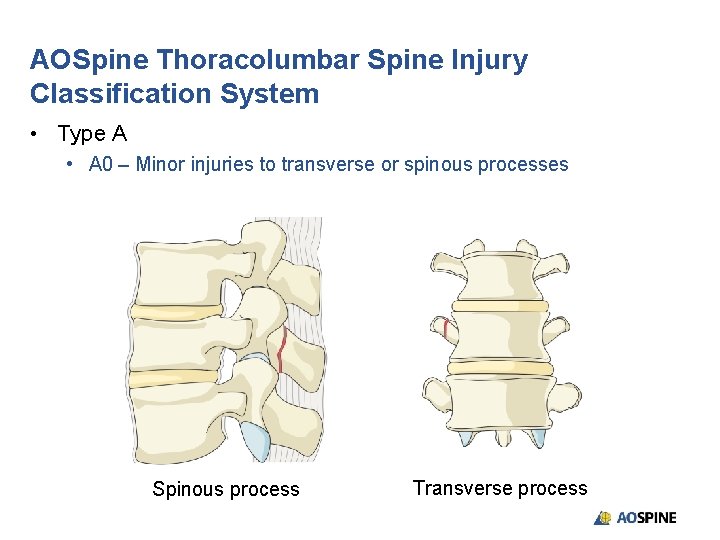
AOSpine Thoracolumbar Spine Injury Classification System • Type A • A 0 – Minor injuries to transverse or spinous processes Spinous process Transverse process
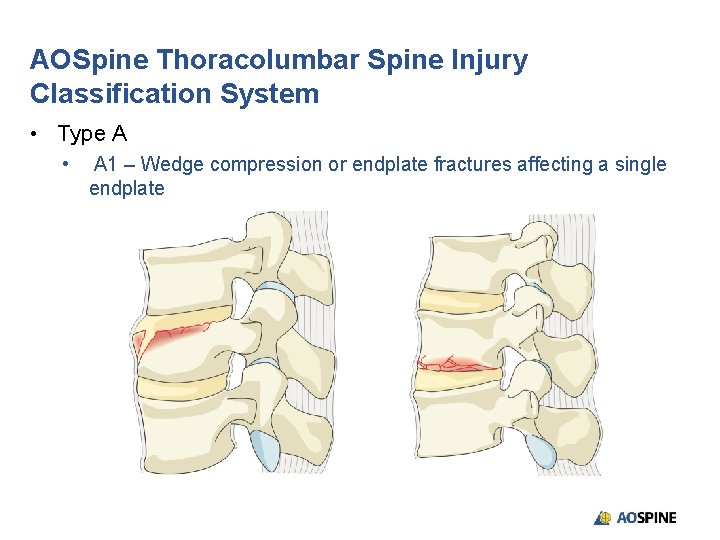
AOSpine Thoracolumbar Spine Injury Classification System • Type A • A 1 – Wedge compression or endplate fractures affecting a single endplate
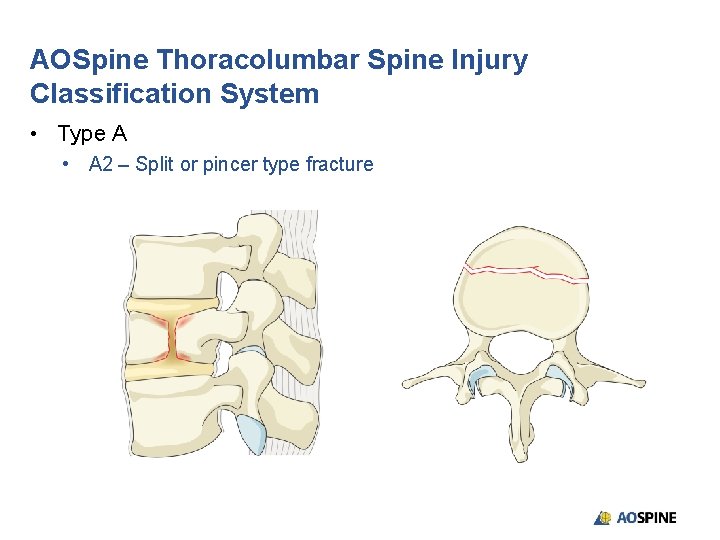
AOSpine Thoracolumbar Spine Injury Classification System • Type A • A 2 – Split or pincer type fracture
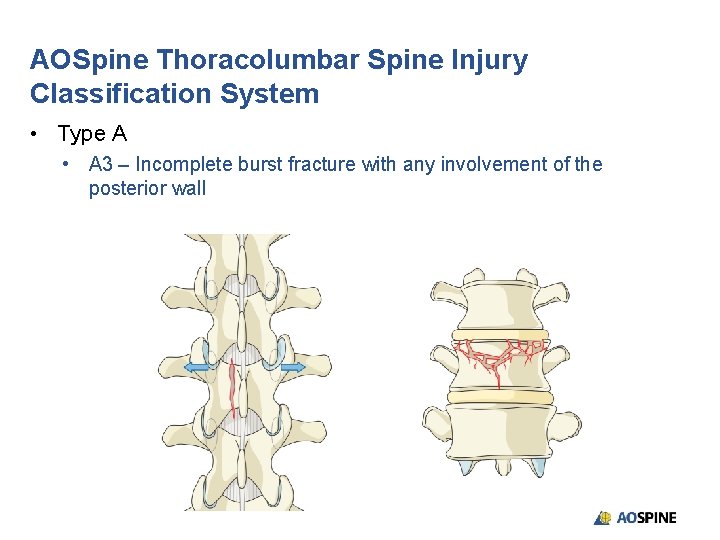
AOSpine Thoracolumbar Spine Injury Classification System • Type A • A 3 – Incomplete burst fracture with any involvement of the posterior wall
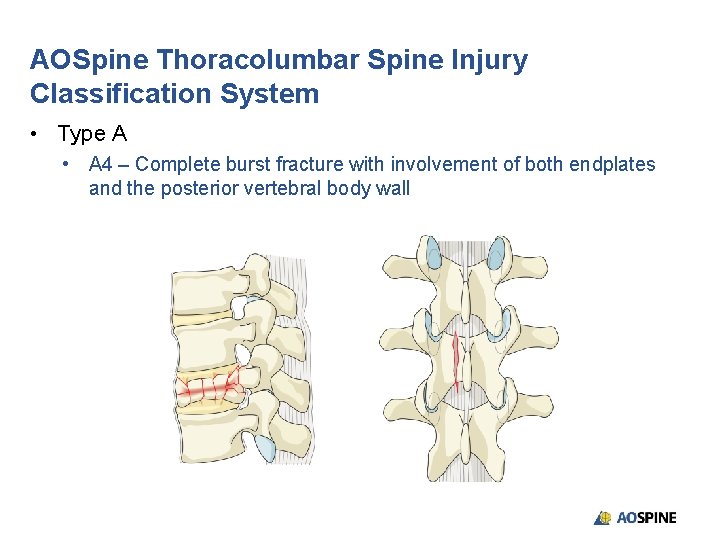
AOSpine Thoracolumbar Spine Injury Classification System • Type A • A 4 – Complete burst fracture with involvement of both endplates and the posterior vertebral body wall
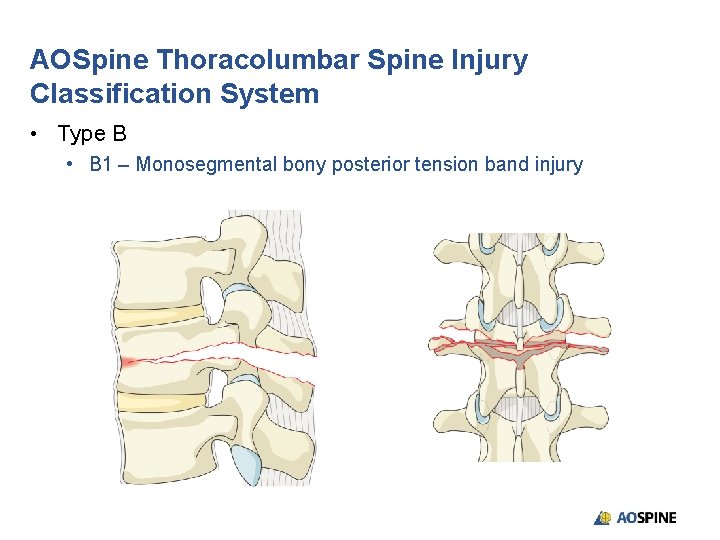
AOSpine Thoracolumbar Spine Injury Classification System • Type B • B 1 – Monosegmental bony posterior tension band injury
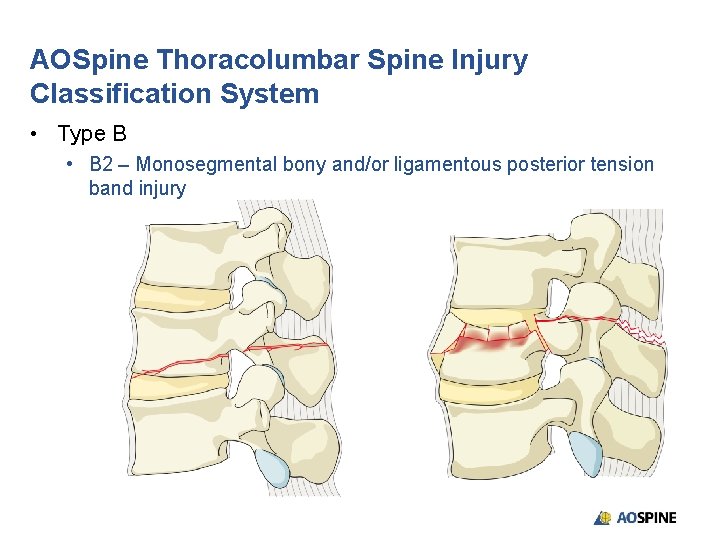
AOSpine Thoracolumbar Spine Injury Classification System • Type B • B 2 – Monosegmental bony and/or ligamentous posterior tension band injury
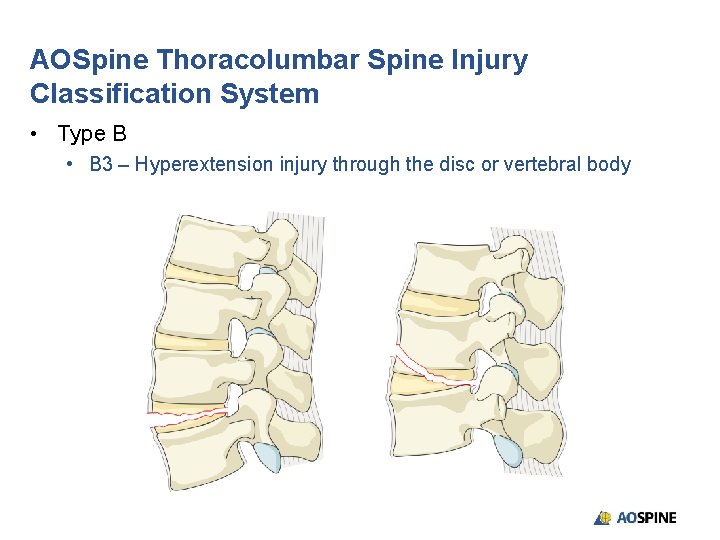
AOSpine Thoracolumbar Spine Injury Classification System • Type B • B 3 – Hyperextension injury through the disc or vertebral body
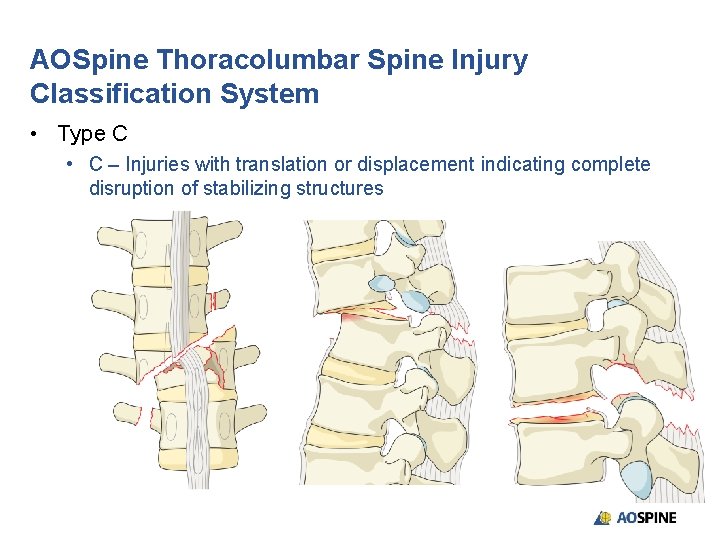
AOSpine Thoracolumbar Spine Injury Classification System • Type C • C – Injuries with translation or displacement indicating complete disruption of stabilizing structures
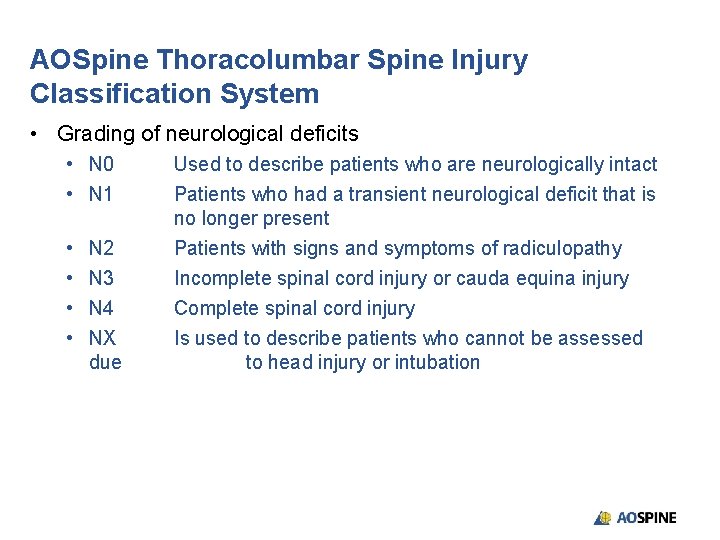
AOSpine Thoracolumbar Spine Injury Classification System • Grading of neurological deficits • N 0 • N 1 • • N 2 N 3 N 4 NX due Used to describe patients who are neurologically intact Patients who had a transient neurological deficit that is no longer present Patients with signs and symptoms of radiculopathy Incomplete spinal cord injury or cauda equina injury Complete spinal cord injury Is used to describe patients who cannot be assessed to head injury or intubation
AOSpine Thoracolumbar Spine Injury Classification System • Case-specific modifiers • M 1 • M 2 Fractures with an indeterminate injury to the tension band based on spinal imaging or examination Designates a patient-specific comorbidity that might influence decision making regarding surgery, eg, ankylosing spondylitis, rheumatologic conditions such as DISH, osteoporosis, etc.

What else do we need to consider? • Age
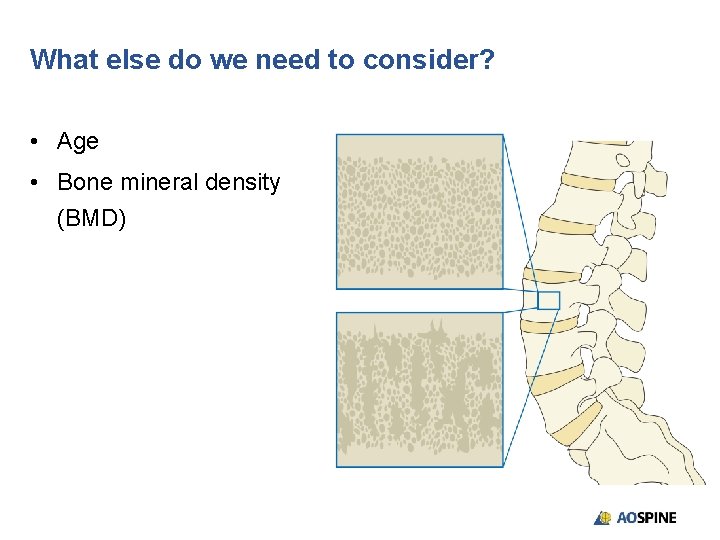
What else do we need to consider? • Age • Bone mineral density (BMD)
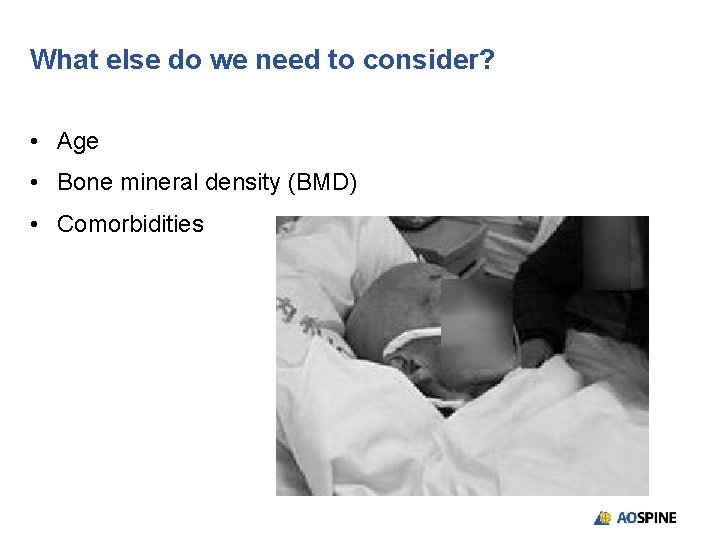
What else do we need to consider? • Age • Bone mineral density (BMD) • Comorbidities
Take-home messages • Multiple classification systems • Holdsworth’s two-column theory addresses the mechanism of injury and the PLC, which is the basis of the AO Classification • Denis’s three-column theory is user friendly but clinically not useful • Mc. Cormack classification addresses only the anterior column • AO Classification system is comprehensive but complicated with poor reproducibility—types and groups are useful • TLICS combines morphological and clinical information into a scoring system that indicates need for surgical intervention • AOSpine Thoracolumbar Spine Injury Classification System incorporates advantages of both AO and TLICS Classifications

Excellence in Spine
- Slides: 57