
CLASSIFICATION AND MANAGEMENT OF BILE DUCT INJURY Dr
CLASSIFICATION AND MANAGEMENT OF BILE DUCT INJURY Dr. Hung Ka Wai Ray Team 1 Hepatobiliary and Pancreatic Surgery Prince of Wales Hospital
INTRODUCTION � Laparoscopic � Standard cholecystectomy treatment of symptomatic gallstone disease � > 750, 000 were performed annually in the United States � Less pain, fewer wound complication, quicker recovery � The only potential disadvantage is a higher incidence of major bile duct injury [1], 0. 3% open vs 0. 6% laparoscopic

INTRODUCTION � Bile duct injury is a very serious complication that lead to mortality, significant morbidity and impaired quality of life � Causes: � Iatrogenic � Cholecysectomy � Gastrectomy � Pancreatectomy � ERCP � Trauma (80 -85%) [2]

PRESENTATION � Intraoperative � Direct observation of a divided duct � Bile in the operative field � Abnormal intra-operative cholangiography � Postoperative � Bile leak � Bile in the drain � Biloma, biliary fistula, or bile ascites � Bile peritonitis in severe cases � Biliary obstruction � Obstructive � Cholangitis jaundice

CLASSIFICATION � � � � Bismuth Strasberg et al. Stewart et al. Mc. Mahon et al. AMA Neuhaus et al. Csendes et al. Hanover Lau and Lai Siewert et al. Cannon et al. Kapoor Sandha et al. EAES
STRASBERG ET AL.
STRASBERG ET AL.
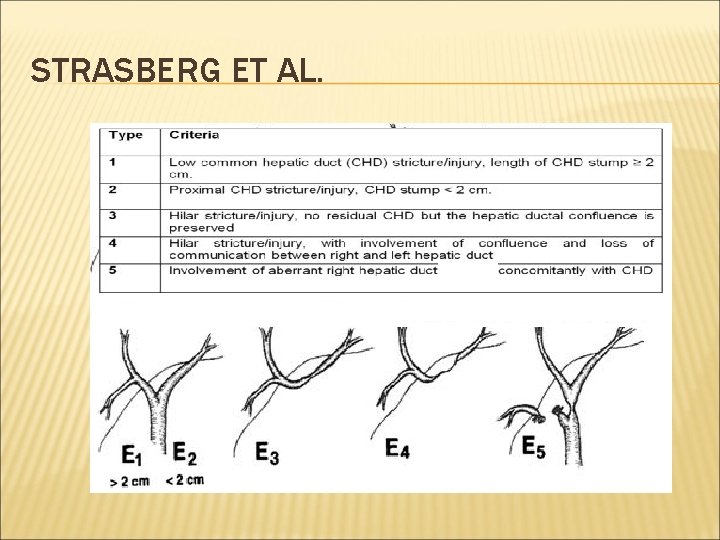
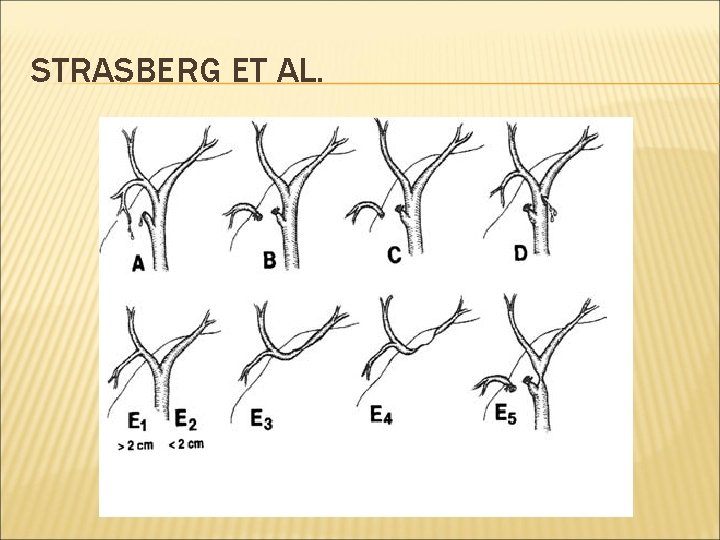
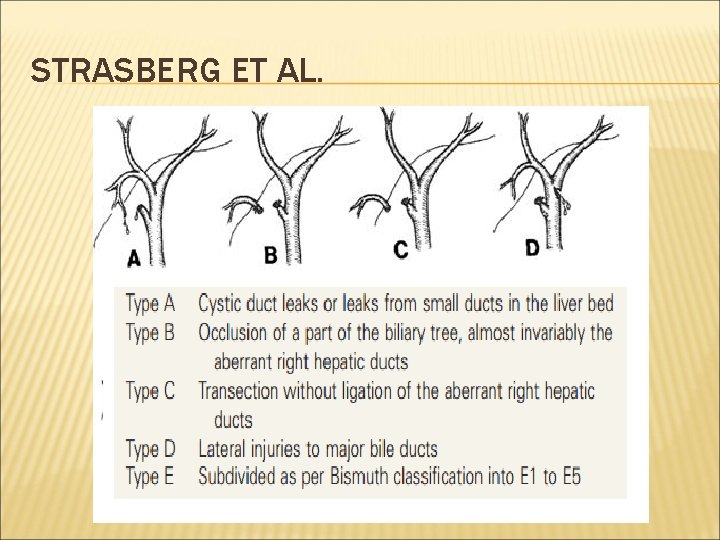
STRASBERG ET AL.
MANAGEMENT � Depend on the timing of recognition of the injury � Intraoperative vs postoperative recognition
![INTRAOPERATIVE RECOGNITION � � � Account for 25%– 32. 4% [3] First consult an](http://slidetodoc.com/presentation_image_h2/4171936e63f0c42fea79419cec123587/image-10.jpg "INTRAOPERATIVE RECOGNITION � � � Account for 25%– 32. 4% [3] First consult an")
INTRAOPERATIVE RECOGNITION � � � Account for 25%– 32. 4% [3] First consult an experienced hepatobiliary surgeon Convert to laparotomy with cholangiography � � If expertise a/v � � � Define the nature of the injury Immediate repair can minimize the morbidity Higher successful rate, fewer morbidty and mortality [4] If expertise not a/v � � Injudicious attempts at exploration may cause further biliary and vascular injury Subhepatic drain to prevent collection External biliary drainage Refer to a specialized hepatobiliary unit
POSTOPERATIVE RECOGNITION � Aim of management � Control sepsis and limit inflammation � Delineate the biliary anatomy and associated vascular injury � Re-establish the biliary enteric continuity
CONTROL SEPSIS � Fluid resuscitation � Broad spectrum antibiotic � Investigation � USG / CT to asses collection +/- drainage
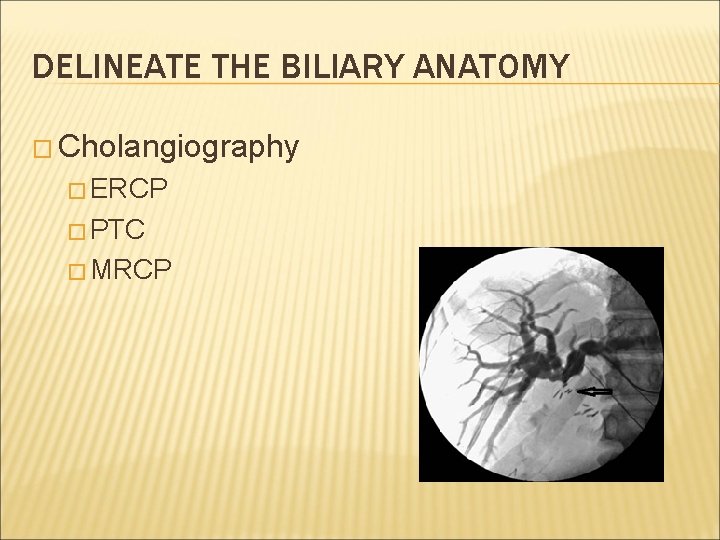
DELINEATE THE BILIARY ANATOMY � Cholangiography � ERCP � PTC � MRCP
![ASSOCIATED VASCULAR INJURY � CTA / MRA Incidence is around 16. 7%-47%[6] � Most](http://slidetodoc.com/presentation_image_h2/4171936e63f0c42fea79419cec123587/image-14.jpg "ASSOCIATED VASCULAR INJURY � CTA / MRA Incidence is around 16. 7%-47%[6] � Most")
ASSOCIATED VASCULAR INJURY � CTA / MRA Incidence is around 16. 7%-47%[6] � Most commonly involving the right hepatic artery � Does not usually lead to early significant complications � Impact on bile duct injury [7] � Associated with increased intraoperative bleeding during repair � Difficult reconstruction � Higher incidence of anastomotic stricture due to bile duct ischamemia � Delayed repair if VBI is present �
RE-ESTABLISH THE BILIARY ENTERIC CONTINUITY � According to the type of injury � Surgery vs endoscopic treatment
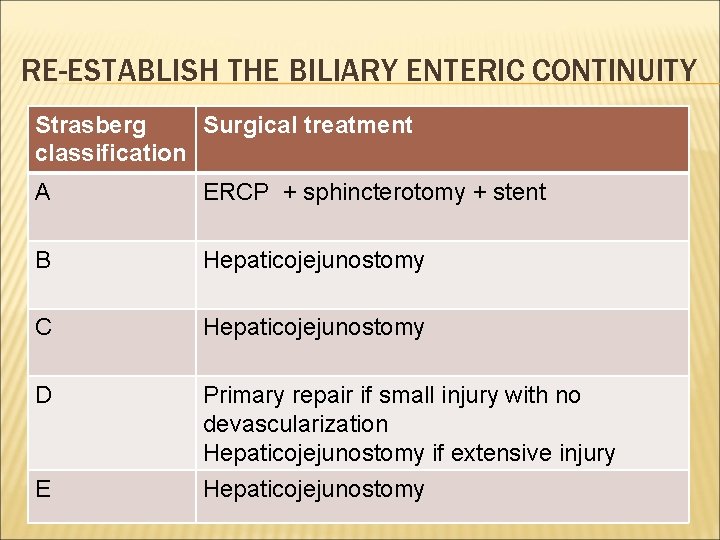
RE-ESTABLISH THE BILIARY ENTERIC CONTINUITY Strasberg Surgical treatment classification A ERCP + sphincterotomy + stent B Hepaticojejunostomy C Hepaticojejunostomy D Primary repair if small injury with no devascularization Hepaticojejunostomy if extensive injury E Hepaticojejunostomy
TREATMENT OF COMPLICATION � Stricture � Balloon dilatation and biliary stenting � Hepaticojejunostomy has higher successful rate � Secondary � Liver biliary cirrhosis transplantation
![REFERENCE [1] Acute bile duct injury. The need for a high repair. Surg Endosc](http://slidetodoc.com/presentation_image_h2/4171936e63f0c42fea79419cec123587/image-18.jpg "REFERENCE [1] Acute bile duct injury. The need for a high repair. Surg Endosc")
REFERENCE [1] Acute bile duct injury. The need for a high repair. Surg Endosc 2003; 17: 1351 -1355 [2] Bile duct injuries during laparoscopic cholecystectomy: primary and long term results from a single institution. Surg Endosc 2007; 21: 1069 -1073 [3] Stewart L, Way LW. Bile duct injuries during laparoscopic cholecystectomy. Factors that influence the results of treatment. Arch. Surg. 1995; 130: 1123– 8. [4] Surgical management of bile duct injuries sustained during laparoscopic cholecystectomy: perioperative results in 200 patients. Ann. Surg 2005; 241: 786 -90
![REFERENCE [5] Laparoscopic bile duct injuries: timing of surgical repair does not influence success](http://slidetodoc.com/presentation_image_h2/4171936e63f0c42fea79419cec123587/image-19.jpg "REFERENCE [5] Laparoscopic bile duct injuries: timing of surgical repair does not influence success")
REFERENCE [5] Laparoscopic bile duct injuries: timing of surgical repair does not influence success rate. A multivariate analysis of factors influencing surgical outcomes, HBP 2009, 11, 516 -522 [6] Management and outcome of patinets with combined bile duct and hepatic arterial injuries after laparoscopic cholecystectomy. Surgery 2004; 135: 613 -8 [7] Management of bile duct injury after laparoscopic cholecystectomy: a review, ANZ J Surg 80 (2010) 75 -81
- Slides: 19