
Classification and Evolutionary Evidence I Taxonomy A Branch

Classification and Evolutionary Evidence

I. Taxonomy A. Branch of biology that specializes in classifying organisms into a series of groups (taxa) called TAXONOMY.
• Aristotle (384 B. C. to 322 B. C) was the first person to classify organisms into the kingdoms of plants and animals. • Carolus Linnaeus (1707 -1778) is considered the father of taxonomy, because he created these taxa (groups) and organized living organisms based on their similarities. His system of classification is still used today!

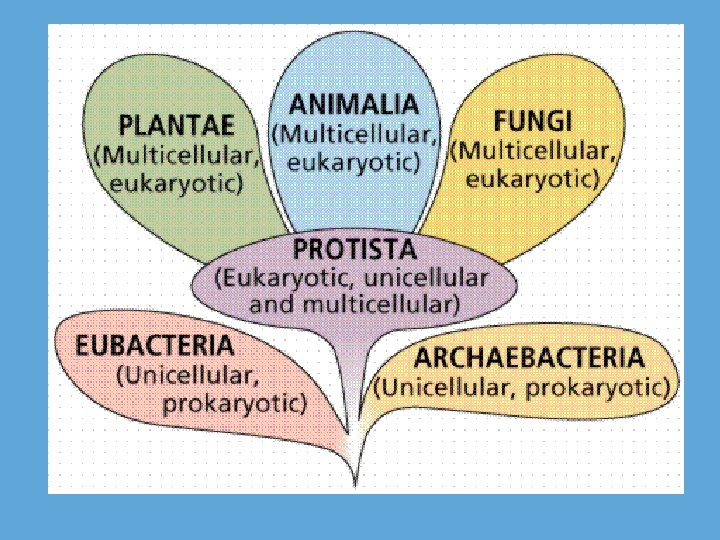
• In 1977, Carl Woese conducted molecular studies of ribosomal RNA and which shows different gene sequences of bacteria. • So, he split the bacteria into two separate kingdoms (Archaebacteria and Eubacteria) • He created the 3 main tree of life system • Domain: the highest taxonomic category, larger than a kingdom • 3 domains: Archaea, Eubacteria, Eukarya • Arachaea includes Kingdom Archaebacteria, Eubacteria includes the Kingdom Eubacteria, and Eukarya includes all eukaryotes (Kingdoms Plantae, Animalia, Protista, and Fungi)
Classification of the diversity of species is studied by: a) evolutionists b) taxonomists c) theorists d) taxidermists

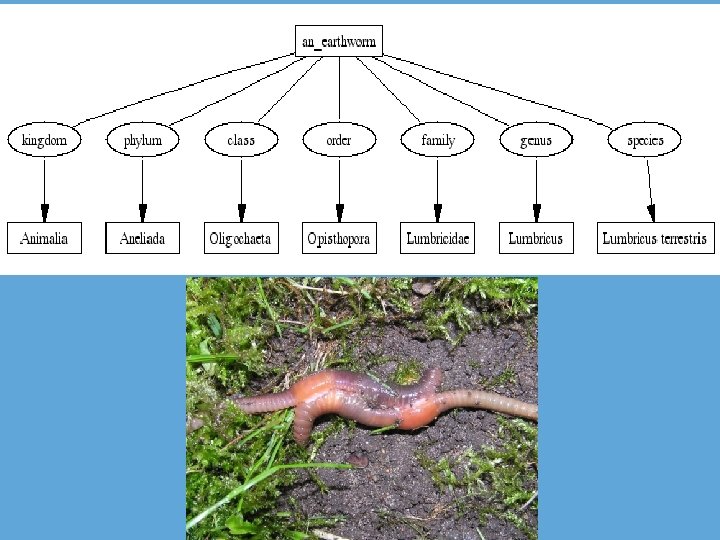
B. Linnaean Classification System 2. KINGDOM : (A group of related Phyla) a. Largest classification taxon b. Has the MOST organisms 3. PHYLUM : (A group of related classes) Called division when referring to plants 4. CLASS : (A group of related orders)
5. ORDER : (A group of related families) 6. FAMILY : (A group of related genera) 7. GENUS : (A group of related species) 8. SPECIES : a. Smallest taxon b. Has the LEAST # OF organisms c. Members of a species to be able to interbreed and produce fertile offspring
A group of related organisms that are able to interbreed in nature & produce fertile offspring is a: a) species b) phylum c) genus d) order
The taxonomic group that shows the greatest similarity among its members is the: a) kingdom b) class c) species d) family
Which statement describes organisms that are classified in the same genus? a) They must be in the same phylum, but may be of a different species. b) They must be of the same species, but may be in different phyla. c) They must be in the same kingdom, but may be in different phyla. d) They must be in the same class, but may be in different phyla.
As we move through the taxonomic groups from the kingdom to the species level, organisms: a) become more similar in appearance b) vary more & more c) are less related to each other
Which of these taxonomic classification groups has the fewest members? a) species b) family c) class d) genus
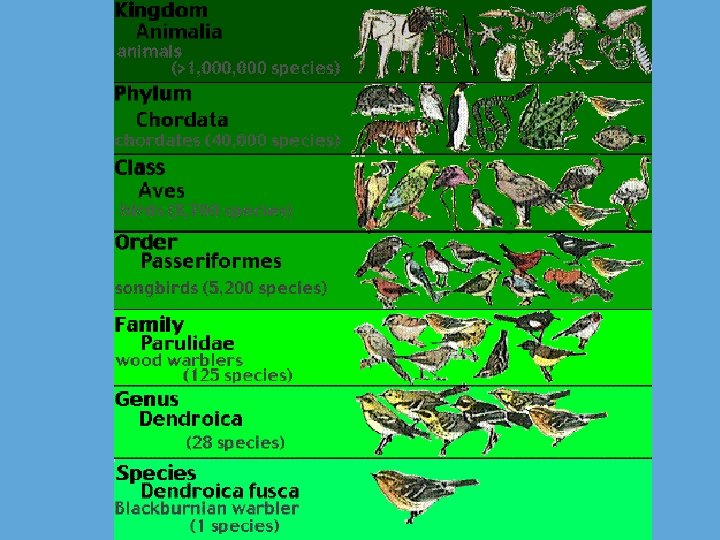
C. If an organism is in the same phylum then they are in the same KINGDOM. What if they were in the same family, what else would they be in that is the same? DOMAIN KINGDOM PHYLUM CLASS ORDER
D. Naming Organisms 1. Scientific names are made by using the GENUS and SPECIES. a. The genus is always written first and is capatilized. b. The species is always written second and is lowercase c. Both the genus and species are italicized 2. Binomial nomenclature: a. Uses TWO names (genus and species) to identify the organism. b. Carlous Linneaus gave us binomial nomenclature. c. Acer rubrum (Acer=genus) (rubrum=species)
The scientific name for the fruit fly is Drosophila melanogaster. The word Drosophila refers to the taxonomic group: a) kingdom b) genus c) species d) phylum
Scientists use a 2 -name method of providing scientific names to organisms that is called: a) binomial nomenclature b) scientific nomenclature c) theoretical nomenclature
The scientific name of an organism: a) varies according to the native language of scientists. b) is the same for scientists all over the world. c) may refer to more than 1 species. d) is different for scientist all over the world.
3. Trinomial nomenclature: a. used when organisms are divided into subspecies or varieties b. The first two names are still the GENUS and SPECIES but the third name is the subspecies or variety c. Example: Haliaeetus leucocephalus washingtoniensis; (Haliaeetus=genus) (leucocephalus=species) (washingtoniensis=subspecies)
The language of scientific names is: a) English b) Latin c) Spanish d) French
Of the following, Felis leo, is most closely related to: a) Rana pipiens b) Xenopus laevis c) Felis domesticus d) Elephas maximus
4. Scientific names tell you if two organisms are closely related. a. If the scientific names are Acer rubrum and Rana rubrum, are these two organisms closely related? NO b. If the scientific names are Acer rubrum and Acer saccharum, are these two organisms closely related? YES
Scientific names come from the taxonomic groups: a) kingdom & phylum b) class & family c) genus & species d) order & family
The red maple tree is known by the scientific name Acer rubrum. The sugar maple tree is known as Acer saccharum. What is the smallest classification division these trees have in common? a) phylum b) order c) genus d) species

It is easy to group snakes based on color. However, a scientist would prefer a system that shows how snakes: a) get their food b) shed their skin c) are genetically related d) mate
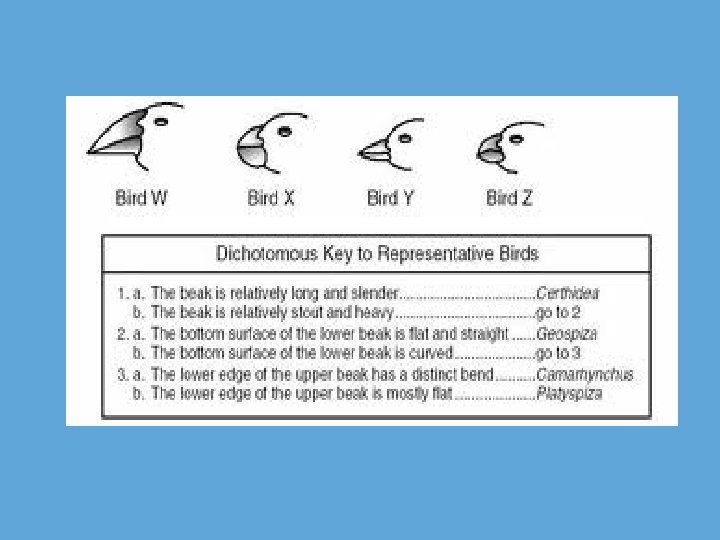
c. If you find an unknown organism, the best way to tell if the unknown organism is related to the known organism is to look at DNA comparisons d. Scientists also use diachotomous keys to determine what species an unknown organism is. i. It is a series of QUESTIONS that leads you to the organism’s name ii. you always start back at question one
There is a six-kingdom classification system: 1. Kingdom Archeabacteria 2. Kingdom Eubacteria 3. Kingdom Protista 4. Kingdom Fungi 5. Kingdom Plantae 6. Kingdom Animalia Kingdoms 1 and 2 used to be combined into Kingdom Monera

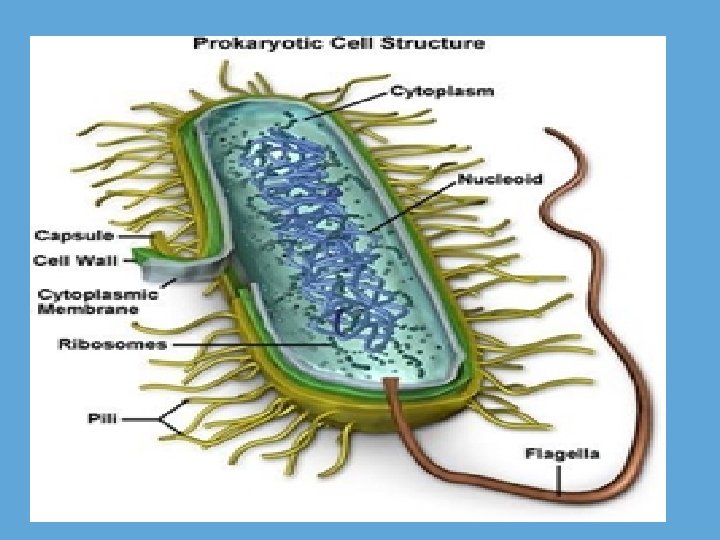
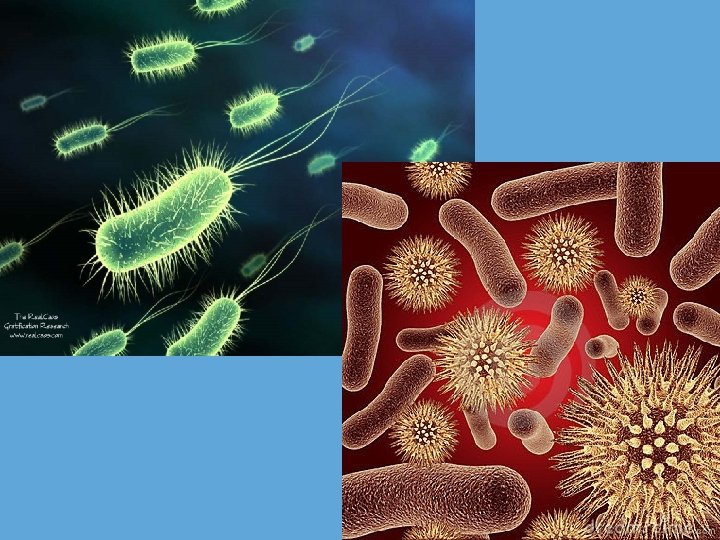
III. Kingdom Monera (Bacteria/Prokaryotic Cells) A. Now divided into Archeabacteria and Eubacteria B. Reproduce by binary fission C. All cells in kingdom monera are prokaryotic meaning they are lacking a nucleus and membrane-bound organelles and their DNA is found in the cytoplasm D. All prokaryotes contain a cell wall E. Most widespread and numerous organisms on Earth
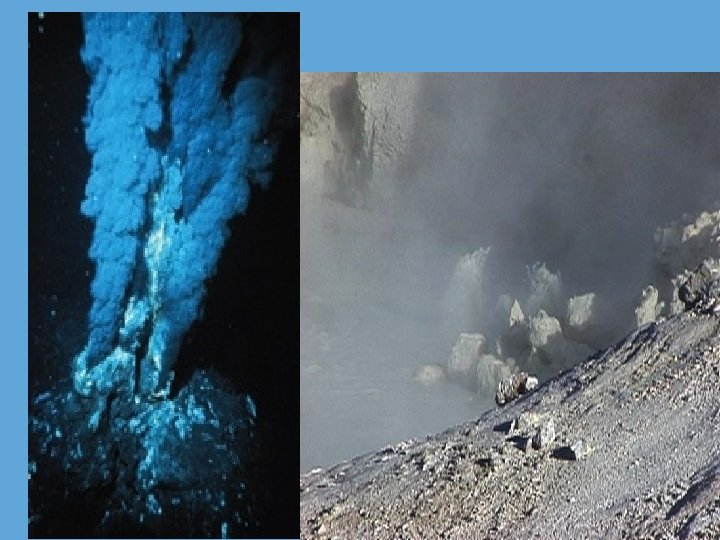
F. Kingdom Archaebacteria 1. Cell wall is NOT made of peptidoglycan (unlike Eubacteria) 2. Genes are more similar to eukaryotes than to eubacteria 3. oldest living organisms 4. Live in harsh environments: hot, salty, acidic, or alkaline habitats Ex: Hot sulfur springs, deep sea vents on the ocean floor, Great Salt Lakes, and intestines of mammals 5. Autotrophic and Heterotrophic 6. Can tell all the archeabacteria are related by their RNA sequencing
Kingdoms Archaebacteria and Eubacteria are sometimes referred to asa) Kingdom Arachaialeu b) Kingdom Euarchae c) Kingdom Monera d) Kingdom Protista
G. Kingdom Eubacteria- typical, TRUE, bacteria 1. Cell wall HAS peptidoglycan (unlike Archaebacteria) 2. Classified according to their shape, oxygen requirement, cell wall, disease causing ability, and reaction to Gram staining 3. Eubacteria Metabolism a. heterotrophic (must eat other organisms) b. parasitic (Live off of other organisms) c. decomposers (Eat dead and decaying organisms) d. Autotrophic (make their own food)
i. Photosynthetic Autotrophs: Contain chlorophyll; Use the sun’s energy to make food through photosynthesis ex: Cynobacteria ii. Chemosynthetic Autotrophs: Break down nitrogen and Sulfur to make organic compounds (glucose )
All bacteria: a) cause disease b) lack a nucleus c) are autotrophic d) contain a nucleus
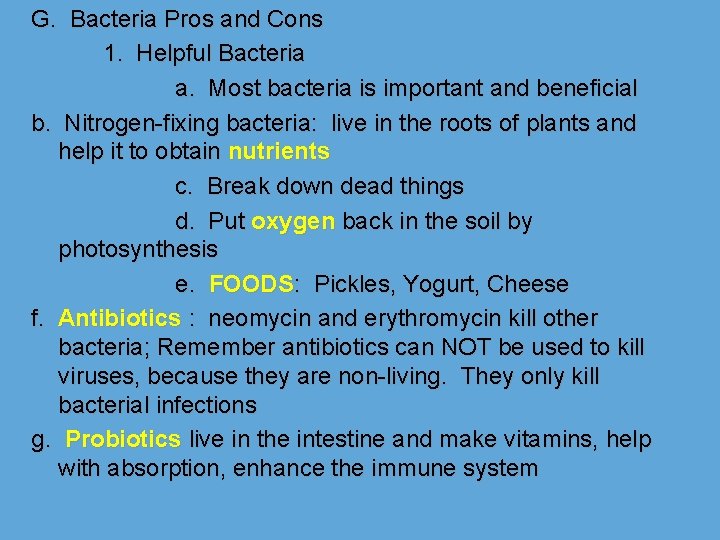
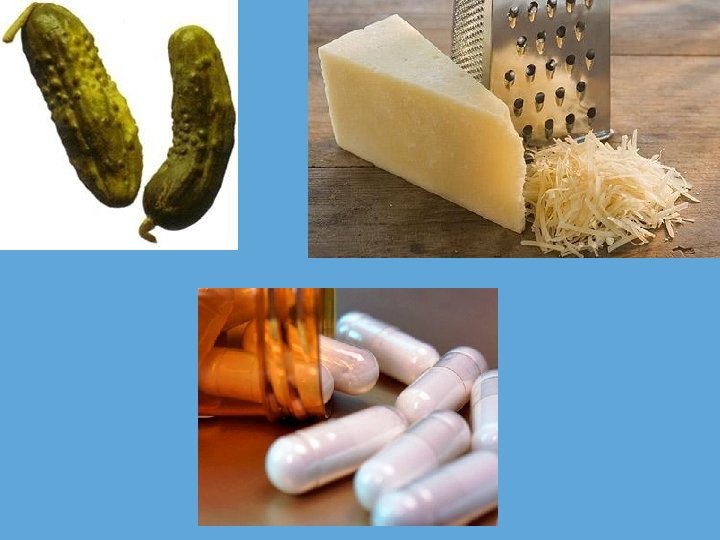
G. Bacteria Pros and Cons 1. Helpful Bacteria a. Most bacteria is important and beneficial b. Nitrogen-fixing bacteria: live in the roots of plants and help it to obtain nutrients c. Break down dead things d. Put oxygen back in the soil by photosynthesis e. FOODS: Pickles, Yogurt, Cheese f. Antibiotics : neomycin and erythromycin kill other bacteria; Remember antibiotics can NOT be used to kill viruses, because they are non-living. They only kill bacterial infections g. Probiotics live in the intestine and make vitamins, help with absorption, enhance the immune system
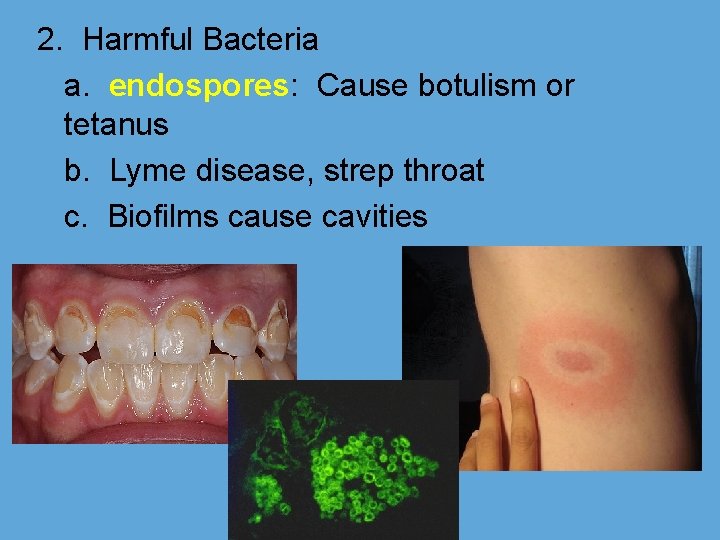
2. Harmful Bacteria a. endospores: Cause botulism or tetanus b. Lyme disease, strep throat c. Biofilms cause cavities
IV. Kingdom Protista A. Called the “catch all ” kingdom because it contains many organisms that don’t fit into the other kingdoms B. The most DIVERSE kingdom C. ALL are eukaryotic (Contain a nucleus and membrane bound organelles) D. Can be heterotrophic or autotrophic, unicellular or mulitcellular, large or microscopic E. Contain contractile vacuole that pumps excess water out of the cell: important for protests that live in fresh water (hypotonic-water will move into the cell and the cell will burst)
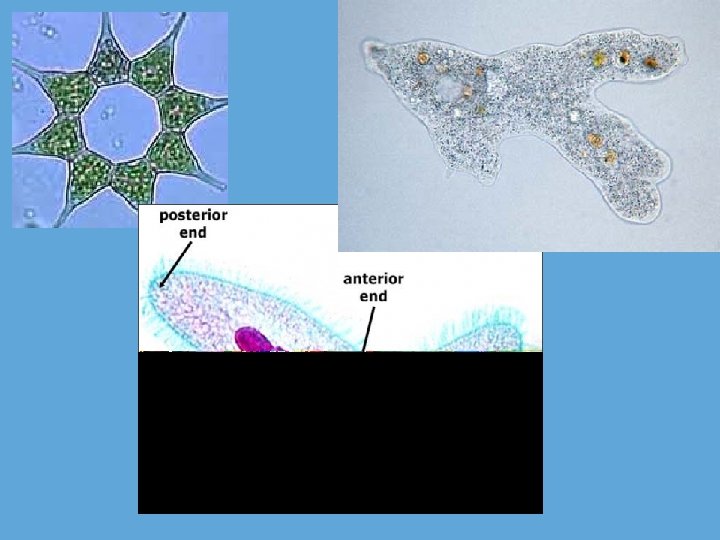
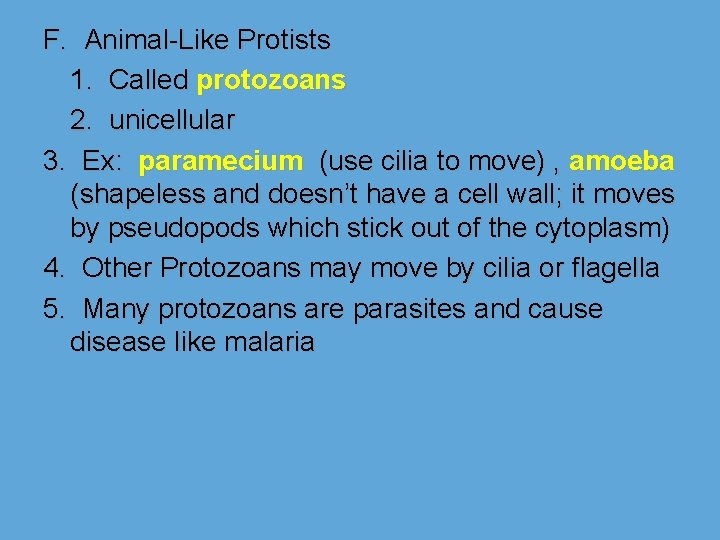
F. Animal-Like Protists 1. Called protozoans 2. unicellular 3. Ex: paramecium (use cilia to move) , amoeba (shapeless and doesn’t have a cell wall; it moves by pseudopods which stick out of the cytoplasm) 4. Other Protozoans may move by cilia or flagella 5. Many protozoans are parasites and cause disease like malaria
Paramecia take in & expel water with: a) contractile vacuoles b) cilia-lined oral grooves c) a flexible outer pellicle
G. Plant-Like Protists 1. Contain chlorophyll and are autotrophic so they carry out photosynthesis 2. Ex: Algae a. they don’t have roots, stems, or leaves like plants so they are not a plant b. May contain red, brown, or golden pigments c. Size ranges from unicellular to a mile long
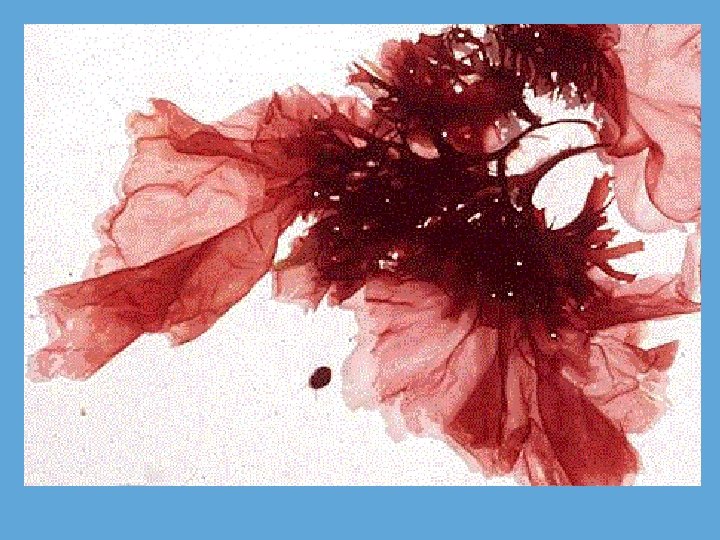
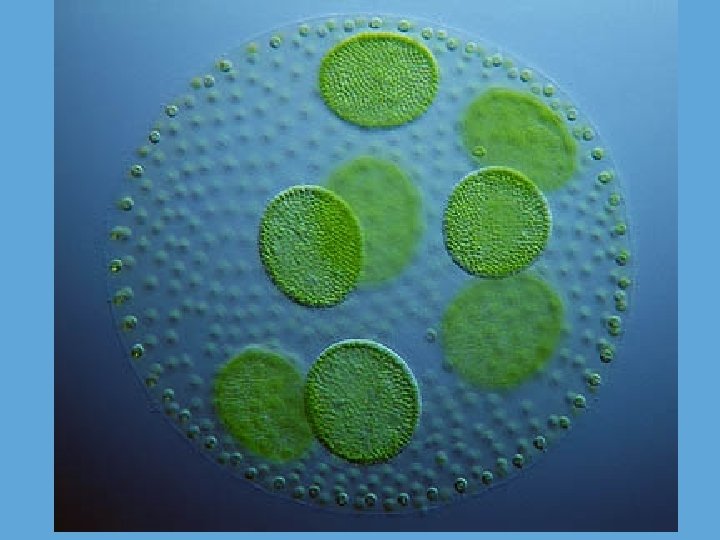
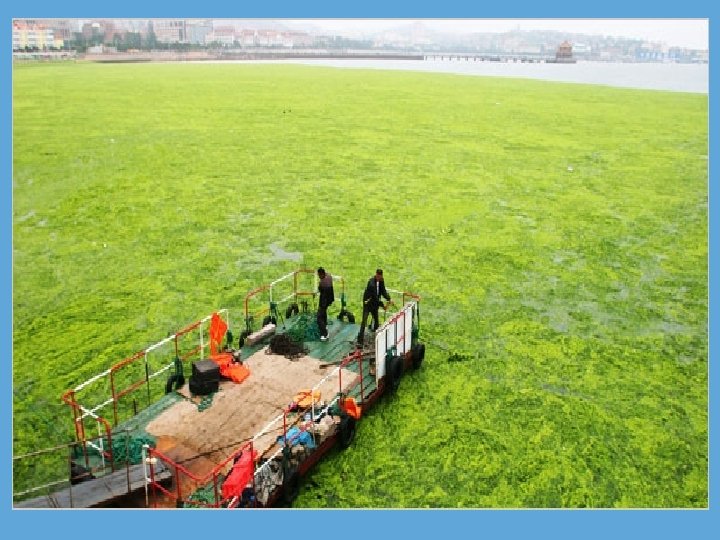
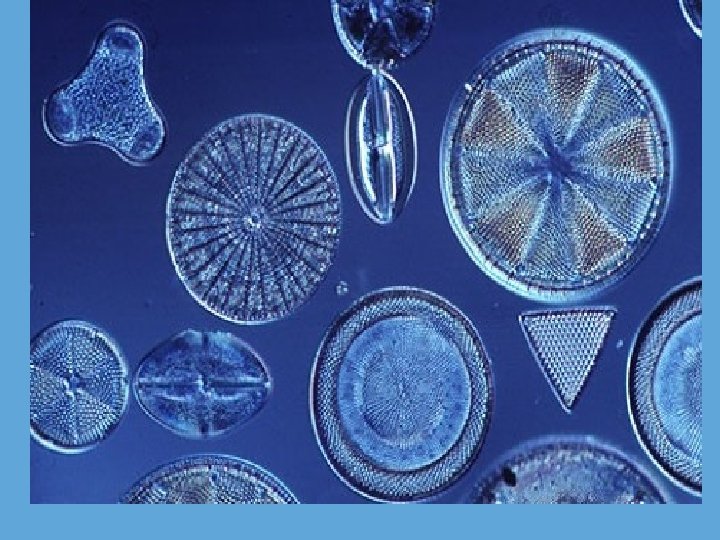
3. Ex: Diatoms a. Made of a glass-like outer shell b. When the protist dies the glass shell sinks to the bottom and collects. c. This collection is called diachotomous earth which is used in abrasives like toothpaste and cleaners and in insecticides 4. Other examples: euglenoids, goden algae, green algae, brown algae, and red algae
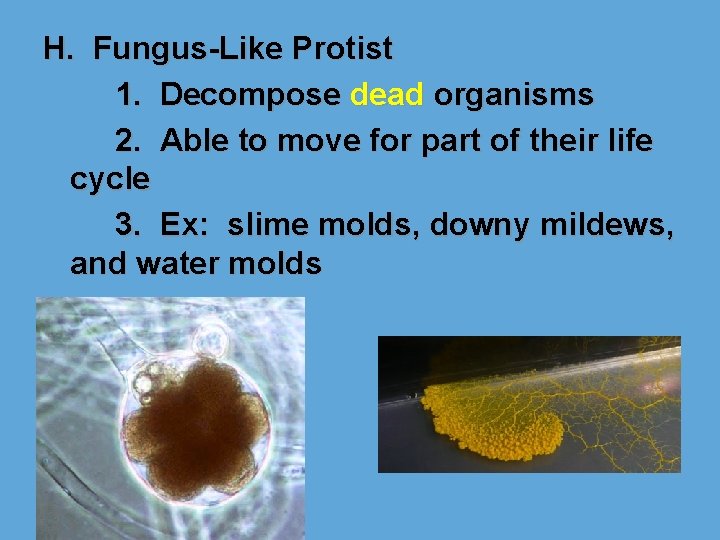
H. Fungus-Like Protist 1. Decompose dead organisms 2. Able to move for part of their life cycle 3. Ex: slime molds, downy mildews, and water molds
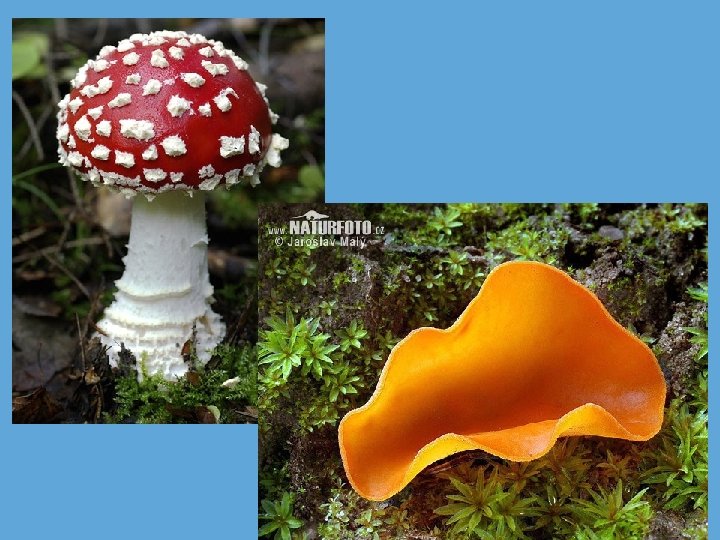
V. Kingdom Fungi A. Grow anywhere that has moisture B. Mostly multicellular (yeast are the only unicellular fungi) C. Used to be classified as plants but they don’t contain chlorophyll so they are not producers…instead they are consumers meaning they have to eat, yes, fungi DO eat They are heterotrophic
Which of these groups is made up entirely of consumers? a) algae b) plants c) fungi d) protists
D. Fungi use extracellular digestion to eat 1. hyphae are threadlike structures sent out into the food source 2. Hyphae release enzymes that break down food until it is small enough to cross the cell walls into the hypahe E. Cell wall made of chitin, a complex carbohydrate) (Remember plants have a cell wall made of cellulose …a polysaccharide)
Which of the following distinguishes the organisms in Kingdom Fungi from other eukaryotic organisms? a) Fungi are unicellular. b) Fungi reproduce sexually. c) Fungi obtain nutrients by absorption (through extracellular digestion) d) Fungi make food through photosynthesis.
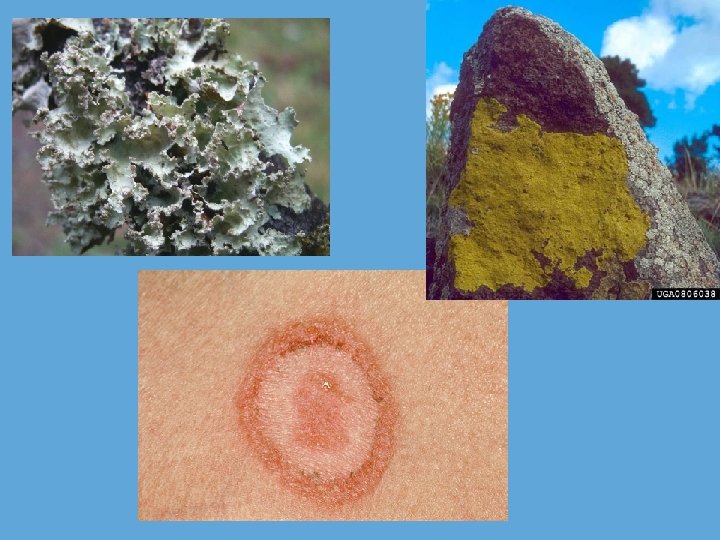
F. Fungi Heterotrophs 1. decomposers : Break down dead and decaying matter 2. Saprophytes like mushrooms break down dead organic matter 3. Parasites like ringworm and athlete’s foot 4. lichens: A mutualistic (both benefit)relationship between fungus and green algae; They are important because they break down rocks into soil so plants can grow and they put nutrients into the soil when they die and decompose
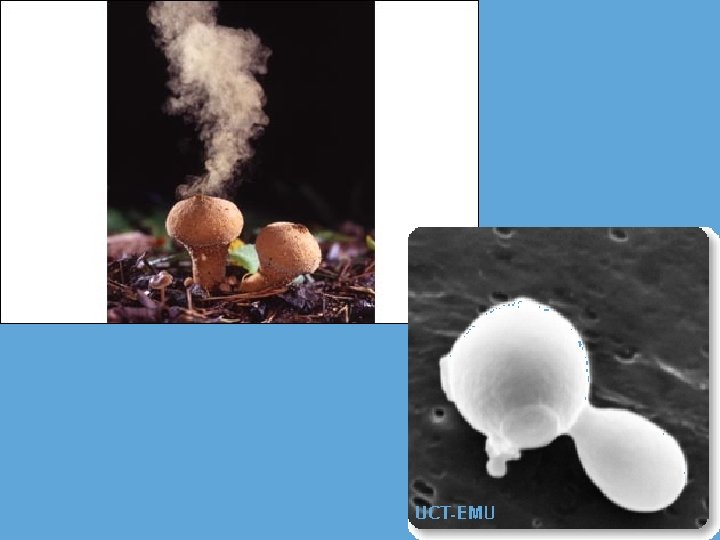
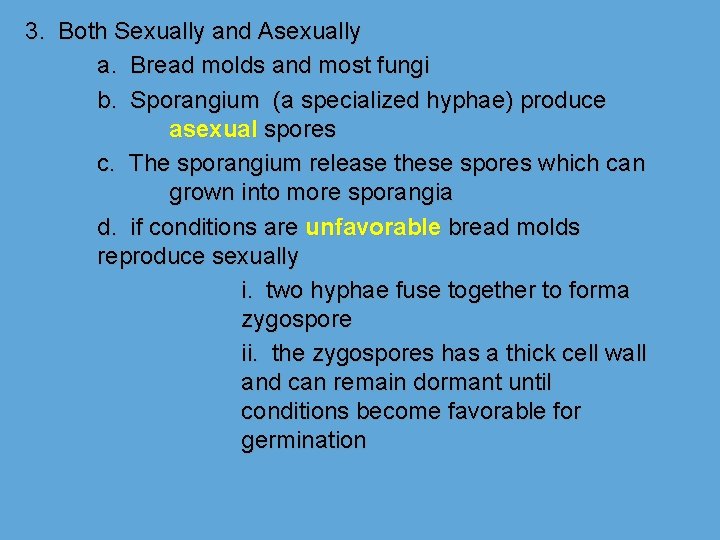
G. Fungi Reproduction 1. Asexual Reproduction a. Yeasts b. budding: organism grows from the parent and then breaks off c. fission: the yeast splits in half to form two yeast cells 2. Sexually: a. Mushrooms b. Spores called basidiospores are produced in the cap of the mushroom c. Spores are produced by meiosis so they are haploid when two spores meet and germinate to have a baby mushroom
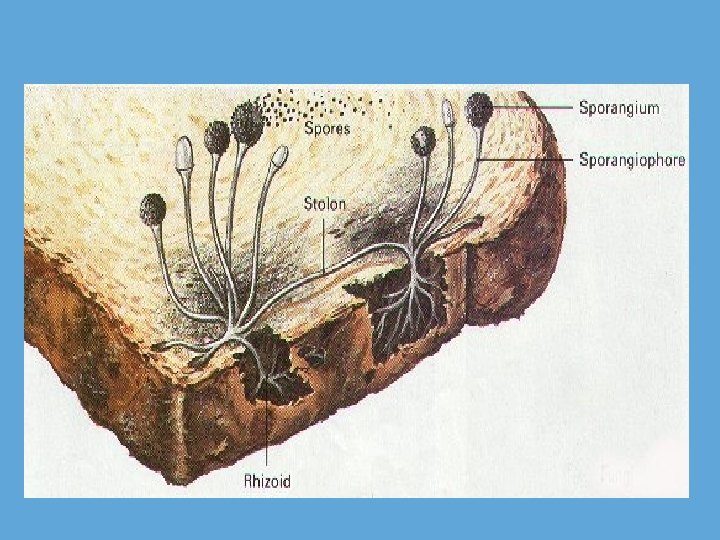
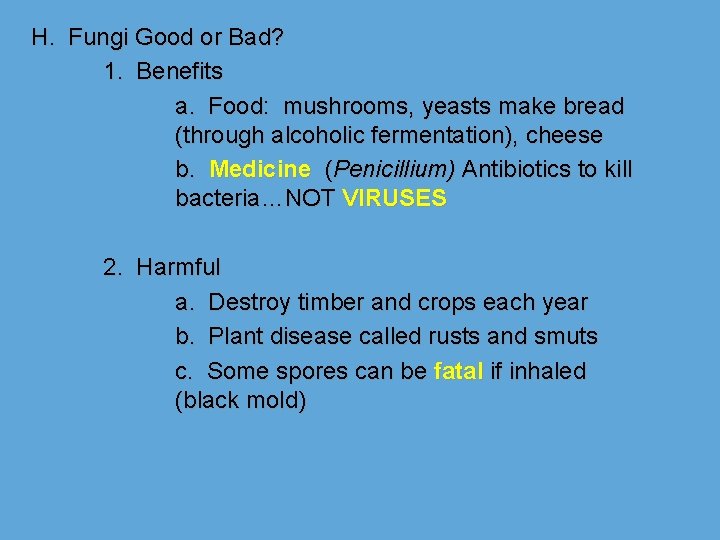
3. Both Sexually and Asexually a. Bread molds and most fungi b. Sporangium (a specialized hyphae) produce asexual spores c. The sporangium release these spores which can grown into more sporangia d. if conditions are unfavorable bread molds reproduce sexually i. two hyphae fuse together to forma zygospore ii. the zygospores has a thick cell wall and can remain dormant until conditions become favorable for germination
H. Fungi Good or Bad? 1. Benefits a. Food: mushrooms, yeasts make bread (through alcoholic fermentation), cheese b. Medicine (Penicillium) Antibiotics to kill bacteria…NOT VIRUSES 2. Harmful a. Destroy timber and crops each year b. Plant disease called rusts and smuts c. Some spores can be fatal if inhaled (black mold)
Kingdom Plantae: • All plants have a cuticle -- a waxy protective coating • All plants are made of one or more cells • Eukaryotic cells (contain a nucleus and membrane bound organelles) • All autotrophic: meaning they contain chlorophyll and make their own food through photosynthesis • Cell walls made of cellulose • Called divisions instead of a phylum when classifying • Twelve divisions have been identified • Botanists: people who study plants
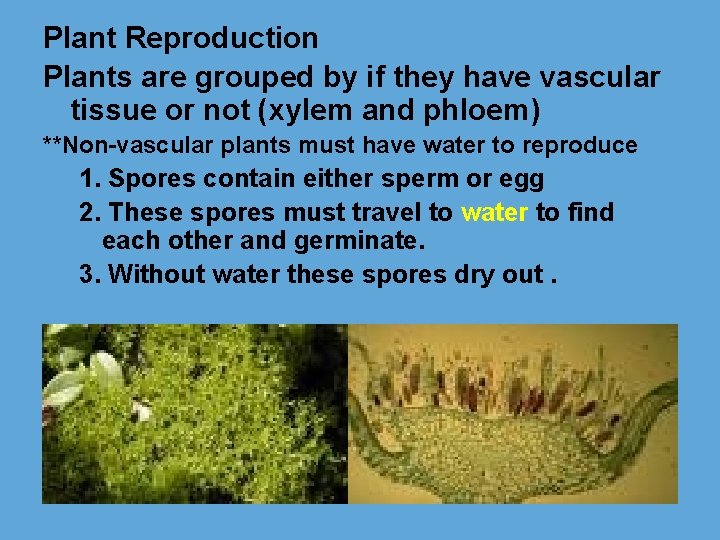
Plant Reproduction Plants are grouped by if they have vascular tissue or not (xylem and phloem) **Non-vascular plants must have water to reproduce 1. Spores contain either sperm or egg 2. These spores must travel to water to find each other and germinate. 3. Without water these spores dry out.
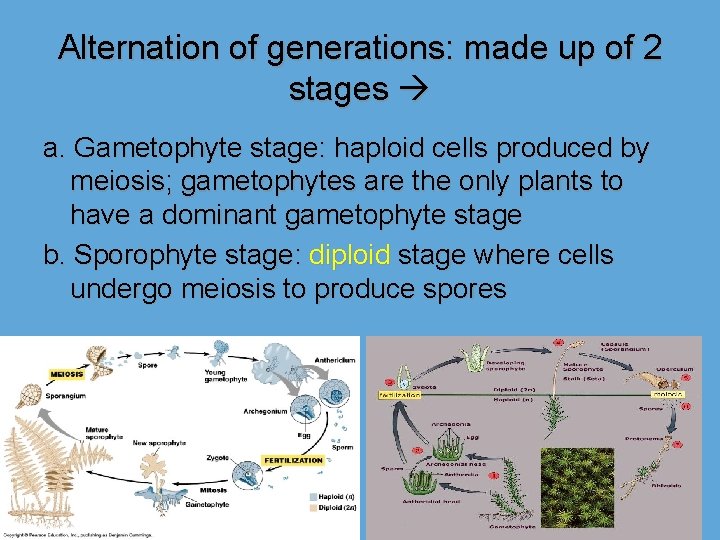
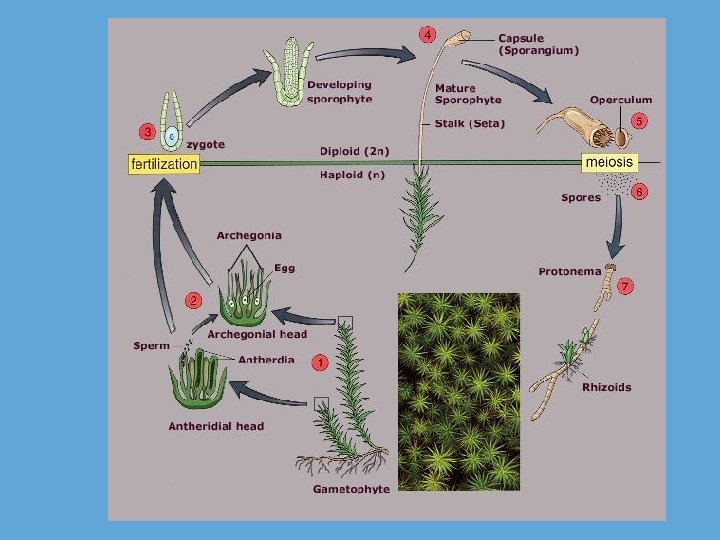
Alternation of generations: made up of 2 stages a. Gametophyte stage: haploid cells produced by meiosis; gametophytes are the only plants to have a dominant gametophyte stage b. Sporophyte stage: diploid stage where cells undergo meiosis to produce spores
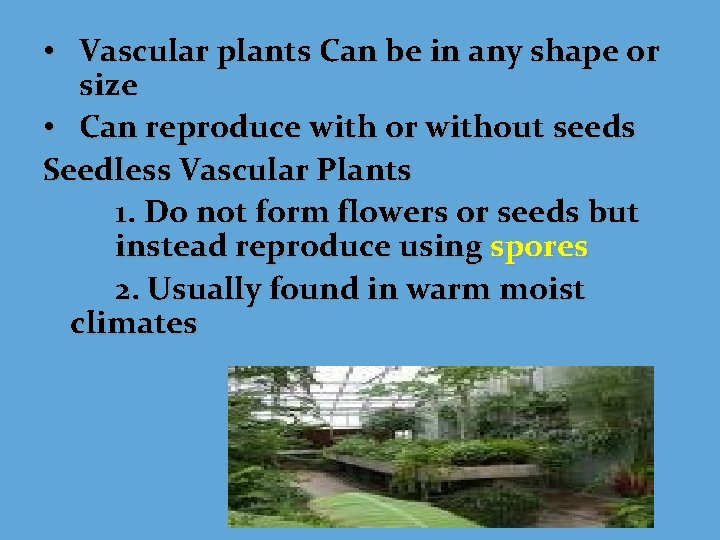
• Vascular plants Can be in any shape or size • Can reproduce with or without seeds Seedless Vascular Plants 1. Do not form flowers or seeds but instead reproduce using spores 2. Usually found in warm moist climates
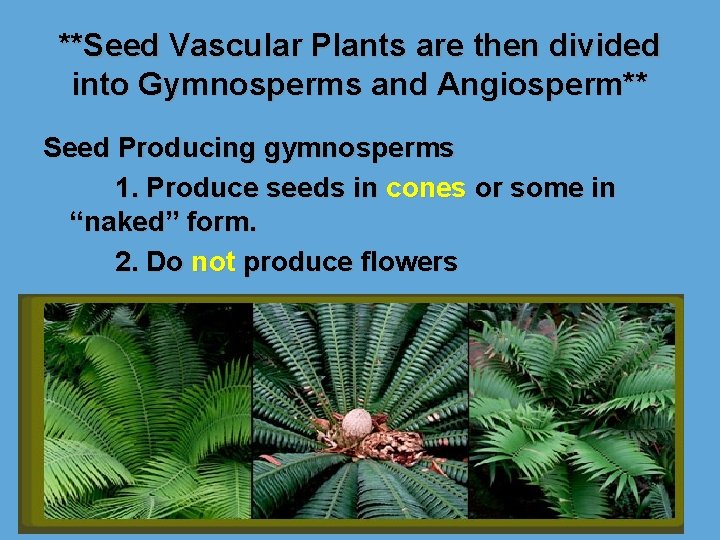
**Seed Vascular Plants are then divided into Gymnosperms and Angiosperm** Seed Producing gymnosperms 1. Produce seeds in cones or some in “naked” form. 2. Do not produce flowers
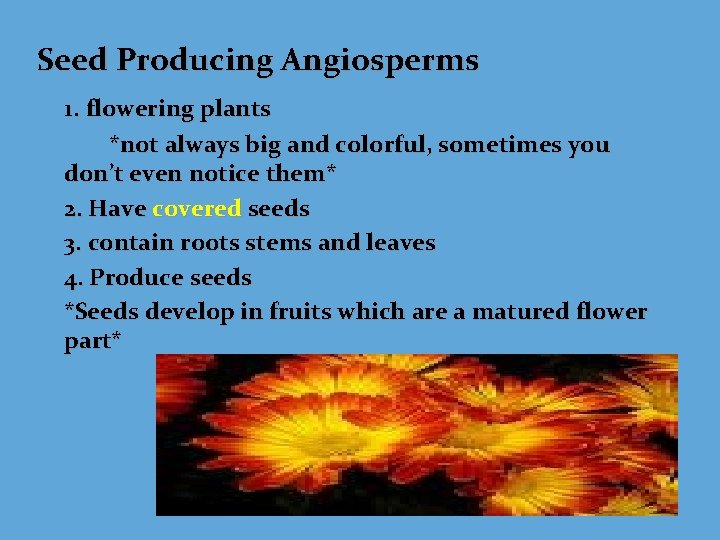
Seed Producing Angiosperms 1. flowering plants *not always big and colorful, sometimes you don’t even notice them* 2. Have covered seeds 3. contain roots stems and leaves 4. Produce seeds *Seeds develop in fruits which are a matured flower part*
KINGDOM ANIMALIA I. An Overview of Animals A. All are multicellular B. Do not have a cell wall and do not contain cholorophyll C. eukaryotic cells D. ALL animals are heterotrophic E. Capable of movement at some point in their lives. Helps with: 1. obtaining food 2. protection 3. Finding habitat 4. reproduction

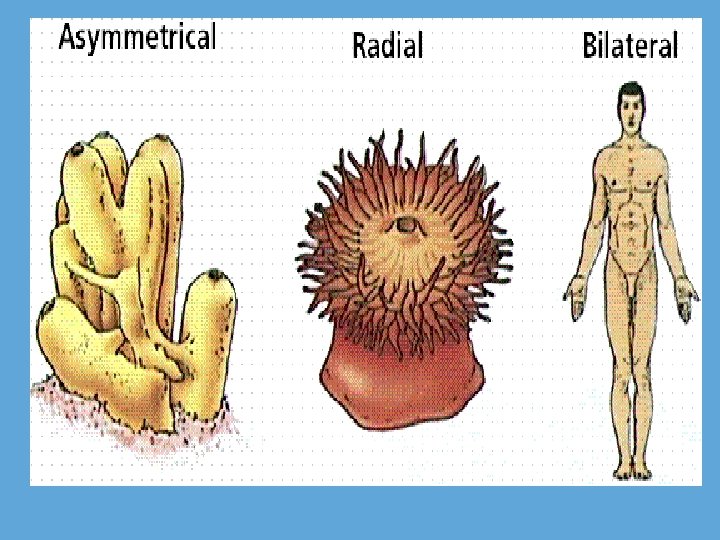
F. Special cells that can form tissues, organs, and systems G. Classified according to: 1. structural similarities 2. Evolutionary relationships 3. Body Plans a. Asymmetrical : do not have a certain shape; ex: sponge b. Radial Symmetry: body arranged around a central point; ex: sea star, pizza c. Bilateral symmetry: divide the animal into two equal halves: ex: all vertebrates
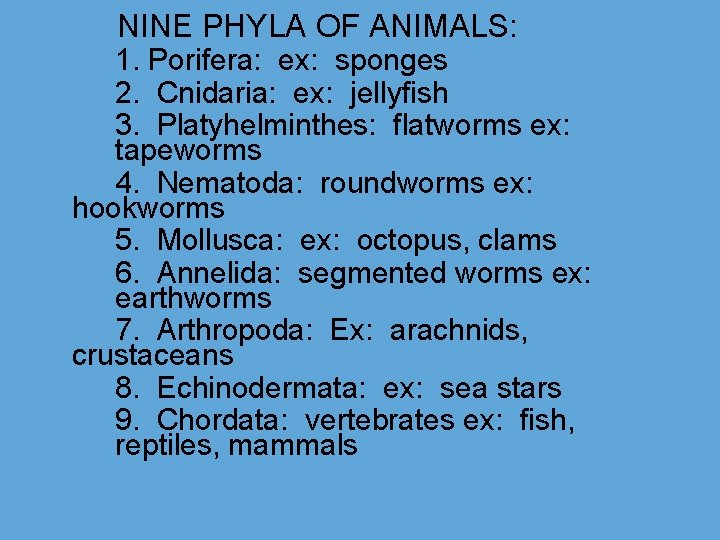
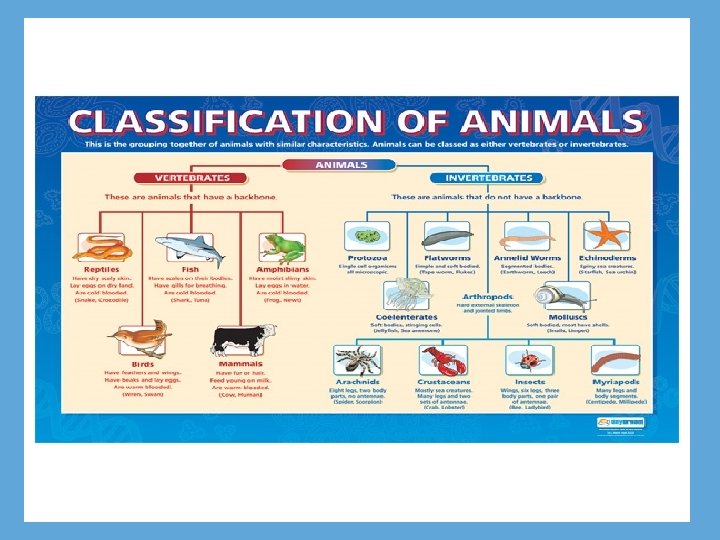
NINE PHYLA OF ANIMALS: 1. Porifera: ex: sponges 2. Cnidaria: ex: jellyfish 3. Platyhelminthes: flatworms ex: tapeworms 4. Nematoda: roundworms ex: hookworms 5. Mollusca: ex: octopus, clams 6. Annelida: segmented worms ex: earthworms 7. Arthropoda: Ex: arachnids, crustaceans 8. Echinodermata: ex: sea stars 9. Chordata: vertebrates ex: fish, reptiles, mammals
All of the following kingdoms include autotrophic organisms EXCEPTa) Plantae b) Protista c) Animalia d) Archaebacteria
Which of the following is NOT considered a living organism? a) AIDS virus b) paramecium c) shiitake mushroom d) nitrogen-fixing bacterium
Name the kingdom • • • unicellular prokaryotic aquatic & terrestrial cause disease used in foods & medicines
Name the kingdom • • • algae slime molds flagellates ciliates sporozoans amoebas
Name the kingdom • unicellular • prokaryotes • harsh environments
Name the kingdom • • • mushrooms molds puffballs mildew yeast
Name the kingdom • “ancient” prokaryotes
Name the kingdom • • most are unicellular eukaryotic aquatic or moist habitats heterotrophs & autotrophs
Name the kingdom • “true” prokaryotes
Name the kingdom • multicellular & unicellular • eukaryotes • absorb nutrients as decomposers of organic matter
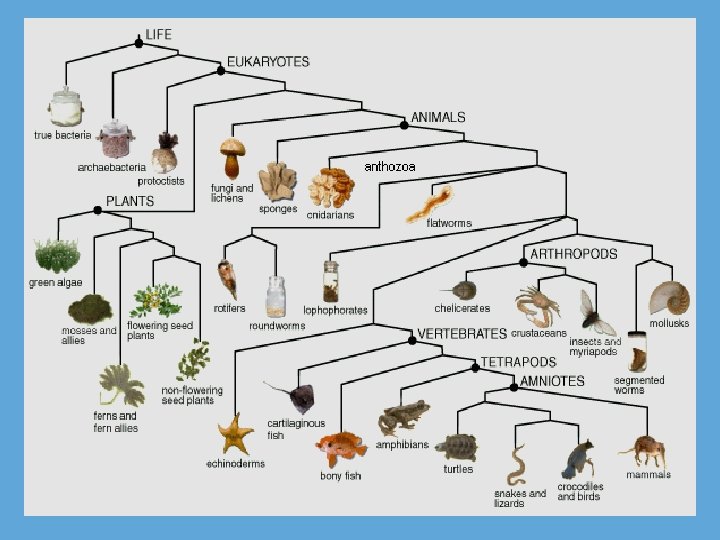
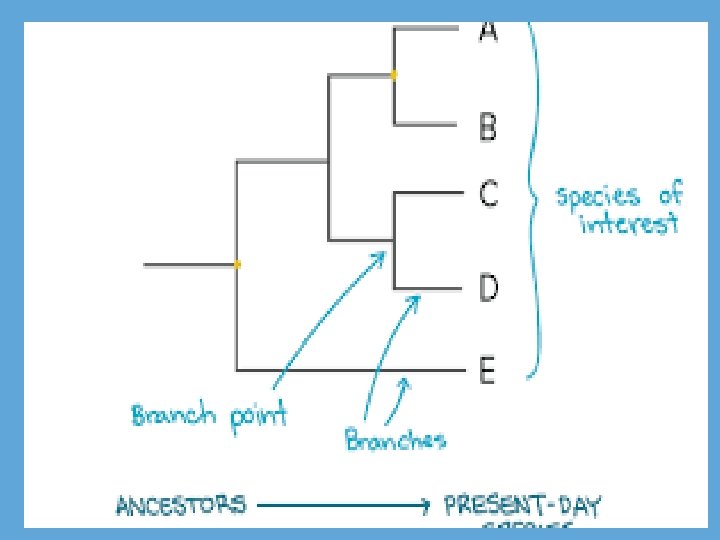
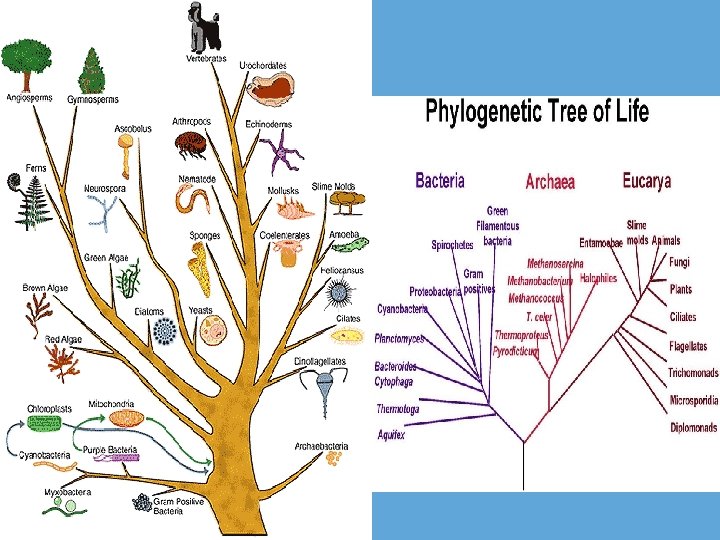
• Speciation: Formation of new species • Common ancestor: parent species which two or more species evolved from Phylogenetic Trees • Diagram that can be used to represent evolutionary relationships • Phylogenetic trees represent how a single cell may have evolved into the 6 kingdoms • They also trace divergent evolution and when speciation is believed to have occurred
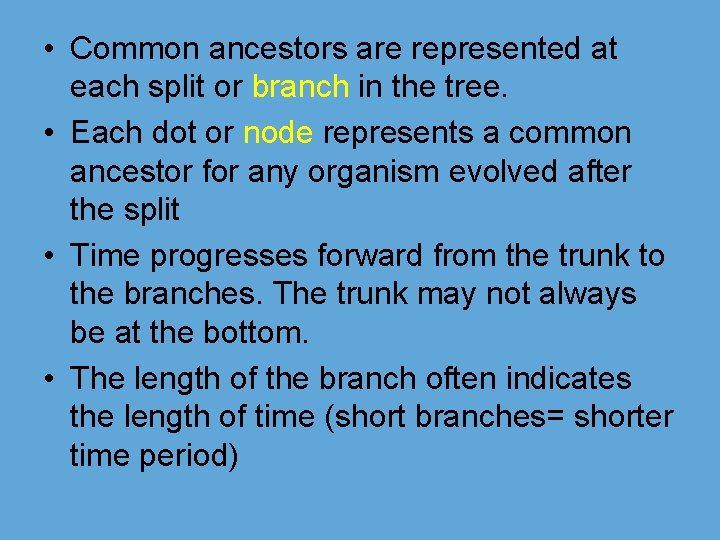
• Common ancestors are represented at each split or branch in the tree. • Each dot or node represents a common ancestor for any organism evolved after the split • Time progresses forward from the trunk to the branches. The trunk may not always be at the bottom. • The length of the branch often indicates the length of time (short branches= shorter time period)
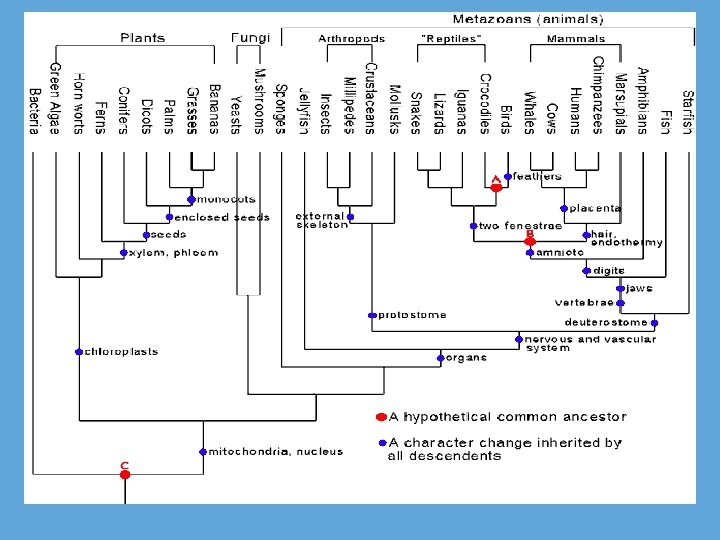

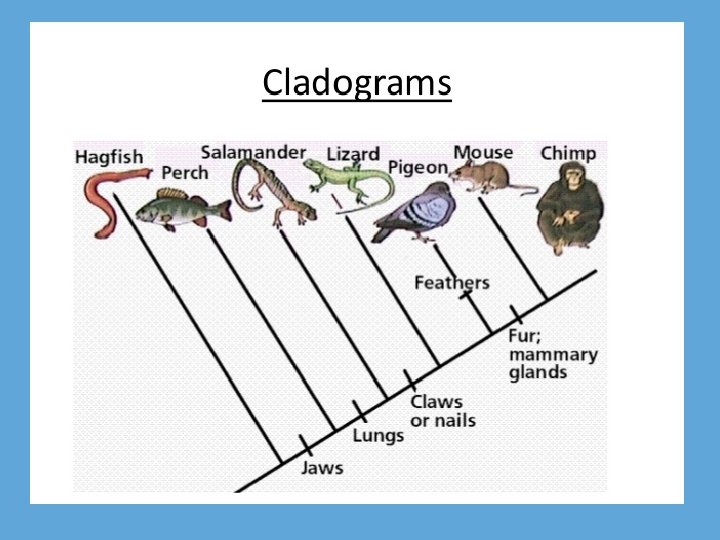
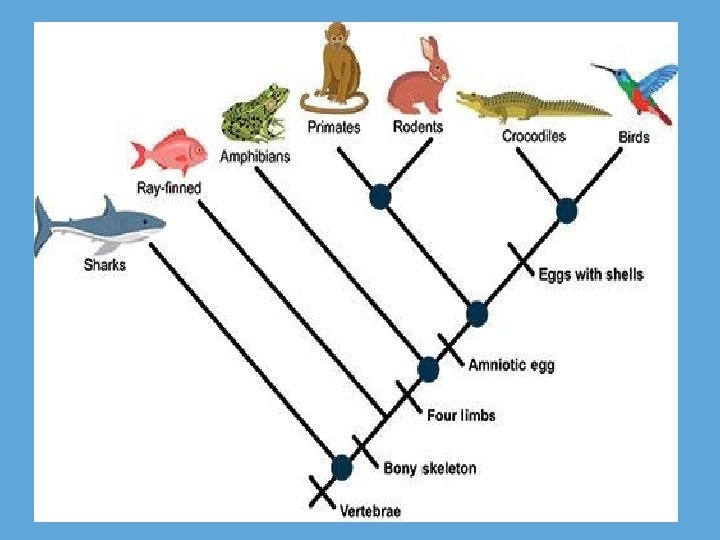
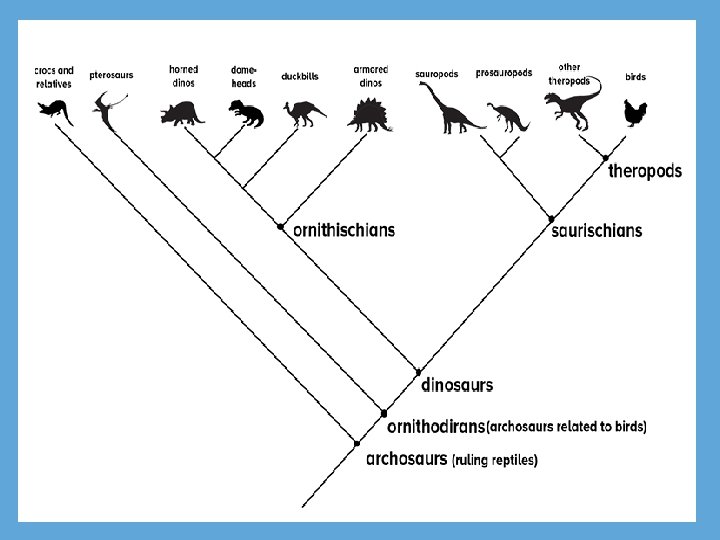
Cladograms • A cladogram is a diagram that shows relationships among organisms based on evolved adaptations or characteristics • It identifies key evolutionary characteristics that separate one group from more evolved organisms. • Derived characters: characteristics or adaptations that are found in new species but are absent in the past lineage – Ex: feathers are in birds but not reptiles and they are both believed to be from the same ancestor

• Evolutionary time is represented as going from the lowest point of the V to the highest point, so to begin reading a cladogram find the bottom node to determine which direction to read it. • Branches that occur sooner in the timeline represent organisms that evolved before others • Derived characters are characteristics like jaws, feathers, eggs, etc that once it shows up all organisms will have the characteristic after that point. Any before it will not have that characteristic
![• We use fossil records, comparative anatomy [structural similarities] (homologous structures), comparative embryology](http://slidetodoc.com/presentation_image_h2/b3033db83f28981d7ea6c375f9c271bf/image-102.jpg "• We use fossil records, comparative anatomy [structural similarities] (homologous structures), comparative embryology")
• We use fossil records, comparative anatomy [structural similarities] (homologous structures), comparative embryology (development before birth), comparative DNA, and comparative biochemistry [physiological similarities] to find similarities in organisms. This is our basis for modern classification.
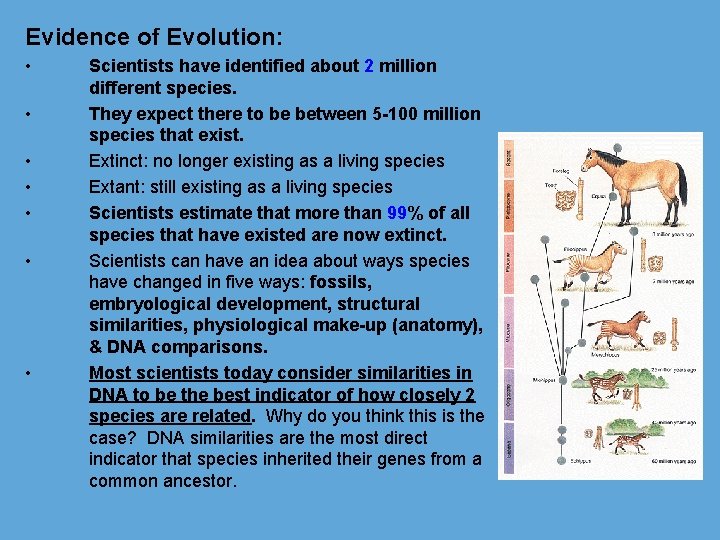
Evidence of Evolution: • • Scientists have identified about 2 million different species. They expect there to be between 5 -100 million species that exist. Extinct: no longer existing as a living species Extant: still existing as a living species Scientists estimate that more than 99% of all species that have existed are now extinct. Scientists can have an idea about ways species have changed in five ways: fossils, embryological development, structural similarities, physiological make-up (anatomy), & DNA comparisons. Most scientists today consider similarities in DNA to be the best indicator of how closely 2 species are related. Why do you think this is the case? DNA similarities are the most direct indicator that species inherited their genes from a common ancestor.
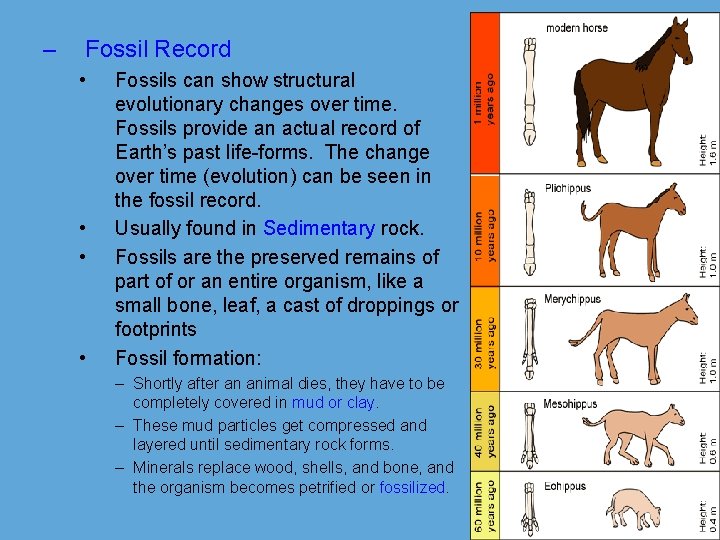
– Fossil Record • • Fossils can show structural evolutionary changes over time. Fossils provide an actual record of Earth’s past life-forms. The change over time (evolution) can be seen in the fossil record. Usually found in Sedimentary rock. Fossils are the preserved remains of part of or an entire organism, like a small bone, leaf, a cast of droppings or footprints Fossil formation: – Shortly after an animal dies, they have to be completely covered in mud or clay. – These mud particles get compressed and layered until sedimentary rock forms. – Minerals replace wood, shells, and bone, and the organism becomes petrified or fossilized.
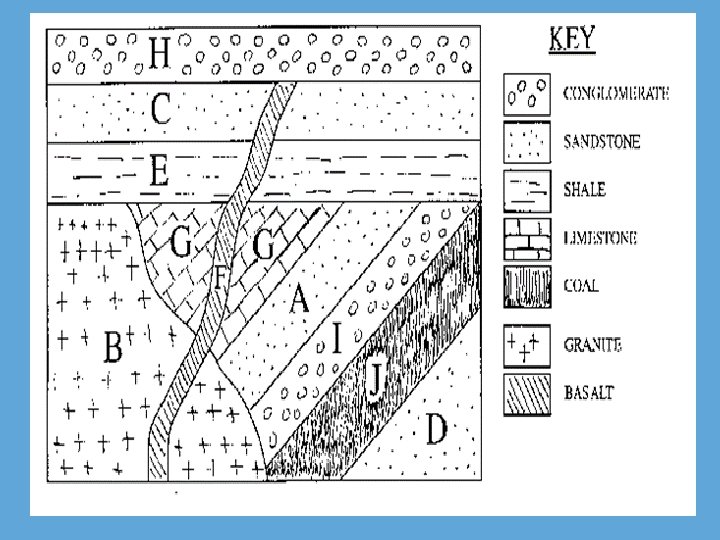
• Paleontologist: scientist who studies fossils found in sedimentary rocks, like shale, limestone, sandstone, and conglomerate • They have found that certain species only lived during specific time periods based on the rock layers. • Geologist: scientist who studies the earth and rocks • Strata: various layers of rock found within sedimentary rock • In general, the oldest rocks are on the bottom layer, and the youngest on the surface. In the same strata layers, they are the same age.
– Radiometric dating and relative dating determine the time period in which an organism lived. – Relative Dating: tells which fossils are older than other fossils based on where they are found in sedimentary rock layers. – Index fossils are organisms that existed for only a specific time period before going extinct. When they lived they were geographically widespread to live in large areas of the world. • Ex: ammonites are mollusks that lived in the Mesozoic Era (252 -66 mya) and were in oceans worldwide
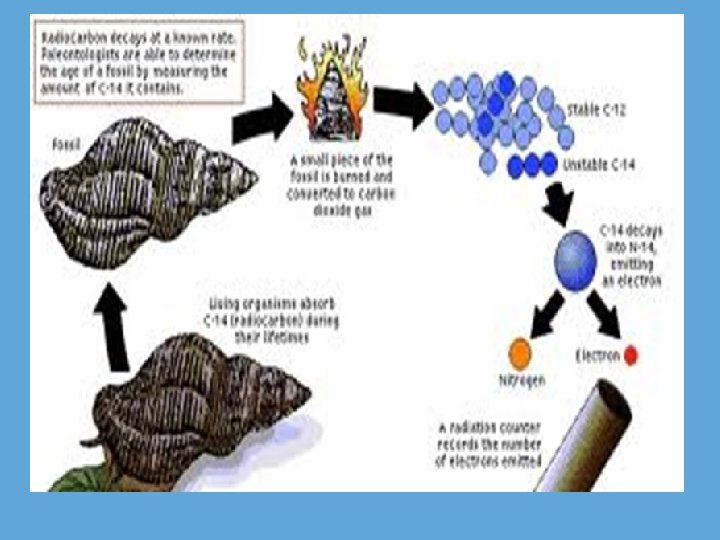
• Radiometric Dating: Process that determines the approximate age of a fossil. This technique measures the amount of radioactive isotopes found in the fossil. The approximate age can then be calculated based on the half-lives of the radioactive isotopes. A half-life is the amount of time that it takes for half of a radioactive material to decay into a different material. • Scientists then compare modern species with species that lived millions of years ago
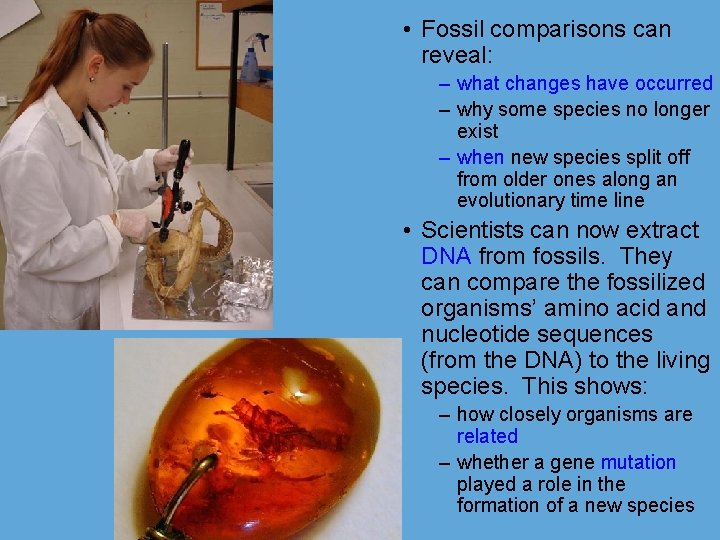
• Fossil comparisons can reveal: – what changes have occurred – why some species no longer exist – when new species split off from older ones along an evolutionary time line • Scientists can now extract DNA from fossils. They can compare the fossilized organisms’ amino acid and nucleotide sequences (from the DNA) to the living species. This shows: – how closely organisms are related – whether a gene mutation played a role in the formation of a new species
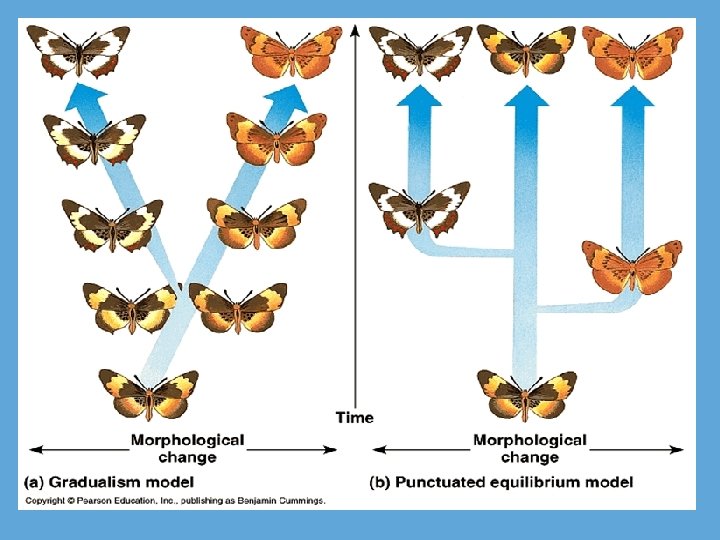
Punctuated Equilibrium: • suggests that long intervals may pass at times in which little or no change may occur, and then suddenly those periods may be interrupted by short bursts of quick, radical transitions. Most scientists now believe that a combination of gradual evolution & punctuated equilibrium have occurred over time. • One example of punctuated equilibrium is the Cambrian Explosion • The rate of evolution is the same as the rate of speciation. • Evolution increases when: mutations are high, rapidly changing environment, and small populations become isolated. • Gradualism is more likely when the environment is fairly stable for a long time.
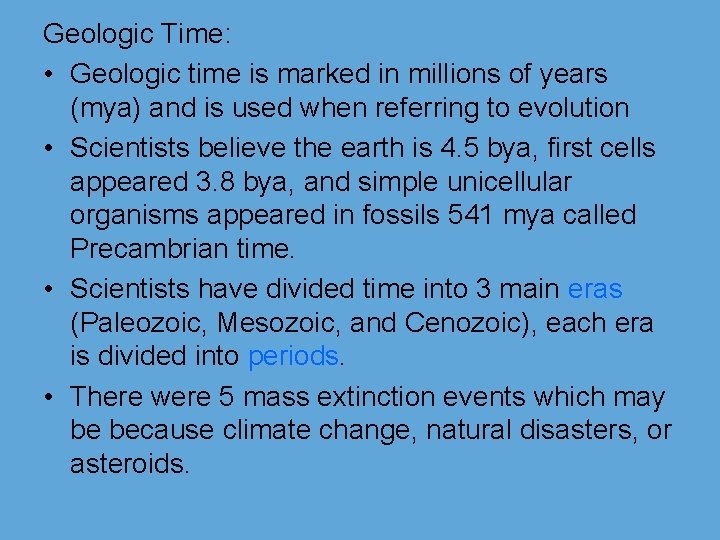
Geologic Time: • Geologic time is marked in millions of years (mya) and is used when referring to evolution • Scientists believe the earth is 4. 5 bya, first cells appeared 3. 8 bya, and simple unicellular organisms appeared in fossils 541 mya called Precambrian time. • Scientists have divided time into 3 main eras (Paleozoic, Mesozoic, and Cenozoic), each era is divided into periods. • There were 5 mass extinction events which may be because climate change, natural disasters, or asteroids.

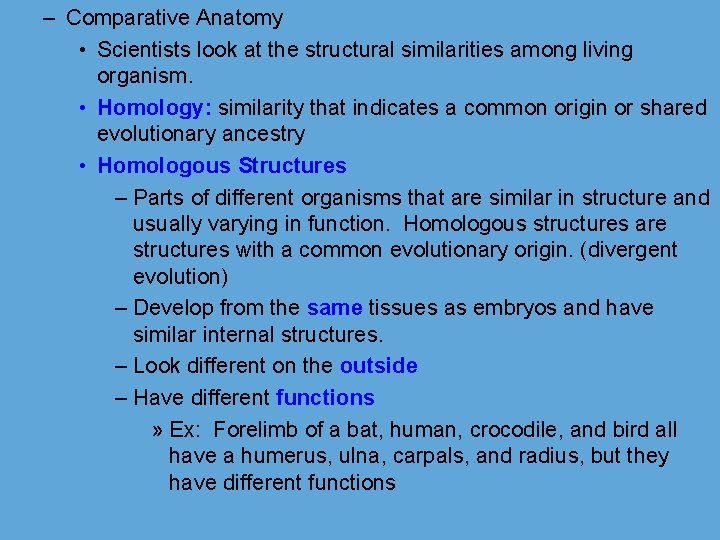
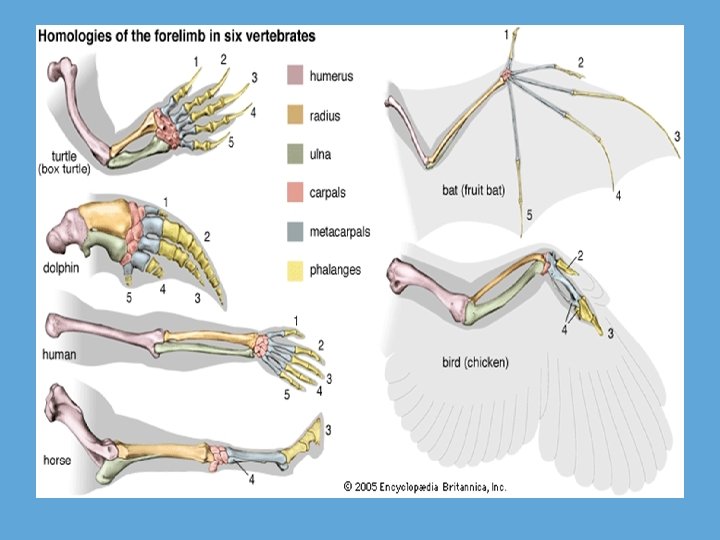
– Comparative Anatomy • Scientists look at the structural similarities among living organism. • Homology: similarity that indicates a common origin or shared evolutionary ancestry • Homologous Structures – Parts of different organisms that are similar in structure and usually varying in function. Homologous structures are structures with a common evolutionary origin. (divergent evolution) – Develop from the same tissues as embryos and have similar internal structures. – Look different on the outside – Have different functions » Ex: Forelimb of a bat, human, crocodile, and bird all have a humerus, ulna, carpals, and radius, but they have different functions
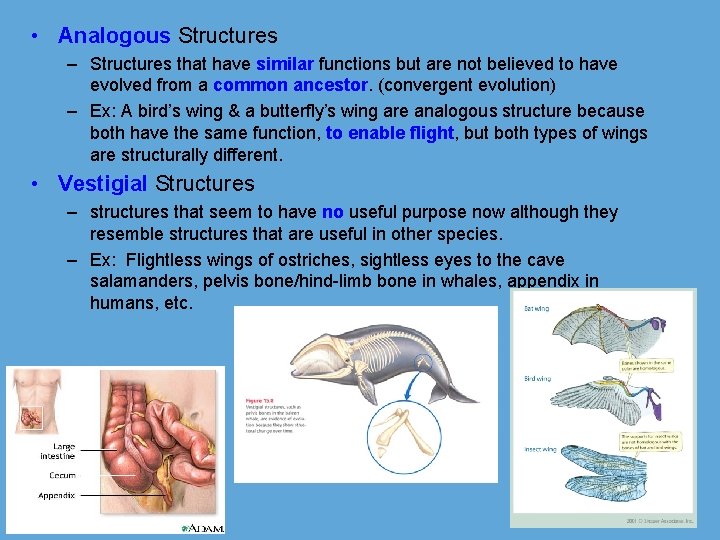
• Analogous Structures – Structures that have similar functions but are not believed to have evolved from a common ancestor. (convergent evolution) – Ex: A bird’s wing & a butterfly’s wing are analogous structure because both have the same function, to enable flight, but both types of wings are structurally different. • Vestigial Structures – structures that seem to have no useful purpose now although they resemble structures that are useful in other species. – Ex: Flightless wings of ostriches, sightless eyes to the cave salamanders, pelvis bone/hind-limb bone in whales, appendix in humans, etc.
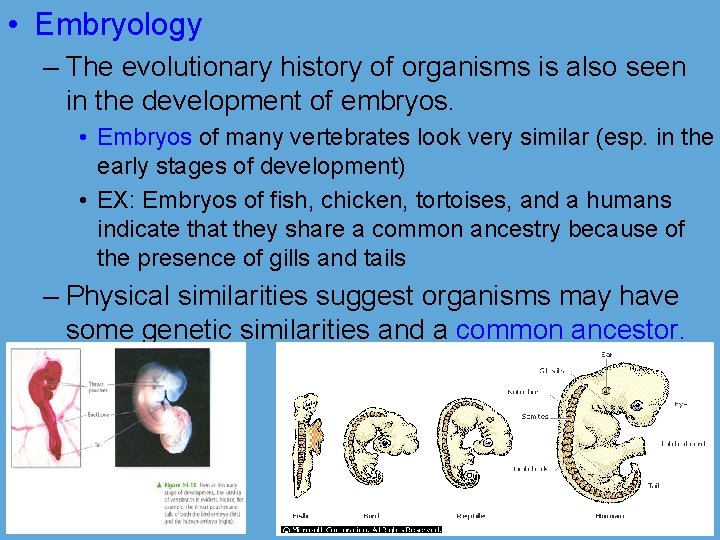
• Embryology – The evolutionary history of organisms is also seen in the development of embryos. • Embryos of many vertebrates look very similar (esp. in the early stages of development) • EX: Embryos of fish, chicken, tortoises, and a humans indicate that they share a common ancestry because of the presence of gills and tails – Physical similarities suggest organisms may have some genetic similarities and a common ancestor.
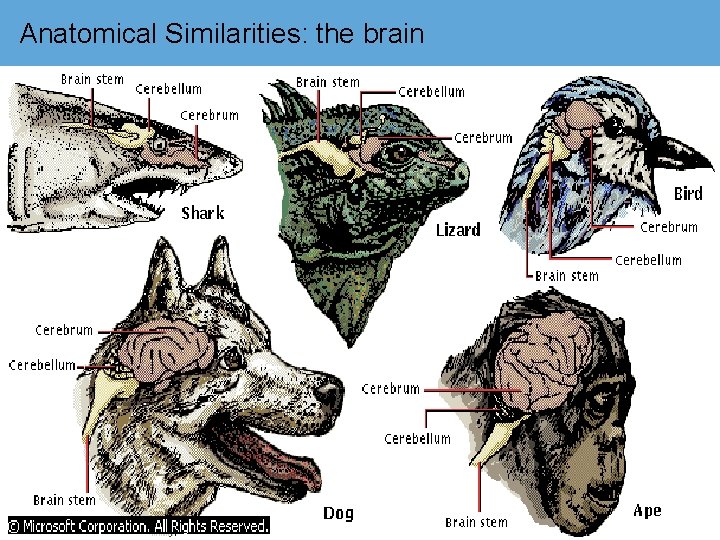
Anatomical Similarities: the brain
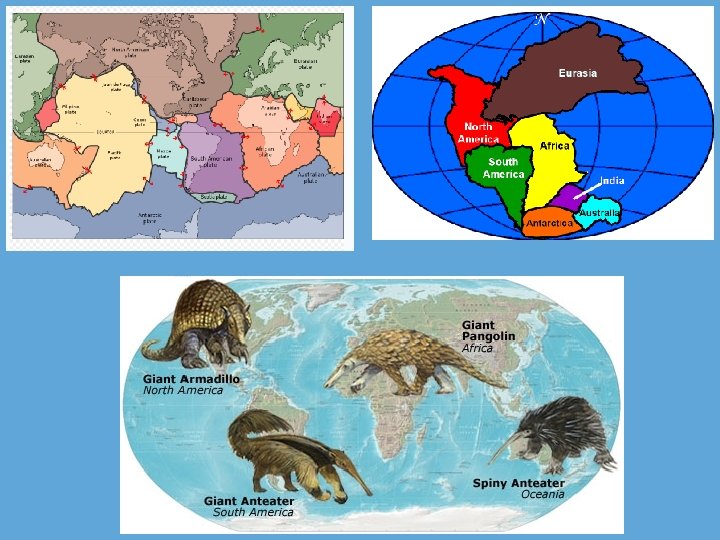
Biogeography • According to the plate tectonics theory, the earth’s surface is divided into large plates that float just underneath the earth’s surface. The plates continually move causing earthquakes, volcanic activity, & the continental drift. • Scientists believed that the continents were once consolidated together in one single landmass, called Pangaea. Over time, the continents were formed as the plates drifted apart. • Biogeography is the study of how plants & animals are distributed around the world. Scientists use biogeography to figure out how & when species may have evolved. – Ex: Some species are isolated to specific continents, like Apes (& all ape fossils) are found only in Africa & Asia. – Ex: Marsupials, mammals with pouch are found only in Australia.
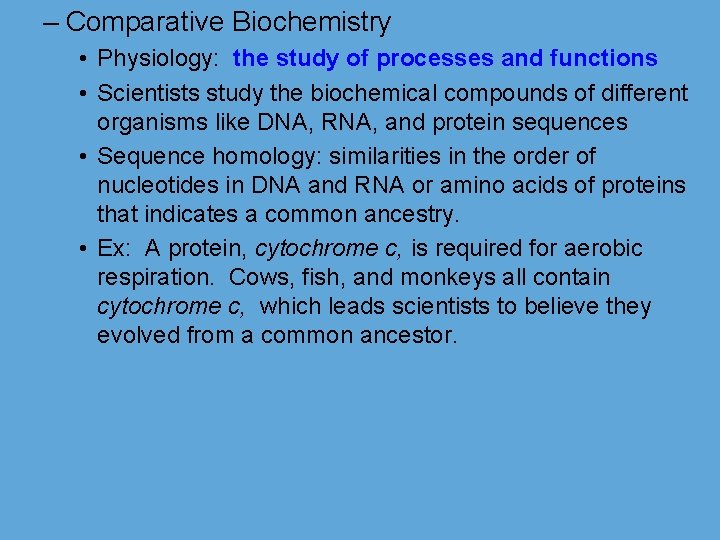
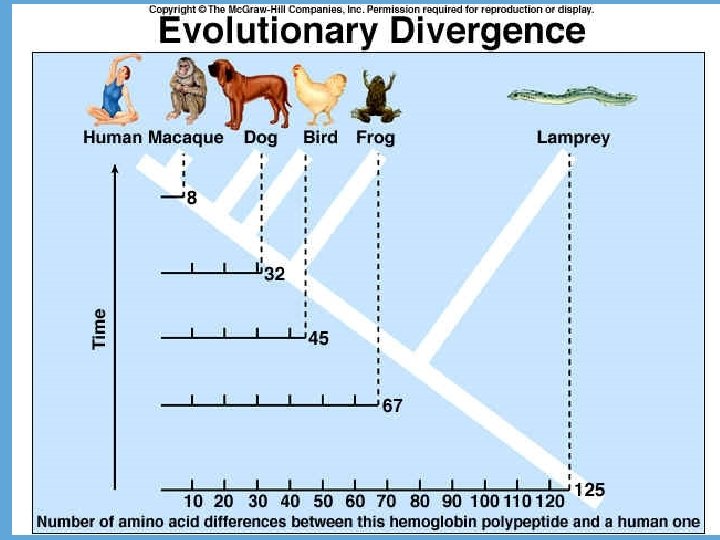
– Comparative Biochemistry • Physiology: the study of processes and functions • Scientists study the biochemical compounds of different organisms like DNA, RNA, and protein sequences • Sequence homology: similarities in the order of nucleotides in DNA and RNA or amino acids of proteins that indicates a common ancestry. • Ex: A protein, cytochrome c, is required for aerobic respiration. Cows, fish, and monkeys all contain cytochrome c, which leads scientists to believe they evolved from a common ancestor.
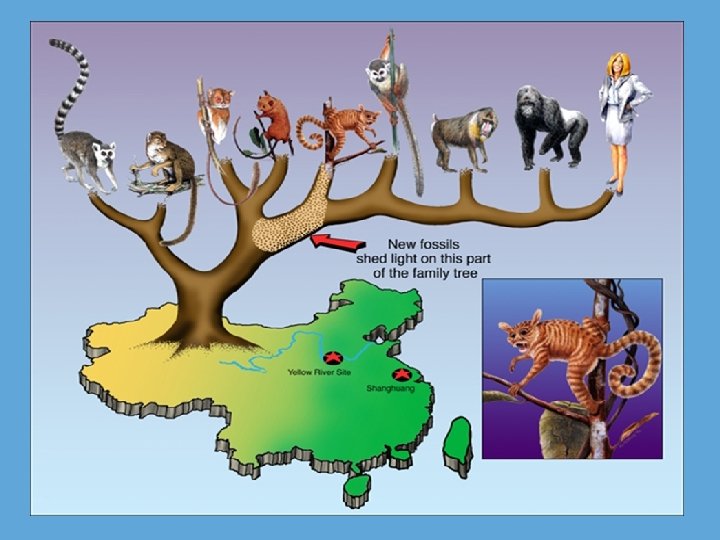
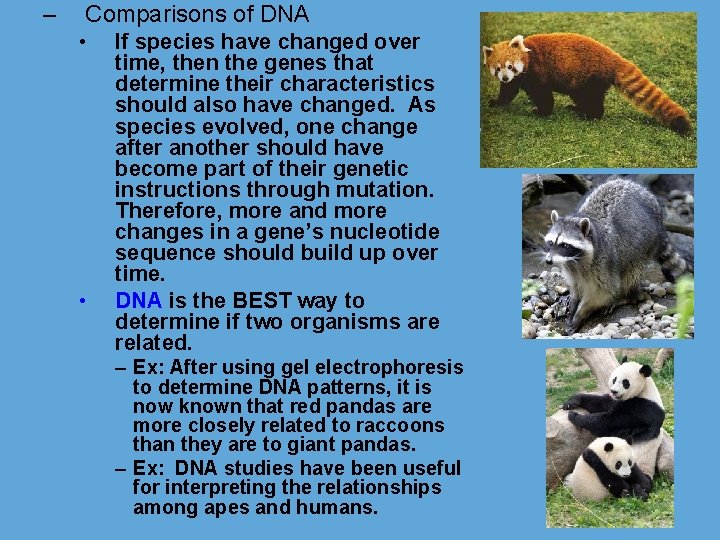
– Comparisons of DNA • • If species have changed over time, then the genes that determine their characteristics should also have changed. As species evolved, one change after another should have become part of their genetic instructions through mutation. Therefore, more and more changes in a gene’s nucleotide sequence should build up over time. DNA is the BEST way to determine if two organisms are related. – Ex: After using gel electrophoresis to determine DNA patterns, it is now known that red pandas are more closely related to raccoons than they are to giant pandas. – Ex: DNA studies have been useful for interpreting the relationships among apes and humans.
• However, genes are not always in the same places on the same chromosomes in different species. Different species also have different numbers of chromosomes • For fossils, it is easier to compare physical similarities than DNA for this reason. • This is why comparing DNA sequences can become difficult.
- Slides: 125