
Classicism is the art movement founded on aesthetic
- Slides: 27
Classicism is the art movement founded on aesthetic attitudes based on the art, literature and culture of ancient Greece and Rome.
The Classical Ideal form proportion restrained emotion simplicity
The principles of classicism were derived from the practices and guidelines of the ancients, and the term has come to mean adherence to specific academic canons.
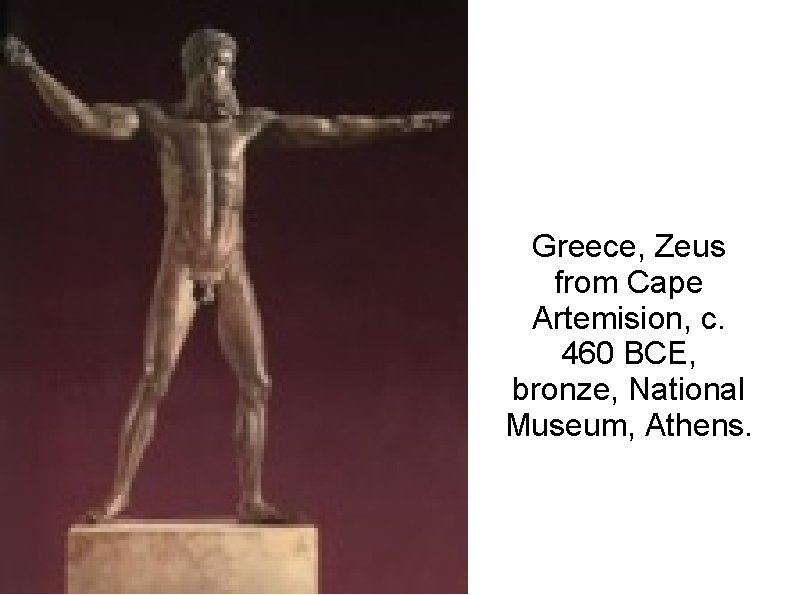
Greece, Zeus from Cape Artemision, c. 460 BCE, bronze, National Museum, Athens.
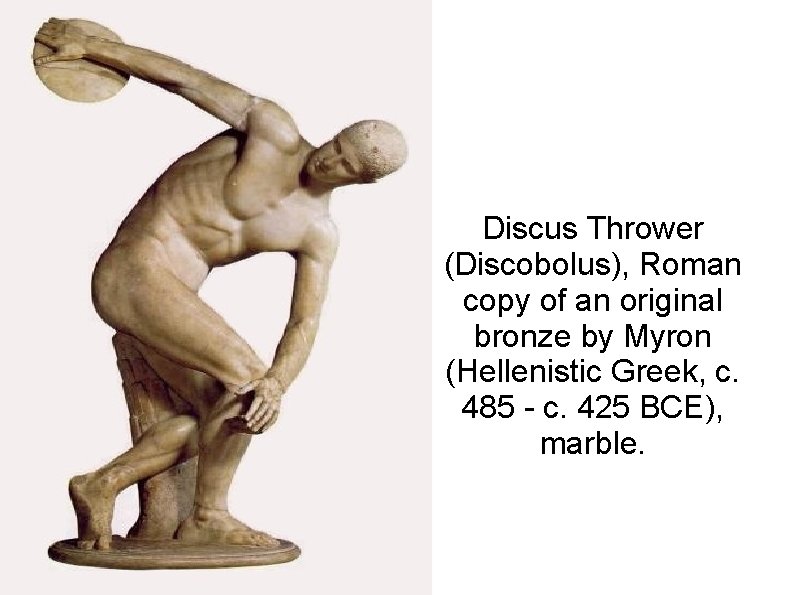
Discus Thrower (Discobolus), Roman copy of an original bronze by Myron (Hellenistic Greek, c. 485 - c. 425 BCE), marble.
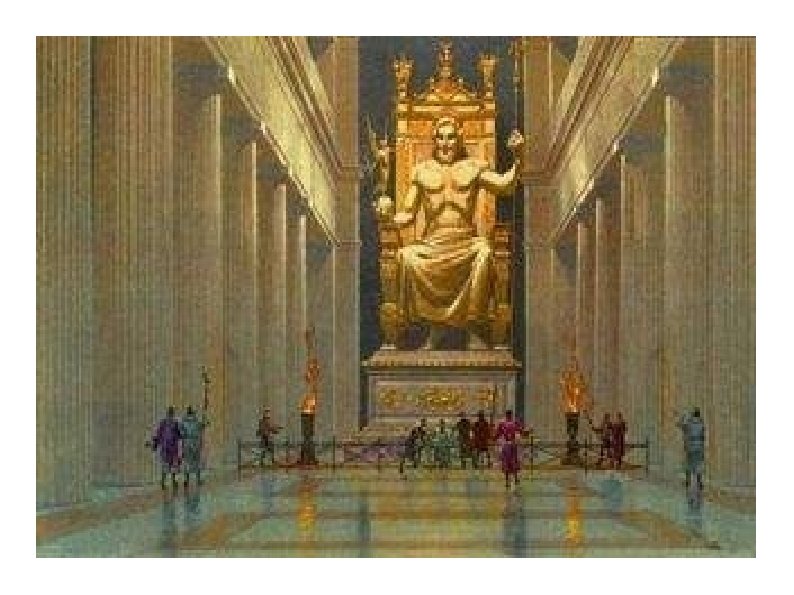
Phidias of Athens was a Classical Greek sculptor who lived from 493 to 430 BC, and is one of the greatest sculptors of ancient Greece. He was son to Charmides and is well known for his 40 foot tall statue of Athena in the Parthenon, and his statue of Zeus at Olympia. The Athena, with "chryselephantine" workmanship, featured plates of ivory on a wood core, with stone flesh and solid gold drapery and ornaments.
Phidias' Athena was destroyed in antiquity and was the chief treasure of Athens. We know of its existence because several copies were made and preserved, and it is also represented on gems and coins. The Zeus was constructed of ivory and gold and is counted as one of the Seven Wonders of the World. Phidias was sent to prison after being charged with impiety and it is thought that he died there.
The first major revival of classicism was during the Renaissance resulting from a fresh interest in Roman and Greek culture. Again in the 18 th century the interest in classicism was sparked by the discovery of Herculaneum and Pompeii; this period is defined as neoclassicism and is considered to be phase one of the romantic movement.
Archaeology Giovanni Paolo Panini's Ancient Rome is representative of the movement, a tour-de-force painting encompassing many of the monuments in and around Rome, including the Pantheon, the Colosseum, Trajan's Column, the Medici Vase, the Farnese Hercules, and the Laocoön. In the midst of a grand gallery, students copy the great works of antiquity.
Neoclassicism Arose from first-hand observation and reproduction of antique works and came to dominate European architecture, painting, sculpture, and decorative arts
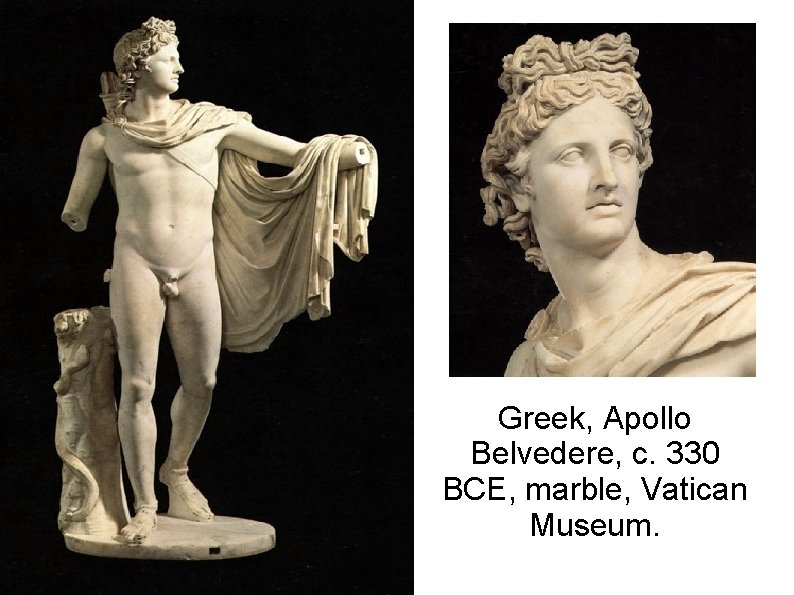
Johann Joachim Winckelmann German archaeologist and philosopher, emphasized the supremacy of Greek art. His major work, Gedanken über die Nachahmung der griechischen Werke in der Malerei und Bildhauerkunst (Reflections on the Painting and Sculpture of the Greeks, 1755), extolled the beauty of the Apollo Belvedere in particular. Rejecting the notion that art imitates life, Winckelmann taught that qualities superior to nature are found in Greek art, specifically, "ideal beauties, brain-born images. " Such transcendent works, he explained, went beyond mere verisimilitude to capture "a more beauteous and more perfect nature. "
Greek, Apollo Belvedere, c. 330 BCE, marble, Vatican Museum.
Graeco-Roman Controversy Winckelmann's writings sparked the Greco-Roman controversy in the 1760 s, a debate as to the relative superiority of Greek and Roman architecture and ornament, thus drawing attention to an overlooked field. Italian printmaker Giovanni Battista Piranesi's (1720– 1778) vast oeuvre of engravings of ancient Roman sites demonstrates his perception of Roman practicality as an improvement over Greek experiment. Other scholars, siding with Winckelmann, contended that Roman culture was a lesser imitation of Greek mastery of form.
Anton Raphael Mengs was born in 1728 in Aussig, Bohemia, into an artistic family of German origin. Soon after his birth his parents returned to Saxony. Anton received his earliest training from his father in Dresden and in Rome, where he studied Italian Renaissance painters and worked in the studio of Marco Benefial. When he came back to Dresden in 1745, he became a painter to the Saxon court of Elector Augustus III, who was at the same time the King of Poland. Mengs executed for the court a large number of portraits.
In the early 1750 s, Mengs again left for Rome. About 1755, he became a close friend of the German archaeologist and art critic J. J. Winckelmann, the author of the famous A History of Ancient Art (1764). Mengs came to share Winckelmann's enthusiasm for classical antiquity, and worked to establish the dominance of Neoclassical painting. At the same time the influence of the Roman Baroque remained strong, particularly in his religious paintings.
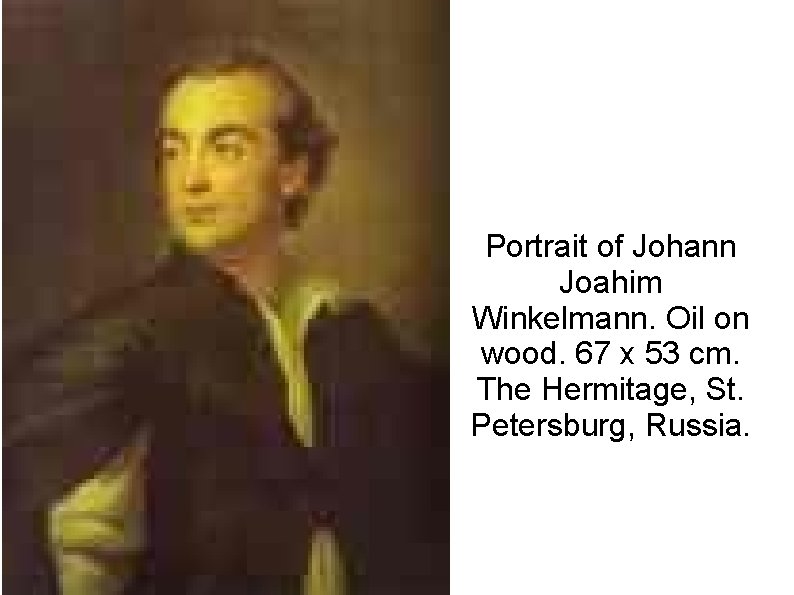
Portrait of Johann Joahim Winkelmann. Oil on wood. 67 x 53 cm. The Hermitage, St. Petersburg, Russia.
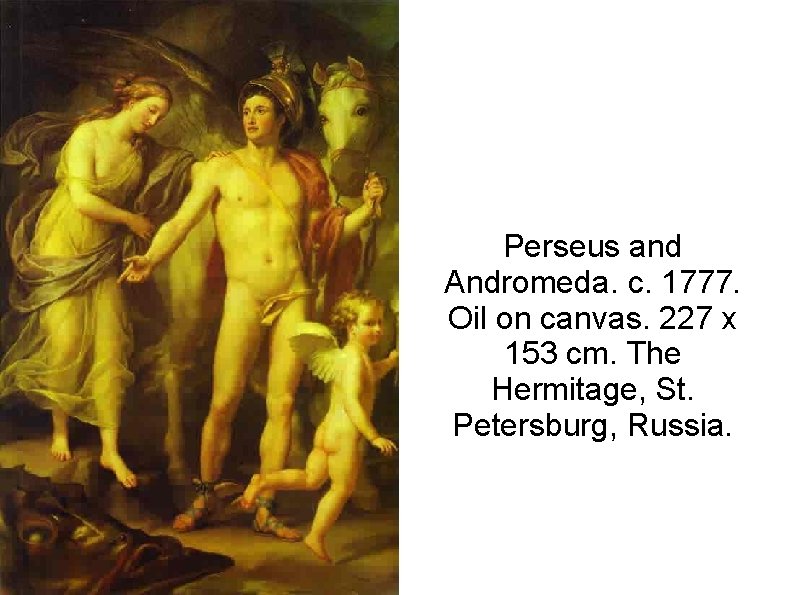
Perseus and Andromeda. c. 1777. Oil on canvas. 227 x 153 cm. The Hermitage, St. Petersburg, Russia.
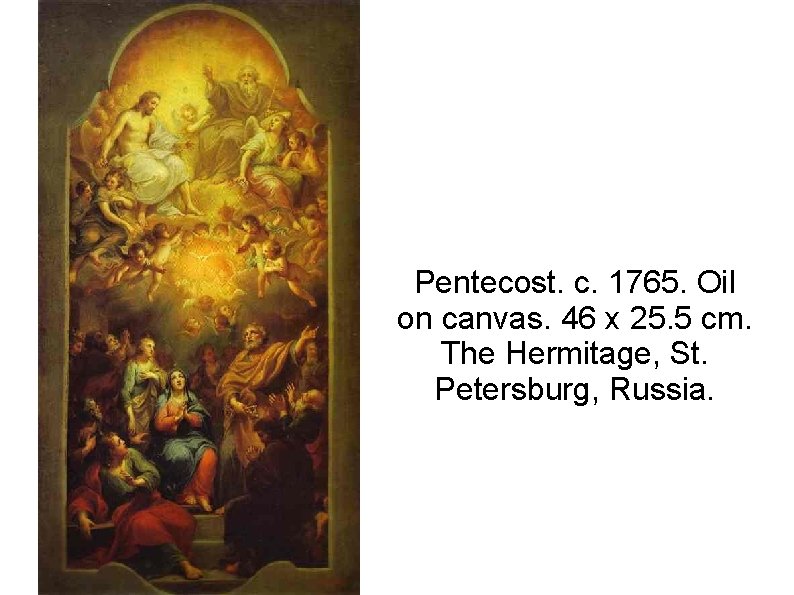
Pentecost. c. 1765. Oil on canvas. 46 x 25. 5 cm. The Hermitage, St. Petersburg, Russia.
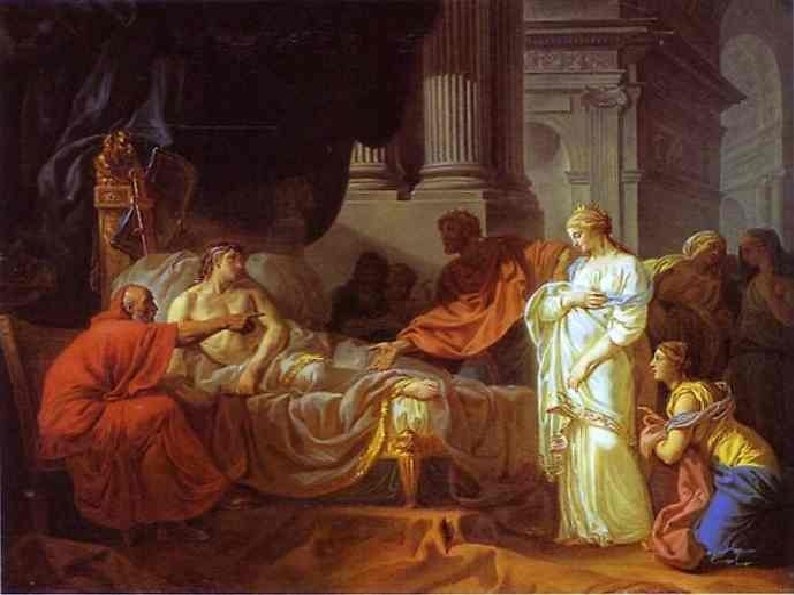
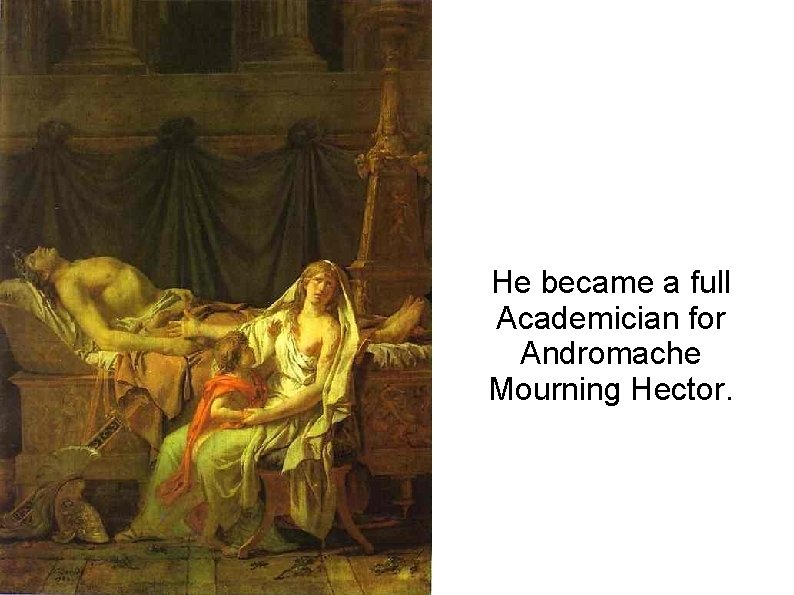
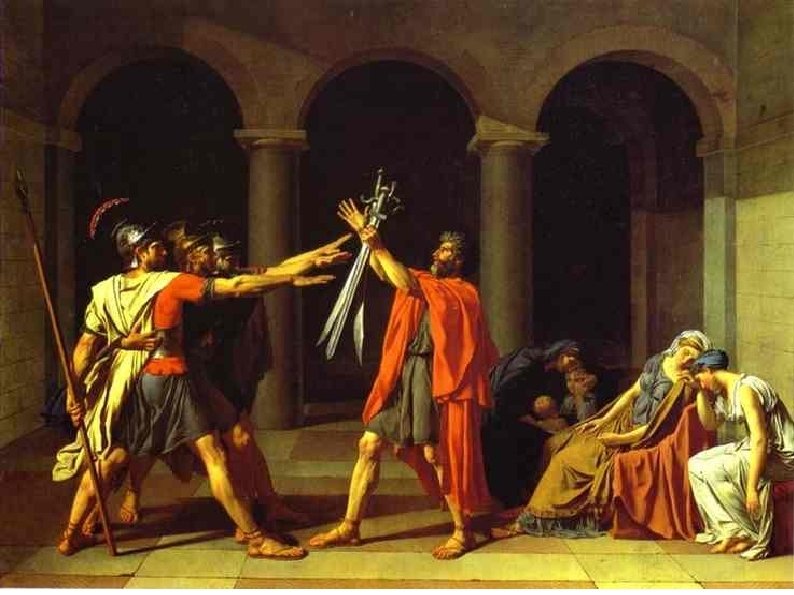
Jacques-Louis David In 1766 -1774 David studied at the Royal Academy of Painting and Sculpture, in Vein's class. The goal of practically every Academy student was to win the premier student prize: the Grand Prix, or Prix de Rome. David took part in the competition every year starting from 1770, until at last in 1774 he finally won it with Antiochus and Stratonice. After that he spent 5 years in Italy (1775 -1780), where drew from antique models. On his return to Paris in 1780, Ancient history and mythology became his favorite subject. In 1781 David was made an Associate member of the Academy for his work Belisarius, which was much admired, and two years later, in 1783, he became a full Academician for Andromache Mourning Hector. In 1784, he fulfilled Louis XVI’s commission - The Oath of the Horatii.
Antiochus and Stratonice. 1774. Oil on canvas. 120 x 155 cm. École Nationale Supériere des Beaux-Arts, Paris, France.
He became a full Academician for Andromache Mourning Hector.
The Oath of Horatii. 1784. Oil on canvas. 330 x 425 cm. Louvre, Paris, France.
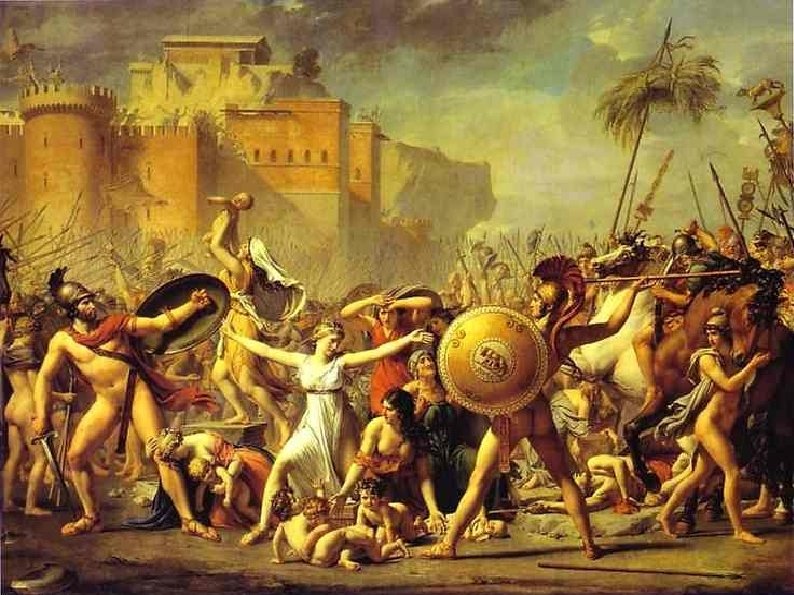
The most prominent work of the second half of the 1790 s was The Intervention of the Sabine Women.