
Classical Organizational Theory Taken From Educational Administration Concepts


- Slides: 23
Classical Organizational Theory Taken From Educational Administration Concepts & Practices Chapter 1 - 2 EDA 6061 Educational Organization and Admin. Lee Droegemueller, Professor Spring 00 1
Management Perspectives • Scientific Management. – Historically-focused on management of workers and work. • Administrative Management. – Focused on how the overall organization should be structured. 2
Scientific Management • Frederick W. Taylor - study the “one best way”. • Four principles of scientific management. – Scientific job analysis. – Selection of personnel. – Management cooperation. – Functional supervising. • Soldiering – working below your capacity. 3
Administrative Management • Primary contributors: – Henri Fayol – Luther Gulick – Max Weber • Henri Fayol’s five basic management functions: a) planning, b) organizing, c) commanding, d) coordinating e) controlling 4
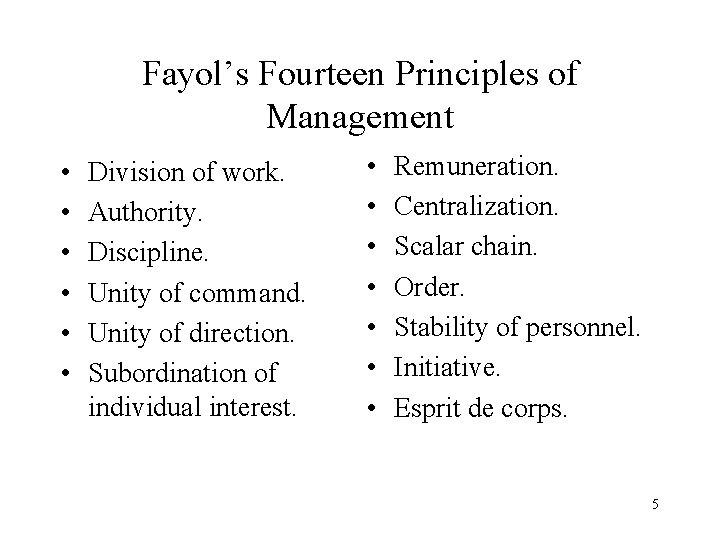
Fayol’s Fourteen Principles of Management • • • Division of work. Authority. Discipline. Unity of command. Unity of direction. Subordination of individual interest. • • Remuneration. Centralization. Scalar chain. Order. Stability of personnel. Initiative. Esprit de corps. 5
Luther Gulik • Augmented Fayol’s five basic management functions. • POSDCo. RB. • Seven functions: planning, organizing, staffing, directing, coordinating, reporting, and budgeting. 6
Max Weber • A concept of bureaucracy based upon a comprehensive set of rational guidelines. • Weber’s “ideal” bureaucracy and Fayol’s fourteen principles of management laid the foundation for contemporary organizational theory. • Psychological and social factors in the workplace were ignored. 7
Human Relations Approach • Started with a series of studies conducted at the Hawthorne Plant of Western Electric. • Located near Chicago. • Conducted by Elton Mayo and his associates. • 1927 -1933. 8
Hawthorne Studies • • • Relay Assembly Test Room Second Relay Assembly Group Mica-Splitting Group The typewriting Group Bank Wiring Observation Room – 21126 employees interviewed – What employees liked and disliked about their work 9
Hawthorne Studies • Both control and experimental groups improved when studied and interviewed • Human-social element operated in the workplace. – Group norms developed • In any different or experimental undertaking – improvement may take place • Called “The Hawthorne Effect” 10
Hawthorne Studies • These studies indicated that the understanding of human behavior, especially group behavior, from the perspective of management was firmly established. 11
Contributors-human Relations Approach • Kurt Lewin: – Field theory and group dynamics. – Democratic and authoritarian groups. • Carl Rogers: – Internal frame reference of the individual. • Jacob Moreno: – Interpersonal relationships between groups. – Groups with individuals that have similar affinities to each other will perform better. 12
Contributors-human Relations Approach • William Whyte: – Group conflict, status, workflow – Found selective preferences worked best. • George Homans: – Theory of Small Groups 13
Assumptions of Human Relations Approach • Employees motivated by social and psychological needs and by economic incentives. • These needs are more important than physical conditions of the work environment. 14
Behavioral Science Approach • Formed because of the inadequacy of human relations and classical mang. approaches. • Chester Barnard: – Effectiveness – Efficiency 15
Behavioral Science Approach • E. Wight Bakke: – Fusion Process – The fusion of the personalizing process of the individual and the socializing processes of the organization is accomplished through the bonds of the organization 16
Behavioral Science Approach • Chris Argyris: • Incompatibility of the between growth and development of the individual’s maturing personality and the repressive nature of the formal organization. • “Organization Man” concept 17
Behavioral Science Approach • Gettzels and Guba: – Education study. – Nomothetic Dimension. – Idiographic Dimension. – Behavior in any social system in an organization can be seen as interaction between personal needs and institutional goals. 18
Behavioral Science Approach • Abraham Maslow: • Five categories – Physical - Air, water, food, rest, and reproductive ability – Safety - protection from threats of well-being – Social – Self-esteem the desire to believe that we are worthwhile, valuable people – Self-actualization - the desire to develop our potential to the maximum 19
Douglas Mc. Gregor • Theories of management developed by Douglas Mc. Gregor depicting two extreme positions representing the options available for the management of people. • Theory X describes workers who are disinterested in work and need manager control through incentives and punishments to be motivated. 20
Douglas Mc. Gregor • Theory Y is the management view that workers are self directed, intrinsically motivated, and want to take the responsibility for work and productivity. • Self-actualization: A term used by Maslow for the effort of the individual to fulfill his or her potential. • Theory Z: Is there one and what is it? 21
Frederick Herzberg • Hygiene Factors: factors that cause or prevent job dissatisfaction. • Motivation Factors: factors that cause job satisfaction. 22
Rensis Likert • Goals of the individual and goals of the organization. – System 1. Exploitive Authoritative – System 2. – System 3. – System 4. Participative Group 23