
Classical India and Hinduism 112 Explain development and



- Slides: 41
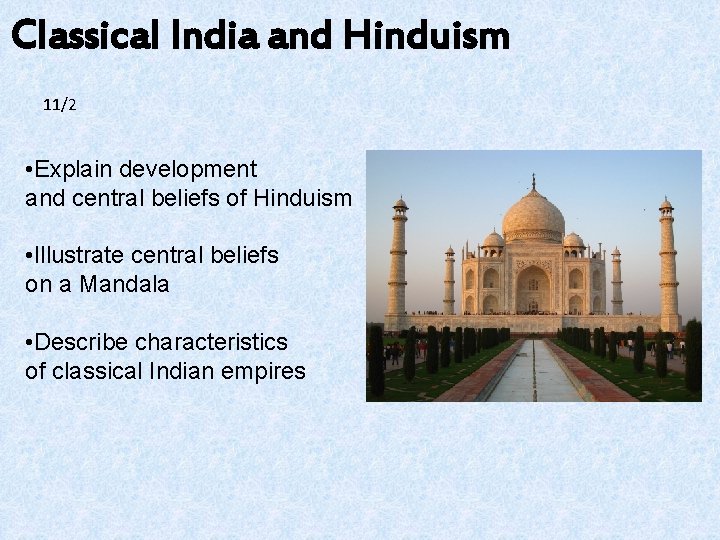
Classical India and Hinduism 11/2 • Explain development and central beliefs of Hinduism • Illustrate central beliefs on a Mandala • Describe characteristics of classical Indian empires
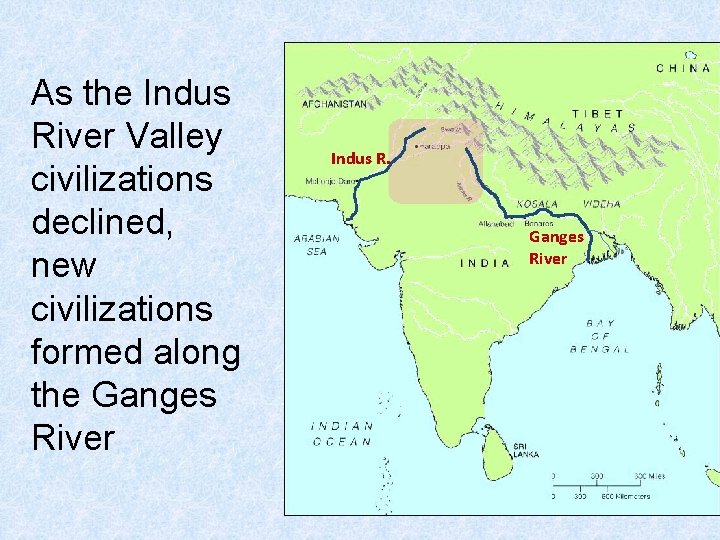
As the Indus River Valley civilizations declined, new civilizations formed along the Ganges River Indus R. Ganges River
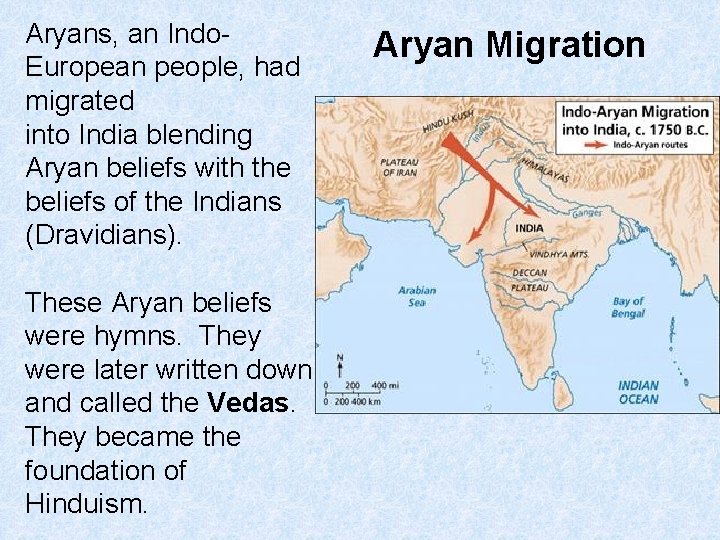
Aryans, an Indo. European people, had migrated into India blending Aryan beliefs with the beliefs of the Indians (Dravidians). These Aryan beliefs were hymns. They were later written down and called the Vedas. They became the foundation of Hinduism. Aryan Migration
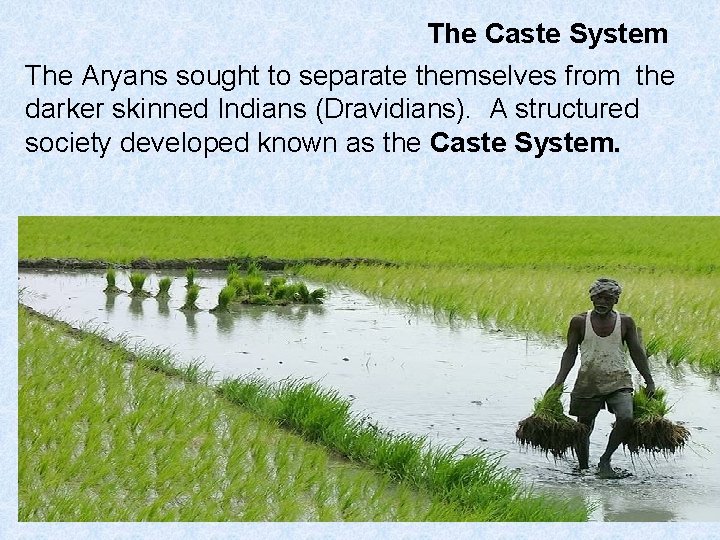
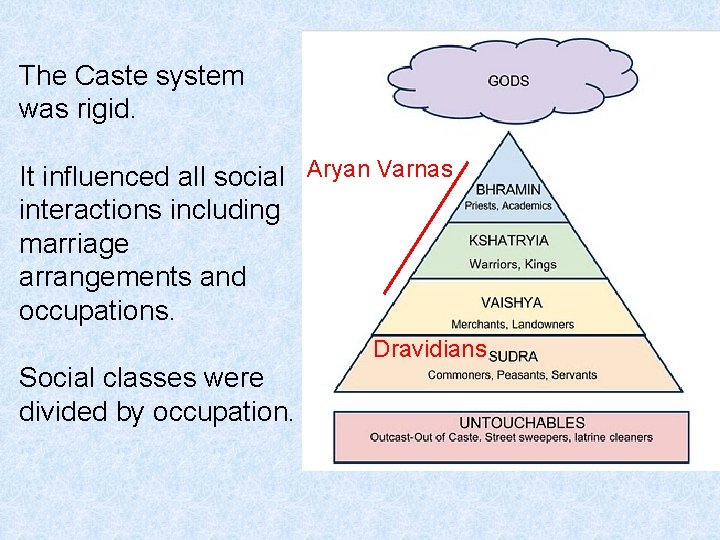
The Caste System The Aryans sought to separate themselves from the darker skinned Indians (Dravidians). A structured society developed known as the Caste System.
The Caste system was rigid. It influenced all social Aryan Varnas interactions including marriage arrangements and occupations. Social classes were divided by occupation. Dravidians
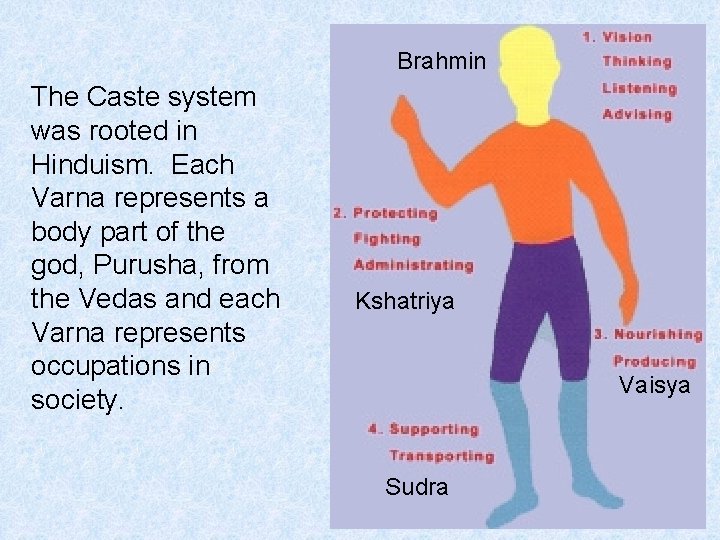
Brahmin The Caste system was rooted in Hinduism. Each Varna represents a body part of the god, Purusha, from the Vedas and each Varna represents occupations in society. Kshatriya Vaisya Sudra
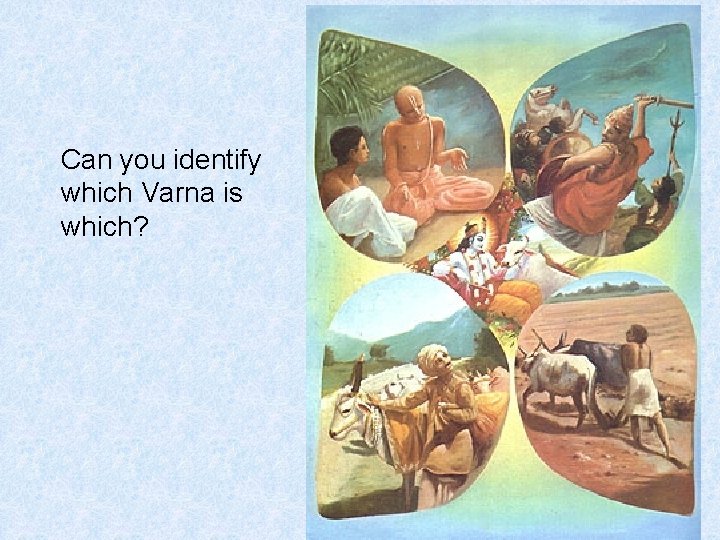
Can you identify which Varna is which?
Hinduism
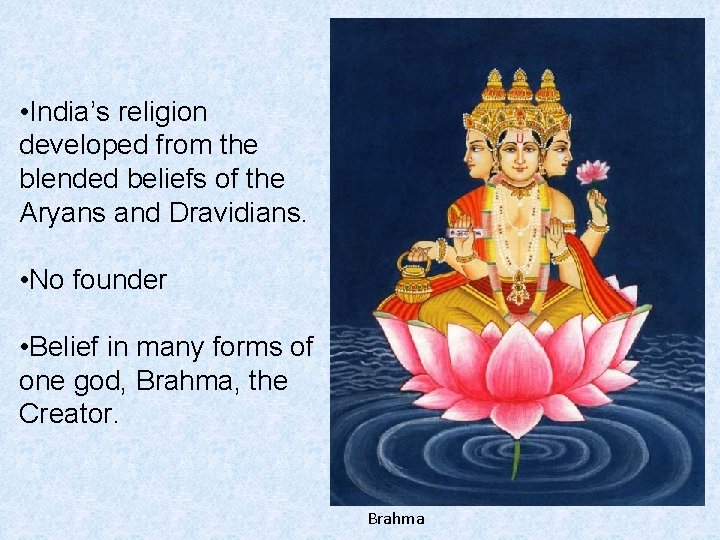
• India’s religion developed from the blended beliefs of the Aryans and Dravidians. • No founder • Belief in many forms of one god, Brahma, the Creator. Brahma
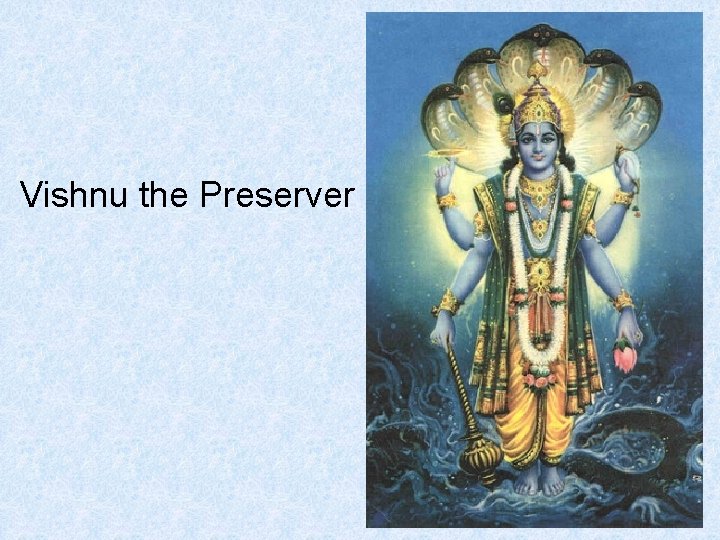
Vishnu the Preserver
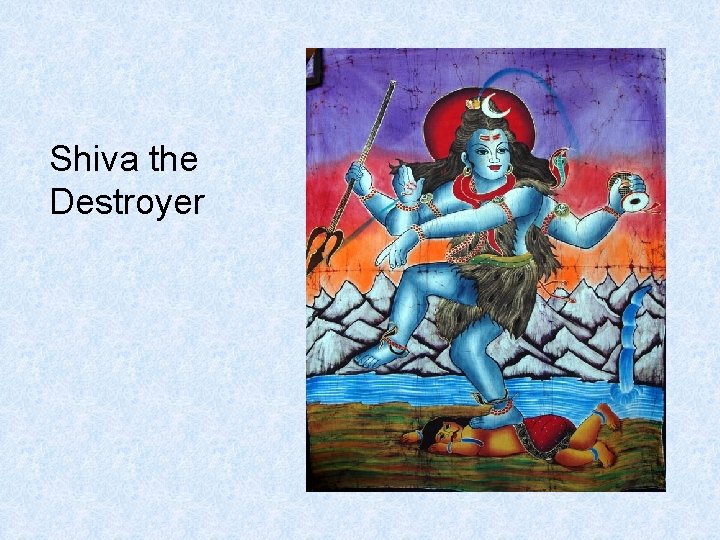
Shiva the Destroyer
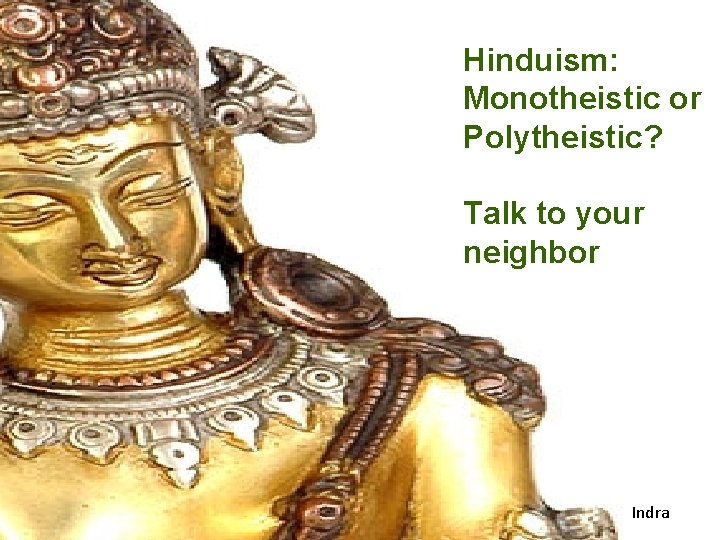
Hinduism: Monotheistic or Polytheistic? Talk to your neighbor Indra
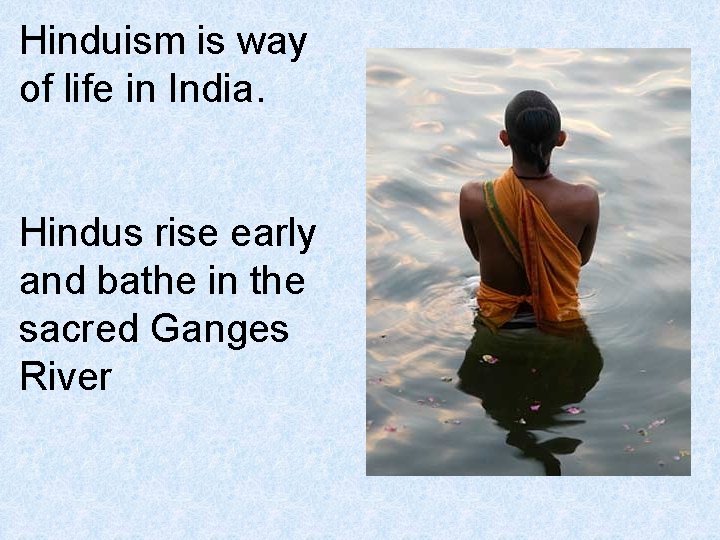
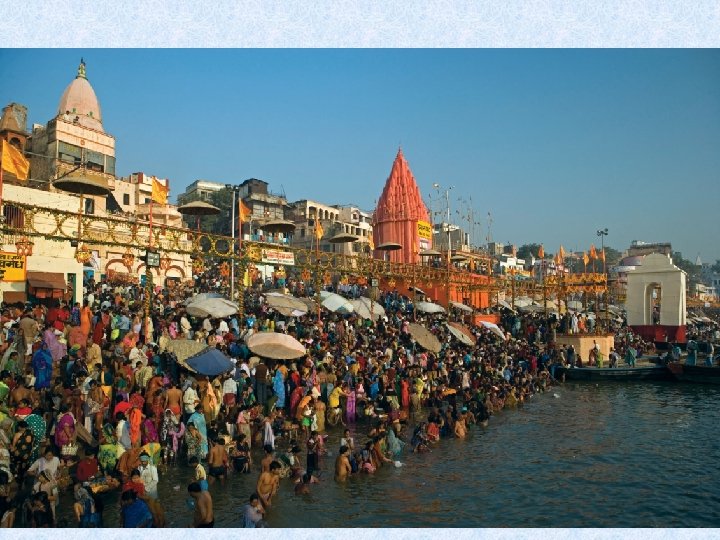
Hinduism is way of life in India. Hindus rise early and bathe in the sacred Ganges River
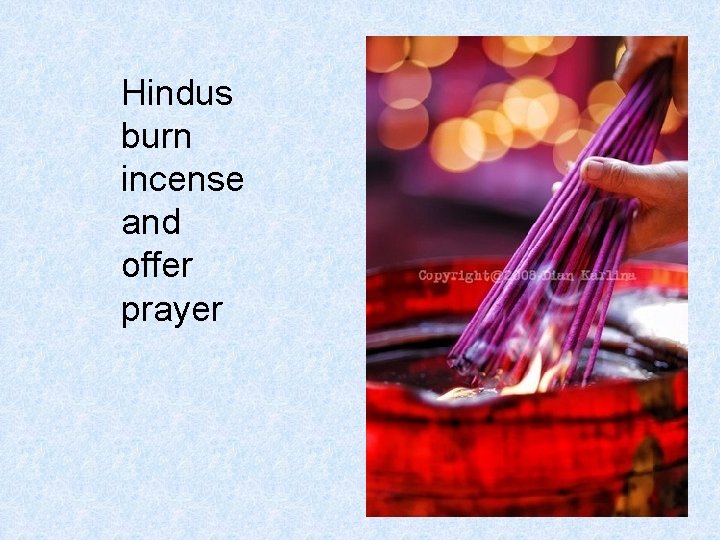
Hindus burn incense and offer prayer
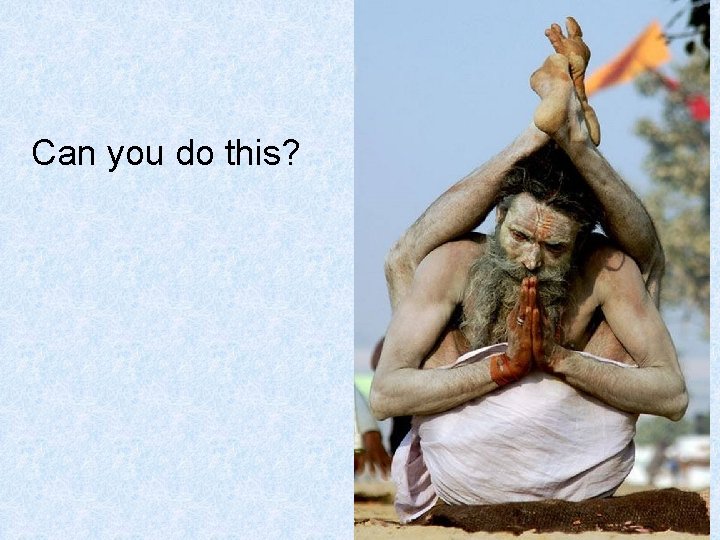
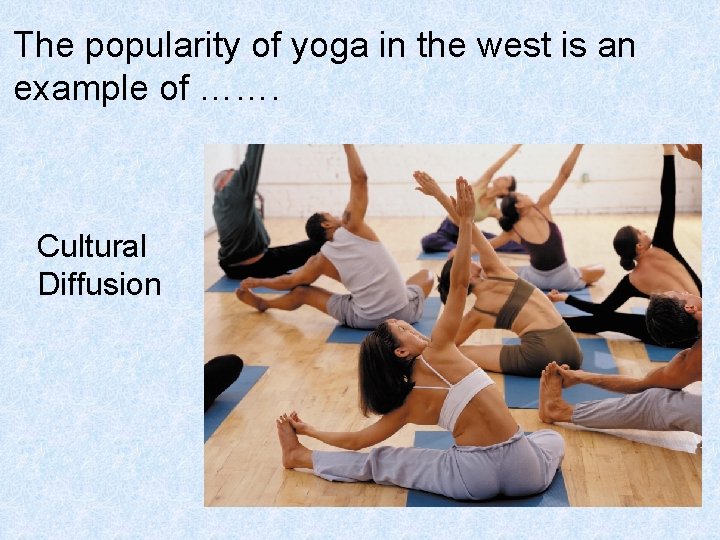
Hindus practice Yoga is about meditation and mind control over body. Spiritual Discipline
Can you do this?
The popularity of yoga in the west is an example of ……. Cultural Diffusion
Central Beliefs of Hinduism • Belief in many forms of one god • Reincarnation: Rebirth based upon karma • Karma = deeds. Knowledge that all thoughts and actions result in future consequences. • Vedas and Upanishads are sacred writings • Spread along major trade routes
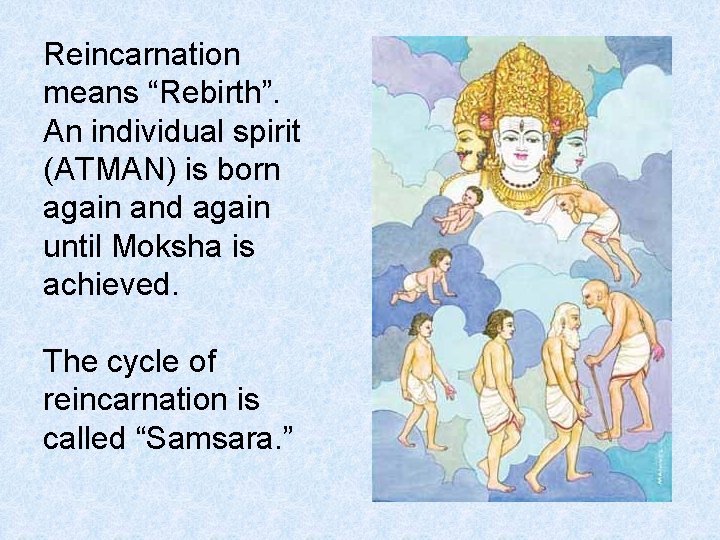
Reincarnation means “Rebirth”. An individual spirit (ATMAN) is born again and again until Moksha is achieved. The cycle of reincarnation is called “Samsara. ”
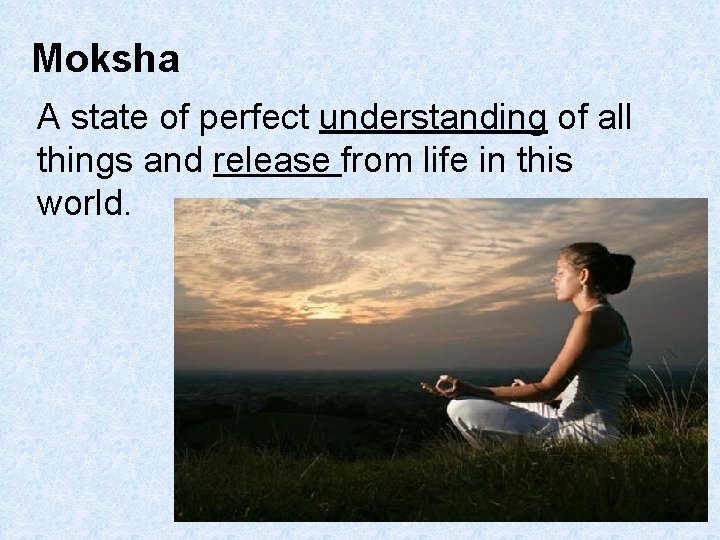
Moksha A state of perfect understanding of all things and release from life in this world.
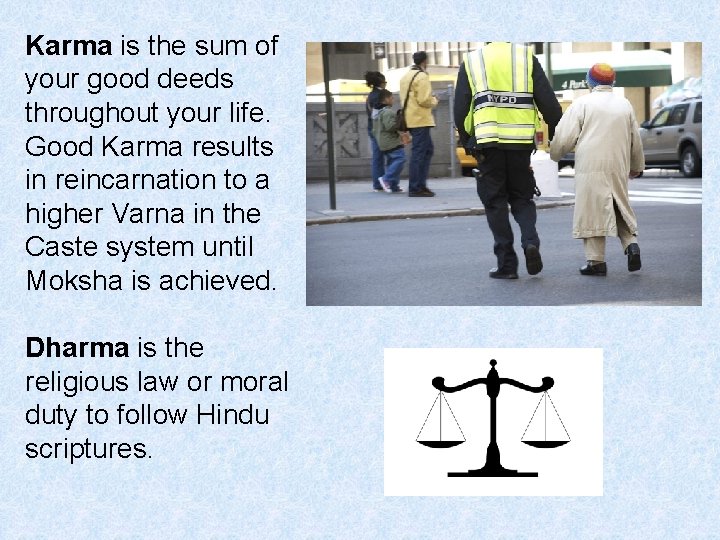
Karma is the sum of your good deeds throughout your life. Good Karma results in reincarnation to a higher Varna in the Caste system until Moksha is achieved. Dharma is the religious law or moral duty to follow Hindu scriptures.
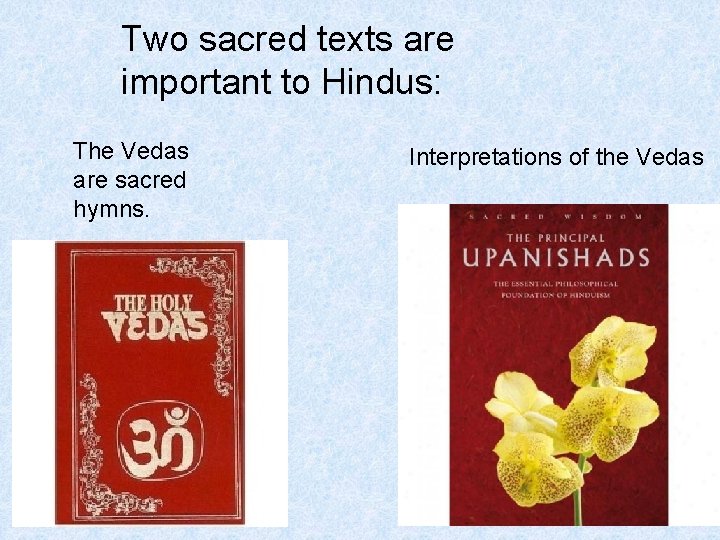
Two sacred texts are important to Hindus: The Vedas are sacred hymns. Interpretations of the Vedas
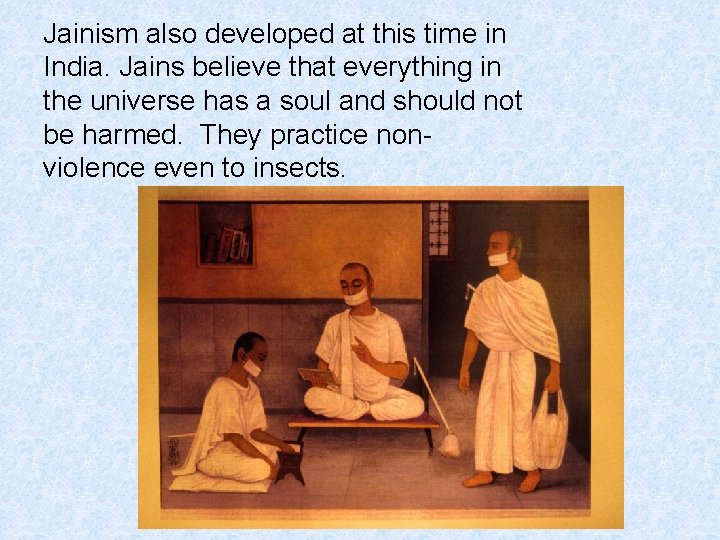
Jainism also developed at this time in India. Jains believe that everything in the universe has a soul and should not be harmed. They practice nonviolence even to insects.
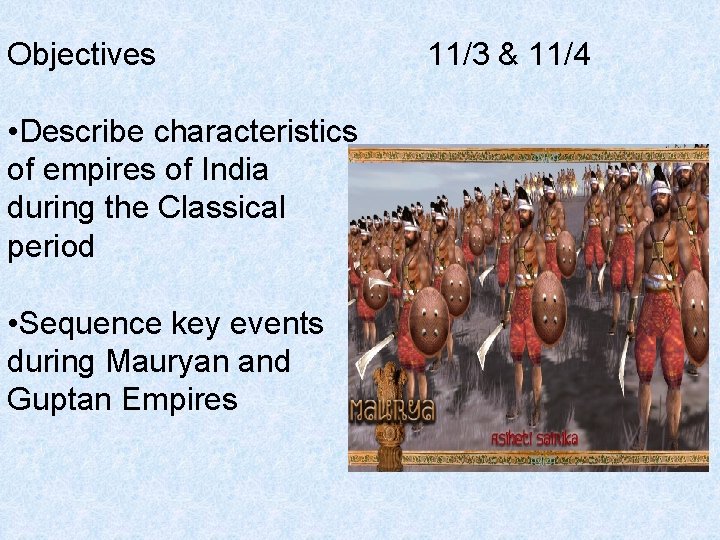
Objectives • Describe characteristics of empires of India during the Classical period • Sequence key events during Mauryan and Guptan Empires 11/3 & 11/4
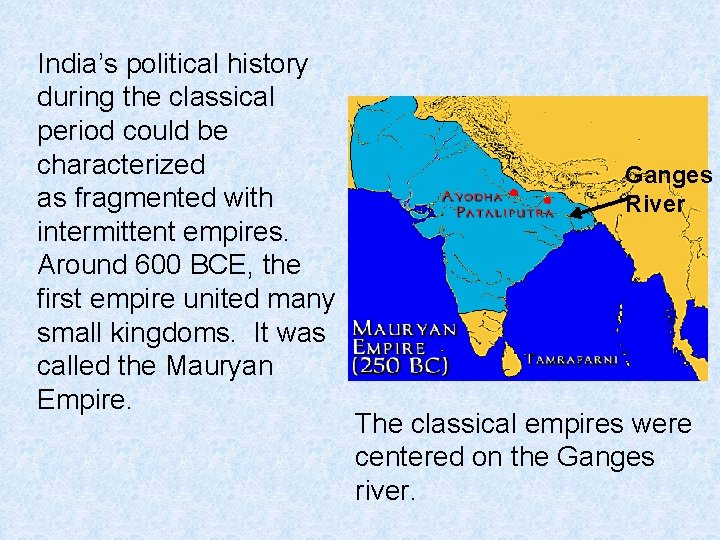
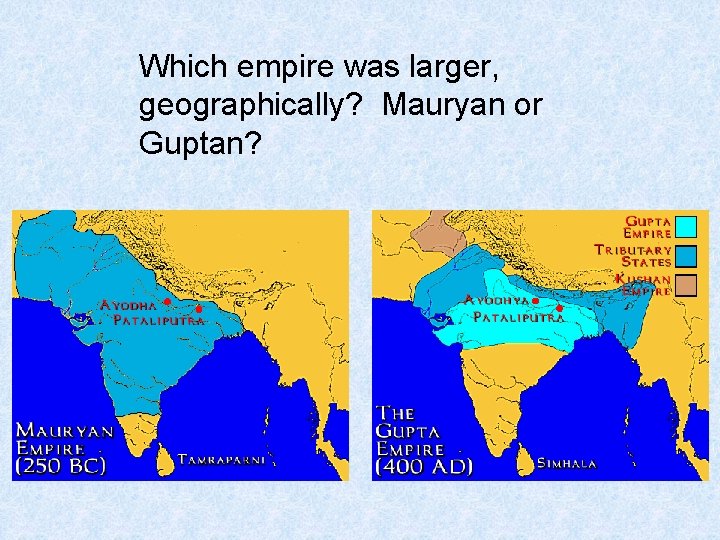
India’s political history during the classical period could be characterized as fragmented with intermittent empires. Around 600 BCE, the first empire united many small kingdoms. It was called the Mauryan Empire. Ganges River The classical empires were centered on the Ganges river.
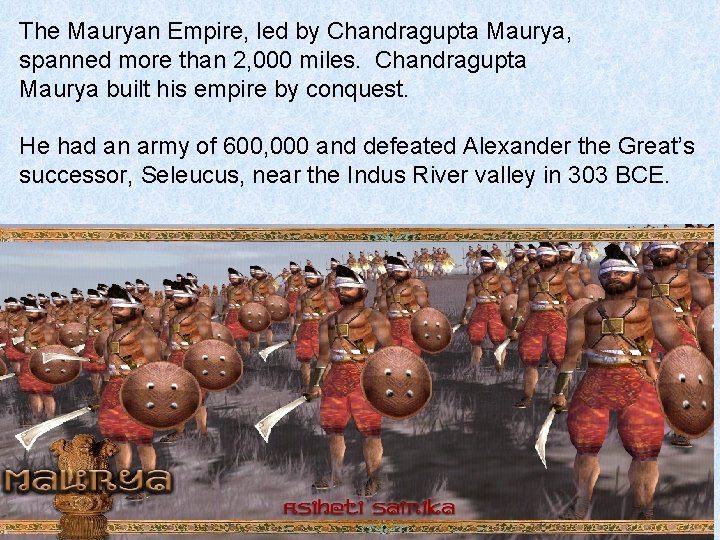
The Mauryan Empire, led by Chandragupta Maurya, spanned more than 2, 000 miles. Chandragupta Maurya built his empire by conquest. He had an army of 600, 000 and defeated Alexander the Great’s successor, Seleucus, near the Indus River valley in 303 BCE.
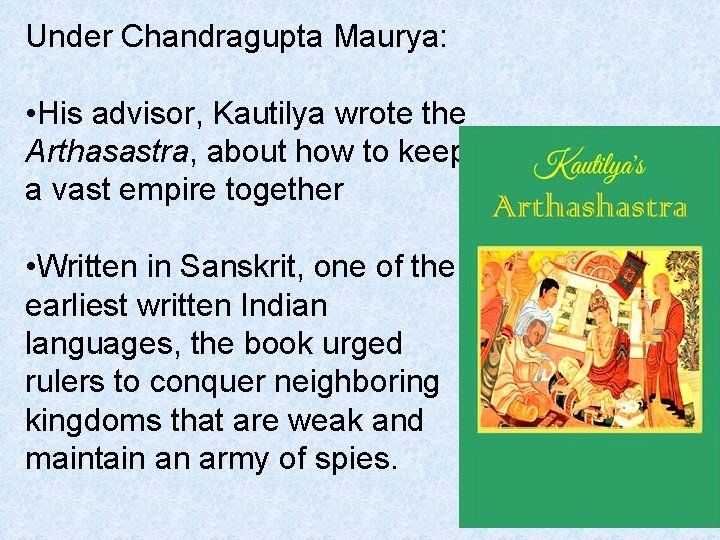
Under Chandragupta Maurya: • His advisor, Kautilya wrote the Arthasastra, about how to keep a vast empire together • Written in Sanskrit, one of the earliest written Indian languages, the book urged rulers to conquer neighboring kingdoms that are weak and maintain an army of spies.
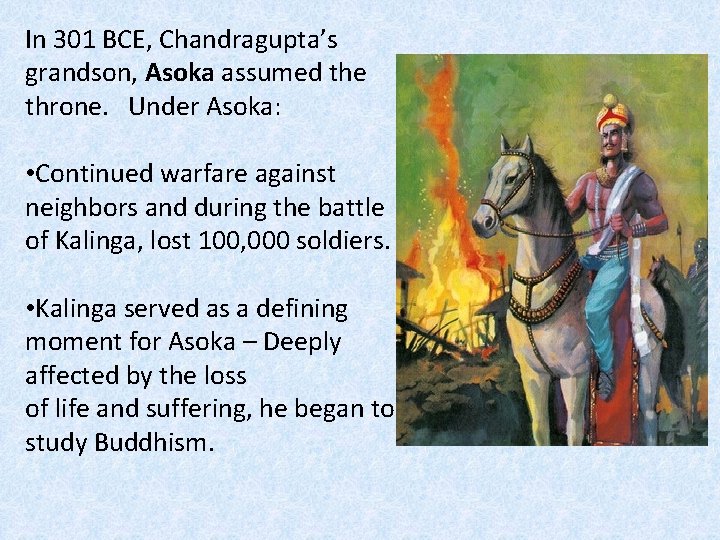
In 301 BCE, Chandragupta’s grandson, Asoka assumed the throne. Under Asoka: • Continued warfare against neighbors and during the battle of Kalinga, lost 100, 000 soldiers. • Kalinga served as a defining moment for Asoka – Deeply affected by the loss of life and suffering, he began to study Buddhism.
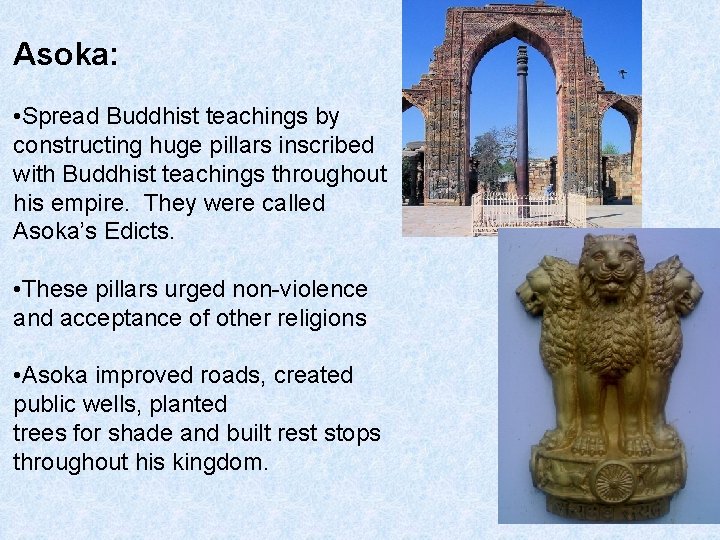
Asoka: • Spread Buddhist teachings by constructing huge pillars inscribed with Buddhist teachings throughout his empire. They were called Asoka’s Edicts. • These pillars urged non-violence and acceptance of other religions • Asoka improved roads, created public wells, planted trees for shade and built rest stops throughout his kingdom.
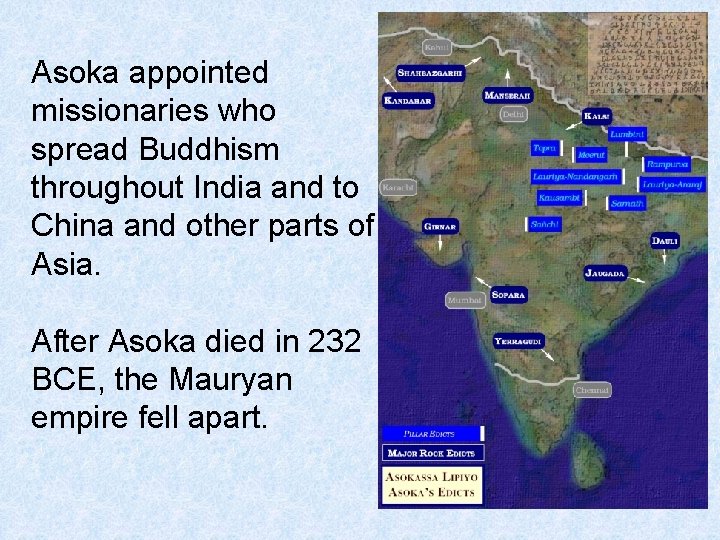
Asoka appointed missionaries who spread Buddhism throughout India and to China and other parts of Asia. After Asoka died in 232 BCE, the Mauryan empire fell apart.
A period of disunity and regional kingdoms followed Asoka’s death and lasted for 500 years. Then, in 320 CE, Chandra Gupta united India into its second empire, the Gupta Empire.
Which empire was larger, geographically? Mauryan or Guptan?
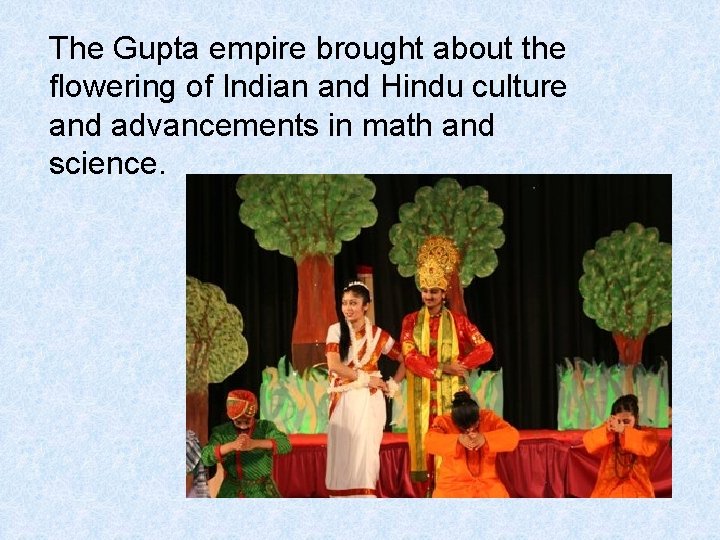
The Gupta empire brought about the flowering of Indian and Hindu culture and advancements in math and science.
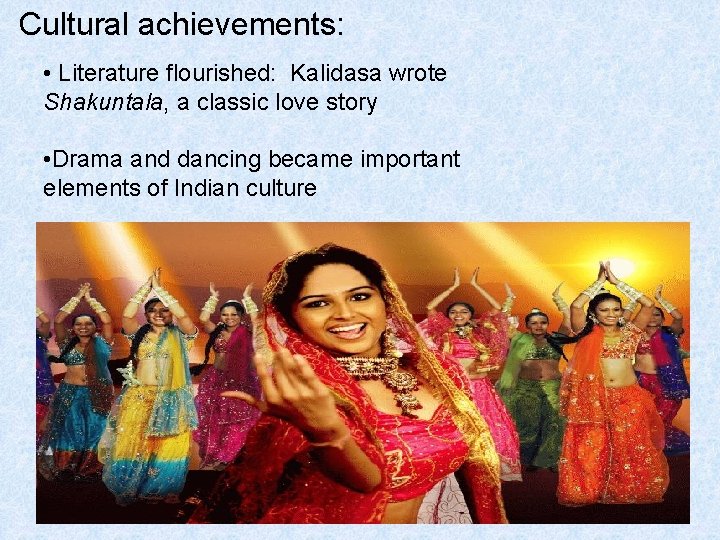
Cultural achievements: • Literature flourished: Kalidasa wrote Shakuntala, a classic love story • Drama and dancing became important elements of Indian culture
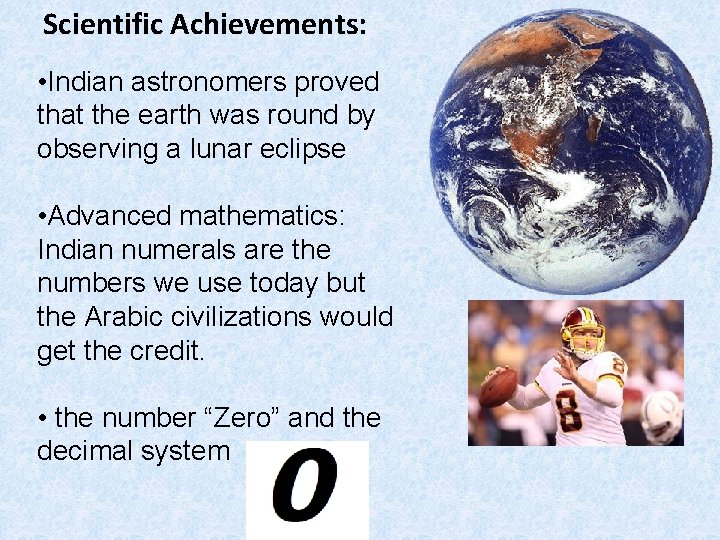
Scientific Achievements: • Indian astronomers proved that the earth was round by observing a lunar eclipse • Advanced mathematics: Indian numerals are the numbers we use today but the Arabic civilizations would get the credit. • the number “Zero” and the decimal system
Scientific achievements continued • Indian mathmetician Aryabhata calculated the value of pi. • Aryabhata also calculated the length of the solar year very accurately • Continued advancements in medicine and surgerycompiled medical texts
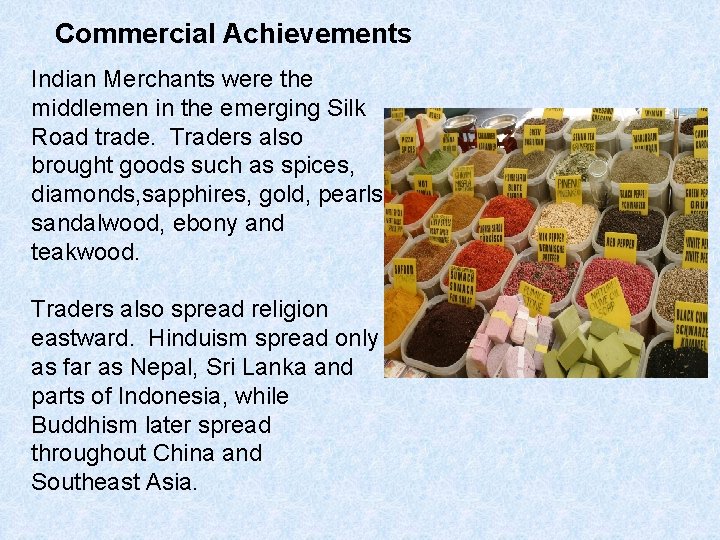
Commercial Achievements Indian Merchants were the middlemen in the emerging Silk Road trade. Traders also brought goods such as spices, diamonds, sapphires, gold, pearls, sandalwood, ebony and teakwood. Traders also spread religion eastward. Hinduism spread only as far as Nepal, Sri Lanka and parts of Indonesia, while Buddhism later spread throughout China and Southeast Asia.
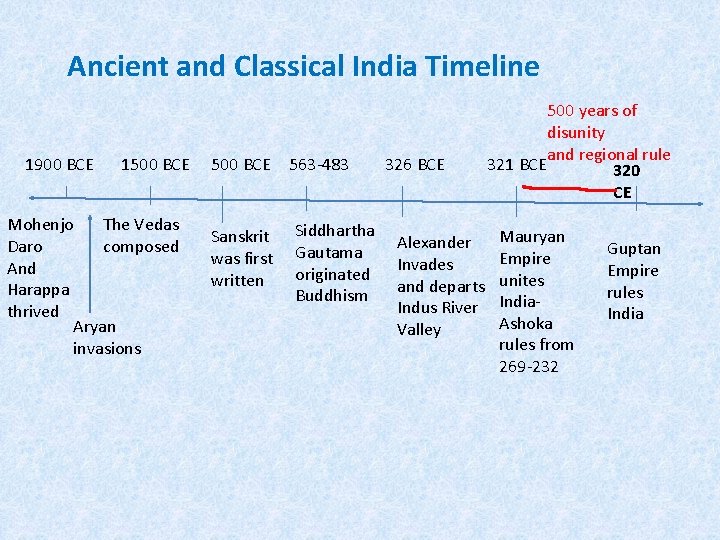
Ancient and Classical India Timeline 1900 BCE 1500 BCE Mohenjo The Vedas Daro composed And Harappa thrived Aryan invasions 500 BCE Sanskrit was first written 563 -483 Siddhartha Gautama originated Buddhism 326 BCE Alexander Invades and departs Indus River Valley 500 years of disunity and regional rule 321 BCE 320 CE Mauryan Empire unites India. Ashoka rules from 269 -232 Guptan Empire rules India
http: //globaltwilight. edublogs. org/files/2011/0 3/caste_system-oo 4 t 9 n. jpg http: //bhoffert. faculty. noctrl. edu/REL 100/Hin duism. Varnasramadharma. jpg http: //www. rgbpicture. com/img/weird/yogafl ex/yogaflex 09. jpg http: //www. lilaarts. com/en/images/BA 085 a. jp g http: //religion-faith. com/images/stories/srimaha-vishnu. jpg http: //www. pbs. org/thestoryofindia/images/g allery/brahmins. jpg http: //www. indianetzone. com/photos_gallery /44/Origin%20 of%20 Arthashastra. jpg http: //latestcarsopics. files. wordpress. com/201 1/07/ashoka-pillar-at-sarnath-great-indianmonument. jpg http: //1. bp. blogspot. com/_8 T 41 b. ELLin. I/TMhe Ezj. L 0 I/AAAABs. I/Dsyjd. HAVx 1 A/s 1600/Bollyw ood_Show 1_big. jpg