
Classical India and China Learning Goal 2 Describe
Classical India and China Learning Goal 2: Describe the major political, religious/philosophical, and cultural influences of Classical India and China including the origins and central ideas of Hinduism, Buddhism, and Confucianism
Classical China
Political Influences • Chinese Dynastic cycle began • Zhou dynasty(1122 BC-256 BC) was based on feudal rule • Qin Dynasty (221 BC-206 BC) oversaw the unification of China under a legalist philosophy and rejection of Confucianism • Qin Shihuangdi a harsh yet skillful ruler created a strong central bureaucracy in China • Mandate of Heaven = g-ds favored and legitimized the emperor’s power • Han Dynasty (206 BC-220 AD) oversaw expansion of the empire and the revival of Confucian teachings • Continued strong centralized imperial rule and introduced civil service exams as entry tests for government jobs • Silk road trade flourished
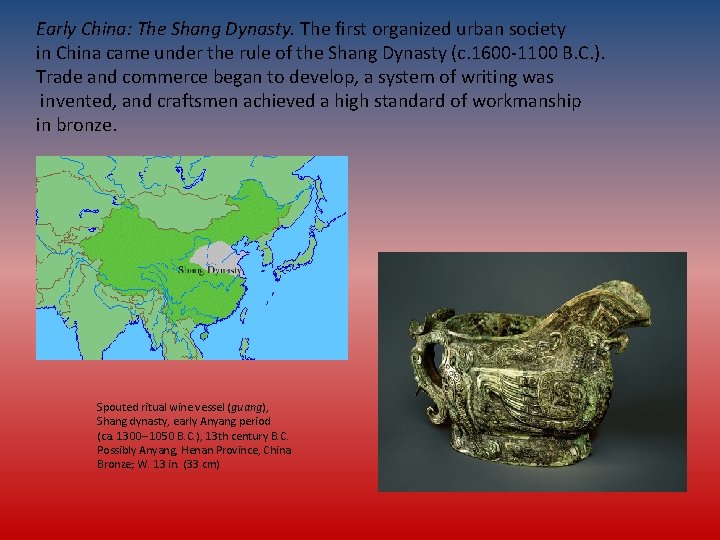
Early China: The Shang Dynasty. The first organized urban society in China came under the rule of the Shang Dynasty (c. 1600 -1100 B. C. ). Trade and commerce began to develop, a system of writing was invented, and craftsmen achieved a high standard of workmanship in bronze. Spouted ritual wine vessel (guang), Shang dynasty, early Anyang period (ca. 1300– 1050 B. C. ), 13 th century B. C. Possibly Anyang, Henan Province, China Bronze; W. 13 in. (33 cm)
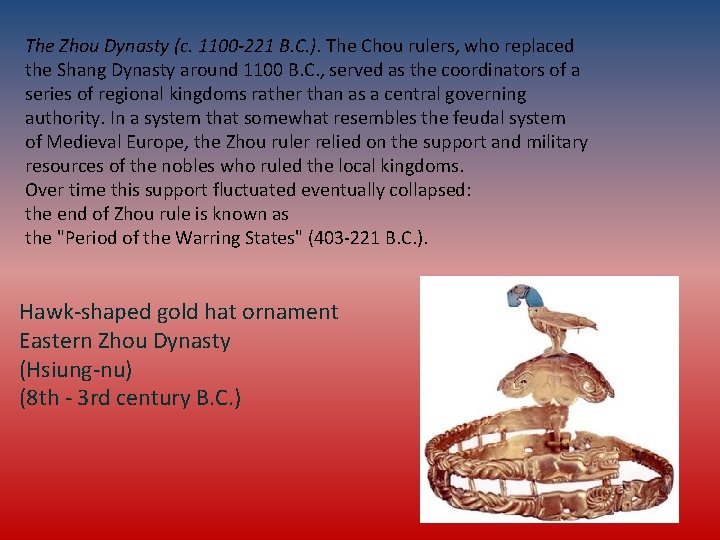
The Zhou Dynasty (c. 1100 -221 B. C. ). The Chou rulers, who replaced the Shang Dynasty around 1100 B. C. , served as the coordinators of a series of regional kingdoms rather than as a central governing authority. In a system that somewhat resembles the feudal system of Medieval Europe, the Zhou ruler relied on the support and military resources of the nobles who ruled the local kingdoms. Over time this support fluctuated eventually collapsed: the end of Zhou rule is known as the "Period of the Warring States" (403 -221 B. C. ). Hawk-shaped gold hat ornament Eastern Zhou Dynasty (Hsiung-nu) (8 th - 3 rd century B. C. )
Religious/Philosophical Ideas • Adoption of Confucian principles especially promotion of filial piety - respect for elders and duty to family • Development of Chinese philosophies of Confucianism, Daoism, and Legalism as social controls and basis for bureaucratic system
Cultural Influences • Written language • Terra-cotta soldiers buried with Qin Shihuangdi • Ancestor worship blended with Confucian practices • Stressed duty and honor

Classical India
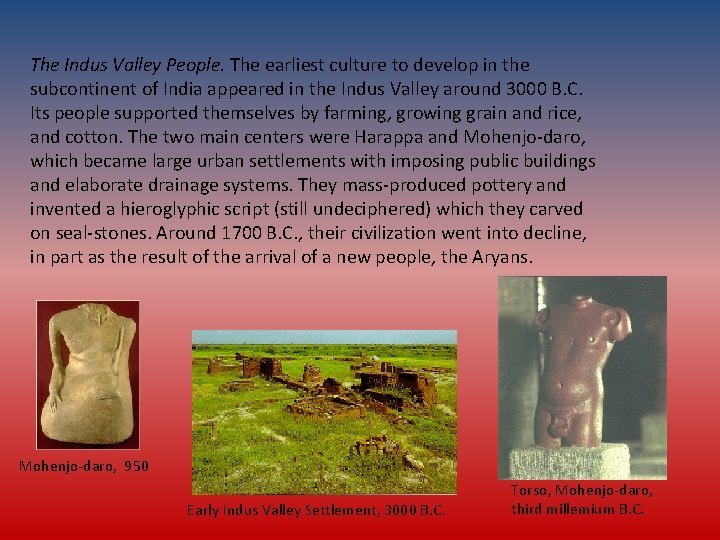
The Indus Valley People. The earliest culture to develop in the subcontinent of India appeared in the Indus Valley around 3000 B. C. Its people supported themselves by farming, growing grain and rice, and cotton. The two main centers were Harappa and Mohenjo-daro, which became large urban settlements with imposing public buildings and elaborate drainage systems. They mass-produced pottery and invented a hieroglyphic script (still undeciphered) which they carved on seal-stones. Around 1700 B. C. , their civilization went into decline, in part as the result of the arrival of a new people, the Aryans. Mohenjo-daro, 950 Early Indus Valley Settlement, 3000 B. C. Torso, Mohenjo-daro, third millemium B. C.
Political Influences • Generally India divided into small regional political units, but for two periods during the Classical Era India was unified by imperial powers • First period of imperial unity was under the rule of the Mauryan Dynasty (324 BC-183 BC) • Divided territory into provinces and use of a strong military • Largest under Ashoka • After the death of Ashoka decline, disunity and collapse of the empire
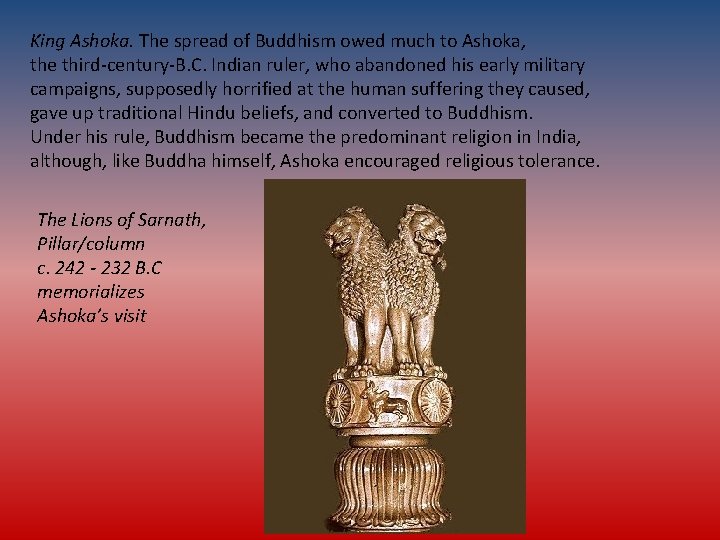
King Ashoka. The spread of Buddhism owed much to Ashoka, the third-century-B. C. Indian ruler, who abandoned his early military campaigns, supposedly horrified at the human suffering they caused, gave up traditional Hindu beliefs, and converted to Buddhism. Under his rule, Buddhism became the predominant religion in India, although, like Buddha himself, Ashoka encouraged religious tolerance. The Lions of Sarnath, Pillar/column c. 242 - 232 B. C memorializes Ashoka’s visit
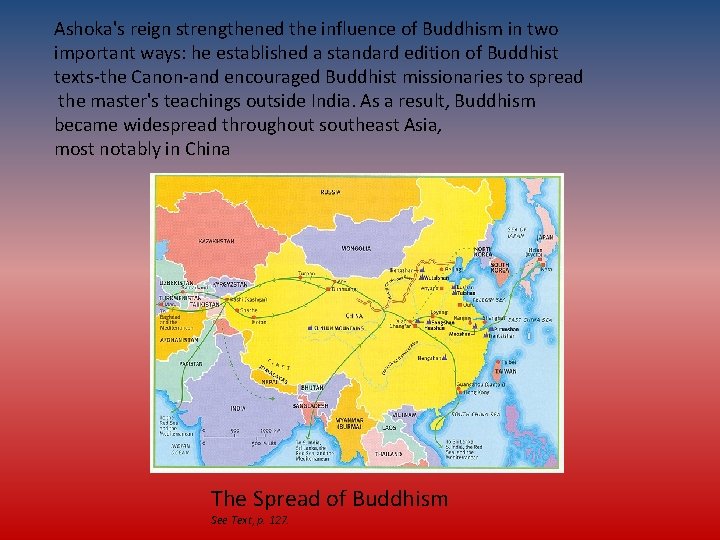
Ashoka's reign strengthened the influence of Buddhism in two important ways: he established a standard edition of Buddhist texts-the Canon-and encouraged Buddhist missionaries to spread the master's teachings outside India. As a result, Buddhism became widespread throughout southeast Asia, most notably in China The Spread of Buddhism See Text, p. 127.
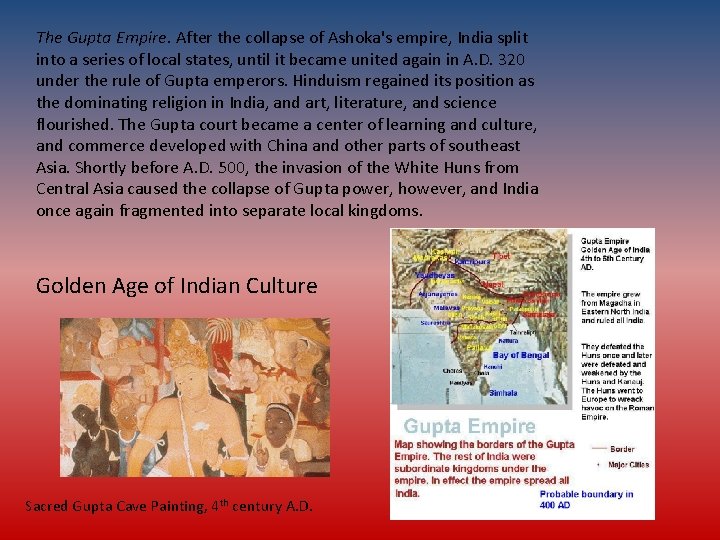
The Gupta Empire. After the collapse of Ashoka's empire, India split into a series of local states, until it became united again in A. D. 320 under the rule of Gupta emperors. Hinduism regained its position as the dominating religion in India, and art, literature, and science flourished. The Gupta court became a center of learning and culture, and commerce developed with China and other parts of southeast Asia. Shortly before A. D. 500, the invasion of the White Huns from Central Asia caused the collapse of Gupta power, however, and India once again fragmented into separate local kingdoms. Golden Age of Indian Culture Sacred Gupta Cave Painting, 4 th century A. D.
More Political Influences • The second period of imperial unity was under Gupta rule (320 AD- circa 500 AD) • Gupta rulers controlled less territory than Mauryan rulers • Nomadic invasions during the 5 th century brought an end to the Gupta empire • Became crossroads in trade network
Religious/Philosophical Influences • Growth of Hinduism and Buddhism in India provided means for social control • Conversion of Ashoka to Buddhism influenced his policies • Social stratification intensified by the caste system
Cultural Influences • Architectural creations of pillars, stupas and rock chambers • Use of zero, decimal system and numerals • Use of Sanskrit • Work in geometry and algebra • Calculation of the circumference of the earth • Concept of zero, decimal system and number system used today
Major Religions
Hinduism - Origin • Evolved in India over hundreds of years starting with the Aryan migrations to the region; ideas appeared in written form in the Vedas around 1500 BC • Began to take shape after 900 BC with writing of the Upanishads, which outlined basic Hindu concepts in essay and poems • Later writings such as the Law of Manu, Ramayana and the Mahabharata including the Bhagavad-Gita emerged
Hinduism – Central Ideas • One supreme force Brahma, the creator, is in all living things • Additionally hundreds of g-ds and g-ddesses are manifestations of Brahma-notably Vishnu and Shiva (polytheism) • Life goal it to be in union with the Brahma, which may take several life cycles • Spiritual perfection is attained by the process of reincarnation • Deeds in this life will determine one’s karma and fate in a future life, which gives justification to the caste system • A rigid social stratification system or caste system made up of Four Main castes – – Brahmins (Priests) Kshatriyas (Warriors/political rulers) Vaishyas (commoners, farmers, artisans) Shudras (servants, serfs) • Additionally an “untouchable” class developed • Males superior to females
Hinduism - Spread • Mainly is confined to the Indian sub-continent, but spread to Southeast Asia along trade routes
Confucianism - Origin • Developed in China during the 6 th century BC by and aristocrat named Confucius • In response to the social upheaval of the “Warring States Period” Confucius began to explore how to restore peace and social order • Confucius’ followers recorded his thoughts in the Analects, which became the basis for study to enter the Chinese bureaucracy • Mencius became a second Confucian theorist and spread Confucian teachings • Mencius taught that rulers have a Mandate of Heaven, or moral justification for authority, those who rule unjustly lose the Mandate of Heaven
Confucianism – Central Ideas • Order and harmony in society are paramount • Society is structured around Five Key Relationships which each show mutual respect – – – ruler/subject parent/child husband/wife older brother/younger brother friend/friend • Filial Piety - Society operates like a family with younger members paying respect to their elders • Females are subservient to males • Moral behavior is about harmony in this life and not about gaining salvation • Government should be made of the most qualified to govern
Confucianism - Spread • Han support of Confucian teachings gave government sanction to the ideas • Study of Confucian teachers became integral in passing civil service exams for government jobs
Buddhism - Origin • Originated in India during the 6 th century BC with ideas of Siddhartha Gautama • Gautama of noble birth was shocked at the pain and suffering he witnessed outside of the palace • Abandoned his noble life and went in search of an answer to human suffering • Initially tried fasting and self-deprivation to find answers and eventually adopted the “middle way” of moderation and peace • After meditating under a sacred bodhi tree became the Buddha, or Enlightened One • His followers spread his teachings after his death and split into two larger movements, Theravada and Mahayana
Buddhism – Central Ideas • No supreme being and Buddha did not claim divinity • Four Noble Truths exist – – All life is suffering. Suffering is caused by desire. One can be freed of this desire. One is freed by following the Eightfold Path. • Like Hinduism- the soul reincarnates toward spiritual perfection • Ultimate goal is to achieve nirvana- a state of perfect peace and harmony • Rejected the caste system
Buddhism - Spread • Conversion by Ashoka helped spread the religion initially in India • In Post-classical period spread throughout China, Southeast Asia and Japan via trade routes
- Slides: 26