
Classical Electromagnetic Multipole Radiation Moving charges in atoms


- Slides: 22
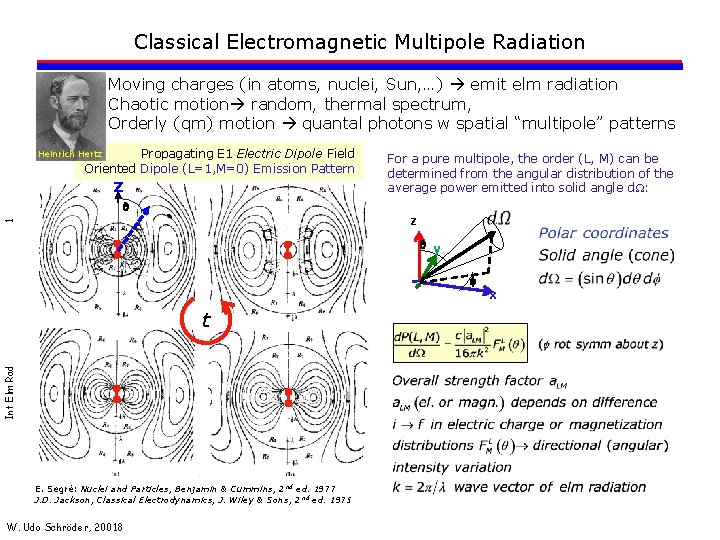
Classical Electromagnetic Multipole Radiation Moving charges (in atoms, nuclei, Sun, …) emit elm radiation Chaotic motion random, thermal spectrum, Orderly (qm) motion quantal photons w spatial “multipole” patterns Propagating E 1 Electric Dipole Field Oriented Dipole (L=1, M=0) Emission Pattern Heinrich Hertz z q For a pure multipole, the order (L, M) can be determined from the angular distribution of the average power emitted into solid angle d. W: 1 z q y f Int Elm Rad t E. Segré: Nuclei and Particles, Benjamin & Cummins, 2 nd ed. 1977 J. D. Jackson, Classical Electrodynamics, J. Wiley & Sons, 2 nd ed. 1975 W. Udo Schröder, 20018 x
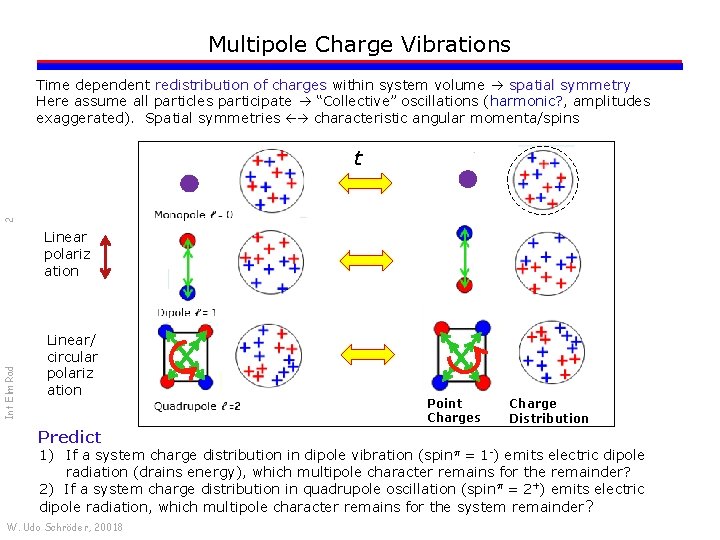
Multipole Charge Vibrations Time dependent redistribution of charges within system volume spatial symmetry Here assume all particles participate “Collective” oscillations (harmonic? , amplitudes exaggerated). Spatial symmetries characteristic angular momenta/spins 2 t Int Elm Rad Linear polariz ation Linear/ circular polariz ation Predict Point Charges Charge Distribution 1) If a system charge distribution in dipole vibration (spin p = 1 -) emits electric dipole radiation (drains energy), which multipole character remains for the remainder? 2) If a system charge distribution in quadrupole oscillation (spin p = 2+) emits electric dipole radiation, which multipole character remains for the system remainder ? W. Udo Schröder, 20018
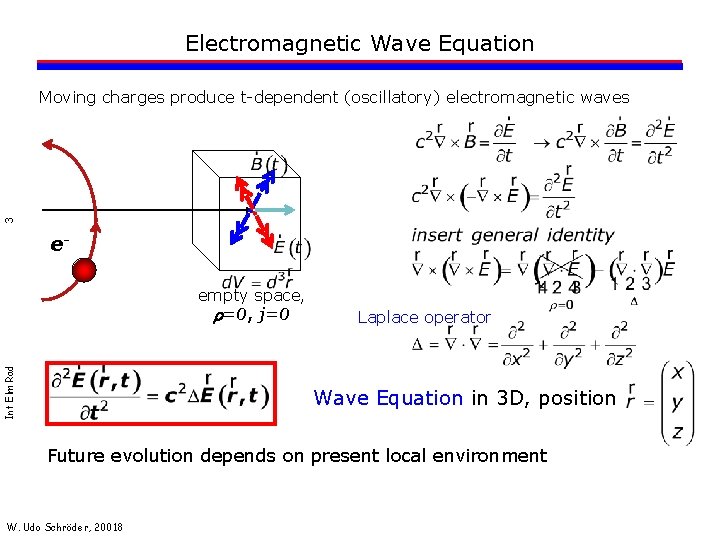
Electromagnetic Wave Equation 3 Moving charges produce t-dependent (oscillatory) electromagnetic waves e- Int Elm Rad empty space, r=0, j=0 Laplace operator Wave Equation in 3 D, position Future evolution depends on present local environment W. Udo Schröder, 20018
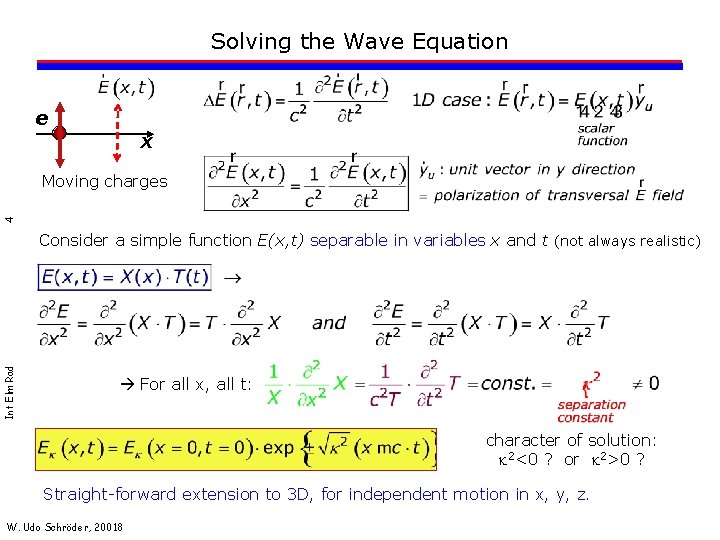
Solving the Wave Equation e x 4 Moving charges Int Elm Rad Consider a simple function E(x, t) separable in variables x and t (not always realistic) For all x, all t: character of solution: k 2<0 ? or k 2>0 ? Straight-forward extension to 3 D, for independent motion in x, y, z. W. Udo Schröder, 20018
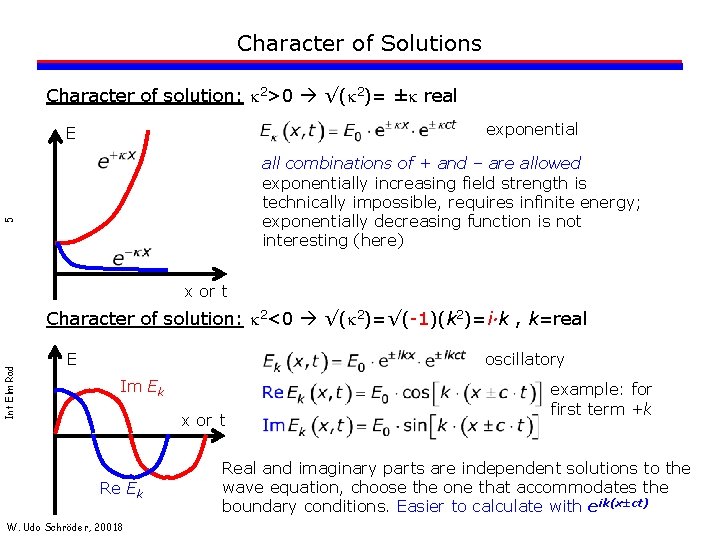
Character of Solutions Character of solution: k 2>0 √(k 2)= ±k real exponential E 5 all combinations of + and – are allowed exponentially increasing field strength is technically impossible, requires infinite energy; exponentially decreasing function is not interesting (here) x or t Int Elm Rad Character of solution: k 2<0 √(k 2)=√(-1)(k 2)=i·k , k=real E oscillatory Im Ek x or t Re Ek W. Udo Schröder, 20018 example: for first term +k Real and imaginary parts are independent solutions to the wave equation, choose the one that accommodates the boundary conditions. Easier to calculate with eik(x±ct)
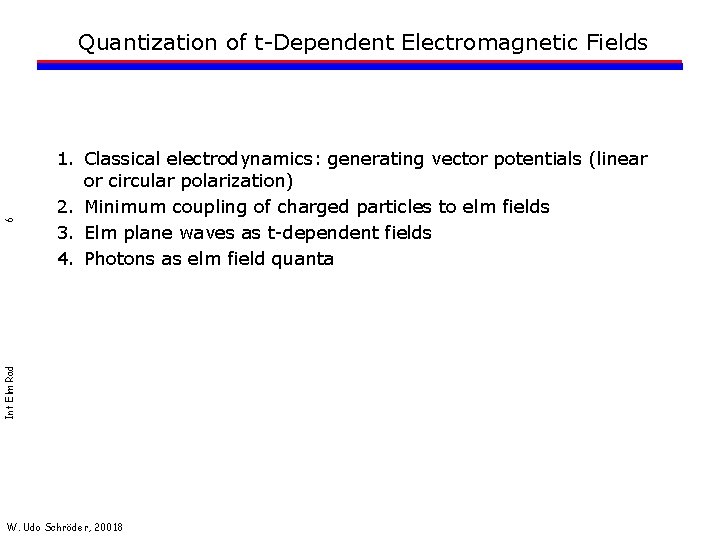
1. Classical electrodynamics: generating vector potentials (linear or circular polarization) 2. Minimum coupling of charged particles to elm fields 3. Elm plane waves as t-dependent fields 4. Photons as elm field quanta Int Elm Rad 6 Quantization of t-Dependent Electromagnetic Fields W. Udo Schröder, 20018
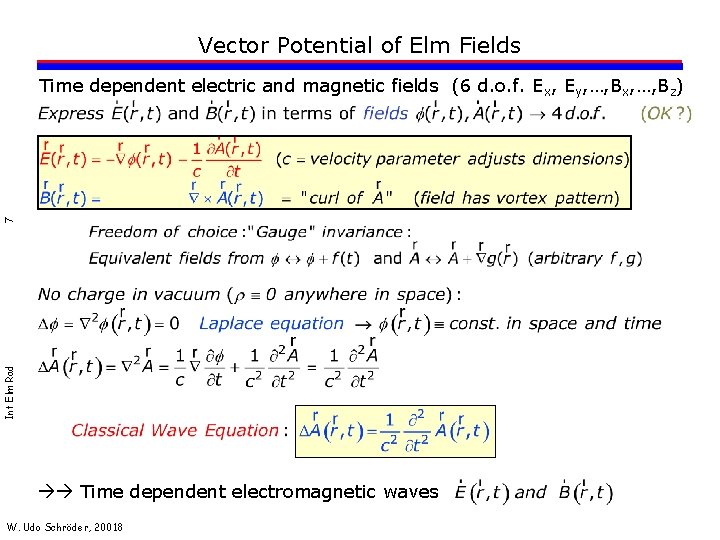
Vector Potential of Elm Fields Int Elm Rad 7 Time dependent electric and magnetic fields (6 d. o. f. Ex, Ey, …, Bx, …, Bz) Time dependent electromagnetic waves W. Udo Schröder, 20018
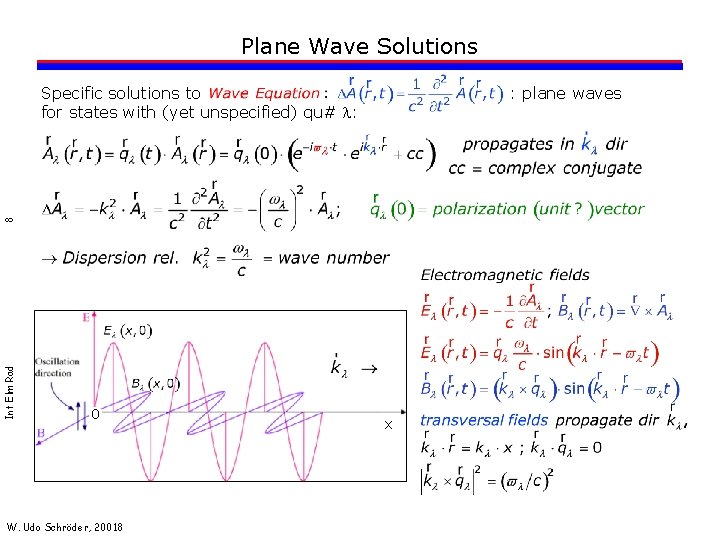
Plane Wave Solutions : plane waves Int Elm Rad 8 Specific solutions to for states with (yet unspecified) qu# l: 0 W. Udo Schröder, 20018 x
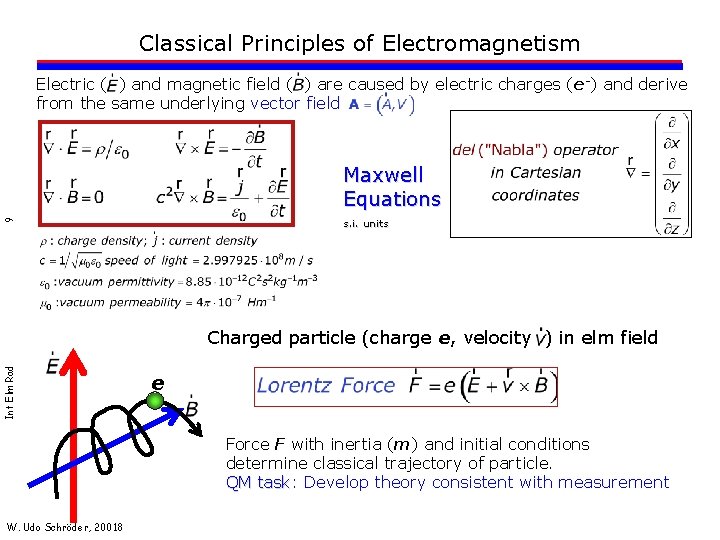
Classical Principles of Electromagnetism Electric ( ) and magnetic field ( ) are caused by electric charges (e-) and derive from the same underlying vector field Maxwell Equations 9 s. i. units Int Elm Rad Charged particle (charge e, velocity ) in elm field e Force F with inertia (m) and initial conditions determine classical trajectory of particle. QM task: task Develop theory consistent with measurement W. Udo Schröder, 20018
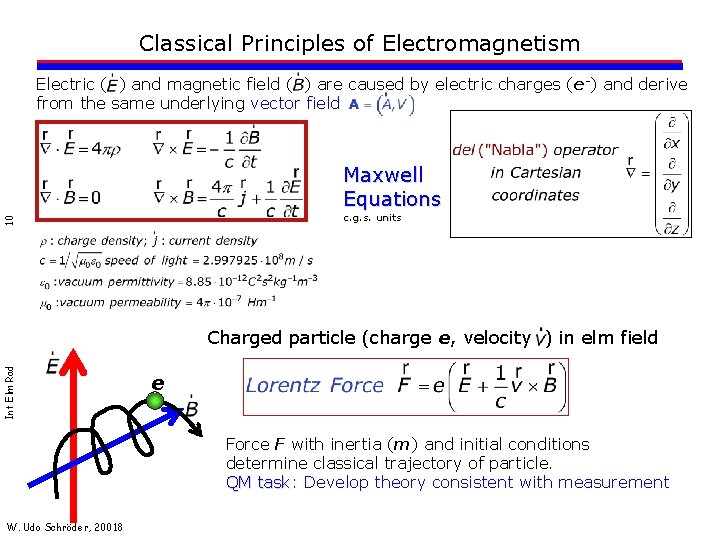
Classical Principles of Electromagnetism Electric ( ) and magnetic field ( ) are caused by electric charges (e-) and derive from the same underlying vector field Maxwell Equations 10 c. g. s. units Int Elm Rad Charged particle (charge e, velocity ) in elm field e Force F with inertia (m) and initial conditions determine classical trajectory of particle. QM task: task Develop theory consistent with measurement W. Udo Schröder, 20018
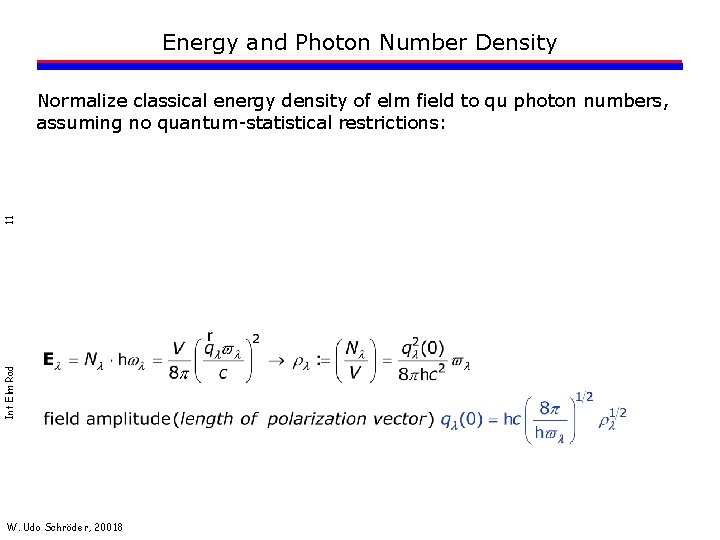
Energy and Photon Number Density Int Elm Rad 11 Normalize classical energy density of elm field to qu photon numbers, assuming no quantum-statistical restrictions: W. Udo Schröder, 20018
12 Int Elm Rad W. Udo Schröder, 20018
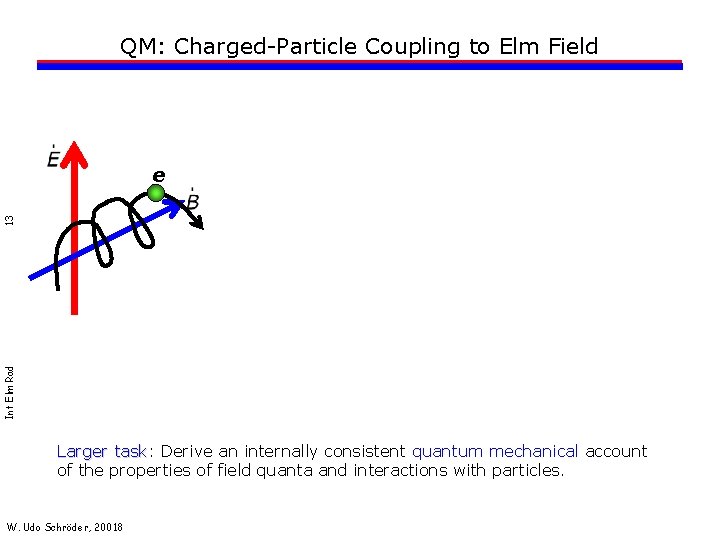
QM: Charged-Particle Coupling to Elm Field Int Elm Rad 13 e Larger task: task Derive an internally consistent quantum mechanical account of the properties of field quanta and interactions with particles. W. Udo Schröder, 20018
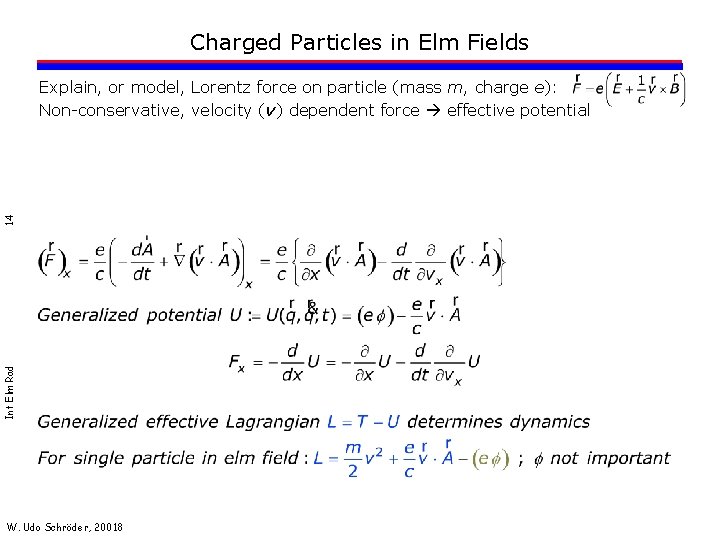
Charged Particles in Elm Fields Int Elm Rad 14 Explain, or model, Lorentz force on particle (mass m, charge e): Non-conservative, velocity (v) dependent force effective potential W. Udo Schröder, 20018
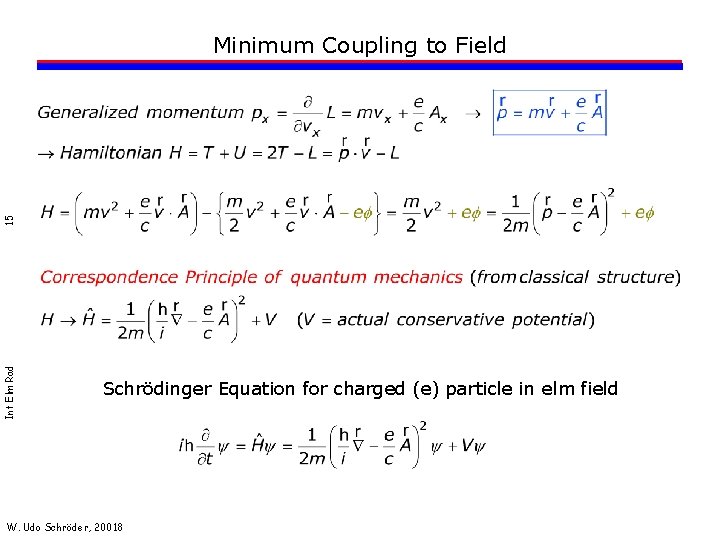
Int Elm Rad 15 Minimum Coupling to Field Schrödinger Equation for charged (e) particle in elm field W. Udo Schröder, 20018
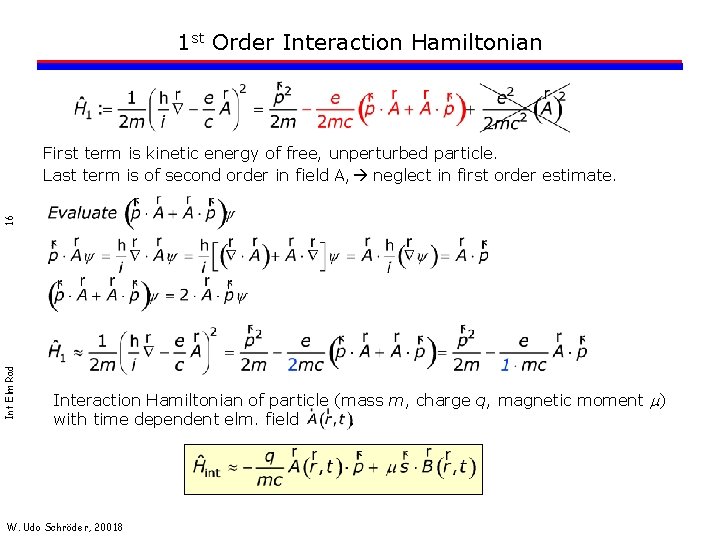
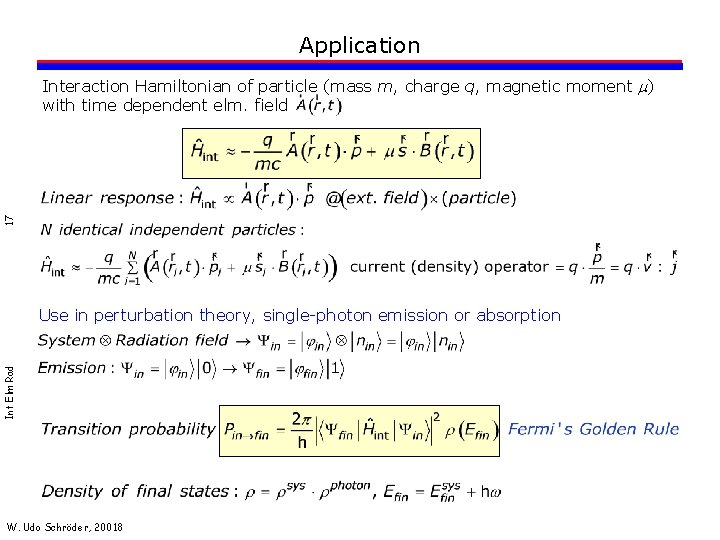
1 st Order Interaction Hamiltonian Int Elm Rad 16 First term is kinetic energy of free, unperturbed particle. Last term is of second order in field A, neglect in first order estimate. Interaction Hamiltonian of particle (mass m, charge q, magnetic moment m) with time dependent elm. field. W. Udo Schröder, 20018
Application 17 Interaction Hamiltonian of particle (mass m, charge q, magnetic moment m) with time dependent elm. field. Int Elm Rad Use in perturbation theory, single-photon emission or absorption W. Udo Schröder, 20018
Extended Task Wish to describe elm transitions between states of specific energies and spins. Search for type of solution to WE describing oscillating el. or mgn. dipoles, quadrupoles, . . Inquire nature of field bosons (photons) Strategy: Consider only spherically symmetric elm. fields separation of variables Solve first for scalar field (function) u, Int Elm Rad 18 Plane waves are too unspecific for spectroscopic purposes: contain all angular momenta ℓ. then construct vector field from functions u. preserving spatial symmetry W. Udo Schröder, 20018
Energy and Photon Number Density Int Elm Rad 19 Normalize classical energy density of elm field to qu photon numbers, assuming no quantum-statistical restrictions: W. Udo Schröder, 20018
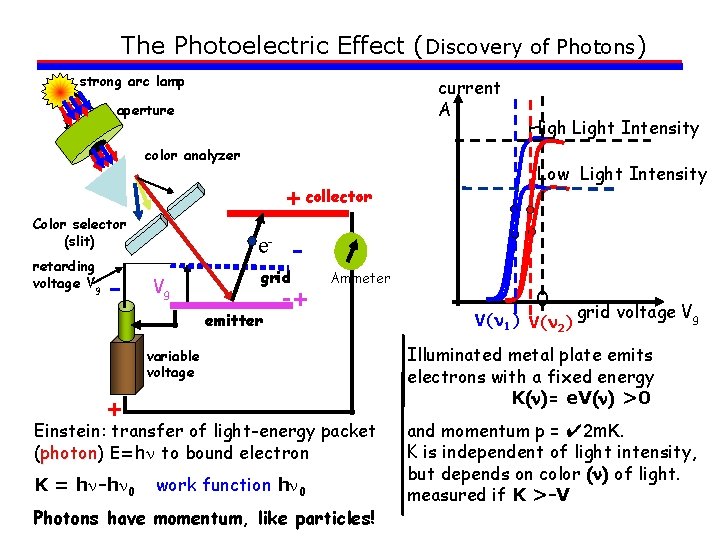
20 Elm Field Quanta: Nature of Photons 1. Are massless (mg = 0) and have no charge 2. Have linear momentum 3. Travel in straight line trajectories, velocity = c 4. Scatter off charged particles (“elm interaction”) and other photons 5. Have helicity h= ± 1 (like intrinsic spin Sg =1 ) directed Photo effect: Momentum Transfer Linear polarization Int Elm Rad Recoil W. Udo Schröder, 20018 Helicity Transfer Circular polarization Torque
The Photoelectric Effect (Discovery of Photons) strong arc lamp current A aperture color analyzer + collector Color selector (slit) retarding voltage Vg - Low Light Intensity e- Vg grid emitter -+ Ammeter variable voltage + Einstein: transfer of light-energy packet (photon) photon E=hn to bound electron K = hn-hn 0 High Light Intensity work function hn 0 Photons have momentum, like particles! 0 V(n 1) V(n 2) grid voltage Vg Illuminated metal plate emits electrons with a fixed energy K(n)= e. V(n) >0 and momentum p = ✔ 2 m. K. K is independent of light intensity, but depends on color (n) of light. measured if K >-V
22 Int Elm Rad W. Udo Schröder, 20018