
Classical Conditioning Pavlovs paired associations SR Spontaneous Recovery
- Slides: 8
Classical Conditioning • • Pavlov’s paired associations S->R Spontaneous Recovery Generalization/discrimination Habituation Higher Order Conditioning Superstitious Behavior Extinction
Classical Conditioning S-R Paradigm Unconditioned Stimulus Conditioned Stimulus Response Conditioned Response Extinction Spontaneous Recovery Generalization/Discrimination Habituation Context effects
Operant Conditioning Behavior ->Response->Consequence Reinforcers or Punishers Satiation and Potency Positive Reinforcement Negative Reinforcement Presentation Punishment Removal Punishment Schedules of Reinforcement, Interval and Ratio, Fixed and Variable. Learned Helplessness
Application • List 5 things that you are classically conditioned to respond to. • List 5 things that you have taught your students to respond to. • List 3 situations of instrumental conditioning in your life, in your classroom life.
How might behavioral theory be used in the classroom?
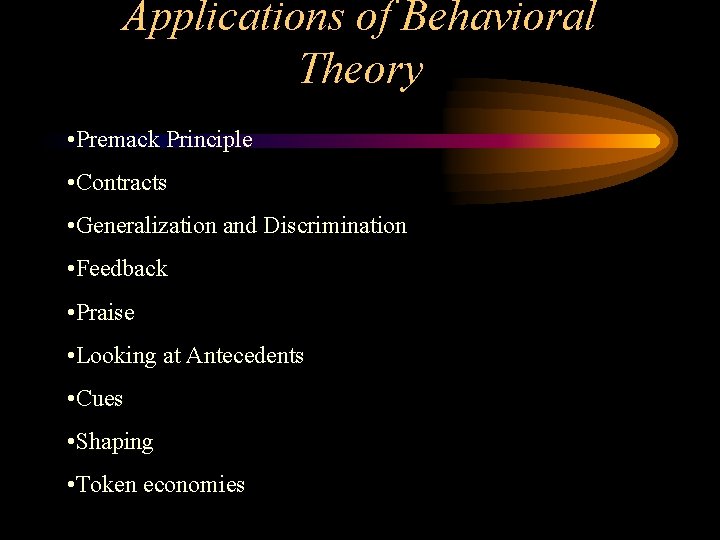
Applications of Behavioral Theory • Premack Principle • Contracts • Generalization and Discrimination • Feedback • Praise • Looking at Antecedents • Cues • Shaping • Token economies
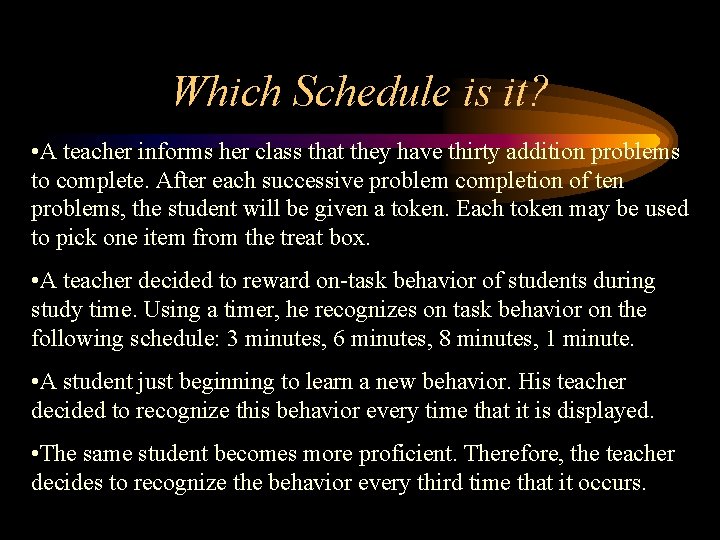
Which Schedule is it? • A teacher informs her class that they have thirty addition problems to complete. After each successive problem completion of ten problems, the student will be given a token. Each token may be used to pick one item from the treat box. • A teacher decided to reward on-task behavior of students during study time. Using a timer, he recognizes on task behavior on the following schedule: 3 minutes, 6 minutes, 8 minutes, 1 minute. • A student just beginning to learn a new behavior. His teacher decided to recognize this behavior every time that it is displayed. • The same student becomes more proficient. Therefore, the teacher decides to recognize the behavior every third time that it occurs.
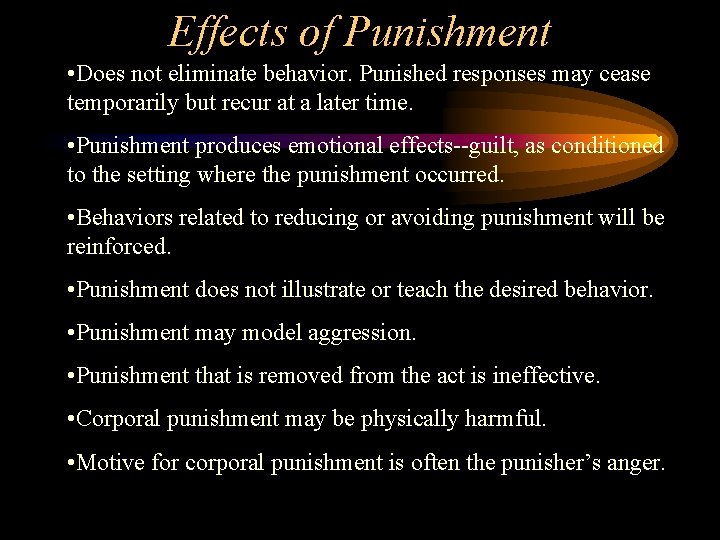
Effects of Punishment • Does not eliminate behavior. Punished responses may cease temporarily but recur at a later time. • Punishment produces emotional effects--guilt, as conditioned to the setting where the punishment occurred. • Behaviors related to reducing or avoiding punishment will be reinforced. • Punishment does not illustrate or teach the desired behavior. • Punishment may model aggression. • Punishment that is removed from the act is ineffective. • Corporal punishment may be physically harmful. • Motive for corporal punishment is often the punisher’s anger.