
Classical Cepheids as tracers of disk gradients kinematics
- Slides: 18
Classical Cepheids as tracers of disk gradients & kinematics G. Bono: Univ. of Rome Tor Vergata F. Caputo + romans + P. B. Stetson (DAO) V. I. M. M. A (napoletans) M. Romaniello, F. Primas (ESO) P. Francois (IAP) J. Lub, J. W. Pel, B. Lemasle, G. Fiorentino (NL)
Summary • Cepheids as distance indicators • Cepheids as chemical tracers – Galactic Abundance Gradient – Recent Findings – VST Survey [outer disk] – Why and Where – Conclusions
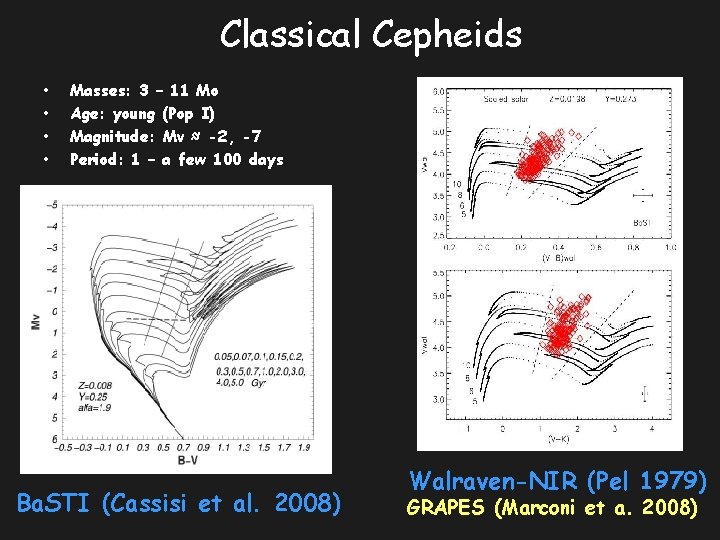
Classical Cepheids • • Masses: 3 – 11 Mo Age: young (Pop I) Magnitude: Mv ≈ -2, -7 Period: 1 – a few 100 days Ba. STI (Cassisi et al. 2008) Walraven-NIR (Pel 1979) GRAPES (Marconi et a. 2008)
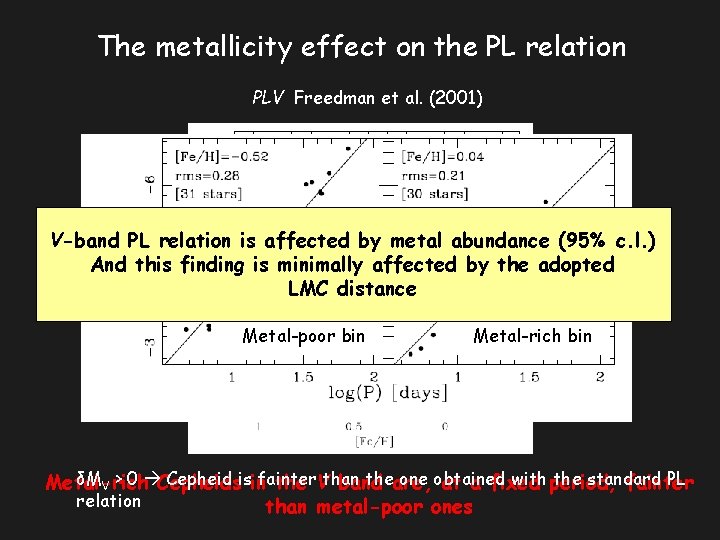
The metallicity effect on the PL relation PLV Freedman et al. (2001) V-band PL relation is affected by metal abundance (95% c. l. ) And this finding is minimally affected by the adopted LMC distance 9σ 2σ Metal-poor bin Metal-rich bin δMV > 0 Cepheids Cepheid isin fainter theare, one obtained with period, the standard PL Metal-rich the Vthan band at a fixed fainter relation than metal-poor ones
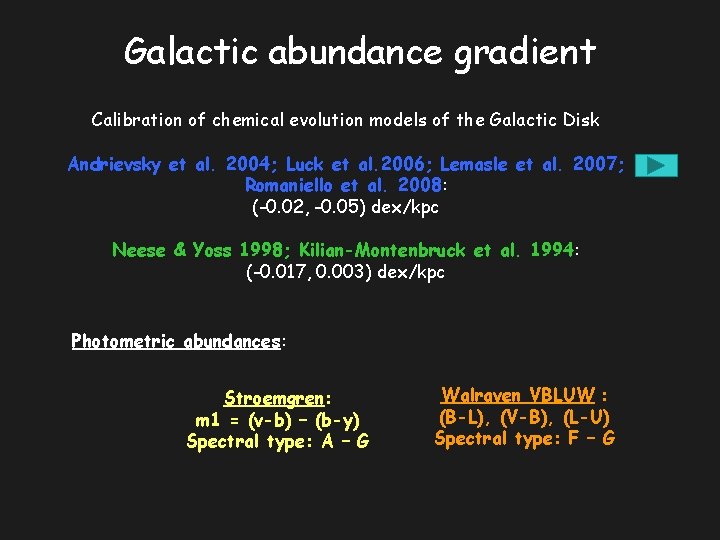
Galactic abundance gradient Calibration of chemical evolution models of the Galactic Disk Andrievsky et al. 2004; Luck et al. 2006; Lemasle et al. 2007; Romaniello et al. 2008: (-0. 02, -0. 05) dex/kpc Neese & Yoss 1998; Kilian-Montenbruck et al. 1994: (-0. 017, 0. 003) dex/kpc Photometric abundances: Stroemgren: m 1 = (v-b) – (b-y) Spectral type: A – G Walraven VBLUW : (B-L), (V-B), (L-U) Spectral type: F – G
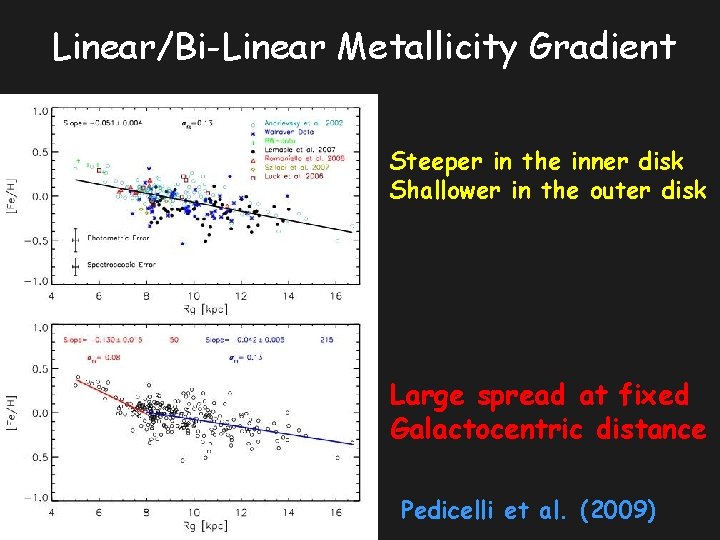
Linear/Bi-Linear Metallicity Gradient Steeper in the inner disk Shallower in the outer disk Large spread at fixed Galactocentric distance Pedicelli et al. (2009)
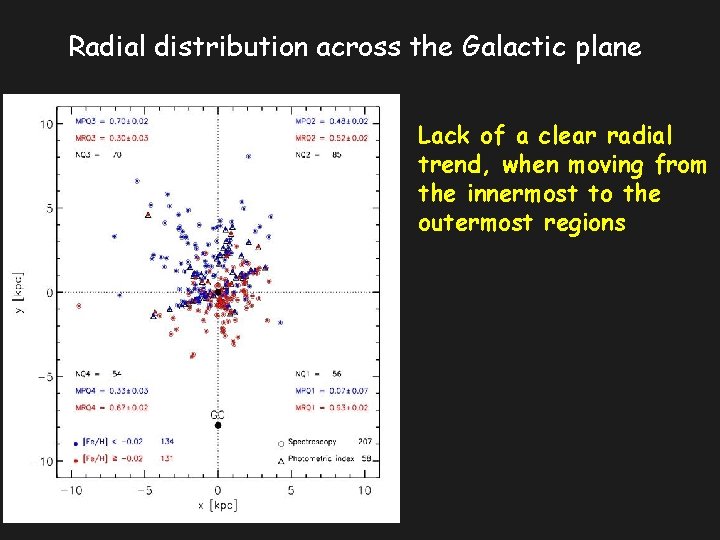
Radial distribution across the Galactic plane Lack of a clear radial trend, when moving from the innermost to the outermost regions
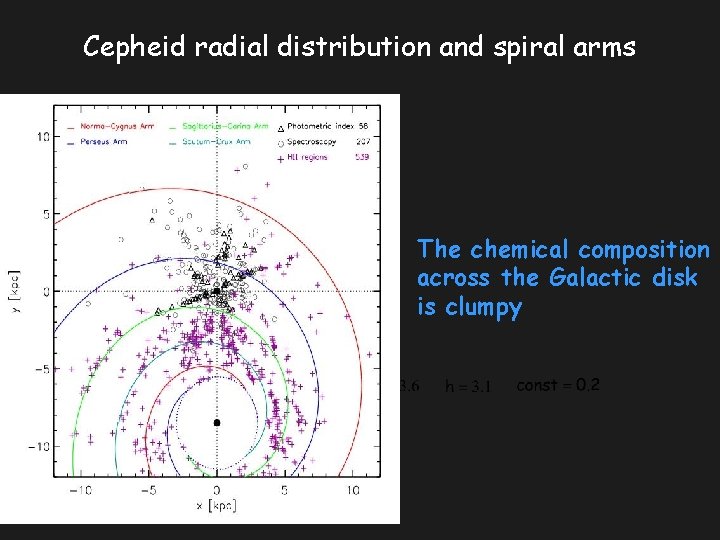
Cepheid radial distribution and spiral arms The chemical composition across the Galactic disk is clumpy
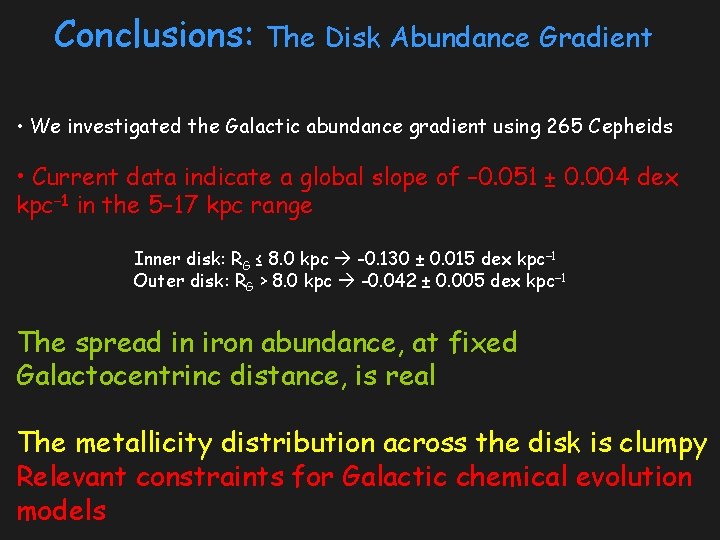
Conclusions: The Disk Abundance Gradient • We investigated the Galactic abundance gradient using 265 Cepheids • Current data indicate a global slope of – 0. 051 ± 0. 004 dex kpc− 1 in the 5– 17 kpc range Inner disk: RG ≤ 8. 0 kpc -0. 130 ± 0. 015 dex kpc− 1 Outer disk: RG > 8. 0 kpc -0. 042 ± 0. 005 dex kpc− 1 The spread in iron abundance, at fixed Galactocentrinc distance, is real The metallicity distribution across the disk is clumpy Relevant constraints for Galactic chemical evolution models
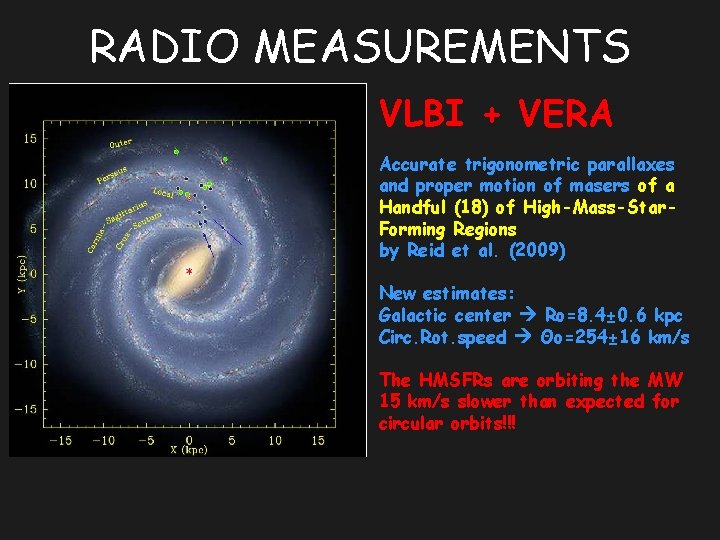
RADIO MEASUREMENTS VLBI + VERA Accurate trigonometric parallaxes and proper motion of masers of a Handful (18) of High-Mass-Star. Forming Regions by Reid et al. (2009) New estimates: Galactic center Ro=8. 4± 0. 6 kpc Circ. Rot. speed Θo=254± 16 km/s The HMSFRs are orbiting the MW 15 km/s slower than expected for circular orbits!!!
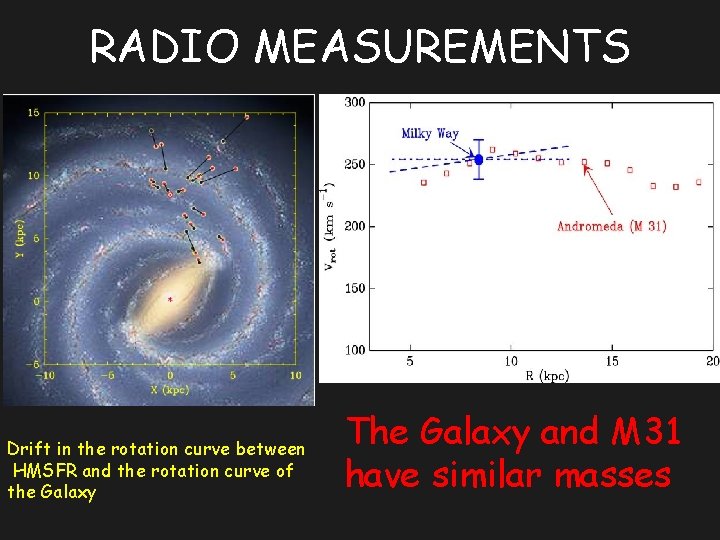
RADIO MEASUREMENTS Drift in the rotation curve between HMSFR and the rotation curve of the Galaxy The Galaxy and M 31 have similar masses
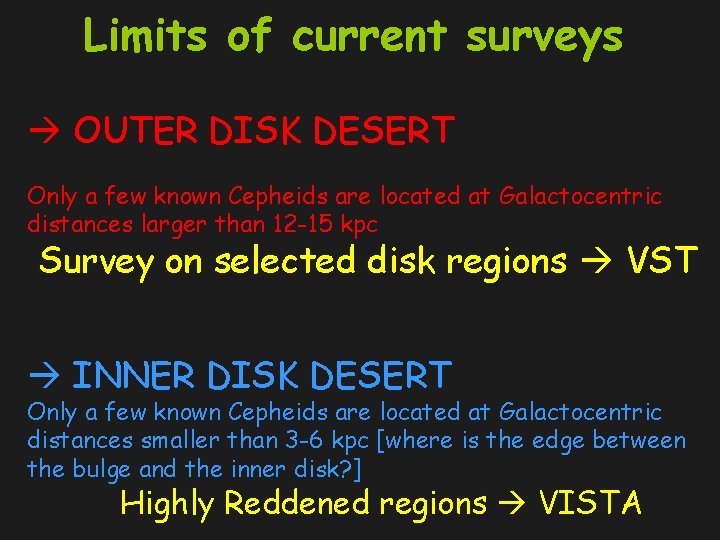
Limits of current surveys OUTER DISK DESERT Only a few known Cepheids are located at Galactocentric distances larger than 12 -15 kpc Survey on selected disk regions VST INNER DISK DESERT Only a few known Cepheids are located at Galactocentric distances smaller than 3 -6 kpc [where is the edge between the bulge and the inner disk? ] Highly Reddened regions VISTA
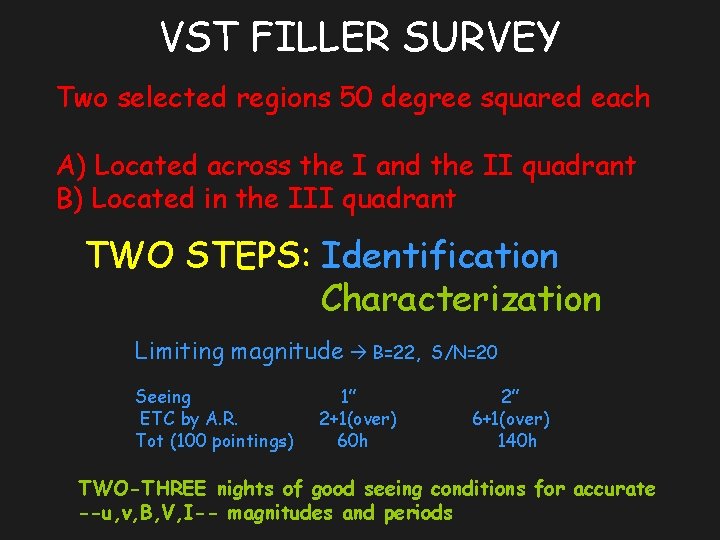
VST FILLER SURVEY Two selected regions 50 degree squared each A) Located across the I and the II quadrant B) Located in the III quadrant TWO STEPS: Identification Characterization Limiting magnitude B=22, Seeing ETC by A. R. Tot (100 pointings) 1” 2+1(over) 60 h S/N=20 2” 6+1(over) 140 h TWO-THREE nights of good seeing conditions for accurate --u, v, B, V, I-- magnitudes and periods
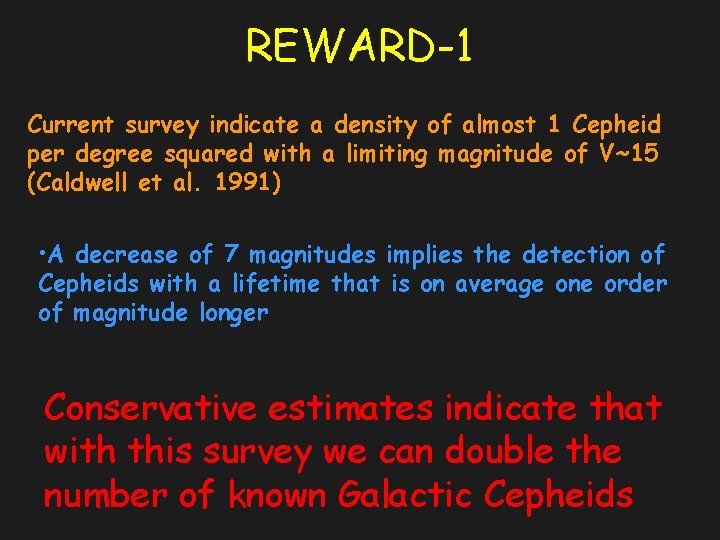
REWARD-1 Current survey indicate a density of almost 1 Cepheid per degree squared with a limiting magnitude of V~15 (Caldwell et al. 1991) • A decrease of 7 magnitudes implies the detection of Cepheids with a lifetime that is on average one order of magnitude longer Conservative estimates indicate that with this survey we can double the number of known Galactic Cepheids
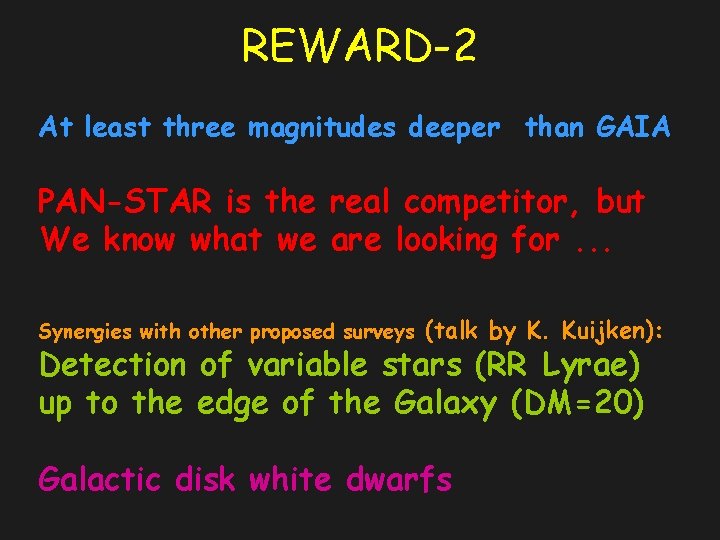
REWARD-2 At least three magnitudes deeper than GAIA PAN-STAR is the real competitor, but We know what we are looking for. . . Synergies with other proposed surveys (talk by K. Kuijken): Detection of variable stars (RR Lyrae) up to the edge of the Galaxy (DM=20) Galactic disk white dwarfs
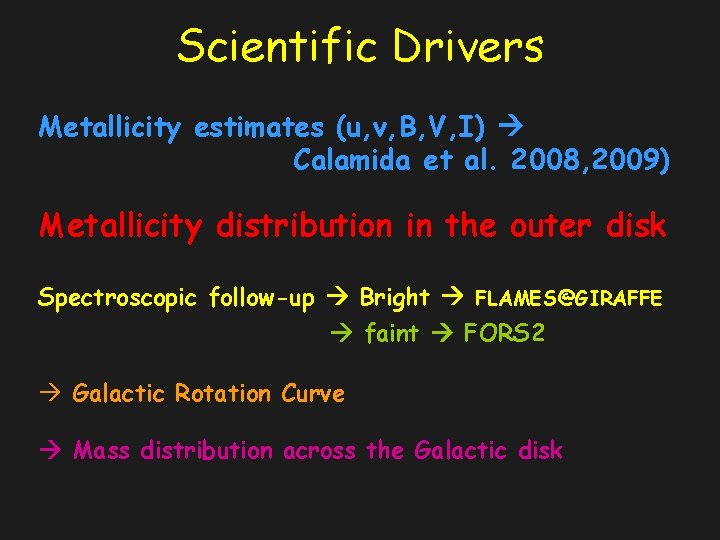
Scientific Drivers Metallicity estimates (u, v, B, V, I) Calamida et al. 2008, 2009) Metallicity distribution in the outer disk Spectroscopic follow-up Bright FLAMES@GIRAFFE faint FORS 2 Galactic Rotation Curve Mass distribution across the Galactic disk
TEAM WE CAN COPE WITH THE REDUCTION AND the ANALYSIS OF THE IMAGES WE PLAN TO COLLECT IN THIS PROJECT iff The pre-reduced images are either MEGACAM@CFHT or SUPRIME@SUBARU like [zero-points within 0. 02 mag across the entire field] NO WAY IF THEY ARE WFI@2. 2 m like
CREDITS S. Pedicelli (Rome-ESO Ph. D) looking for a post-doc M. Dall’ORA Ricercatore astronomo idoneo A. Calamida, post-doc at ESO Garching M. Monelli, post-doc at IAC G. Fiorentino, post-doc in Groeningen M. Dicriscienzo, post-doc in Rome