
CLASSICAL ATHENS SLAVES www misterconnor org THE BARE
CLASSICAL ATHENS SLAVES www. misterconnor. org
THE BARE BONES Attica in this period had a population of approximately 300, 000. Approximately 125, 000 were slaves. “Citizens” numbered between 30 -50, 000 – no more than 30% of the population. Most slaves were prisoners of war. Some were captured by pirates and sold on. Some were sold by poor parents. Some were simply the children of slaves and inherited their lack of status.

THE SLAVE TRADE Every large city had a slave market. Slaves of all nationalities, genders and ages were available. Eastern Mediterranean slaves were the most expensive. Black slaves sold for high prices out of novelty. Good-looking or intelligent slaves fetched high prices. Musically talented/ dancers/ etc. all sold well.
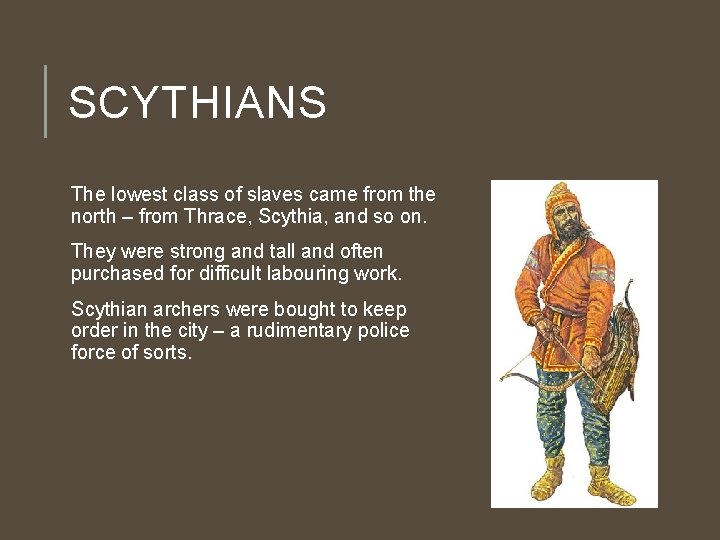
SCYTHIANS The lowest class of slaves came from the north – from Thrace, Scythia, and so on. They were strong and tall and often purchased for difficult labouring work. Scythian archers were bought to keep order in the city – a rudimentary police force of sorts.
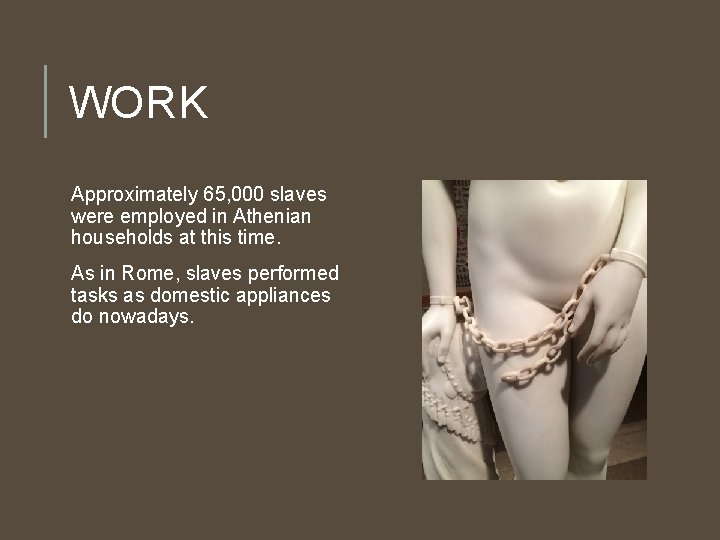
WORK Approximately 65, 000 slaves were employed in Athenian households at this time. As in Rome, slaves performed tasks as domestic appliances do nowadays.
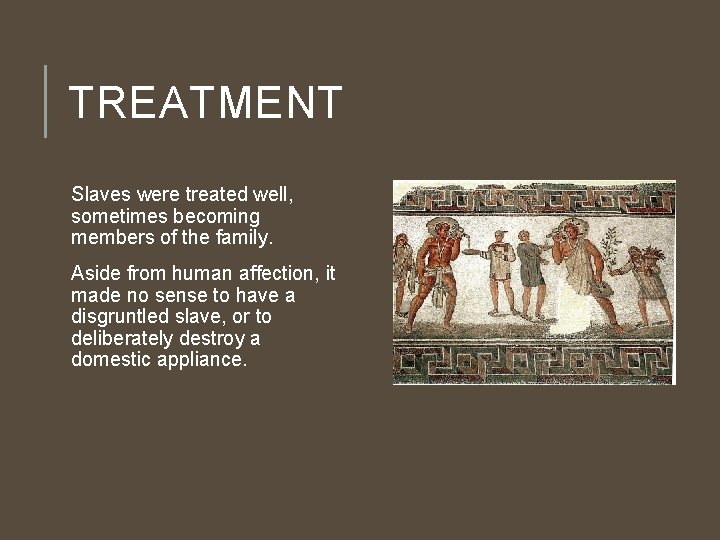
TREATMENT Slaves were treated well, sometimes becoming members of the family. Aside from human affection, it made no sense to have a disgruntled slave, or to deliberately destroy a domestic appliance.
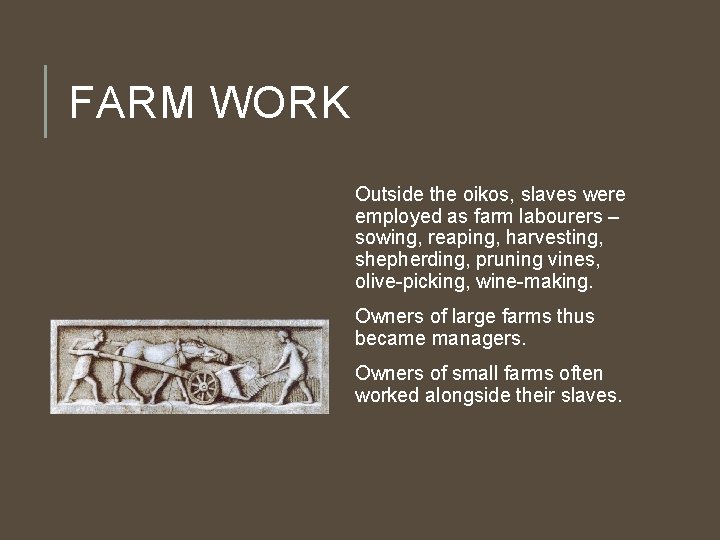
FARM WORK Outside the oikos, slaves were employed as farm labourers – sowing, reaping, harvesting, shepherding, pruning vines, olive-picking, wine-making. Owners of large farms thus became managers. Owners of small farms often worked alongside their slaves.
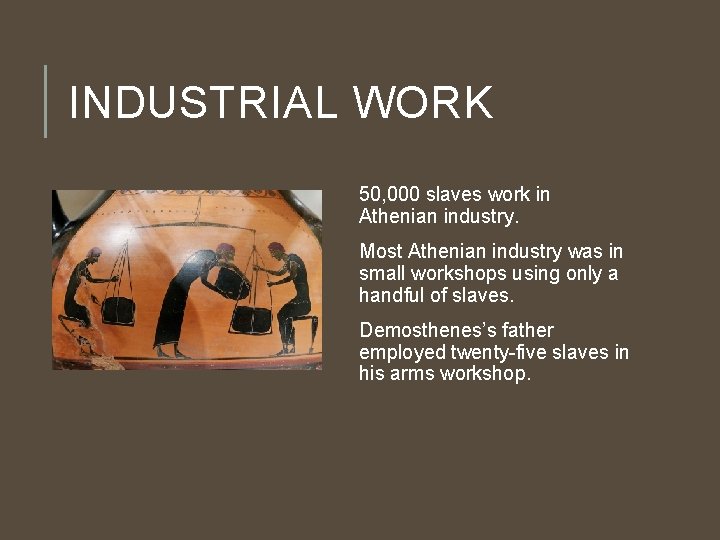
INDUSTRIAL WORK 50, 000 slaves work in Athenian industry. Most Athenian industry was in small workshops using only a handful of slaves. Demosthenes’s father employed twenty-five slaves in his arms workshop.
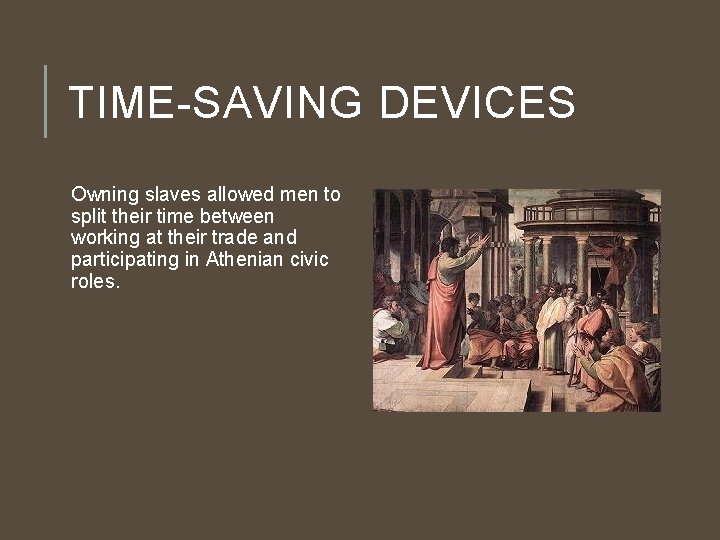
TIME-SAVING DEVICES Owning slaves allowed men to split their time between working at their trade and participating in Athenian civic roles.
AN EXAMPLE We learn of one slave who worked in a shoe-maker’s workshop. He arrived in the morning to collect tools and begin making shoes. In the afternoon, he went to the market and tried to sell them for the best price. Only a percentage was paid to his owner, and the rest he pocketed. This would allow him to save up to buy his freedom, and then set up his own business.
COMMERCE Trade in Athens relied heavily on slaves. Basic operations were carried out by slaves who could read, write and count. These slaves had many opportunities to improve their status. Pasion of Athens was owned by two bankers. He became known for his honesty and hard work. When his owners retired, they turned the running of the business over to him, and he became one of the richest men in Athens (and was awarded his freedom).
THE MINES In contrast to this liberal and opportunity-laden life in the city, slaves who worked in the mines were tried with cruelty. About 10, 000 slaves worked in the mines of Laureion in southern Attica. Tunnels were 100 cm x 75 cm. Ventilation was poor and heat was high. Dust got into lungs and the mine could collapse at any moment. Hours were long (ten hours with no break) and there were no prospects of being released. Mine slaves were worked until they dropped dead.
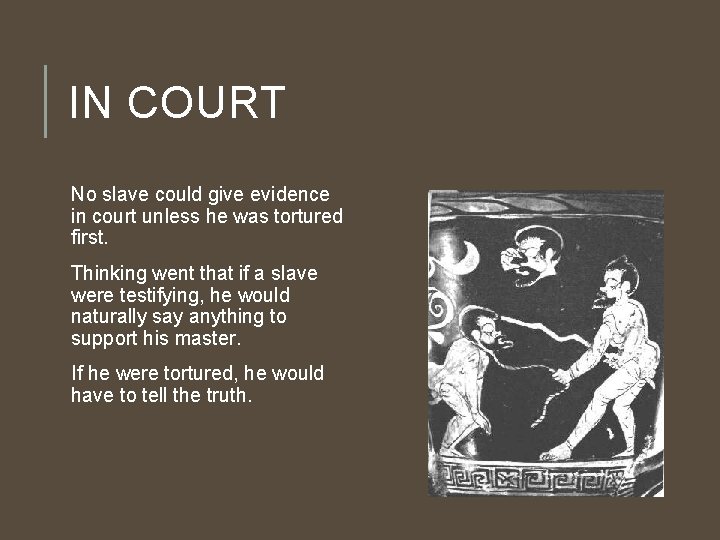
IN COURT No slave could give evidence in court unless he was tortured first. Thinking went that if a slave were testifying, he would naturally say anything to support his master. If he were tortured, he would have to tell the truth.
MALTREATMENT Slaves were termed as Andrapoda - many footed things. They had no legal rights, they were merely property. A master could legally do as she pleased with his slaves. He could beat them, withdraw food or have forced sexual relationships with them. He could even kill them if he wished. Treatment always depended very much on the type of master a slave had. Master did not have to pay them, although many did to encourage them to work harder. Freedom was rarely given. People were often forcibly uprooted from their families and homes and forced into slavery e. g. kidnapped or prisoners of war. If a slave ran away and was caught again, they could be branded across the face or have their legs broken.
GENERALLY Slaves were treated well. This may be down to inherent humanity, or out of practicality – a happy slave worked better than an unhappy slave. “Slaves are extremely undisciplined here at Athens. You are not allowed to hit other people’s slaves, and a slave will not get out of your way. If it were allowed… one might easily hit an Athenian citizen by mistake, thinking that he was a slave. And if you wonder at their letting slaves be comfortable, and some of them indeed have a high standard of living, there is sense in that too. Where sea-power is important, it is necessary that slaves should work for money, so that we may collect revenue from them, and we must let them be free…”
THE SKINNY 125, 000/ 300, 000 slaves (c. 40%). 30, 000 citizens (c. 10%). Most slaves were prisoners of war. Some were captured by pirates; some sold by poor parents; some were children of slaves. Eastern Mediterranean slaves were the most expensive. Good-looking or intelligent slaves fetched high prices. Musically talented/ dancers/ etc. all sold well. Scythian archers were bought to keep order in the city. 65, 000 slaves were used in Athenian households. Slaves were employed on farms, in workshops, in commerce and in mines (a living death-sentence). Testimony from slaves was only accepted after torture. Slaves were generally treated well.
SOURCES Pomeroy, S. B. , et al. (2015). A Brief History of Ancient Greece: Politics, Society, and Culture. New York: Oxford University Press. Hornblower, S. , & Spawforth, A. (2004). The Oxford Companion to Classical Civilization. Oxford: Oxford University Press. Renshaw, J. (2008). In search of the Greeks. London: Bristol Classical Press. http: //www. victorianweb. org/sculpture/usa/powers 2. html http: //www. hellenicaworld. com/Greece/Ancient/en/Slavery. html
- Slides: 17