
Classical and Iterative Map Reduce on Azure Cloud

- Slides: 27
Classical and Iterative Map. Reduce on Azure Cloud Futures Workshop Microsoft Conference Center Building 33, Redmond, Washington June 2 2011 Geoffrey Fox gcf@indiana. edu http: //www. infomall. org http: //www. salsahpc. org Director, Digital Science Center, Pervasive Technology Institute Associate Dean for Research and Graduate Studies, School of Informatics and Computing Indiana University Bloomington Work with Thilina Gunarathne, Judy Qiu Twister introduced in Jaliya Ekanayake’s Ph. D Thesis https: //portal. futuregrid. org
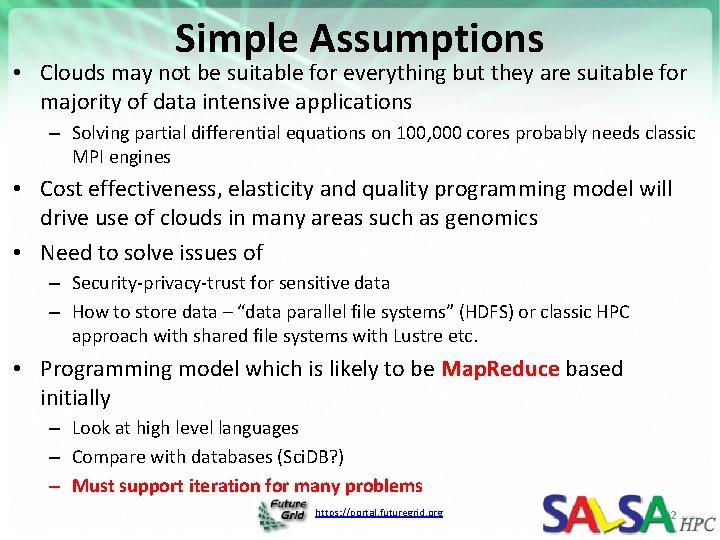
Simple Assumptions • Clouds may not be suitable for everything but they are suitable for majority of data intensive applications – Solving partial differential equations on 100, 000 cores probably needs classic MPI engines • Cost effectiveness, elasticity and quality programming model will drive use of clouds in many areas such as genomics • Need to solve issues of – Security-privacy-trust for sensitive data – How to store data – “data parallel file systems” (HDFS) or classic HPC approach with shared file systems with Lustre etc. • Programming model which is likely to be Map. Reduce based initially – Look at high level languages – Compare with databases (Sci. DB? ) – Must support iteration for many problems https: //portal. futuregrid. org 2
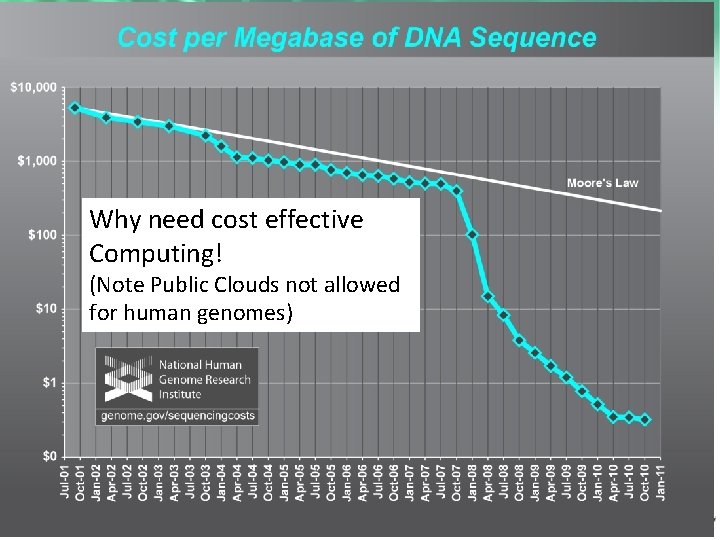
Why need cost effective Computing! (Note Public Clouds not allowed for human genomes) https: //portal. futuregrid. org
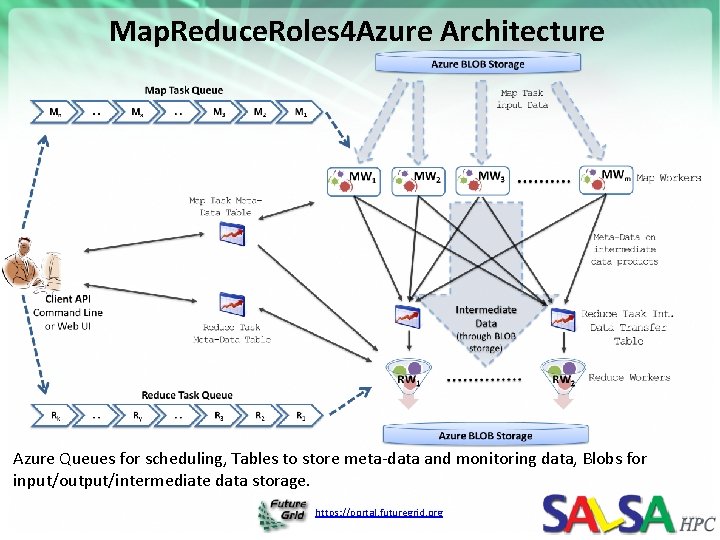
Map. Reduce. Roles 4 Azure Architecture Azure Queues for scheduling, Tables to store meta-data and monitoring data, Blobs for input/output/intermediate data storage. https: //portal. futuregrid. org
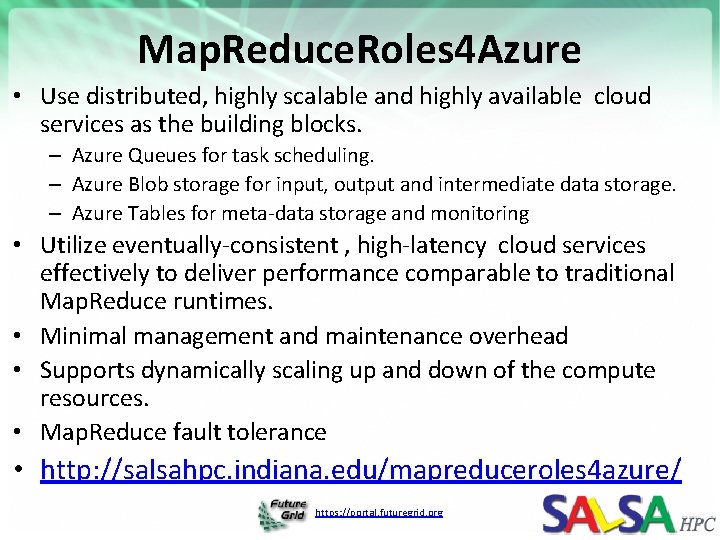
Map. Reduce. Roles 4 Azure • Use distributed, highly scalable and highly available cloud services as the building blocks. – Azure Queues for task scheduling. – Azure Blob storage for input, output and intermediate data storage. – Azure Tables for meta-data storage and monitoring • Utilize eventually-consistent , high-latency cloud services effectively to deliver performance comparable to traditional Map. Reduce runtimes. • Minimal management and maintenance overhead • Supports dynamically scaling up and down of the compute resources. • Map. Reduce fault tolerance • http: //salsahpc. indiana. edu/mapreduceroles 4 azure/ https: //portal. futuregrid. org
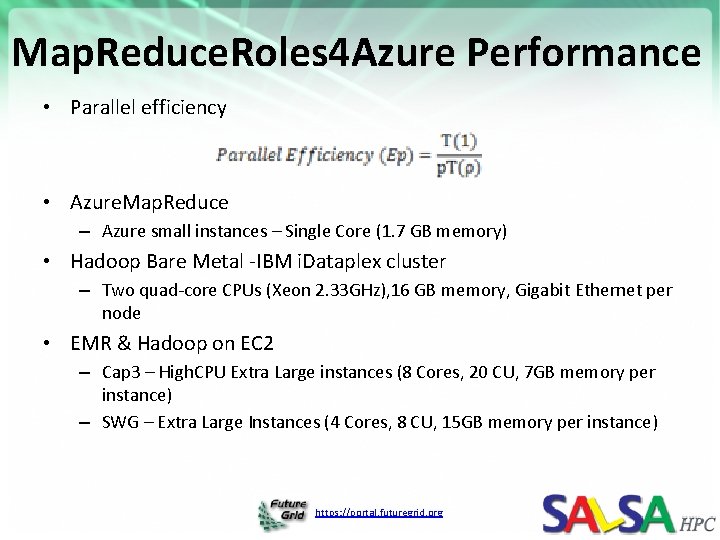
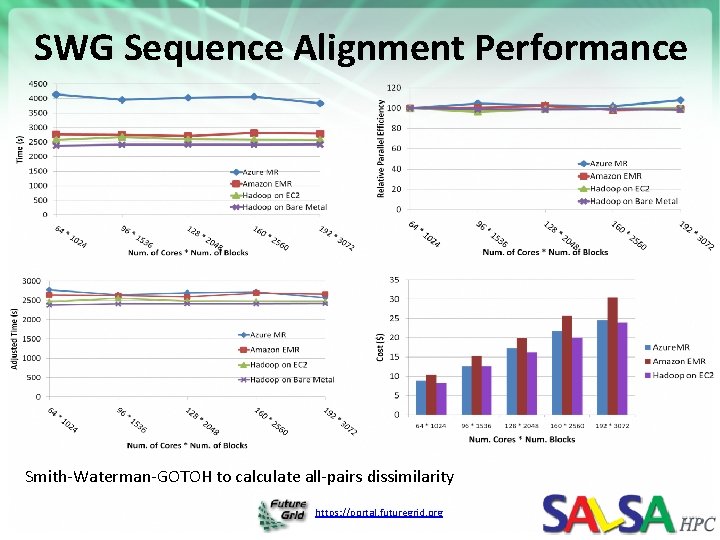
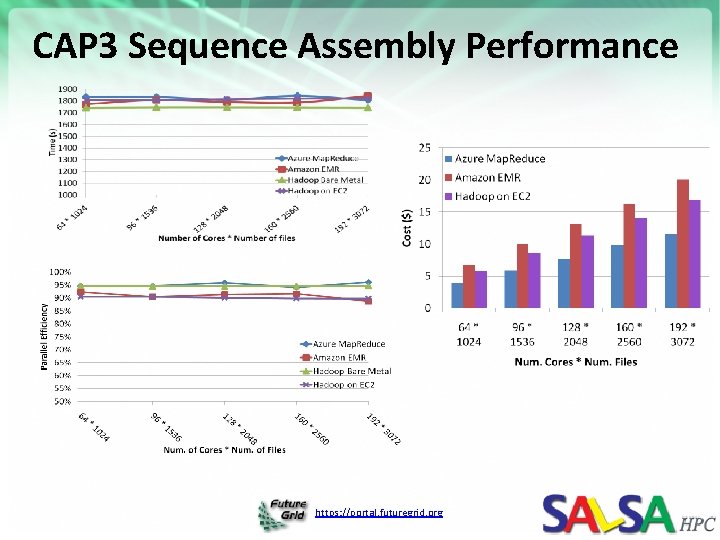
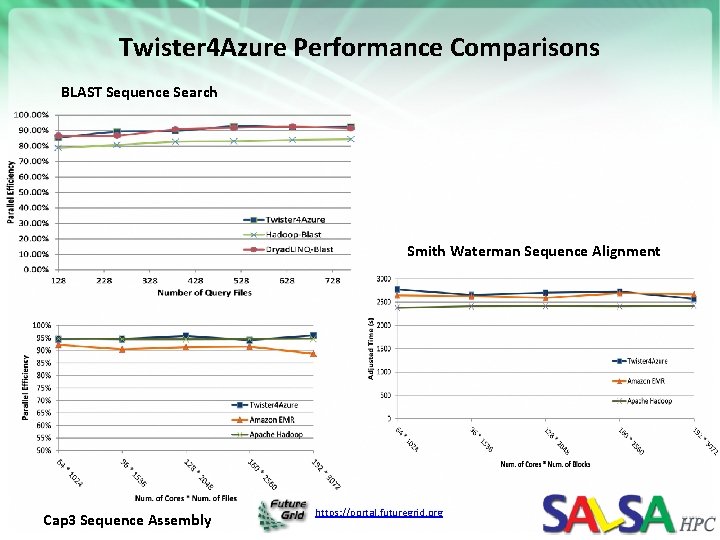
Map. Reduce. Roles 4 Azure Performance • Parallel efficiency • Azure. Map. Reduce – Azure small instances – Single Core (1. 7 GB memory) • Hadoop Bare Metal -IBM i. Dataplex cluster – Two quad-core CPUs (Xeon 2. 33 GHz), 16 GB memory, Gigabit Ethernet per node • EMR & Hadoop on EC 2 – Cap 3 – High. CPU Extra Large instances (8 Cores, 20 CU, 7 GB memory per instance) – SWG – Extra Large Instances (4 Cores, 8 CU, 15 GB memory per instance) https: //portal. futuregrid. org
SWG Sequence Alignment Performance Smith-Waterman-GOTOH to calculate all-pairs dissimilarity https: //portal. futuregrid. org
CAP 3 Sequence Assembly Performance https: //portal. futuregrid. org
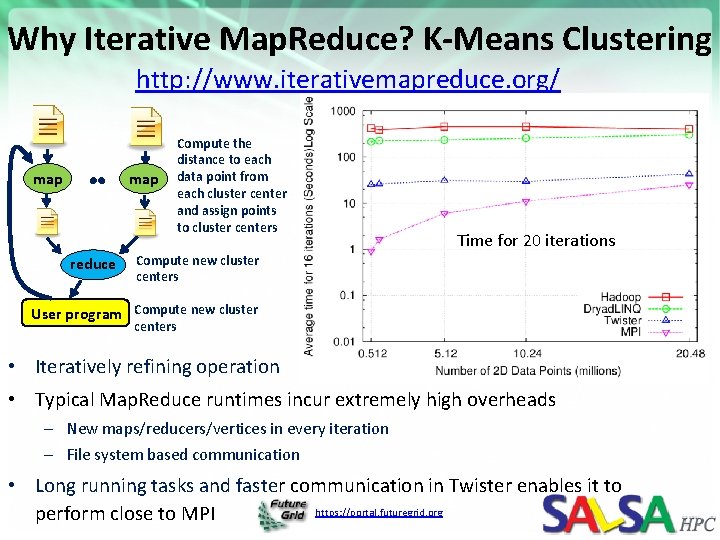
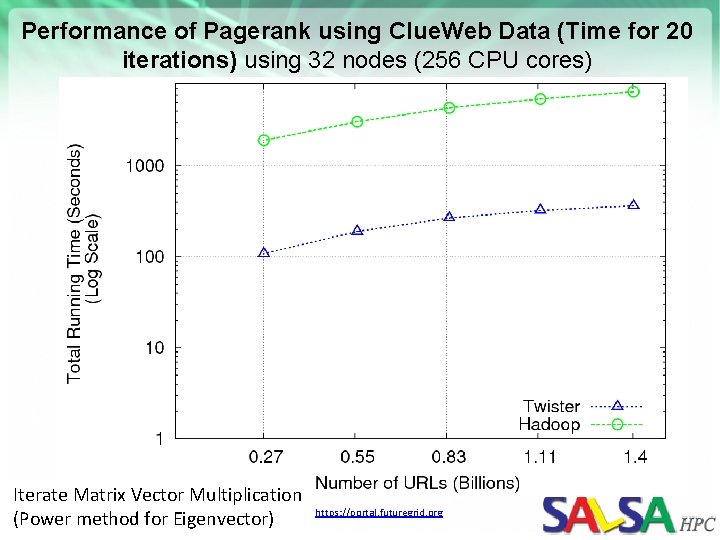
Why Iterative Map. Reduce? K-Means Clustering http: //www. iterativemapreduce. org/ map reduce Compute the distance to each data point from each cluster center and assign points to cluster centers Time for 20 iterations Compute new cluster centers User program Compute new cluster centers • Iteratively refining operation • Typical Map. Reduce runtimes incur extremely high overheads – New maps/reducers/vertices in every iteration – File system based communication • Long running tasks and faster communication in Twister enables it to https: //portal. futuregrid. org perform close to MPI
Performance of Pagerank using Clue. Web Data (Time for 20 iterations) using 32 nodes (256 CPU cores) Iterate Matrix Vector Multiplication (Power method for Eigenvector) https: //portal. futuregrid. org
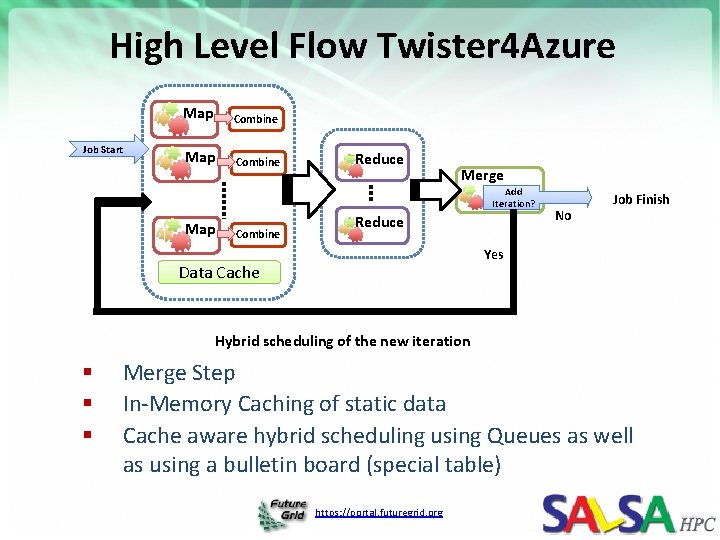
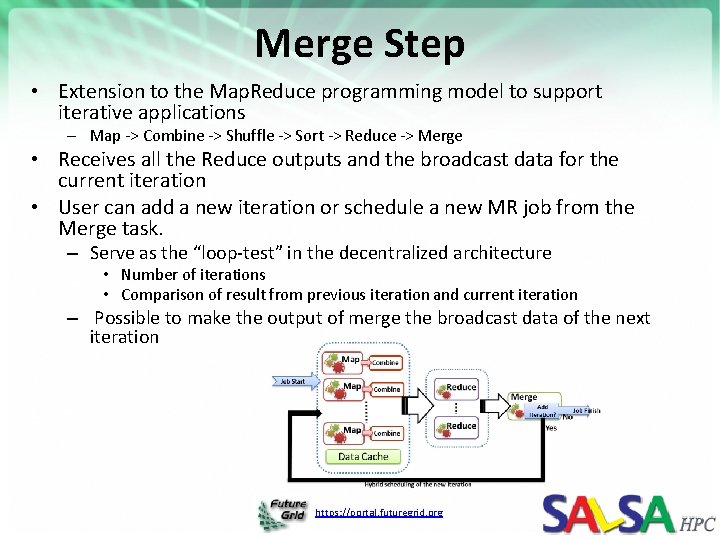
High Level Flow Twister 4 Azure Job Start Map Combine Reduce Merge Add Iteration? Map Combine Reduce No Job Finish Yes Data Cache Hybrid scheduling of the new iteration § § § Merge Step In-Memory Caching of static data Cache aware hybrid scheduling using Queues as well as using a bulletin board (special table) https: //portal. futuregrid. org
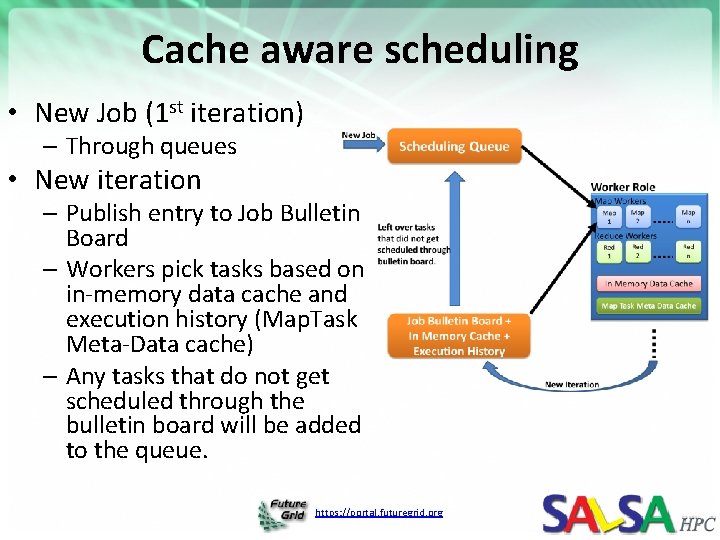
Cache aware scheduling • New Job (1 st iteration) – Through queues • New iteration – Publish entry to Job Bulletin Board – Workers pick tasks based on in-memory data cache and execution history (Map. Task Meta-Data cache) – Any tasks that do not get scheduled through the bulletin board will be added to the queue. https: //portal. futuregrid. org
Twister 4 Azure Performance Comparisons BLAST Sequence Search Smith Waterman Sequence Alignment Cap 3 Sequence Assembly https: //portal. futuregrid. org
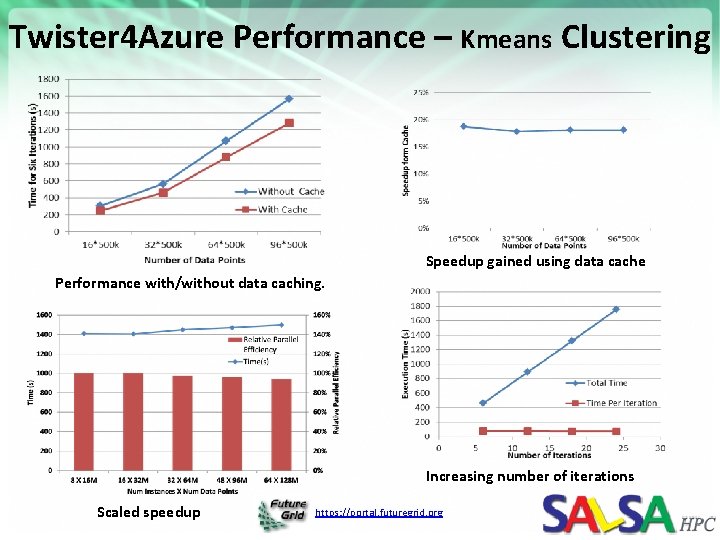
Twister 4 Azure Performance – Kmeans Clustering Speedup gained using data cache Performance with/without data caching. Increasing number of iterations Scaled speedup https: //portal. futuregrid. org
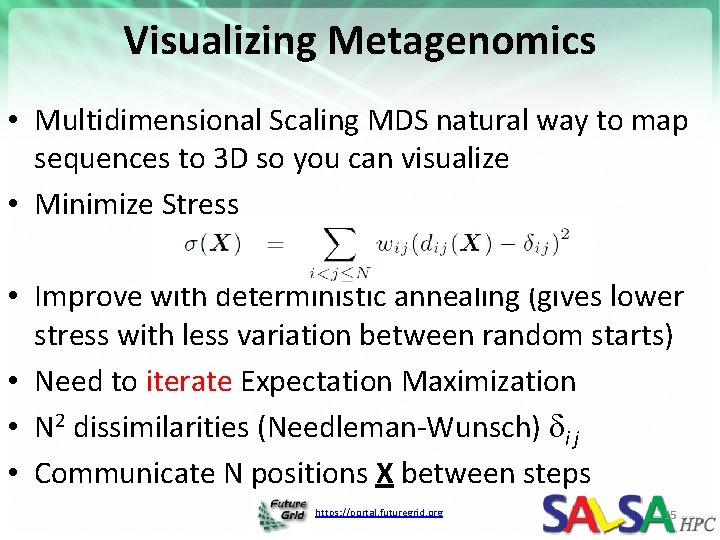
Visualizing Metagenomics • Multidimensional Scaling MDS natural way to map sequences to 3 D so you can visualize • Minimize Stress • Improve with deterministic annealing (gives lower stress with less variation between random starts) • Need to iterate Expectation Maximization • N 2 dissimilarities (Needleman-Wunsch) i j • Communicate N positions X between steps https: //portal. futuregrid. org 15
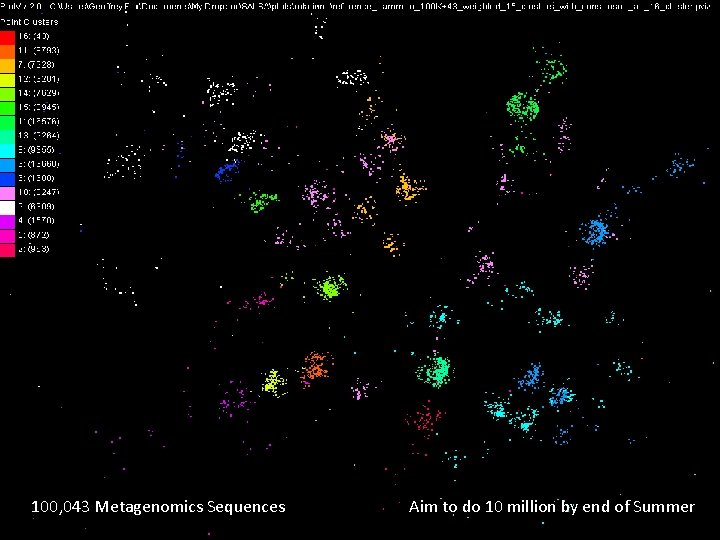
100, 043 Metagenomics Sequences Aim to do 10 million by end of Summer https: //portal. futuregrid. org
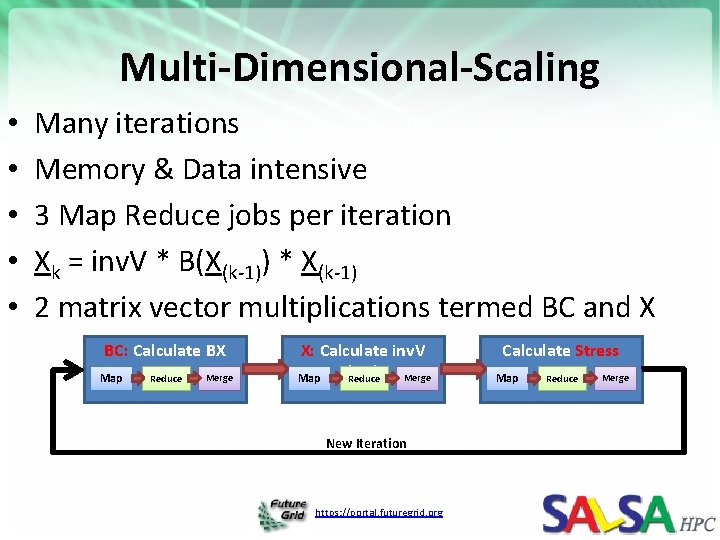
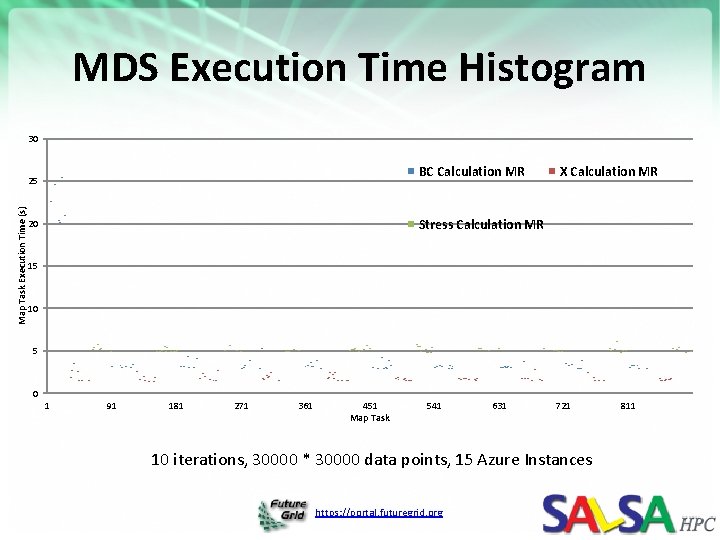
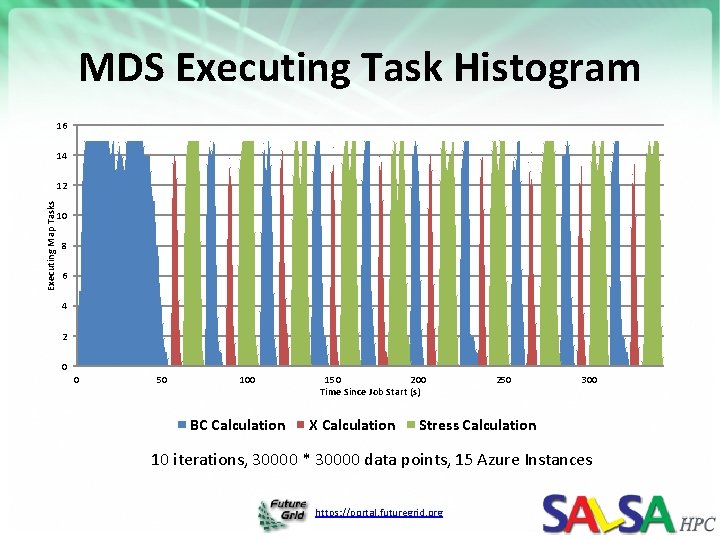
Multi-Dimensional-Scaling • • • Many iterations Memory & Data intensive 3 Map Reduce jobs per iteration Xk = inv. V * B(X(k-1)) * X(k-1) 2 matrix vector multiplications termed BC and X BC: Calculate BX Map Reduce Merge X: Calculate inv. V (BX) Merge Reduce Map New Iteration https: //portal. futuregrid. org Calculate Stress Map Reduce Merge
MDS Execution Time Histogram 30 BC Calculation MR Map Task Execution Time (s) 25 X Calculation MR Stress Calculation MR 20 15 10 5 0 1 91 181 271 361 451 Map Task 541 631 721 10 iterations, 30000 * 30000 data points, 15 Azure Instances https: //portal. futuregrid. org 811
MDS Executing Task Histogram 16 14 Executing Map Tasks 12 10 8 6 4 2 0 0 50 100 BC Calculation 150 200 Time Since Job Start (s) X Calculation 250 300 Stress Calculation 10 iterations, 30000 * 30000 data points, 15 Azure Instances https: //portal. futuregrid. org
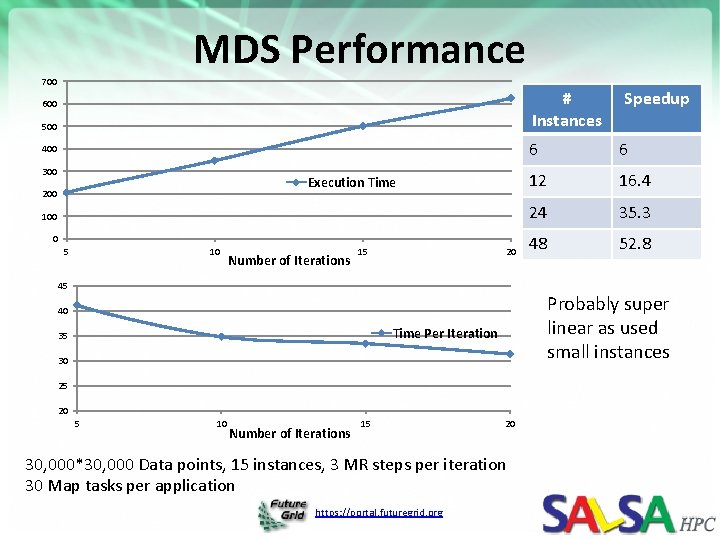
MDS Performance 700 Speedup 500 # Instances 400 6 6 12 16. 4 24 35. 3 48 52. 8 600 300 Execution Time 200 100 0 5 10 Number of Iterations 15 20 45 Probably super linear as used small instances 40 Time Per Iteration 35 30 25 20 5 10 Number of Iterations 15 20 30, 000*30, 000 Data points, 15 instances, 3 MR steps per iteration 30 Map tasks per application https: //portal. futuregrid. org
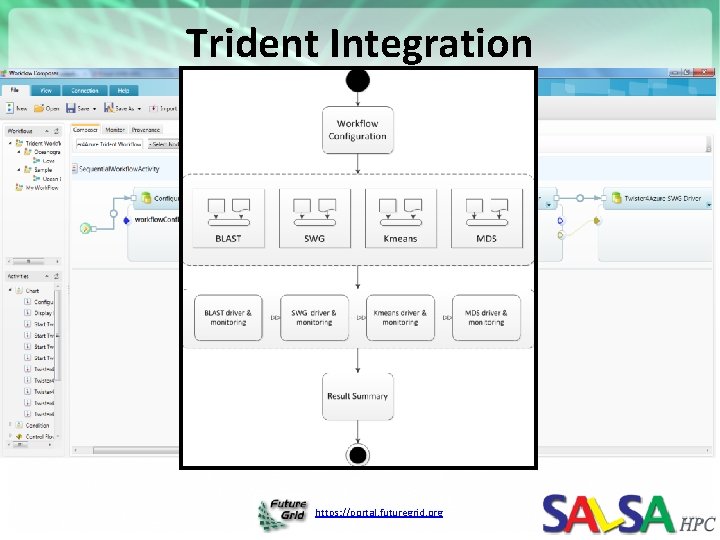
Trident Integration https: //portal. futuregrid. org
Types of Data • Loop invariant data (static data) – traditional MR key-value pairs – Comparatively larger sized data – Cached between iterations • Loop variant data (dynamic data) – broadcast to all the map tasks in beginning of the iteration – Comparatively smaller sized data • Can be specified even for non-iterative MR jobs https: //portal. futuregrid. org
In-Memory Data Cache • Caches the loop-invariant (static) data across iterations – Data that are reused in subsequent iterations • Avoids the data download, loading and parsing cost between iterations – Significant speedups for some data-intensive iterative Map. Reduce applications • Cached data can be reused by any MR application within the job https: //portal. futuregrid. org
Cache Aware Scheduling • Map tasks need to be scheduled with cache awareness – Map task which process data ‘X’ needs to be scheduled to the worker with ‘X’ in the Cache • Nobody has global view of the data products cached in workers – Decentralized architecture – Impossible to do cache aware assigning of tasks to workers • Solution: workers pick tasks based on the data they have in the cache – Job Bulletin Board : advertise the new iterations https: //portal. futuregrid. org
Merge Step • Extension to the Map. Reduce programming model to support iterative applications – Map -> Combine -> Shuffle -> Sort -> Reduce -> Merge • Receives all the Reduce outputs and the broadcast data for the current iteration • User can add a new iteration or schedule a new MR job from the Merge task. – Serve as the “loop-test” in the decentralized architecture • Number of iterations • Comparison of result from previous iteration and current iteration – Possible to make the output of merge the broadcast data of the next iteration https: //portal. futuregrid. org
Multiple Applications per Deployment • Ability to deploy multiple Map Reduce applications in a single deployment • Possible to invoke different MR applications in a single job • Support for many application invocations in a workflow without redeployment https: //portal. futuregrid. org
Conclusions • Twister 4 Azure enables users to easily and efficiently perform large scale iterative data analysis and scientific computations on Azure cloud. – Supports classic and iterative Map. Reduce • Utilizes a hybrid scheduling mechanism to provide the caching of static data across iterations. • Can integrate with Trident (or other workflow) • Plenty of testing and improvements to come! • Open source: Please use http: //salsahpc. indiana. edu/twister 4 azure • Is it useful to make available as a Service? https: //portal. futuregrid. org