
Classic Optimizing Compilers IBMs Fortran H Compiler COMP
Classic Optimizing Compilers IBM’s Fortran H Compiler COMP 512 Rice University Houston, Texas Fall 2003 Copyright 2003, Keith D. Cooper & Linda Torczon, all rights reserved. Students enrolled in Comp 512 at Rice University have explicit permission to make copies of these materials for their personal use. COMP 512, Fall 2003 1
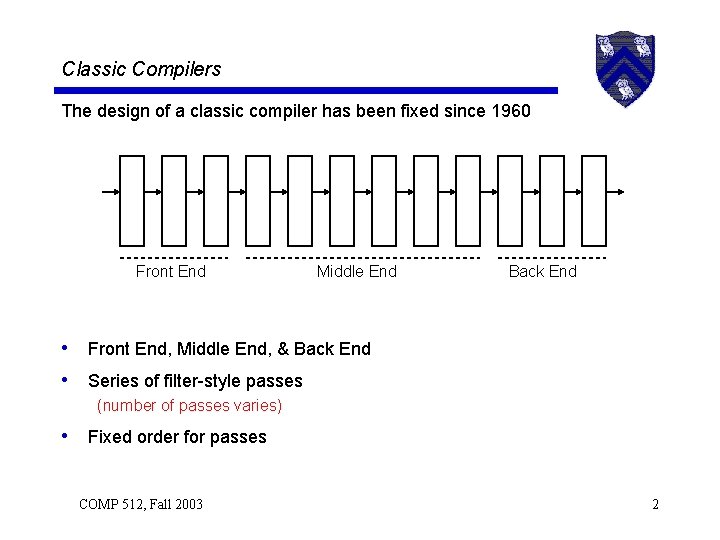
Classic Compilers The design of a classic compiler has been fixed since 1960 Front End Middle End Back End • Front End, Middle End, & Back End • Series of filter-style passes (number of passes varies) • Fixed order for passes COMP 512, Fall 2003 2
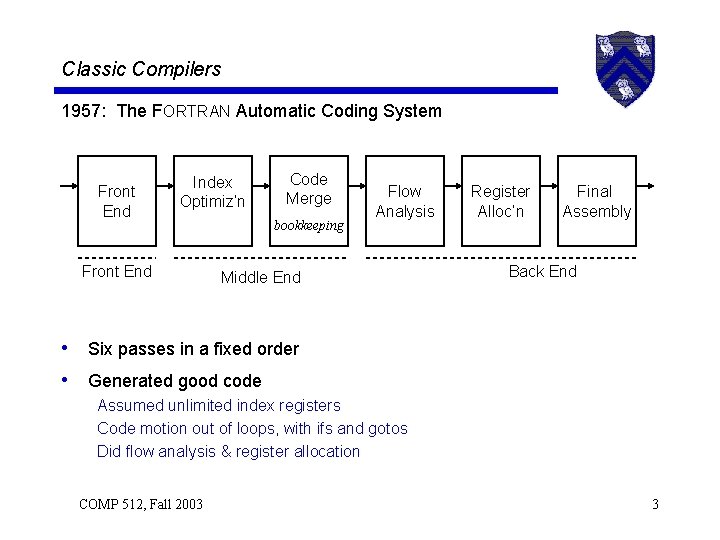
Classic Compilers 1957: The FORTRAN Automatic Coding System Front End Index Optimiz’n Front End Code Merge bookkeeping Flow Analysis Middle End Register Alloc’n Final Assembly Back End • Six passes in a fixed order • Generated good code Assumed unlimited index registers Code motion out of loops, with ifs and gotos Did flow analysis & register allocation COMP 512, Fall 2003 3
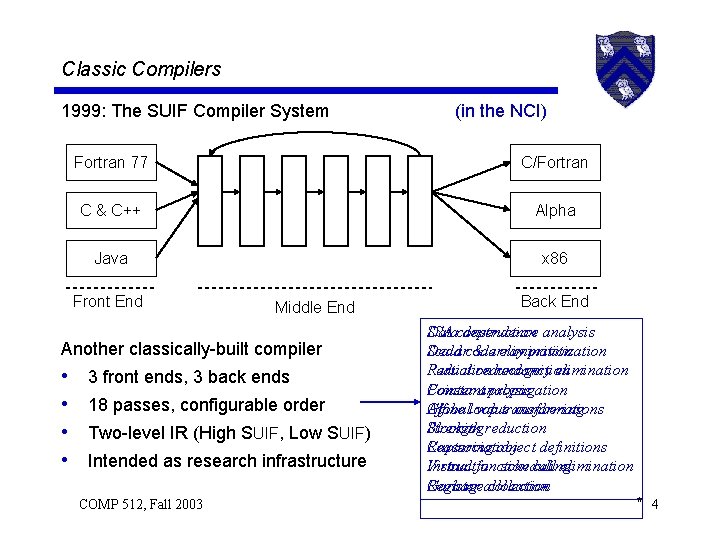
Classic Compilers 1999: The SUIF Compiler System Fortran 77 C/Fortran C & C++ Alpha Java x 86 Front End Middle End Another classically-built compiler • • (in the NCI) 3 front ends, 3 back ends 18 passes, configurable order Two-level IR (High SUIF, Low SUIF) Intended as research infrastructure COMP 512, Fall 2003 Back End SSA Dataconstruction dependence analysis Dead elimination Scalarcode & array privitization Partial redundancy elimination Reduction recognition Constant propagation Pointer analysis Global value numbering Affine loop transformations Strength Blocking reduction Reassociation Capturing object definitions Instruction scheduling Virtual function call elimination Register Garbageallocation collection * 4
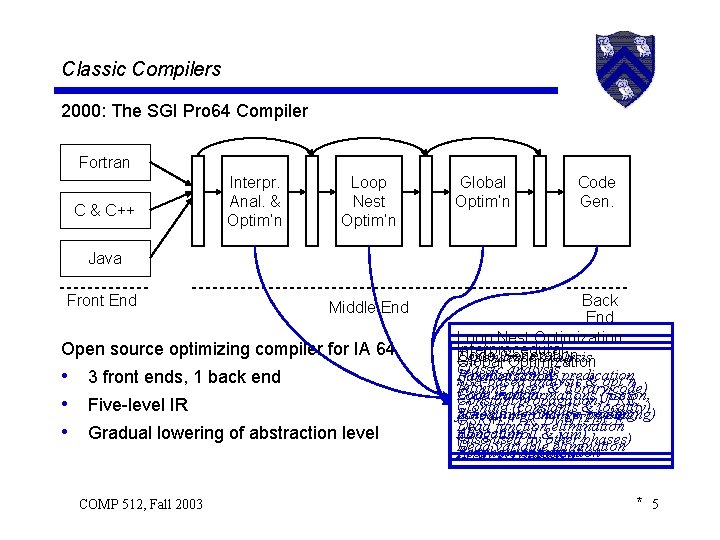
Classic Compilers 2000: The SGI Pro 64 Compiler Fortran C & C++ Interpr. Anal. & Optim’n Loop Nest Optim’n Global Optim’n Code Gen. Java Front End Middle End Open source optimizing compiler for IA 64 • 3 front ends, 1 back end • Five-level IR • Gradual lowering of abstraction level COMP 512, Fall 2003 Back End Loop Nest Optimization Interprocedural Code Dependence analysis Global. Generation Optimization Classic analysis If conversion & predication Parallelization SSA-based analysis & opt’n Inlining (user & library code) Code motion Loop transformations (fission, Constant propagation, PRE, Cloning (constants locality) Scheduling (inc. sw& pipelining) fusion, interchange, peeling, OSR+LFTR, DVNT, DCE Dead function elimination Allocation tiling, unroll & jam)phases) (also used by other Dead variable elimination Peephole optimization Array privitization * 5

Classic Compilers Even a 2000 JIT fits the mold, albeit with fewer passes native code bytecode Middle End Back End Java Environment • Front end tasks are handled elsewhere • Few (if any) optimizations Avoid expensive analysis Emphasis on generating native code Compilation must be profitable COMP 512, Fall 2003 6
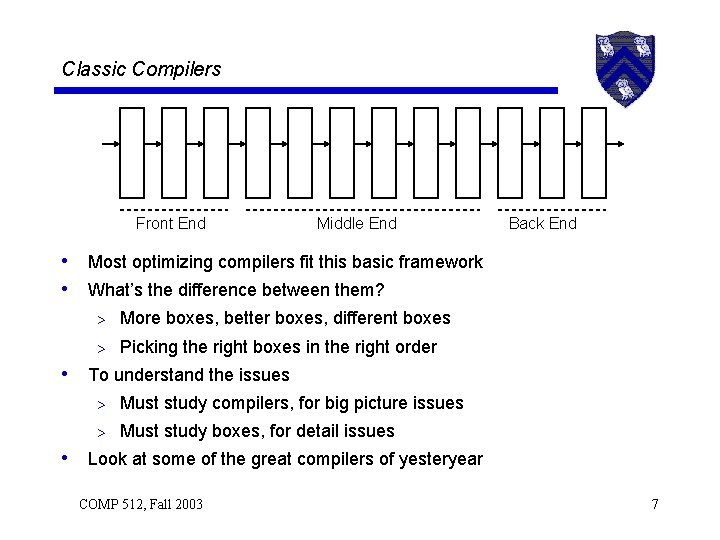
Classic Compilers Front End Middle End Back End • Most optimizing compilers fit this basic framework • What’s the difference between them? > More boxes, better boxes, different boxes > Picking the right boxes in the right order • To understand the issues > Must study compilers, for big picture issues > Must study boxes, for detail issues • Look at some of the great compilers of yesteryear COMP 512, Fall 2003 7
Fortran H Enhanced (the “new” compiler) Improved Optimization of Fortran Object Programs R. G. Scarborough & H. G. Kolsky Started with a good compiler — Fortran H Extended • Fortran H - one of 1 st commercial compilers to perform systematic analysis (both control flow & data flow) • Extended for System 370 features • Subsequently served as model for parts of VS Fortran Authors had commercial concerns • Compilation speed • Bit-by-bit equality of results • Numerical methods must remain fixed COMP 512, Fall 2003 8
Fortran H Extended (the “old” compiler) Some of its quality comes from choosing the right shape Translation to quads performs careful local optimization • Replace integer multiply by 2 k with a shift • Expand exponentiation by known integer constant • Performs minor algebraic simplification on the fly > Handling multiple negations, local constant folding Code Shape • Bill Wulf popularized the term (probably coined it) • Refers to the choice of specific code sequences • “Shape” often encodes heuristics to handle complex issues COMP 512, Fall 2003 9
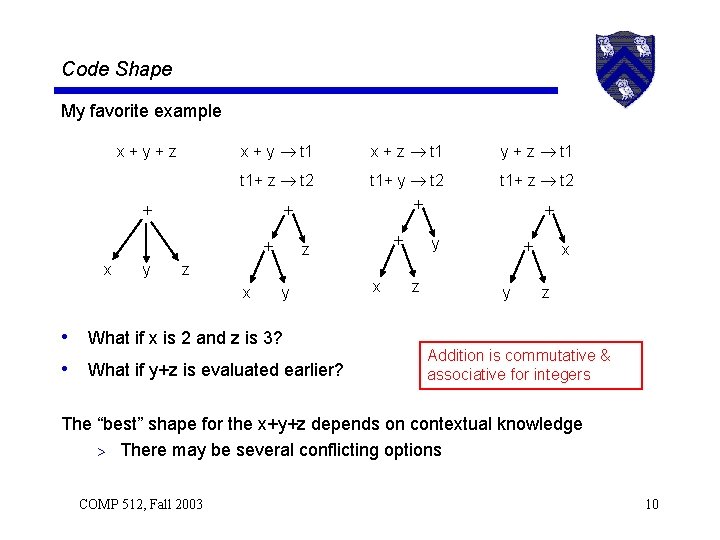
Code Shape My favorite example x+y+z x + y t 1 x + z t 1 y + z t 1+ z t 2 t 1+ y t 2 t 1+ z t 2 x y z x z y • What if x is 2 and z is 3? • What if y+z is evaluated earlier? x y z y x z Addition is commutative & associative for integers The “best” shape for the x+y+z depends on contextual knowledge > There may be several conflicting options COMP 512, Fall 2003 10
Fortran H Extended (old) Some of the improvement in Fortran H comes from choosing the right code shape • Simplifies the analysis & optimization • Encodes heuristics to handle complex issues The rest came from systematic optimization • • • Common subexpression elimination Code motion Strength reduction Register allocation Branch optimization COMP 512, Fall 2003 11
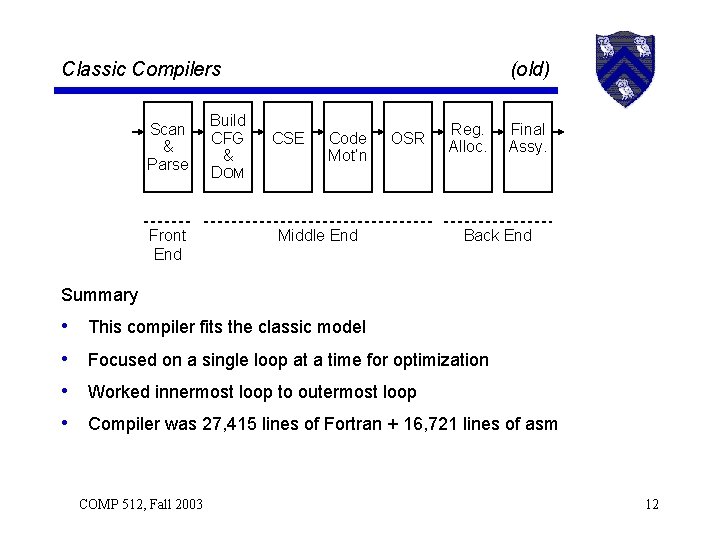
Classic Compilers Scan & Parse Front End Build CFG & DOM (old) CSE Code Mot’n OSR Middle End Reg. Alloc. Final Assy. Back End Summary • • This compiler fits the classic model Focused on a single loop at a time for optimization Worked innermost loop to outermost loop Compiler was 27, 415 lines of Fortran + 16, 721 lines of asm COMP 512, Fall 2003 12
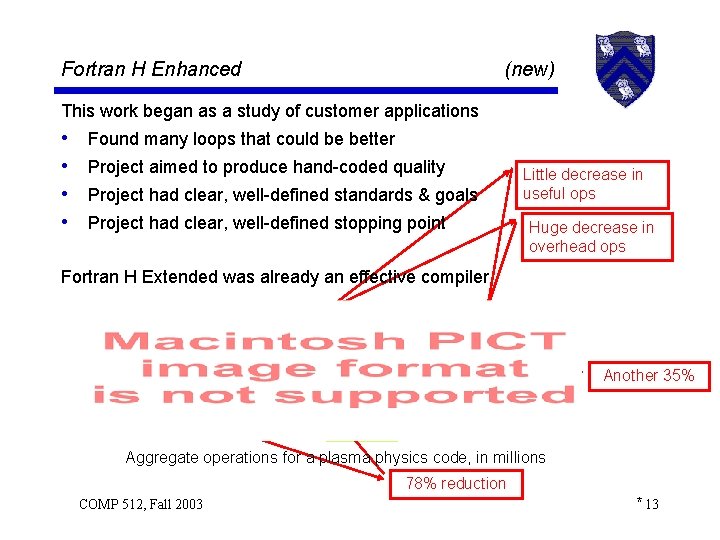
Fortran H Enhanced (new) This work began as a study of customer applications • • Found many loops that could be better Project aimed to produce hand-coded quality Project had clear, well-defined standards & goals Project had clear, well-defined stopping point Little decrease in useful ops Huge decrease in overhead ops Fortran H Extended was already an effective compiler Another 35% Aggregate operations for a plasma physics code, in millions 78% reduction COMP 512, Fall 2003 * 13
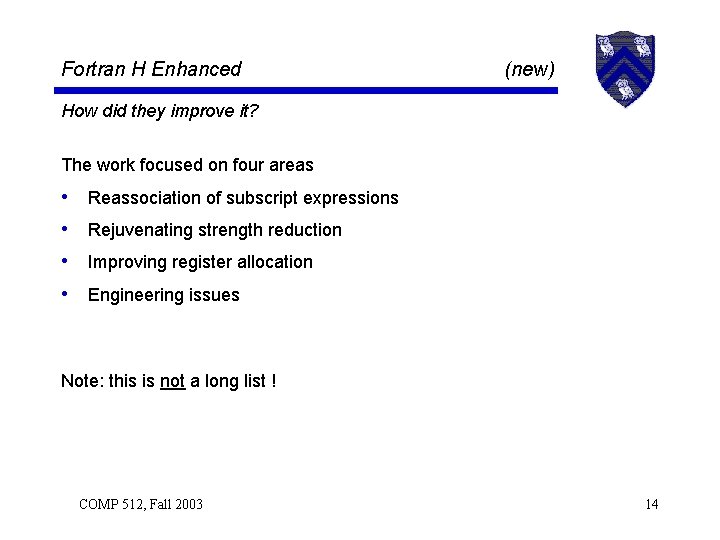
Fortran H Enhanced (new) How did they improve it? The work focused on four areas • • Reassociation of subscript expressions Rejuvenating strength reduction Improving register allocation Engineering issues Note: this is not a long list ! COMP 512, Fall 2003 14
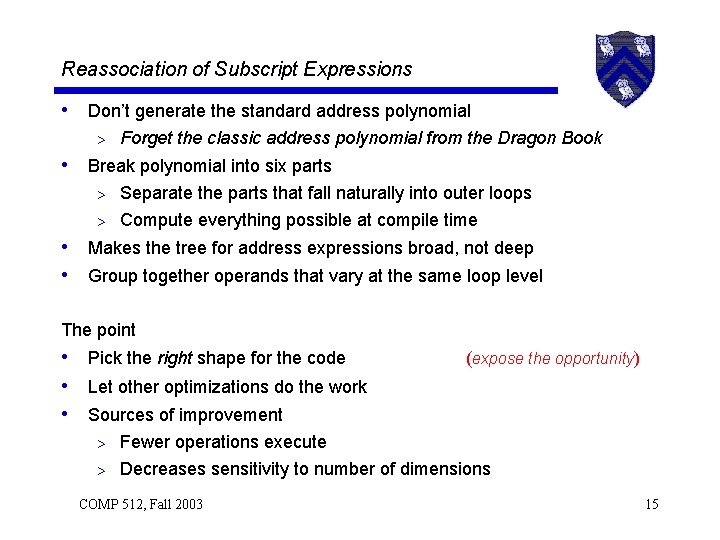
Reassociation of Subscript Expressions • Don’t generate the standard address polynomial > Forget the classic address polynomial from the Dragon Book • Break polynomial into six parts > Separate the parts that fall naturally into outer loops > Compute everything possible at compile time • Makes the tree for address expressions broad, not deep • Group together operands that vary at the same loop level The point • Pick the right shape for the code • Let other optimizations do the work • Sources of improvement (expose the opportunity) Fewer operations execute > Decreases sensitivity to number of dimensions > COMP 512, Fall 2003 15
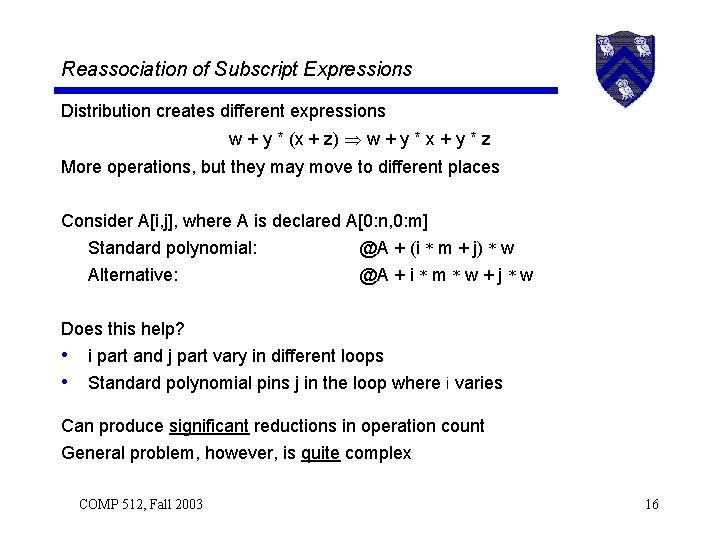
Reassociation of Subscript Expressions Distribution creates different expressions w + y * (x + z) w + y * x + y * z More operations, but they may move to different places Consider A[i, j], where A is declared A[0: n, 0: m] Standard polynomial: @A + (i * m + j) * w Alternative: @A + i * m * w + j * w Does this help? • i part and j part vary in different loops • Standard polynomial pins j in the loop where i varies Can produce significant reductions in operation count General problem, however, is quite complex COMP 512, Fall 2003 16
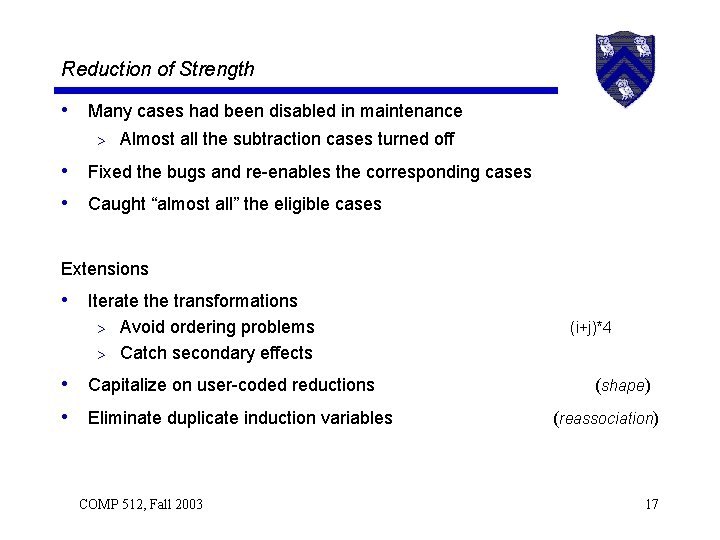
Reduction of Strength • Many cases had been disabled in maintenance > Almost all the subtraction cases turned off • Fixed the bugs and re-enables the corresponding cases • Caught “almost all” the eligible cases Extensions • Iterate the transformations Avoid ordering problems > Catch secondary effects > • Capitalize on user-coded reductions • Eliminate duplicate induction variables COMP 512, Fall 2003 (i+j)*4 (shape) (reassociation) 17
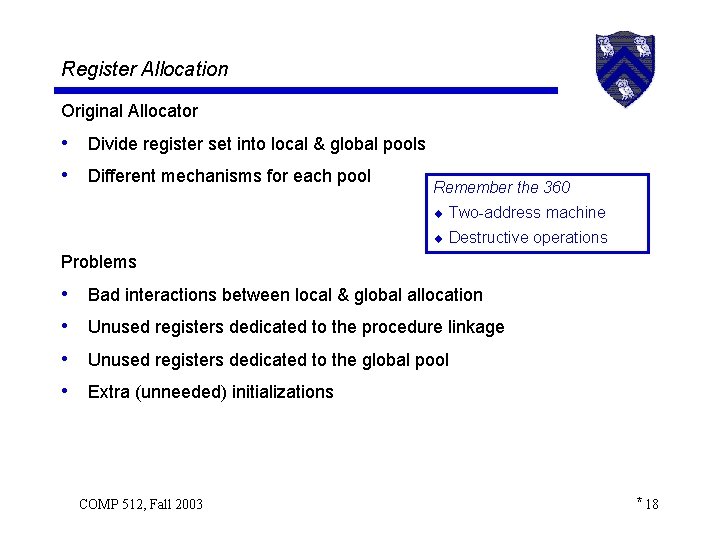
Register Allocation Original Allocator • Divide register set into local & global pools • Different mechanisms for each pool Remember the 360 ¨ Two-address machine ¨ Destructive operations Problems • • Bad interactions between local & global allocation Unused registers dedicated to the procedure linkage Unused registers dedicated to the global pool Extra (unneeded) initializations COMP 512, Fall 2003 * 18
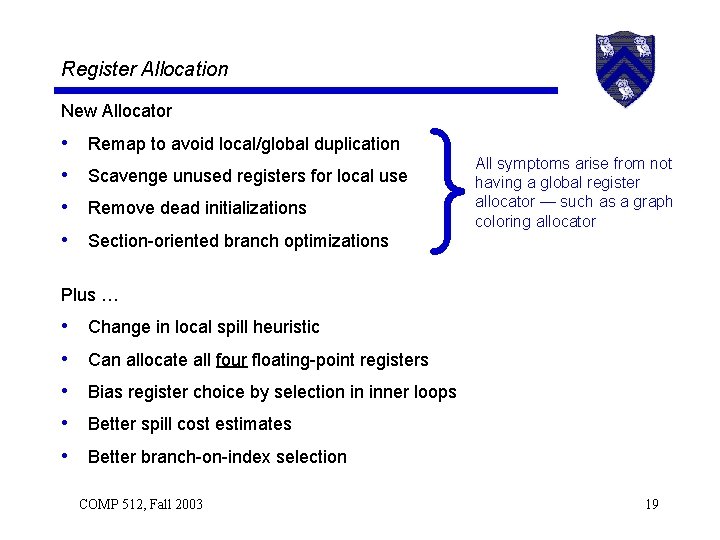
Register Allocation New Allocator • • Scavenge unused registers for local use Remove dead initializations Section-oriented branch optimizations Plus … • • • } Remap to avoid local/global duplication All symptoms arise from not having a global register allocator — such as a graph coloring allocator Change in local spill heuristic Can allocate all four floating-point registers Bias register choice by selection in inner loops Better spill cost estimates Better branch-on-index selection COMP 512, Fall 2003 19
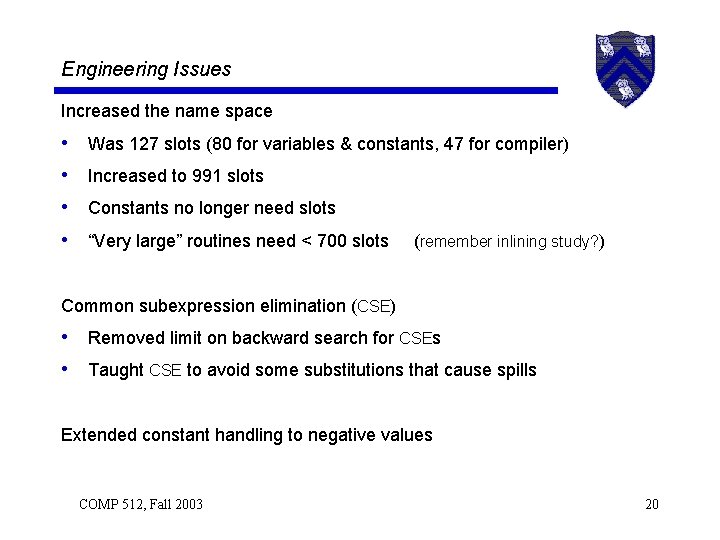
Engineering Issues Increased the name space • • Was 127 slots (80 for variables & constants, 47 for compiler) Increased to 991 slots Constants no longer need slots “Very large” routines need < 700 slots (remember inlining study? ) Common subexpression elimination (CSE) • Removed limit on backward search for CSEs • Taught CSE to avoid some substitutions that cause spills Extended constant handling to negative values COMP 512, Fall 2003 20
Results They stopped working on the optimizer. Hand-coding no longer improved the inner loops. Produced significant change in ratio of flops to instructions I consider this to be the classic Fortran optimizing compiler Aggregate operations for a plasma physics code, in millions COMP 512, Fall 2003 21
Results Final points • Performance numbers vary from model to model • Compiler ran faster, too ! It relies on • A handful of carefully targeted optimizations • Generating the right IR in the first place (code shape) Next class (Thursday) Start on Redundancy Elimination (Chapter 8 of Ea. C) COMP 512, Fall 2003 22
- Slides: 22