
Classes of Networks a LAN Local Area Network
- Slides: 17
Classes of Networks a. LAN (Local Area Network) u Maximum distance not more than a few kms u Ownership by a single organization u Transmission speed of at least several Mbps (tens to hundreds are economical) u Often broadcast, shared media based 09 September 2020 ECE 478/578 K. M. Mc. Neill, Ph. D. 1
Classes of Networks - LANS u Some widely used standards include: F IEEE 803. 3 - Ethernet F IEEE 803. 5 - Token ring F FDDI F ATM u An important issue in broadcast LANs is the allocation of the shared channel (media access control) u Control may be static (time division multiplexing) or dynamic (contention or arbitration) 09 September 2020 ECE 478/578 K. M. Mc. Neill, Ph. D. 2
Classes of Networks - MANS a. MAN (Metropolitan Area Network) u Distances between 5 and 50 kms u Data rate above 1 Mbps u Standards: IEEE 802. 6 DQDB, FDDI, and ATM 09 September 2020 ECE 478/578 K. M. Mc. Neill, Ph. D. 3
Classes of Networks - WANS a. WAN (Wide Area Network) u Spans entire states or countries u Data rate of 1. 544 (T 1), and 45 (T 3) Mbps common u Higher data rates are available with the wide deployment of ATM backbone networks u Often owned by multiple organizations 09 September 2020 ECE 478/578 K. M. Mc. Neill, Ph. D. 4
Classes of Networks - WANS u Usually separate communications functions from application functions u Transmission lines: circuits, channels or trunks u Switching elements: FSpecialized computers connecting two or more circuits FThese elements receive data on an incoming circuit and transmit it on an outgoing circuit 09 September 2020 ECE 478/578 K. M. Mc. Neill, Ph. D. 5
Classes of Networks - WANS FIntermediate Systems, Packet Switching Node, Data Switching Exchange, Router, etc. FIntermediate systems store a complete packet before forwarding it • store-and-forward; packet switched; point-topoint network 09 September 2020 ECE 478/578 K. M. Mc. Neill, Ph. D. 6
Classes of Networks - Internetworks a. Internetworks u Unlike WANs they often interconnect different, incompatible networks u Use special types of intermediate systems called Gateways u Gateways translate between different types of physical media and network software 09 September 2020 ECE 478/578 K. M. Mc. Neill, Ph. D. 7
Network Software a. Network software is highly structured a. This technique has been immensely successful a. The key is Layered design u Each layer provides a service to the layer above u Each layer hides details of how the service is provided to the layer above u The Nth layer on one machine “talks to” or interacts with the Nth layer on another machine 09 September 2020 ECE 478/578 K. M. Mc. Neill, Ph. D. 8
Network Software - Protocols a. Conventions and rules governing this interaction are specified by the Layer N Protocol u A protocol is an agreement about how communications are to proceed u Without a protocol, communication can be difficult or even impossible u E. g. Telephone conversation, Postal addresses 09 September 2020 ECE 478/578 K. M. Mc. Neill, Ph. D. 9
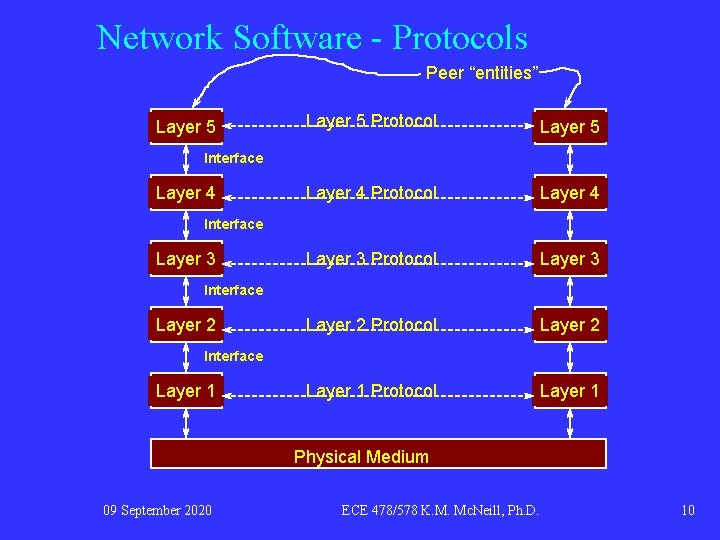
Network Software - Protocols Peer “entities” Layer 5 Protocol Layer 5 Layer 4 Protocol Layer 4 Layer 3 Protocol Layer 3 Layer 2 Protocol Layer 2 Layer 1 Protocol Layer 1 Interface Layer 4 Interface Layer 3 Interface Layer 2 Interface Layer 1 Physical Medium 09 September 2020 ECE 478/578 K. M. Mc. Neill, Ph. D. 10
Network Software - Protocols a. Information is not actually transferred directly between peer layer N entities u Peer layer N entities carry on a virtual communication using the services of the layers below u Layer N passes data and control information down to (or receives data and control from) Layer N-1 until the physical medium is reached 09 September 2020 ECE 478/578 K. M. Mc. Neill, Ph. D. 11
Network Software - Interfaces & Services a. Interfaces exist between each layer a. Interface defines which primitive functions and services layer N-1 provides to layer N a. Want layers to: u Perform a well defined, logically related set of functions u Minimize the amount of information needed to pass between layers u Keep interfaces “clean” to allow easy and transparent replacement of layers 09 September 2020 ECE 478/578 K. M. Mc. Neill, Ph. D. 12
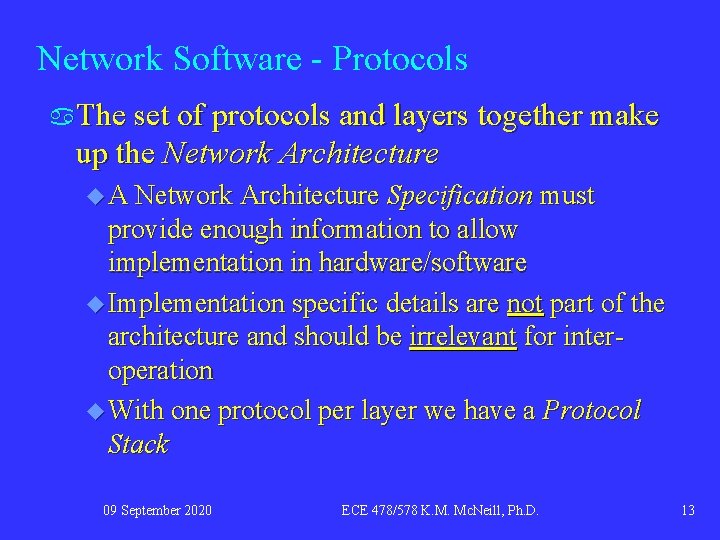
Network Software - Protocols a. The set of protocols and layers together make up the Network Architecture u A Network Architecture Specification must provide enough information to allow implementation in hardware/software u Implementation specific details are not part of the architecture and should be irrelevant for interoperation u With one protocol per layer we have a Protocol Stack 09 September 2020 ECE 478/578 K. M. Mc. Neill, Ph. D. 13
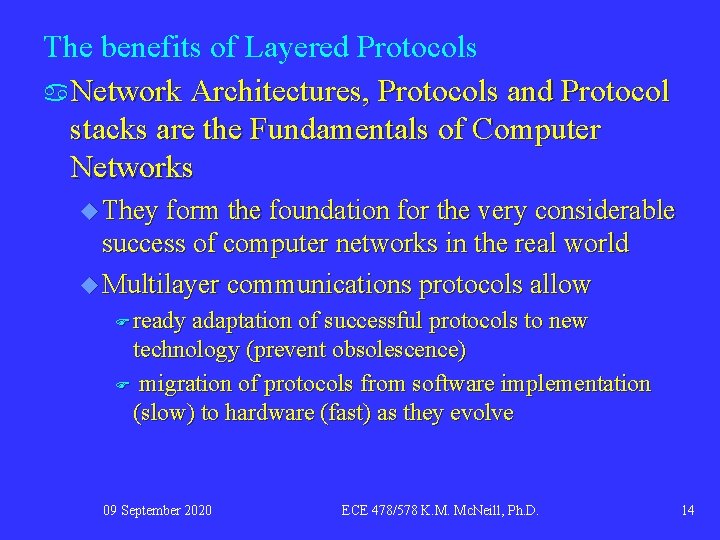
The benefits of Layered Protocols a. Network Architectures, Protocols and Protocol stacks are the Fundamentals of Computer Networks u They form the foundation for the very considerable success of computer networks in the real world u Multilayer communications protocols allow F ready adaptation of successful protocols to new technology (prevent obsolescence) F migration of protocols from software implementation (slow) to hardware (fast) as they evolve 09 September 2020 ECE 478/578 K. M. Mc. Neill, Ph. D. 14
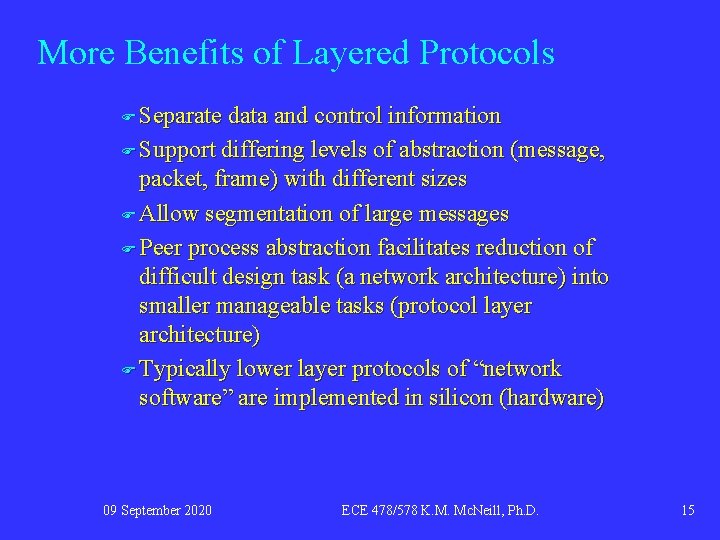
More Benefits of Layered Protocols F Separate data and control information F Support differing levels of abstraction (message, packet, frame) with different sizes F Allow segmentation of large messages F Peer process abstraction facilitates reduction of difficult design task (a network architecture) into smaller manageable tasks (protocol layer architecture) F Typically lower layer protocols of “network software” are implemented in silicon (hardware) 09 September 2020 ECE 478/578 K. M. Mc. Neill, Ph. D. 15
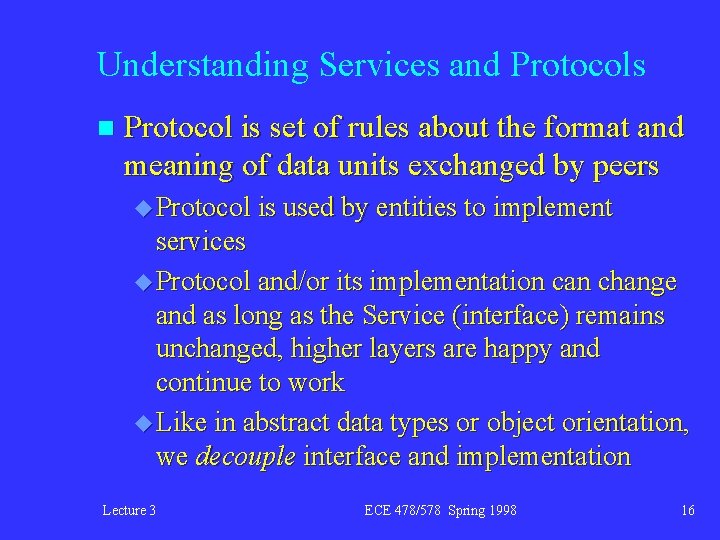
Understanding Services and Protocols n Protocol is set of rules about the format and meaning of data units exchanged by peers u Protocol is used by entities to implement services u Protocol and/or its implementation can change and as long as the Service (interface) remains unchanged, higher layers are happy and continue to work u Like in abstract data types or object orientation, we decouple interface and implementation Lecture 3 ECE 478/578 Spring 1998 16
Layering concept elsewhere a Layering is used in other software (e. g. Operating systems) - UNIX a For Network Software the important difference is that we are not allowed to violate layering (Layer 5 cannot directly access Layer 1) a For Network Software, its important Layers don’t “peek” into headers of other layers and rely on protocol data of other layers Lecture 3 ECE 478/578 Spring 1998 17