
Classes In C What is a class Can

- Slides: 34
Classes In C++
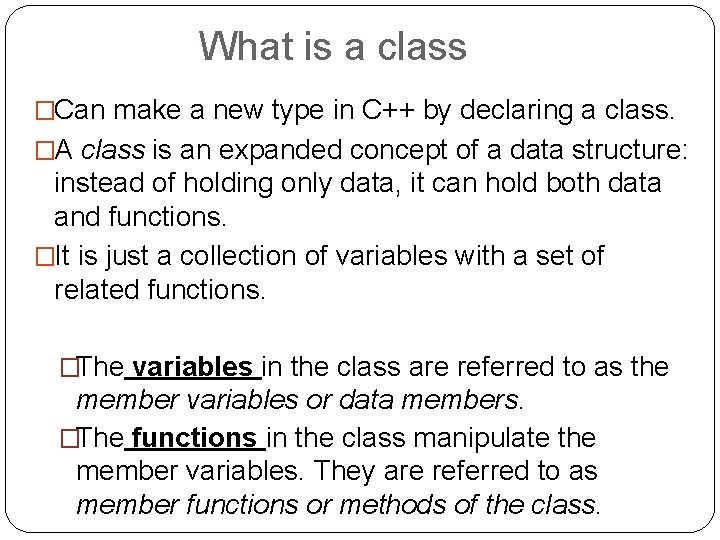
What is a class �Can make a new type in C++ by declaring a class. �A class is an expanded concept of a data structure: instead of holding only data, it can hold both data and functions. �It is just a collection of variables with a set of related functions. �The variables in the class are referred to as the member variables or data members. �The functions in the class manipulate the member variables. They are referred to as member functions or methods of the class.
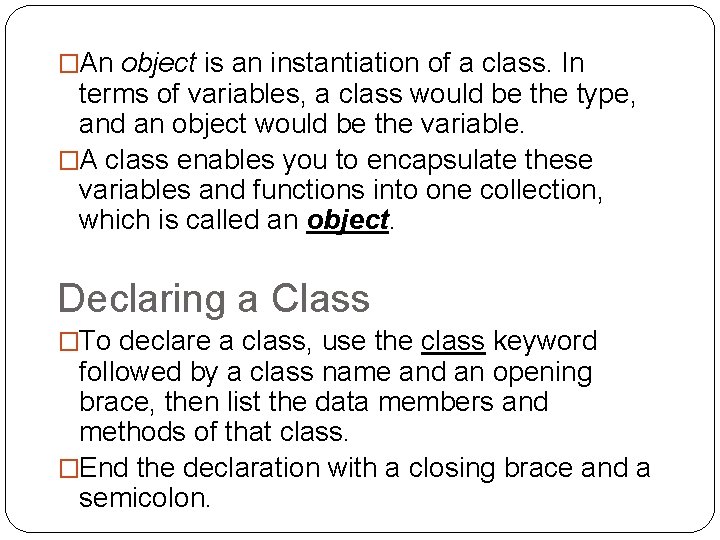
�An object is an instantiation of a class. In terms of variables, a class would be the type, and an object would be the variable. �A class enables you to encapsulate these variables and functions into one collection, which is called an object. Declaring a Class �To declare a class, use the class keyword followed by a class name and an opening brace, then list the data members and methods of that class. �End the declaration with a closing brace and a semicolon.
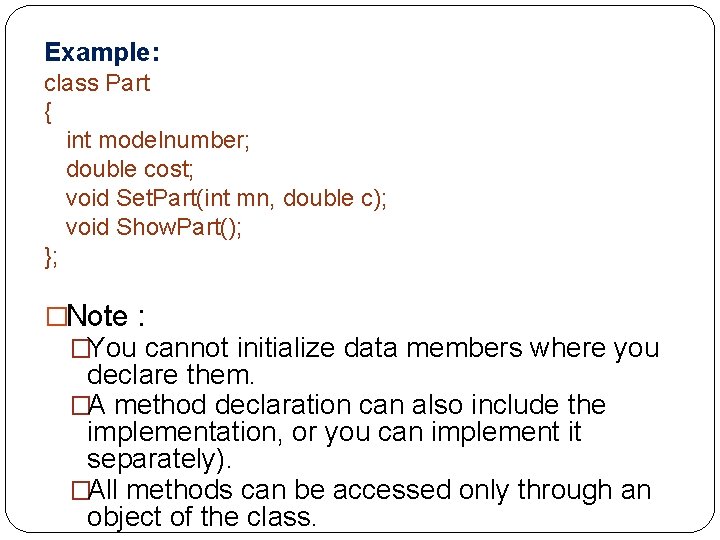
Example: class Part { int modelnumber; double cost; void Set. Part(int mn, double c); void Show. Part(); }; �Note : �You cannot initialize data members where you declare them. �A method declaration can also include the implementation, or you can implement it separately). �All methods can be accessed only through an object of the class.
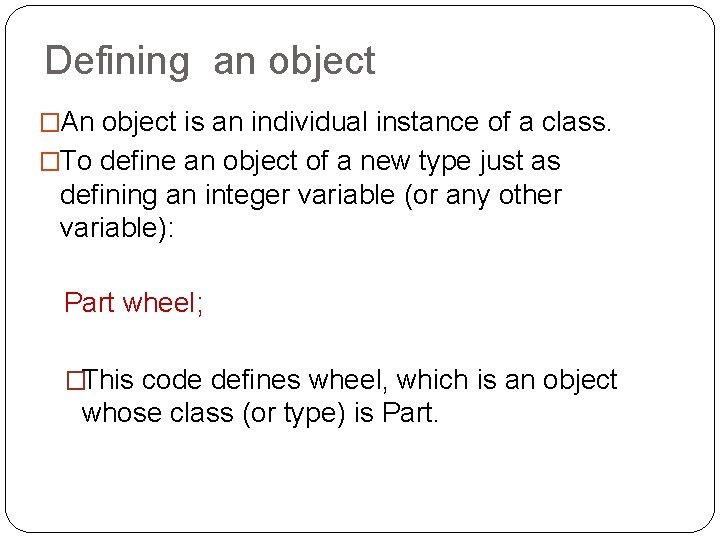
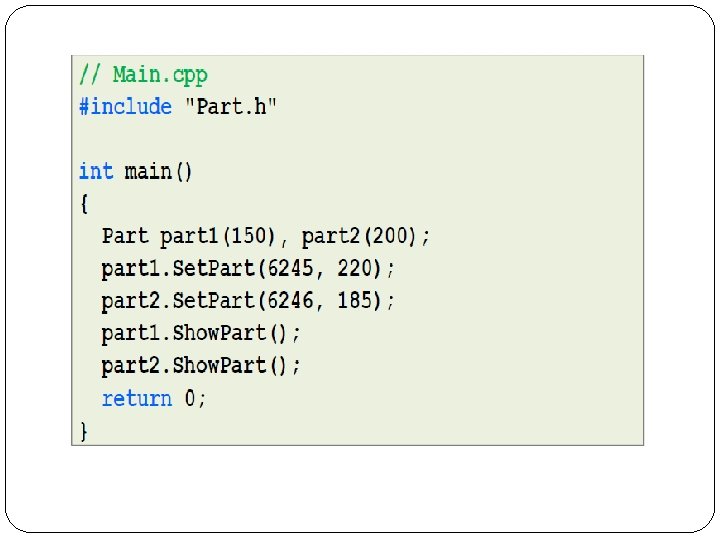
Defining an object �An object is an individual instance of a class. �To define an object of a new type just as defining an integer variable (or any other variable): Part wheel; �This code defines wheel, which is an object whose class (or type) is Part.
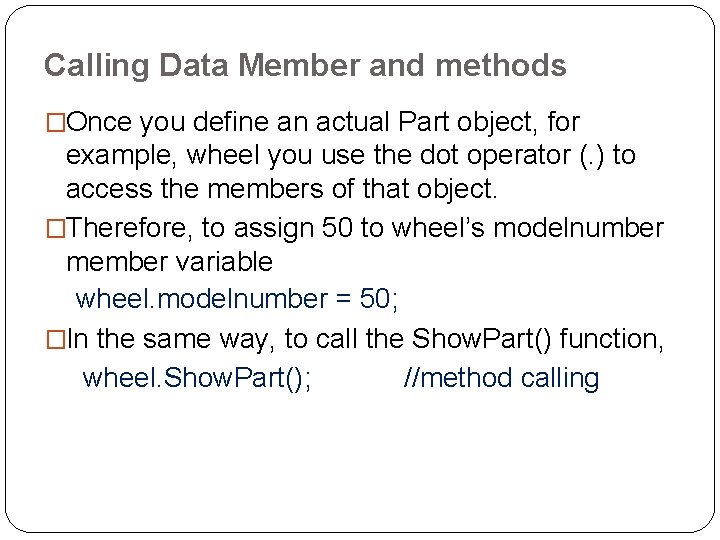
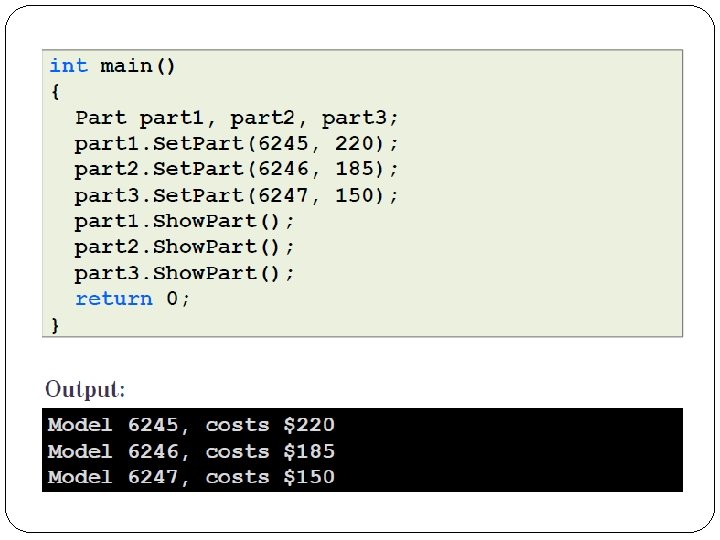
Calling Data Member and methods �Once you define an actual Part object, for example, wheel you use the dot operator (. ) to access the members of that object. �Therefore, to assign 50 to wheel’s modelnumber member variable wheel. modelnumber = 50; �In the same way, to call the Show. Part() function, wheel. Show. Part(); //method calling
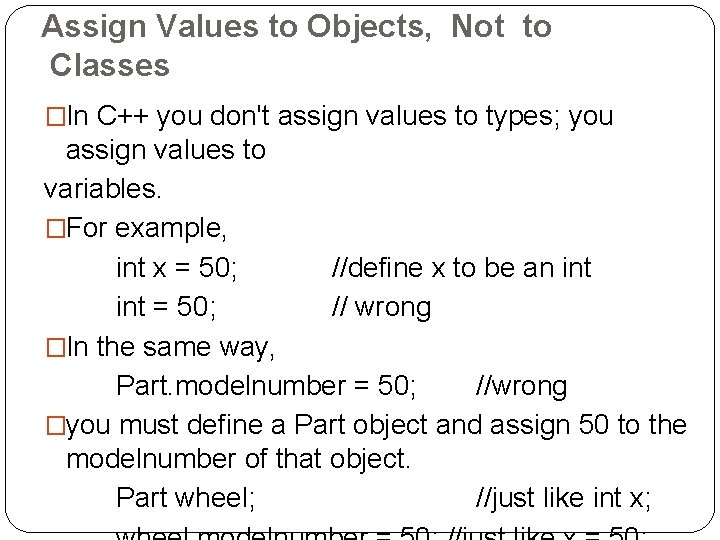
Assign Values to Objects, Not to Classes �In C++ you don't assign values to types; you assign values to variables. �For example, int x = 50; //define x to be an int = 50; // wrong �In the same way, Part. modelnumber = 50; //wrong �you must define a Part object and assign 50 to the modelnumber of that object. Part wheel; //just like int x;
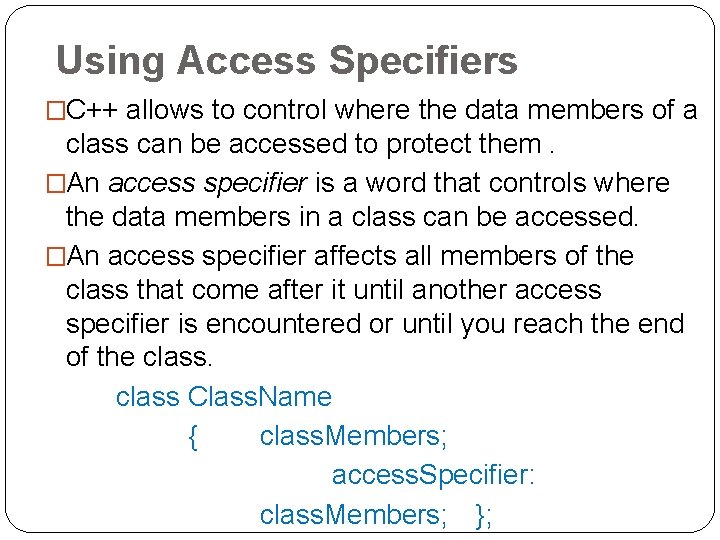
Using Access Specifiers �C++ allows to control where the data members of a class can be accessed to protect them. �An access specifier is a word that controls where the data members in a class can be accessed. �An access specifier affects all members of the class that come after it until another access specifier is encountered or until you reach the end of the class Class. Name { class. Members; access. Specifier: class. Members; };
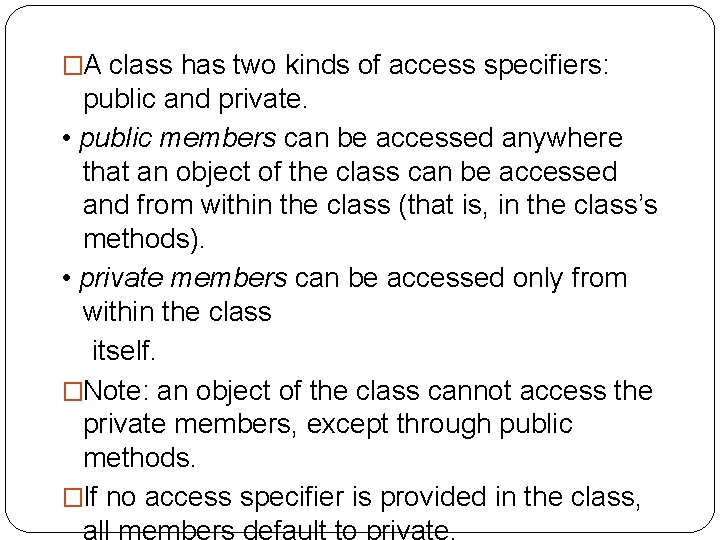
�A class has two kinds of access specifiers: public and private. • public members can be accessed anywhere that an object of the class can be accessed and from within the class (that is, in the class’s methods). • private members can be accessed only from within the class itself. �Note: an object of the class cannot access the private members, except through public methods. �If no access specifier is provided in the class, all members default to private.
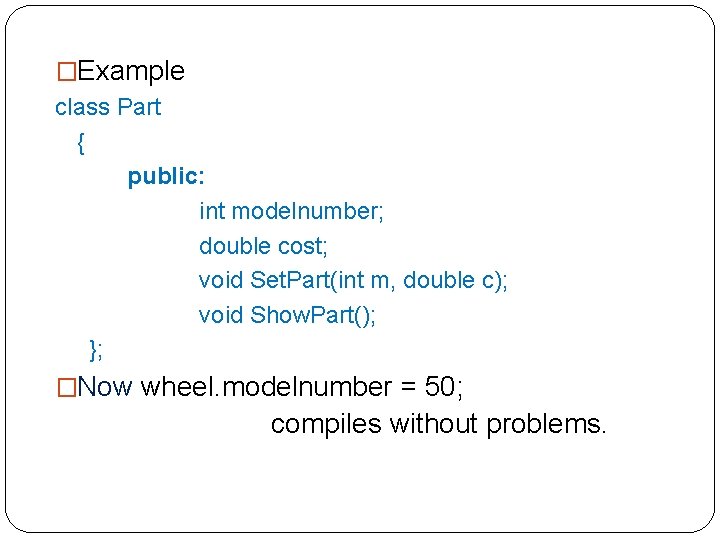
�Example class Part { public: int modelnumber; double cost; void Set. Part(int m, double c); void Show. Part(); }; �Now wheel. modelnumber = 50; compiles without problems.
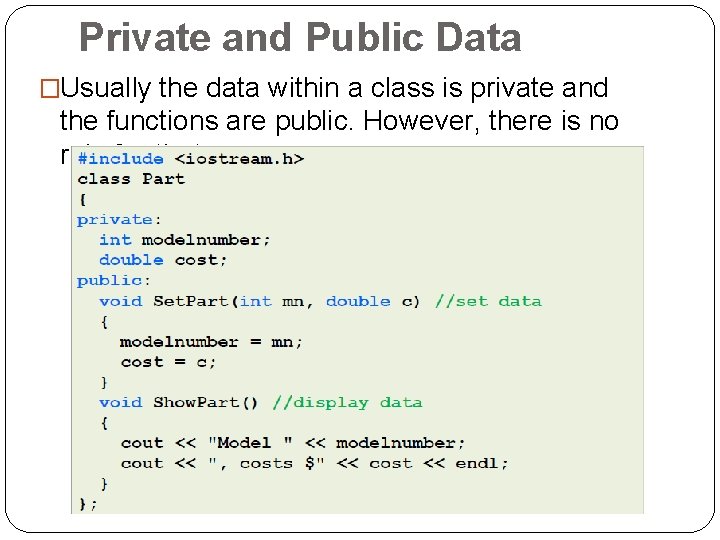
Private and Public Data �Usually the data within a class is private and the functions are public. However, there is no rule for that.
Memory Allocation �Declaring this class doesn't allocate memory for a Part. �It just tells the compiler what a Part is, what data it contains, and what it can do. �It also tells the compiler how big a Part is (that is, how much room the compiler set for each Part (objects) that you create).
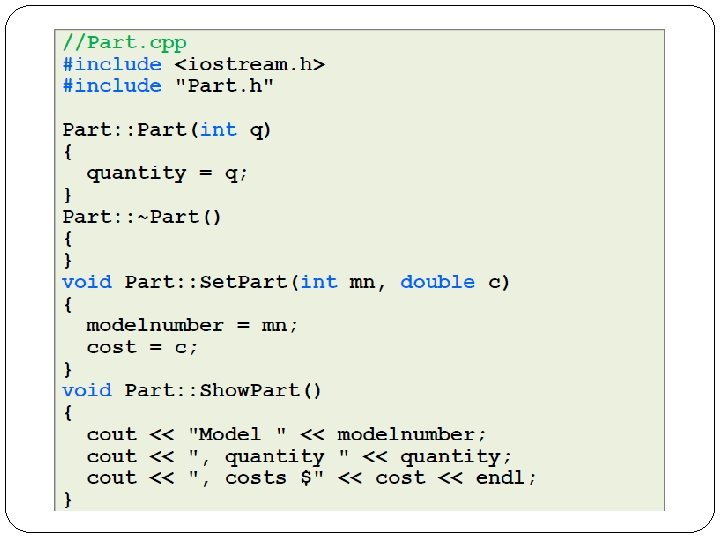
Creating Methods �You can declare a method two ways. The most common way is to declare a method inside the class declaration and then implement it outside. 2. The second way is to declare and implement the method at the same time inside the class declaration. �However, there is special syntax for the method definition. A member function definition begins with the return type, followed by the name of the class, two colons (: : ), the name of the function, and its parameters. 1.
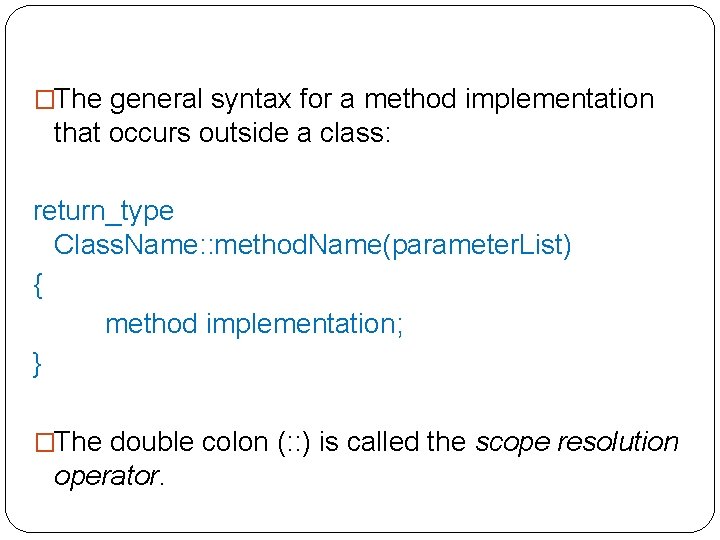
�The general syntax for a method implementation that occurs outside a class: return_type Class. Name: : method. Name(parameter. List) { method implementation; } �The double colon (: : ) is called the scope resolution operator.
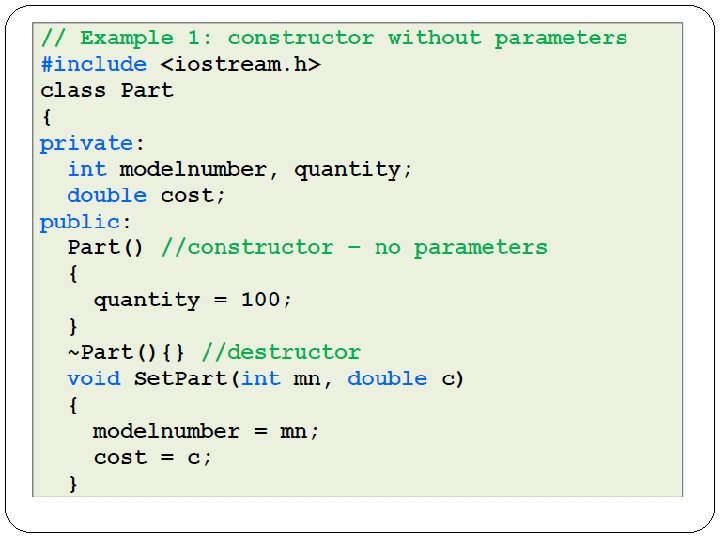
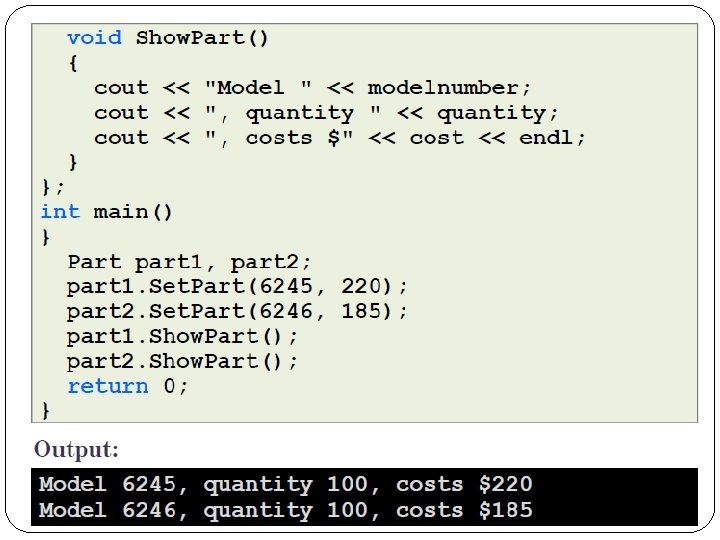
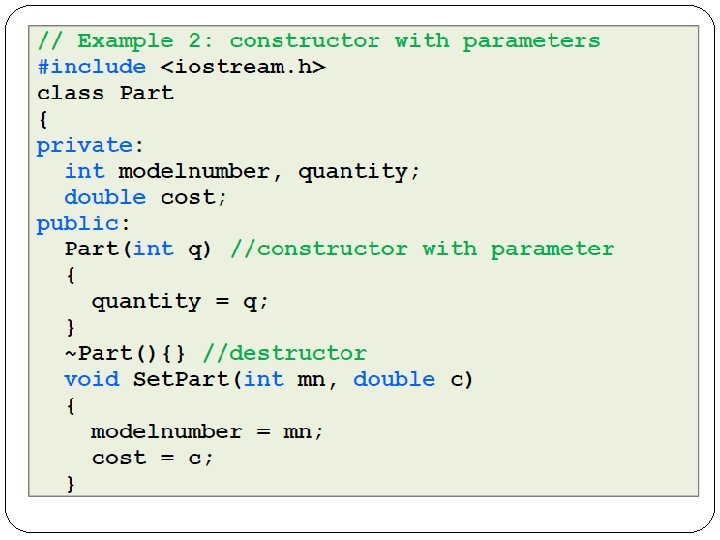
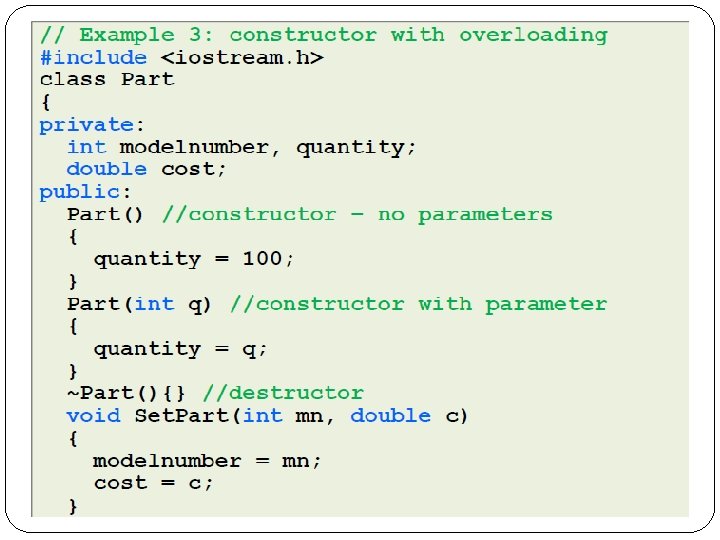
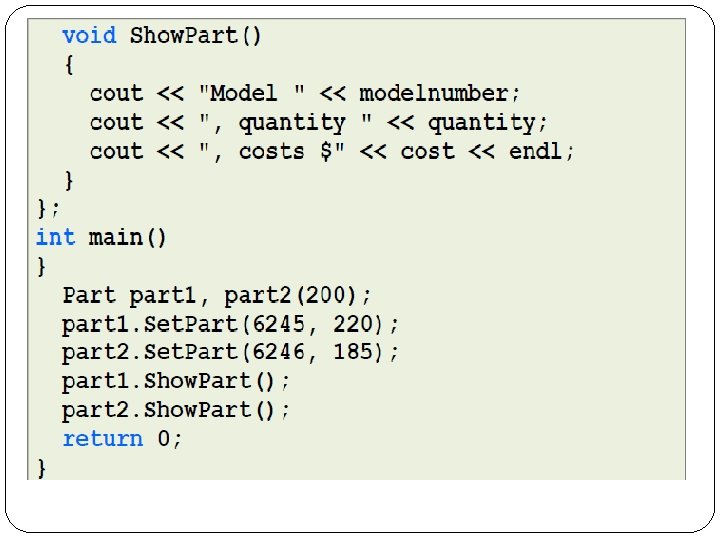
Constructor and Destructor �These are special kinds of methods that can be in a class, and they are optional �They provide special functionality that other methods cannot provide. �A constructor is executed every time you declare a new object. �It is normally used to set initial values for the data members. �always has the same name as the class and cannot have a return value (not even void).
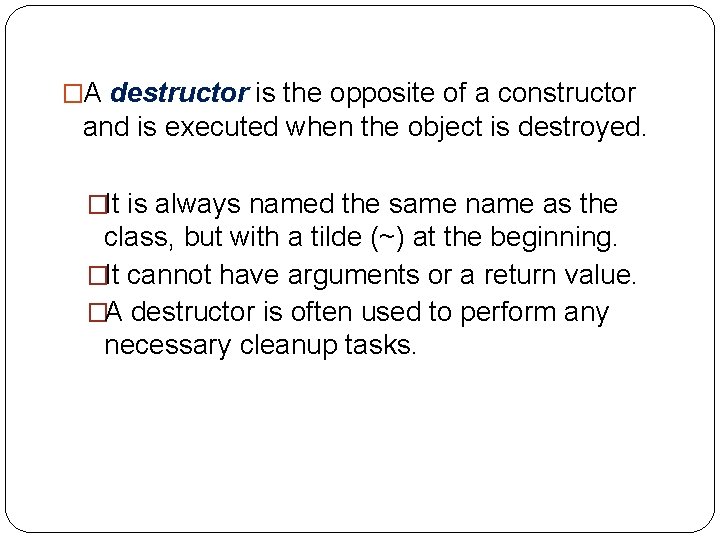
�A destructor is the opposite of a constructor and is executed when the object is destroyed. �It is always named the same name as the class, but with a tilde (~) at the beginning. �It cannot have arguments or a return value. �A destructor is often used to perform any necessary cleanup tasks.
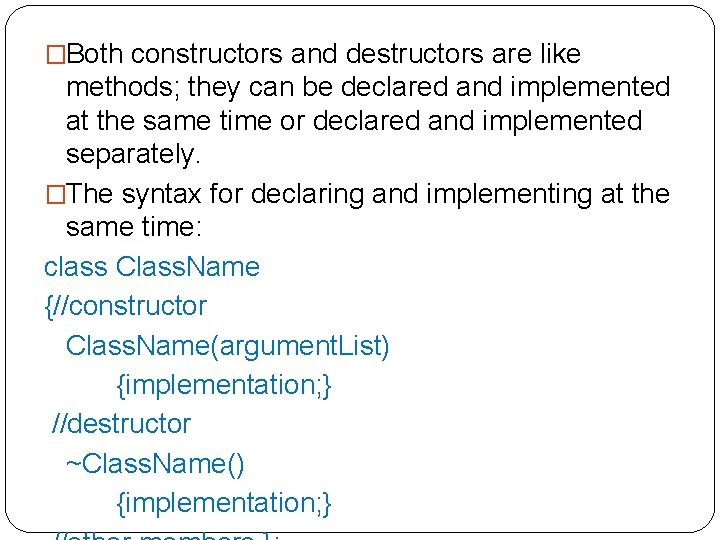
�Both constructors and destructors are like methods; they can be declared and implemented at the same time or declared and implemented separately. �The syntax for declaring and implementing at the same time: class Class. Name {//constructor Class. Name(argument. List) {implementation; } //destructor ~Class. Name() {implementation; }
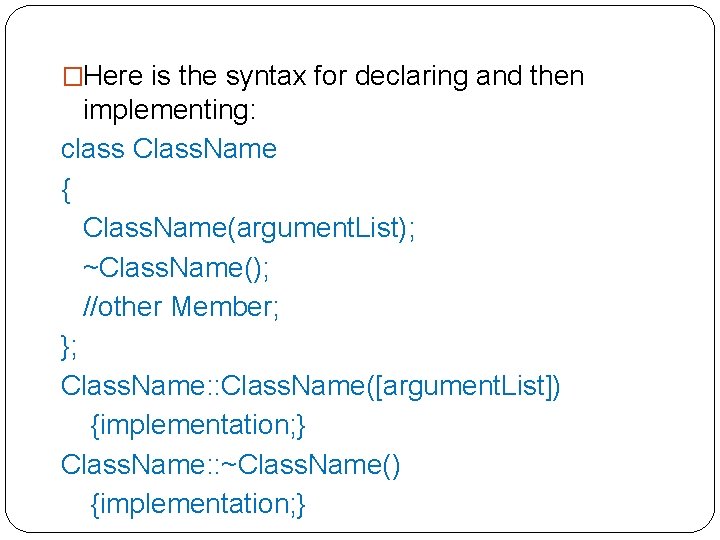
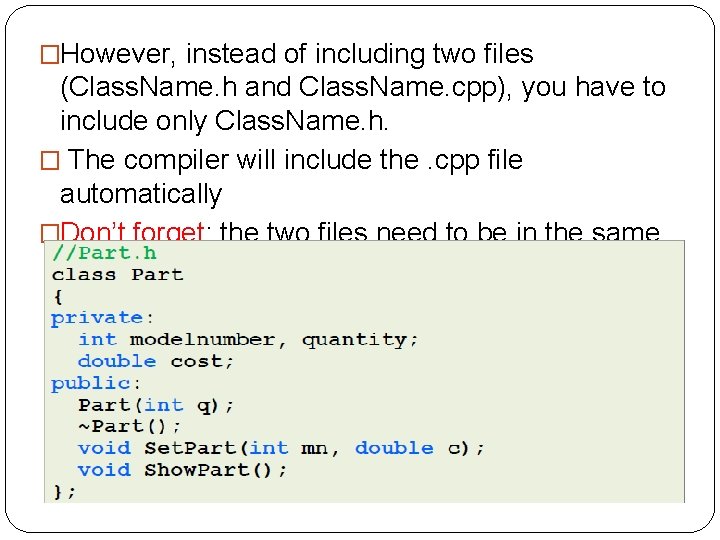
�Here is the syntax for declaring and then implementing: class Class. Name { Class. Name(argument. List); ~Class. Name(); //other Member; }; Class. Name: : Class. Name([argument. List]) {implementation; } Class. Name: : ~Class. Name() {implementation; }
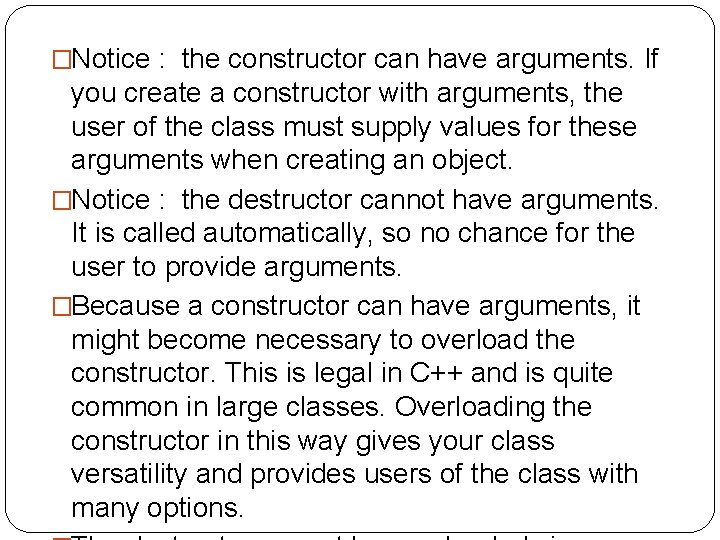
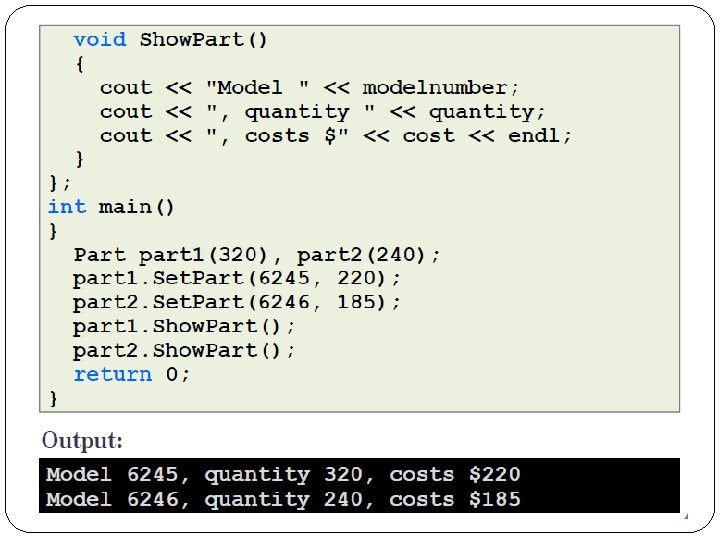
�Notice : the constructor can have arguments. If you create a constructor with arguments, the user of the class must supply values for these arguments when creating an object. �Notice : the destructor cannot have arguments. It is called automatically, so no chance for the user to provide arguments. �Because a constructor can have arguments, it might become necessary to overload the constructor. This is legal in C++ and is quite common in large classes. Overloading the constructor in this way gives your class versatility and provides users of the class with many options.
Separating Classes into Files �What are the benefit of separating classes in to files ? �Normally, to do the separation, the class declaration is placed in one file (header file), and the implementation of all the methods is put in another file. �The class declaration file is normally called Class. Name. h. �The implementation file is normally called Class. Name. cpp. �Then you include the header file in your
�However, instead of including two files (Class. Name. h and Class. Name. cpp), you have to include only Class. Name. h. � The compiler will include the. cpp file automatically �Don’t forget: the two files need to be in the same directory to achieve that).
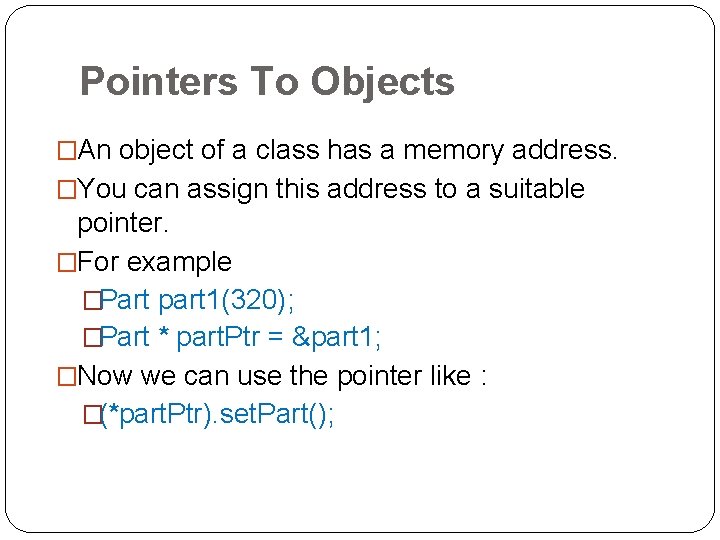
Pointers To Objects �An object of a class has a memory address. �You can assign this address to a suitable pointer. �For example �Part part 1(320); �Part * part. Ptr = &part 1; �Now we can use the pointer like : �(*part. Ptr). set. Part();
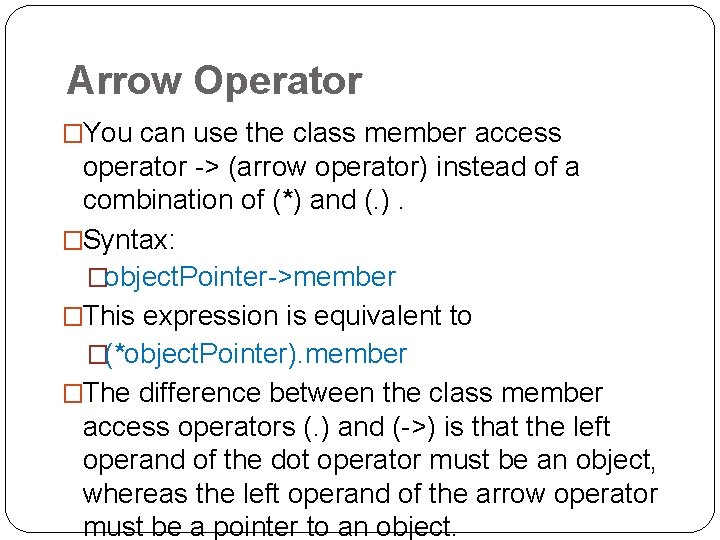
Arrow Operator �You can use the class member access operator -> (arrow operator) instead of a combination of (*) and (. ). �Syntax: �object. Pointer->member �This expression is equivalent to �(*object. Pointer). member �The difference between the class member access operators (. ) and (->) is that the left operand of the dot operator must be an object, whereas the left operand of the arrow operator must be a pointer to an object.
Any Question? �Refer to chapter 1 of the book for further reading