
Classes A Deeper Look Based on Chapter 9
Classes: A Deeper Look Based on Chapter 9 of C++ How to Program, 10/e © 1992 -2017 by Pearson Education, Inc. All Rights Reserved.
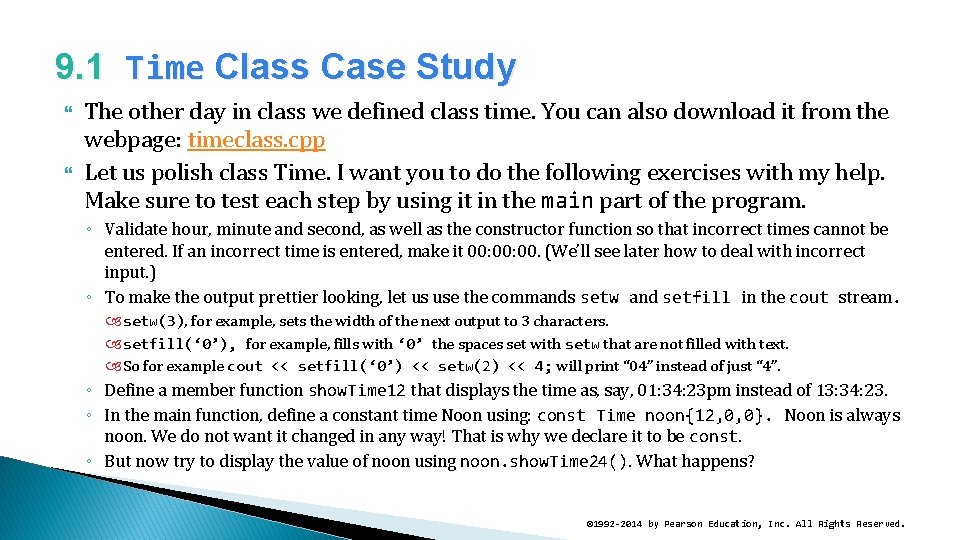
9. 1 Time Class Case Study The other day in class we defined class time. You can also download it from the webpage: timeclass. cpp Let us polish class Time. I want you to do the following exercises with my help. Make sure to test each step by using it in the main part of the program. ◦ Validate hour, minute and second, as well as the constructor function so that incorrect times cannot be entered. If an incorrect time is entered, make it 00: 00. (We’ll see later how to deal with incorrect input. ) ◦ To make the output prettier looking, let us use the commands setw and setfill in the cout stream. setw(3), for example, sets the width of the next output to 3 characters. setfill(‘ 0’), for example, fills with ‘ 0’ the spaces set with setw that are not filled with text. So for example cout << setfill(‘ 0’) << setw(2) << 4; will print “ 04” instead of just “ 4”. ◦ Define a member function show. Time 12 that displays the time as, say, 01: 34: 23 pm instead of 13: 34: 23. ◦ In the main function, define a constant time Noon using: const Time noon{12, 0, 0}. Noon is always noon. We do not want it changed in any way! That is why we declare it to be const. ◦ But now try to display the value of noon using noon. show. Time 24(). What happens? © 1992 -2014 by Pearson Education, Inc. All Rights Reserved.
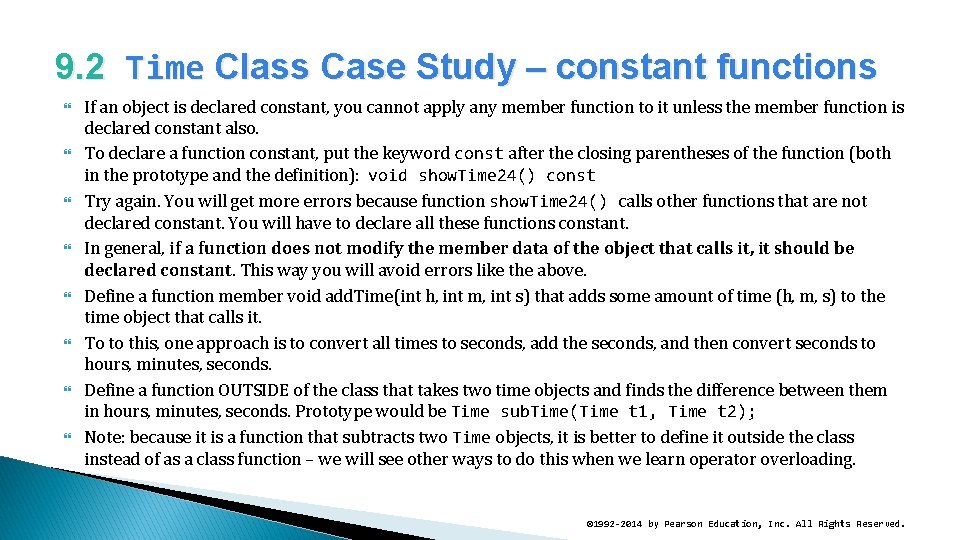
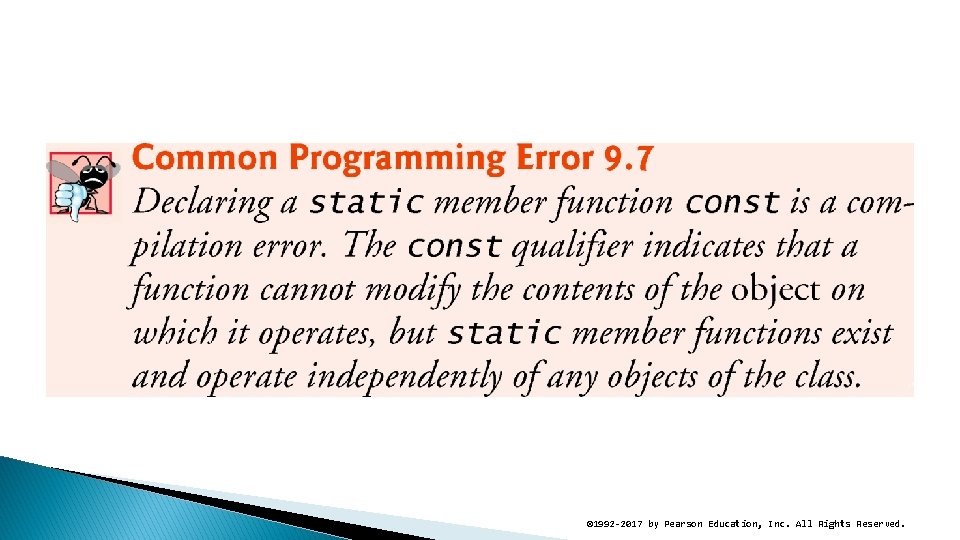
9. 2 Time Class Case Study – constant functions If an object is declared constant, you cannot apply any member function to it unless the member function is declared constant also. To declare a function constant, put the keyword const after the closing parentheses of the function (both in the prototype and the definition): void show. Time 24() const Try again. You will get more errors because function show. Time 24() calls other functions that are not declared constant. You will have to declare all these functions constant. In general, if a function does not modify the member data of the object that calls it, it should be declared constant. This way you will avoid errors like the above. Define a function member void add. Time(int h, int m, int s) that adds some amount of time (h, m, s) to the time object that calls it. To to this, one approach is to convert all times to seconds, add the seconds, and then convert seconds to hours, minutes, seconds. Define a function OUTSIDE of the class that takes two time objects and finds the difference between them in hours, minutes, seconds. Prototype would be Time sub. Time(Time t 1, Time t 2); Note: because it is a function that subtracts two Time objects, it is better to define it outside the class instead of as a class function – we will see other ways to do this when we learn operator overloading. © 1992 -2014 by Pearson Education, Inc. All Rights Reserved.

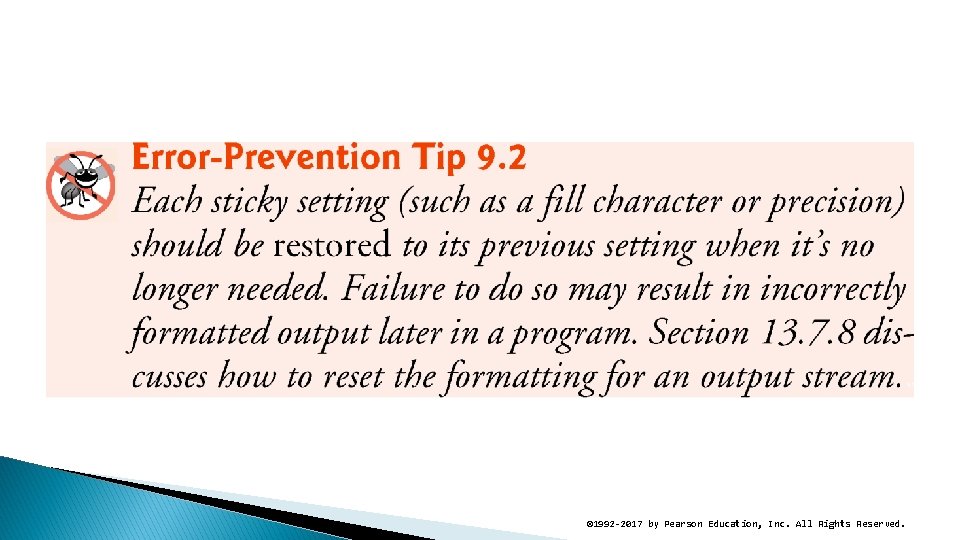
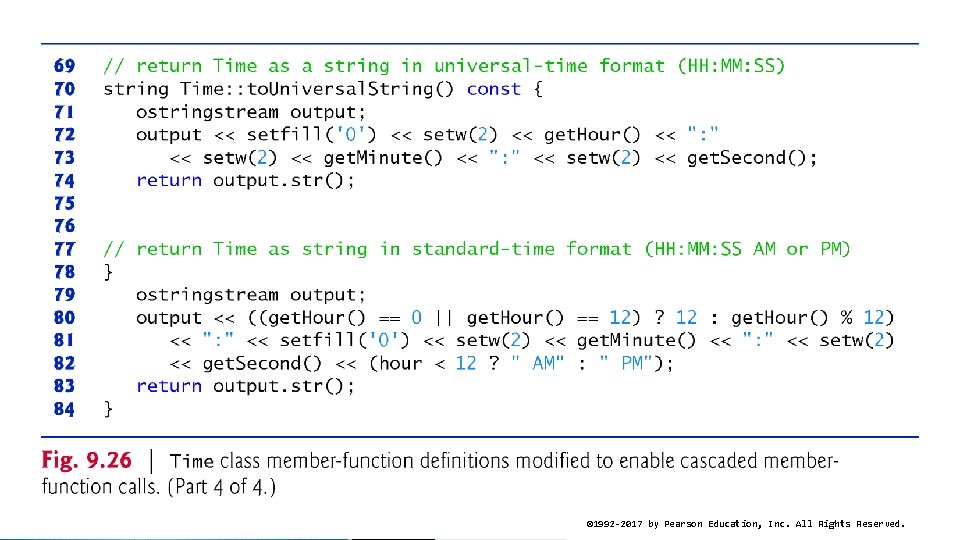
9. 3 setfill and setw Parameterized stream manipulator setfill specifies the fill character that’s displayed when an integer is output in a field wider than the number of digits in the value ◦ fill characters appear to the left of the digits in the number, because the number is right aligned by default ◦ for left-aligned values (specified with the left stream manipulator) the fill characters would appear to the right If the minute value is 2, it will be displayed as 02, because the fill character is set to zero ('0') If the number being output fills the specified field, the fill character will not be displayed Once the fill character is specified with setfill, it applies for all subsequent values that are displayed in fields wider than the value being displayed ◦ setfill is a sticky setting This is in contrast to setw, which applies only to the next value displayed ◦ setw is a nonsticky setting © 1992 -2014 by Pearson Education, Inc. All Rights Reserved.
© 1992 -2017 by Pearson Education, Inc. All Rights Reserved.
© 1992 -2017 by Pearson Education, Inc. All Rights Reserved.
© 1992 -2017 by Pearson Education, Inc. All Rights Reserved.
© 1992 -2017 by Pearson Education, Inc. All Rights Reserved.
9. 4 Evaluating member functions on objects, references to objects, and pointers to objects. Time can be used as a type in object, array, pointer and reference declarations as follows. Define the following objects in main: ◦ Time sunset; // object of type Time ◦ array< Time, 5 > array. Of. Times; // array of 5 Time objects ◦ Time &dinner. Time = sunset; // reference to a Time object ◦ Time *time. Ptr = &dinner. Time; // pointer to a Time object As you know, using a member function on an object is done via the. operator: for object sunset it would be sunset. show. Time 24() Same thing applies to references to Time objects. However, for pointers to objects one needs to use the -> operator instead: use time. Ptr->show. Time(24); © 1992 -2014 by Pearson Education, Inc. All Rights Reserved.
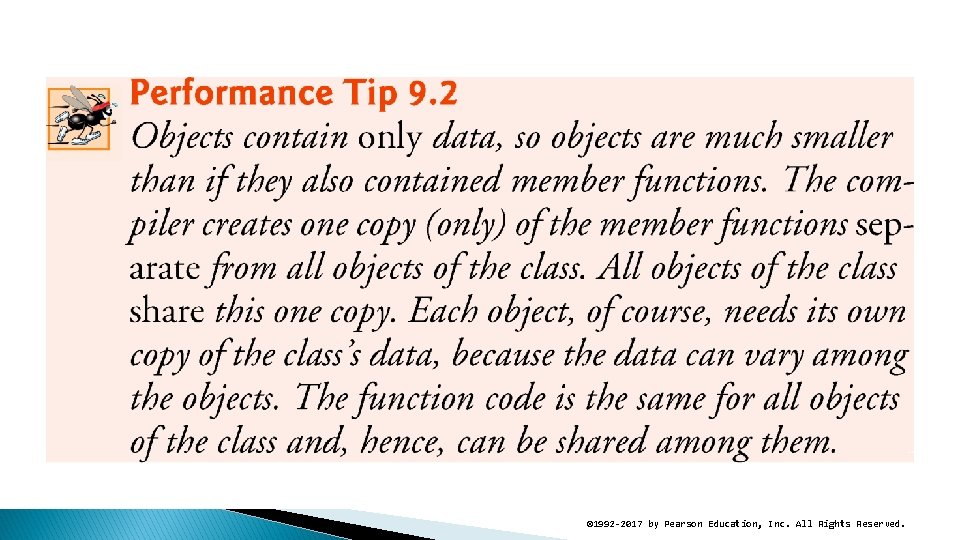
9. 5 Object Size People new to object-oriented programming often suppose that objects must be quite large because they contain data members and member functions. Logically, this is true—you may think of objects as containing data and functions (and our discussion has certainly encouraged this view); physically, however, this is not true. © 1992 -2014 by Pearson Education, Inc. All Rights Reserved.
© 1992 -2017 by Pearson Education, Inc. All Rights Reserved.
9. 6 Class Scope and Accessing Class Members A class’s data members and member functions belong to that class’s scope. Nonmember functions are defined at global namespace scope, by default. Within a class’s scope, class members are immediately accessible by all of that class’s member functions and can be referenced by name. Outside a class’s scope, public class members are referenced through one of the handles on an object—an object name, a reference to an object or a pointer to an object. © 1992 -2014 by Pearson Education, Inc. All Rights Reserved.
9. 7 Access Functions and Utility Functions Access Functions Access functions can read or display data, but not modify it. A common use for access functions is to test the truth or falsity of conditions—such functions are often called predicate functions. Utility Functions A utility function (also called a helper function) is a private member function that supports the operation of the class’s other member functions. For example, in our definition of add. Time we had to convert times to seconds. We could write a function that does that and is only used by the other function members, and then use it in the definition of add. Time. Do this: define a private member function to. Sec() with integer output that converts time to seconds. Then modify the definition of add. Time to use this function. Can we also use it in sub. Time, where we also had to convert time to seconds? © 1992 -2014 by Pearson Education, Inc. All Rights Reserved.
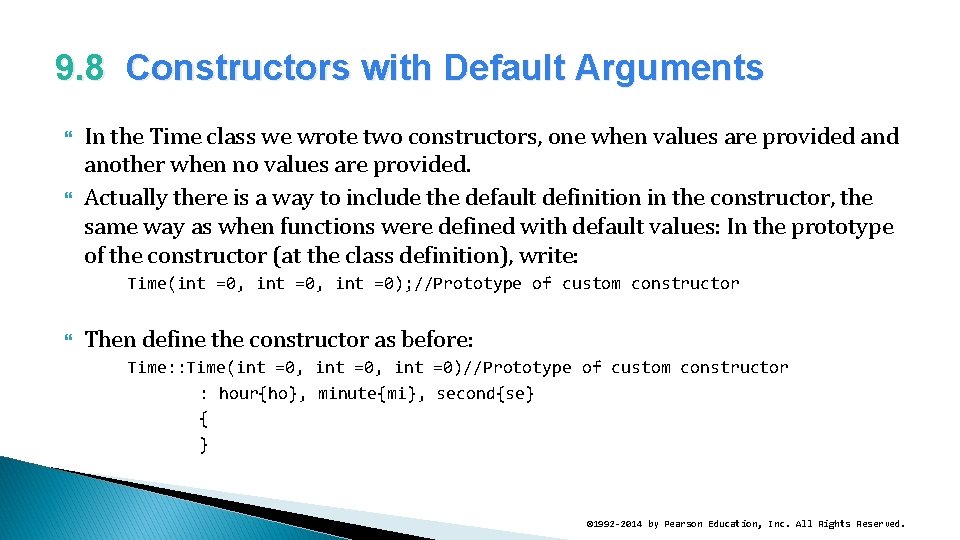
9. 8 Constructors with Default Arguments In the Time class we wrote two constructors, one when values are provided another when no values are provided. Actually there is a way to include the default definition in the constructor, the same way as when functions were defined with default values: In the prototype of the constructor (at the class definition), write: Time(int =0, int =0); //Prototype of custom constructor Then define the constructor as before: Time: : Time(int =0, int =0)//Prototype of custom constructor : hour{ho}, minute{mi}, second{se} { } © 1992 -2014 by Pearson Education, Inc. All Rights Reserved.
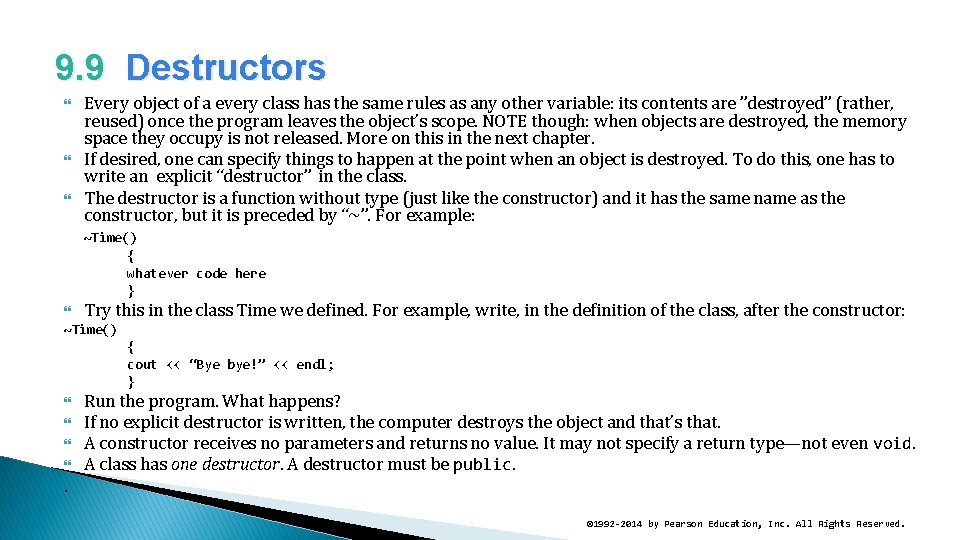
9. 9 Destructors Every object of a every class has the same rules as any other variable: its contents are ”destroyed” (rather, reused) once the program leaves the object’s scope. NOTE though: when objects are destroyed, the memory space they occupy is not released. More on this in the next chapter. If desired, one can specify things to happen at the point when an object is destroyed. To do this, one has to write an explicit “destructor” in the class. The destructor is a function without type (just like the constructor) and it has the same name as the constructor, but it is preceded by “~”. For example: ~Time() { whatever code here } Try this in the class Time we defined. For example, write, in the definition of the class, after the constructor: ~Time() { cout << “Bye bye!” << endl; } Run the program. What happens? If no explicit destructor is written, the computer destroys the object and that’s that. A constructor receives no parameters and returns no value. It may not specify a return type—not even void. A class has one destructor. A destructor must be public. . © 1992 -2014 by Pearson Education, Inc. All Rights Reserved.
9. 9 When Constructors and Destructors Are Called Constructors and destructors are called implicitly. The order in which these function calls occur depends on the order in which execution enters and leaves the scopes where the objects are instantiated. Generally, destructor calls are made in the reverse order of the corresponding constructor calls ◦ Global and static objects can alter the order in which destructors are called. © 1992 -2014 by Pearson Education, Inc. All Rights Reserved.
9. 9 Constructors and Destructors for Objects in Global Scope Constructors are called for objects defined in global scope (also called global namespace scope) before any other function (including main) in that program begins execution (although the order of execution of global object constructors between files is not guaranteed). The corresponding destructors are called when main terminates. Constructors and destructors for non-static local objects are called each time execution enters and leaves the scope of the object. © 1992 -2014 by Pearson Education, Inc. All Rights Reserved.
9. 10 Default Memberwise Assignment The assignment operator (=) can be used to assign an object to another object of the same type. By default, such assignment is performed by memberwise assignment (also called copy assignment). ◦ Each data member of the object on the right of the assignment operator is assigned individually to the same data member in the object on the left of the assignment operator. In the Time class example, define a new object Time new. Time; Then write new. Time=now; and print new. Time (which should be equal to now). Can you assign time noon to new. Time? Try! © 1992 -2014 by Pearson Education, Inc. All Rights Reserved.
9. 11 Composition: Objects as Members of Classes An Alarmclock object needs to know when it’s supposed to sound its alarm, so why not include a Time object as a member of the Alarmclock class? Such a capability is called composition (or aggregation) and is sometimes referred to as a has-a relationship—a class can have objects of other classes as members. Let us build an Alarmclock class and test it with a program! Download files timeclass 3. cpp and alarmclass 0. cpp. Alarmclass 0. cpp has the skeleton of an alarm clock class. Let us fill it in! © 1992 -2014 by Pearson Education, Inc. All Rights Reserved.
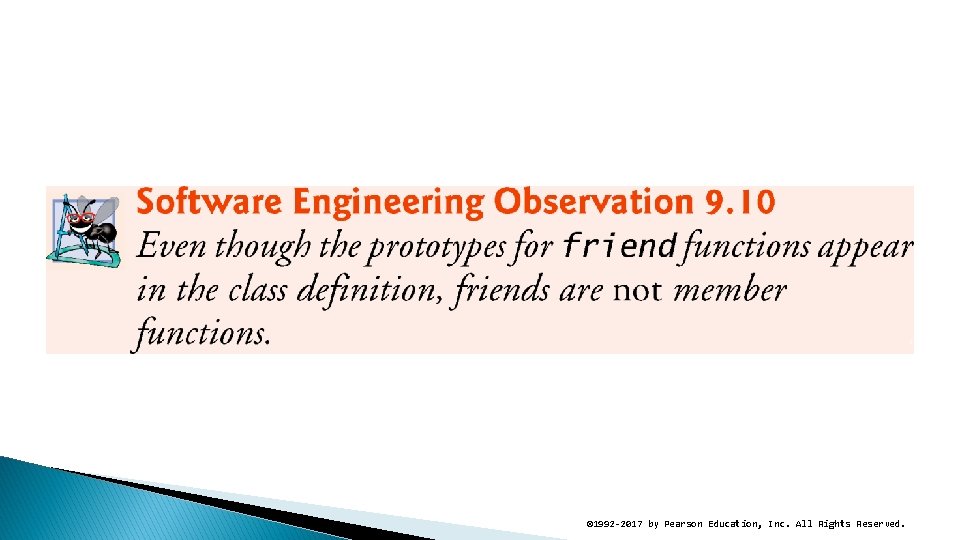
9. 12 friend Functions and friend Classes A friend function of a class is a non-member function that has the right to access the public and nonpublic class members. Standalone functions, entire classes or member functions of other classes may be declared to be friends of another class. © 1992 -2014 by Pearson Education, Inc. All Rights Reserved.
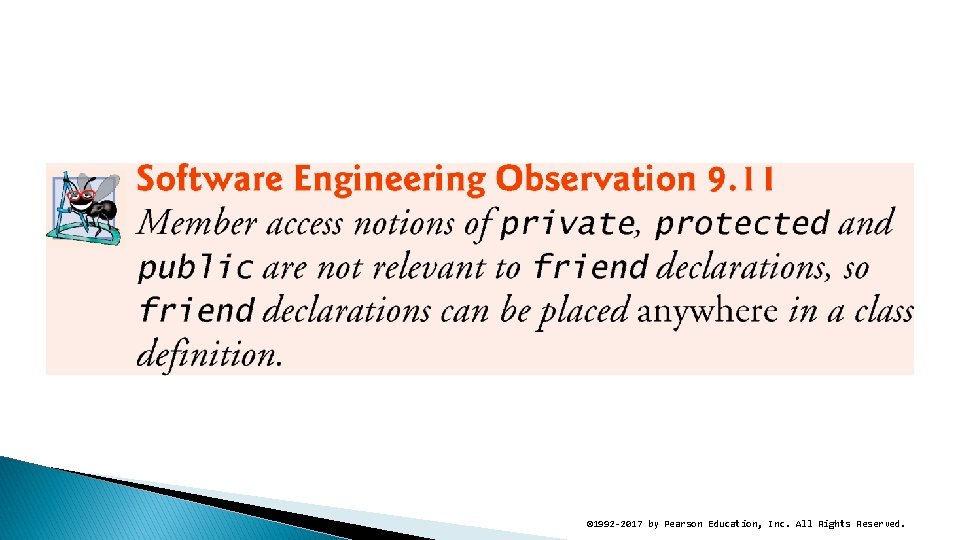
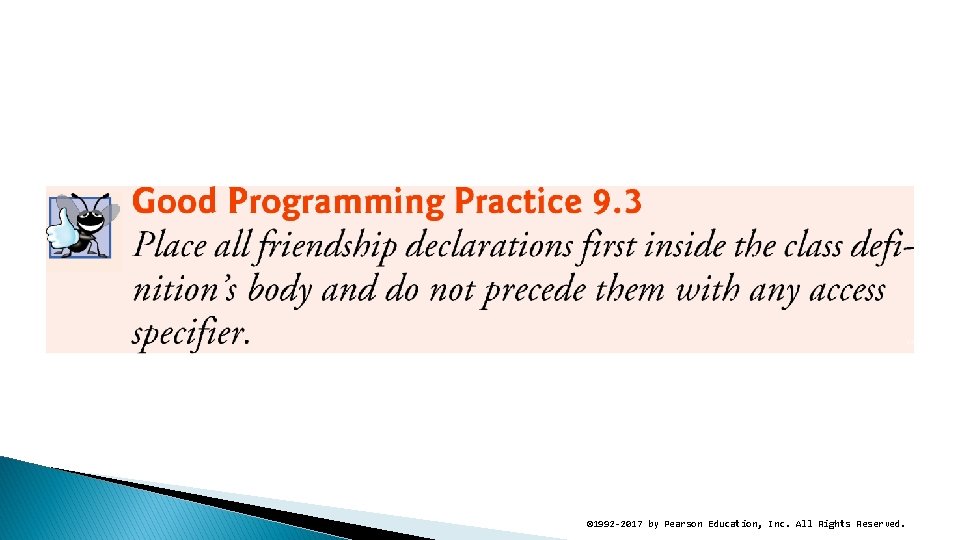
9. 12 friend Functions and friend Classes (cont. ) Declaring a friend To declare a non-member function as a friend of a class, place the function prototype in the class definition and precede it with keyword friend. To declare all member functions of class Class. Two as friends of class Class. One, place a declaration of the form friend class Class. Two; in the definition of class Class. One. The friend declaration(s) can appear anywhere in a class and are not affected by access specifiers public or private (or protected, which we discuss in Chapter 11). © 1992 -2014 by Pearson Education, Inc. All Rights Reserved.
9. 13 friend Functions and friend Classes (cont. ) Declaring a friend Friendship is granted, not taken—for class B to be a friend of class A, class A must explicitly declare that class B is its friend. Friendship is not symmetric—if class A is a friend of class B, you cannot infer that class B is a friend of class A. Friendship is not transitive—if class A is a friend of class B and class B is a friend of class C, you cannot infer that class A is a friend of class C. © 1992 -2014 by Pearson Education, Inc. All Rights Reserved.
9. 13 friend Functions and friend Classes (cont. ) For the Time class, we defined add. Time as a member function. It added 3 integers to a Time object. Now let us define it different: let us add two Time objects and return a Time object. However, it is weird to write Time 1. add. Time(Time 2); when one wants to do Time 1 + Time 2. It would make more sense to write add. Time(Time 1, Time 2); We can use the same name add. Time because the arguments will be different: we defined: ◦ void add. Time(int, int); Now we want ◦ Time add. Time(Time, Time); Because it receives different arguments, there is no confusion if we use the same name for both functions. Do this in your timeclass. cpp file! If you do not have it, you can find the latest version here. Essentially we copy what we did before. But it has to be defined outside of the class, because it is NOT a class function. But in order to use the private members of Time, we need to declare the function friend. © 1992 -2014 by Pearson Education, Inc. All Rights Reserved.
9. 13 friend Functions and friend Classes (cont. ) Overloaded friend Functions It’s possible to specify overloaded functions as friends of a class. Each function intended to be a friend must be explicitly declared in the class definition as a friend of the class. © 1992 -2014 by Pearson Education, Inc. All Rights Reserved.
© 1992 -2017 by Pearson Education, Inc. All Rights Reserved.
© 1992 -2017 by Pearson Education, Inc. All Rights Reserved.
© 1992 -2017 by Pearson Education, Inc. All Rights Reserved.
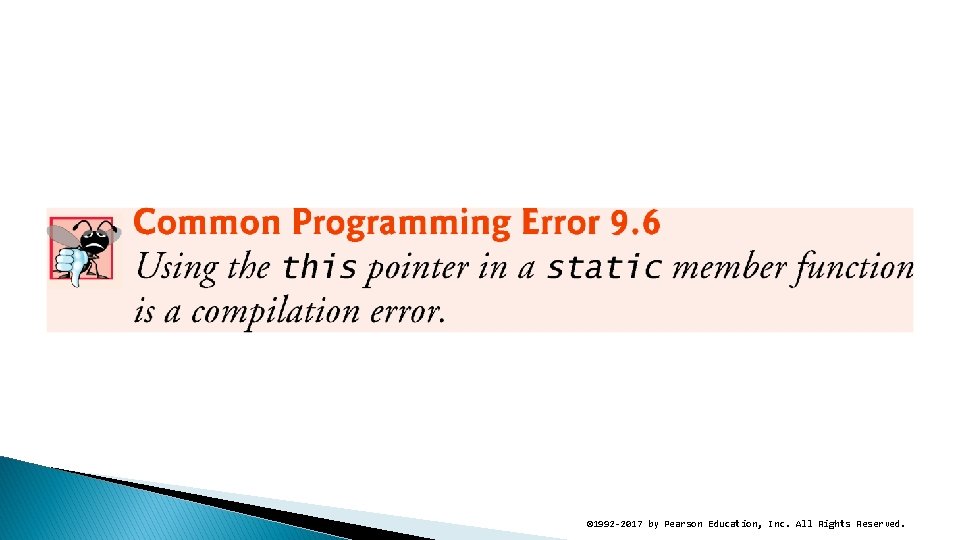
9. 14 Using the this Pointer Every object has access to its own address through a pointer called this (a C++ keyword). The this pointer is not part of the object itself—i. e. , the memory occupied by the this pointer is not reflected in the result of a sizeof operation on the object. Rather, the this pointer is passed (by the compiler) as an implicit argument to each of the object’s nonstatic member functions. © 1992 -2014 by Pearson Education, Inc. All Rights Reserved.
9. 14 Using the this Pointer (cont. ) This is how it works: say you have a Time object sunset. When you call a member function to do something on sunset (say show. Time 24()) you write sunset. show. Time 24(); Automatically the compiler knows that the data you are calling is from object sunset (not from any other). The definition of show. Time 24() is cout << setfill('0') << setw(2) << hour << ": " << setw(2) << minute << ": " << setw(2) << second << endl; Whose hour does this definition refer to? Answer: the hour of the calling object. The this pointer is a pointer to the calling object. In other words, instead of writing hour in the last definition, we could write: this->hour or (*this). hour: Try this: redefine show. Time 24() as: cout << setfill('0') << setw(2) << (*this). hour << ": " << setw(2) << this>minute << ": " << setw(2) << this->second << endl; You can see that it works exactly the same. Note: you will probably not need to use this pointer much, but it is good to know what it is. © 1992 -2014 by Pearson Education, Inc. All Rights Reserved.
9. 14 Using the this Pointer (cont. ) Member functions use this pointer implicitly or explicitly to reference an object’s data members and other member functions A common explicit use of the this pointer is to avoid naming conflicts between a class’s data members and member-function parameters (or other local variables) © 1992 -2014 by Pearson Education, Inc. All Rights Reserved.
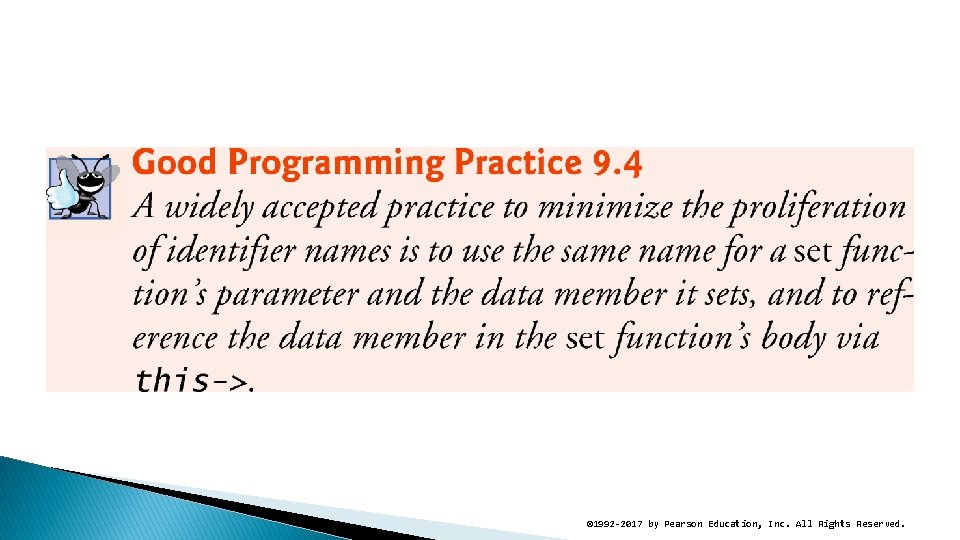
© 1992 -2017 by Pearson Education, Inc. All Rights Reserved.
9. 14 Using the this Pointer (cont. ) Type of the this Pointer The type of the this pointer depends on the type of the object and whether the member function in which this is used is declared const ◦ In a non-const member function of class Employee, the this pointer has the type Employee* const—a constant pointer to a nonconstant Employee. ◦ In a const member function, this has the type const Employee* const—a constant pointer to a constant Employee. © 1992 -2014 by Pearson Education, Inc. All Rights Reserved.
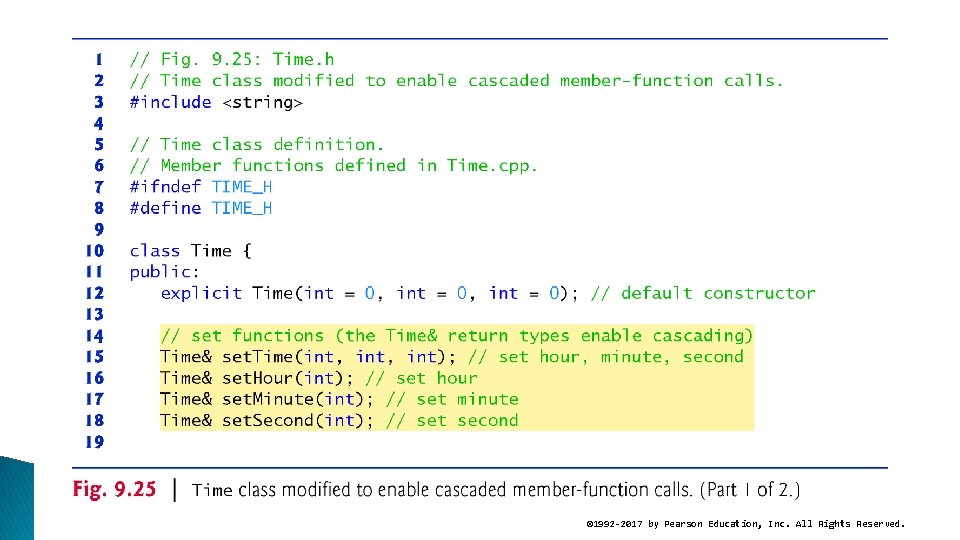
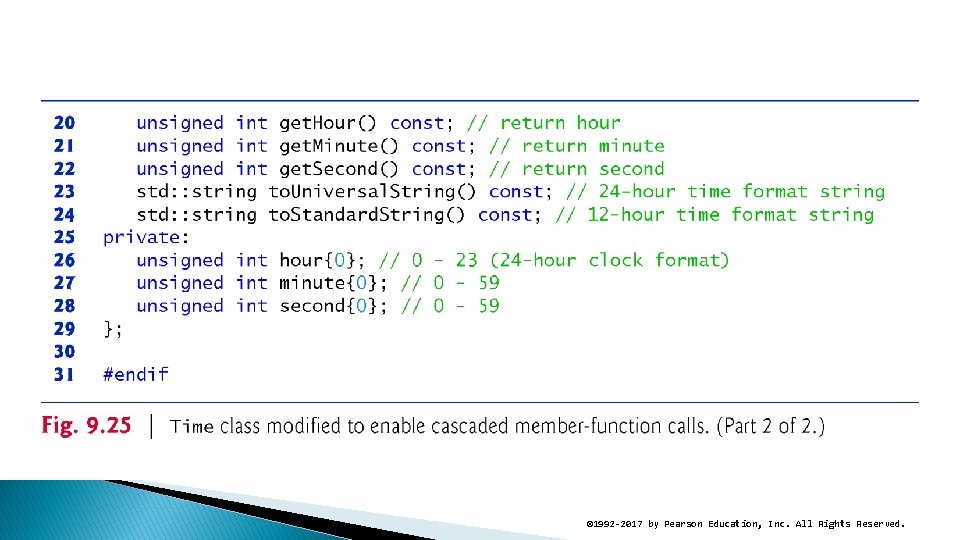
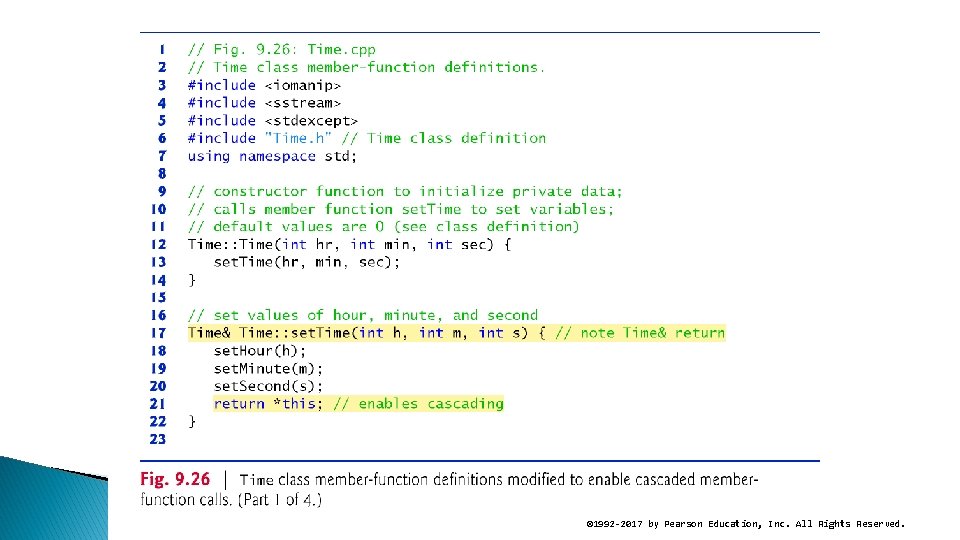
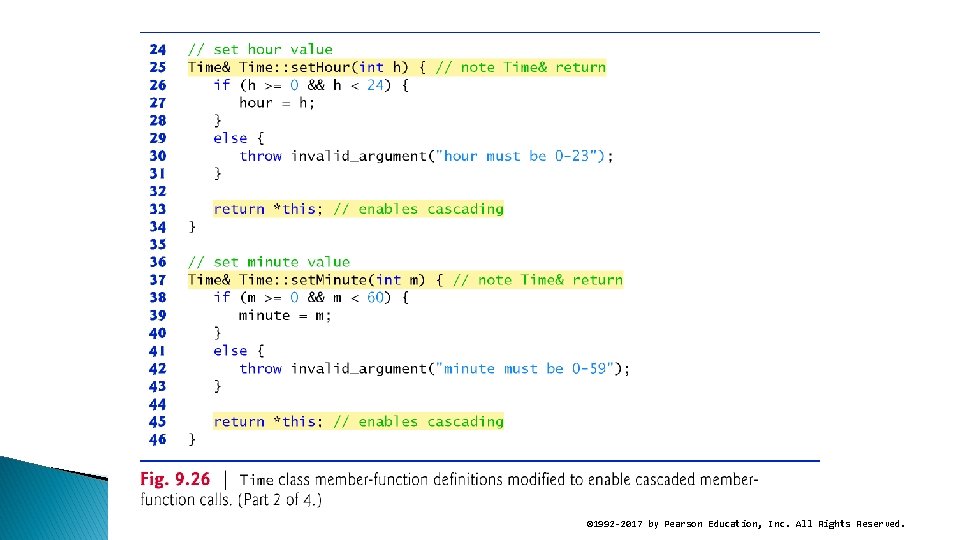
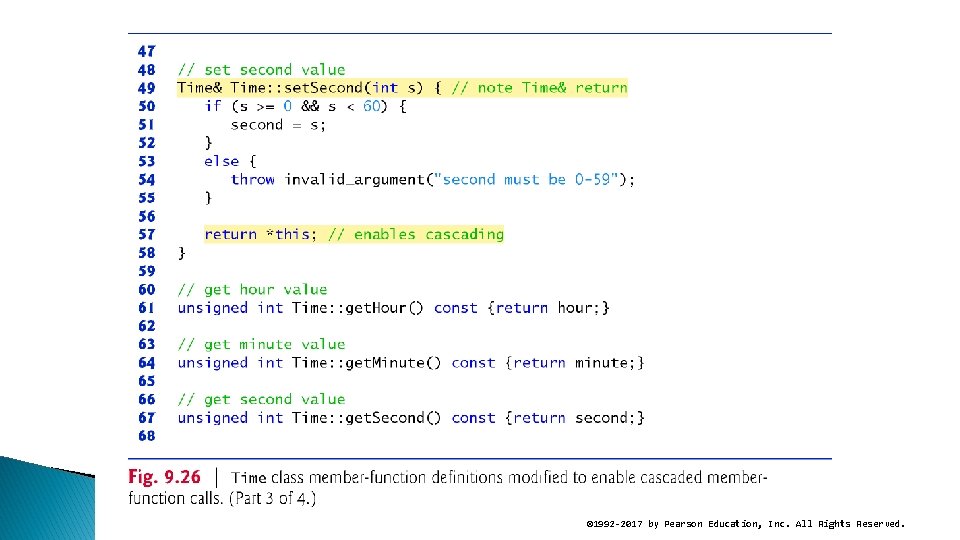
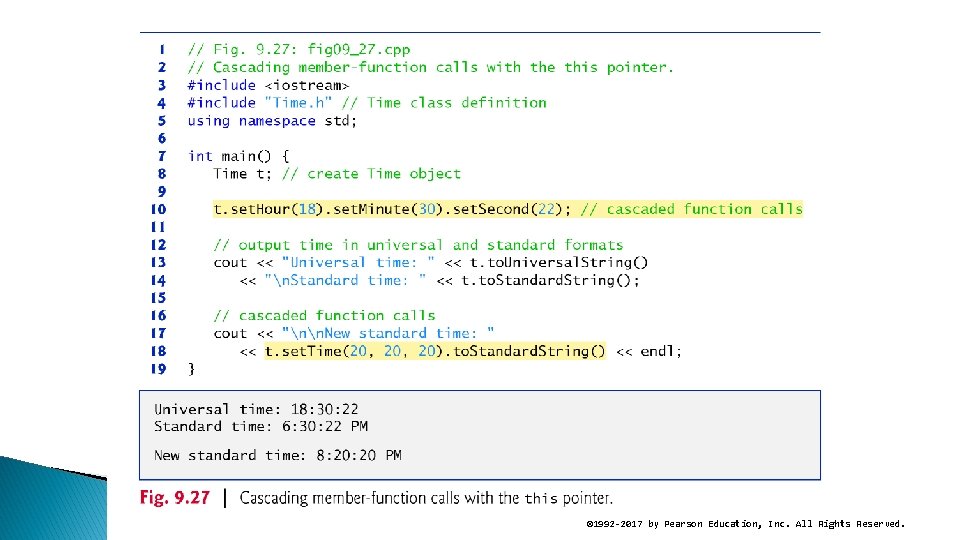
9. 14. 2 Using the this Pointer to Enable Cascaded Function Calls (READ ON YOUR OWN) Another use of the this pointer is to enable cascaded memberfunction calls—that is, invoking multiple functions sequentially in the same statement The program of Figs. 9. 25– 9. 27 modifies class Time’s set functions set. Time, set. Hour, set. Minute and set. Second such that each returns a reference to a Time object to enable cascaded memberfunction calls. The last statement in the body of each of these member functions returns * into a return type of Time &. The program of Fig. 9. 27 creates Time object t, then uses it in cascaded member-function calls © 1992 -2014 by Pearson Education, Inc. All Rights Reserved.
© 1992 -2017 by Pearson Education, Inc. All Rights Reserved.
© 1992 -2017 by Pearson Education, Inc. All Rights Reserved.
© 1992 -2017 by Pearson Education, Inc. All Rights Reserved.
© 1992 -2017 by Pearson Education, Inc. All Rights Reserved.
© 1992 -2017 by Pearson Education, Inc. All Rights Reserved.
© 1992 -2017 by Pearson Education, Inc. All Rights Reserved.
© 1992 -2017 by Pearson Education, Inc. All Rights Reserved.
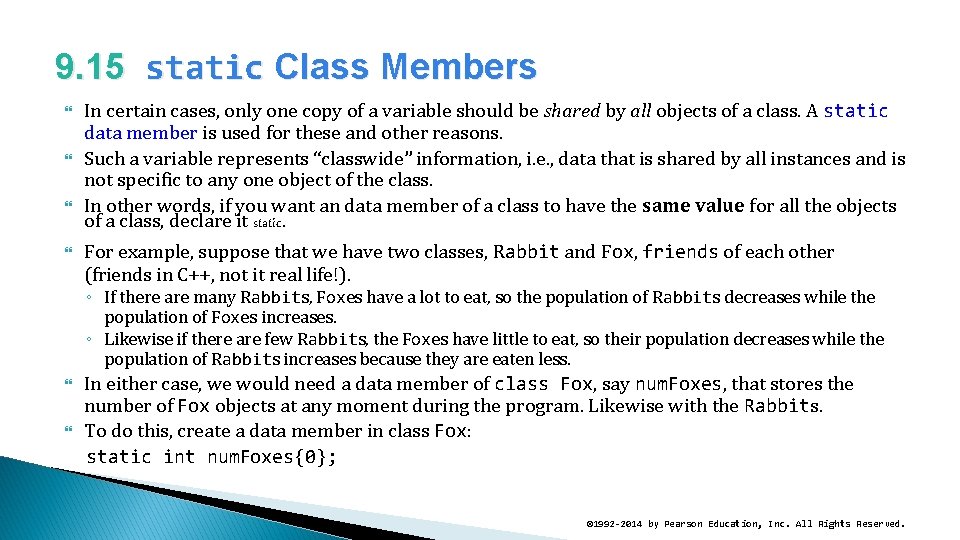
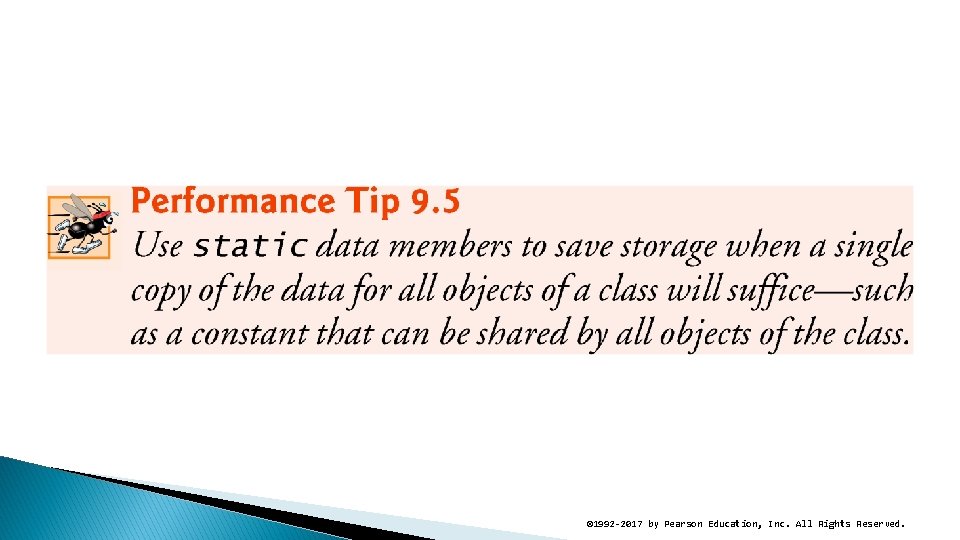
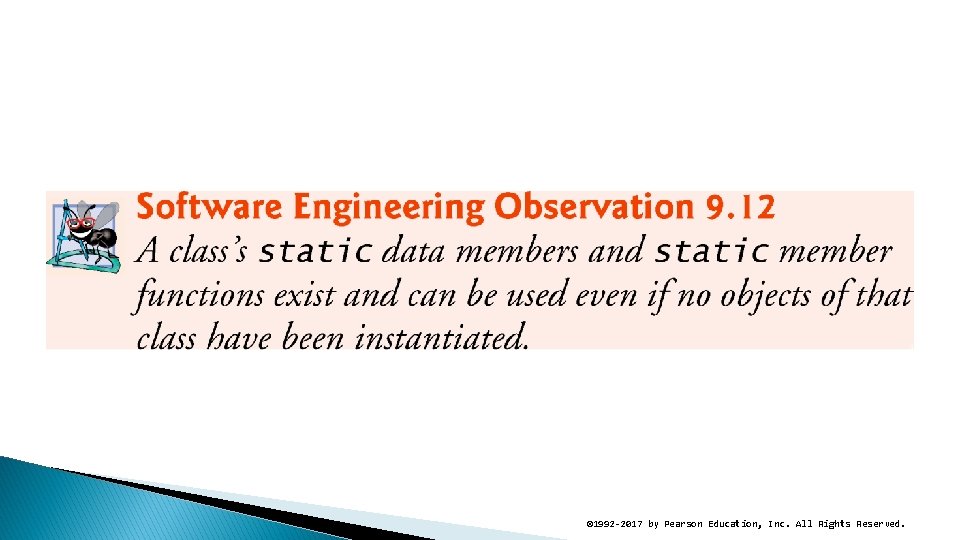
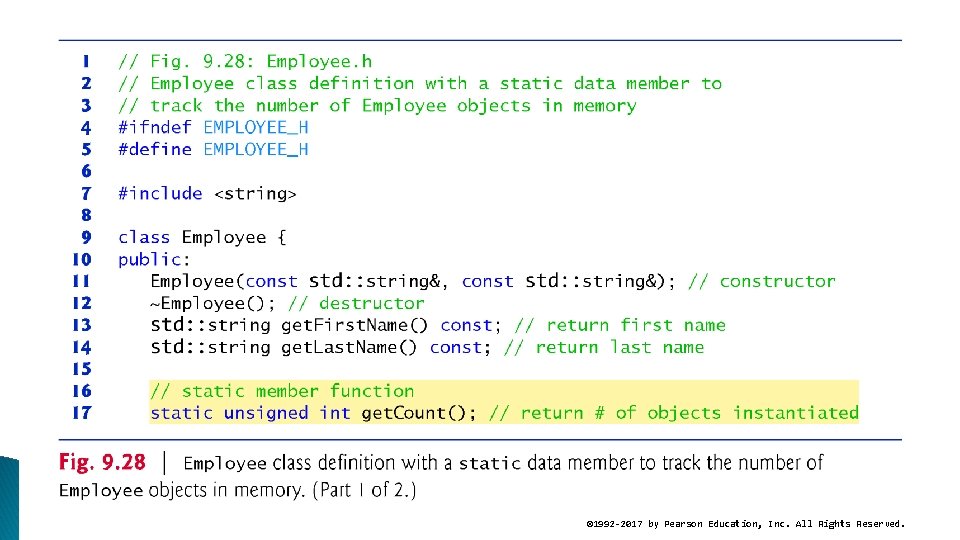
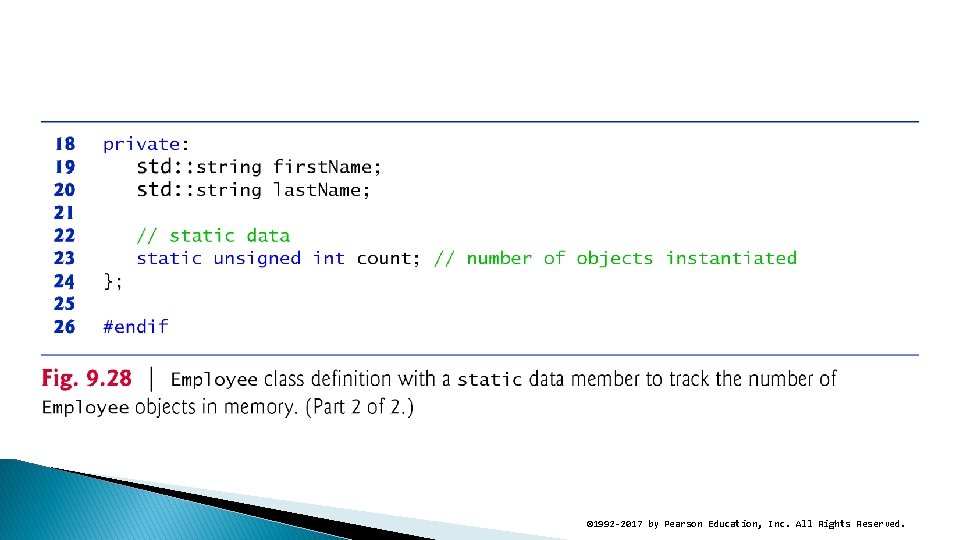
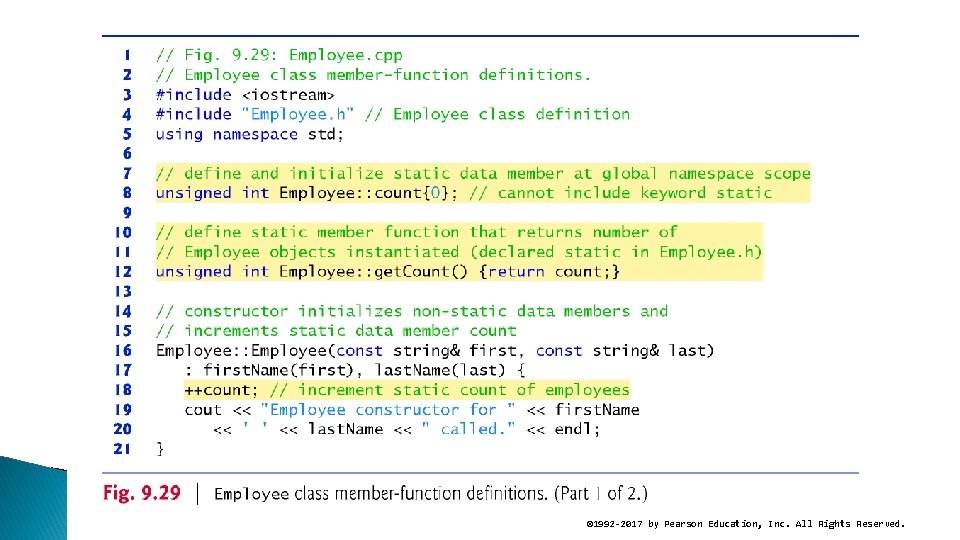
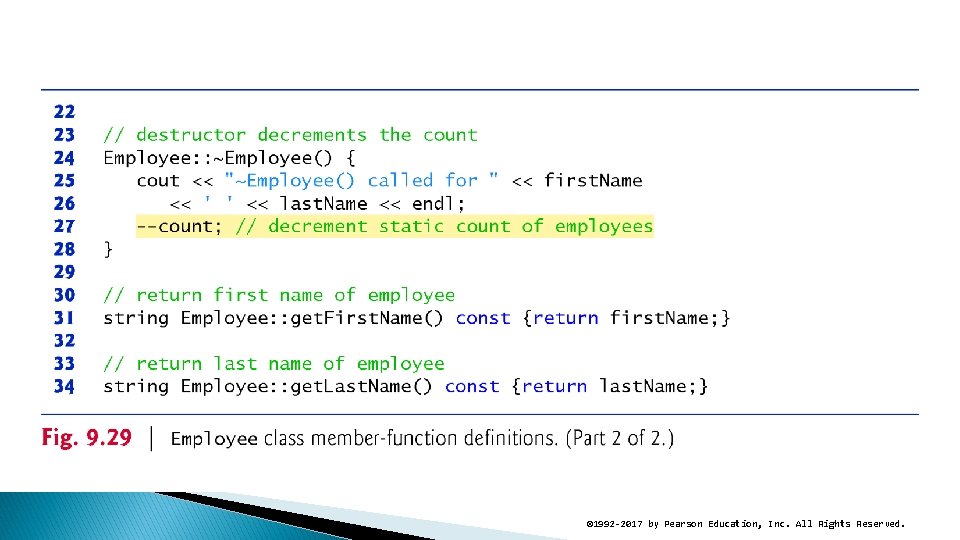
9. 15 static Class Members In certain cases, only one copy of a variable should be shared by all objects of a class. A static data member is used for these and other reasons. Such a variable represents “classwide” information, i. e. , data that is shared by all instances and is not specific to any one object of the class. In other words, if you want an data member of a class to have the same value for all the objects of a class, declare it static. For example, suppose that we have two classes, Rabbit and Fox, friends of each other (friends in C++, not it real life!). ◦ If there are many Rabbits, Foxes have a lot to eat, so the population of Rabbits decreases while the population of Foxes increases. ◦ Likewise if there are few Rabbits, the Foxes have little to eat, so their population decreases while the population of Rabbits increases because they are eaten less. In either case, we would need a data member of class Fox, say num. Foxes, that stores the number of Fox objects at any moment during the program. Likewise with the Rabbits. To do this, create a data member in class Fox: static int num. Foxes{0}; © 1992 -2014 by Pearson Education, Inc. All Rights Reserved.
9. 15 Constructors and Destructors for static Local Objects The constructor for a static local object is called only once, when execution first reaches the point where the object is defined—the corresponding destructor is called when main terminates or the program calls function exit. Global and static objects are destroyed in the reverse order of their creation. Destructors are not called for static objects if the program terminates with a call to function abort. © 1992 -2014 by Pearson Education, Inc. All Rights Reserved.
© 1992 -2017 by Pearson Education, Inc. All Rights Reserved.
9. 15. 2 Scope and Initialization of static Data Members static data members have class scope. A static data member must be initialized exactly once. Fundamental-type static data members are initialized by default to 0. In C++11’s all static const data members can have inclass initializers © 1992 -2014 by Pearson Education, Inc. All Rights Reserved.
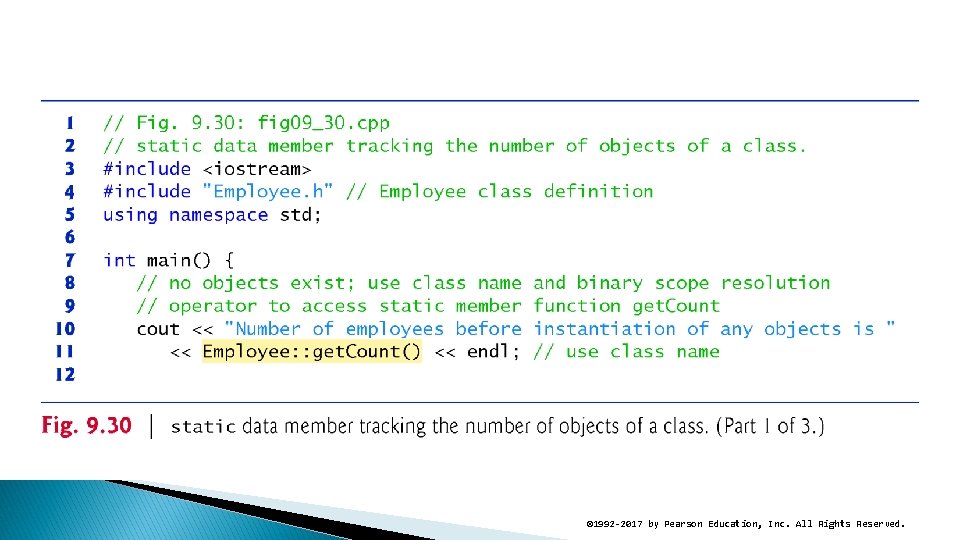
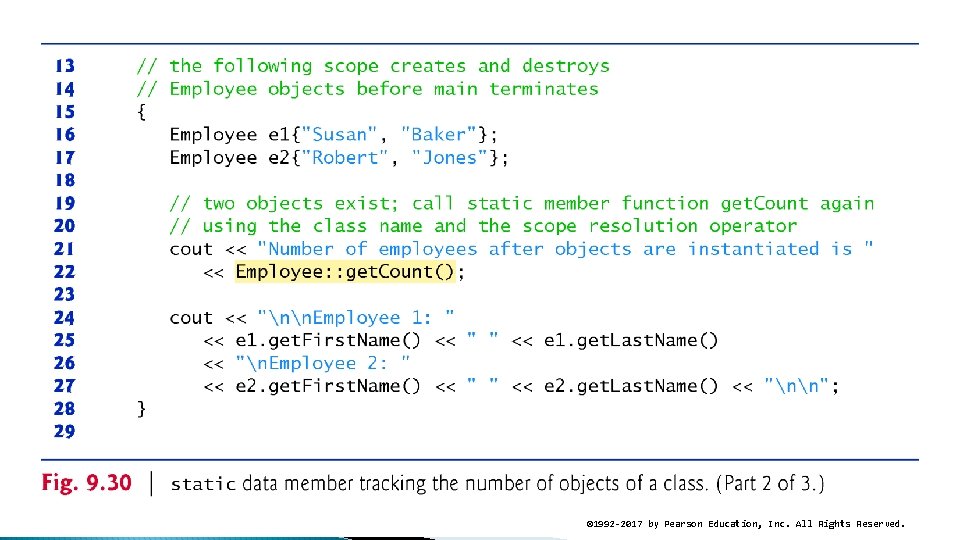
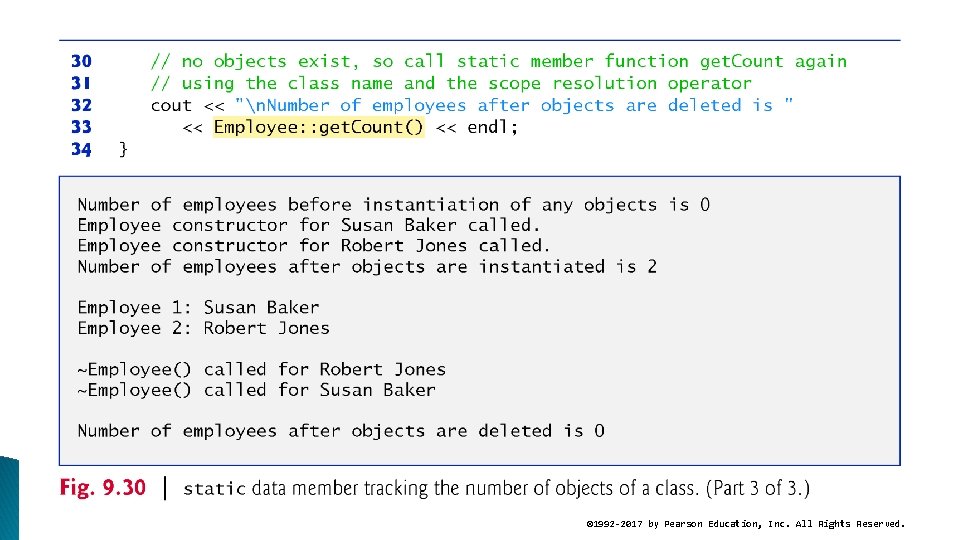
9. 15. 3 Accessing static Data Members A class’s private and protected static members are normally accessed through the class’s public member functions or friends. A class’s static members exist even when no objects of that class exist. To access a public static class member when no objects of the class exist, simply prefix the class name and the scope resolution operator (: : ) to the name of the data member. To access a private or protected static class member when no objects of the class exist, provide a public static member function and call the function by prefixing its name with the class name and scope resolution operator. A static member function is a service of the class, not of a specific object of the class. © 1992 -2014 by Pearson Education, Inc. All Rights Reserved.
© 1992 -2017 by Pearson Education, Inc. All Rights Reserved.
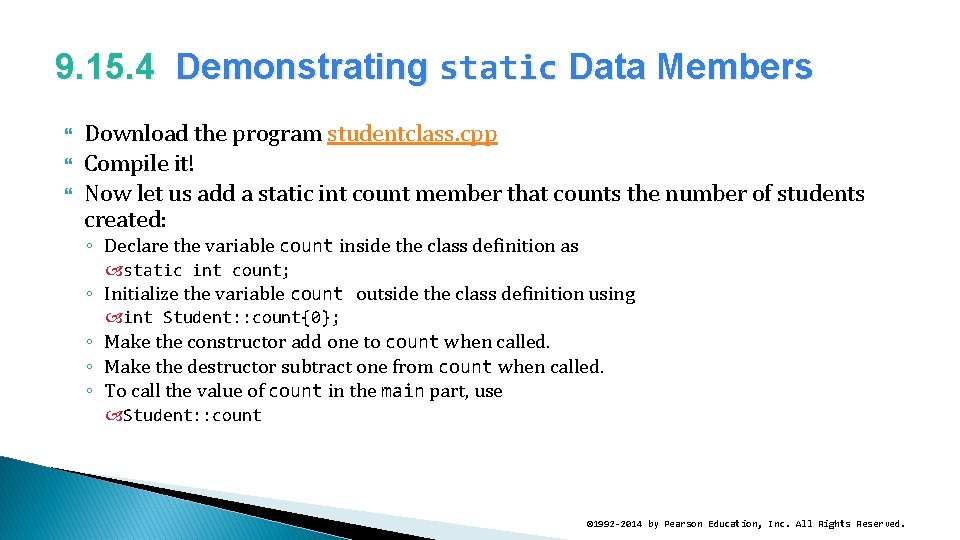
9. 15. 4 Demonstrating static Data Members Download the program studentclass. cpp Compile it! Now let us add a static int count member that counts the number of students created: ◦ Declare the variable count inside the class definition as static int count; ◦ Initialize the variable count outside the class definition using int Student: : count{0}; ◦ Make the constructor add one to count when called. ◦ Make the destructor subtract one from count when called. ◦ To call the value of count in the main part, use Student: : count © 1992 -2014 by Pearson Education, Inc. All Rights Reserved.
© 1992 -2017 by Pearson Education, Inc. All Rights Reserved.
© 1992 -2017 by Pearson Education, Inc. All Rights Reserved.
© 1992 -2017 by Pearson Education, Inc. All Rights Reserved.
© 1992 -2017 by Pearson Education, Inc. All Rights Reserved.
© 1992 -2017 by Pearson Education, Inc. All Rights Reserved.
© 1992 -2017 by Pearson Education, Inc. All Rights Reserved.
© 1992 -2017 by Pearson Education, Inc. All Rights Reserved.
© 1992 -2017 by Pearson Education, Inc. All Rights Reserved.
© 1992 -2017 by Pearson Education, Inc. All Rights Reserved.
- Slides: 56