
Classes 35 By Pius Nyaanga Momanyi Outline Variables
Classes 3/5 By Pius Nyaanga Momanyi
Outline • • • Variables and Memory References Class Type Variables Store a Reference Assignment Operator with Class Type Variables Class Parameters of a Class Type Differences Between Primitive and Class-Type Parameters Comparing Parameters of a Class Type and a Primitive Type Example: A Toy Class The Constant null The new Operator and Anonymous Objects By Pius Nyaanga Momanyi
- Variables and Memory … • A computer has two forms of memory • Secondary memory is used to hold files for "permanent" storage • Main memory is used by a computer when it is running a program – Values stored in a program's variables are kept in main memory By Pius Nyaanga Momanyi
… - Variables and Memory … • Main memory consists of a long list of numbered locations called bytes – Each byte contains eight bits: eight 0 or 1 digits • The number that identifies a byte is called its address – A data item can be stored in one (or more) of these bytes – The address of the byte is used to find the data item when needed By Pius Nyaanga Momanyi
… - Variables and Memory … • Values of most data types require more than one byte of storage – Several adjacent bytes are then used to hold the data item – The entire chunk of memory that holds the data is called its memory location – The address of the first byte of this memory location is used as the address for the data item • A computer's main memory can be thought of as a long list of memory locations of varying sizes By Pius Nyaanga Momanyi

… - Variables in Memory By Pius Nyaanga Momanyi
- References … • Every variable is implemented as a location in computer memory • When the variable is a primitive type, the value of the variable is stored in the memory location assigned to the variable – Each primitive type always require the same amount of memory to store its values By Pius Nyaanga Momanyi
… - References … • When the variable is a class type, only the memory address (or reference) where its object is located is stored in the memory location assigned to the variable – The object named by the variable is stored in some other location in memory – Like primitives, the value of a class variable is a fixed size – Unlike primitives, the value of a class variable is a memory address or reference – The object, whose address is stored in the variable, can be of any size By Pius Nyaanga Momanyi

… - References • Two reference variables can contain the same reference, and therefore name the same object – The assignment operator sets the reference (memory address) of one class type variable equal to that of another – Any change to the object named by one of theses variables will produce a change to the object named by the other variable, since they are the same object variable 2 = variable 1; By Pius Nyaanga Momanyi
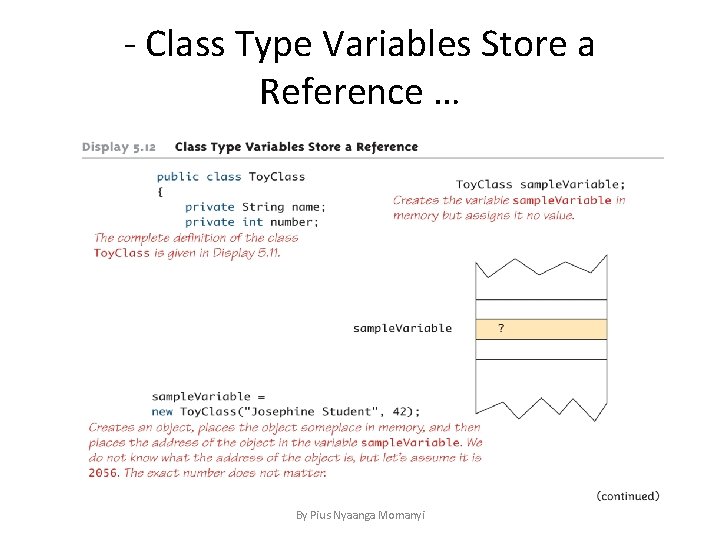
- Class Type Variables Store a Reference … By Pius Nyaanga Momanyi
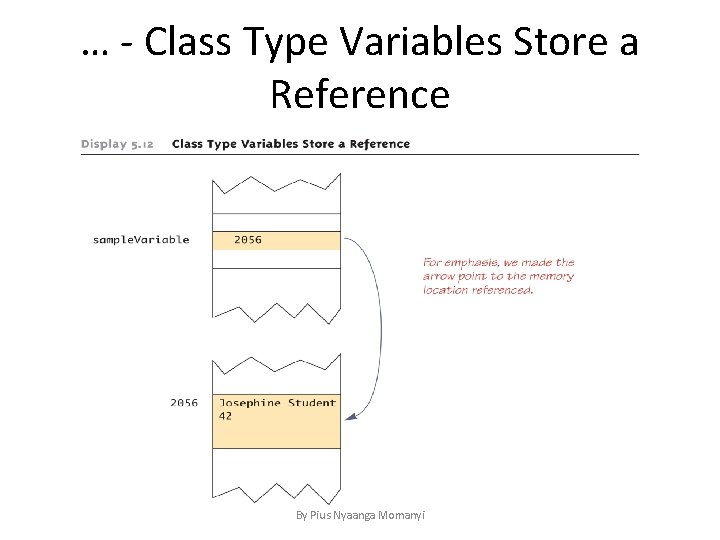
… - Class Type Variables Store a Reference By Pius Nyaanga Momanyi
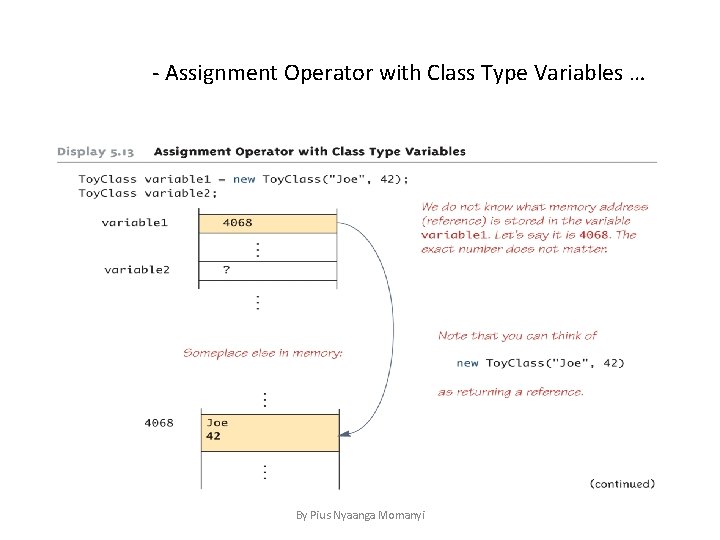
- Assignment Operator with Class Type Variables … By Pius Nyaanga Momanyi
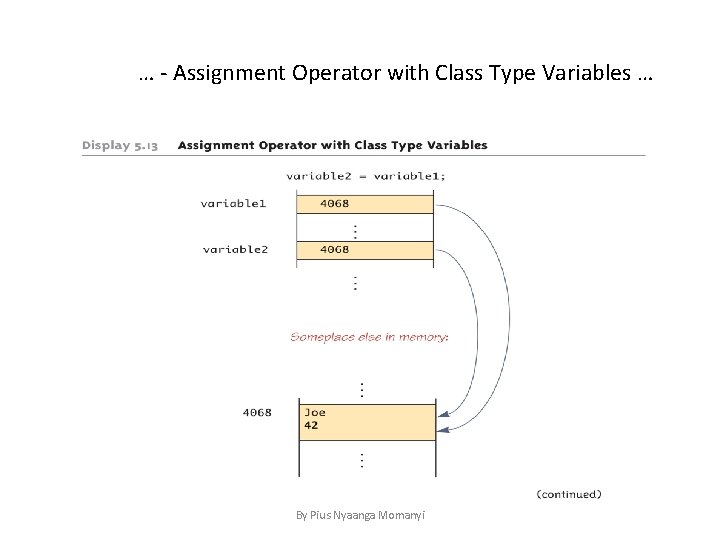
… - Assignment Operator with Class Type Variables … By Pius Nyaanga Momanyi
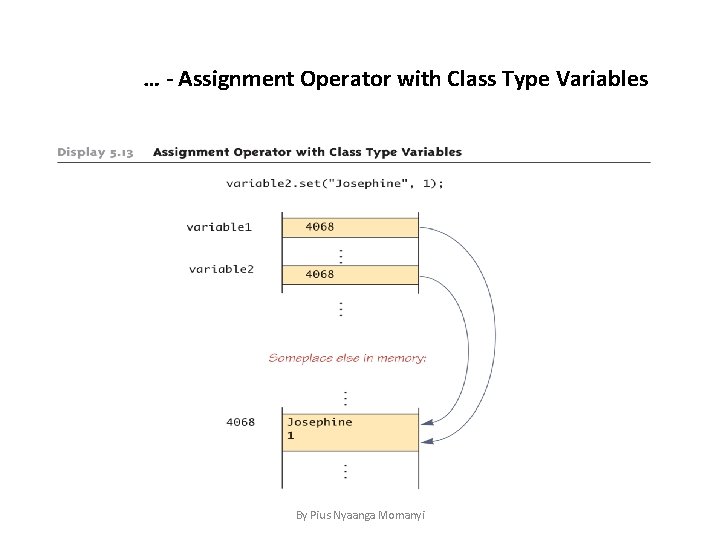
… - Assignment Operator with Class Type Variables By Pius Nyaanga Momanyi
- Class Parameters … • All parameters in Java are call-by-value parameters – A parameter is a local variable that is set equal to the value of its argument – Therefore, any change to the value of the parameter cannot change the value of its argument • Class type parameters appear to behave differently from primitive type parameters – They appear to behave in a way similar to parameters in languages that have the call-by -reference parameter passing mechanism By Pius Nyaanga Momanyi
… - Class Parameters • The value plugged into a class type parameter is a reference (memory address) – Therefore, the parameter becomes another name for the argument – Any change made to the object named by the parameter (i. e. , changes made to the values of its instance variables) will be made to the object named by the argument, because they are the same object – Note that, because it still is a call-by-value parameter, any change made to the class type parameter itself (i. e. , its address) will not By Pius Nyaanga Momanyi change its argument (the reference or memory
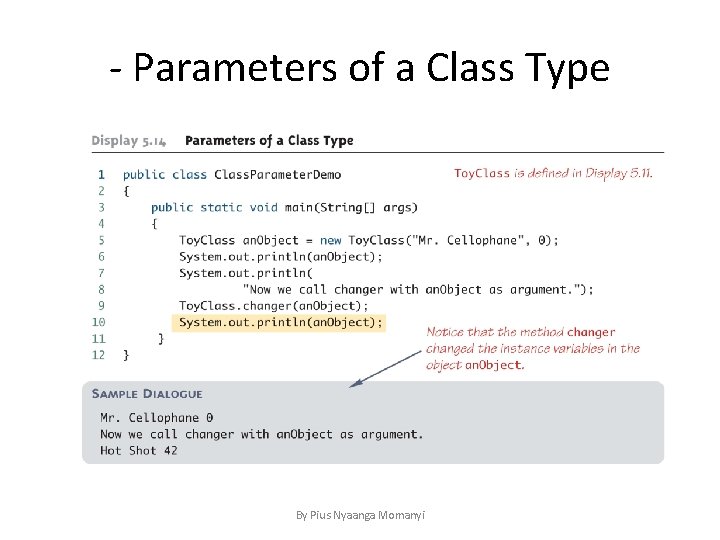
- Parameters of a Class Type By Pius Nyaanga Momanyi
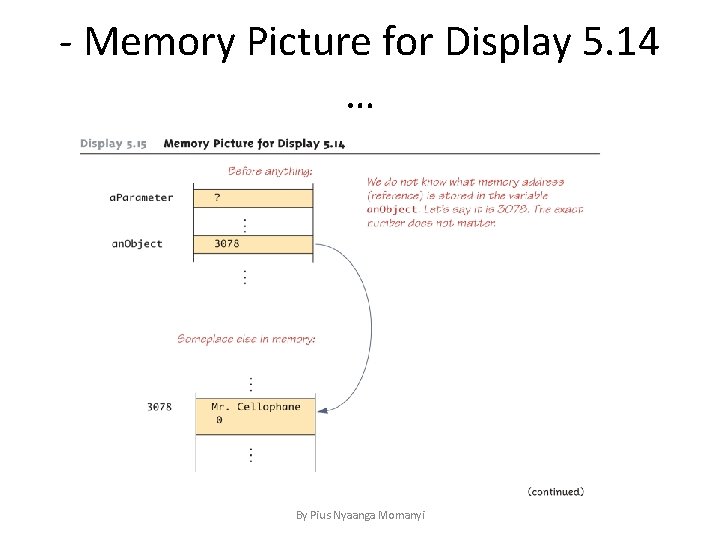
- Memory Picture for Display 5. 14 … By Pius Nyaanga Momanyi
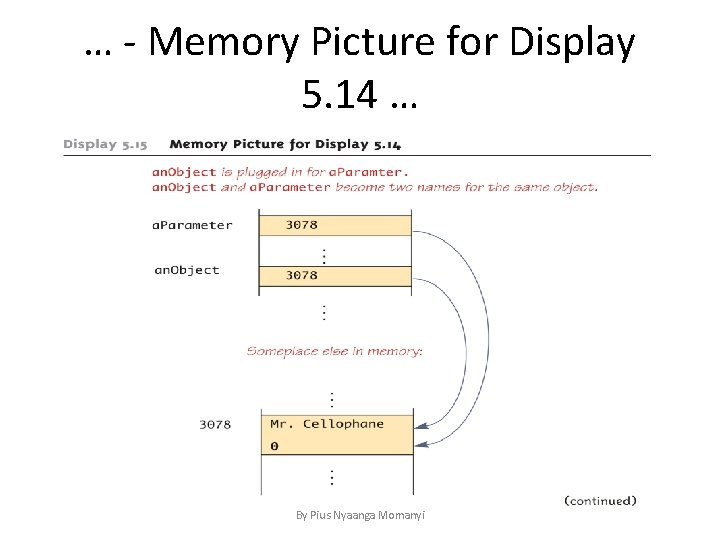
… - Memory Picture for Display 5. 14 … By Pius Nyaanga Momanyi
… - Memory Picture for Display 5. 14 By Pius Nyaanga Momanyi
- Differences Between Primitive and Class-Type Parameters • A method cannot change the value of a variable of a primitive type that is an argument to the method • In contrast, a method can change the values of the instance variables of a class type that is an argument to the method By Pius Nyaanga Momanyi
- Comparing Parameters of a Class Type and a Primitive Type … By Pius Nyaanga Momanyi
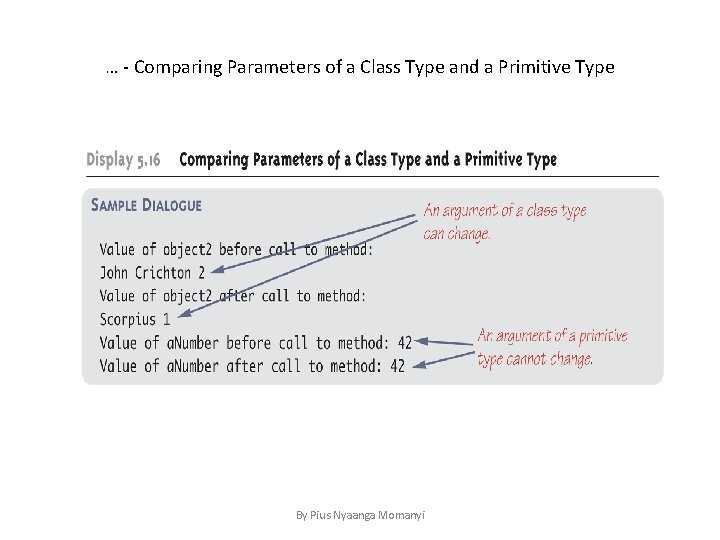
… - Comparing Parameters of a Class Type and a Primitive Type By Pius Nyaanga Momanyi
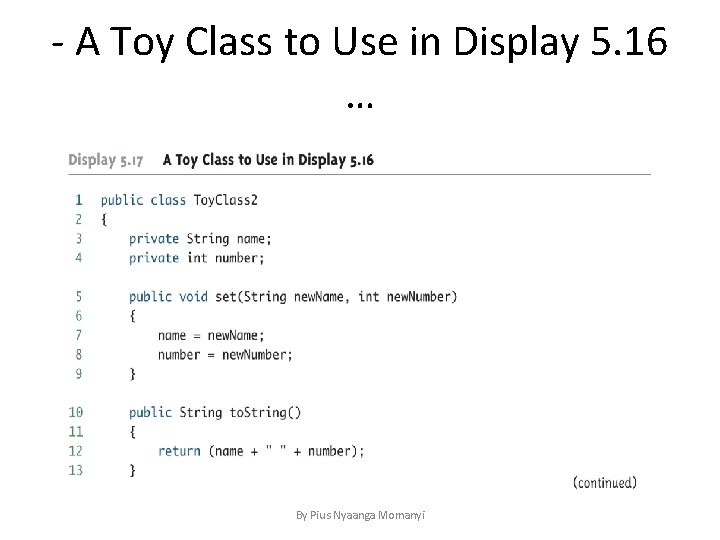
- A Toy Class to Use in Display 5. 16 … By Pius Nyaanga Momanyi
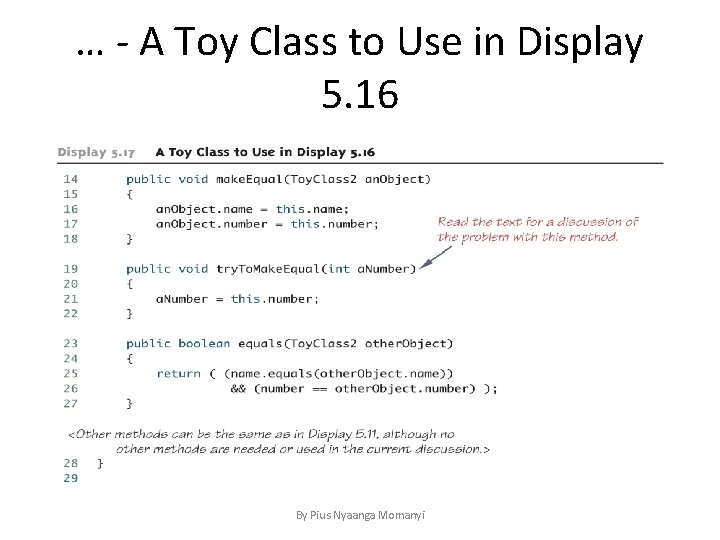
… - A Toy Class to Use in Display 5. 16 By Pius Nyaanga Momanyi
Pitfall: Use of = and == with Variables of a Class Type • Used with variables of a class type, the assignment operator (=) produces two variables that name the same object – This is very different from how it behaves with primitive type variables • The test for equality (==) also behaves differently for class type variables – The == operator only checks that two class type variables have the same memory address – Unlike the equals method, it does not check that their instance variables have the same values – Two objects in two different locations whose By Pius Nyaanga Momanyi instance variables have exactly the same values
- The Constant null • null is a special constant that may be assigned to a variable of any class type Your. Class your. Object = null; • It is used to indicate that the variable has no "real value“ – It is often used in constructors to initialize class type instance variables when there is no obvious object to use • null is not an object: It is, rather, a kind of "placeholder" for a reference that does not name any memory location – Because it is like a memory address, use == or != (instead of equals) to test if a class variable contains null By Pius Nyaanga Momanyi
Pitfall: Null Pointer Exception • Even though a class variable can be initialized to null, this does not mean that null is an object – null is only a placeholder for an object • A method cannot be invoked using a variable that is initialized to null – The calling object that must invoke a method does not exist • Any attempt to do this will result in a "Null Pointer Exception" error message – For example, if the class variable has not been By Pius Nyaanga Momanyi initialized at all (and is not assigned to null),
- The new Operator and Anonymous Objects • The new operator invokes a constructor which initializes an object, and returns a reference to the location in memory of the object created – This reference can be assigned to a variable of the object's class type • Sometimes the object created is used as an argument to a method, and never used again – In this case, the object need not be assigned to a variable, i. e. , given a name • An object whose reference is not assigned to a variable is called an anonymous object By Pius Nyaanga Momanyi

THE END By Pius Nyaanga Momanyi
- Slides: 30