
Class VIII Mathematics Chapter 7 Cubes and Cube
Class VIII – Mathematics Chapter – 7 Cubes and Cube Roots Module 1 of 3 Prepared by Atomic Energy Education Society/Distance Learning Programme/2020 Sumithra Madathil TGT(Maths/Physics) A E C S – 2 , Mumbai 1
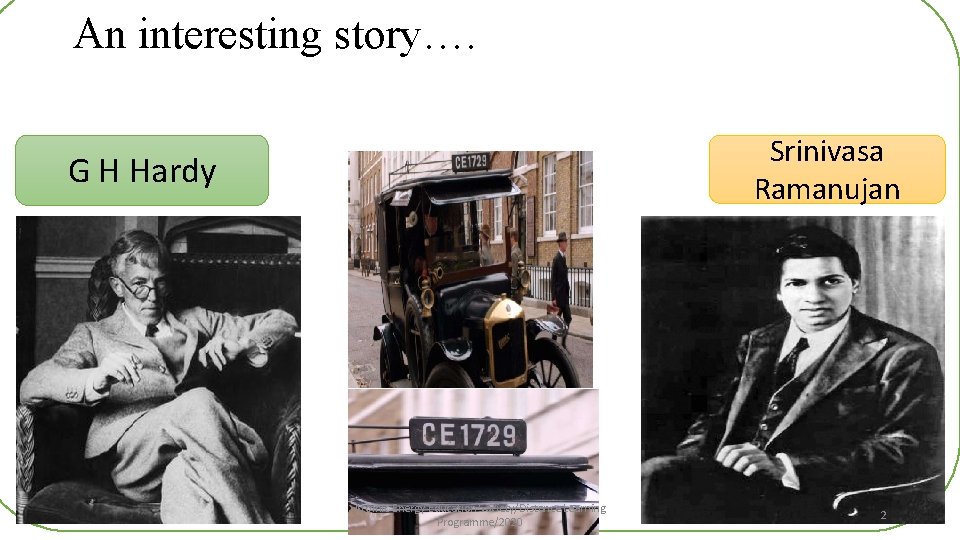
An interesting story…. Srinivasa Ramanujan G H Hardy Atomic Energy Education Society/Distance Learning Programme/2020 2

• This is a story about one of India’s great mathematical geniuses, Srinivasa Ramanujan. • Once another famous mathematician and his friend Prof. G. H. Hardy came to visit him in a taxi whose number was 1729. • While talking to Ramanujan, Hardy said……. . Atomic Energy Education Society/Distance Learning Programme/2020 3
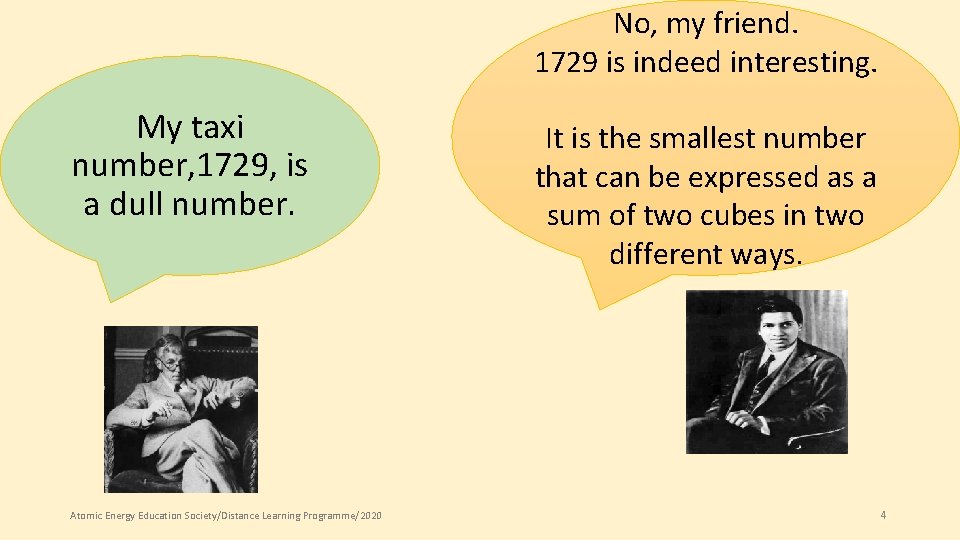
No, my friend. 1729 is indeed interesting. My taxi number, 1729, is a dull number. Atomic Energy Education Society/Distance Learning Programme/2020 It is the smallest number that can be expressed as a sum of two cubes in two different ways. 4
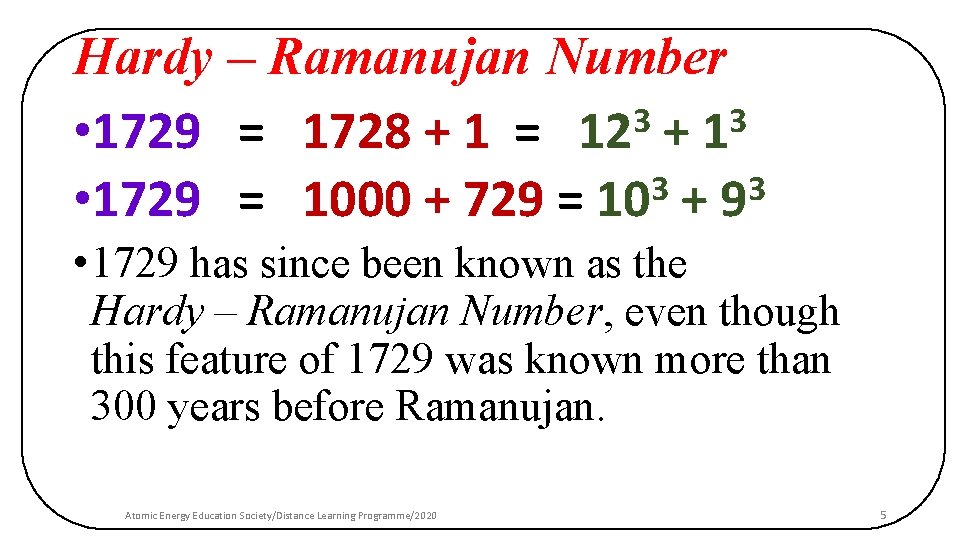
Hardy – Ramanujan Number 3 3 • 1729 = 1728 + 1 = 12 + 1 3 3 • 1729 = 1000 + 729 = 10 + 9 • 1729 has since been known as the Hardy – Ramanujan Number, even though this feature of 1729 was known more than 300 years before Ramanujan. Atomic Energy Education Society/Distance Learning Programme/2020 5
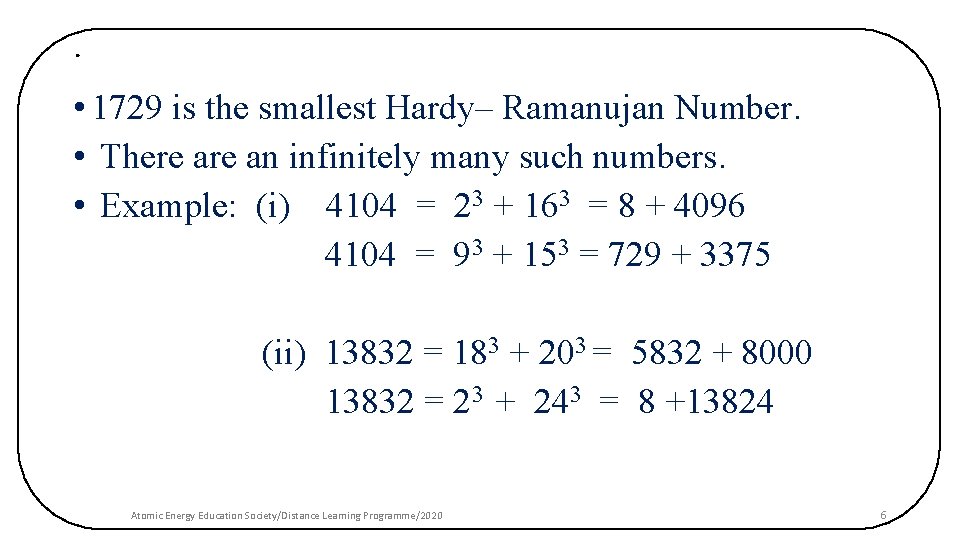
. • 1729 is the smallest Hardy– Ramanujan Number. • There an infinitely many such numbers. • Example: (i) 4104 = 23 + 163 = 8 + 4096 4104 = 93 + 153 = 729 + 3375 (ii) 13832 = 183 + 203 = 5832 + 8000 13832 = 23 + 243 = 8 +13824 Atomic Energy Education Society/Distance Learning Programme/2020 6
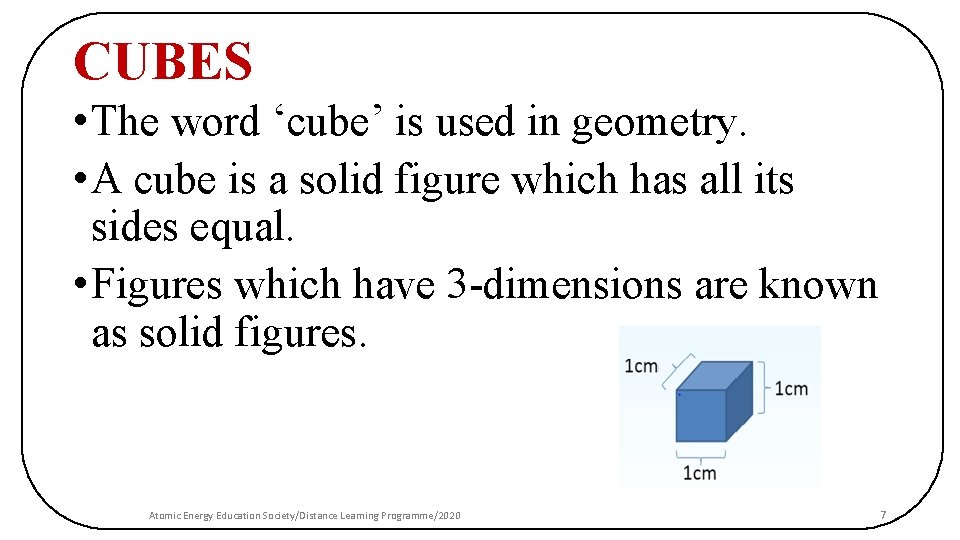
CUBES • The word ‘cube’ is used in geometry. • A cube is a solid figure which has all its sides equal. • Figures which have 3 -dimensions are known as solid figures. Atomic Energy Education Society/Distance Learning Programme/2020 7
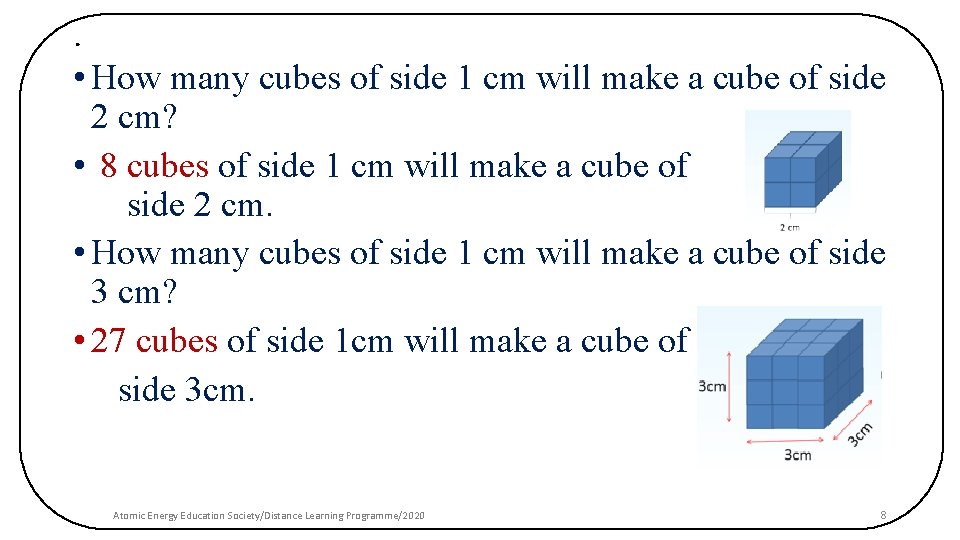
. • How many cubes of side 1 cm will make a cube of side 2 cm? • 8 cubes of side 1 cm will make a cube of side 2 cm. • How many cubes of side 1 cm will make a cube of side 3 cm? • 27 cubes of side 1 cm will make a cube of side 3 cm. Atomic Energy Education Society/Distance Learning Programme/2020 8

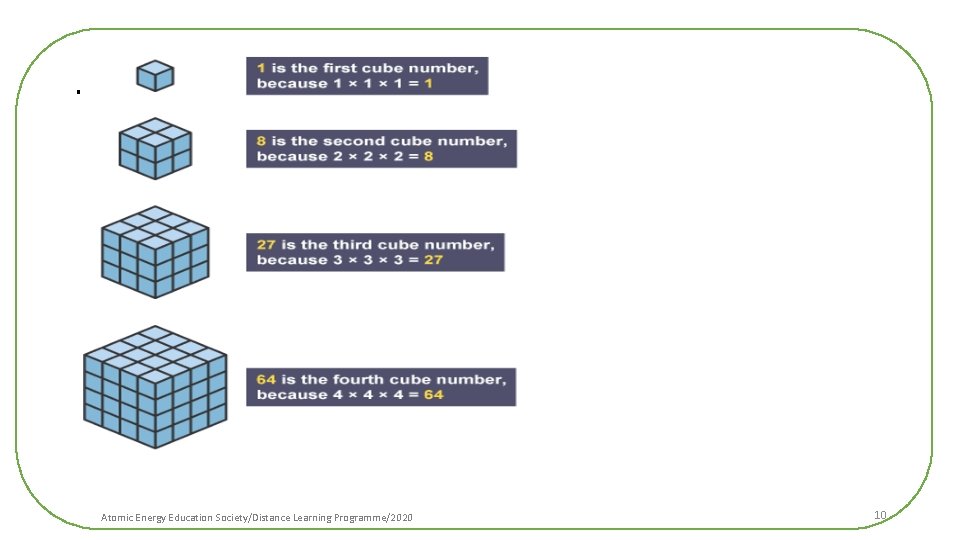
. • The numbers 1, 8, 27, . . . are called perfect cubes or cube numbers. • Each of them is obtained when a number is multiplied by taking it three times. 1 = 1 × 1 = 13 8 = 2 × 2 = 23 27 = 3 × 3 = 33 64 = 4 x 4 = 43 ……… Atomic Energy Education Society/Distance Learning Programme/2020 9
. Atomic Energy Education Society/Distance Learning Programme/2020 10
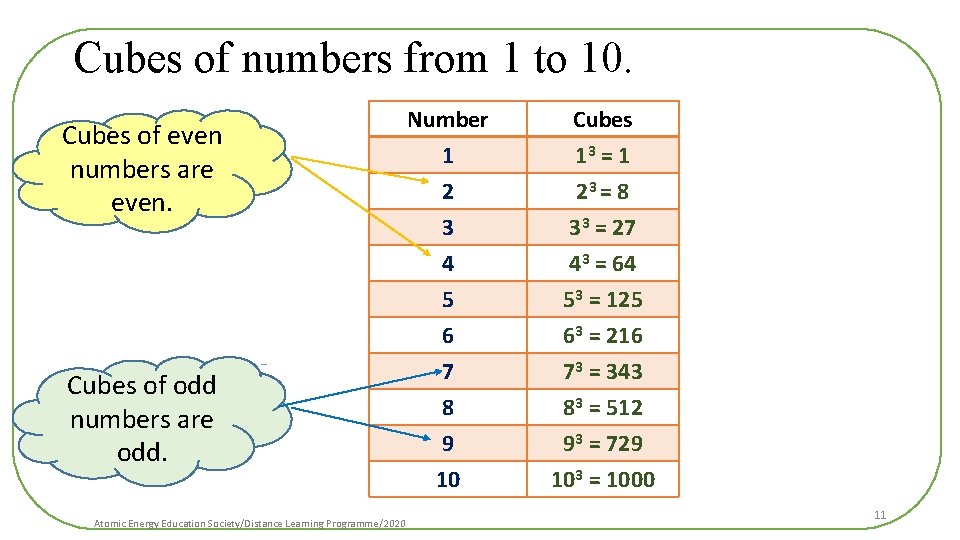
Cubes of numbers from 1 to 10. Cubes of even numbers are even. Cubes of odd numbers are odd. Atomic Energy Education Society/Distance Learning Programme/2020 Number 1 2 3 Cubes 13 = 1 23 = 8 33 = 27 4 5 6 7 8 9 10 43 = 64 53 = 125 63 = 216 73 = 343 83 = 512 93 = 729 103 = 1000 11
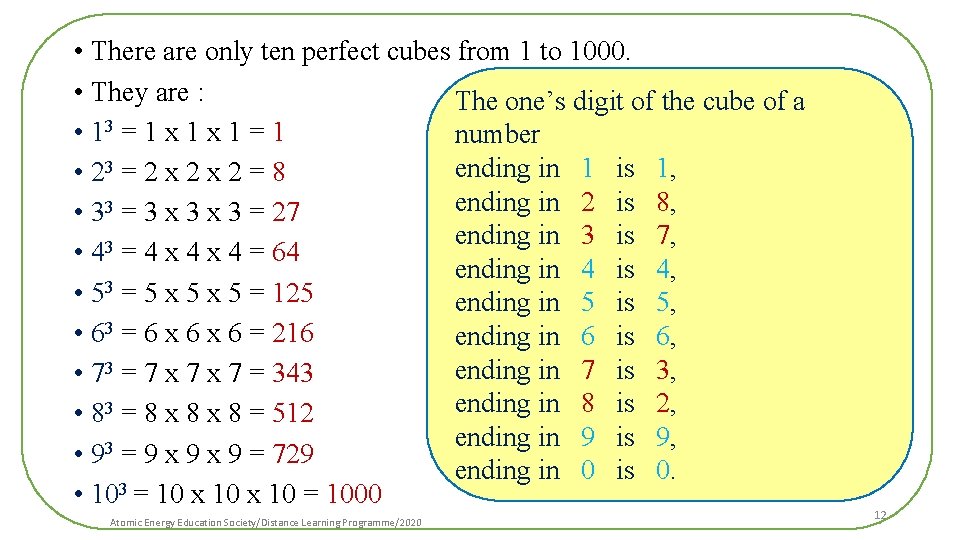
. • There are only ten perfect cubes from 1 to 1000. • They are : The one’s digit of the cube of a • 13 = 1 x 1 = 1 number ending in 1 is 1, • 23 = 2 x 2 = 8 ending in 2 is 8, • 33 = 3 x 3 = 27 ending in 3 is 7, 3 • 4 = 4 x 4 = 64 ending in 4 is 4, • 53 = 5 x 5 = 125 ending in 5 is 5, • 63 = 6 x 6 = 216 ending in 6 is 6, ending in 7 is 3, • 73 = 7 x 7 = 343 ending in 8 is 2, • 83 = 8 x 8 = 512 ending in 9 is 9, 3 • 9 = 9 x 9 = 729 ending in 0 is 0. • 103 = 10 x 10 = 1000 Atomic Energy Education Society/Distance Learning Programme/2020 12
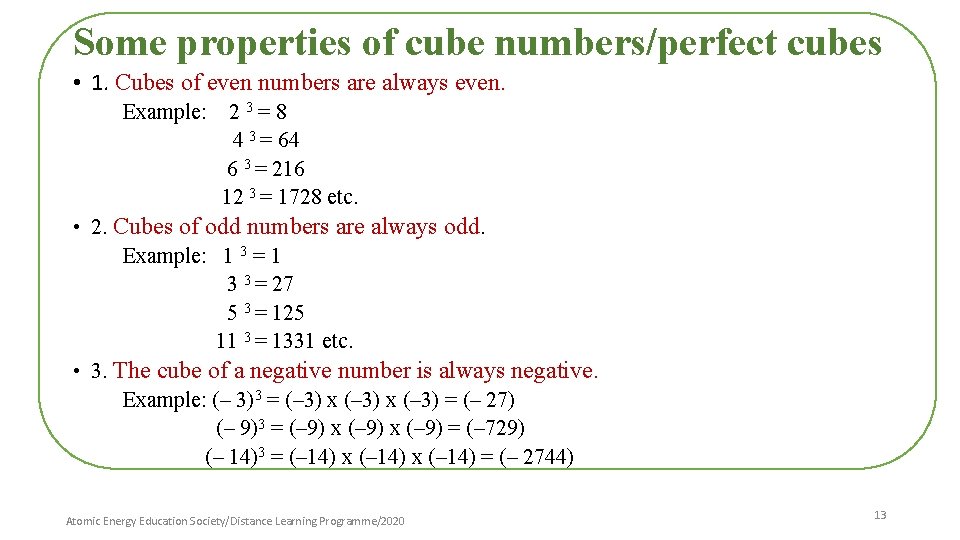
Some properties of cube numbers/perfect cubes • 1. Cubes of even numbers are always even. Example: 23=8 4 3 = 64 6 3 = 216 12 3 = 1728 etc. • 2. Cubes of odd numbers are always odd. Example: 1 3 = 1 3 3 = 27 5 3 = 125 11 3 = 1331 etc. • 3. The cube of a negative number is always negative. Example: (– 3)3 = (– 3) x (– 3) = (– 27) (– 9)3 = (– 9) x (– 9) = (– 729) (– 14)3 = (– 14) x (– 14) = (– 2744) Atomic Energy Education Society/Distance Learning Programme/2020 13
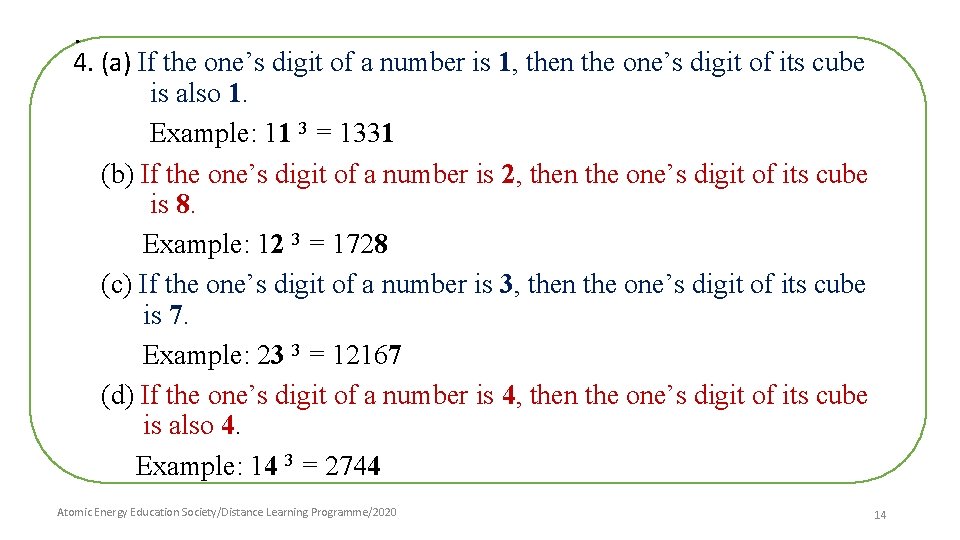
. 4. (a) If the one’s digit of a number is 1, then the one’s digit of its cube is also 1. Example: 11 3 = 1331 (b) If the one’s digit of a number is 2, then the one’s digit of its cube is 8. Example: 12 3 = 1728 (c) If the one’s digit of a number is 3, then the one’s digit of its cube is 7. Example: 23 3 = 12167 (d) If the one’s digit of a number is 4, then the one’s digit of its cube is also 4. Example: 14 3 = 2744 Atomic Energy Education Society/Distance Learning Programme/2020 14
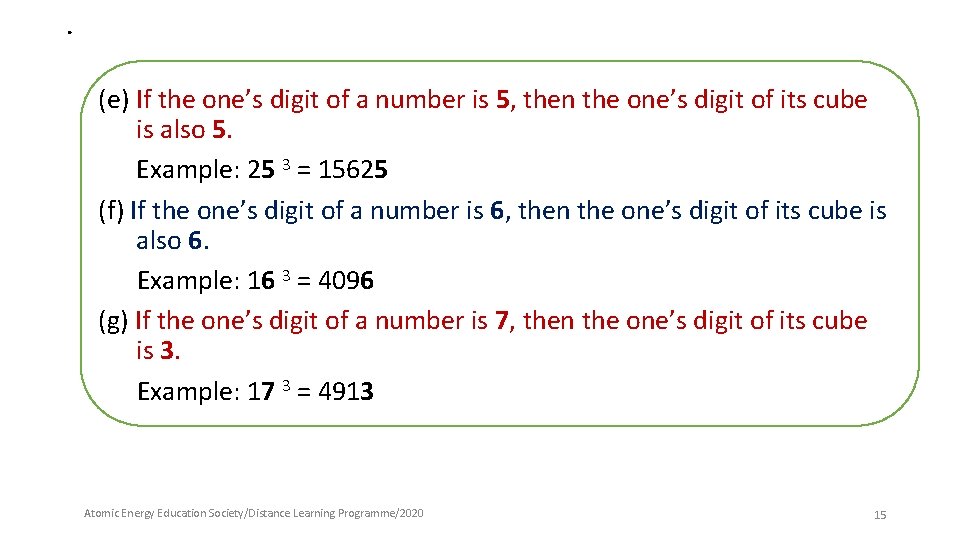
. (e) If the one’s digit of a number is 5, then the one’s digit of its cube is also 5. Example: 25 3 = 15625 (f) If the one’s digit of a number is 6, then the one’s digit of its cube is also 6. Example: 16 3 = 4096 (g) If the one’s digit of a number is 7, then the one’s digit of its cube is 3. Example: 17 3 = 4913 Atomic Energy Education Society/Distance Learning Programme/2020 15
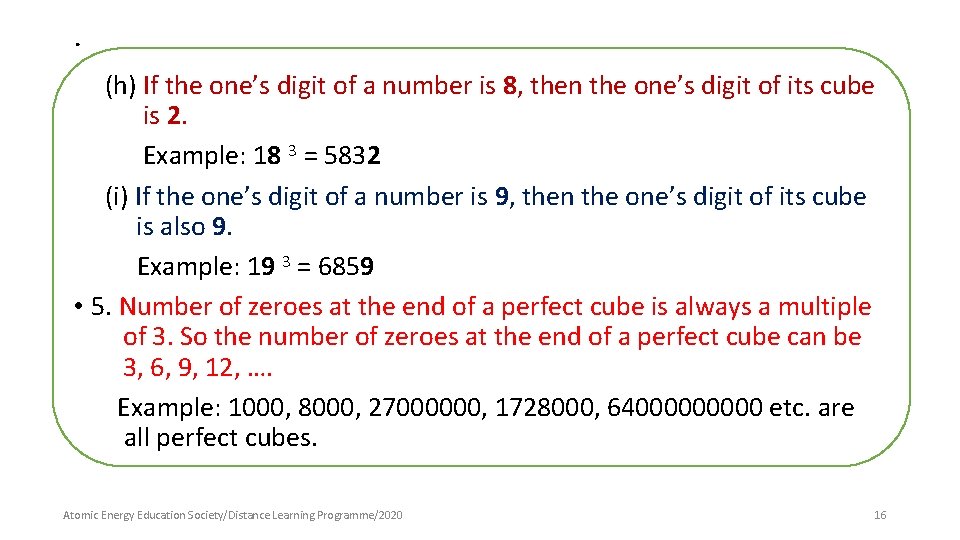
. (h) If the one’s digit of a number is 8, then the one’s digit of its cube is 2. Example: 18 3 = 5832 (i) If the one’s digit of a number is 9, then the one’s digit of its cube is also 9. Example: 19 3 = 6859 • 5. Number of zeroes at the end of a perfect cube is always a multiple of 3. So the number of zeroes at the end of a perfect cube can be 3, 6, 9, 12, …. Example: 1000, 8000, 27000000, 1728000, 6400000 etc. are all perfect cubes. Atomic Energy Education Society/Distance Learning Programme/2020 16
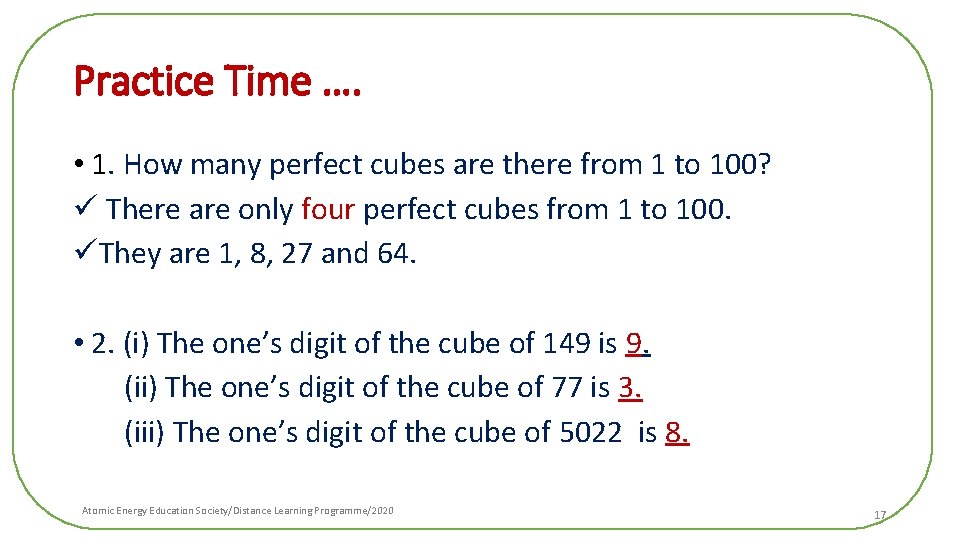
Practice Time …. • 1. How many perfect cubes are there from 1 to 100? ü There are only four perfect cubes from 1 to 100. üThey are 1, 8, 27 and 64. • 2. (i) The one’s digit of the cube of 149 is 9. (ii) The one’s digit of the cube of 77 is 3. (iii) The one’s digit of the cube of 5022 is 8. Atomic Energy Education Society/Distance Learning Programme/2020 17
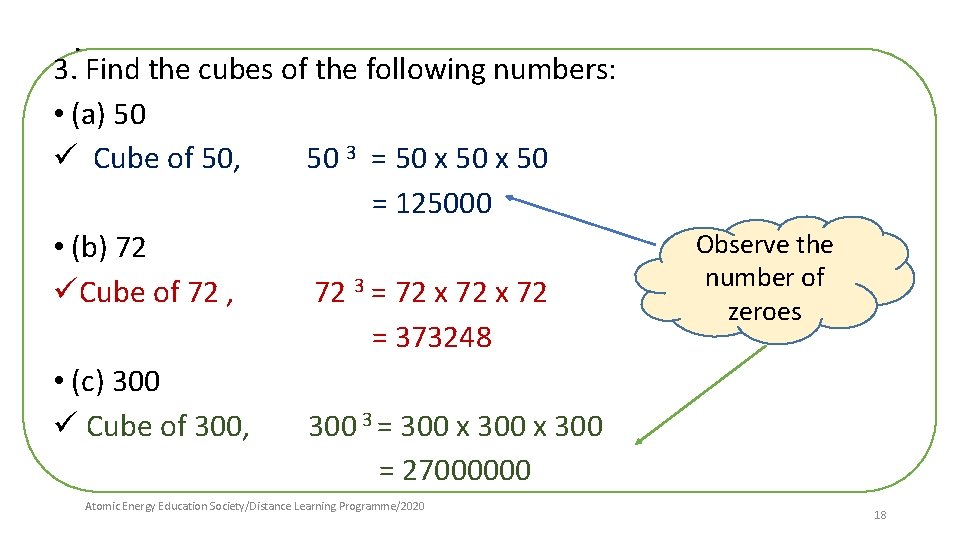
. 3. Find the cubes of the following numbers: • (a) 50 ü Cube of 50, 50 3 = 50 x 50 = 125000 • (b) 72 üCube of 72 , 72 3 = 72 x 72 = 373248 • (c) 300 ü Cube of 300, 300 3 = 300 x 300 = 27000000 Atomic Energy Education Society/Distance Learning Programme/2020 Observe the number of zeroes 18
. • 4. Is 9 a perfect cube ? ü No, as 9 = 3 × 3 and there is no natural number which multiplied by taking it three times gives 9. üThis shows that 9 is not a perfect cube. • 5. Is 1728 a cube number? üYes, as 1728 is obtained by multiplying the number 12 three times; it is a cube number or a perfect cube. ü 1728 = 12 x 12 Atomic Energy Education Society/Distance Learning Programme/2020 19
What have we discussed ? üNumbers like 1729, 4104, 13832, are known as Hardy – Ramanujan Numbers. They can be expressed as the sum of two cubes in two different ways. üNumbers obtained when a number is multiplied by itself three times are known as cube numbers or perfect cubes. For example 1, 8, 27, . . . etc. üCubes of even numbers are even. üCubes of odd numbers are odd. üDetermining the one’s digit of cube of a number ^*^*^* Atomic Energy Education Society/Distance Learning Programme/2020 20
. • End of Module 1 of 3 Atomic Energy Education Society/Distance Learning Programme/2020 21
- Slides: 21