
CLASS VI MATHEMATICS CLASS VI Mathematics HELLO STUDENTS

- Slides: 24
CLASS – VI MATHEMATICS CLASS – VI Mathematics
HELLO STUDENTS • • We hope you all are doing well. Be healthy and stay at home. Learn more by studying more. Utilize your time in productive activities.
General Instructions • This presentation is based on Chapter – 1 ( Knowing Our Numbers) and is divided into two parts • Go to the Insert tab and choose Video → Online Video or open a blank tab in your Internet browser and paste the link into the address bar. • If possible take printouts or use A-4 size sheets or previous year’s notebooks to solve the given worksheets. • Submit them in a labeled folder when the school reopens.
WEEK - 1 Topics to be covered v Comparing Numbers. v Forming numbers with the given condition. v Indian System of Numeration v International System of Numeration v Use of Commas v Ascending and Descending order of Numbers.
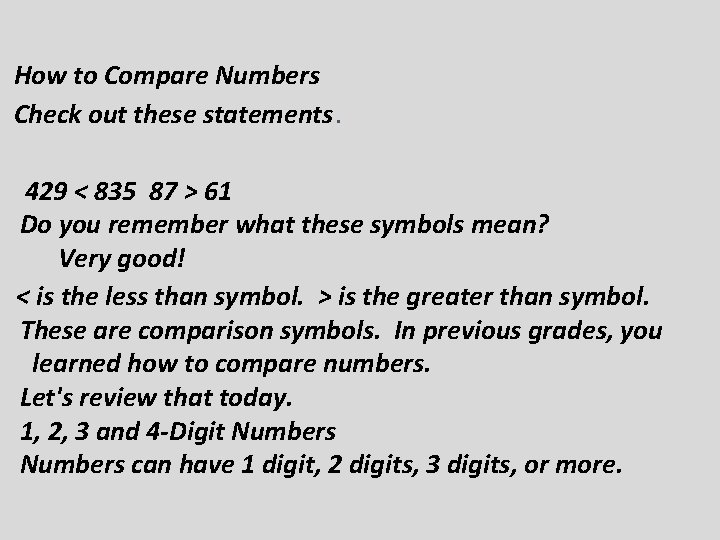
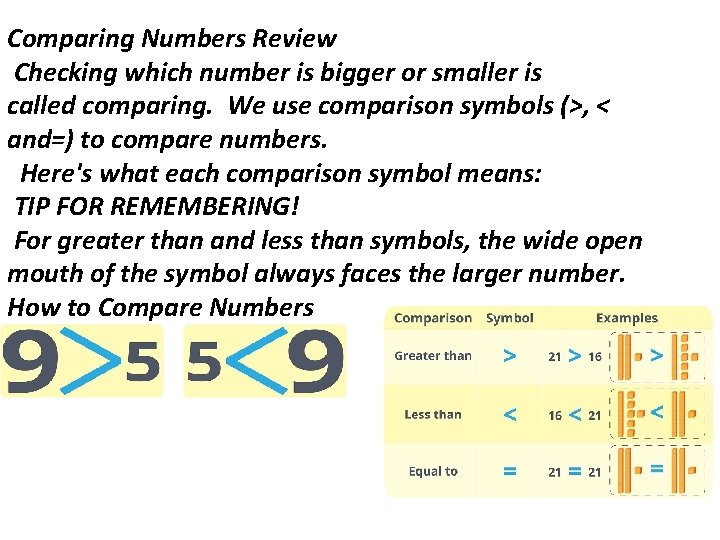
How to Compare Numbers Check out these statements. 429 < 835 87 > 61 Do you remember what these symbols mean? Very good! < is the less than symbol. > is the greater than symbol. These are comparison symbols. In previous grades, you learned how to compare numbers. Let's review that today. 1, 2, 3 and 4 -Digit Numbers can have 1 digit, 2 digits, 3 digits, or more.
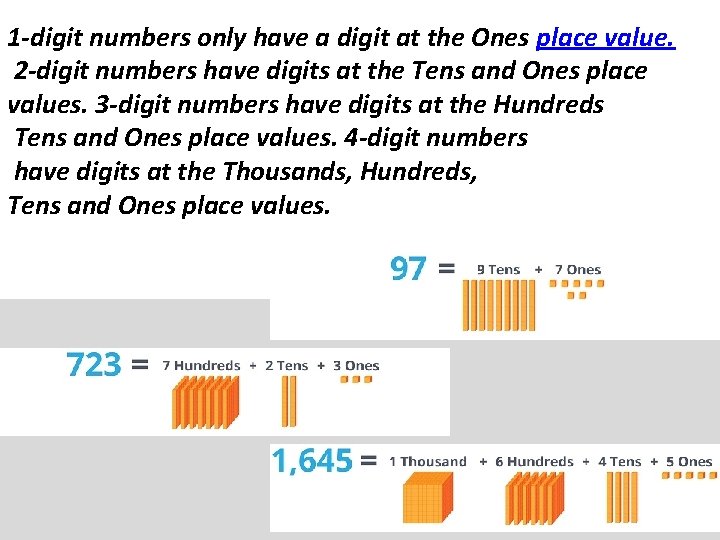
1 -digit numbers only have a digit at the Ones place value. 2 -digit numbers have digits at the Tens and Ones place values. 3 -digit numbers have digits at the Hundreds Tens and Ones place values. 4 -digit numbers have digits at the Thousands, Hundreds, Tens and Ones place values.
Comparing Numbers Review Checking which number is bigger or smaller is called comparing. We use comparison symbols (>, < and=) to compare numbers. Here's what each comparison symbol means: TIP FOR REMEMBERING! For greater than and less than symbols, the wide open mouth of the symbol always faces the larger number. How to Compare Numbers
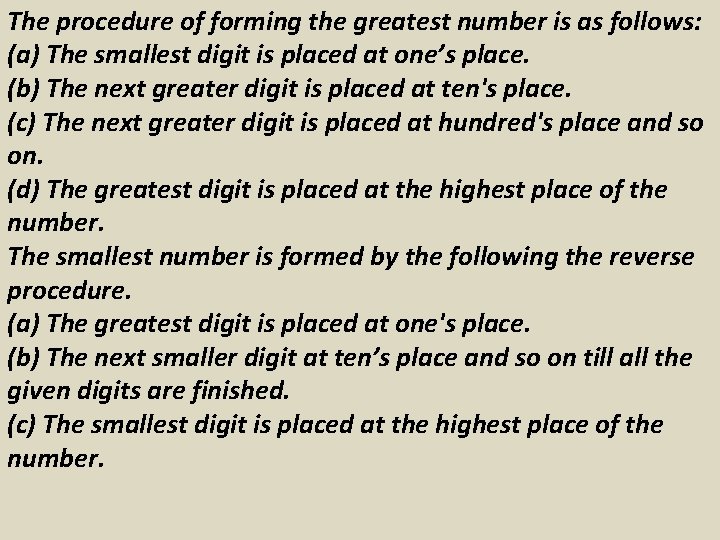
The procedure of forming the greatest number is as follows: (a) The smallest digit is placed at one’s place. (b) The next greater digit is placed at ten's place. (c) The next greater digit is placed at hundred's place and so on. (d) The greatest digit is placed at the highest place of the number. The smallest number is formed by the following the reverse procedure. (a) The greatest digit is placed at one's place. (b) The next smaller digit at ten’s place and so on till all the given digits are finished. (c) The smallest digit is placed at the highest place of the number.
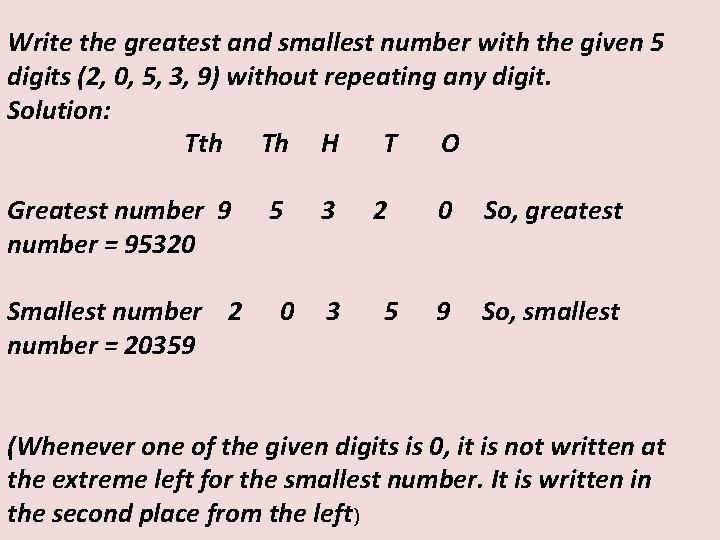
Write the greatest and smallest number with the given 5 digits (2, 0, 5, 3, 9) without repeating any digit. Solution: Tth Th H T O Greatest number 9 number = 95320 Smallest number 2 number = 20359 5 0 3 3 2 5 0 So, greatest 9 So, smallest (Whenever one of the given digits is 0, it is not written at the extreme left for the smallest number. It is written in the second place from the left)
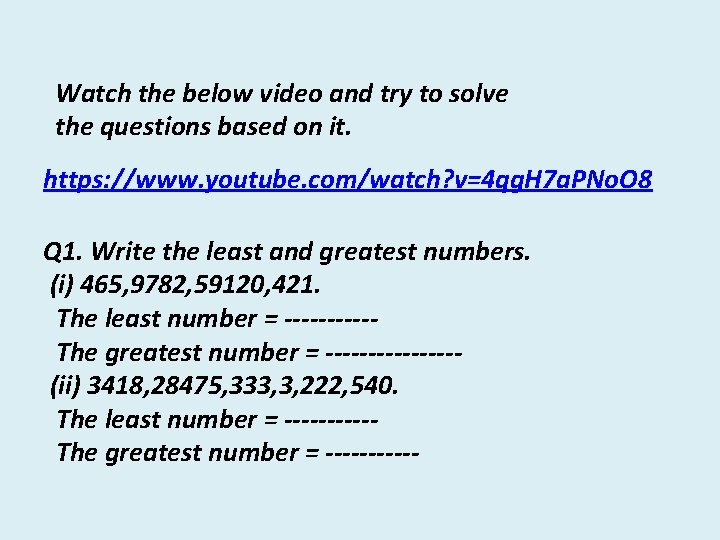
Watch the below video and try to solve the questions based on it. https: //www. youtube. com/watch? v=4 qg. H 7 a. PNo. O 8 Q 1. Write the least and greatest numbers. (i) 465, 9782, 59120, 421. The least number = -----The greatest number = --------(ii) 3418, 28475, 333, 3, 222, 540. The least number = -----The greatest number = ------
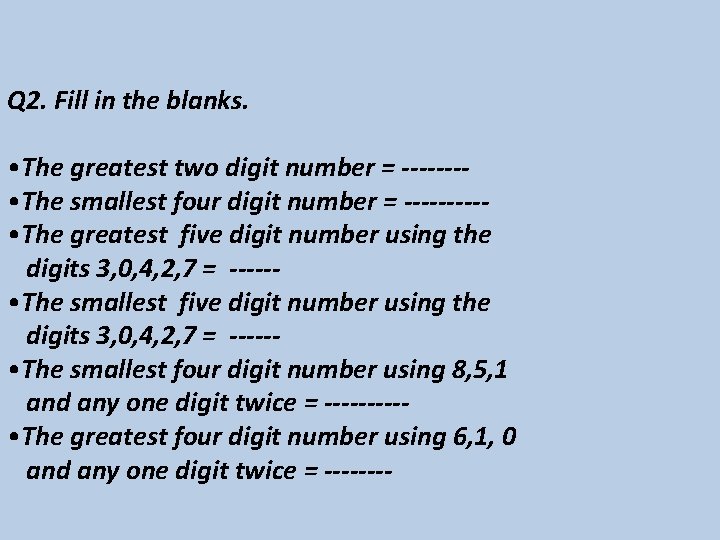
Q 2. Fill in the blanks. • The greatest two digit number = ------- • The smallest four digit number = ----- • The greatest five digit number using the digits 3, 0, 4, 2, 7 = ----- • The smallest four digit number using 8, 5, 1 and any one digit twice = ----- • The greatest four digit number using 6, 1, 0 and any one digit twice = ----
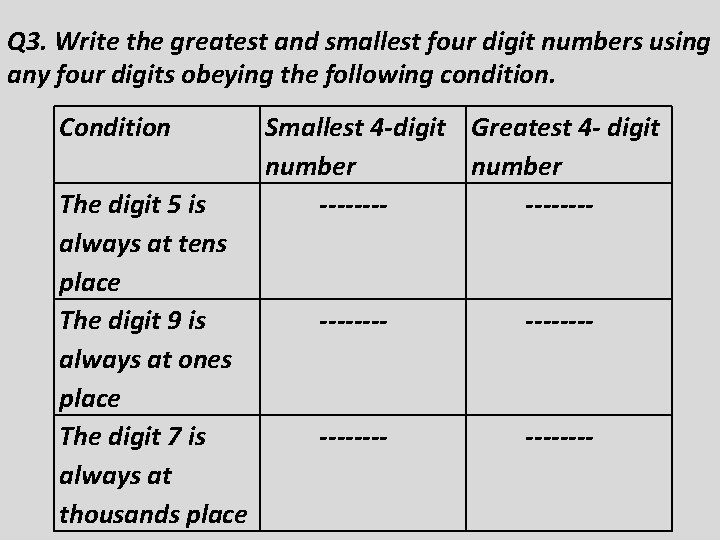
Q 3. Write the greatest and smallest four digit numbers using any four digits obeying the following condition. Condition The digit 5 is always at tens place The digit 9 is always at ones place The digit 7 is always at thousands place Smallest 4 -digit Greatest 4 - digit number -------- --------
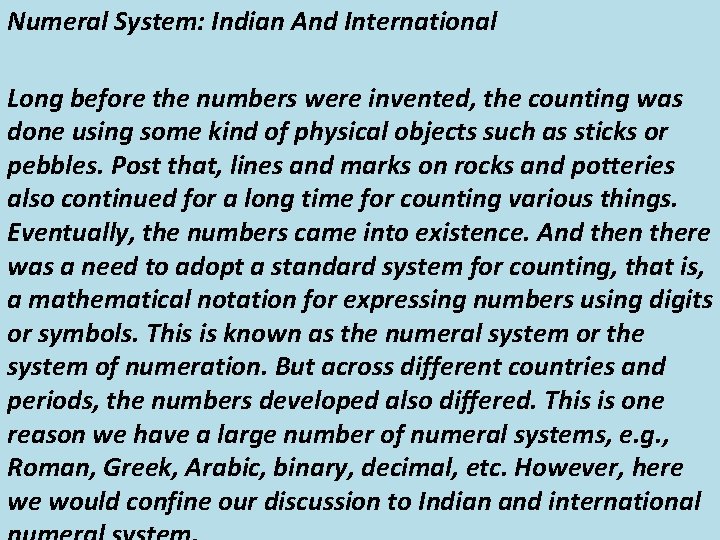
Numeral System: Indian And International Long before the numbers were invented, the counting was done using some kind of physical objects such as sticks or pebbles. Post that, lines and marks on rocks and potteries also continued for a long time for counting various things. Eventually, the numbers came into existence. And then there was a need to adopt a standard system for counting, that is, a mathematical notation for expressing numbers using digits or symbols. This is known as the numeral system or the system of numeration. But across different countries and periods, the numbers developed also differed. This is one reason we have a large number of numeral systems, e. g. , Roman, Greek, Arabic, binary, decimal, etc. However, here we would confine our discussion to Indian and international
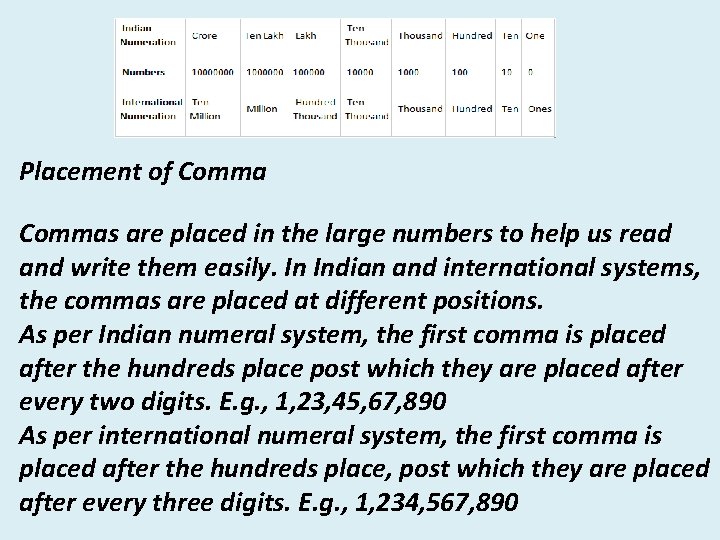
Indian Numeral System Let us consider a number, say 225. Notice that the digit 2 is used twice in this number. Both of them have a different value. We differentiate them by stating their place value, which is defined as the numerical value of a digit on the basis of its position in a number. So the place value of the leftmost 2 is Hundreds while the one in the center is Tens. Coming back to the Indian numeral system, the place values of digits go in the sequence of Ones, Tens, Hundreds, Thousands, Ten Thousands, Lakhs, Ten Lakhs, Crores and so on. In the number 10, 23, 45, 678 the place values of each digit are:
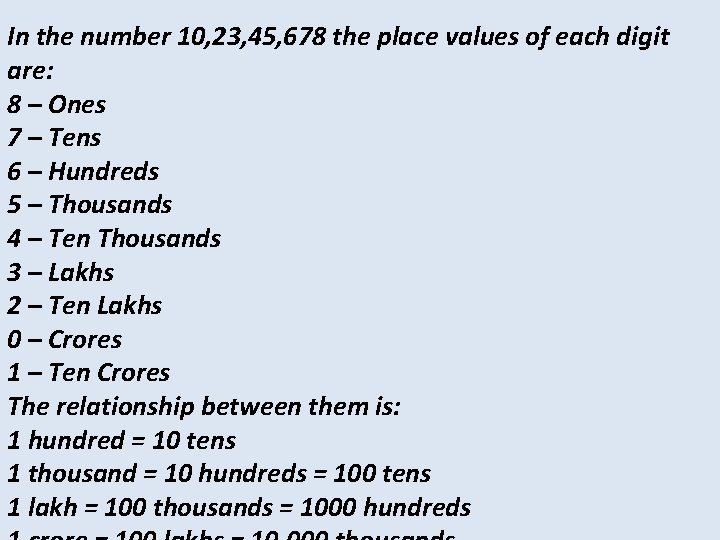
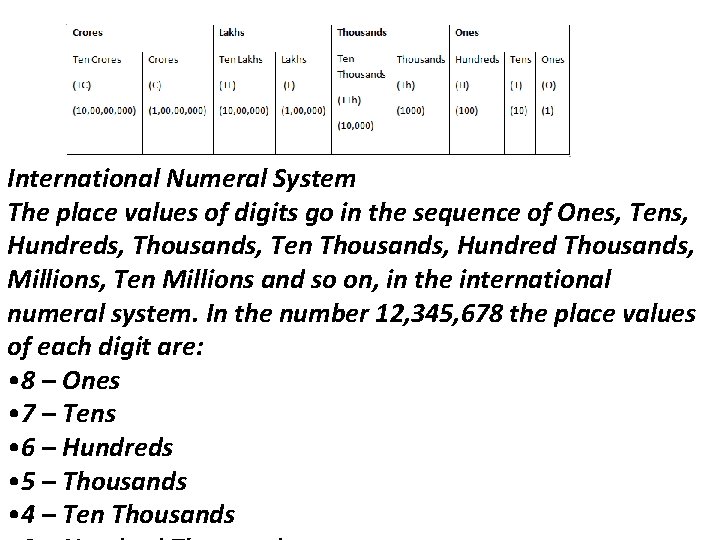
In the number 10, 23, 45, 678 the place values of each digit are: 8 – Ones 7 – Tens 6 – Hundreds 5 – Thousands 4 – Ten Thousands 3 – Lakhs 2 – Ten Lakhs 0 – Crores 1 – Ten Crores The relationship between them is: 1 hundred = 10 tens 1 thousand = 10 hundreds = 100 tens 1 lakh = 100 thousands = 1000 hundreds
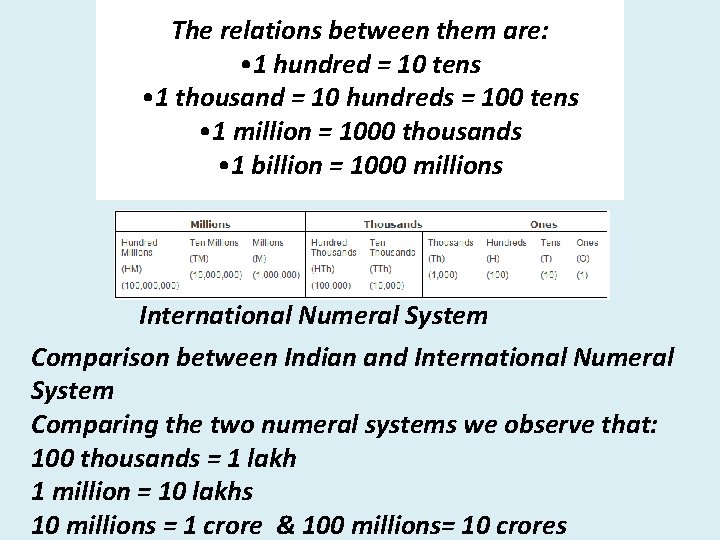
International Numeral System The place values of digits go in the sequence of Ones, Tens, Hundreds, Thousands, Ten Thousands, Hundred Thousands, Millions, Ten Millions and so on, in the international numeral system. In the number 12, 345, 678 the place values of each digit are: • 8 – Ones • 7 – Tens • 6 – Hundreds • 5 – Thousands • 4 – Ten Thousands
The relations between them are: • 1 hundred = 10 tens • 1 thousand = 10 hundreds = 100 tens • 1 million = 1000 thousands • 1 billion = 1000 millions International Numeral System Comparison between Indian and International Numeral System Comparing the two numeral systems we observe that: 100 thousands = 1 lakh 1 million = 10 lakhs 10 millions = 1 crore & 100 millions= 10 crores
Placement of Commas are placed in the large numbers to help us read and write them easily. In Indian and international systems, the commas are placed at different positions. As per Indian numeral system, the first comma is placed after the hundreds place post which they are placed after every two digits. E. g. , 1, 23, 45, 67, 890 As per international numeral system, the first comma is placed after the hundreds place, post which they are placed after every three digits. E. g. , 1, 234, 567, 890
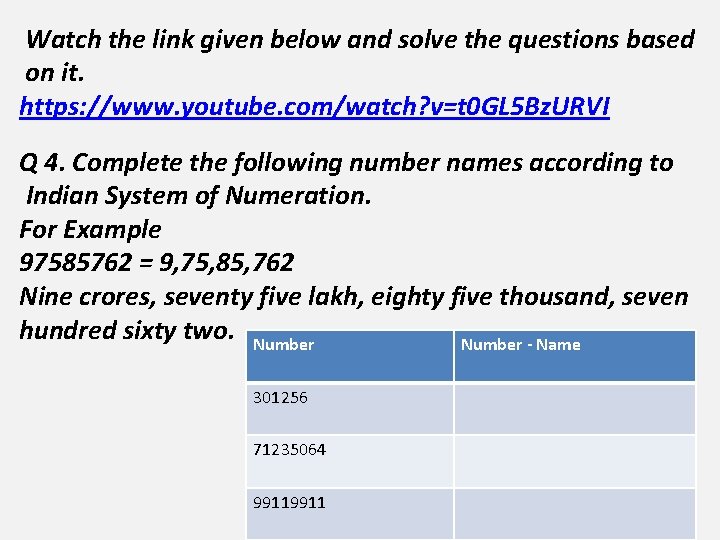
Watch the link given below and solve the questions based on it. https: //www. youtube. com/watch? v=t 0 GL 5 Bz. URVI Q 4. Complete the following number names according to Indian System of Numeration. For Example 97585762 = 9, 75, 85, 762 Nine crores, seventy five lakh, eighty five thousand, seven hundred sixty two. Number - Name 301256 71235064 9911
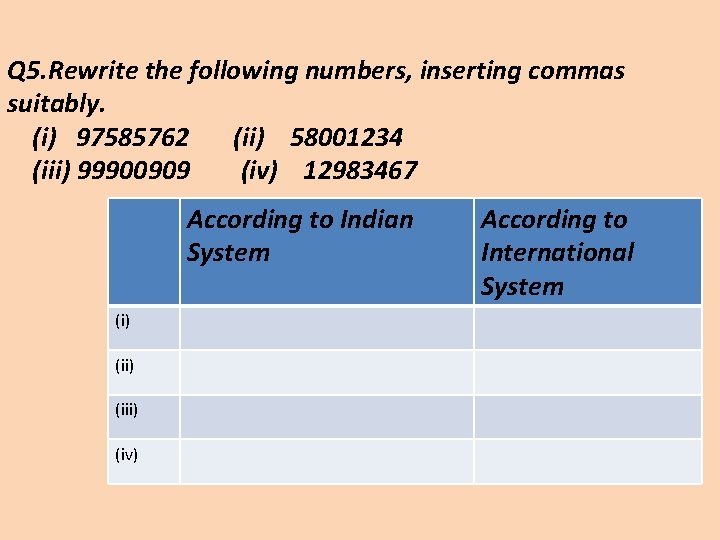
Q 5. Rewrite the following numbers, inserting commas suitably. (i) 97585762 (ii) 58001234 (iii) 99900909 (iv) 12983467 According to Indian System (i) (iii) (iv) According to International System
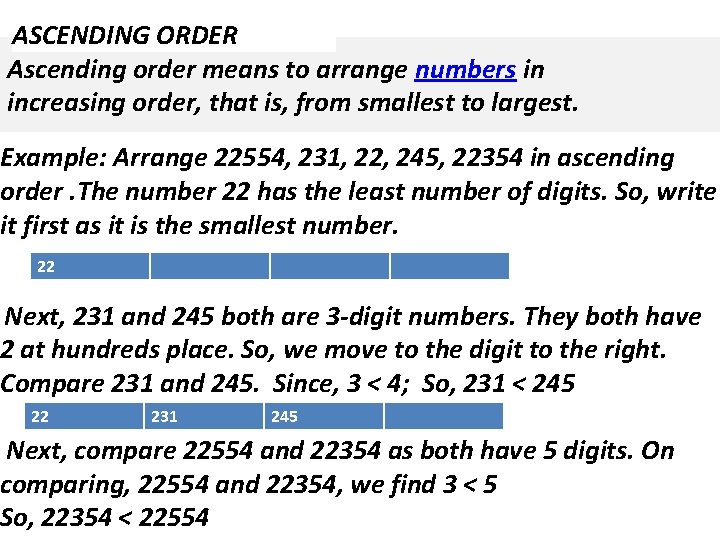
ASCENDING ORDER Ascending order means to arrange numbers in increasing order, that is, from smallest to largest. Example: Arrange 22554, 231, 22, 245, 22354 in ascending order. The number 22 has the least number of digits. So, write it first as it is the smallest number. 22 Next, 231 and 245 both are 3 -digit numbers. They both have 2 at hundreds place. So, we move to the digit to the right. Compare 231 and 245. Since, 3 < 4; So, 231 < 245 22 231 245 Next, compare 22554 and 22354 as both have 5 digits. On comparing, 22554 and 22354, we find 3 < 5 So, 22354 < 22554
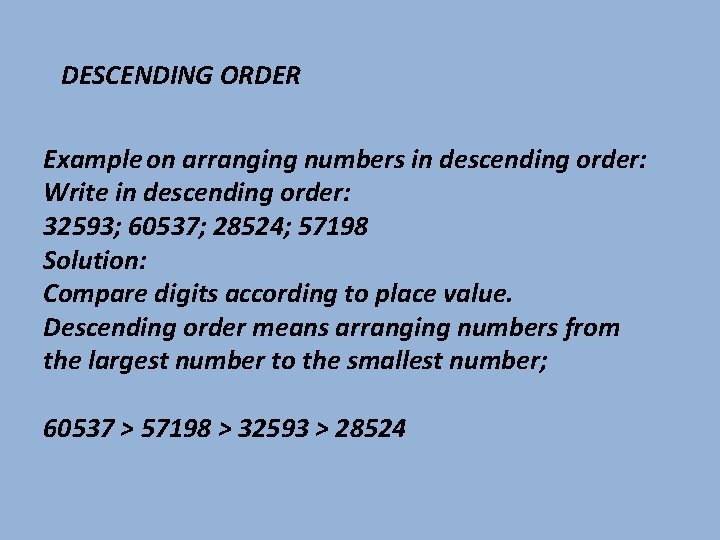
DESCENDING ORDER Example on arranging numbers in descending order: Write in descending order: 32593; 60537; 28524; 57198 Solution: Compare digits according to place value. Descending order means arranging numbers from the largest number to the smallest number; 60537 > 57198 > 32593 > 28524
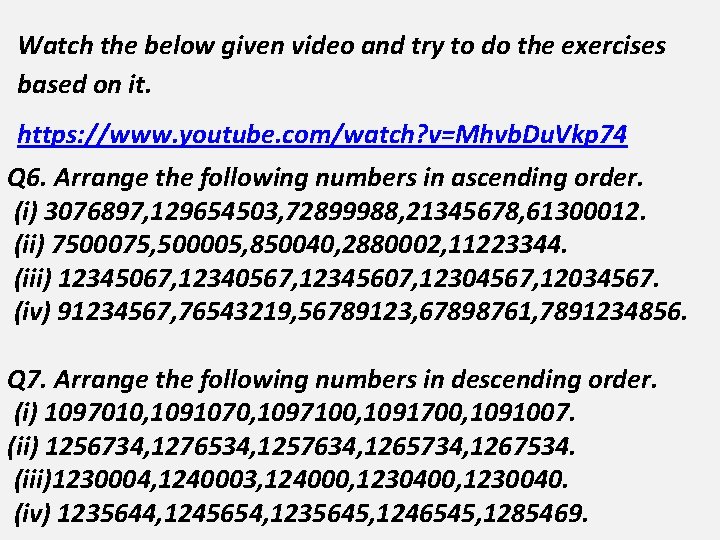
Watch the below given video and try to do the exercises based on it. https: //www. youtube. com/watch? v=Mhvb. Du. Vkp 74 Q 6. Arrange the following numbers in ascending order. (i) 3076897, 129654503, 72899988, 21345678, 61300012. (ii) 7500075, 500005, 850040, 2880002, 11223344. (iii) 12345067, 12340567, 12345607, 12304567, 12034567. (iv) 91234567, 76543219, 56789123, 67898761, 7891234856. Q 7. Arrange the following numbers in descending order. (i) 1097010, 1091070, 1097100, 1091700, 1091007. (ii) 1256734, 1276534, 1257634, 1265734, 1267534. (iii)1230004, 1240003, 124000, 1230400, 1230040. (iv) 1235644, 1245654, 1235645, 1246545, 1285469.
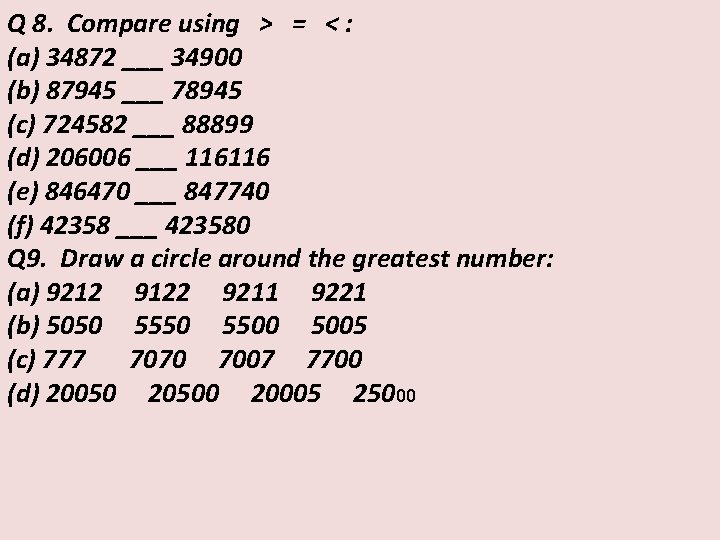
Q 8. Compare using > = < : (a) 34872 ___ 34900 (b) 87945 ___ 78945 (c) 724582 ___ 88899 (d) 206006 ___ 116116 (e) 846470 ___ 847740 (f) 42358 ___ 423580 Q 9. Draw a circle around the greatest number: (a) 9212 9122 9211 9221 (b) 5050 5500 5005 (c) 777 7070 7007 7700 (d) 20050 20500 20005 25000