
Class Presentation Outline for Projectile Motion Created for


- Slides: 38
Class Presentation Outline for Projectile Motion Created for CVCA Physics By Dick Heckathorn 28 November 2 K+4 Needs updating from short one
Table of Contents 3 4 5 7 9 11 12 22 24 28 31 A projectile is Dropping an object Laser Disk A: 41, 42, 43, 44 Dropping an Object Throwing Horizontally Dropping a Super Ball Laser Disk B: 11, 12, 13, 14, 15 Problem: Thrown Horizontal Problem: Horizontal Up Problem: Horizontal Down p 205 # 45 Assumptions
A projectile is: Any object that moves through the air or through space acted only on by gravity (and air resistance if any). We will ignore air resistance unless information relative to it is stated.
Dropping an object. The only force acting on the object is the pull of the earth acting on it in a down direction. This causes the object to accelerate at the rate of 9. 8 m/s 2 in the same downward direction.
A 41 Free Fall Ride Falling on Demon Drop Accelerometer Shown Always parallel to tracks
A 42, 43 Falling Bowling Ball Bowling ball released from 4 m A 44 Falling “Down Under” in Australia Object dropped in both New York and Australia
Droping an object To analyze the motion one uses the five kinematic equations with the variables: a, vi , vf , d and t. Remember that you can use one of the calculator programs to find any two variables given the other three.
Coffee Filter Investigation Handout: #13 Air Resistance Motion Sensor on Ceiling Computer Lab Pro TI-83+ Printer – Online & Epson FX
Throwing an Object Horizontal If one assumes that there is no gravitational force of the earth on the object… it will travel in a horizontal direction with a constant velocity. Relative variables are: vh, dh, and t.
Throwing an Object Horizontal It we deal with reality, there is the force of gravity acting on the object. How does this force affect the horizontal component of the motion of the object?
Throwing an Object Horizontal Demo: Super Ball We can see that the force of gravity acting on the ball does not affect the horizontal motion which is at right angles to the direction of the force of gravity.
B 11 Projectile Motion Ball was projected horizontally, another dropped straight down Later, horizontally lines drawn Old PSSC – large white balls
B 12 Projectile Motion Ball shot horizontally from crossbow as a target ball is dropped horizontally. Both originally aligned horizontal. Old PSSC – large white balls
B 13 Projectile Motion Ball shot at an upward angle from crossbow as a target ball is dropped horizontally. Old PSSC – large white balls
B 14 Projectile Motion Ping pong balls glued to plexiglas sheet at equal time intervals Old PSSC – Professor Hume
B 15 a Projectile Motion Air table is tilted so pucks respond to “diluted gravity”. One shot horizontal, one dropped. Frame 3573
B 15 b Projectile Motion Frame 3914 Determine range of angle vs angle of shot.
B 15 c Projectile Motion Frame 4385 Shot-putter
Throwing an Object Horizontal We have seen that: the horizontal and vertical components do not affect each other the vertical motion is that of free fall.
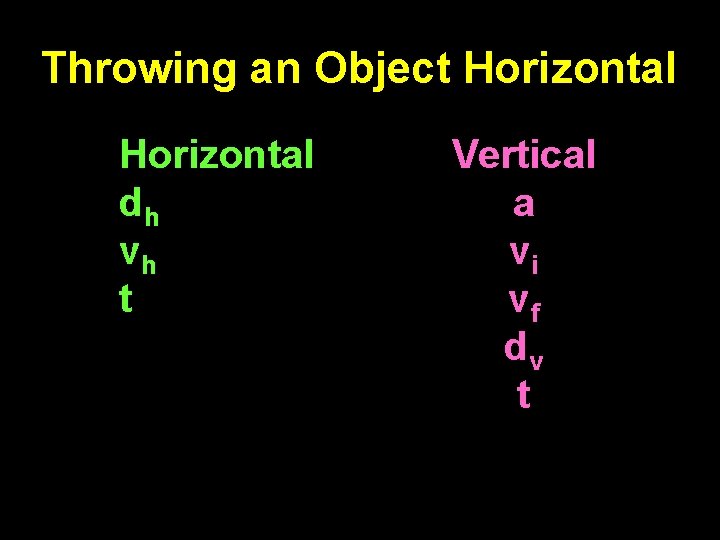
Throwing an Object Horizontal Each component can be analyzed independent of each other. We do so according to the following:
Throwing an Object Horizontal dh vh t Vertical a vi vf dv t
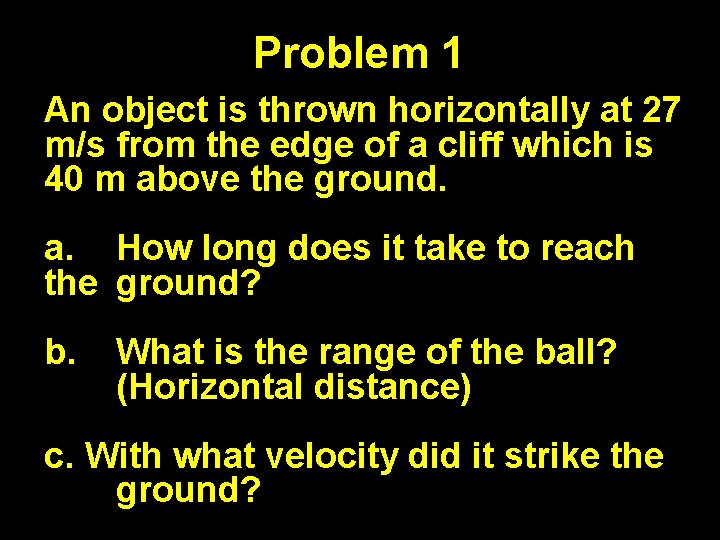
Problem 1 An object is thrown horizontally at 27 m/s from the edge of a cliff which is 40 m above the ground. a. How long does it take to reach the ground? b. What is the range of the ball? (Horizontal distance) c. With what velocity did it strike the ground?
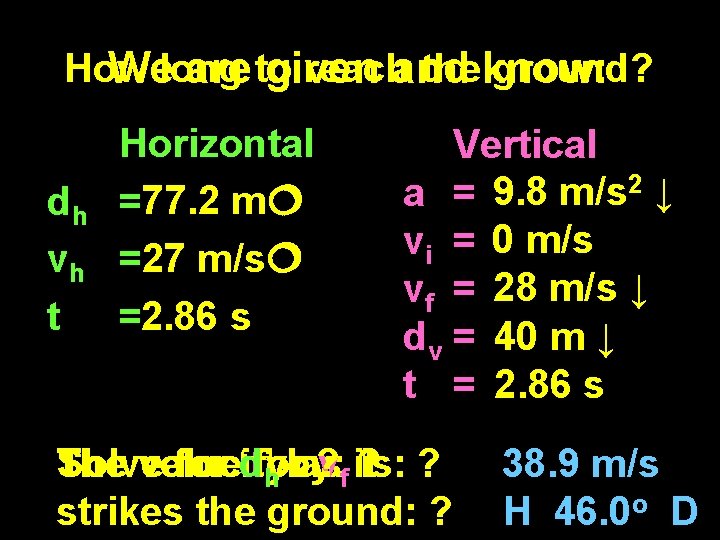
How reachand theknow: ground? Welong are to given dh vh t Horizontal =77. 2 m =27 m/s =2. 86 s Vertical a = 9. 8 m/s 2 ↓ vi = 0 m/s vf = 28 m/s ↓ dv = 40 m ↓ t = 2. 86 s The velocity value vf it is: ? Solve for ‘t’ ? dfor : as ? h by: strikes the ground: ? 38. 9 m/s H 46. 0 o D
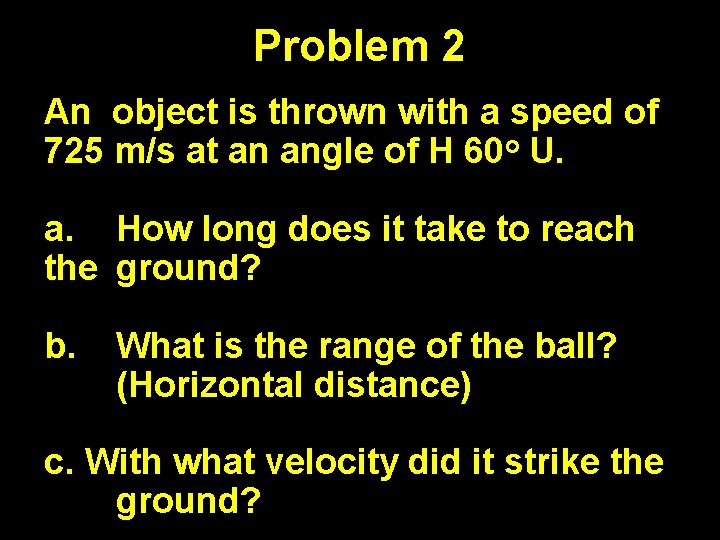
Problem 2 An object is thrown with a speed of 725 m/s at an angle of H 60 o U. a. How long does it take to reach the ground? b. What is the range of the ball? (Horizontal distance) c. With what velocity did it strike the ground?
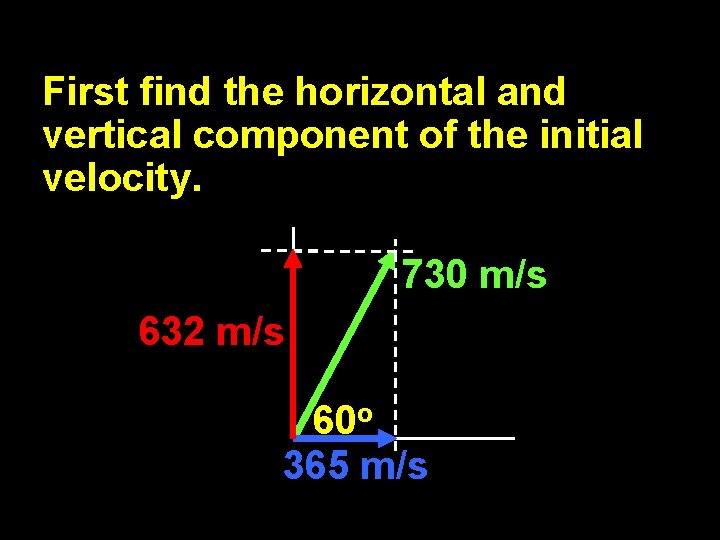
First find the horizontal and vertical component of the initial velocity. 730 m/s 632 m/s 60 o 365 m/s
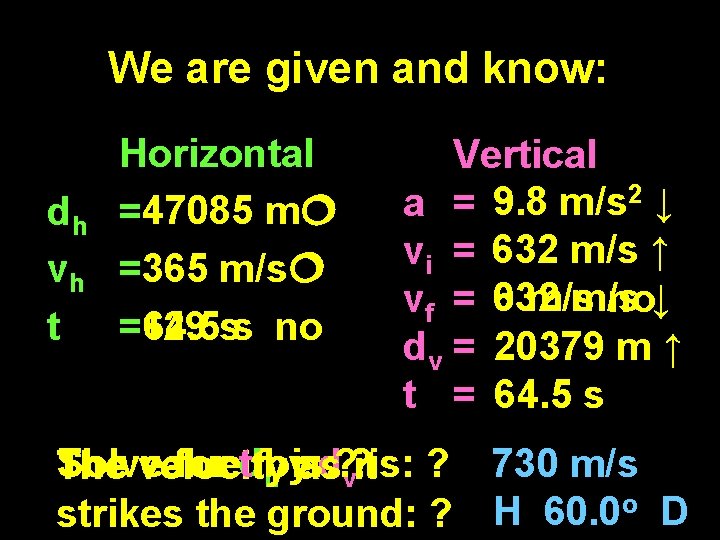
We are given and know: dh vh t Horizontal =47085 m =365 m/s =129 64. 5 ss no Vertical 2 9. 8 m/s ↓ a = vi = 632 m/s ↑ m/s 0 m/s no↓ vf = 632 dv = 20379 m ↑ t = 64. 5 s value d? v? itis: ? 730 m/s Solve for tdfor by: The velocity as h is: strikes the ground: ? H 60. 0 o D
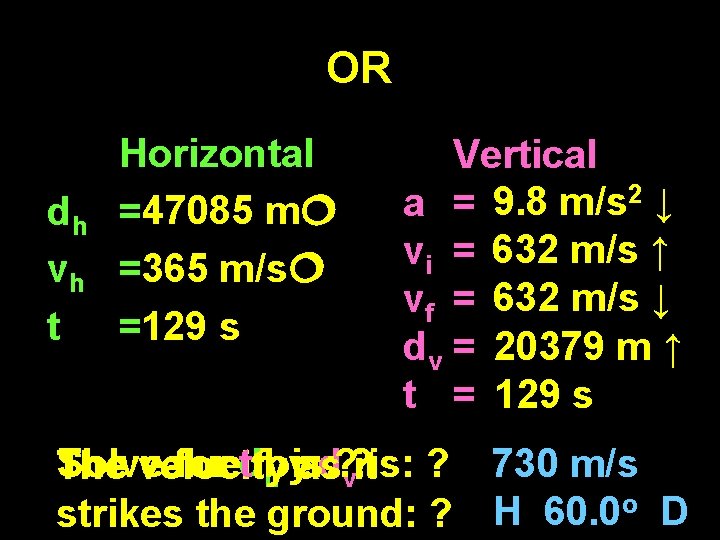
OR dh vh t Horizontal =47085 m =365 m/s =129 s Vertical 2 9. 8 m/s ↓ a = vi = 632 m/s ↑ vf = 632 m/s ↓ dv = 20379 m ↑ t = 129 s value d? v? itis: ? 730 m/s Solve for tdfor by: The velocity as h is: strikes the ground: ? H 60. 0 o D
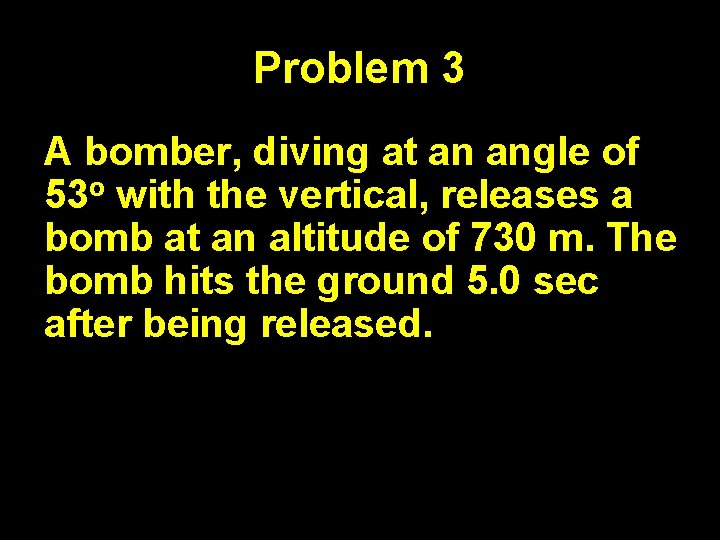
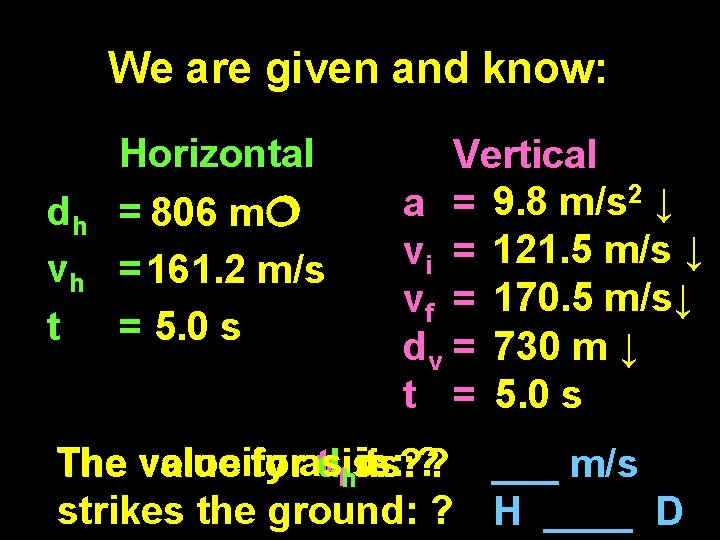
Problem 3 A bomber, diving at an angle of 53 o with the vertical, releases a bomb at an altitude of 730 m. The bomb hits the ground 5. 0 sec after being released.
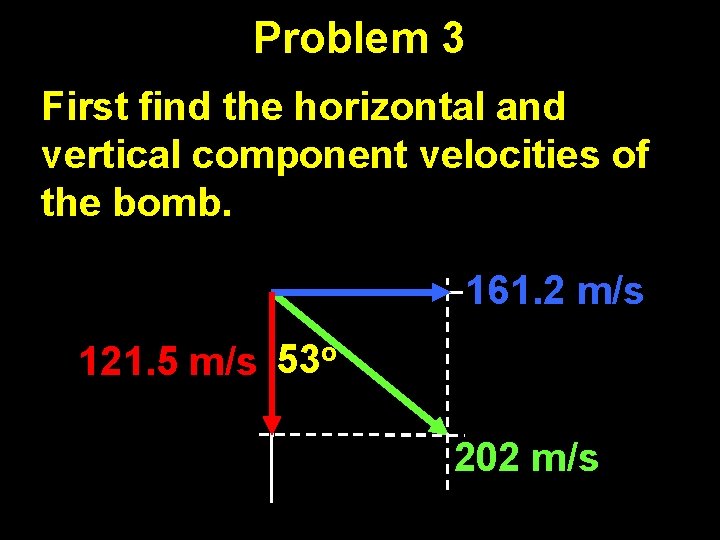
Problem 3 First find the horizontal and vertical component velocities of the bomb. 161. 2 m/s 121. 5 m/s 53 o 202 m/s
We are given and know: dh vh t Horizontal = 806 m = 161. 2 m/s = 5. 0 s Vertical 2 9. 8 m/s ↓ a = vi = 121. 5 m/s ↓ vf = 170. 5 m/s↓ dv = 730 m ↓ t = 5. 0 s velocity The value foras v is: t fis: d is: ? ? ? ___ m/s hit strikes the ground: ? H ____ D
Assumptions Projectile Motion 1. The effect air resistance has been ignored. Air resistance will shorten the horizontal distance a ball will go. A baseball projected to go 120 -m will only go 71. 4 -m.
Assumptions Projectile Motion 2. The acceleration due to gravity is constant. We will find that the acceleration due to gravity varies inversely proportional to the square of the distance from the center of the earth.
Assumptions Projectile Motion 3. The earth is assumed to be flat as the circumference is very large. Thus for large horizontal distances the calculated distance is not exactly correct.
Assumptions Projectile Motion 4. Projectile remains in same vertical plane during flight. A projectile launched directly north will not follow the longitudinal line from which it is launched due to the rotation of the earth on its axis.
Need for a computer When sending a rocket to the moon, constant calculations are needed to update the corrections need to get the rocket to the moon. When the computers went down on Apollo 13, there was nothing to update the data.
Apollo 13 Video Scene when aligning up spacecraft to enter earth’s atmosphere at the correct angle.
Article Notes from the Military
That’s all folks!