
Class Osteichthyes Bony Fish Class Osteichthyes Subphylum Vertebrata
Class Osteichthyes “Bony Fish”

Class Osteichthyes Subphylum Vertebrata Phylum Chordata Kingdom Animalia


General Characteristics • The largest (by species) class of vertebrates – Over 29, 000 known species • Bony skeleton of calcium • Dermal scales provide protection, but are very different from chondrichthyes scales – Epidermal mucous secretion=reduce friction • Bilateral symmetry – Appendages adapted for aquatic environment
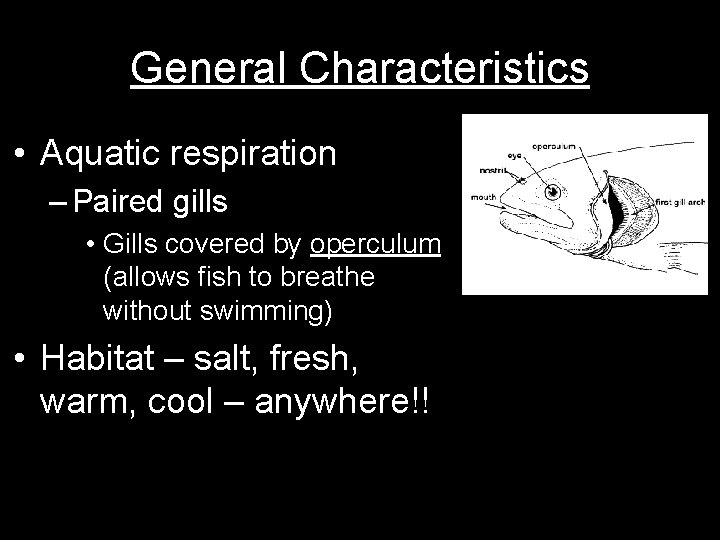
General Characteristics • Aquatic respiration – Paired gills • Gills covered by operculum (allows fish to breathe without swimming) • Habitat – salt, fresh, warm, cool – anywhere!!
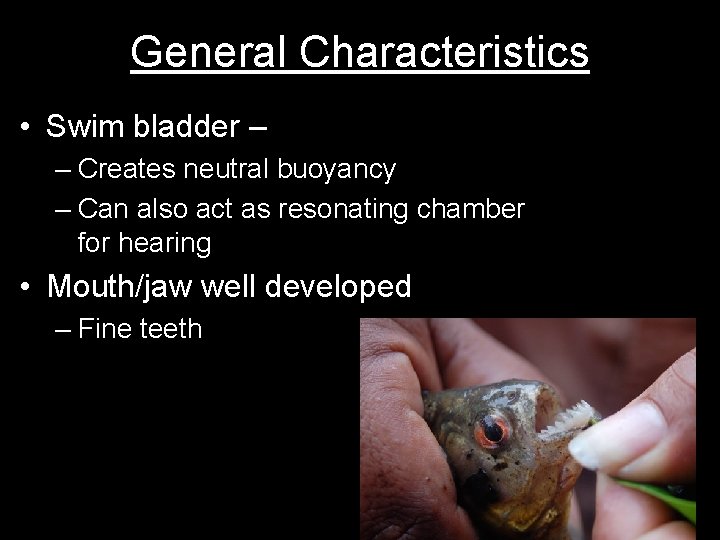
General Characteristics • Swim bladder – – Creates neutral buoyancy – Can also act as resonating chamber for hearing • Mouth/jaw well developed – Fine teeth

Scales • 3 types of scales – Ganoid • Very tough, external coating of protective enamel • Diamond shape, shiny • Uncommon in modern fish (found on sturgeon, gar)

Scales – Ctenoid • Terminate in tiny spines along posterior edge • Most common type of scale in bony fish
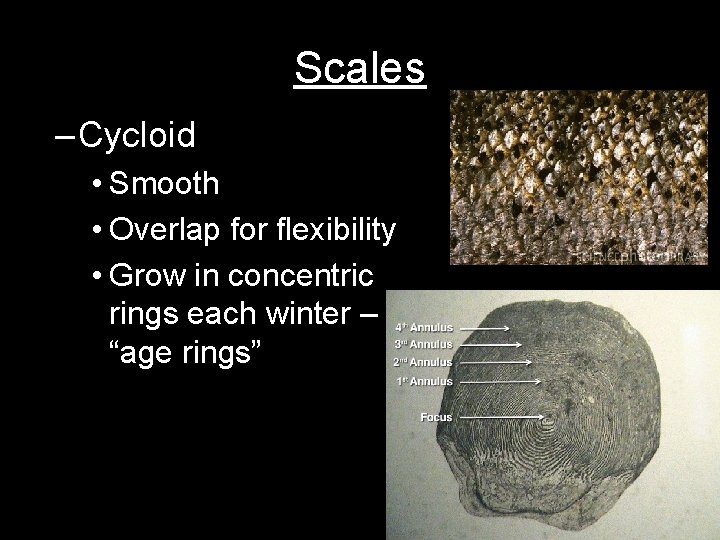
Scales – Cycloid • Smooth • Overlap for flexibility • Grow in concentric rings each winter – “age rings”
Skeleton • Endoskeleton – axial & appendicular – Axial – pertaining to the central axis of the body – skull, vertebrae, ribs, spines, caudal vertebrae – Appendicular – parts of the skeleton adjacent to the axial skeleton – pectoral girdle, pelvic girdle, fin rays
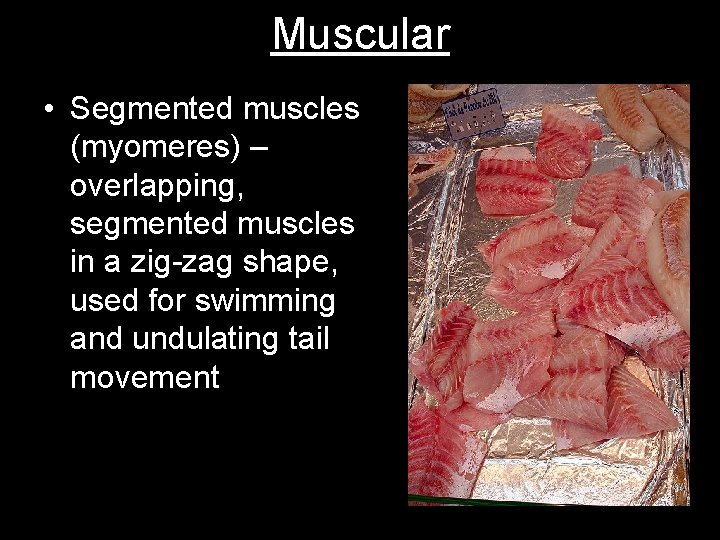
Muscular • Segmented muscles (myomeres) – overlapping, segmented muscles in a zig-zag shape, used for swimming and undulating tail movement
Digestive • Complete – mouth, pharynx, esophagus, stomach, pyloric valve, pyloric caeca, intestines, anus – Also have liver & gall bladder to aid in digestion
Circulatory • Closed – two chambered heart – Pericardial cavity with an auricle & a ventricle – Arteries lead away from heart to gills – veins return blood to the heart – Capillaries close the system between arteries & veins at the cells
Respiratory • Aquatic – gills – Gills covered by muscular plate – “operculum” – Gill filaments – minute capillaries for absorption of O 2 & excretion of Co 2 – Gill arch – provides cartilaginous support – Gill rakers – protect against foreign substance entering gills (cleaning & filtering water)
Excretory • Two kidneys – strains fluid nitrogenous waste – Ureter – Fluid tube leading to urinary bladder
Nervous system/sensory • Brain well developed – division of function • Nerve cord branches to lateral spinal nerves – Cerebral hemisphere – capable of “thinking” – Olfactory lobes – receive & process signals from nostrils • Nostrils – olfactory sacs pick up dissolved substances (aquatic smelling) – Auditory – inner ear • Otolith – bone growth for equilibrium & balance
Nervous system/sensory – Lateral line – picks up low frequency vibrations – aquatic touch/hearing – Optic lobes – midbrain area, process vision • Eyes – well developed, binocular – allow fish to be predaceous • See in color; some can see ultraviolet light – Taste buds – fish have taste preferences, can distinguish what’s “good”
Reproduction • External fertilization (oviparous) – most species – Brook trout – 80 eggs – Ocean sunfish – 5, 000 • A few species are viviparous
- Slides: 18