
Class Number CS 486 Class Name Mobile and

Class Number – CS 486 Class Name – Mobile and Sensor Data Management Instructor – Sanjay Madria Lesson Title - Introduction
What is Pervasive Computing? • “Pervasive computing is a term for the strongly emerging trend toward: – Numerous, casually accessible, often invisible computing devices – Frequently mobile or embedded in the environment – Connected to an increasingly ubiquitous network structure. ” – NIST, Pervasive Computing 2001
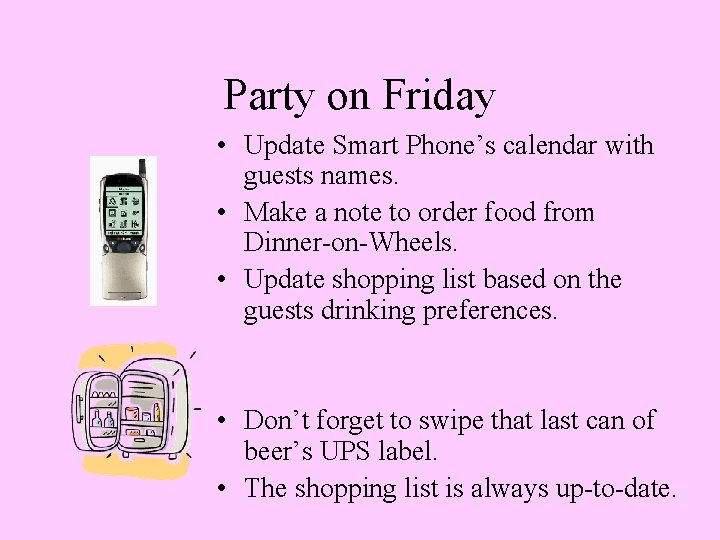
Party on Friday • Update Smart Phone’s calendar with guests names. • Make a note to order food from Dinner-on-Wheels. • Update shopping list based on the guests drinking preferences. • Don’t forget to swipe that last can of beer’s UPS label. • The shopping list is always up-to-date.
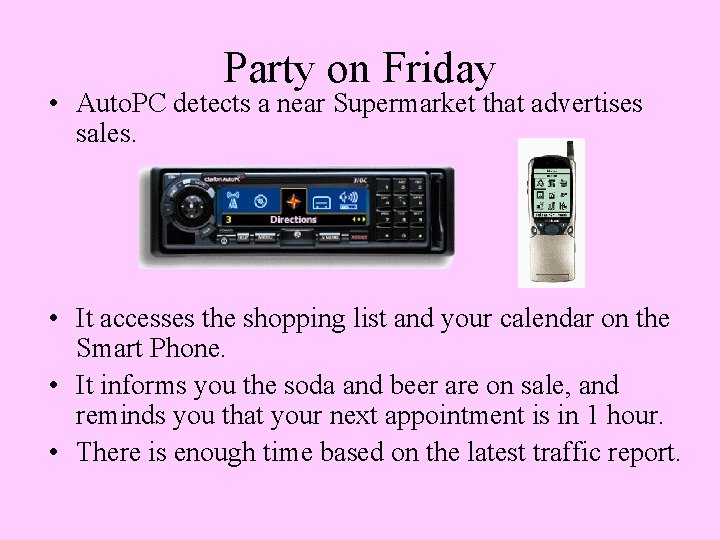
Party on Friday • Auto. PC detects a near Supermarket that advertises sales. • It accesses the shopping list and your calendar on the Smart Phone. • It informs you the soda and beer are on sale, and reminds you that your next appointment is in 1 hour. • There is enough time based on the latest traffic report.
Party on Friday • Smart Phone reminds you that you need to order food by noon. • It downloads the Dinner-on-Wheels menu from the Web on your PC with the guests’ preferences marked. • It sends the shopping list to your CO-OP’s PC. • Everything will be delivered by the time you get home in the evening.
Mobile Applications • Expected to create an entire new class of Applications – new massive markets in conjunction with the Web – Mobile Information Appliances - combining personal computing and consumer electronics • Applications: – Vertical: vehicle dispatching, tracking, point of sale – Horizontal: mail enabled applications, filtered information provision, collaborative computing…
Mobile and Wireless Computing • Goal: Access Information Anywhere, Anytime, and in Any Way. • Aliases: Mobile, Nomadic, Wireless, Pervasive, Invisible, Ubiquitous Computing. • Distinction: 1. Fixed wired network: Traditional distributed computing. 2. Fixed wireless network: Wireless computing. 3. Wireless network: Mobile Computing. 1. Key Issues: Wireless communication, Mobility, Portability.
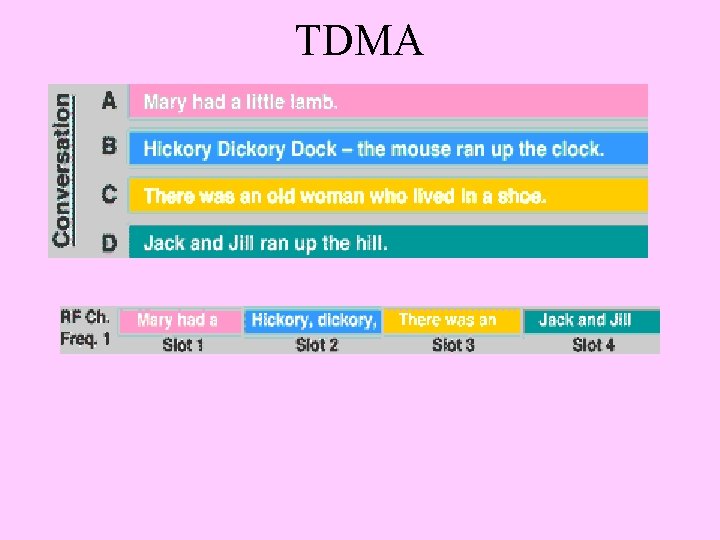
Terminologies • GSM - Global System for Mobile Communication – GSM allows eight simultaneous calls on the same radio frequency and uses narrowband TDMA. It uses time as well as frequency division. • TDMA - Time Division Multiple Access – With TDMA, a frequency band is chopped into several channels or time slots which are then stacked into shorter time units, facilitating the sharing of a single channel by several calls • CDMA - Code Division Multiple Access – data can be sent over multiple frequencies simultaneously, optimizing the use of available bandwidth. – data is broken into packets, each of which are given a unique identifier, so that they can be sent out over multiple frequencies and then re-built in the correct order by the receiver.
TDMA
Wireless Technologies • Wireless local area networks (Wave. Lan, Aironet) – Possible Transmission error, 1. 2 Kbps-15 Mbps • Cellular wireless (GSM, TDMA, CDMA)– Low bandwidth, low speed, long range - Digital: 9. 6 -14. 4 Kbps • Packet radio (Metricom) -Low bandwidth, high speed, low range and cost • Paging Networks – One way • Satellites (Inmarsat, Iridium(LEO)) – Long Latency, long range, high cost
Mobile Network Architecture
Wireless characteristics • Variant Connectivity – Low bandwidth and reliability • Frequent disconnections • predictable or sudden • Asymmetric Communication – Broadcast medium • Monetarily expensive – Charges per connection or per message/packet Ø Connectivity is weak, intermittent and expensive
Portable Information Devices • PDAs, Personal Communicators – – Light, small and durable to be easily carried around dumb terminals, palmtops, wristwatch PC/Phone, will run on AA+ /Ni-Cd/Li-Ion batteries may be diskless • I/O devices: Mouse is out, Pen is in • Wireless connection to information networks – either infrared or cellular phone • Specialized Hardware (for compression/encryption)
Portability Characteristics • Battery power restrictions – transmit/receive, disk spinning, display, CPUs, memory consume power • Battery lifetime will see very small increase – need energy efficient hardware (CPUs, memory) and system software – planned disconnections - doze mode Ø Power consumption vs. resource utilization
Portability Characteristics Cont. • Resource constraints – Mobile computers are resource poor – Reduce program size – interpret script languages (Mobile Java? ) – Computation and communication load cannot be distributed equally • Small screen sizes Ø Asymmetry between static and mobile computers
Mobility Characteristics • Location changes • location management - cost to locate is added to communication • Heterogeneity in services – bandwidth restrictions and variability • Dynamic replication of data • data and services follow users • Querying data - location-based responses • Security and authentication Ø System configuration is no longer static
What Needs to be Reexamined? • • • Operating systems - Tiny. OS File systems - CODA Data-based systems – Tiny. DB Communication architecture and protocols Hardware and architecture Real-Time, multimedia, Qo. S Security Application requirements and design PDA design: Interfaces, Languages
Mobility Constraints • • • CPU Power Variable Bandwidth Delay tolerance, but unreliable Physical size Constraints on peripherals and GUIs Frequent Location changes Security Heterogeneity Expensive Frequent disconnections but predictable
What is Mobility? • A device that moves between – different geographical locations – Between different networks • A person who moves between – different geographical locations – different networks – different communication devices – different applications
Device mobility • Laptop moves between Ethernet, Wave. LAN and Metricom networks – Wired and wireless network access – Potentially continuous connectivity, but may be breaks in service – Network address changes – Radically different network performance on different networks – Network interface changes • Can we achieve best of both worlds? – Continuous connectivity of wireless access – Performance of better networks when available
Mobility Means Changes • Addresses – IP addresses • Network performance – Bandwidth, delay, bit error rates, cost, connectivity • Network interfaces – PPP, eth 0, strip • Between applications – Different interfaces over phone & laptop • Within applications – Loss of bandwidth trigger change from color to B&W • Available resources – Files, printers, displays, power, even routing
Bandwidth Management • Clients assumed to have weak and/or unreliable communication capabilities • Broadcast--scalable but high latency • On-demand--less scalable and requires more powerful client, but better response • Client caching allows bandwidth conservation
Energy Management • Battery life expected to increase by only 20% in the next 10 years • Reduce the number of messages sent • Doze modes • Power aware system software • Power aware microprocessors • Indexing wireless data to reduce tuning time
Why Mobile Data Management? • Wireless Connectivity and use of PDA’s, handheld computing devices on the rise • Workforces will carry extracts of corporate databases with them to have continuous connectivity • Need central database repositories to serve these work groups and keep them fairly upto-date and consistent
Mobile Data Applications • Sales Force Automation - especially in pharmaceutical industry, consumer goods, parts • Financial Consulting and Planning • Insurance and Claim Processing - Auto, General, and Life Insurance • Real Estate/Property Management Maintenance and Building Contracting • Mobile E-commerce
Mobility – Impact on DBMS • • • Handling/representing fast-changing data Scale Data Shipping v/s Query shipping Transaction Management Replica management Integrity constraint enforcement Recovery Location Management Security User interfaces
DBMS Industry Scenario • Most RDBMS vendors support the mobile scenario but no design and optimization aids • Specialized Environments for mobile applications: Sybase Remote Server Synchrologic i. MOBILE Microsoft SQL server - mobile application support Oracle Lite Xtnd-Connect-Server (Extended Technologies) Scoutware (Riverbed Technologies)
Query Processing • New Issues – Energy Efficient Query Processing – Location Dependent Query Processing • Old Issues - New Context – Cost Model
Location Management • New Issues – Tracking Mobile Users • Old Issues - New Context – Managing Update Intensive Location Information – Providing Replication to Reduce Latency for Location Queries – Consistent Maintenance of Location Information
Transaction Processing • • • New Issues – Recovery of Mobile Transactions – Lock Management in Mobile Transaction Old Issues - New Context Extended Transaction Models – Partitioning Objects while Maintaining Correctness
Data Processing Scenario • One server or many servers • Shared Data • Some Local Data per client , mostly subset of global data • Need for accurate, up-to-date information, but some applications can tolerate bounded inconsistency • Client side and Server side Computing • Long disconnection should not constraint availability • Mainly Serial Transactions at Mobile Hosts • Update Propagation and Installation
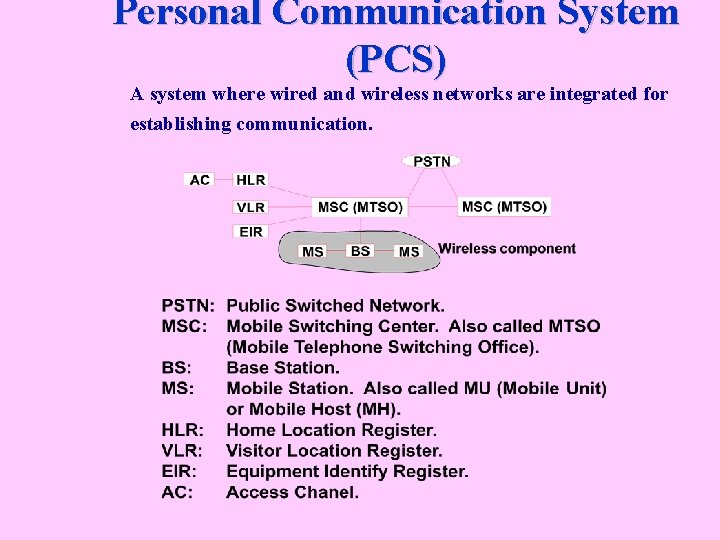
Personal Communication System (PCS) A system where wired and wireless networks are integrated for establishing communication.
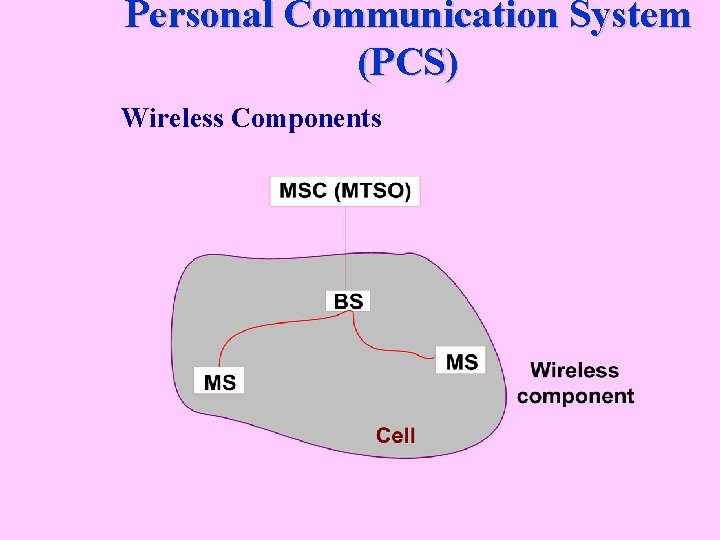
Personal Communication System (PCS) Wireless Components
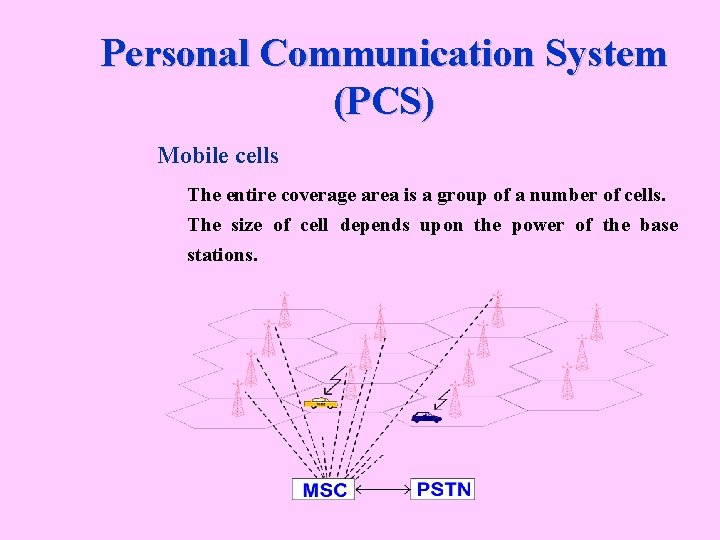
Personal Communication System (PCS) Mobile cells The entire coverage area is a group of a number of cells. The size of cell depends upon the power of the base stations.
Personal Communication System (PCS) Problems with cellular structure v How to maintain continuous communication between two parties in the presence of mobility? Solution: Handoff v How to maintain continuous communication between two parties in the presence of mobility? Solution: Roaming v How to locate of a mobile unit in the entire coverage area? Solution: Location management
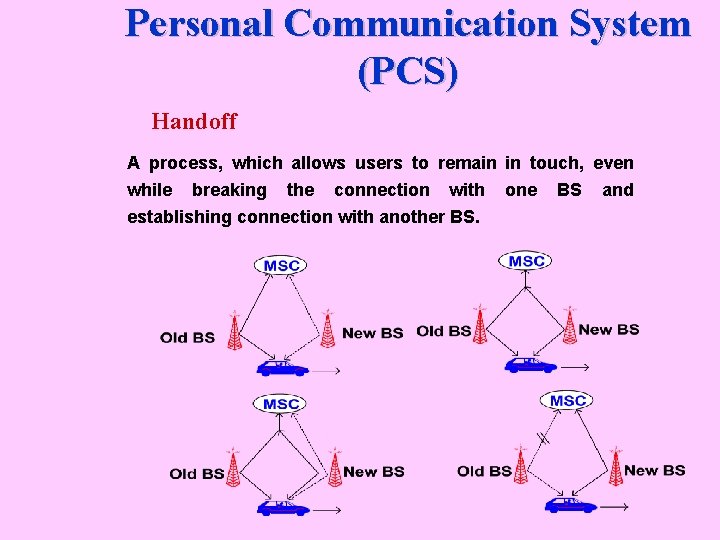
Personal Communication System (PCS) Handoff A process, which allows users to remain in touch, even while breaking the connection with establishing connection with another BS. one BS and
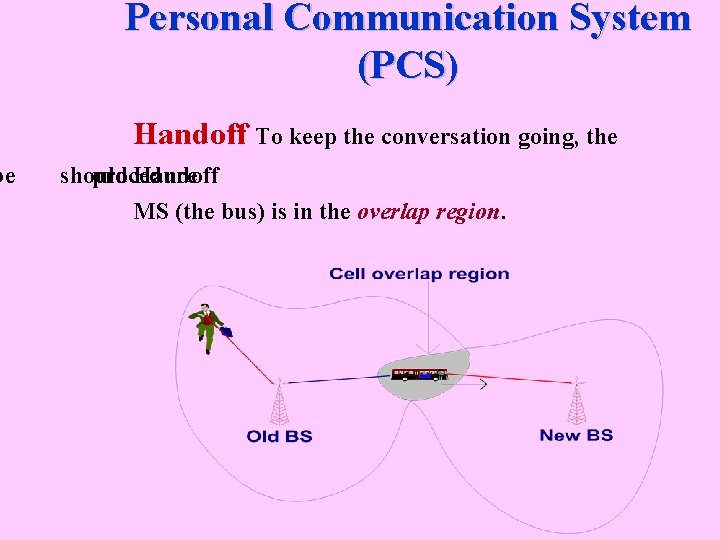
be Personal Communication System (PCS) Handoff To keep the conversation going, the should procedure Handoff MS (the bus) is in the overlap region.
Personal Communication System (PCS) Roaming v Roaming is a facility, which allows a subscriber to enjoy uninterrupted communication from anywhere in the entire coverage space. v A mobile network coverage space may be managed by a number of different service providers. They must cooperate with each other to provide roaming facility. v Roaming can be provided only if some administrative and technical constraints are met.
Personal Communication System (PCS) Roaming Administrative constraints v Billing. v Subscription agreement. v Call transfer charges. v User profile and database sharing. v Any other policy constraints.
Personal Communication System (PCS) Roaming Technical constraints v Bandwidth mismatch. For example, European 900 MHz band may not be available in other parts of the world. v Integration of a new service provider into the network. A roaming subscriber must be able to detect this new provider. v Service providers must be able to communicate with each other. Needs some standard. v Mobile station constraints.
Personal Communication System (PCS) Roaming Two basic operations management are in roaming v Registration (Location update): The process of informing the presence or arrival of a MU to a cell. v Location tracking: the process of locating the desired MU.
Personal Communication System (PCS) Roaming Registration (Location update): There are six different types of registration. v Power-down registration. Done by the MU when it intends to switch itself off. v Power-up registration. Opposite to power-down registration. When an MU is switched on, it registers. v Deregistration. A MU decides to acquire control channel service on a different type of network (public, private, or residential).
Personal Communication System (PCS) Roaming Registration (Location update): There are six different types of registration. v v v New system/Location area registration: when the location area of the MU changes, it sends a registration message. Periodic registration: A MU may be instructed to periodically register with the network. Forced registration: A network may, under certain circumstances, force all MUs to register.
Personal Communication System (PCS) Registration Two-Tier Scheme HLR: Home Location Register A HLR stores user profile and the geographical location of each moving object at a prespecified location VLR: Visitor Location Register A VLR stores user profile and the current location who is a visitor to a different cell than its home cell.
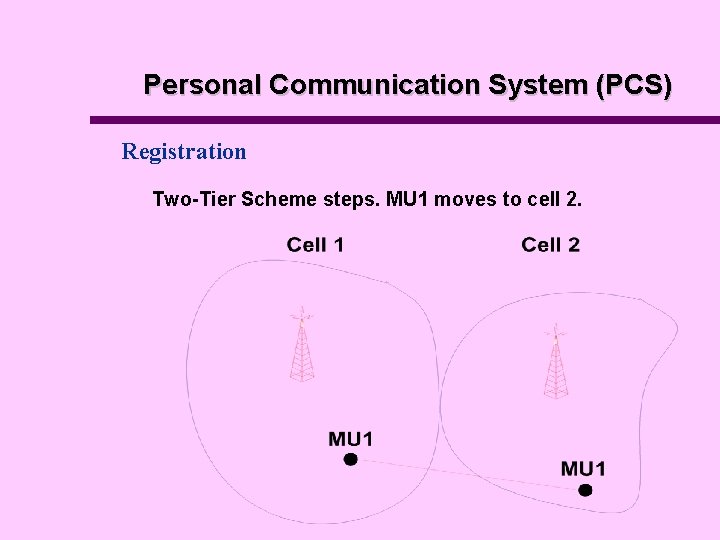
Personal Communication System (PCS) Registration Two-Tier Scheme steps. MU 1 moves to cell 2.
Personal Communication System (PCS) Registration Steps 1. MU 1 moves to cell 2. The MSC of cell 2 launches a registration query to its VLR 2 sends a registration message containing MU’s identity (MIN), which can be translated to HLR address. 3. After registration, HLR sends an acknowledgment back to VLR 2. 4. HLR sends a deregistration message to VLR 1 (of cell 1) to delete the record of MU 1 (obsolete). acknowledges the cancellation. VLR 1
Personal Communication System (PCS) Location tracking (MU 2 wants to communicate with MU 1) Steps 1. VLR of cell 2 is searched for MU 1’s profile. 2. If it is not found, then HLR is searched. 3. Once the location of MU 1 is found, then the information is sent to the base station of cell 1. 4. Cell 1 establishes the communication.
- Slides: 48