
Class Notes Kinetic Theory and States of Matter


- Slides: 10
Class Notes: Kinetic Theory and States of Matter
http: //www. kentchemistry. com/links/Matter/phases. htm
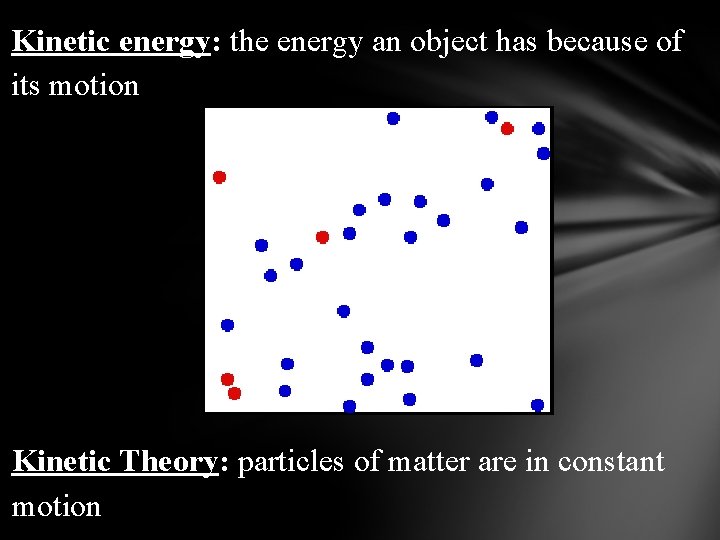
Kinetic energy: the energy an object has because of its motion Kinetic Theory: particles of matter are in constant motion
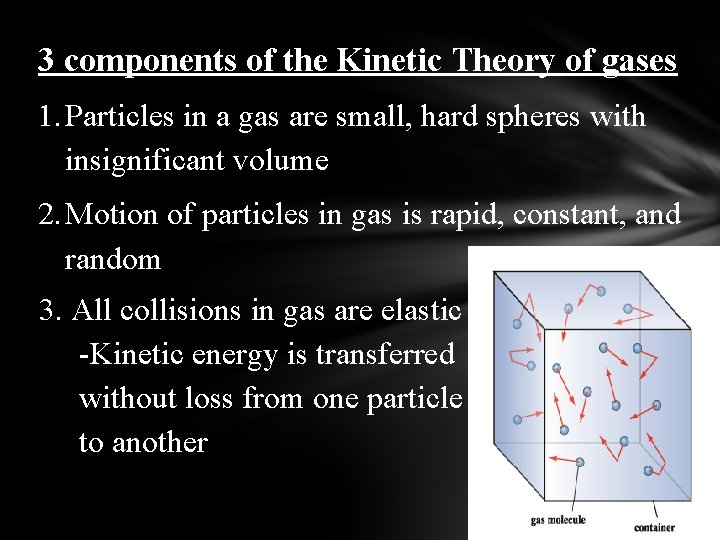
3 components of the Kinetic Theory of gases 1. Particles in a gas are small, hard spheres with insignificant volume 2. Motion of particles in gas is rapid, constant, and random 3. All collisions in gas are elastic -Kinetic energy is transferred without loss from one particle to another
*Behavior of gas depends on its volume, pressure, and temperature When a substance is heated it absorbs energy This speeds up particles = increase kinetic energy (this causes an increase in temperature) http: //chemsite. lsrhs. net/Atoms. In. Motion/KMT. html
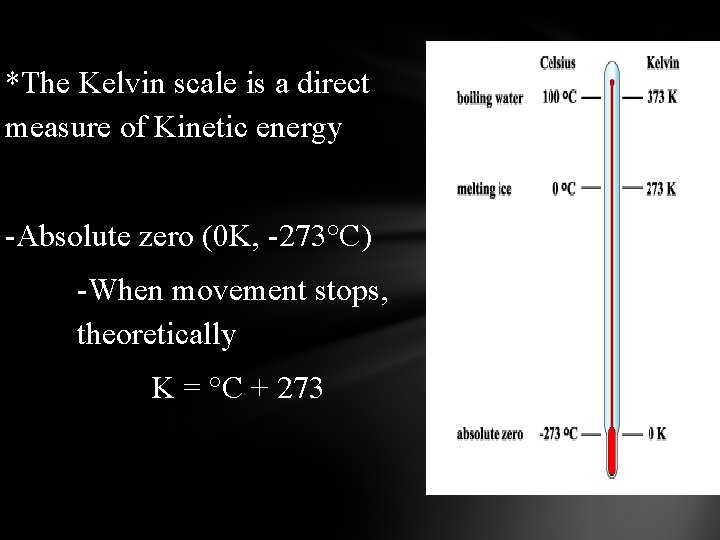
*The Kelvin scale is a direct measure of Kinetic energy -Absolute zero (0 K, -273°C) -When movement stops, theoretically K = °C + 273
Gas pressure = force of gas particles colliding with container walls Scales to measure pressure 1 atm = 760 mm. Hg = 101. 3 k. Pa = 760 Torr
Facts about liquids - Particles are in motion but they are held together by weak attractive forces, therefore they slide and flow - Most particles do not have enough kinetic energy to escape the attractive forces
- Liquids are more dense than gases because the forces of attraction between the particles pull them close together - increasing pressure has little effect on volume
Characteristics of Solids: -Motion in a solid is about a fixed point, not random and chaotic -Particles are solidly packed and organized -Solids are dense, incompressible and do not flow