
Class NeoMarxist and Neo Weberian Analyses By Scott

Class: Neo-Marxist and Neo. Weberian Analyses By Scott Tuttle
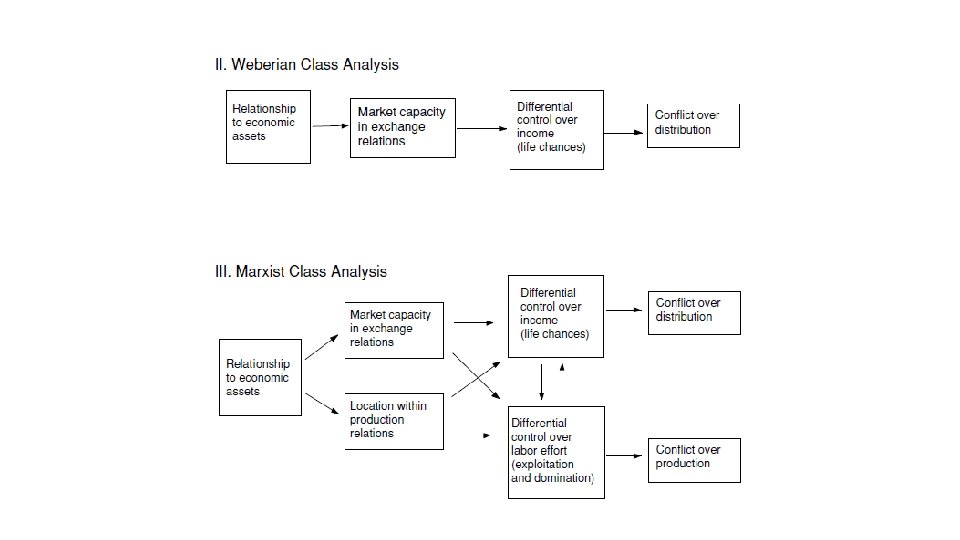
(Wright, 2005) Foundations of a neo. Marxist class analysis. • Marxist concept of class: Unique from others in it’s emphasis on exploitation • Normative dimension: Neo-Marxist Class analysis is rooted in normative commitments to some form of “radical egalitarianism” • Class relation and class structure at the core of Marxist analysis • Class structure-how class is determined (by ownership of the means of production, labor power) • Class relation-the struggles and the “conflict” between the two main classes
8 Concepts in Marxist Class Analysis • social relations of production • the idea of class relations • “variations” of class relations • complexity in class relations • “location” within class relations • complexity in specifying class locations • Micro vs macro levels of analysis • Agency
3 Criteria for Exploitation • The inverse interdependent welfare principle: “The material welfare of exploiters causally depends upon the material deprivations of the exploited” –antagonistic relationship, brings harm to exploited • The exclusion principle: “This inverse interdependence of the welfare of exploiters and exploited depends upon the exclusion of the exploited from access to certain productive resources” • The appropriation principle: “Exclusion generates material advantage to exploiters because it enables them to appropriate the labor effort of the exploited” Exploiters need the exploited in this relationship
Question 1 • Can anyone think of an example of non-exploitative economic oppression?
(Breen, 2005) Foundations of a neo. Weberian class analysis. • Weber’s view on social class: Emphasizes “life chances” in gaining valued outcomes • Can be determined by the market • Depends on what individuals bring to it (this can include property ownership, skills, other assets) • All these assets only have value in the context of a market (class situation is identified with market situation)
4 Major Social Classes-Weber • The haute bourgeoisie “Dominant entrepreneurial and propertied groups” • The petty bourgeoisie-small business owners, farmers, etc • “Workers with formal credentials” (the middle class) • Workers whose “only asset is their labor power” (the working class). Classes are separated by social mobility-it is hard to move between these classes, but not so hard to move within them. Classes aren’t the only place where power is distributed. There also status groups and parties.
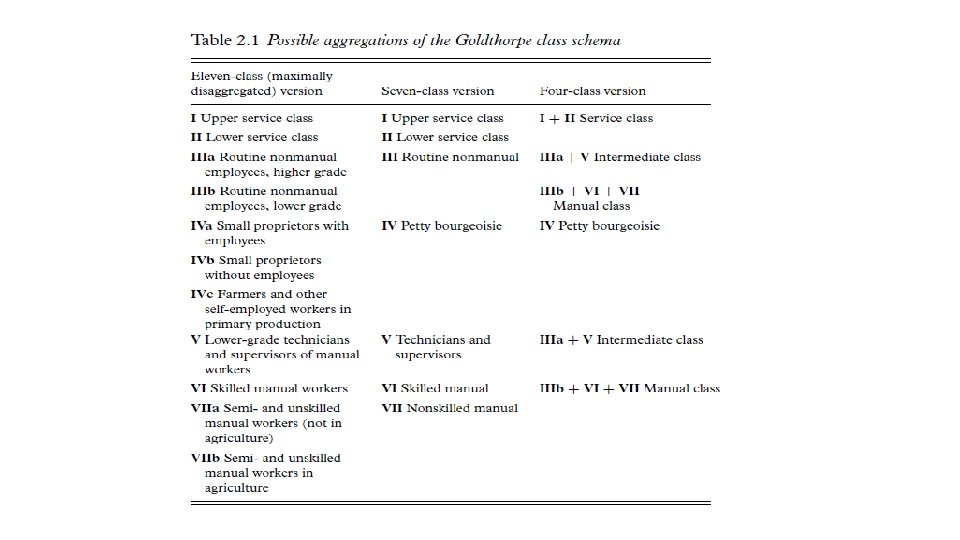
Goldthorpe (2000)-Class Schema • Positions classified according to 1) relationship to the means of production and 2) kind of employment relationship • 4 dimensions: asset specificity, monitoring difficulty, labor contracts, service relationships • Asset specificity: is the job high-skilled, low-skilled, require training? • Monitoring difficulty: when its hard to tell if employee is acting in the employer’s interests • Labor contracts: physical labor, perhaps blue-collar • Service relationships: less physical, perhaps white-collar
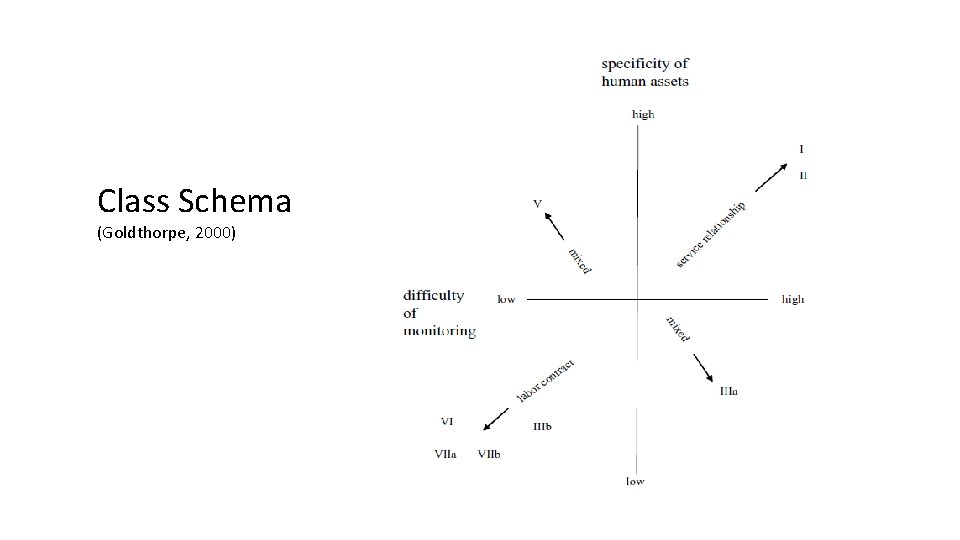
Class Schema (Goldthorpe, 2000)

Question 2 • Think about your own research on class conflict (or paper proposals). Does your approach more resemble a neo-Marxist or neo-Weberian analysis? Why?
- Slides: 12