
CLASS Keys TM Module 1 Content and Structure
- Slides: 13
CLASS Keys TM Module 1: Content and Structure Spring 2010 Teacher and Leader Quality Education Support and Improvement “We will lead the nation in improving student achievement. ”
Resources and Materials Teachers will need the following resources and materials for this module: • CLASS Keys™ Notebook • Handouts 1 A, 1 B, 1 C, 1 D, and 1 E • Handout 1 F will be given out after slide 12. • Module 1 Power. Point
Module Objectives § Introduces teachers to the CLASS Keys™ Evaluation System. § Introduces teachers to the five CLASS Keys™ strands. § Introduces teachers to the 28 CLASS Keys™ elements. § Allows teachers to assess their background knowledge regarding the strands and elements. § Allows teachers to begin to fill the gaps in their knowledge regarding the strands and elements.
The CLASS Keys™ Evaluation System is designed to: • Evaluate classroom teachers using qualitative rubrics to assess their instructional practices. • Evaluate classroom teachers on the basis of the academic gains of their students. • Engage teachers in their own assessment and professional growth. • Increase the quantity and quality of feedback that teachers receive from their evaluator(s). • Use an array of evidence collected over time to assess teacher performance and student learning.
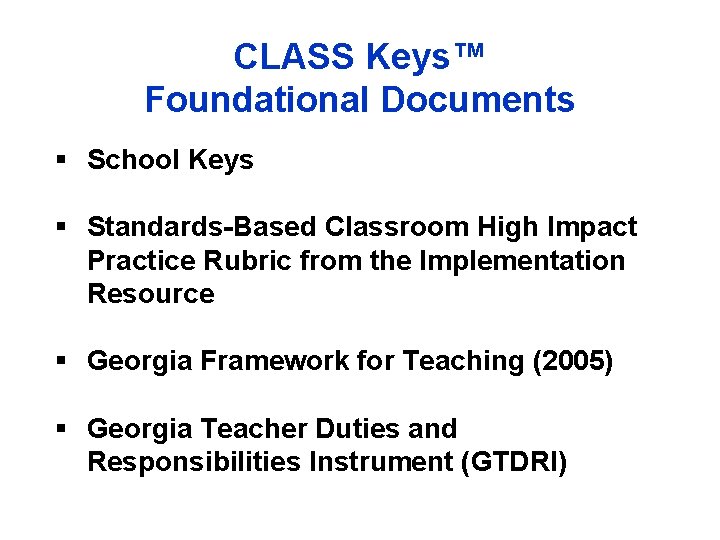
CLASS Keys™ Foundational Documents § School Keys § Standards-Based Classroom High Impact Practice Rubric from the Implementation Resource § Georgia Framework for Teaching (2005) § Georgia Teacher Duties and Responsibilities Instrument (GTDRI)
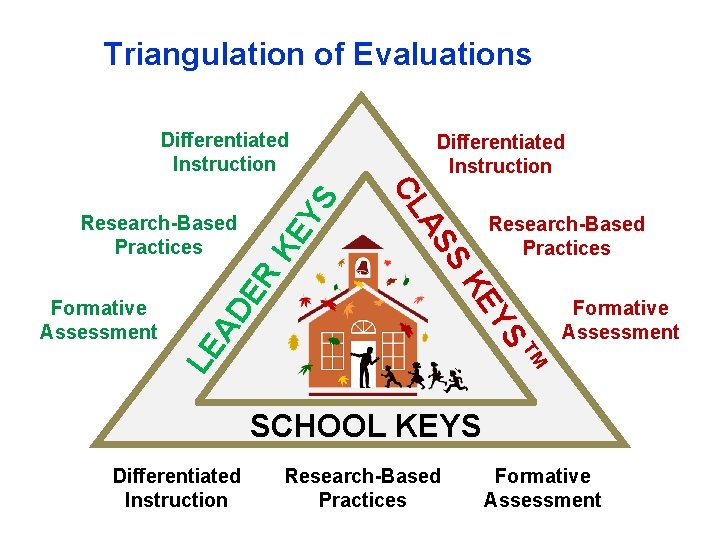
Triangulation of Evaluations LE AD ER Research-Based Practices ™ YS KE Formative Assessment Differentiated Instruction S AS CL Research-Based Practices KE YS Differentiated Instruction Formative Assessment SCHOOL KEYS Differentiated Instruction Research-Based Practices Formative Assessment
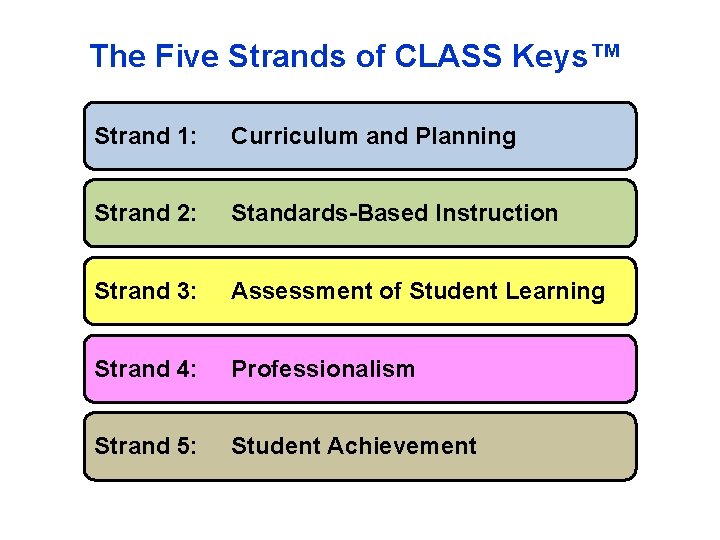
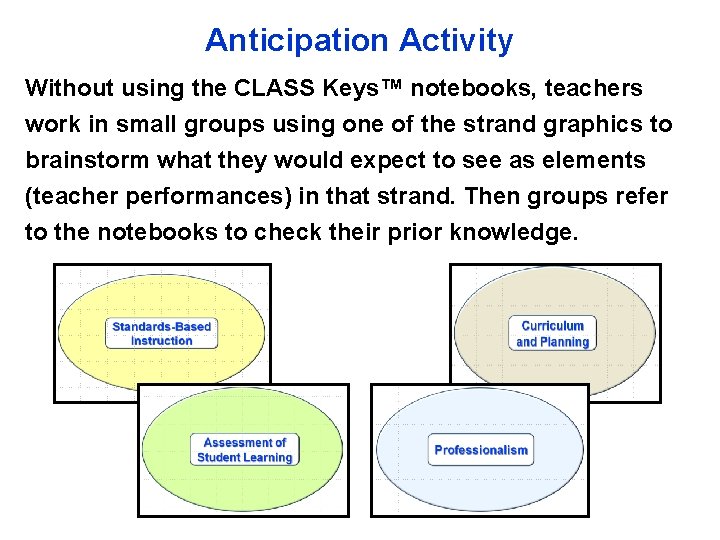
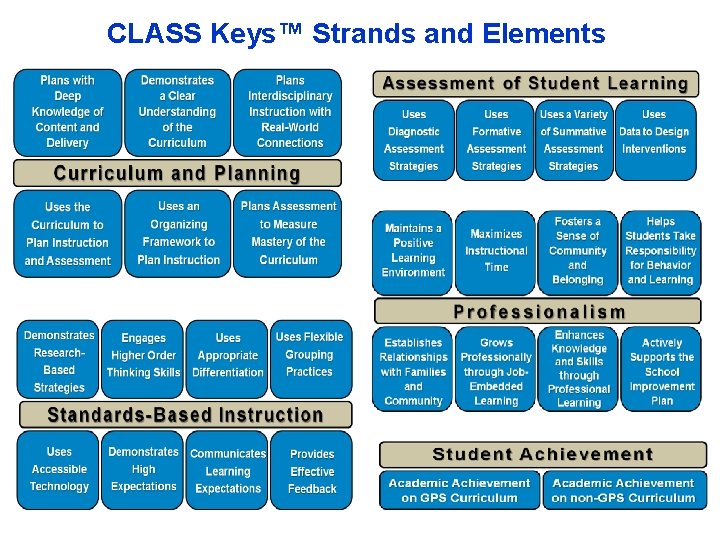
The Five Strands of CLASS Keys™ Strand 1: Curriculum and Planning Strand 2: Standards-Based Instruction Strand 3: Assessment of Student Learning Strand 4: Professionalism Strand 5: Student Achievement
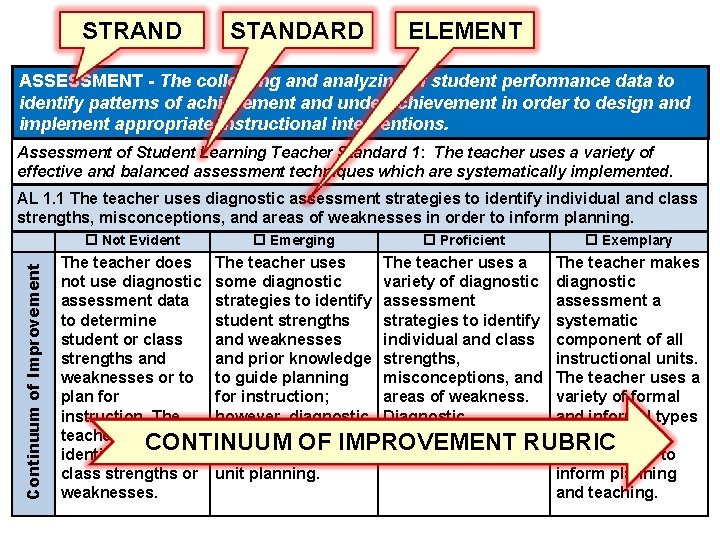
STRAND STANDARD ELEMENT ASSESSMENT - The collecting and analyzing of student performance data to identify patterns of achievement and underachievement in order to design and implement appropriate instructional interventions. Assessment of Student Learning Teacher Standard 1: The teacher uses a variety of effective and balanced assessment techniques which are systematically implemented. AL 1. 1 The teacher uses diagnostic assessment strategies to identify individual and class strengths, misconceptions, and areas of weaknesses in order to inform planning. Continuum of Improvement Not Evident Emerging Proficient Exemplary The teacher does The teacher uses a The teacher makes not use diagnostic some diagnostic variety of diagnostic assessment data strategies to identify assessment a to determine student strengths strategies to identify systematic student or class and weaknesses individual and class component of all strengths and prior knowledge strengths, instructional units. weaknesses or to to guide planning misconceptions, and The teacher uses a plan for instruction; areas of weakness. variety of formal instruction. The however, diagnostic Diagnostic and informal types teacher does not assessment is part of diagnostic CONTINUUM OF IMPROVEMENT RUBRIC identify student or an integral part of of most planning. assessments to class strengths or unit planning. inform planning weaknesses. and teaching.
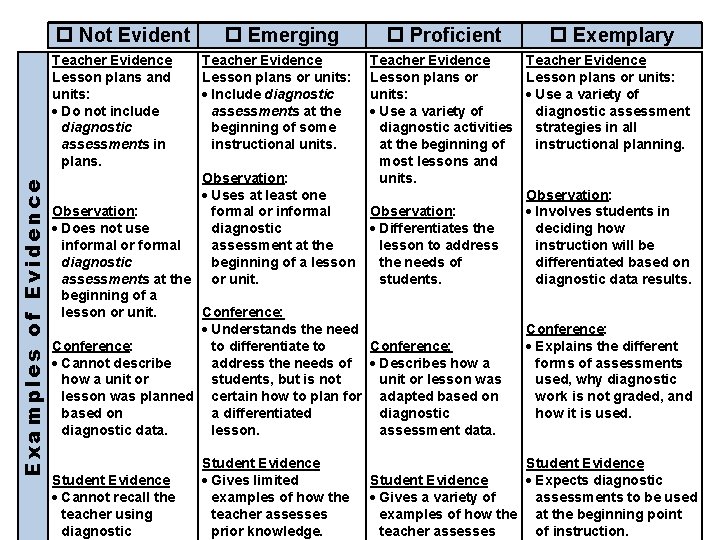
Not Evident Examples of Evidence Teacher Evidence Lesson plans and units: Do not include diagnostic assessments in plans. Emerging Teacher Evidence Lesson plans or units: Include diagnostic assessments at the beginning of some instructional units. Proficient Teacher Evidence Lesson plans or units: Use a variety of diagnostic assessment diagnostic activities strategies in all at the beginning of instructional planning. most lessons and units. Observation: Involves students in Differentiates the deciding how lesson to address instruction will be the needs of differentiated based on students. diagnostic data results. Observation: Uses at least one formal or informal Observation: diagnostic Does not use assessment at the informal or formal beginning of a lesson diagnostic assessments at the or unit. beginning of a Conference: lesson or unit. Understands the need to differentiate to Conference: address the needs of Describes how a Cannot describe students, but is not how a unit or lesson was planned certain how to plan for adapted based on a differentiated based on diagnostic lesson. diagnostic data. assessment data. Student Evidence Cannot recall the teacher using diagnostic Student Evidence Gives limited examples of how the teacher assesses prior knowledge. Exemplary Conference: Explains the different forms of assessments used, why diagnostic work is not graded, and how it is used. Student Evidence Expects diagnostic Student Evidence assessments to be used Gives a variety of examples of how the at the beginning point of instruction. teacher assesses
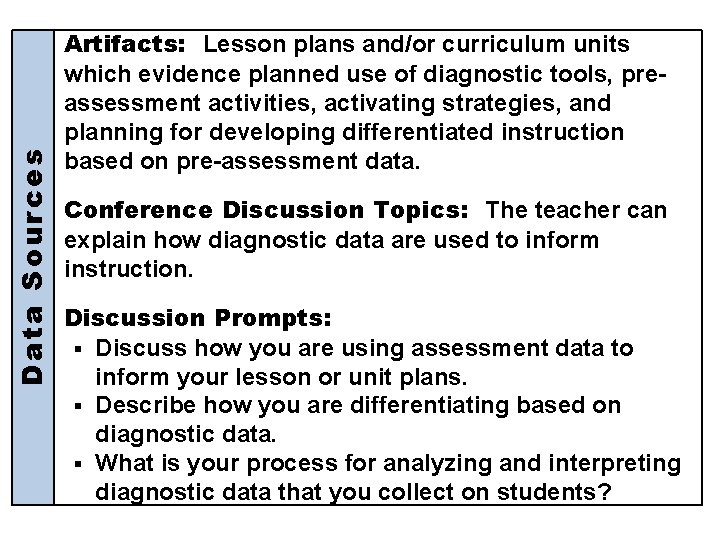
Data Sources Artifacts: Lesson plans and/or curriculum units which evidence planned use of diagnostic tools, preassessment activities, activating strategies, and planning for developing differentiated instruction based on pre-assessment data. Conference Discussion Topics: The teacher can explain how diagnostic data are used to inform instruction. Discussion Prompts: § Discuss how you are using assessment data to inform your lesson or unit plans. § Describe how you are differentiating based on diagnostic data. § What is your process for analyzing and interpreting diagnostic data that you collect on students?
Anticipation Activity Without using the CLASS Keys™ notebooks, teachers work in small groups using one of the strand graphics to brainstorm what they would expect to see as elements (teacher performances) in that strand. Then groups refer to the notebooks to check their prior knowledge.
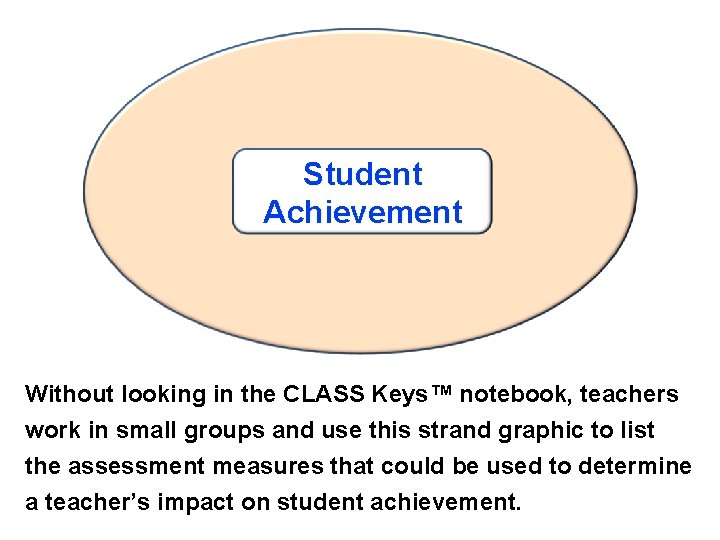
Student Achievement Without looking in the CLASS Keys™ notebook, teachers work in small groups and use this strand graphic to list the assessment measures that could be used to determine a teacher’s impact on student achievement.
CLASS Keys™ Strands and Elements