
Class Experiment The Tipping Point M Gladwell The
- Slides: 15
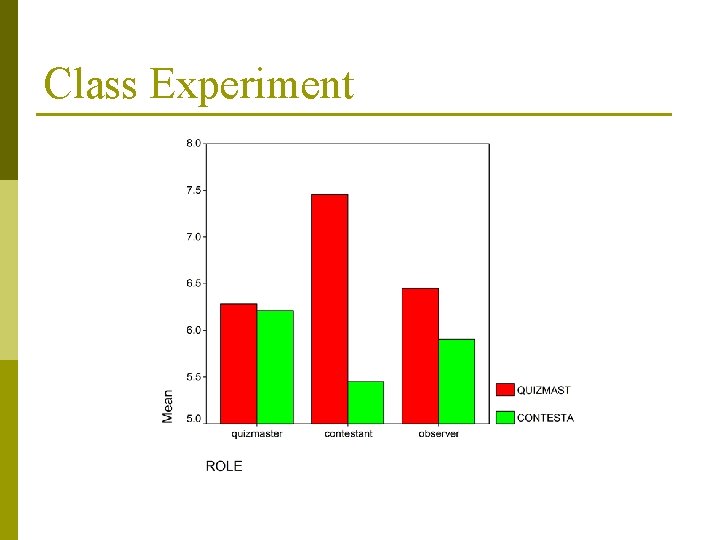
Class Experiment
The Tipping Point (M. Gladwell) “The Tipping Point is the biography of an idea and the idea is very simple. It is that the best way to understand the emergence of fashion trends, the ebb and flow of crime waves, or, for that matter, the transformation of unknown books into bestsellers, or the rise in teenage smoking, or the phenomenon of word of mouth, or any number of the other mysterious changes that mark everyday life is to think of them as epidemics. Ideas and products and messages and behaviors spread just like viruses do. ”
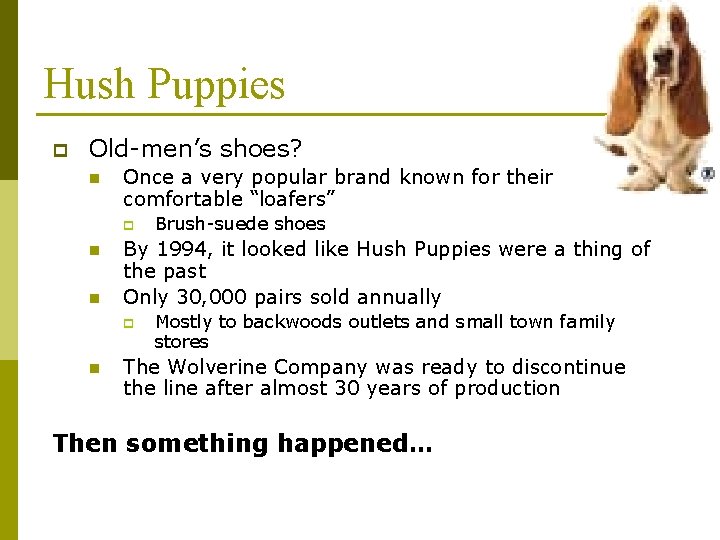
Hush Puppies p Old-men’s shoes? n Once a very popular brand known for their comfortable “loafers” p n n By 1994, it looked like Hush Puppies were a thing of the past Only 30, 000 pairs sold annually p n Brush-suede shoes Mostly to backwoods outlets and small town family stores The Wolverine Company was ready to discontinue the line after almost 30 years of production Then something happened…
Hush-Puppies “Tipped” p Two Hush Puppy executives learned that Hush Puppies had suddenly become “hip” and “cool” in Manhattan Night-clubs n p The shoes were being bought in thrift stores in the Village and SOHO and becoming hard to find Why would such unfashionable shoes suddenly become fashionable?
Hush-Puppies “Tipped” p p By 1995, Fashion Designers wanted to use Hush Puppies in their upcoming fashion shows A Los Angeles designer put a 25 -foot Bassett-Hound on the roof of his Hollywood store and gutted an adjacent art gallery to turn it into a “Hush Puppy” boutique
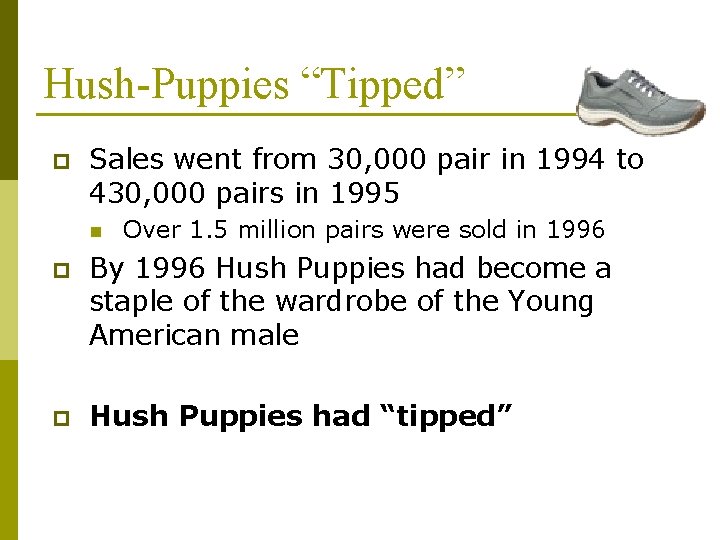
Hush-Puppies “Tipped” p Sales went from 30, 000 pair in 1994 to 430, 000 pairs in 1995 n Over 1. 5 million pairs were sold in 1996 p By 1996 Hush Puppies had become a staple of the wardrobe of the Young American male p Hush Puppies had “tipped”
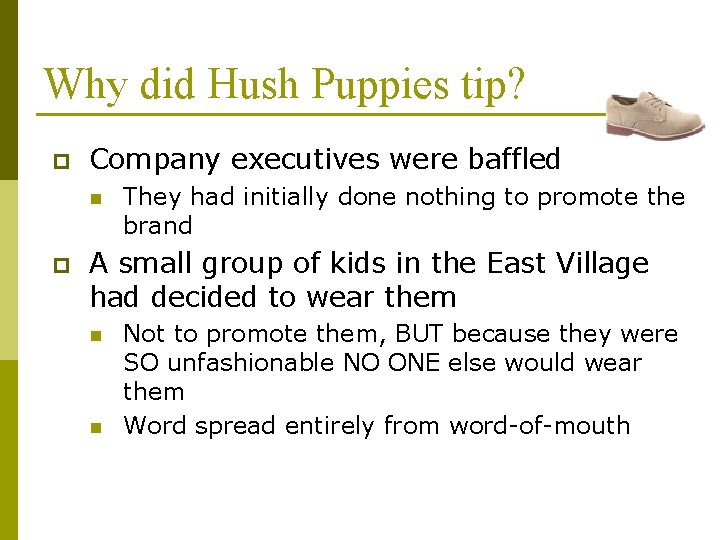
Why did Hush Puppies tip? p Company executives were baffled n p They had initially done nothing to promote the brand A small group of kids in the East Village had decided to wear them n n Not to promote them, BUT because they were SO unfashionable NO ONE else would wear them Word spread entirely from word-of-mouth
Hush Puppies. . p Then a small group of fashion designers used them to peddle “Haute Couture” p No one tried to make Hush Puppies a trend, but they did
Malcolm Gladwell’s Tipping Point p The story of Hush Puppies illustrates the central argument of Malcolm Gladwell’s book The Tipping Point: How Little Things Can Make a Big Difference p Gladwell argues that to understand the phenomena of new trends, you should study them as “social epidemics”
Social Epidemics p The rise of Hush Puppies is a text-book example of an epidemic in action n p Contagious behavior No one said Hush Puppies were “cool” n n Those kids just started wearing them as a rebellious statement of counter-culture In doing so they “exposed” others and “infected” them with the “Hush Puppy virus”
Three Characteristics of an Epidemic p p Contagiousness Little Causes with Big Effects Change that happens not gradually but at one dramatic moment This is exactly how a virus spreads n n The same principles behind the spread of measles in a second-grade classroom Or the winter flu
The Tipping Point Small changes can have big effects p The law of the few -- individual actions can be amplified by social connections, energy, enthusiasm and personality n n n Connectors – those who know lots of people…social glue Mavens – those who accumulate knowledge…data banks Salesmen – those with skills to persuade…persuaders p The stickiness factor-- simple changes in the presentation and structuring of information can make a big difference in its impact p The power of context -- individual behavior is markedly affected by the environment
The Tipping Point p The possibility of sudden change is at the center of the idea of the tipping point n We can define the tipping point as the moment of critical mass, the threshold, the boiling point p The term first came into use in the 1970 s to describe residential segregation caused by the flight of whites to the suburbs from old American cities p When the number of African Americans moving in to the neighborhood reached 20% the population “tipped” and whites fled
The Tipping Point p Every new technology has a tipping point n 1984: First low-cost Fax Machines introduced p n Sales grew slowly but steadily until 1987, when enough people had faxes that it made sense for EVERYONE to have a fax -- 1987 was the tipping point Cell Phones got smaller, cheaper, and service improved through the 1990 s p When they tipped in 1998 and everyone had a cell phone
Role Models in a Community p Sociologists have looked at the number of role models in a community n n n p Professionals, managers, teachers – “High Status” workers In neighborhoods with 5 – 40% high status workers, there is little change in pregnancy rates, school dropout rates Go below 5% and problems explode p Go from 5. 6% to 3. 4% and drop-out rates double p Its not slow gradual change, but dramatic and substantial The Tipping Point was at 5%