
Class B ComII semester SubjectBusiness Mathematics TopicSub Divided

§ § § Class – B. Com-II semester Subject-Business Mathematics Topic-Sub Divided Bar Diagrams, Duo Directional Bar Diagrams, Sliding Bar Diagrams and Pie charts Prepared By—Ms. Bhanu Sachdeva (Assistant Professor) Department- Commerce and management College-I. B(PG) college Panipat, Affiliated to Kurukshetra University, Kurukshetra
Sub -Divided Bar Diagrams § Definition: In drawing such diagrams, First bars are drawn for total sum of values of different variables and then these bars are divided to show various components of variables. Different parts of bars must be distinguished by different shades or colours
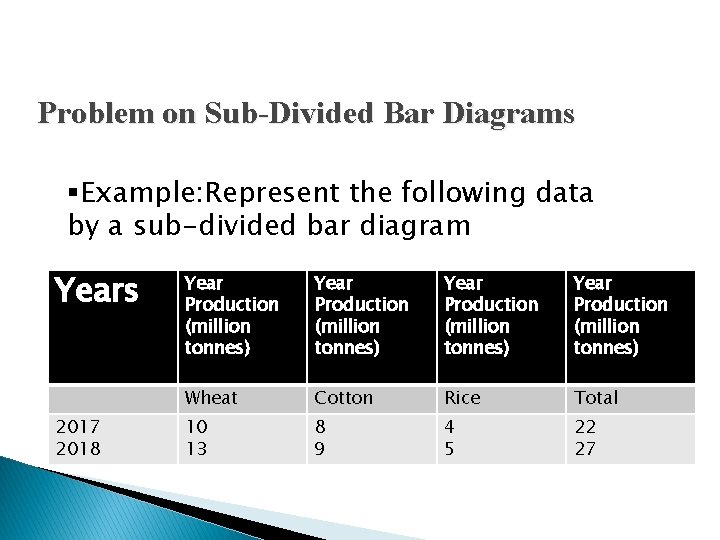
Problem on Sub-Divided Bar Diagrams §Example: Represent the following data by a sub-divided bar diagram Years 2017 2018 Year Production (million tonnes) Wheat Cotton Rice Total 10 13 8 9 4 5 22 27
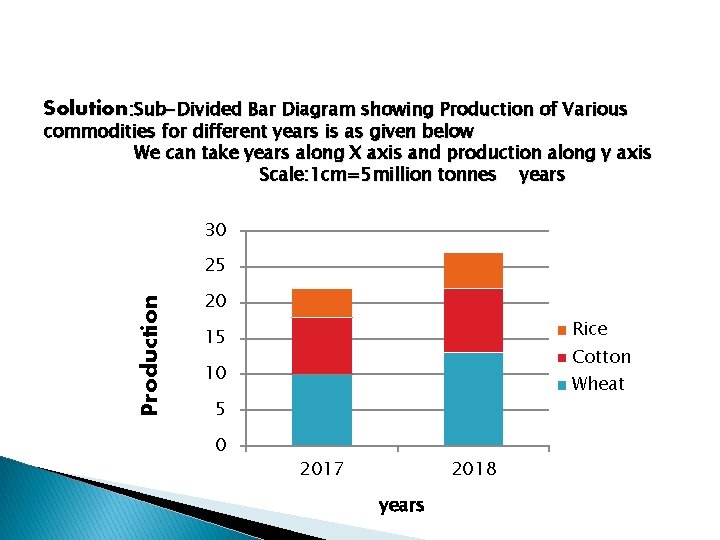
Solution: Sub-Divided Bar Diagram showing Production of Various commodities for different years is as given below We can take years along X axis and production along y axis Scale: 1 cm=5 million tonnes years 30 Production 25 20 Rice 15 Cotton 10 Wheat 5 0 2017 2018 years
Duo-Directional Bar Diagrams § Duo-Directional Bar Diagrams : These diagrams are drawn to represent two different attributes. The bars can have both positive and negative values. Positive values are shown above and negative values are shown below the base line.
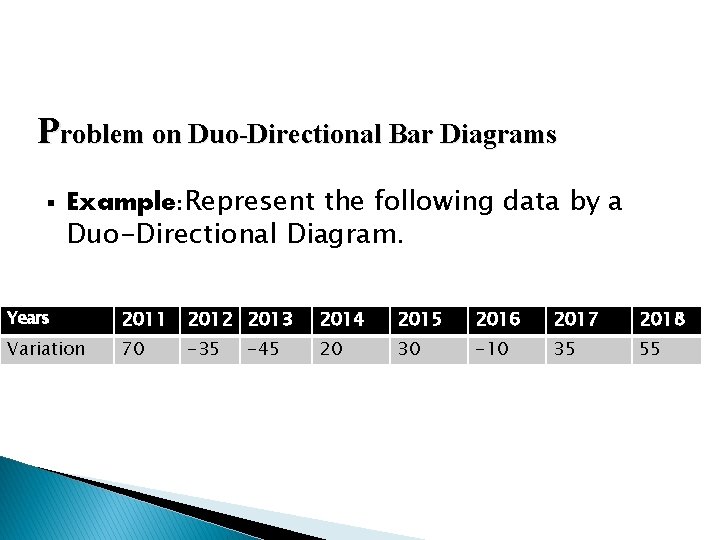
Problem on Duo-Directional Bar Diagrams § Example: Represent the following data by a Duo-Directional Diagram. Years 2011 2012 2013 2014 2015 2016 2017 2018 Variation 70 -35 20 30 -10 35 55 -45
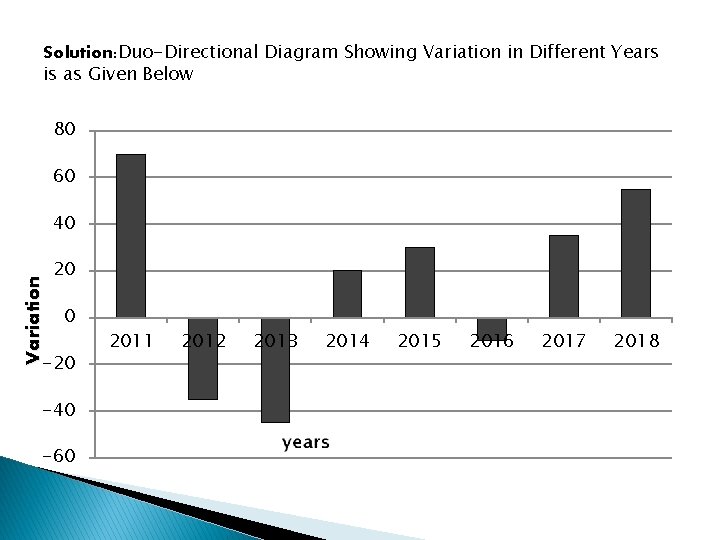
Solution: Duo-Directional Diagram Showing Variation in Different Years is as Given Below 80 60 Variation 40 20 0 -20 -40 -60 2011 2012 2013 2014 2015 2016 2017 2018
Sliding-Bar Diagram § Sliding-Bar Diagram: In these type of diagrams, the length of a bar is taken to be 100. on one side of base line the percentage of one part is shown and on other side of base line the percentage of other part is shown.
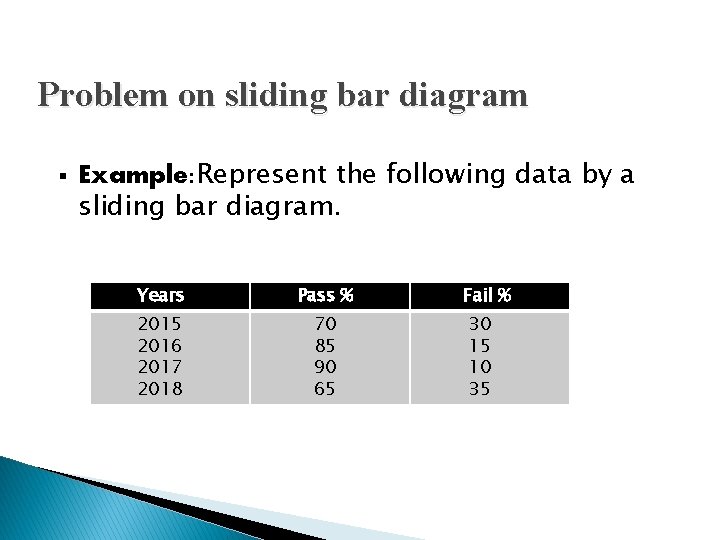
Problem on sliding bar diagram § Example: Represent the following data by a sliding bar diagram. Years Pass % 2015 2016 2017 2018 70 85 90 65 Fail % 30 15 10 35
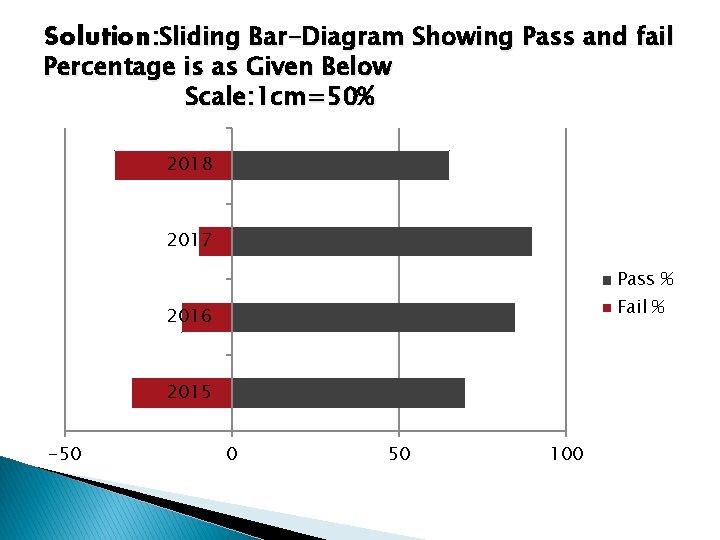
Solution: Sliding Bar-Diagram Showing Pass and fail Percentage is as Given Below Scale: 1 cm=50% 2018 2017 Pass % Fail % 2016 2015 -50 0 50 100
Pie Charts § these the total quantity is distributed over one complete circle or 3600. This angle 3600 is divided into a number of small angles whose degrees will be proportional to the values of component. Pie chart: In
Method to Draw a Pie chart § § Find fraction by dividing the value of each element by total (sum) of values of all elements Multiply this fraction by 3600 Draw a circle and then draw angles obtained in step 2 at centre of circle Different part of circle may be shaded differently or with different colour and highlights the different values.
Problem on Pie Chart § Example: Represent the following data by Pie Diagram Subject Eng Maths Physics Chemistry Economics Commerce No. of students 45 60 20 30 10 15 Solution: To draw the pie chart, we first calculate the angle at centre as shown in the following table The pie chart is obtained by marking the angles obtained in the above table at centre of the circle
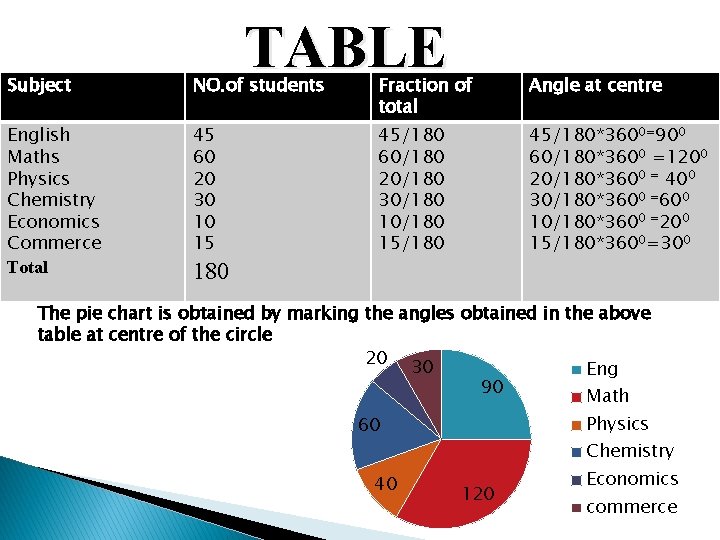
TABLE Subject NO. of students Fraction of total Angle at centre English Maths Physics Chemistry Economics Commerce Total 45 60 20 30 10 15 45/180 60/180 20/180 30/180 15/180 45/180*3600=900 60/180*3600 =1200 20/180*3600 = 400 30/180*3600 =600 10/180*3600 =200 15/180*3600=300 180 The pie chart is obtained by marking the angles obtained in the above table at centre of the circle 20 30 Eng 90 Math Physics 60 40 Chemistry 120 Economics commerce

THANK YOU
- Slides: 15