
Class Assessment Best Practices for Monitoring and Evaluating
Class Assessment Best Practices for Monitoring and Evaluating Your Classroom pp. 75 -90
Objectives • To discuss basic concepts of classroom assessment. • To discuss specific strategies for classroom assessment. • To practice critically evaluating classroom assessment strategies.
Schedule Day 1: • Introductions • Make groups to work in • What you think assessment is • Lecture on classroom assessment Day 2: • Classroom assessment activity feedback

Who am I? • Certified Teacher – U. S. A • 9. 5 yrs teaching experience Ø 5 yrs U. S. Ø 4. 5 yrs South Korea • MRes- Educational and Social Research • EPIK/ Ta. LK Teacher Trainer • Assistant Professor of English at Gimcheon University Daniel Moonasar

Who are you? • Graduates (4 yrs with degree)? • Undergraduates (2 yrs and or no degree)? • Education majors? • Teaching experience? • 6 month contract? • 1 year contract? • Lived or visited South Korea before?

Group Discussion Activity 10 -min Directions: 1. Make a group of 3 people. (about 10 groups) 2. Discuss and answer the questions. 3. Pick your best answer and 1 person to speak for your group. 4. When finished, we will share answers.
Group Discussion Activity Q 1. Why is class assessment important? --G 1&10 Q 2. What is purpose of class assessment? –G 2&9 Q 3. How is assessment important for the teacher? For the learners? – G 3&8 Q 4. What do you take into account when you design assessment? – G 4&7 Q 5. What types of assessment do you remember from your
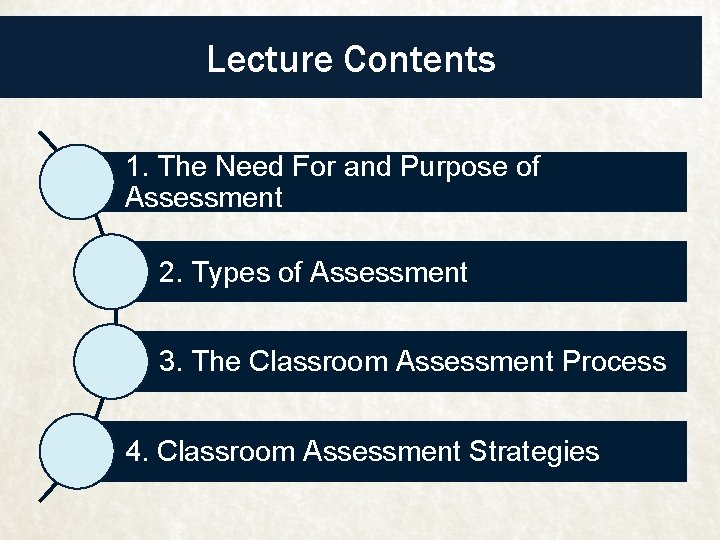
Lecture Contents 1. The Need For and Purpose of Assessment 2. Types of Assessment 3. The Classroom Assessment Process 4. Classroom Assessment Strategies
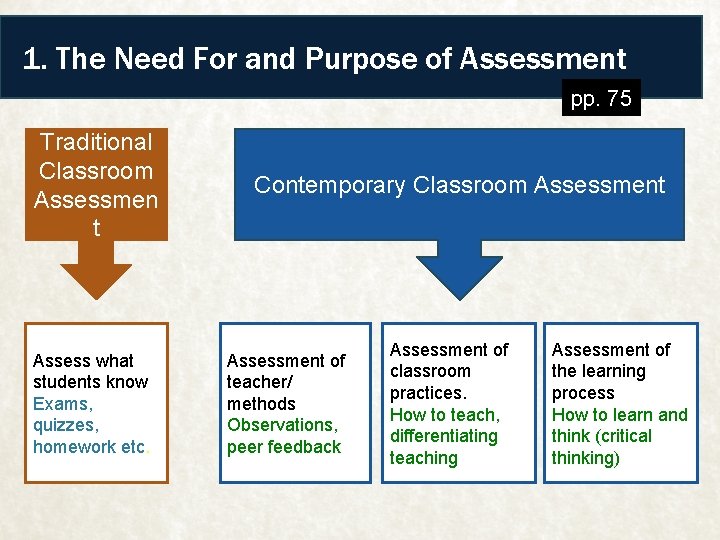
1. The Need For and Purpose of Assessment pp. 75 Traditional Classroom Assessmen t Assess what students know Exams, quizzes, homework etc. Contemporary Classroom Assessment of teacher/ methods Observations, peer feedback Assessment of classroom practices. How to teach, differentiating teaching Assessment of the learning process How to learn and think (critical thinking)
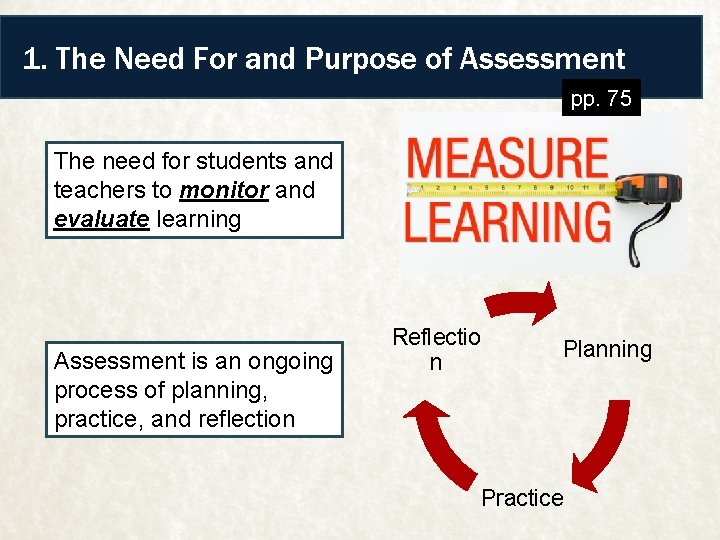
1. The Need For and Purpose of Assessment pp. 75 The need for students and teachers to monitor and evaluate learning Assessment is an ongoing process of planning, practice, and reflection Reflectio n Planning Practice
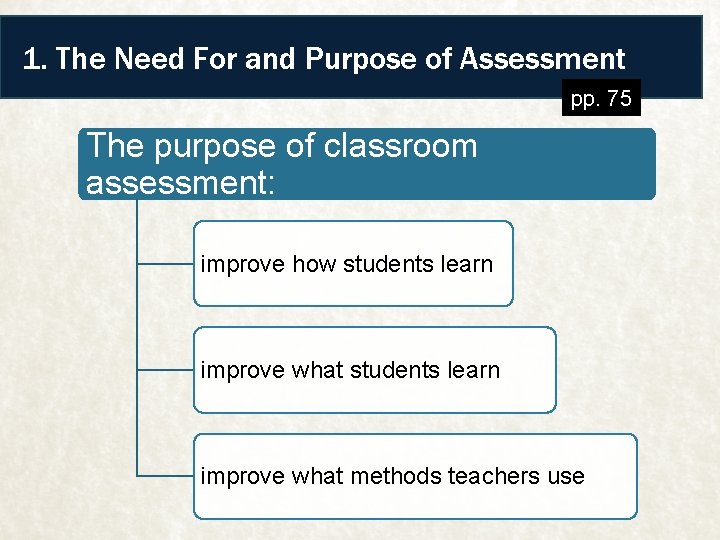
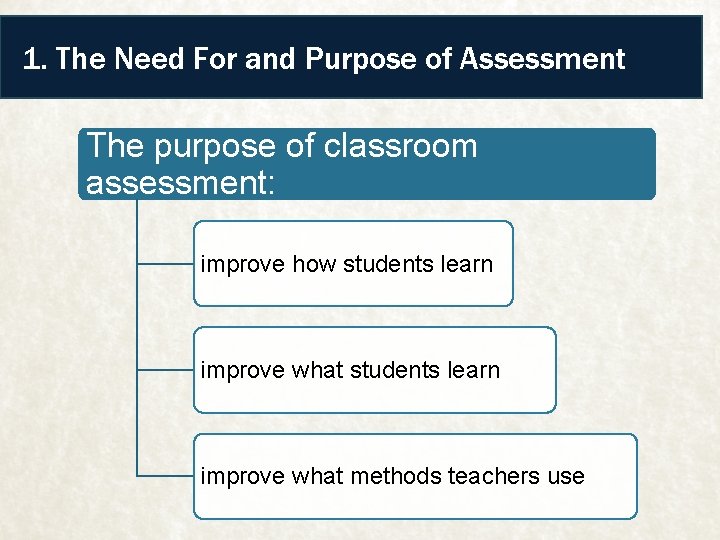
1. The Need For and Purpose of Assessment pp. 75 The purpose of classroom assessment: improve how students learn improve what methods teachers use
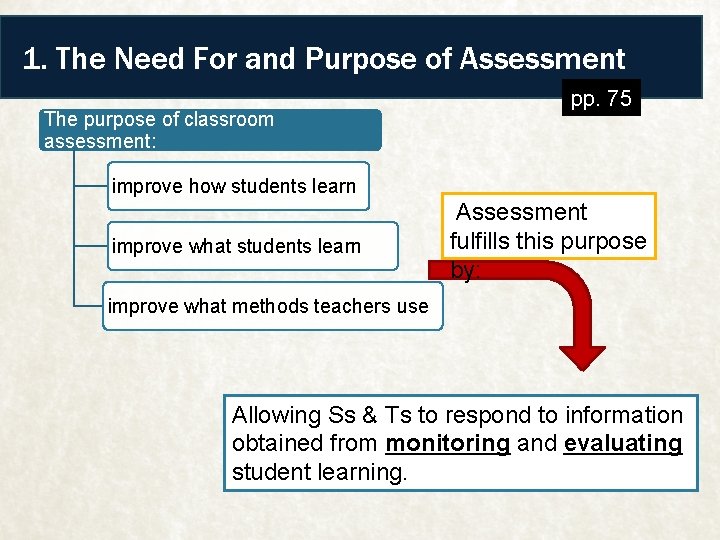
1. The Need For and Purpose of Assessment The purpose of classroom assessment: pp. 75 improve how students learn improve what students learn Assessment fulfills this purpose by: improve what methods teachers use Allowing Ss & Ts to respond to information obtained from monitoring and evaluating student learning.
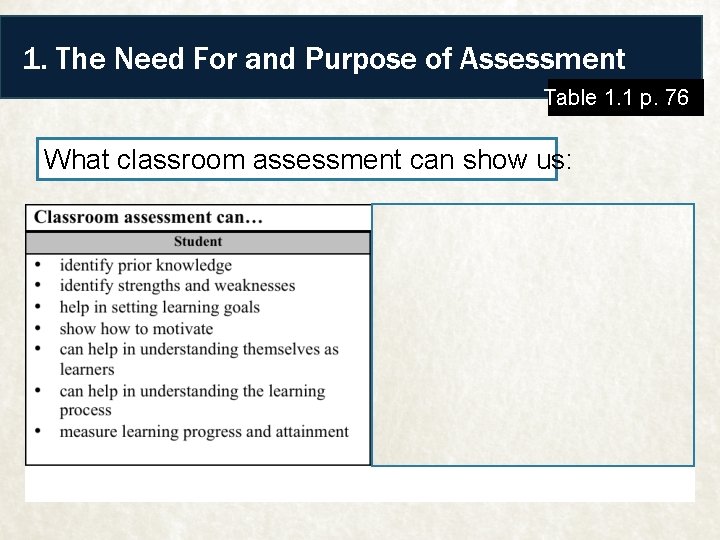
1. The Need For and Purpose of Assessment Table 1. 1 p. 76 What classroom assessment can show us:
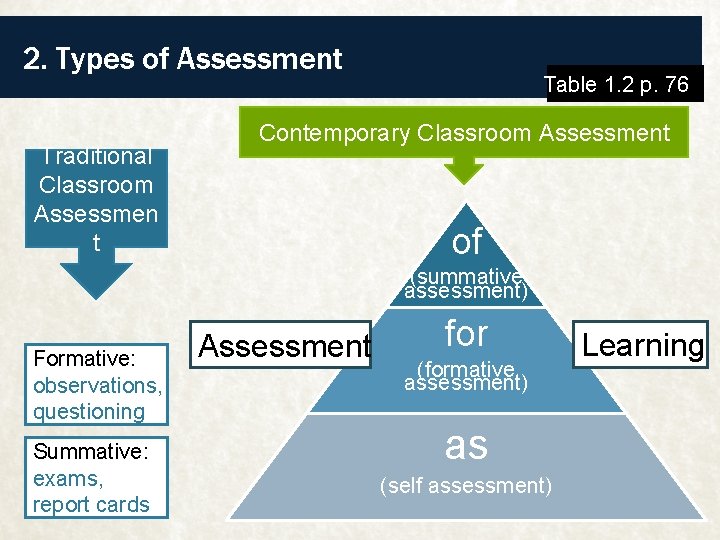
2. Types of Assessment Traditional Classroom Assessmen t Table 1. 2 p. 76 Contemporary Classroom Assessment of (summative assessment) Formative: observations, questioning Summative: exams, report cards Assessment for (formative assessment) as (self assessment) Learning
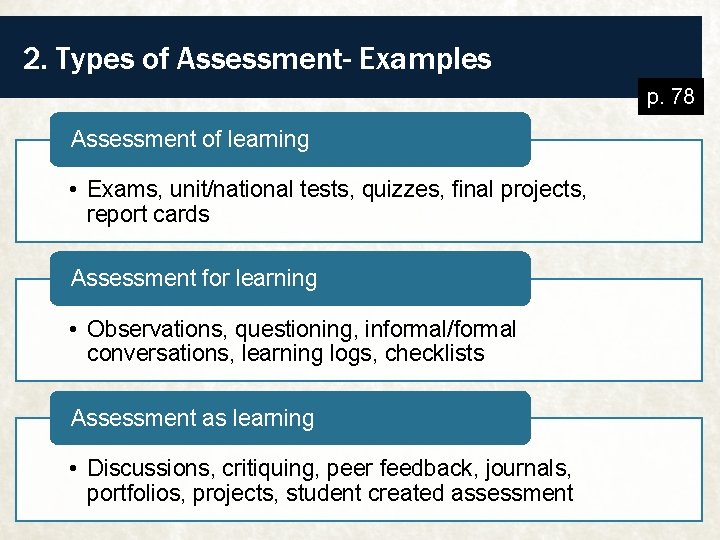
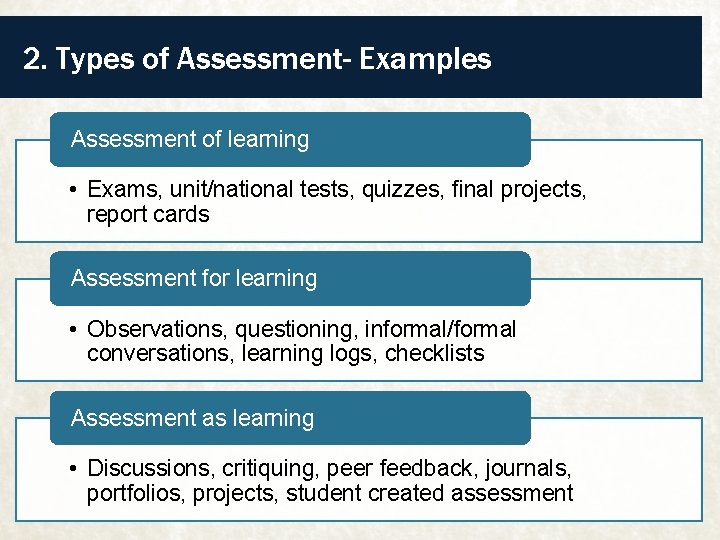
2. Types of Assessment- Examples p. 78 Assessment of learning • Exams, unit/national tests, quizzes, final projects, report cards Assessment for learning • Observations, questioning, informal/formal conversations, learning logs, checklists Assessment as learning • Discussions, critiquing, peer feedback, journals, portfolios, projects, student created assessment
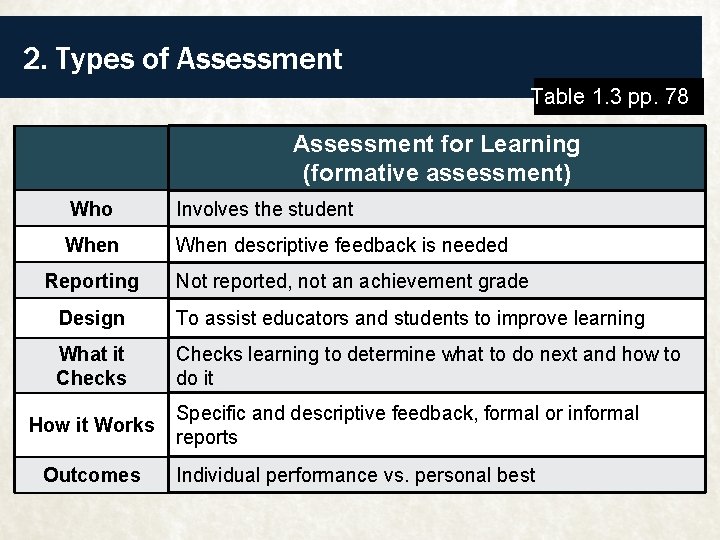
2. Types of Assessment Table 1. 3 pp. 78 Assessment for Learning (formative assessment) Who Involves the student When descriptive feedback is needed Reporting Not reported, not an achievement grade Design To assist educators and students to improve learning What it Checks learning to determine what to do next and how to do it How it Works Outcomes Specific and descriptive feedback, formal or informal reports Individual performance vs. personal best
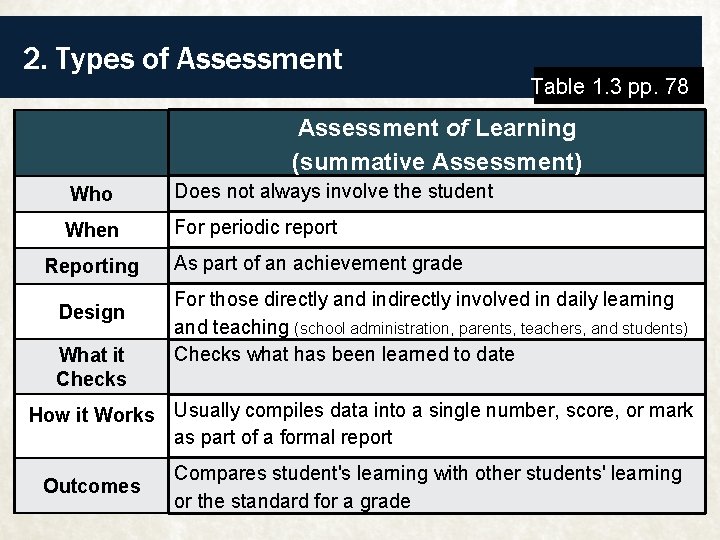
2. Types of Assessment Table 1. 3 pp. 78 Assessment of Learning (summative Assessment) Who Does not always involve the student When For periodic report Reporting Design What it Checks As part of an achievement grade For those directly and indirectly involved in daily learning and teaching (school administration, parents, teachers, and students) Checks what has been learned to date How it Works Usually compiles data into a single number, score, or mark as part of a formal report Outcomes Compares student's learning with other students' learning or the standard for a grade
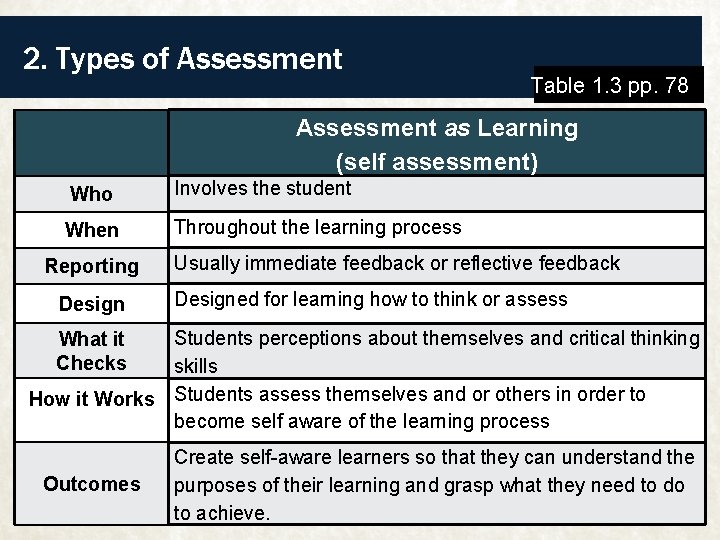
2. Types of Assessment Table 1. 3 pp. 78 Assessment as Learning (self assessment) Who Involves the student When Throughout the learning process Reporting Design Usually immediate feedback or reflective feedback Designed for learning how to think or assess Students perceptions about themselves and critical thinking skills How it Works Students assess themselves and or others in order to become self aware of the learning process What it Checks Outcomes Create self-aware learners so that they can understand the purposes of their learning and grasp what they need to do to achieve.
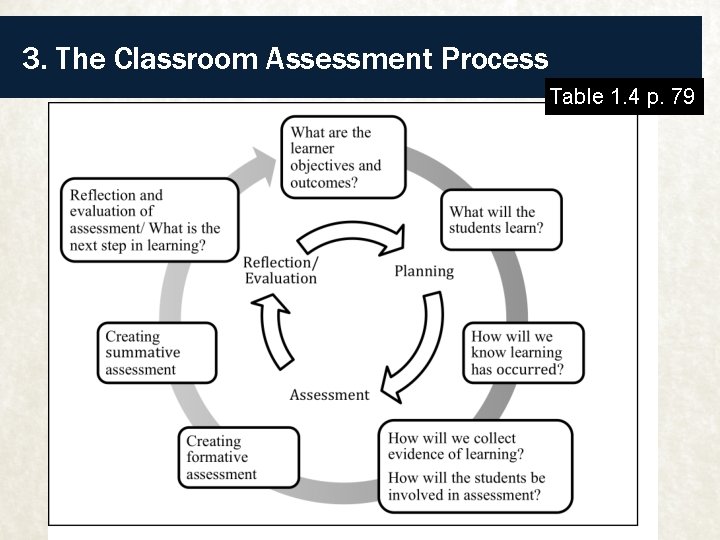
3. The Classroom Assessment Process Table 1. 4 p. 79
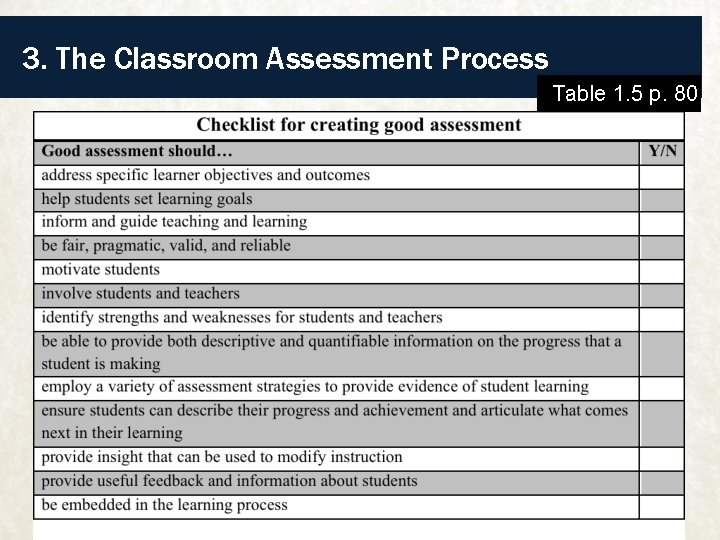
3. The Classroom Assessment Process Table 1. 5 p. 80
4. Classroom Assessment Strategies pp. 80 Tips for classroom assessment strategies: 1. Use them as a framework 2. Modify them to your classroom situation 3. If possible assessment should be in English 4. Read up and look for resources
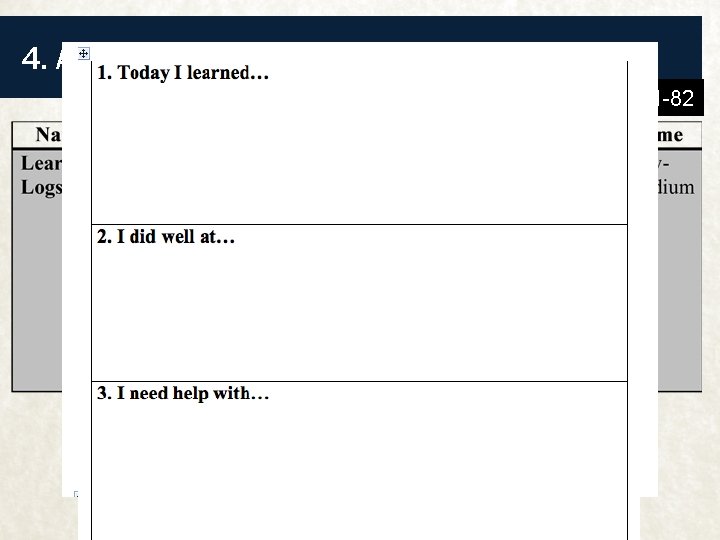
4. Assessment as Learning Strategies Table 1. 5 pp. 81 -82

4. Assessment as Learning Strategies Table 1. 5 pp. 82 -83
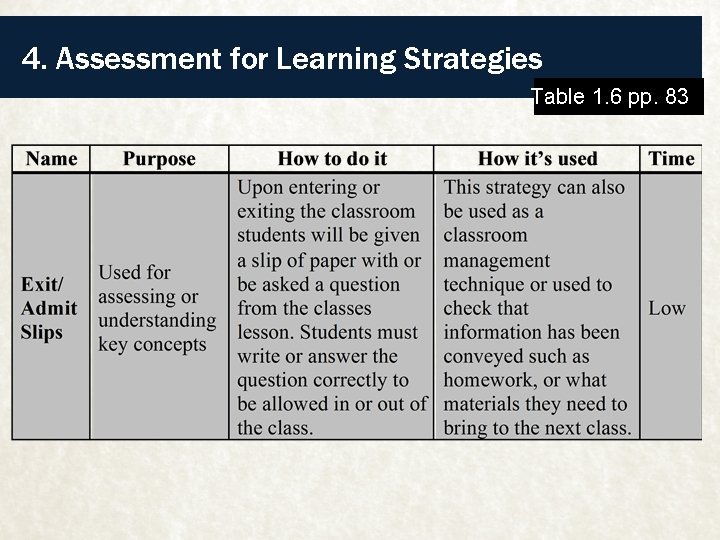
4. Assessment for Learning Strategies Table 1. 6 pp. 83
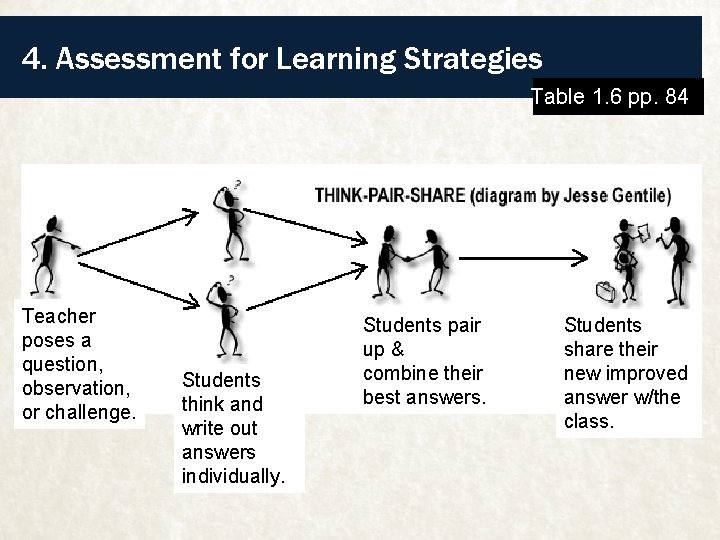
4. Assessment for Learning Strategies Table 1. 6 pp. 84 Teacher poses a question, observation, or challenge. Students think and write out answers individually. Students pair up & combine their best answers. Students share their new improved answer w/the class.
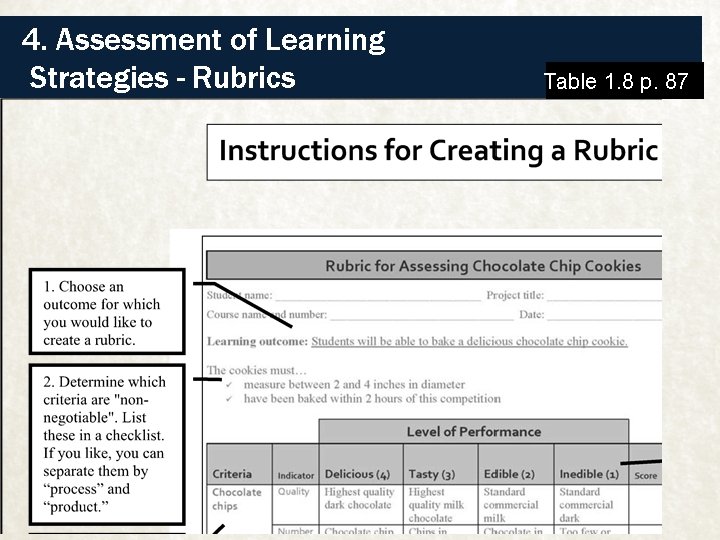
4. Assessment of Learning Strategies - Rubrics Table 1. 8 p. 87
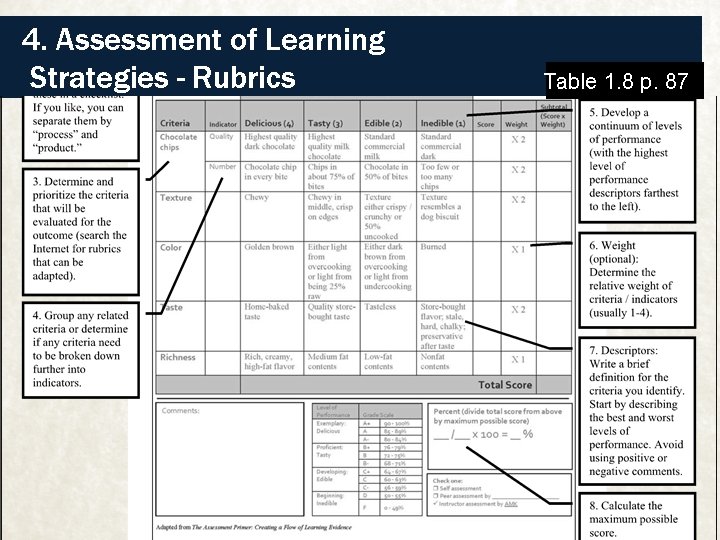
4. Assessment of Learning Strategies - Rubrics Table 1. 8 p. 87
Class Assessment Best Practices for Monitoring and Evaluating Your Classroom pp. 75 -90
Schedule Day 2: • A little review • Classroom assessment activity feedback • Questions/ Closing
1. The Need For and Purpose of Assessment The purpose of classroom assessment: improve how students learn improve what methods teachers use
2. Types of Assessment- Examples Assessment of learning • Exams, unit/national tests, quizzes, final projects, report cards Assessment for learning • Observations, questioning, informal/formal conversations, learning logs, checklists Assessment as learning • Discussions, critiquing, peer feedback, journals, portfolios, projects, student created assessment
Classroom Assessment Activity Objective: Create a classroom assessment strategy based on the lecture, orientation book, and your ideas. Part 1 Instructions: 1. Discuss and plan an assessment strategy based on the scenario given to you. 2. You need to answer all of the assessment process questions. 3. Keep your answers specific, succinct, and focused as possible with the time that you have.
Classroom Assessment Activity Objective: Create a classroom assessment strategy based on the lecture, orientation book, and your ideas. Part 2 Instructions: 1. Discuss the other group’s assessment plan that was given to you. 2. Focus on giving specific constructive feedback. Refrain from giving negative or unconstructive feedback. 4. Write notes/ suggestions directly on the other group’s paper. 5. When finished do not give back the paper.
Classroom Assessment Activity Objective: Create a classroom assessment strategy based on the lecture, orientation book, and your ideas. Part 3 Instructions: 1. Each group will take a turn giving feedback to the other group. 2. Focus on giving specific constructive feedback. Refrain from giving negative or unconstructive feedback. 3. When you explain, give specific reasons why you chose the strategy/strategies, or why you agreed or disagreed with them.
Feedback and Questions moonasard@gmail. com Blog in the lecture book
Sources Bibliography and Links Cohen, A. D. (1996). Verbal reports as a source of insights into second language learner strategies. Applied Language Learning, 7(1– 2), 5– 24. Pally, Marcia. Sustained Content Teaching in Academic ESL/EFL: A Practical Approach. Houghton Mifflin Company, 222 Berkeley Street, Boston, MA 021163764, 2000. Oxford, Rebecca L. , Mary Evelyn Holloway, and Diana Horton-Murillo. "Language learning styles: Research and practical considerations for teaching in the multicultural tertiary ESL/EFL classroom. " System 20. 4 (1992): 439 -456. Reid, Joy M. Learning Styles in the ESL/EFL Classroom. Heinle & Heinle Publishers, International Thomson Publishing Book Distribution Center, 7625 Empire Drive, Florence, KY 41042. 1995. Saito, Hidetoshi. "EFL classroom peer assessment: Training effects on rating and commenting. " Language Testing 25. 4 (2008): 553 -581.
Sources Assessment Basics and Concepts http: //www. celt. iastate. edu/teaching/cat. html http: //www. cmu. edu/teaching/assessment/assesslearning/index. html http: //www. cmu. edu/teaching/assessment/index. html Assessment Strategies https: //www. eduweb. vic. gov. au/edulibrary/public/teachlearn/student/activity 4_4 A. pdf http: //wvde. state. wv. us/teach 21/Examplesof. Formative. Assessment. html http: //www. scsk 12. org/scs/subject-areas/esl/pdfs/hurleys-esl-modifications. pdf Rubrics http: //www. schrockguide. net/assessment-and-rubrics. html http: //edtechteacher. org/index. php/teaching-technology/assessment-rubrics http: //www. nwic. edu/assessment/Assessment. Resources/rubrics/Instruction. Rubri c. pdf
- Slides: 38