
Class and Socioeconomic Status and the effects on
- Slides: 14
Class and Socioeconomic Status and the effects on Status. Chapter 3 By Kenny Wiebe TEL 212
What is Class? Class as a Socioeconomic status Political Status Cultural Status Social and Economic resources Most widely understood class structure Upper, Middle, and Lower class. Our book breaks them into 5 th’s
Socioeconomic status The economic conditions of persons or groups with specific standards A combination of a family or individuals judging their These Occupation Education attainment or Level Income (Wealth) Power determinants are interrelated, and most simply observable.
Income The amount of money earned in wages or salaries. Breaking up into fifths Lowest earning the lowest (holding 4%) And the highest earning the highest (holding 48% of total income) 3/5 th’s, leaving 48% for the rest. According to the 2006 census bureau: 5% of the wealthiest families in America earn 21% of all total income. Some consider this the American way – do you think so? Is it true that those who contribute at high levels to their job’s are be compensated correctly for that?
Wealth The amount of money examined between families, is considered between their yearly income. This does not include the amount of money made through investments. Wealth partially guarantees a future income The top 10% of he population had a median net worth of 1. 3 million, while the bottom 5 th’s median was 1, 100 (Keenan, 2003)
Interesting Fact on Wealth and Income 225 of the richest people in the world have a combined wealth of equal to the annual income of the poorer half of the world population.
Occupation 10 top growing occupations in Home Health Aides 2006 Network systems and data communications analysis. Medical Assistants Physician Assistants Computer software engineers, applications. Physical Therapist Assistants Dental Hygienists Computer software engineers, systems software. Dental Assistants Personal and Home care aides. *U. S. Census Bureua 2006 Notice all these positions require several years of schooling
Ø Ø Before we get into a political or economical debate, lets talk about what this has to do with education. The way I see it, the low income communities cannot afford the nice schools, or salaries of good teachers – this leads to poorly educated students who 1) don’t care about school, considering they have teachers who don’t care either, or 2) if they do care they are made fun of for acting “white”, and not fitting into their environment/community, being oppressed by their own neighbors. They are then forced into a world with no education and not much real knowledge of the outside world, so they continue to stay in the same bad economic situation, and then bring in children who then have to start over the entire system. Education One little girl said it very well in the “Brown vs. Blue eye experiment” “why try to do anything if I already know what the out come will be” Trying the same exacting thing over and over again receiving the same outcome is the definition of insanity. Ø
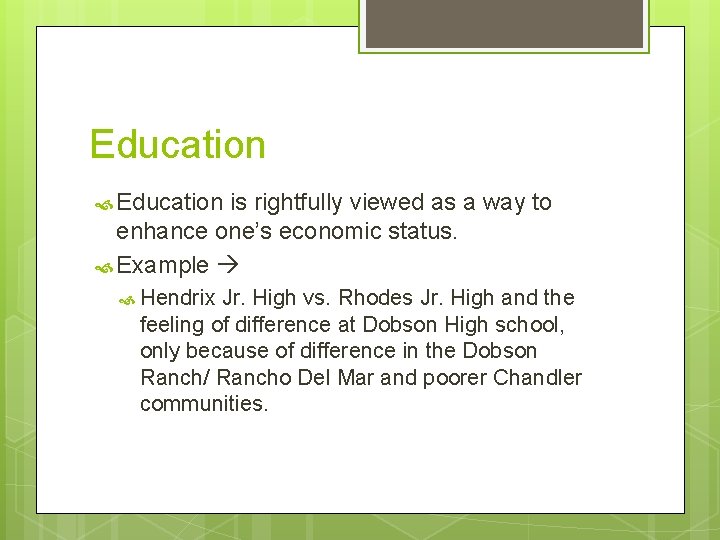
Education is rightfully viewed as a way to enhance one’s economic status. Example Hendrix Jr. High vs. Rhodes Jr. High and the feeling of difference at Dobson High school, only because of difference in the Dobson Ranch/ Rancho Del Mar and poorer Chandler communities.
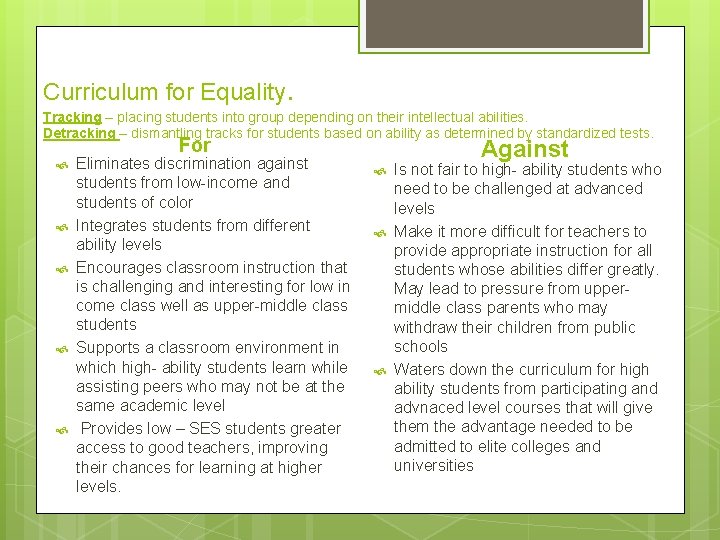
Curriculum for Equality. Tracking – placing students into group depending on their intellectual abilities. Detracking – dismantling tracks for students based on ability as determined by standardized tests. For Eliminates discrimination against students from low-income and students of color Integrates students from different ability levels Encourages classroom instruction that is challenging and interesting for low in come class well as upper-middle class students Supports a classroom environment in which high- ability students learn while assisting peers who may not be at the same academic level Provides low – SES students greater access to good teachers, improving their chances for learning at higher levels. Against Is not fair to high- ability students who need to be challenged at advanced levels Make it more difficult for teachers to provide appropriate instruction for all students whose abilities differ greatly. May lead to pressure from uppermiddle class parents who may withdraw their children from public schools Waters down the curriculum for high ability students from participating and advnaced level courses that will give them the advantage needed to be admitted to elite colleges and universities
Question? What other steps could school officials take to provide low-income students greater access to advanced courses? Is the curriculum watered down, or are the teachers not to par with most middle to Higher class school systems?
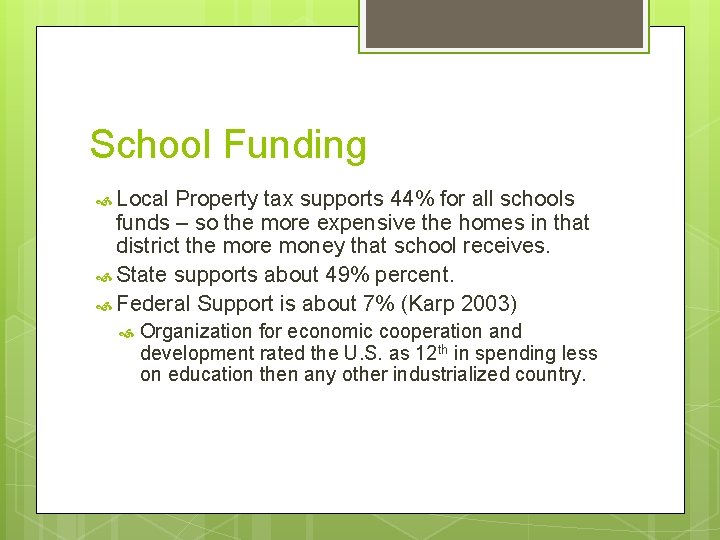
School Funding Local Property tax supports 44% for all schools funds – so the more expensive the homes in that district the more money that school receives. State supports about 49% percent. Federal Support is about 7% (Karp 2003) Organization for economic cooperation and development rated the U. S. as 12 th in spending less on education then any other industrialized country.
Question? Is it the cultural differences and lower income communities that are holding back the students attending low income schools, while still contributing to the downward cycle of poor living? OR is the lack of Money being offered to low income schools not allowing students the educations to break the cycle, and move away from poor living?
http: //academicearth. org/lectures/fixing- problems-in-k-12 -education http: //www. edutopia. org/high-expectationselementary-assessment-video http: //www. 5 min. com/Video/How-to-Improve. Early-Education-27296474