
Class agenda Sima Qian and the Shiji 1
- Slides: 18
Class agenda Sima Qian and the Shiji 1. Sima Qian’s autobiography 2. Connections with the Spring and Autumn tradition 1
Who was Sima Qian? c. 145 - 90 BCE • Grand Scribe / Historian / Astronomer. Astrologer • Son of the Grand Scribe / Historian / Astronomer-Astrologer • Gives an account in his autobiography – Shiji chapter 130 2
Structure of Sima’s autobiography 1. Sima family lineage 2. Father’s education – Notes training under Yijing master – Studied under Huang-Lao Daoist teacher 3. Sima Tan’s epitome of the “Six Schools” – Yin-yang Naturalists, Confucian, Mohist, Logicians, Legalists, Daoists 3
Sima Tan’s epitome • Yin-yang Naturalists • Excellent observation of regularities • Promote superstitious belief in determinism • Confucians • Ritual arts shape a well ordered moral society • Overwhelming detail undermines possibility of success • Mohists • Frugal utilitarianism is excellent • Promote rigid and unworkable social homogeneity • Logicians: good on analysis; undermine knowledge • Legalists: good on hierarchy; undermine human relations 4
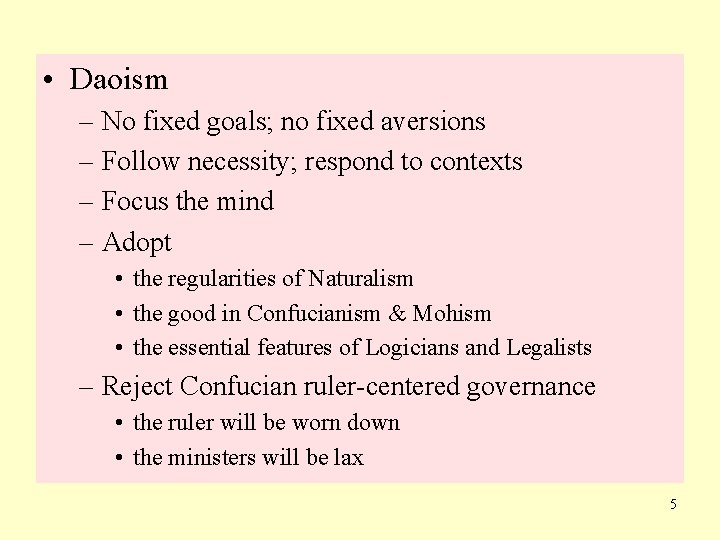
• Daoism – No fixed goals; no fixed aversions – Follow necessity; respond to contexts – Focus the mind – Adopt • the regularities of Naturalism • the good in Confucianism & Mohism • the essential features of Logicians and Legalists – Reject Confucian ruler-centered governance • the ruler will be worn down • the ministers will be lax 5
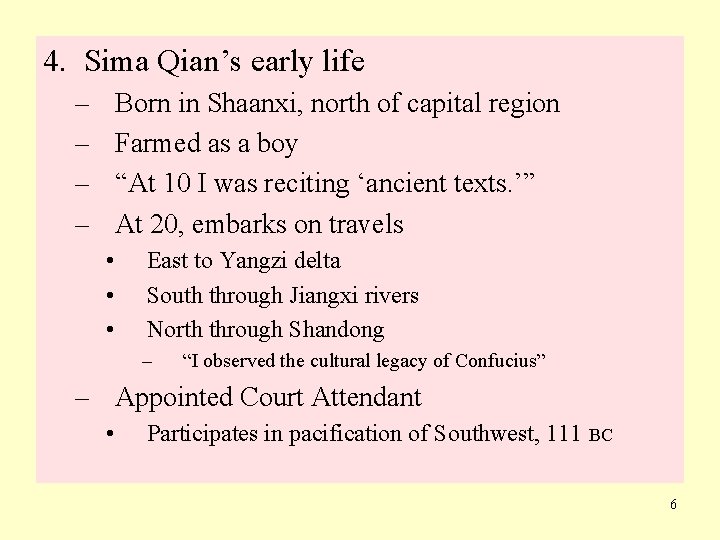
4. Sima Qian’s early life – – Born in Shaanxi, north of capital region Farmed as a boy “At 10 I was reciting ‘ancient texts. ’” At 20, embarks on travels • • • East to Yangzi delta South through Jiangxi rivers North through Shandong – “I observed the cultural legacy of Confucius” – Appointed Court Attendant • Participates in pacification of Southwest, 111 BC 6
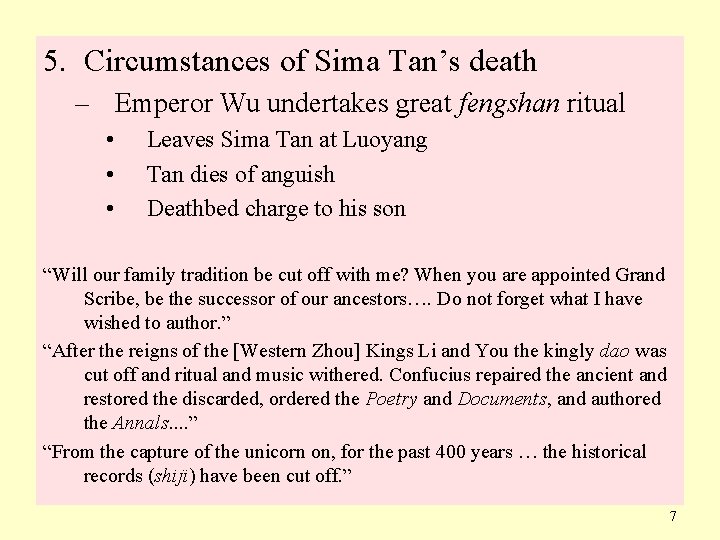
5. Circumstances of Sima Tan’s death – Emperor Wu undertakes great fengshan ritual • • • Leaves Sima Tan at Luoyang Tan dies of anguish Deathbed charge to his son “Will our family tradition be cut off with me? When you are appointed Grand Scribe, be the successor of our ancestors…. Do not forget what I have wished to author. ” “After the reigns of the [Western Zhou] Kings Li and You the kingly dao was cut off and ritual and music withered. Confucius repaired the ancient and restored the discarded, ordered the Poetry and Documents, and authored the Annals. . ” “From the capture of the unicorn on, for the past 400 years … the historical records (shiji) have been cut off. ” 7
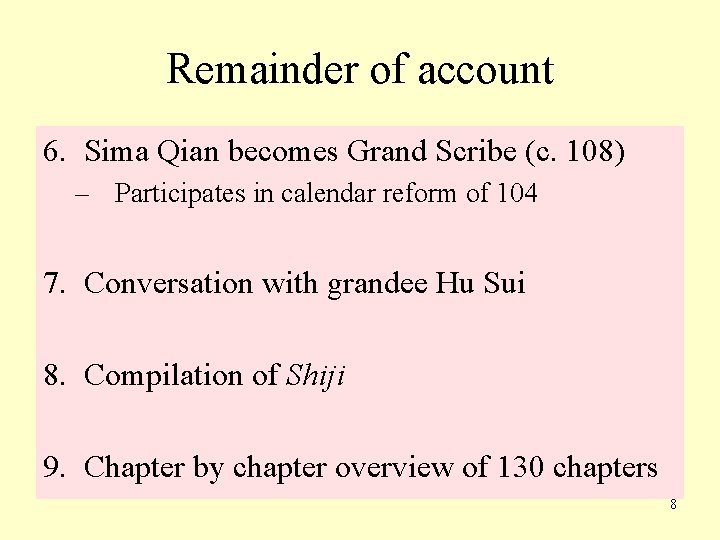
Remainder of account 6. Sima Qian becomes Grand Scribe (c. 108) – Participates in calendar reform of 104 7. Conversation with grandee Hu Sui 8. Compilation of Shiji 9. Chapter by chapter overview of 130 chapters 8
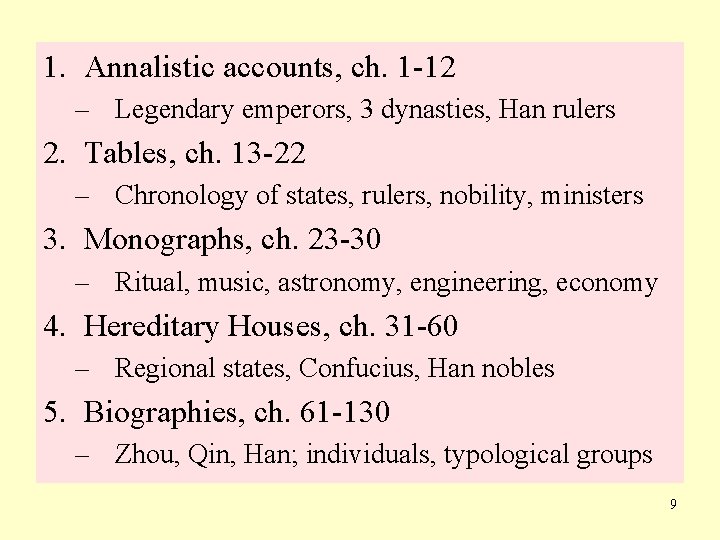
1. Annalistic accounts, ch. 1 -12 – Legendary emperors, 3 dynasties, Han rulers 2. Tables, ch. 13 -22 – Chronology of states, rulers, nobility, ministers 3. Monographs, ch. 23 -30 – Ritual, music, astronomy, engineering, economy 4. Hereditary Houses, ch. 31 -60 – Regional states, Confucius, Han nobles 5. Biographies, ch. 61 -130 – Zhou, Qin, Han; individuals, typological groups 9
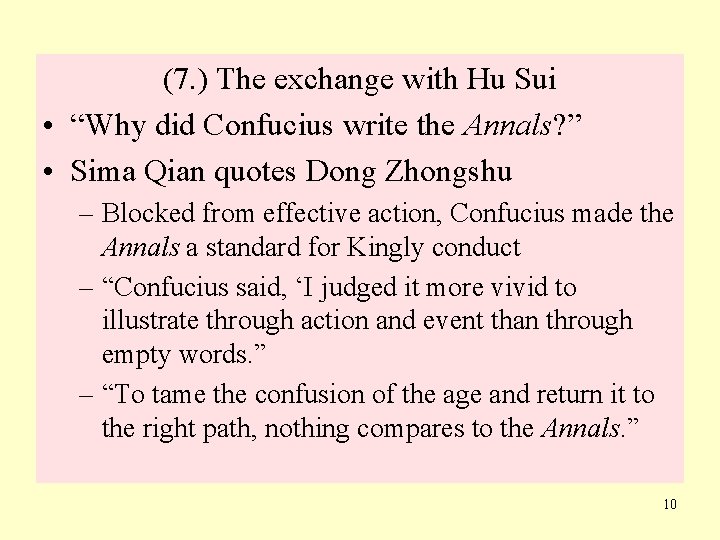
(7. ) The exchange with Hu Sui • “Why did Confucius write the Annals? ” • Sima Qian quotes Dong Zhongshu – Blocked from effective action, Confucius made the Annals a standard for Kingly conduct – “Confucius said, ‘I judged it more vivid to illustrate through action and event than through empty words. ” – “To tame the confusion of the age and return it to the right path, nothing compares to the Annals. ” 10
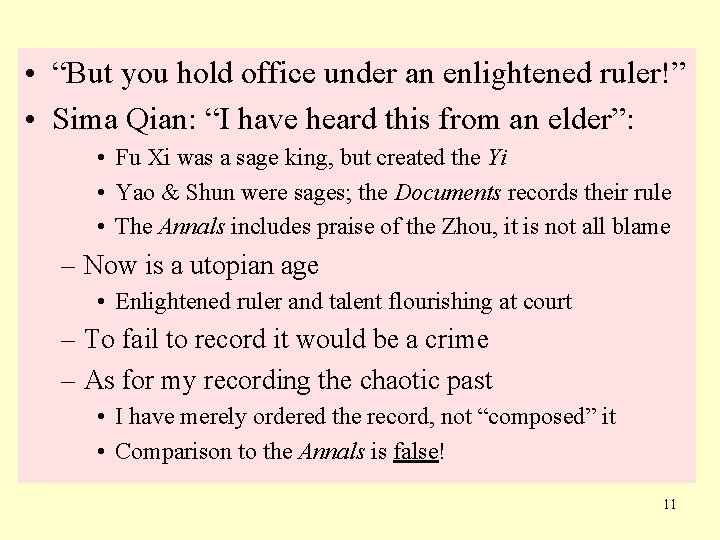
• “But you hold office under an enlightened ruler!” • Sima Qian: “I have heard this from an elder”: • Fu Xi was a sage king, but created the Yi • Yao & Shun were sages; the Documents records their rule • The Annals includes praise of the Zhou, it is not all blame – Now is a utopian age • Enlightened ruler and talent flourishing at court – To fail to record it would be a crime – As for my recording the chaotic past • I have merely ordered the record, not “composed” it • Comparison to the Annals is false! 11
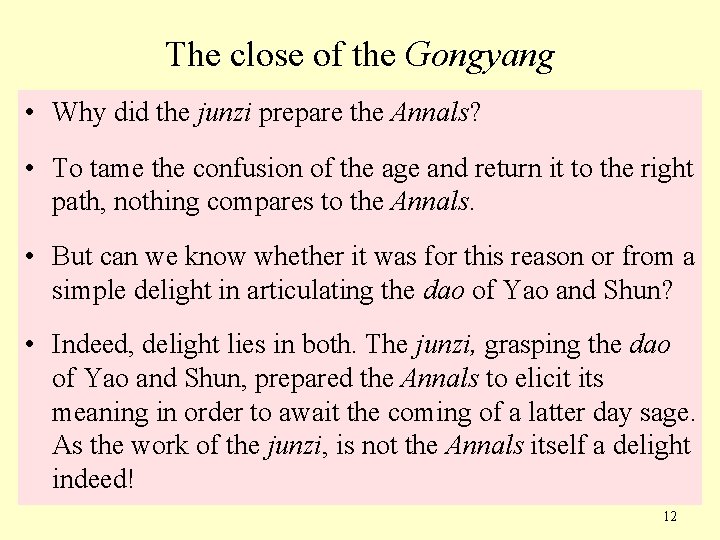
The close of the Gongyang • Why did the junzi prepare the Annals? • To tame the confusion of the age and return it to the right path, nothing compares to the Annals. • But can we know whether it was for this reason or from a simple delight in articulating the dao of Yao and Shun? • Indeed, delight lies in both. The junzi, grasping the dao of Yao and Shun, prepared the Annals to elicit its meaning in order to await the coming of a latter day sage. As the work of the junzi, is not the Annals itself a delight indeed! 12
Sima Qian’s letter to Ren An • “I have sought, through examination of the interface of Heaven and man, and comprehension of change from past through present to found a new tradition of philosophy. But then, before my rough draft was complete this disaster overtook me! It was my anxiety for my unfinished work that led me to submit to the worst of all punishments with no outward show of the bitterness within me. • “And now with all my heart I shall take this book that I have written and hide it within the Mountain of Fame, that it may find its way into the hands of the man who will understand it, and then on throughout the great cities and crossroads of the world. ” 13
Visible Annals tradition influence • The portraits of the First Emperor and Wu-di • The portraits of Xiang Yu vs. Liu Bang 14
• Liu Bang hoped to pass through his old home of Pei and gather up his family before proceeding west. But Xiang Yu had in the meantime sent men to pursue him to Pei and seize the members of his family, so that they had all fled into hiding and Liu Bang could not find them. Along the road, however, he happened to encounter his son and daughter. Putting them in his chariot, he hastened on his way. • The horsemen of Chu closed upon them in hot pursuit, and Liu Bang, in desperation, several times pushed his little son and daughter out of the chariot. But each time, Lord Teng, who was riding with him, got out, picked them up, and put them back in the chariot. This had happened three times when Lord Teng finally said, “No matter how sorely we are pressed in this chase, it will not do to abandon the children!” 15
The Shiji described to Ren An • “I have instead in recent years relied on my unskilled words to gather together scattered fragments of ancient lore. Probing into the events behind them, connecting their narrative flow, scrutinizing the regularities governing victory and defeat, flourishing and decay, tracing back to the Yellow Emperor and following down to our time, I have composed … 130 chapters in all. I have sought, through examination of the interface of Heaven and man, and comprehension of change from past through present to found a new school. ” 16
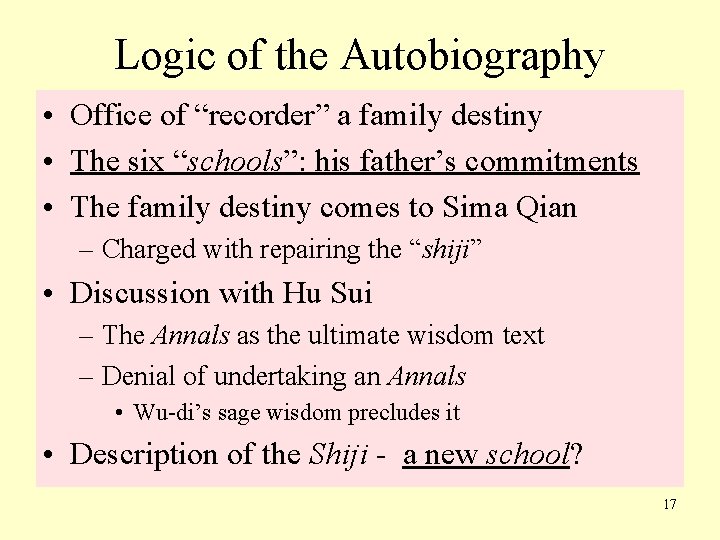
Logic of the Autobiography • Office of “recorder” a family destiny • The six “schools”: his father’s commitments • The family destiny comes to Sima Qian – Charged with repairing the “shiji” • Discussion with Hu Sui – The Annals as the ultimate wisdom text – Denial of undertaking an Annals • Wu-di’s sage wisdom precludes it • Description of the Shiji - a new school? 17
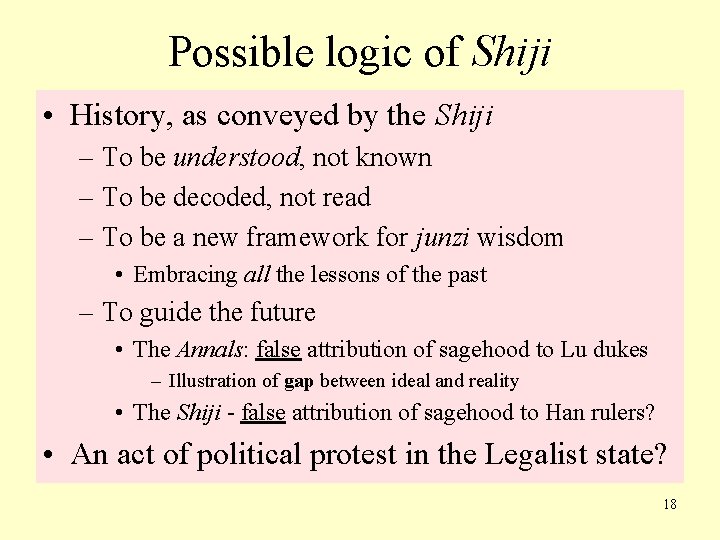
Possible logic of Shiji • History, as conveyed by the Shiji – To be understood, not known – To be decoded, not read – To be a new framework for junzi wisdom • Embracing all the lessons of the past – To guide the future • The Annals: false attribution of sagehood to Lu dukes – Illustration of gap between ideal and reality • The Shiji - false attribution of sagehood to Han rulers? • An act of political protest in the Legalist state? 18