
Class 8 October 30 My Image is My
Class 8 – October 30 My Image is My Own – Rights to your image and reputation online and “revenge porn”
Admin Crap / Announcements • Essay topics looking good! • CIPP Seminar "Apple, Microsoft, Netflix: Stories of Global Success Through Intellectual Property" with Me Pierre Nguyen (Norton Rose Fulbright), 13 h 00 October 31 NCDH 316 • MLJ Annual Symposium – “Programming Governance / Governing Programming: Regulatory Challenges on the Edge of Technology” 9 h 00 November 4 NCDH 101 • “The Facebook Dilemma” on PBS Frontline Class 8
News Item 1 Marie-Laurence Goyette presentation Class 8
In the News • California net neutrality law on hold (by agreement) while Federal NN lawsuit works its way through the courts • On Oct. 27, the Indian government’s telecom department told ISPs to ban 827 websites for hosting pornographic content • Social Network Gab in trouble… (let’s come back to this later) Class 8
CLASS 7 (CASL) FOLLOW-UP Class 8
Compliance and Enforcement Decision CRTC 2017 -367 Compu. Finder challenges constitutionality of CASL 5 issues 1. Can the Commission determine the constitutionality of the impugned provisions at issue in this proceeding? Yes! CASL itself says the Commission can determine Qs of law 2. Is CASL intra vires Parliament’s legislative powers? Yes, general trade and commerce power s. 91(2) Class 8
Compliance and Enforcement Decision CRTC 2017 -367 (cont. ) 3 a. Does CASL violate the freedom of expression guaranteed to Compu. Finder by section 2(b) of the Charter? Yes! A-G of Canada admits as much. Businesses have free speech too 3 b. If so, is any such violation justified under section 1? Yes!! Passed Oakes Test. E-commerce regulation and spam is a real problem! Class 8
Compliance and Enforcement Decision CRTC 2017 -367 (cont. ) 4. Does CASL violate any of the rights of Compu. Finder protected by section 11 of the Charter? (crim / penal rights) No. CASL proceedings “not criminal in nature”, they are administrative; AMPs not penal sanctions, s. 11 does not apply 5. Does CASL violate the section 7 Charter protection against self-incrimination or the section 8 Charter right against unreasonable search and seizure? No, see reasoning issue 4 Class 8
CLASS 6 FINISH (DEFAMATION) Class 8
“Innocent” third party liability Class 6
Canoë Inc. c. Corriveau Petar’s presentation Class 6
Canoë Inc. c. Corriveau - takeaway « Dans les circonstances, la juge de première instance était justifiée de conclure que l'appelante connaissait les conséquences probables de son inaction à cet égard. » Class 6
Third party liability - removal Message board: Baglow v. Smith, 2015 ONSC 1175 National Post comment section: Weaver v. Corcoran, 2015 BCSC 165 Class 6
Third-Party liability - links Crookes v. Newton, 2011 SCC 47 “a hyperlink, by itself, should never be seen as ‘publication’ of the content to which it refers” (Abella J. ) (concurring, Mc. Lachlin and Fish JJ. ) “Publication of a defamatory statement via a hyperlink should be found if the text indicates adoption or endorsement of the content of the hyperlinked text. “ Class 6
Third-party liability- USA Section 230 Communications Decency Act § 230 No provider or user of an interactive computer service shall be treated as the publisher or speaker of any information provided by another information content provider. “Section 230 marks a departure from the common-law rule that allocates liability to publishers or distributors of tortious material written or prepared by others” (Jones case, coming up in a few slides) Class 6
Section 230 Communications Decency Act Exceptions: 1. ) federal (and state? ) criminal liability 2. ) intellectual property claims Class 6
The “innocent” 3 rd parties - USA Zeran v. AOL 129 F. 3 d 327 (4 th Cir. 1997) F – Posting of “Naughty Oklahoma T-Shirts” on AOL message board with Zeran’s phone # and other defamation which repeated even after Zeran told AOL and AOL took them down Issue – AOL liable? Held: No “AOL falls squarely within this traditional definition of a publisher and, therefore, is clearly protected by § 230's immunity. ” “Section 230 creates a federal immunity to any cause of action that would make service providers liable for information originating with a third-party user of the service” Class 6
Zeran v. AOL (cont. ) Publisher vs. distributor liability in the USA Distributor must remove content upon receiving notice “liability upon notice has a chilling effect on the freedom of Internet speech” “notice-based liability for interactive computer service providers would provide third parties with a no-cost means to create the basis for future lawsuits” Class 6
Hiding behind s. 230 CDA and freedom of expression • thedirty. com • ripoffreport. com Jones v. Dirty World Entm’t Recordings, et al, 755 F. 3 d 398 (6 th Cir. 2014) , US Ct. App. “Section 230(c)(1) therefore bars Jones’s claims” Class 6
Freedom of Expression in Quebec Gagné c. Fortin, 2018 QCCQ 4470 F: Alleged defamotary comments on Company’s Facebook page « De l’avis du Tribunal, les propos tenus par messieurs Fortin et Nadeau constituent un exercice légitime de leur liberté d’expression. Ils n’ont pas franchi la limite de cette liberté d’expression de manière à entacher aux yeux d’une personne raisonnable, c’est-à-dire avisée, diligente et attentive aux droits d’autrui, la réputation de monsieur Gagné. La preuve démontre que la qualification des propos litigieux par monsieur Gagné ne relève que de sa perception purement subjective. Ainsi, les sentiments qu’il a vécus même justifiés ne peuvent servir de fondement à un recours en diffamation. » Class 6
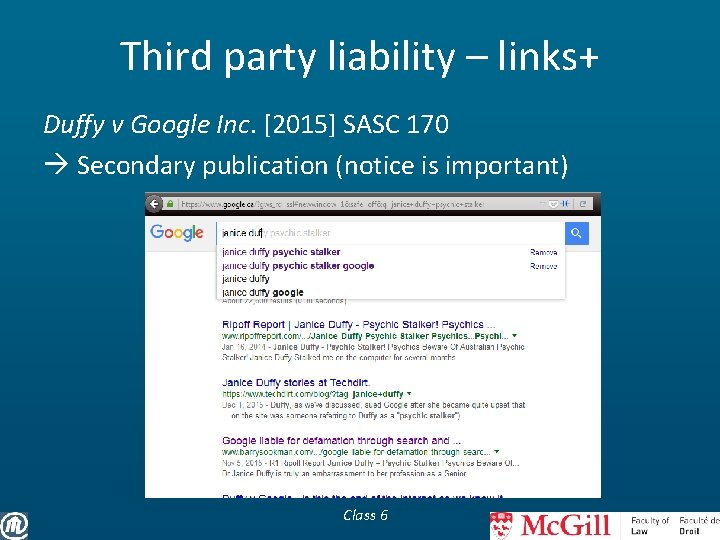
Third party liability – links+ Duffy v Google Inc. [2015] SASC 170 Secondary publication (notice is important) Class 6
Third party liability – links+ Duffy v Google Inc. [2017] SASCFC 130 (October 4, 2017) upheld, Google is in fact a secondary publisher “There is an important distinction between a pre-programmed automated system and passivity. It is the degree to which the automated programmers facilitate the production of defamatory material in a written and therefore comprehensible form which is important” “Google participated in the publication of the paragraphs about Dr Duffy produced by its search engine because it intended its search engine to do what it programmed it to do” Class 6
Google Auto-Complete Policy 1. Sexually explicit predictions We remove predictions that contain sexually explicit or vulgar language. Pornographic terms or terms that are closely associated with pornography are removed from predictions. 2. Hateful predictions against groups and individuals We remove predictions that include language that denigrates or insults individuals or groups on the basis of race, ethnic origin, religion, disability, gender, age, nationality, veteran status, sexual orientation, or gender identity. 3. Violent predictions We remove predictions that include graphic descriptions of violence or advocate violence generally. 4. Dangerous and harmful activity in predictions We remove predictions promoting dangerous or criminal activities that would lead to real-world harm. Class 6
More Google Trkulja v Google LLC [2018] HCA 25 F: Autcomplete – Michael Trk… becomes “Michael Trkulja criminal…”, also publication of images in G Images search Issue: Google a publisher? Held: Yes! “Google’s intentional participation in the communication of the allegedly defamatory results to Google search engine users supports a finding that Google published the allegedly defamatory results” (note Google did not file defense, this was preliminary, will go on for years…) Class 6
Parting thoughts on the topic… Gab “Gab users frequently call for the murder of women, Jews and other minorities on Gab, and are rewarded with likes and reposts” Synagogue shooter on Gab Pay. Pal, Stripe, Medium, Go. Daddy, hosting company all cancelled Gab’s accounts Do they / should they have 230 CDA immunity? Class 8
Defamation - criminal remedies? Class 6
Defamatory Libel Criminal Code 298. (1) A defamatory libel is matter published, without lawful justification or excuse, that is likely to injure the reputation of any person by exposing him to hatred, contempt or ridicule, or that is designed to insult the person of or concerning whom it is published. 300. Every one who publishes a defamatory libel that he knows is false is guilty of an indictable offence and liable to imprisonment for a term not exceeding five years. 301. Every one who publishes a defamatory libel is guilty of an indictable offence and liable to imprisonment for a term not exceeding two years Class 6
Criminal Harassment • s. 264 Criminal Code 264 (1) No person shall, without lawful authority and knowing that another person is harassed or recklessly as to whether the other person is harassed, engage in conduct referred to in subsection (2) that causes that other person reasonably, in all the circumstances, to fear for their safety or the safety of anyone known to them. (2) The conduct mentioned in subsection (1) consists of (…) (b) repeatedly communicating with, either directly or indirectly, the other person or anyone known to them; Class 6
Criminal Harassment on Twitter? Elliott v. R, 2016 ONCJ 35 ” The element that the fear be reasonable in all of the circumstances has not been established” ”I am not satisfied beyond a reasonable doubt that Mr. Elliott’s repeated communications caused Ms. Reilly to fear for her safety” Class 6
On the other hand R. v Gardner, 2018 Can. LII 72609 (NL PC) FB: “I’m just in the mood to break your fucking pig face Terry Murphy. Get the money or I’ll beat your ugly head out your own asshole. You got 1 day bitch. Or you’re fucked…test me you piece of shit” (17 messages like this) “engage in conduct that caused Terry Murphy reasonably in all circumstances to fear for his safety and the safety of anyone known to him contrary to s. 264” 90 days sentence, no contact order Class 6

CLASS 8 START! Class 8
RIGHTS TO YOUR IMAGE Class 8
Personality Rights Publication Rights • • • Right to your image Right to your likeness Right to your voice Right to your name Others? Your persona Class 8
Personality Rights in play when… $$$$$$$ Reputation / defamation Class 8
Personality Rights in play when… $$$$$$$ Reputation / defamation Recall Douez v. Facebook Class 3 – territorial jurisdiction A. B. v Bragg Communications 2012 SCC 46 Fake FB profile with picture of A. B. and similar name, along with unflattering comments, sexual references BUT underlying privacy rights case Mrs. Douez’ (and potential class) photo and name used in FB advertisement (see November 13 class) Class 8
Personality Rights – Common Law • Specific references in Privacy Acts of British Columbia, Manitoba, Newfoundland, and Saskatchewan • Other common law provinces – tort of “appropriation of personality” or “wrongful appropriation of personality” Class 8
Common Law Statutes MB, NL, SK British Columbia Ø Personality rights are a subset of the right to privacy Ø Name, likeness, voice Ø No proof of damages required Ø Personality rights violations are a tort in and of themselves Ø Name and likeness only Ø No proof of damages required Class 8
e. g. Manitoba The Privacy Act 2. A person who substantially, unreasonably, and without claim of right, violates the privacy of another person, commits a tort against that other person. 3. Without limiting the generality of section 2, privacy of a person may be violated (…) (c) by the unauthorized use of the name or likeness or voice of that person for the purposes of advertising or promoting the sale of, or any other trading in, any property or services, or for any other purposes of gain to the user if, in the course of the use, that person is identified or identifiable and the user intended to exploit the name or likeness or voice of that person Class 8
British Columbia – The Privacy Act 3. (1) In this section, “portrait” means a likeness, still or moving, and includes (a) a likeness of another deliberately disguised to resemble the plaintiff, and (b) a caricature. (2) It is a tort, actionable without proof of damage, for a person to use the name or portrait of another for the purpose of advertising or promoting the sale of, or other trading in, property or services, unless that other, or a person entitled to consent on his or her behalf, consents to the use for that purpose. Class 8
Common law tort Krouse v. Chrysler Canada Ltd. et al. (1974), 1 O. R. (2 d) 225 (Ont. CA) F – pictures of a football game, players with numbers on jerseys used in car ad “…there may well be circumstances in which the Courts would be justified in holding a defendant liable in damages for appropriation of a plaintiff's personality, amounting to an invasion of his right to exploit his personality by the use of his image, voice or otherwise with damage to the plaintiff, but… “ Class 8
Common Law Developments Jones v. Tsige, 2012 ONCA 32 F: “appellant, Sandra Jones, discovered that the respondent, Winnie Tsige, had been surreptitiously looking at Jones' banking records. Tsige and Jones did not know each other despite the fact that they both worked for the same bank and Tsige had formed a common-law relationship with Jones' former husband. As a bank employee, Tsige had full access to Jones' banking information and, contrary to the bank's policy, looked into Jones' banking records at least 174 times over a period of four years. ” Class 8
Jones v. Tsige Issue: Does Ontario law recognize a right to bring a civil action for damages for the invasion of personal privacy? Held: It does now! Ratio Prosser’s torts (USA) – 4 invasion of privacy torts: 1. Intrusion upon the plaintiff's seclusion or solitude, or into his private affairs. (“Intrusion upon seclusion”) 2. Public disclosure of embarrassing private facts about the plaintiff. (2 more, ignore them) Class 8
Jones v. Tsige Ratio “we are presented in this case with facts that cry out for a remedy. While Tsige is apologetic and contrite, her actions were deliberate, prolonged and shocking” “In my view, it is appropriate for this court to confirm the existence of a right of action for INTRUSION UPON SECLUSION. Recognition of such a cause of action would amount to an incremental step that is consistent with the role of this court to develop the common law in a manner consistent with the changing needs of society. Class 8
Jones v. Tsige Ratio “The case law, while certainly far from conclusive, supports the existence of such a cause of action. Privacy has long been recognized as an important underlying and animating value of various traditional causes of action to protect personal and territorial privacy. Charter jurisprudence recognizes privacy as a fundamental value in our law and specifically identifies, as worthy of protection, A RIGHT TO INFORMATIONAL PRIVACY THAT IS DISTINCT FROM PERSONAL AND TERRITORIAL PRIVACY. The right to informational privacy closely tracks the same interest that would be protected by a cause of action for intrusion upon seclusion. ” “I would essentially adopt as the elements of the action for intrusion upon seclusion the Restatement (Second) of Torts (2010) formulation which, for the sake of convenience, I repeat here: One who intentionally intrudes, physically or otherwise, upon the seclusion of another or his private affairs or concerns, is subject to liability to the other for invasion of his privacy, if the invasion would be highly offensive to a reasonable person. ” Class 8
SRSLY PROF. MENDELSOHN, WHY SHOULD I CARE ABOUT JONES V. TSIGE? Class 8
Why do we care about Jones v. Tsige? Vanderveen v Waterbridge Media Inc. , 2017 Can. LII 77435 (ON SCSM) F: Filming of person jogging while trying to lose post-partum weight, video used to promote condo community without her consent “I have no hesitation in concluding that in capturing the image of Mme Vanderveen and publishing it in a commercial video for Bridgeport, the defendant committed the tort of intrusion upon seclusion” “While Jones v. Tsige dealt with the examination of Jones’ bank account by Tsige on 174 occasions over a 4 year period, I am satisfied that the elements of intrusion upon seclusion mentioned above apply to capturing the persona or likeness of an individual and using it for commercial purposes without consent. ” Class 8
• • Various defenses at common law re images Consent Public interest Fair comment Not recognizable Group picture unless identified Non-intentional Incidental to another legal act Law enforcement images Class 8
Personality Rights in Quebec Charter 4. dignity, honour and reputation; and 5. respect for private life C. C. Q. 35. Every person has a right to the respect of his reputation and privacy. 36. The following acts, in particular, may be considered as invasions of the privacy of a person (. . . ) (3) appropriating or using his image or voice while he is in private premises; (…) (5) using his name, image, likeness or voice for a purpose other than the legitimate information of the public; Class 8
Personality Rights in Quebec Aubry c. Éditions Vice-Versa inc. [1998] 1 SCR 591 F – Aubry (17 years old) had her photo taken in a public place, sitting on some steps, and published in an arts magazine without her consent Issue – Does publication of photograph without permission lead to liability? Held: Yes! Class 8
Aubry c. Éditions Vice-Versa inc (cont. ) “Since the right to one’s image is included in the right to respect for one’s private life, it is axiomatic that every person possesses a protected right to his or her image. This right arises when the subject is recognizable. There is, thus, an infringement of the person’s right to his or her image, and therefore fault, as soon as the image is published without consent and enables the person to be identified. ” “Since every person is entitled to protection of his or her privacy, and since the person’s image is protected accordingly, it is possible for the rights inherent in the protection of privacy to be infringed even though the published image is in no way reprehensible and has in no way injured the person’s reputation. ” Class 8
Aubry c. Éditions Vice-Versa inc (cont. ) “The public’s right to information, supported by freedom of expression, places limits on the right to respect for one’s private life in certain circumstances. This is because the expectation of privacy is reduced in certain cases. ” Depends on context, e. g. public interest. So here… “In our view, the artistic expression of the photograph, which was alleged to have served to illustrate contemporary urban life, cannot justify the infringement of the right to privacy it entails. It has not been shown that the public’s interest in seeing this photograph is predominant. ” Class 8
Aubry c. Éditions Vice-Versa inc (cont. ) “The appellants argued that there was no causal connection between the publication of the photograph and the damages. In our view, no particular problem arises here since the damages are the logical, direct and immediate consequence of the fault. A teenager’s sensitivity and the possibility of being teased by her friends are eminently foreseeable. ” “In this regard, the respondent is correct in stating that the magazine does not cease to be “commercial” merely because it has an artistic content. In the case at bar, the photograph was used for commercial purposes, in particular to sell the magazine. ” Class 8
Aubry c. Éditions Vice-Versa inc (cont. ) Notes: Ø Case facts from 1989, CCLC applies, does not have specific CCQ right to image; case decided under s. 5 of Charter right to image held to be included in right to privacy Ø dissent no damages here! Some classmates laughing at her is not enough; Aubry never said she felt humiliated Class 8
Bring it all home “I note that the legal principles discussed, the societal values protected and the determination of the quantum of damages in Jones v. Tsige are entirely consistent with the decision of the Supreme Court of Canada in Aubry v. Les Editions Vice-Versa, a case grounded in the Civil Code of Quebec and the Charter of Human Rights and Freedoms rather than the common law in Ontario. ” (Vanderveen) Class 8
NON-CONSENSUAL PORNOGRAPHY (A. K. A. REVENGE PORN? ) Class 8
Nonconsensual pornography The distribution of sexual or pornographic images of individuals without their consent No revenge motive per se 1. images originally obtained without consent (e. g. using hidden cameras, hacking phones, or recording sexual assaults) 2. images consensually obtained within the context of an intimate relationship Class 8
e. g. B. C. Privacy Act L. A. M. v. J. E. L. I. , 2008 BCSC 1147 F – D videotaped nude P and her young daughter in the bathroom (D also convicted for child pornography) Held - $60 k total damages (including $35 k punitive) for violating BC Privacy Act Note – no distribution here, but privacy violation Class 8
e. g. B. C. Privacy Act T. K. L. v. T. M. P. , 2016 BCSC 789 F – D videotaped nude P (his stepdaughter) in bedroom and bathroom / shower, said he did it for humiliation and revenge Held - ~ $94 k total damages for violating BC Privacy Act Class 8
What if there is no Privacy Act? Doe 464533 v. N. D. , 2016 ONSC 541 Recall Kristyn’s presentation F – posting of intimate video made during relationship without consent following breakup Held – liable for $100, 000 in damages Class 8
Doe 464533 v. N. D. Recall: Prosser’s torts (USA) – 4 invasion of privacy torts: 1. Intrusion upon seclusion 2. Public disclosure of embarrassing private facts Class 8
Doe 464533 v. N. D. [45] To permit someone who has been confidentially entrusted with such details – and in particular intimate images - to intentionally reveal them to the world via the Internet, without legal recourse, would be to leave a gap in our system of remedies. I therefore would hold that such a remedy should be available in appropriate cases. [46] I would essentially adopt as the elements of the cause of action for public disclosure of private facts the Restatement (Second) of Torts (2010) formulation, with one minor modification: One who gives publicity to a matter concerning the private life of another is subject to liability to the other for invasion of the other’s privacy, if the matter publicized or the act of the publication (a) would be highly offensive to a reasonable person, and (b) is not of legitimate concern to the public. [modification shown by underlining] Class 8
Doe 464533 v. N. D. , part deux 2016 ONSC 4920 (September 2016) Motion to set aside default judgment “Guided by the factors detailed above [ed. – from Mountain View case], the overall interest of justice favours the granting of the order with terms. That is, the finding of liability on the defendant and the assessment of damages are to be set aside upon the defendant paying to the plaintiff her costs thrown away within 90 days” Should allow a defense to be mounted Class 8
Doe 464533 v. N. D. , part trois 2017 ONSC 127 (January 2017) Motion for leave to appeal of decision in part deux that set aside the default judgment, denied “I am not persuaded that the motion judge erred in his conclusion that both liability and damages should be the subject of a trial on the merits. ” “I am not persuaded that the motion judge erred in his application of the Mountain View factors. ” Class 8
Doe 464533 v. N. D. , part trois (cont. ) “I do not see the dismissal of this motion for leave to appeal as a discouragement of victims. Indeed, it is a matter of general importance that the facts in this case be the subject of a hearing on its merits so that the significant legal conclusions deriving therefrom will have more weight in future cases as opposed to findings made as a result of a hearing where only one side participated, albeit through the fault of the other side. The uniqueness of the case and the prospect for a decision on the merits making a contribution to the development of torts in an important area of the law is a compelling reason to conclude that it is a question of general importance that the defendant have the opportunity to participate in a trial. ” Class 8
Doe 464533 v. N. D. follow-up Does “public disclosure of private facts” still exist on tort law? Doucet v. The Royal Winnipeg Ballet, 2018 ONSC 4008 Class action approved, intimate photos taken and distributed, Doe cited (public disclosure of private facts as basis for damages) Class 8
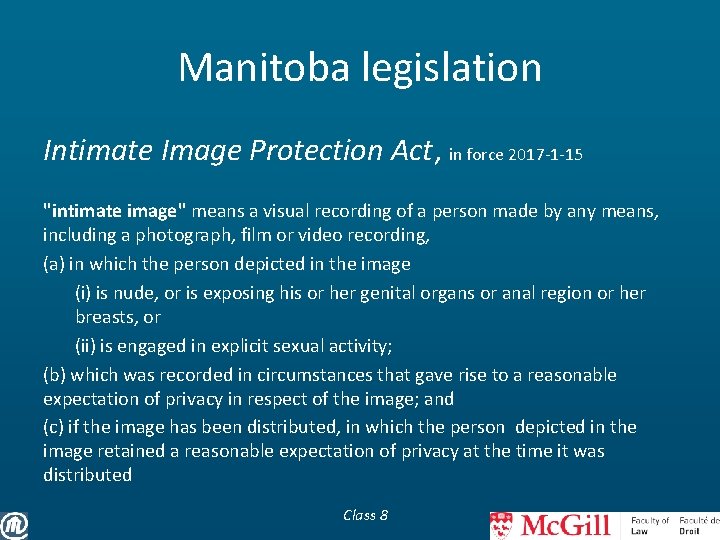
Manitoba legislation Intimate Image Protection Act, in force 2017 -1 -15 "intimate image" means a visual recording of a person made by any means, including a photograph, film or video recording, (a) in which the person depicted in the image (i) is nude, or is exposing his or her genital organs or anal region or her breasts, or (ii) is engaged in explicit sexual activity; (b) which was recorded in circumstances that gave rise to a reasonable expectation of privacy in respect of the image; and (c) if the image has been distributed, in which the person depicted in the image retained a reasonable expectation of privacy at the time it was distributed Class 8
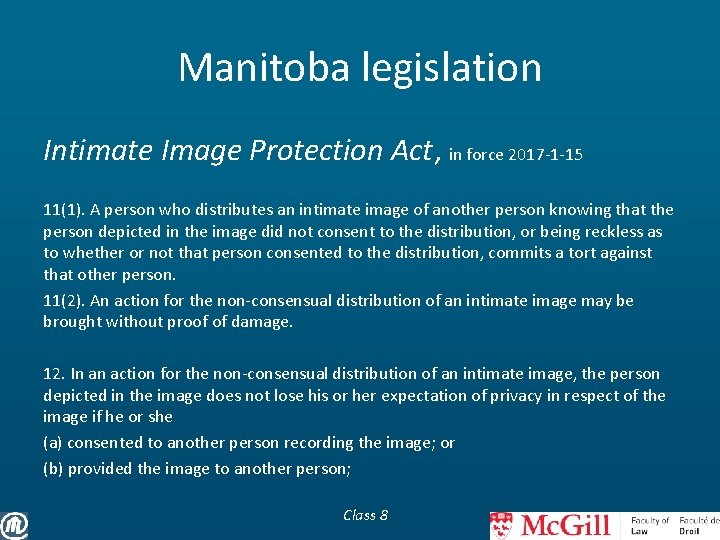
Manitoba legislation Intimate Image Protection Act, in force 2017 -1 -15 11(1). A person who distributes an intimate image of another person knowing that the person depicted in the image did not consent to the distribution, or being reckless as to whether or not that person consented to the distribution, commits a tort against that other person. 11(2). An action for the non-consensual distribution of an intimate image may be brought without proof of damage. 12. In an action for the non-consensual distribution of an intimate image, the person depicted in the image does not lose his or her expectation of privacy in respect of the image if he or she (a) consented to another person recording the image; or (b) provided the image to another person; Class 8
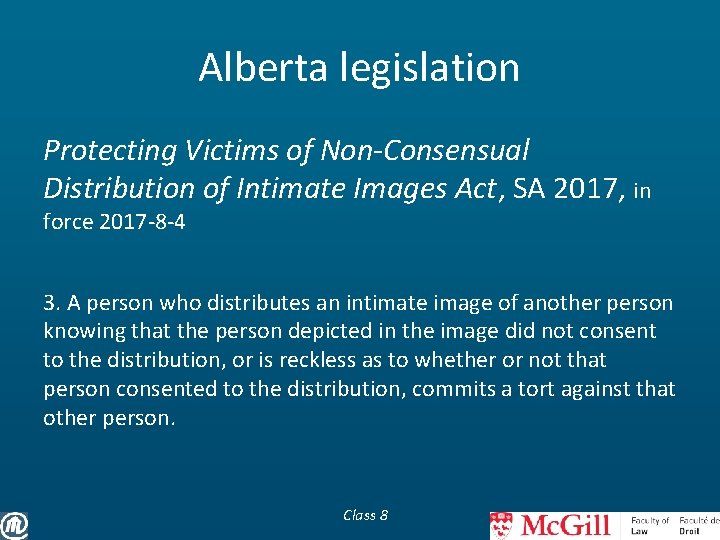
Alberta legislation Protecting Victims of Non-Consensual Distribution of Intimate Images Act, SA 2017, in force 2017 -8 -4 3. A person who distributes an intimate image of another person knowing that the person depicted in the image did not consent to the distribution, or is reckless as to whether or not that person consented to the distribution, commits a tort against that other person. Class 8
Nova Scotia Legislation An Act Respecting the Unauthorized Distribution of Intimate Images and Protection Against Cyber -bullying Cited as the Intimate Images and Cyberprotection Act In force July 2018 Class 8
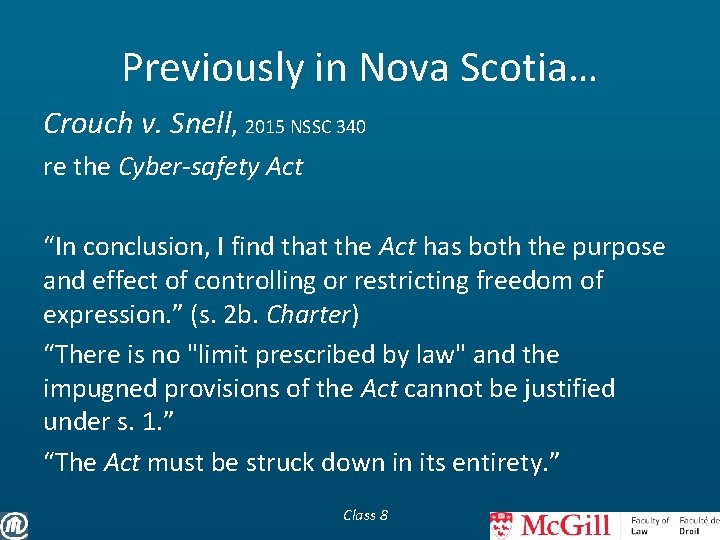
Previously in Nova Scotia… Crouch v. Snell, 2015 NSSC 340 re the Cyber-safety Act “In conclusion, I find that the Act has both the purpose and effect of controlling or restricting freedom of expression. ” (s. 2 b. Charter) “There is no "limit prescribed by law" and the impugned provisions of the Act cannot be justified under s. 1. ” “The Act must be struck down in its entirety. ” Class 8
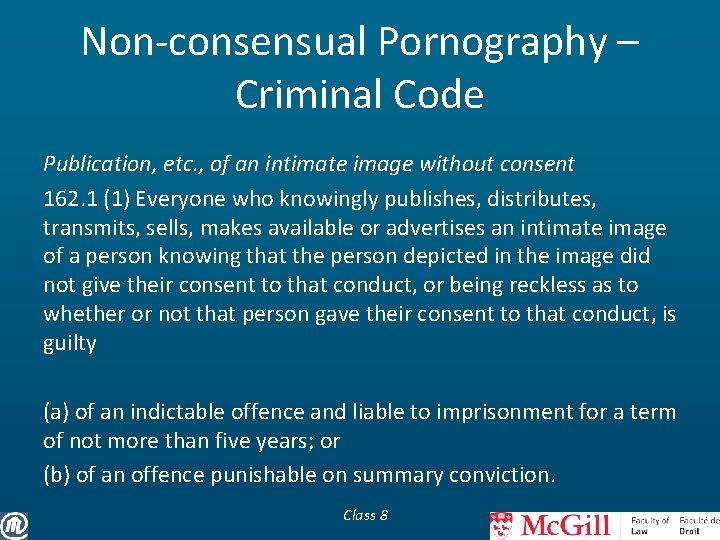
Non-consensual Pornography – Criminal Code Publication, etc. , of an intimate image without consent 162. 1 (1) Everyone who knowingly publishes, distributes, transmits, sells, makes available or advertises an intimate image of a person knowing that the person depicted in the image did not give their consent to that conduct, or being reckless as to whether or not that person gave their consent to that conduct, is guilty (a) of an indictable offence and liable to imprisonment for a term of not more than five years; or (b) of an offence punishable on summary conviction. Class 8
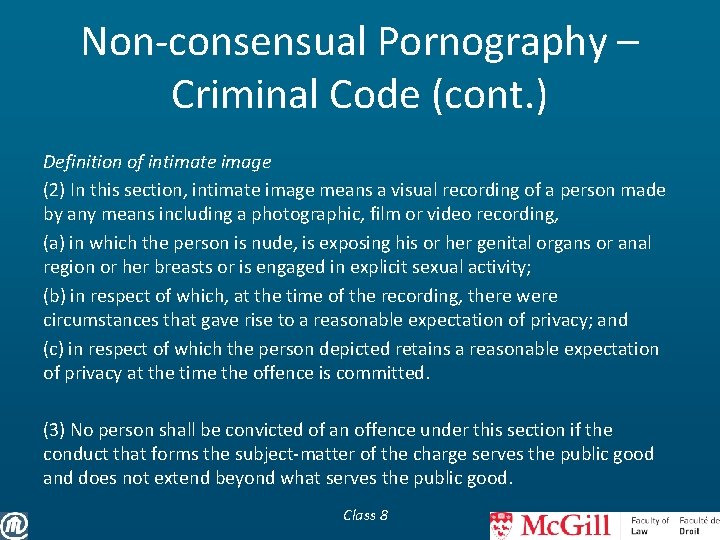
Non-consensual Pornography – Criminal Code (cont. ) Definition of intimate image (2) In this section, intimate image means a visual recording of a person made by any means including a photographic, film or video recording, (a) in which the person is nude, is exposing his or her genital organs or anal region or her breasts or is engaged in explicit sexual activity; (b) in respect of which, at the time of the recording, there were circumstances that gave rise to a reasonable expectation of privacy; and (c) in respect of which the person depicted retains a reasonable expectation of privacy at the time the offence is committed. (3) No person shall be convicted of an offence under this section if the conduct that forms the subject-matter of the charge serves the public good and does not extend beyond what serves the public good. Class 8
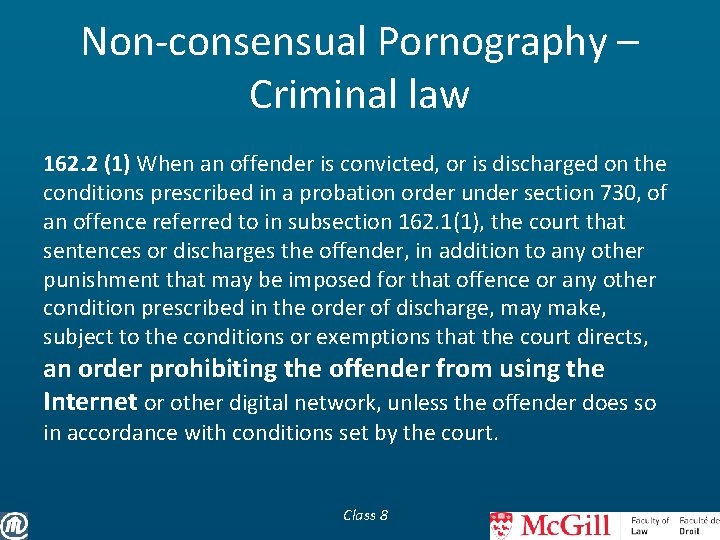
Non-consensual Pornography – Criminal law 162. 2 (1) When an offender is convicted, or is discharged on the conditions prescribed in a probation order under section 730, of an offence referred to in subsection 162. 1(1), the court that sentences or discharges the offender, in addition to any other punishment that may be imposed for that offence or any other condition prescribed in the order of discharge, may make, subject to the conditions or exemptions that the court directs, an order prohibiting the offender from using the Internet or other digital network, unless the offender does so in accordance with conditions set by the court. Class 8
Non-consensual Pornography – Criminal Code (cont. ) R. v. A. C. 2017 ONCJ 317 F – Victim searched her name, found videos and pictures of her having intercourse with A. C. , which she had consented to as they were in a relationship; uploaded by A. C. after relationship ended Issue – guilty under s. 162. 1 of the Criminal Code? Sentence? Held – Yes, he pleaded guilty. Issue was mostly about sentence, 162. 2 order. LOTS of aggravating factors (e. g. attached name and other PI to pics and videos); five months imprisonment “It is difficult to overstate the seriousness of this offence. The offender deliberately set out to violate C. S. ’s privacy in a most obscene and far-reaching way. He did so, motivated by revenge, with the intent to degrade and humiliate her. ” Class 8
Recent jurisprudence under 162. 1 • R v. P. S. D. , 2016 BCPC 400 (Can. LII) Time served • R v. Calpito, 2017 ONCJ 129 Conditional discharge, probation • R. v Hunt, 2017 Can. LII 86655 (NL PC) Threatened to release intimate pictures, charged with extortion, 9 months jail Class 8
Discussion Question Does Facebook, or Google, Porntube. com or The. Dirty. com have a legal obligation to remove non-consensual pornography uploaded by a user? Class 8
Non-consensual Pornography - USA • • 40 states (+DC) have criminal laws Generally stronger privacy torts in USA No national criminal or civil law Problem of s. 230 CDA Class 8
FIN Class 8
- Slides: 78