
CLASS 6 APRIL 19 AGENDA Homework Review Verb

CLASS 6: APRIL 19
AGENDA • Homework Review • Verb Tenses • Active vs. passive voice
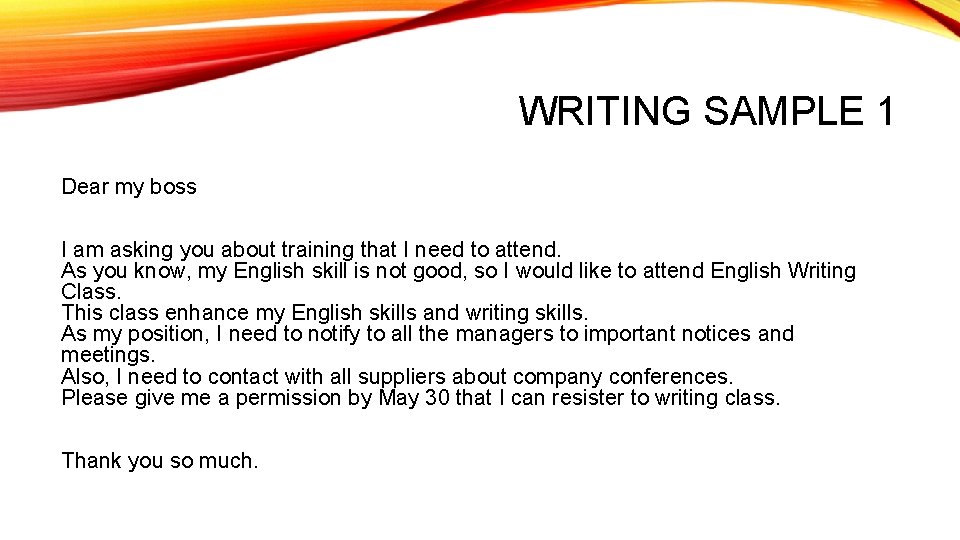
WRITING SAMPLE 1 Dear my boss I am asking you about training that I need to attend. As you know, my English skill is not good, so I would like to attend English Writing Class. This class enhance my English skills and writing skills. As my position, I need to notify to all the managers to important notices and meetings. Also, I need to contact with all suppliers about company conferences. Please give me a permission by May 30 that I can resister to writing class. Thank you so much.
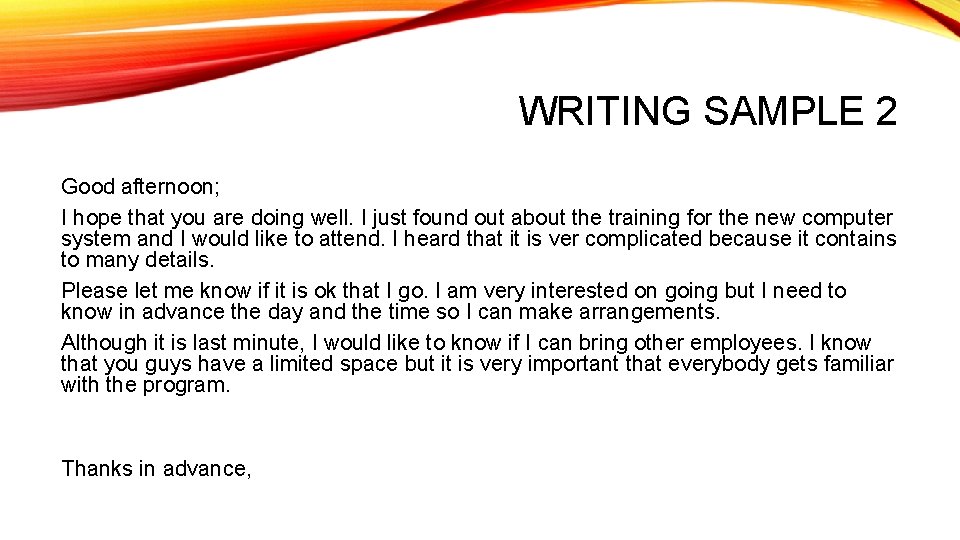
WRITING SAMPLE 2 Good afternoon; I hope that you are doing well. I just found out about the training for the new computer system and I would like to attend. I heard that it is ver complicated because it contains to many details. Please let me know if it is ok that I go. I am very interested on going but I need to know in advance the day and the time so I can make arrangements. Although it is last minute, I would like to know if I can bring other employees. I know that you guys have a limited space but it is very important that everybody gets familiar with the program. Thanks in advance,
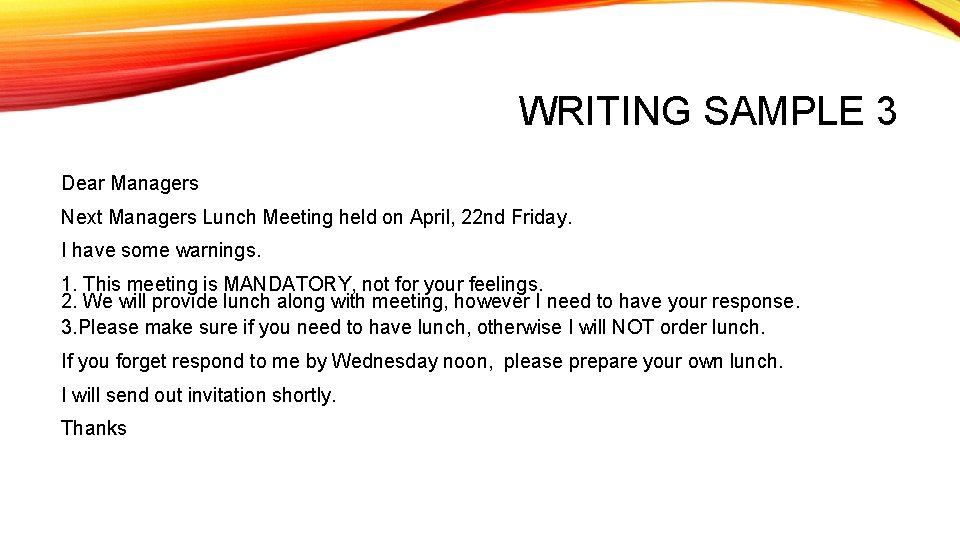
WRITING SAMPLE 3 Dear Managers Next Managers Lunch Meeting held on April, 22 nd Friday. I have some warnings. 1. This meeting is MANDATORY, not for your feelings. 2. We will provide lunch along with meeting, however I need to have your response. 3. Please make sure if you need to have lunch, otherwise I will NOT order lunch. If you forget respond to me by Wednesday noon, please prepare your own lunch. I will send out invitation shortly. Thanks
VERB FORMS • infinitive—the original form of the verb • to run, to jump, to play, to be • simple—the simplest form of the verb • run, runs, ran, jumps, jumped, plays, played, is, was • past participle—the past tense form • ran, jumped, played, was, were
PRESENT TENSE • Something that is taking place right now • Leave verb in original form (if happening now) • Add –s to form present tense (if it continues) • I understand your problem. (happening now) • She enjoys romantic movies. (continuous)
PRESENT PROGRESSIVE • continuing action that takes place at the time of speaking or writing • add the correct form “to be” (is, am, are) in front of the verb and –ing to the verb • The wind is blowing, and it is shaking the leaves. • I am suffering from laryngitis; that is why I am speaking softly.
PAST TENSE • an action that has already happened • use the past tense form of the verb • add –ed to regular verbs and the unique past form for irregular verbs • He fell down the stairs yesterday and broke his arm. • When George failed the test, he became depressed.
PAST PROGRESSIVE • a continuing action occurring in the past or action occurring at the same time as another action in the past • use the correct form of “to be” (was, were) and add –ing to the verb • She was arguing with her boss all day yesterday • Bob was talking on his cell phone when he ran into a parked car.
FUTURE TENSE • an action that will take place • add will to the infinitive • The company will conduct training sessions for new employees next week. • The college announced that it will require all students to buy computers. • The hurricane will mostly likely hit the coast by nightfall. English has a unique feature called the split infinitive where you can add descriptive words in the middle of a verb phrase Example: To boldly go
FUTURE PROGRESSIVE • a continuing action in the future • add will be and –ing ending to the verb • We will be deducting taxes from your paycheck. • The company will be conducting orientation sessions next week.
PRESENT PERFECT TENSE • action that began in the past and is now finished OR action that begin in the past and continues to the present • add has and simple past verb ending • Professor Jones has written a book on the habits of zebras. • He has adored her ever sine the day they met.
PRESENT PERFECT PROGRESSIVE • an action continuing from the past into the present and possibly into the future • add has been and –ing ending to verb • Ever since its introduction, the television has been influencing the lives of those who watch it. • The cost of energy has been increasing each year.
PAST PERFECT TENSE • To form verbs in the past perfect tense: • add had and simple past tense verb form • By the year 2000, computers had become necessary for prosperous business. • John had hoped to graduate from college, but he couldn’t pass English.
PAST PERFECT PROGRESSIVE • a past action that went on until another action occurred • add had been and –ing ending to verb • We had been enjoying the picnic until the rain started. • Before she published Harry Potter, she had been living in poverty.
FUTURE PERFECT TENSE • an action that will be finished before a certain time or that will finish before another occurs in the future • add will have to simple past tense • By Tuesday, we will have collected all the information needed. • By the time dinner is on the table, I will have died of hunger.
FUTURE PERFECT PROGRESSIVE • an action that will continue until a certain future time • add will have been and –ing ending to verb form • By midnight, I will have been driving for five hours. • Angie will have been studying for hours by the time the day is over.

IRREGULAR VERBS • https: //www. englishclub. com/vocabulary/irregular-verbs-list. htm
ACTIVE VS. PASSIVE • https: //www. youtube. com/watch? v=nd 1 zu. Yfjqn. I&index=8&list=PLKa. Sm. SZi. J 0 c 2 S 0 Sbxd. NKs p. L 2 Fn. Nm. OS 436 • Active voice: when the subject completes the action in a sentence • Marcus runs an underground dance club. • Mamiko found the missing keys. • Passive voice: when the object receives the action before the subject is named • An underground dance club is run by Marcus. • The missing keys were found. • An easy way to figure out if you are using the active vs. passive voice: • Add “by zombies” after your verb and if the sentence DOES NOT make sense, you have active voice; if it does make sense, you have passive. • Example: Marcus runs “by zombies”… (active) • An underground dance club is run “by zombies”. (passive) • Mamiko found “by zombies”… (active) • The missing keys were found “by zombies”. (passive)
- Slides: 20