
Class 4 Basic Psychometric Characteristics Variability Reliability Interpretability
Class 4 Basic Psychometric Characteristics: Variability, Reliability, Interpretability October 15, 2009 Anita L. Stewart Institute for Health & Aging University of California, San Francisco 1
Overview of Class 4 u. Concepts of error, sources of error and bias in measures. u. Indicators of variability and reasons for poor variability u. Indicators of reliability u. Interpretability of scores 2
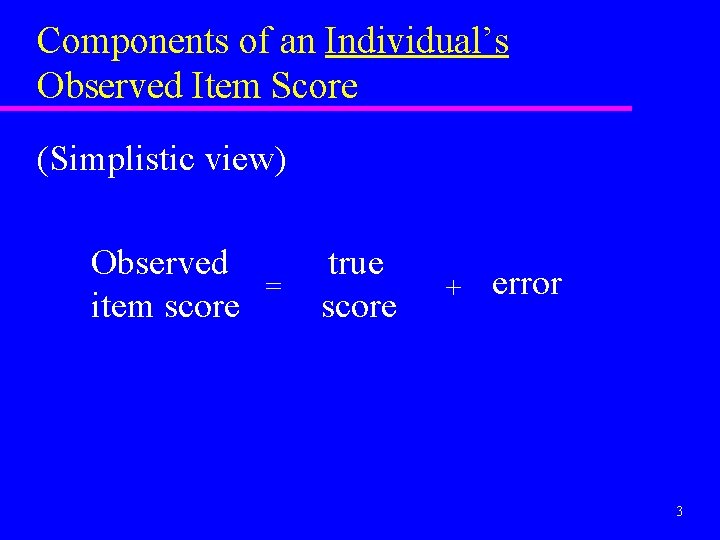
Components of an Individual’s Observed Item Score (Simplistic view) Observed = item score true score + error 3
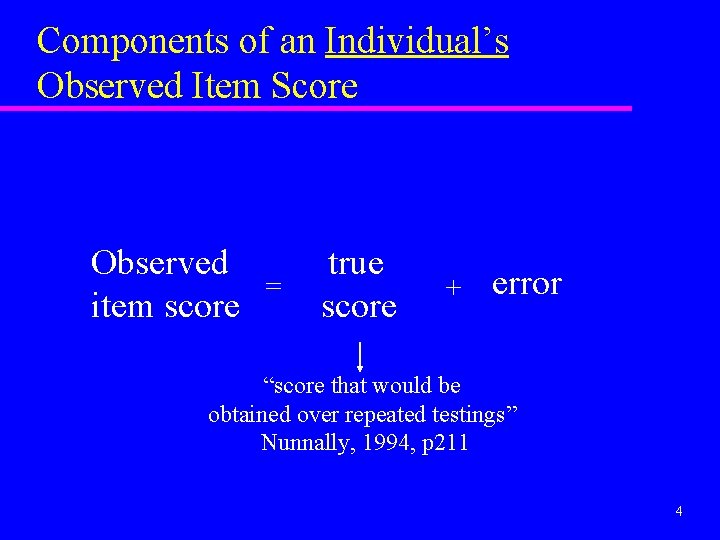
Components of an Individual’s Observed Item Score Observed = item score true score + error “score that would be obtained over repeated testings” Nunnally, 1994, p 211 4

Random versus Systematic Error Observed true = + error item score random systematic 5
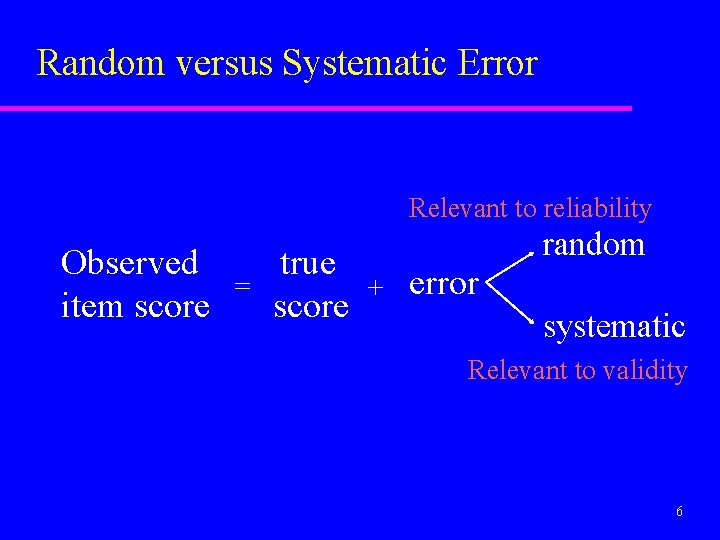
Random versus Systematic Error Relevant to reliability Observed true = + error item score random systematic Relevant to validity 6
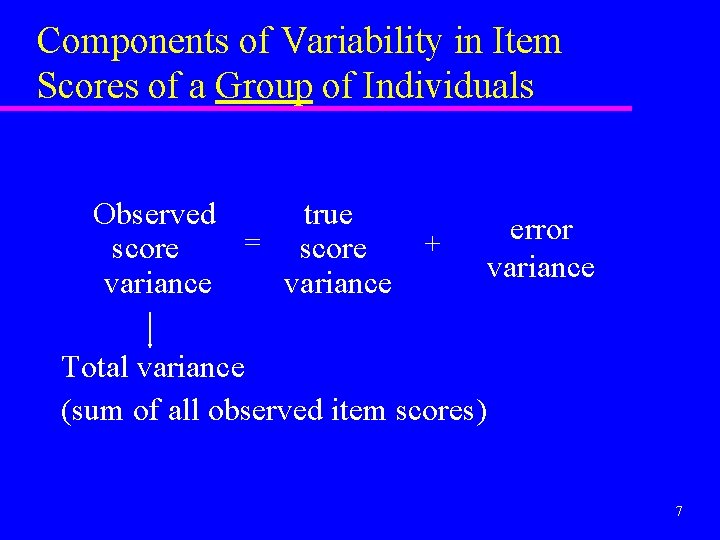
Components of Variability in Item Scores of a Group of Individuals Observed true = score + score variance error variance Total variance (sum of all observed item scores) 7
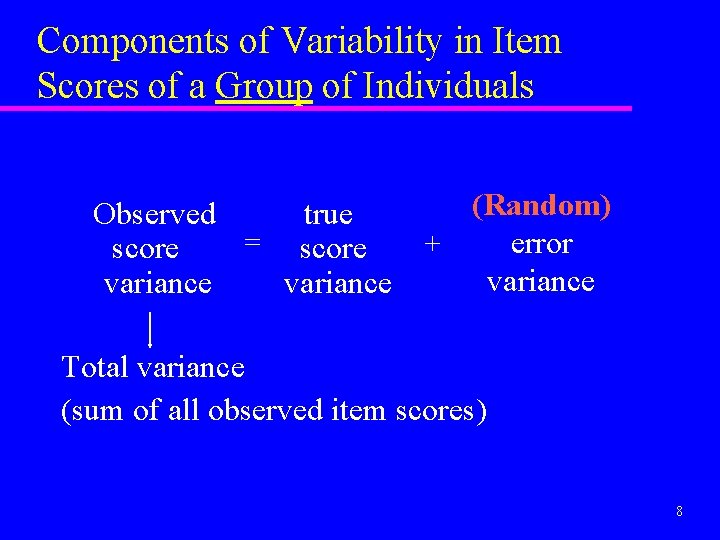
Components of Variability in Item Scores of a Group of Individuals (Random) Observed true error = score + score variance Total variance (sum of all observed item scores) 8
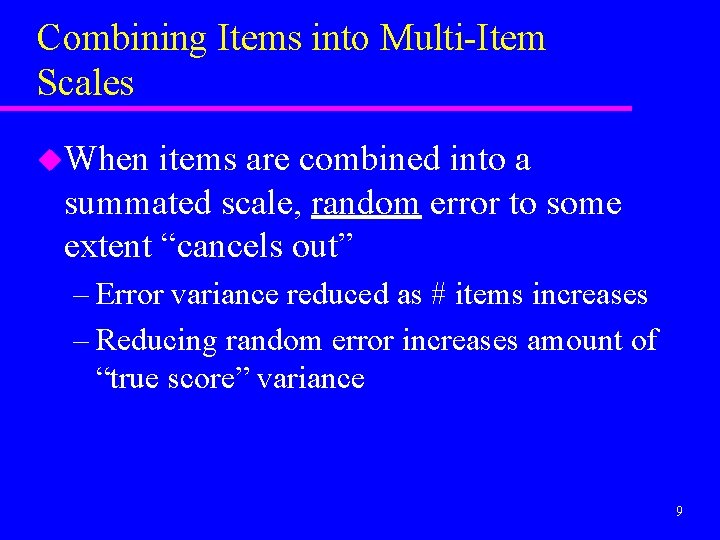
Combining Items into Multi-Item Scales u. When items are combined into a summated scale, random error to some extent “cancels out” – Error variance reduced as # items increases – Reducing random error increases amount of “true score” variance 9
Sources of Error u. Subjects u. Observers or interviewers u. Measure or instrument 10
Example: Measuring Weight of Children u. Observed score is a linear combination of many sources of variation for an individual 11
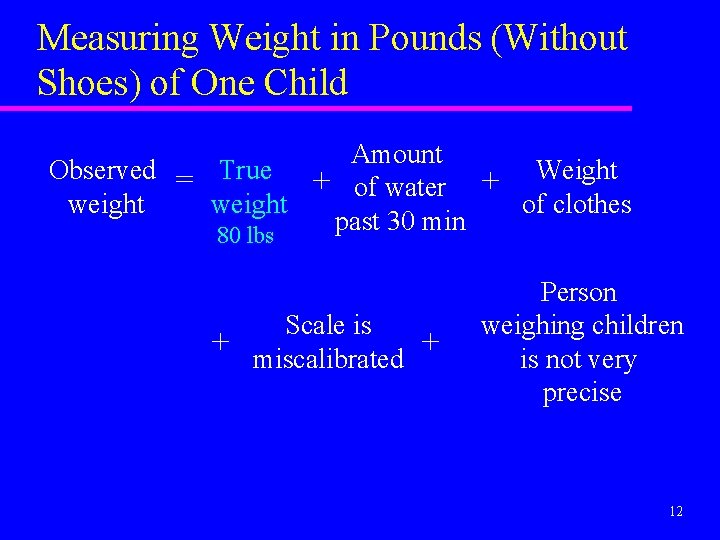
Measuring Weight in Pounds (Without Shoes) of One Child Observed weight = Amount True + of water weight past 30 min 80 lbs + Scale is miscalibrated + + Weight of clothes Person weighing children is not very precise 12
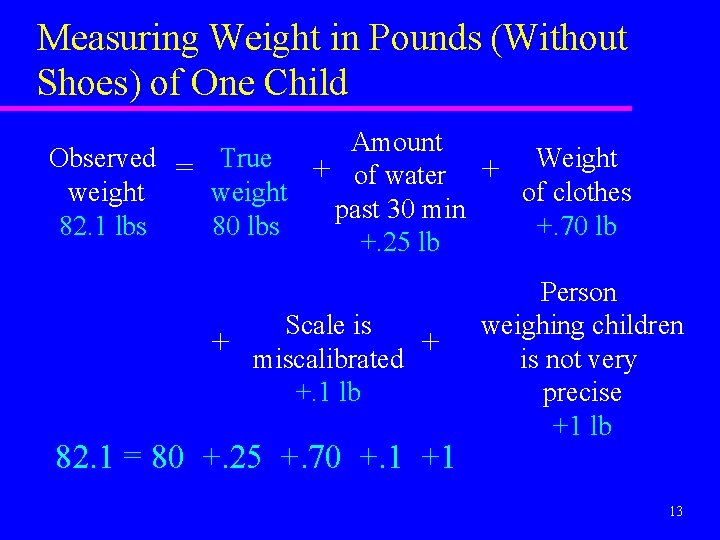
Measuring Weight in Pounds (Without Shoes) of One Child Observed weight 82. 1 lbs = Amount True + of water weight past 30 min 80 lbs +. 25 lb + Scale is miscalibrated +. 1 lb + 82. 1 = 80 +. 25 +. 70 +. 1 +1 + Weight of clothes +. 70 lb Person weighing children is not very precise +1 lb 13
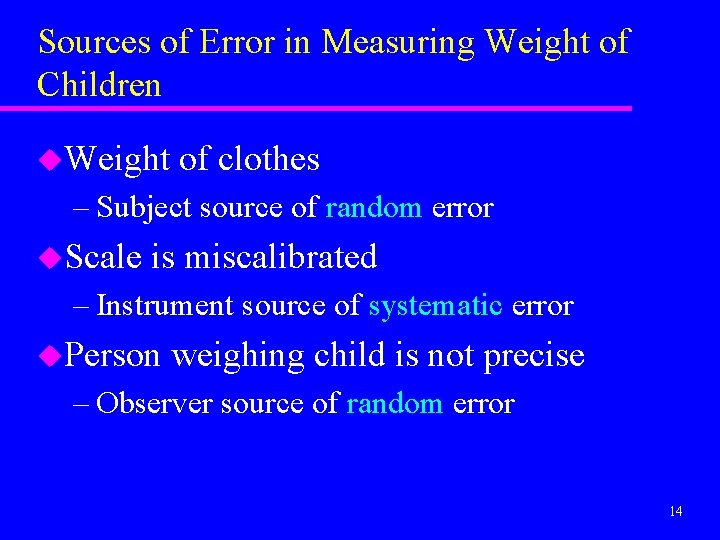
Sources of Error in Measuring Weight of Children u. Weight of clothes – Subject source of random error u. Scale is miscalibrated – Instrument source of systematic error u. Person weighing child is not precise – Observer source of random error 14
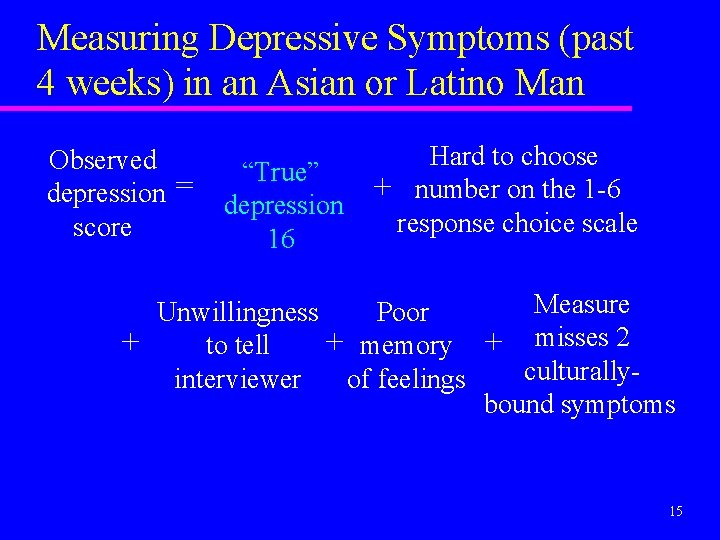
Measuring Depressive Symptoms (past 4 weeks) in an Asian or Latino Man Observed depression score + = “True” depression 16 Hard to choose + number on the 1 -6 response choice scale Unwillingness Poor + memory to tell interviewer of feelings Measure + misses 2 culturallybound symptoms 15
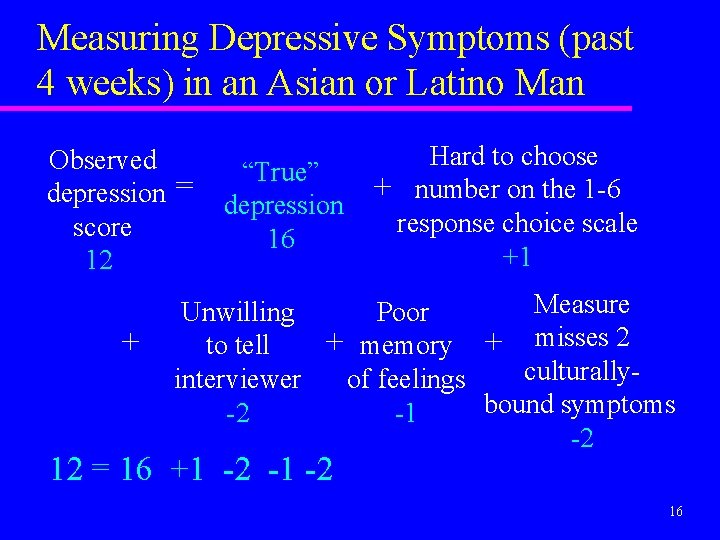
Measuring Depressive Symptoms (past 4 weeks) in an Asian or Latino Man Observed depression score 12 + = “True” depression 16 Unwilling to tell interviewer -2 Hard to choose + number on the 1 -6 response choice scale +1 Measure Poor + memory + misses 2 culturallyof feelings bound symptoms -1 -2 12 = 16 +1 -2 -1 -2 16
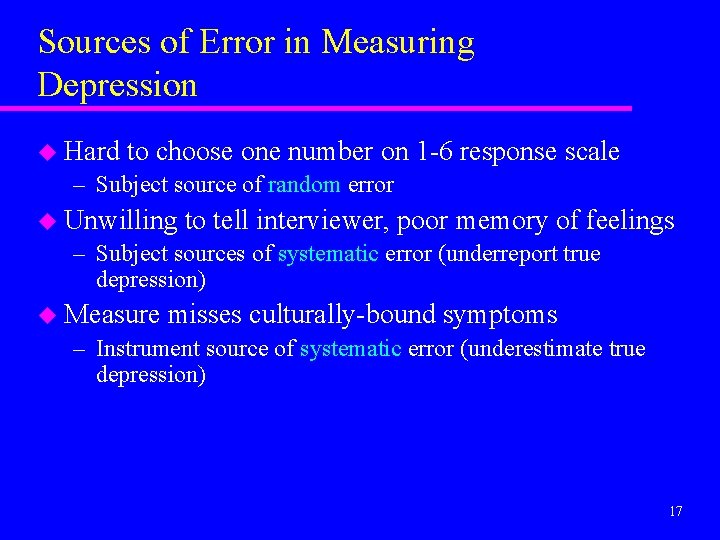
Sources of Error in Measuring Depression u Hard to choose one number on 1 -6 response scale – Subject source of random error u Unwilling to tell interviewer, poor memory of feelings – Subject sources of systematic error (underreport true depression) u Measure misses culturally-bound symptoms – Instrument source of systematic error (underestimate true depression) 17
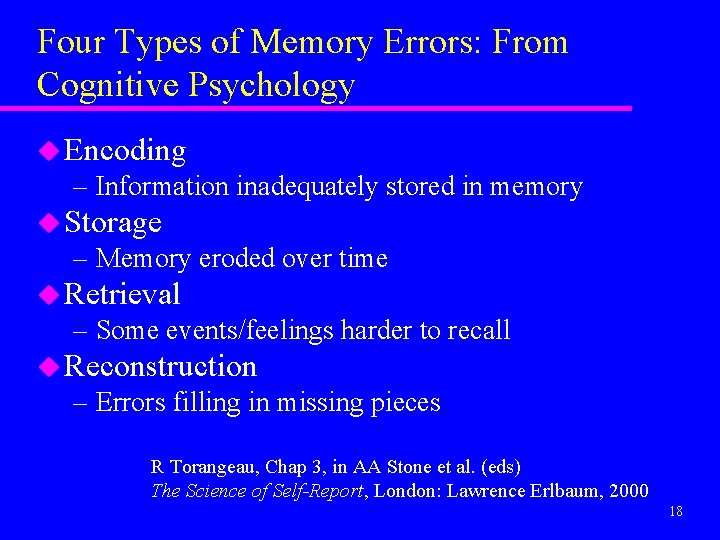
Four Types of Memory Errors: From Cognitive Psychology u Encoding – Information inadequately stored in memory u Storage – Memory eroded over time u Retrieval – Some events/feelings harder to recall u Reconstruction – Errors filling in missing pieces R Torangeau, Chap 3, in AA Stone et al. (eds) The Science of Self-Report, London: Lawrence Erlbaum, 2000 18
Memory and Time u Autobiographical memory – memory of things in time and space u Events not encoded with their calendar dates – Thus time is a poor retrieval method u Numerous errors remembering “when” and “how often” something occurred within a particular time frame N Bradburn, Chap 4, The Science of Self-Report 19
Memory and Emotion u. Tend to remember – positive more than negative experiences – more emotionally intense than neutral experiences – non-threatening events more than threatening, sensitive events Kihlstrom et al, Chap 6, The Science of Self-Report 20
Overview u Concepts u Basic of error psychometric characteristics – Variability – Reliability – Interpretability 21
Variability u Good variability – All (or nearly all) scale levels are represented – Distribution approximates bell-shaped normal u Variability is a function of the sample – Need to understand variability of a measure in sample similar to one you are studying u Review criteria – Adequate variability on the latent variable that is relevant to your study 22
Indicators of Variability u Range of scores u Mean, median, mode u Standard deviation (or standard error) u Interquartile range u Skewness statistic u % at floor (lowest possible score) u % at ceiling (highest possible score) 23
Range of Scores: Possible and Observed u Especially important for multi-item measures u Example: – CES-D possible range is 0 -30 – Wong et al. study of mothers of young children: observed range was 0 -23 » missing entire high end of the distribution (none had high levels of depression) 24
Mean, Median, Mode u Mean - average u Median - midpoint u Mode - most frequent score u In normally distributed measures, these are all the same u In non-normal distributions, they will vary 25
Mean and Standard Deviation u. Most information on variability is from mean and standard deviation – Can envision how measure is distributed on the possible range – Mean + 1 SD = 64% of the scores 26
Interquartile Range (IR) u. Difference between the 3 rd and 1 st quartiles IR = Quartile 3 - Quartile 1 u. This range contains the middle 50% of the distribution – 25% of the sample is above and 25% is below this range 27
Quartiles Divide distribution into 4 parts with 25% of the sample in each part (quartiles) u Quartile 1 - the scale score at the boundary of the lowest 25% of the distribution u Quartile 2 - the score that divides the distribution in half (same as the median) u Quartile 3 - the score at the boundary of the highest 25% (25% of the sample scores above this point) 28
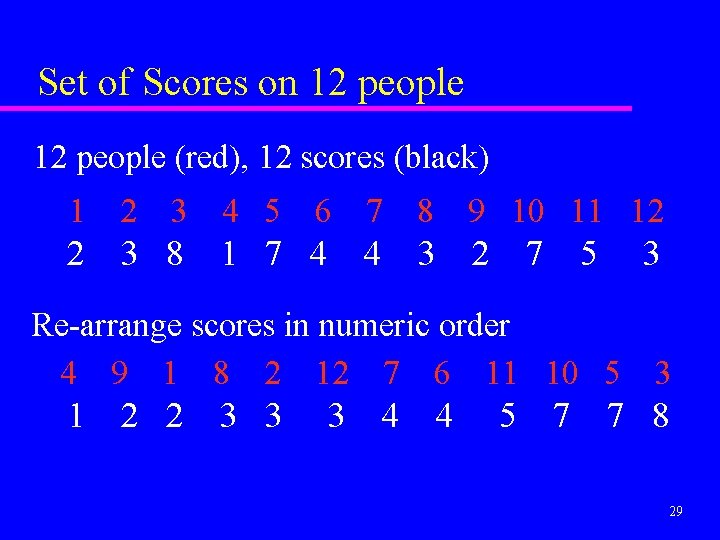
Set of Scores on 12 people (red), 12 scores (black) 1 2 3 8 4 5 6 7 8 9 10 11 12 1 7 4 4 3 2 7 5 3 Re-arrange scores in numeric order 4 9 1 8 2 12 7 6 11 10 5 1 2 2 3 3 3 4 4 5 7 3 7 8 29
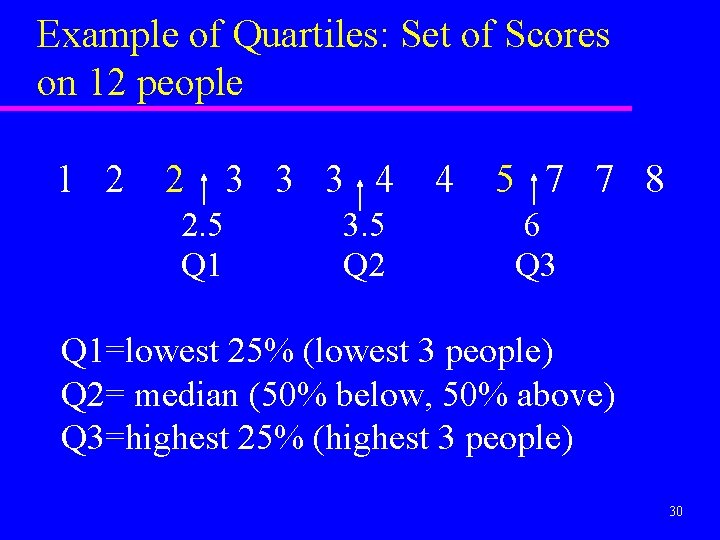
Example of Quartiles: Set of Scores on 12 people 1 2 2 3 3 3 4 2. 5 Q 1 3. 5 Q 2 4 5 7 7 8 6 Q 3 Q 1=lowest 25% (lowest 3 people) Q 2= median (50% below, 50% above) Q 3=highest 25% (highest 3 people) 30
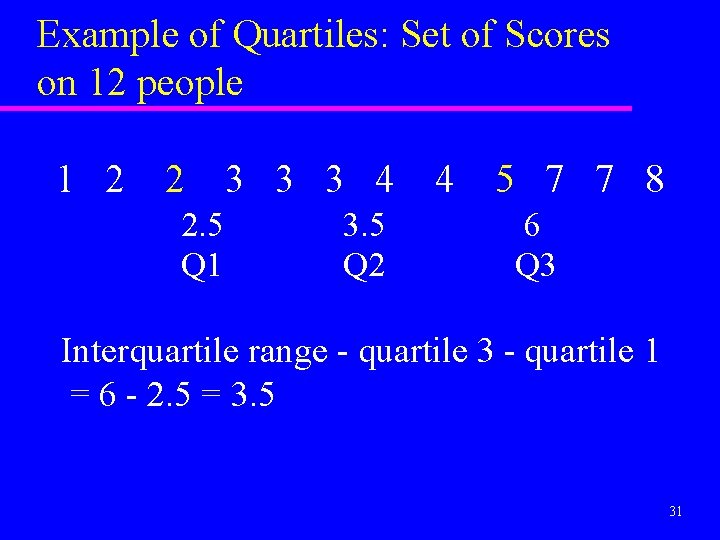
Example of Quartiles: Set of Scores on 12 people 1 2 2 3 3 3 4 2. 5 Q 1 3. 5 Q 2 4 5 7 7 8 6 Q 3 Interquartile range - quartile 3 - quartile 1 = 6 - 2. 5 = 3. 5 31
Skewness u Positive skew - scores bunched at low end, long tail to the right u Negative skew - opposite pattern u Skewness coefficient ranges from - infinity to + infinity – the closer to zero, the more normal u Scores +2. 0 are cause for concern 32
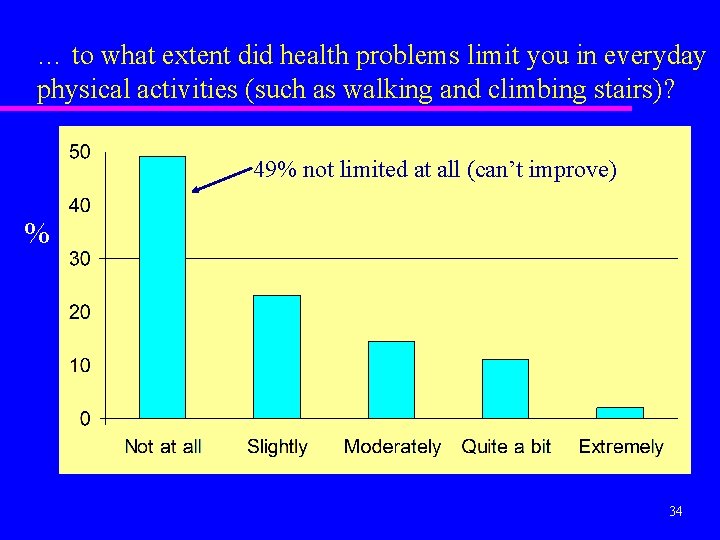
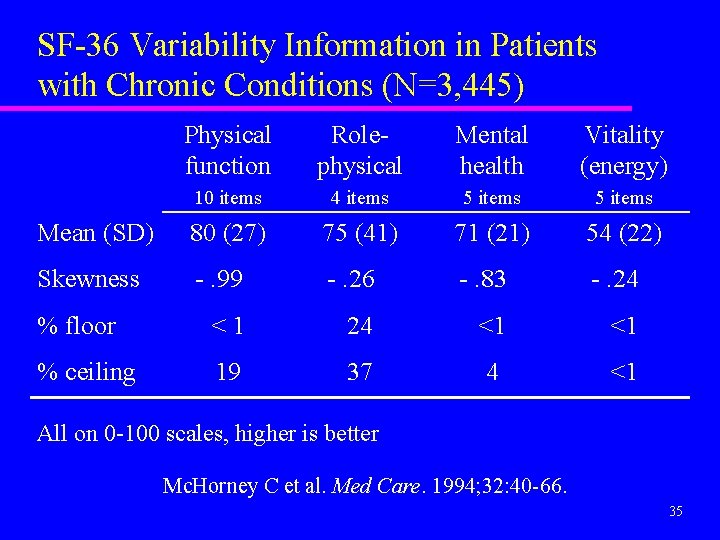
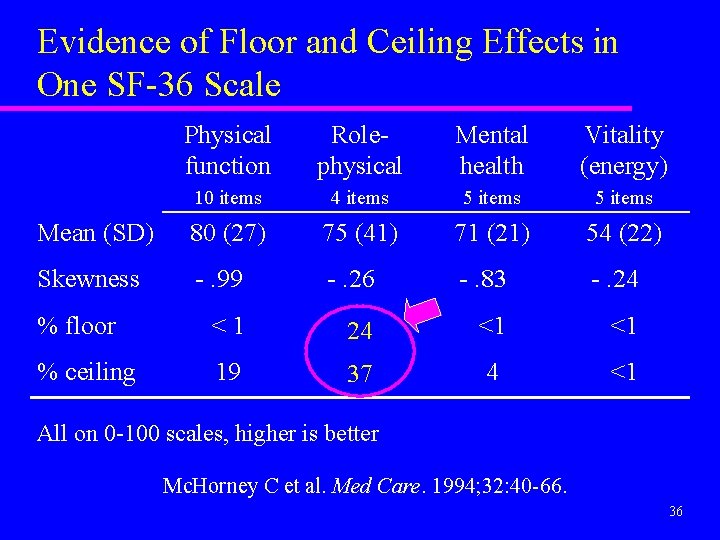
Ceiling and Floor Effects: Similar to Skewness Information u Ceiling effects: substantial number of people get highest possible score u Floor effects: opposite u More helpful for single-item measures or coarse scales with only a few levels 33
… to what extent did health problems limit you in everyday physical activities (such as walking and climbing stairs)? 49% not limited at all (can’t improve) % 34
SF-36 Variability Information in Patients with Chronic Conditions (N=3, 445) Physical function Rolephysical Mental health Vitality (energy) 10 items 4 items 5 items Mean (SD) 80 (27) 75 (41) 71 (21) 54 (22) Skewness -. 99 -. 26 -. 83 -. 24 % floor <1 24 <1 <1 % ceiling 19 37 4 <1 All on 0 -100 scales, higher is better Mc. Horney C et al. Med Care. 1994; 32: 40 -66. 35
Evidence of Floor and Ceiling Effects in One SF-36 Scale Physical function Rolephysical Mental health Vitality (energy) 10 items 4 items 5 items Mean (SD) 80 (27) 75 (41) 71 (21) 54 (22) Skewness -. 99 -. 26 -. 83 -. 24 % floor <1 24 <1 <1 % ceiling 19 37 4 <1 All on 0 -100 scales, higher is better Mc. Horney C et al. Med Care. 1994; 32: 40 -66. 36
Reasons for Poor Variability u Low variability in construct being measured in that “sample” (true low variation) u Items not adequately tapping construct – If only one item, especially hard u Items not detecting variation at one end u What to do: – If developing measures, add items – If selecting measures – find another one 37
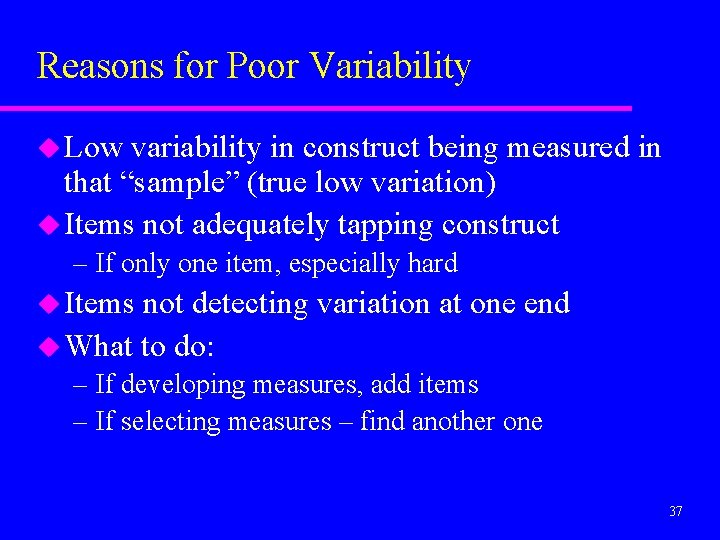
Advantages of Multi-item Scales Revisited u. Using multi-item scales minimizes likelihood of ceiling/floor effects u. Even if items are skewed, multi-item scale “normalizes” the skew 38
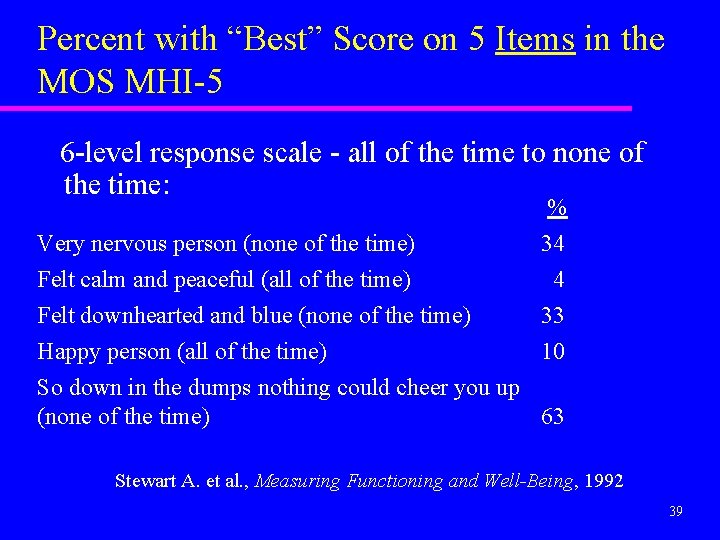
Percent with “Best” Score on 5 Items in the MOS MHI-5 6 -level response scale - all of the time to none of the time: Very nervous person (none of the time) Felt calm and peaceful (all of the time) Felt downhearted and blue (none of the time) % 34 4 33 Happy person (all of the time) 10 So down in the dumps nothing could cheer you up (none of the time) 63 Stewart A. et al. , Measuring Functioning and Well-Being, 1992 39
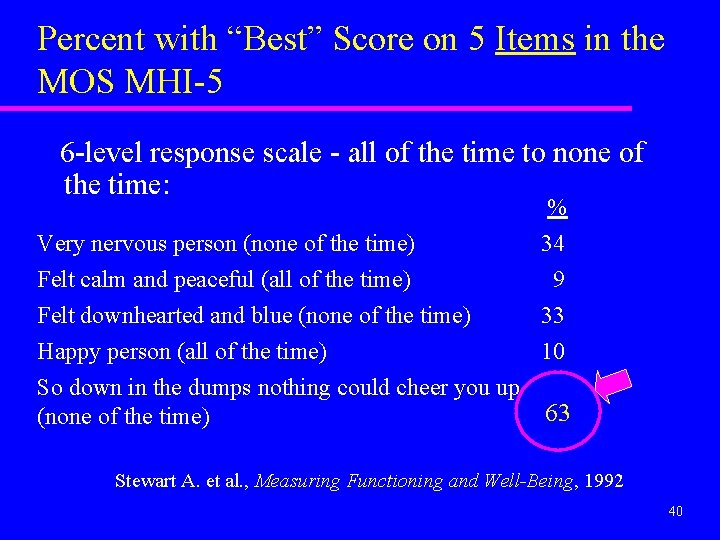
Percent with “Best” Score on 5 Items in the MOS MHI-5 6 -level response scale - all of the time to none of the time: Very nervous person (none of the time) Felt calm and peaceful (all of the time) Felt downhearted and blue (none of the time) % 34 9 33 Happy person (all of the time) 10 So down in the dumps nothing could cheer you up 63 (none of the time) Stewart A. et al. , Measuring Functioning and Well-Being, 1992 40
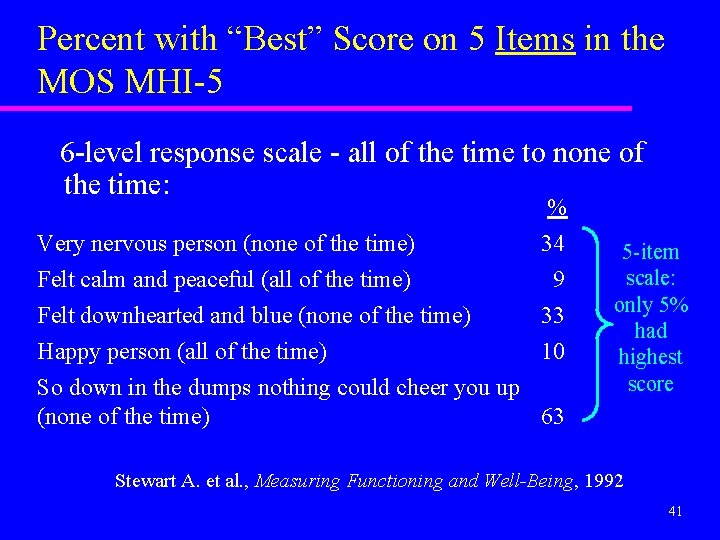
Percent with “Best” Score on 5 Items in the MOS MHI-5 6 -level response scale - all of the time to none of the time: Very nervous person (none of the time) Felt calm and peaceful (all of the time) Felt downhearted and blue (none of the time) % 34 9 33 Happy person (all of the time) 10 So down in the dumps nothing could cheer you up (none of the time) 63 5 -item scale: only 5% had highest score Stewart A. et al. , Measuring Functioning and Well-Being, 1992 41
Overview u Concepts u Basic of error psychometric characteristics – Variability – Reliability – Interpretability 42
Reliability u Extent to which an observed score is free of random error – Produces the same score each time it is administered (all else being equal) u Population-specific - reliability affected by: – sample size – variability in scores (dispersion) – a person’s level on the scale 43
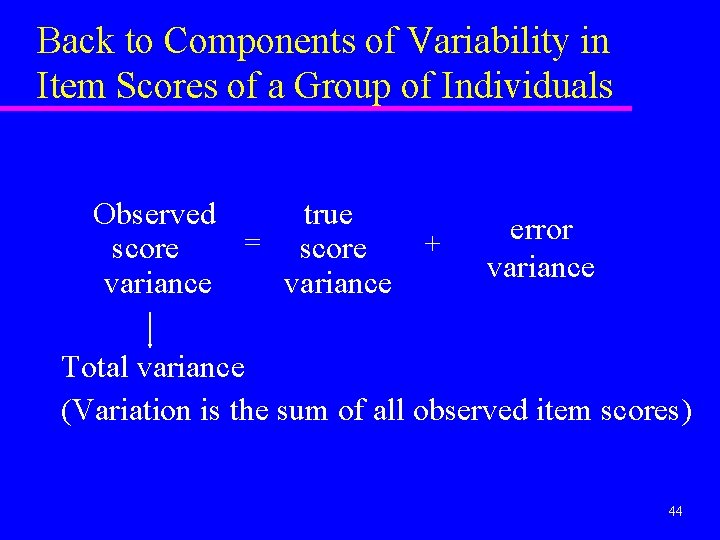
Back to Components of Variability in Item Scores of a Group of Individuals Observed true = score + score variance error variance Total variance (Variation is the sum of all observed item scores) 44
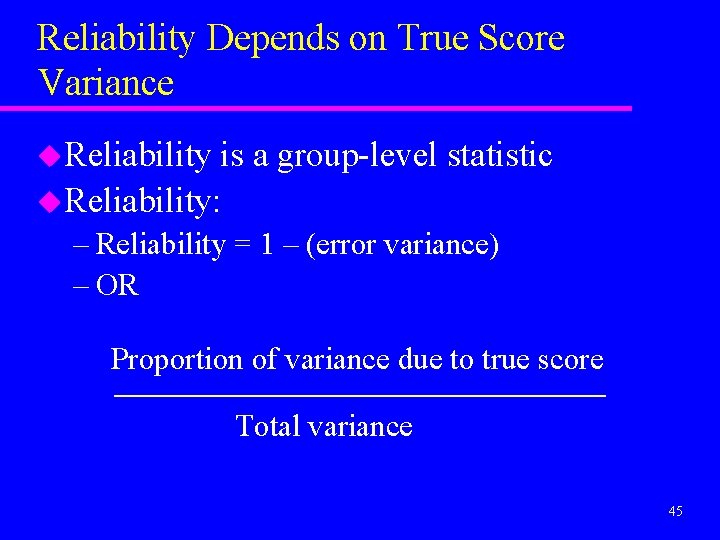
Reliability Depends on True Score Variance u. Reliability is a group-level statistic u. Reliability: – Reliability = 1 – (error variance) – OR Proportion of variance due to true score Total variance 45
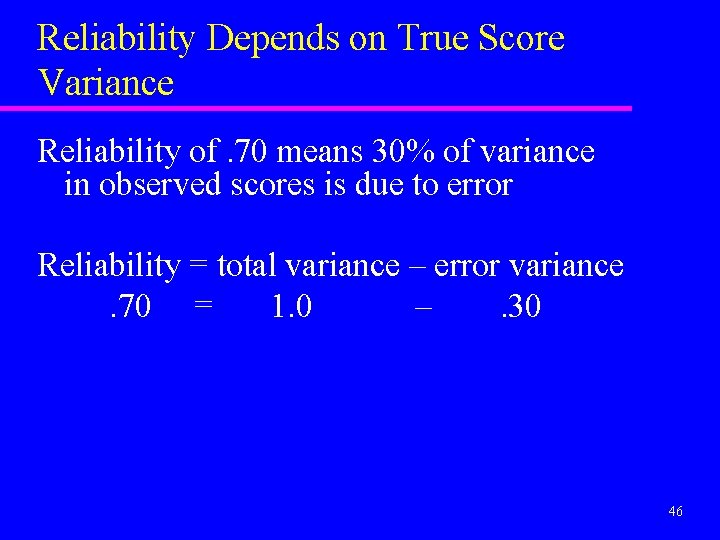
Reliability Depends on True Score Variance Reliability of. 70 means 30% of variance in observed scores is due to error Reliability = total variance – error variance. 70 = 1. 0 –. 30 46
Reliability Coefficient u. Typically ranges from. 00 - 1. 00 u. Higher scores indicate better reliability 47
Importance of Reliability u. Necessary for validity (but not sufficient) – Low reliability (or high measurement error) attenuates correlations with other variables – May conclude that two variables are not related when they are u. Greater reliability = greater power – The more reliable your scales, the smaller sample size you need to detect an association 48
Reliable Scale? u NO! u There is no such thing as a “reliable” scale u We accumulate “evidence” of reliability in a variety of populations in which it has been tested 49
How Do You Know if a Scale or Measure Has Adequate Reliability? u Adequacy of reliability judged according to standard criteria – Criteria depend on type of coefficient 50
Types of Reliability Tests Internal-consistency u Test-retest u Inter-rater u Intra-rater u 51
Internal Consistency Reliability: Cronbach’s Alpha u. Requires multiple items supposedly measuring same construct to calculate u. Extent to which all items measure the same construct (same latent variable) 52
Internal-Consistency Reliability u For multi-item scales u Cronbach’s alpha – for scales using ordinal items (e. g. , 1 -5) u Kuder Richardson 20 (KR-20) – for scales using dichotomous items 53
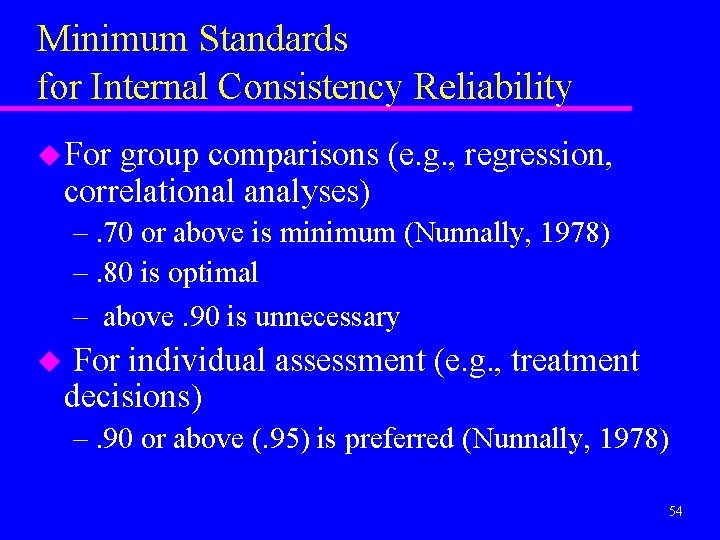
Minimum Standards for Internal Consistency Reliability u For group comparisons (e. g. , regression, correlational analyses) –. 70 or above is minimum (Nunnally, 1978) –. 80 is optimal – above. 90 is unnecessary u For individual assessment (e. g. , treatment decisions) –. 90 or above (. 95) is preferred (Nunnally, 1978) 54
Internal-Consistency Reliability Can be Spurious u. Based on only those who answered all questions in the measure – If a lot of people are having trouble with the items and skip some, they are not included in test of reliability u. Important to compare sample size in reliability calculation to total sample 55
Internal-Consistency Reliability is a Function of Number of Items in Scale u. Increases with the number of items u. Very large scales (20 or more items) can have high reliability without other good psychometric properties 56
Example: 20 item Beck Depression Inventory (BDI) u. BDI 1978 version (asks about past week) – Internal consistency reliability =. 86 Beck AT et al. J Clin Psychol. 1984; 40: 1365 -1367 57
Example: 20 item Beck Depression Inventory (BDI) u. BDI 1978 version (asks about past week) – Internal consistency reliability =. 86 – BUT: 3 items correlated <. 30 with other items in the scale Beck AT et al. J Clin Psychol. 1984; 40: 1365 -1367 58
Reliability Varies by Level on Measure u. Reliability can be poorer for those scoring at one end of the scale u. Example: Number of visits to doctor in past 12 months – More reliable for those with fewer visits 59
Test-Retest Reliability u Repeat assessment on individuals not expected to change u Time between assessments should be: – Short enough so no change occurs – Long enough so subjects don’t recall first response u Only reliability test for single item measures u Coefficient: correlation between 2 measurements 60
Appropriate Test-Retest Coefficients by Type of Scale u Continuous scales (ratio or interval scales, multi-item Likert scales): – Pearson u Ordinal or non-normally distributed scales: – Spearman or Kendall’s tau u Dichotomous (categorical) measures: – Phi or Kappa 61
Minimum Standards for Test-Retest Reliability u Magnitude of a test-retest correlation is important, not significance u Criterion: similar to that for internal consistency – >. 70 is desirable – >. 80 is optimal 62
Observer or Rater Reliability u Inter-rater reliability (across two or more raters) – Consistency (correlation) between two or more observers of the same subjects (one point in time) u Intra-rater reliability (within one rater) – Consistency within one observer – Correlation among repeated values obtained by the same observer (over time) 63
Observer or Rater Reliability u Sometimes Pearson correlations are used – scores on a group of individuals obtained by one observer correlated with scores obtained by another observer – Assesses association only u. 65 to. 95 are typical correlations u >. 85 is considered acceptable Mc. Dowell I et al. Measuring Health, 2006, p. 45. 64
Association vs. Agreement When Correlating Scores from Two Times or Ratings u Association: degree to which scores of one rater linearly predict scores of 2 nd rater u Agreement: extent to which same score obtained on 2 nd measurement (retest, 2 nd rater) u Can have high correlation and poor agreement – If second score is consistently higher for all subjects, can obtain high correlation – Need second test of mean differences 65
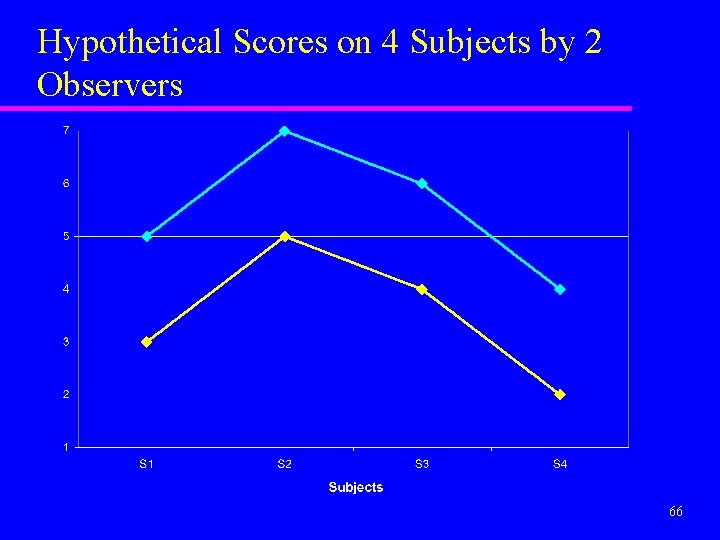
Hypothetical Scores on 4 Subjects by 2 Observers 66
Example of Association and Agreement u. Scores by observer 1 are exactly 2 points above scores by observer 2 – Correlation (association) would be perfect (r=1. 0) – Agreement is poor (no agreement on score in all cases - a difference of 2 between scores on each subject 67
Intraclass Correlation Coefficient (Kappa) for Testing Inter-rater Reliability u Coefficient indicates level of agreement of two or more judges, exceeding that which would be expected by chance u Appropriate for dichotomous (categorical) scales and ordinal scales u Several forms of kappa: – e. g. , Cohen’s kappa: 2 judges, dichotomous scale u Sensitive to number of observations, distribution of data 68
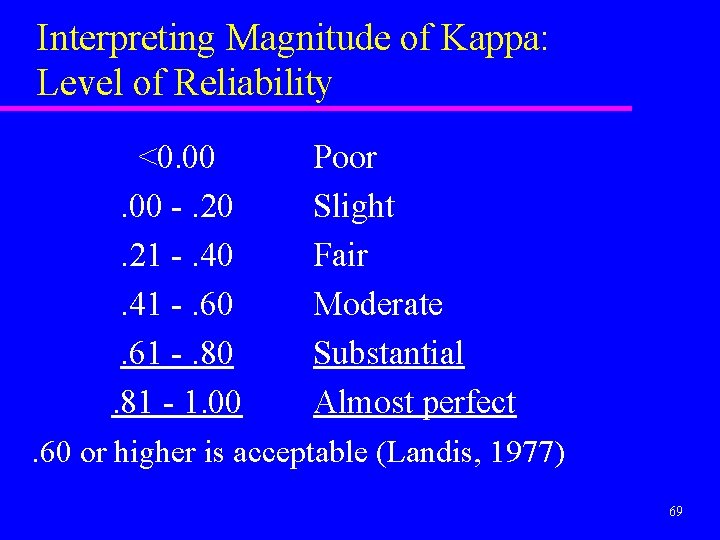
Interpreting Magnitude of Kappa: Level of Reliability <0. 00 -. 20. 21 -. 40. 41 -. 60. 61 -. 80. 81 - 1. 00 Poor Slight Fair Moderate Substantial Almost perfect . 60 or higher is acceptable (Landis, 1977) 69
Reliability Often Poorer in Lower SES or Low Literacy Groups More random error due to u. Reading problems u. Difficulty understanding complex questions u. Unfamiliarity with questionnaires and surveys 70
Advantages of Multi-item Scales Revisited u. Using multi-item scales improves reliability u. Random error is “canceled out” across multiple items 71
What Makes a Measure Reliable? u Preventing measurement error easier than assessing its effects u Measure – Clear items, appropriate response choices, etc. u Format – Make instrument easily understood u Method of administration – Train raters to do their job – Adhere to standard administration procedures 72
Overview u Concepts u Basic of error psychometric characteristics – Variability – Reliability – Interpretability 73
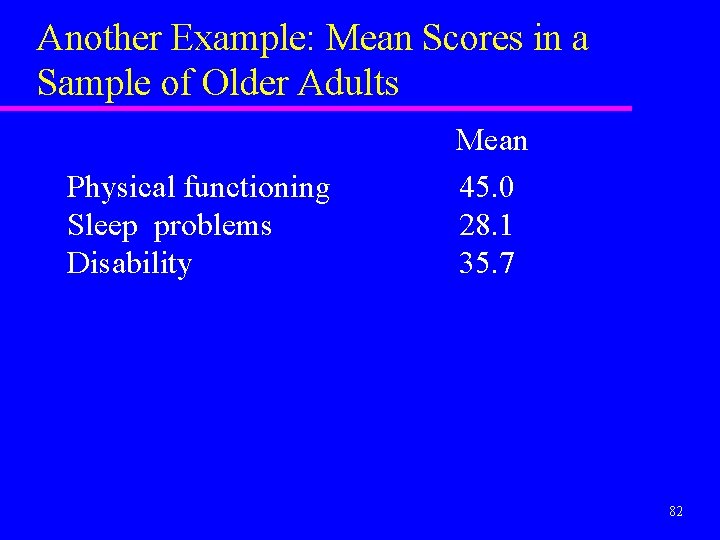
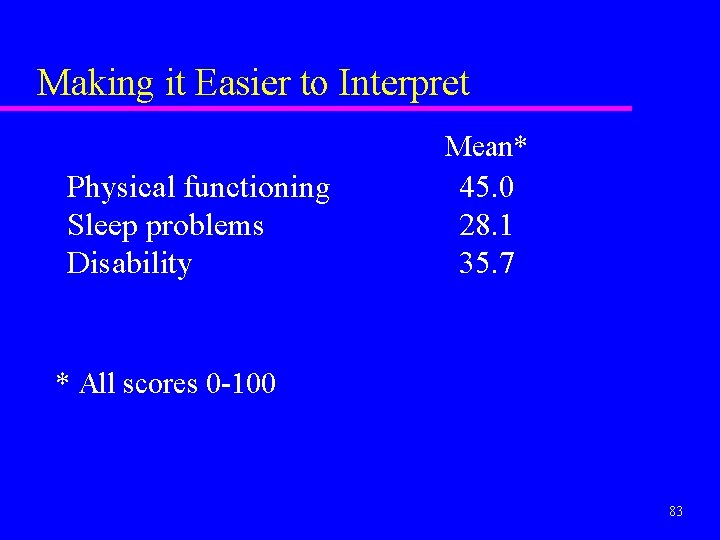
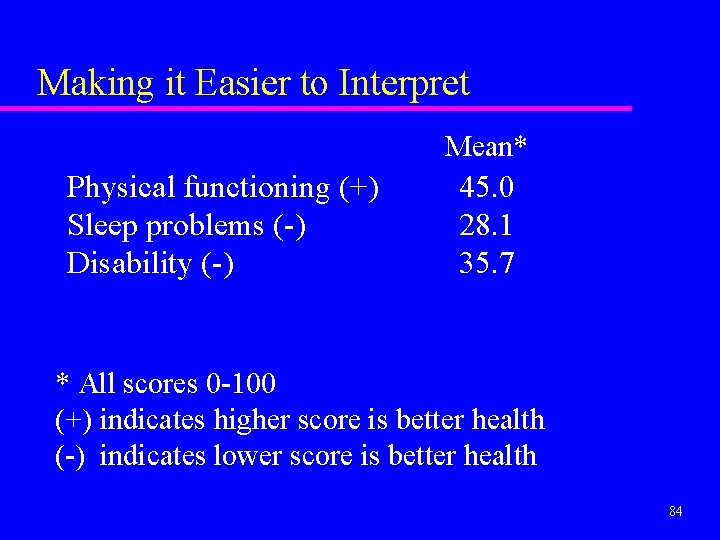
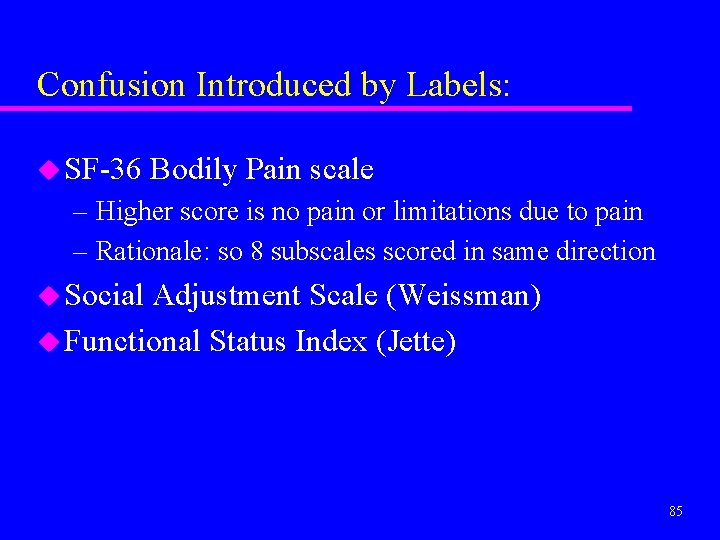
Interpretability: What does a Score Mean? u What are the endpoints? u What does a high score mean? (direction of scoring) u Compared to norms - is score low or high? Single items, more easily interpretable Multi-item scales, no inherent meaning to scores 74
Endpoints u What is minimum and maximum possible? – Enable interpretation of mean score u When scores are added, endpoints depend on number of items & number of response choices – 5 items, 4 response choices = 5 to 20 – 3 items, 5 response choices = 3 to 15 75
Compare Results to Norms u Comparing your means to published norms helps interpret the mean of your sample u SF-36 has numerous norms, e. g. – General population » By age group, gender, and chronic disease 76
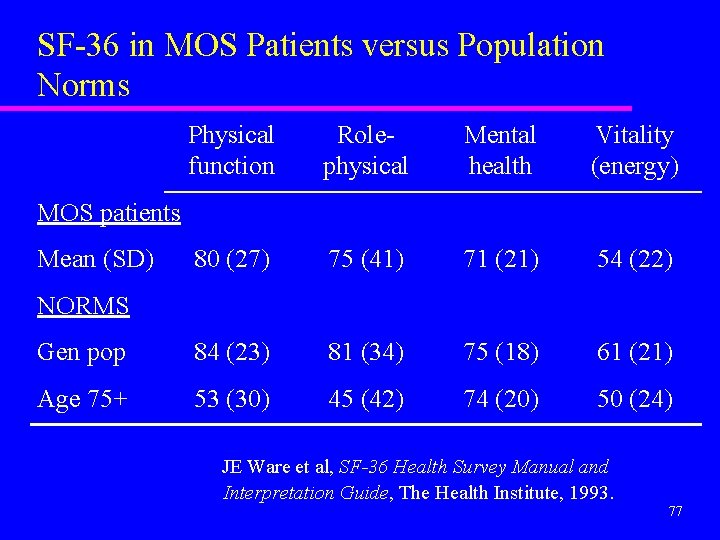
SF-36 in MOS Patients versus Population Norms Physical function Rolephysical Mental health Vitality (energy) 80 (27) 75 (41) 71 (21) 54 (22) Gen pop 84 (23) 81 (34) 75 (18) 61 (21) Age 75+ 53 (30) 45 (42) 74 (20) 50 (24) MOS patients Mean (SD) NORMS JE Ware et al, SF-36 Health Survey Manual and Interpretation Guide, The Health Institute, 1993. 77
Direction of Scoring u. What does a high score mean? u. Where in the range does the mean score lie? – Toward top, bottom? – In the middle? 78
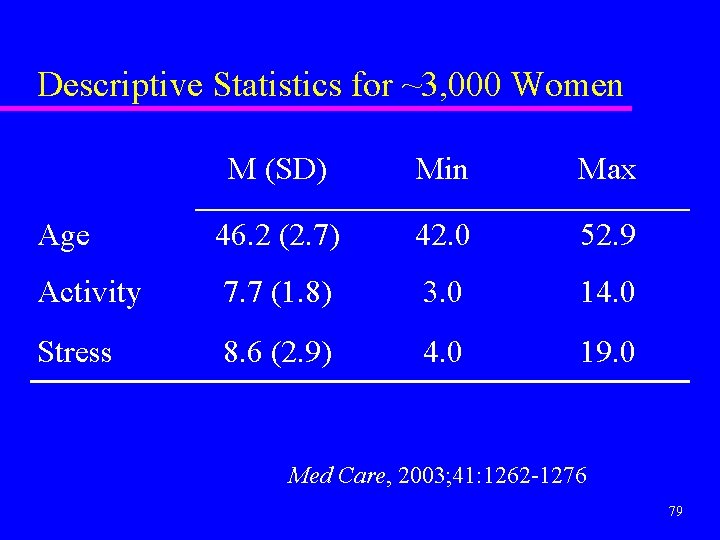
Descriptive Statistics for ~3, 000 Women M (SD) Min Max Age 46. 2 (2. 7) 42. 0 52. 9 Activity 7. 7 (1. 8) 3. 0 14. 0 Stress 8. 6 (2. 9) 4. 0 19. 0 Med Care, 2003; 41: 1262 -1276 79
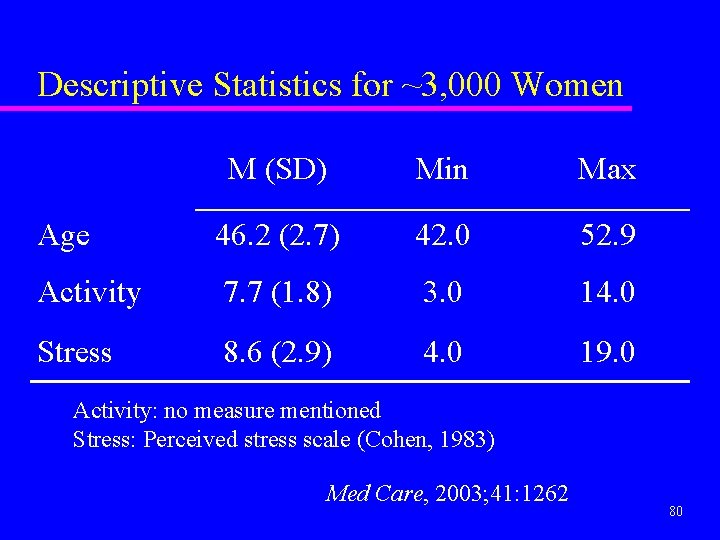
Descriptive Statistics for ~3, 000 Women M (SD) Min Max Age 46. 2 (2. 7) 42. 0 52. 9 Activity 7. 7 (1. 8) 3. 0 14. 0 Stress 8. 6 (2. 9) 4. 0 19. 0 Activity: no measure mentioned Stress: Perceived stress scale (Cohen, 1983) Med Care, 2003; 41: 1262 80
Perceived Stress Scale (Cohen 1983): Hard to Find u. Available in JSTOR – Can print one page at a time u. Searched article “on line” – Could not find scoring information other than reverse 7 of the 14 items and sum them » Possible score range of 0 -56 – Could not find response choices 81
Another Example: Mean Scores in a Sample of Older Adults Physical functioning Sleep problems Disability Mean 45. 0 28. 1 35. 7 82
Making it Easier to Interpret Mean* Physical functioning Sleep problems Disability 45. 0 28. 1 35. 7 * All scores 0 -100 83
Making it Easier to Interpret Mean* Physical functioning (+) Sleep problems (-) Disability (-) 45. 0 28. 1 35. 7 * All scores 0 -100 (+) indicates higher score is better health (-) indicates lower score is better health 84
Confusion Introduced by Labels: u SF-36 Bodily Pain scale – Higher score is no pain or limitations due to pain – Rationale: so 8 subscales scored in same direction u Social Adjustment Scale (Weissman) u Functional Status Index (Jette) 85
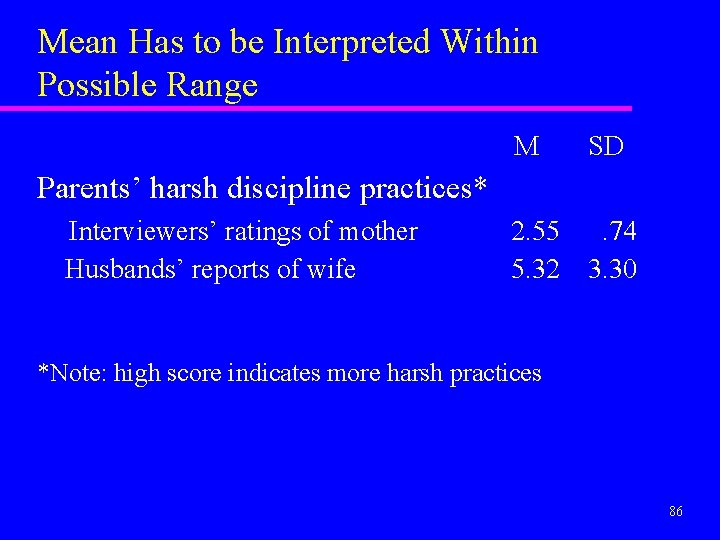
Mean Has to be Interpreted Within Possible Range M SD 2. 55 5. 32 . 74 3. 30 Parents’ harsh discipline practices* Interviewers’ ratings of mother Husbands’ reports of wife *Note: high score indicates more harsh practices 86
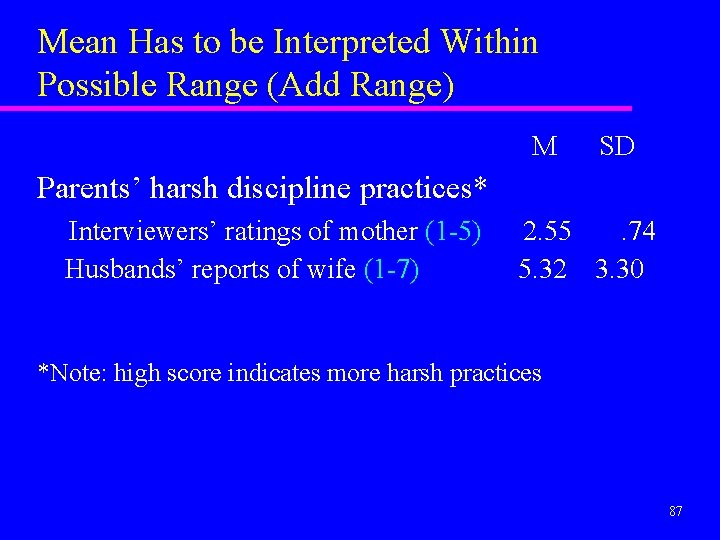
Mean Has to be Interpreted Within Possible Range (Add Range) M SD Parents’ harsh discipline practices* Interviewers’ ratings of mother (1 -5) Husbands’ reports of wife (1 -7) 2. 55. 74 5. 32 3. 30 *Note: high score indicates more harsh practices 87
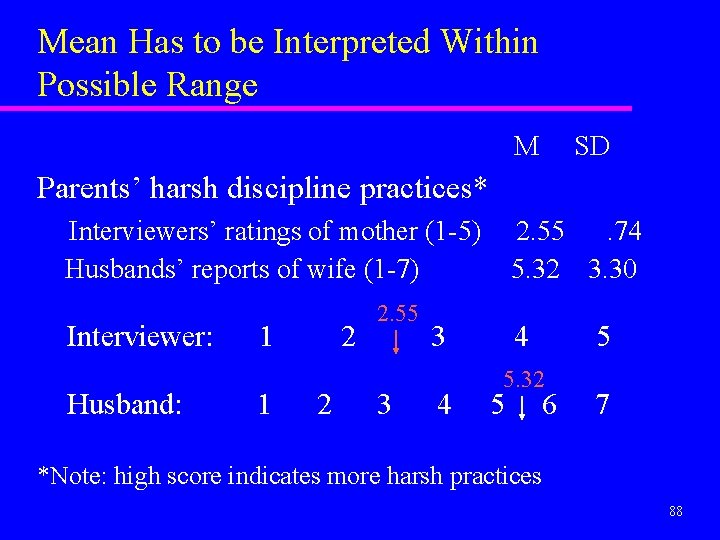
Mean Has to be Interpreted Within Possible Range M SD Parents’ harsh discipline practices* Interviewers’ ratings of mother (1 -5) Husbands’ reports of wife (1 -7) Interviewer: Husband: 1 1 2 2 2. 55 3 2. 55. 74 5. 32 3. 30 3 4 4 5 5. 32 5 6 7 *Note: high score indicates more harsh practices 88
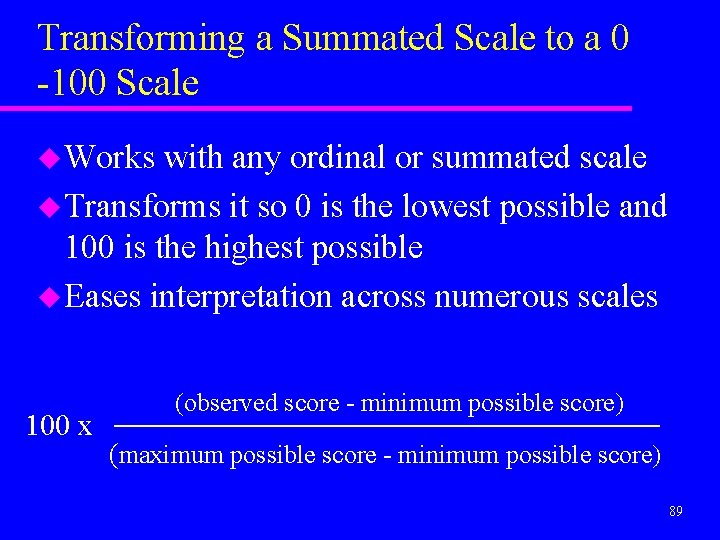
Transforming a Summated Scale to a 0 -100 Scale u Works with any ordinal or summated scale u Transforms it so 0 is the lowest possible and 100 is the highest possible u Eases interpretation across numerous scales 100 x (observed score - minimum possible score) (maximum possible score - minimum possible score) 89
Homework u. Complete rows 13 -19 on matrix for both measures – Interpretability, nature of samples on which it has been tested, variability and central tendency, reliability 90
- Slides: 90