
Class 34 Models of Computation CS 200 Computer
- Slides: 28
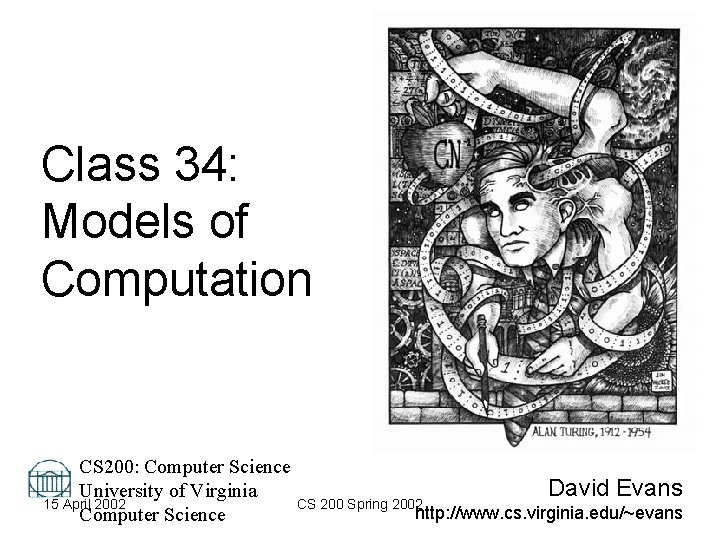
Class 34: Models of Computation CS 200: Computer Science David Evans University of Virginia 15 April 2002 CS 200 Spring 2002 http: //www. cs. virginia. edu/~evans Computer Science
Menu • • Are complexity classes really meaningful? How can we model computation? Turing Machines Universal Turing Machine 15 April 2002 CS 200 Spring 2002 2
Complexity Classes • We claimed problem complexity doesn’t depend on the language or computer: problems are in class P and NP regardless of what kind of computer you have • In PS 7, we saw that if you have a quantum computer you solve a problem that has no known polynomial time solution on a “normal computer” in polynomial time. • This should bother you! 15 April 2002 CS 200 Spring 2002 3
Computability • Does our computer model change whether or not something is undecidable? No – we proved things we undecidable by showing a contradiction. It doesn’t depend on how we model computers. 15 April 2002 CS 200 Spring 2002 4
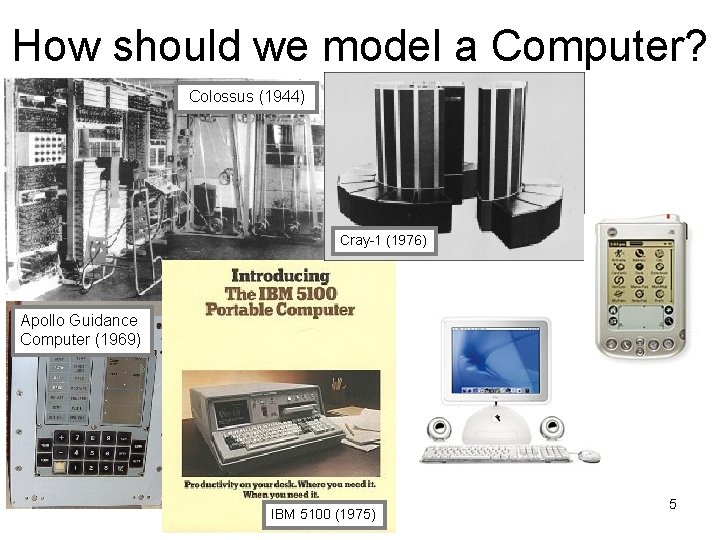
How should we model a Computer? Colossus (1944) Cray-1 (1976) Apollo Guidance Computer (1969) IBM 5100 (1975) 5
Modeling Computers • Input – Without it, we can’t describe a problem • Output – Without it, we can’t get an answer • Processing – Need some way of getting from the input to the output • Memory – Need to keep track of what we are doing 15 April 2002 CS 200 Spring 2002 6
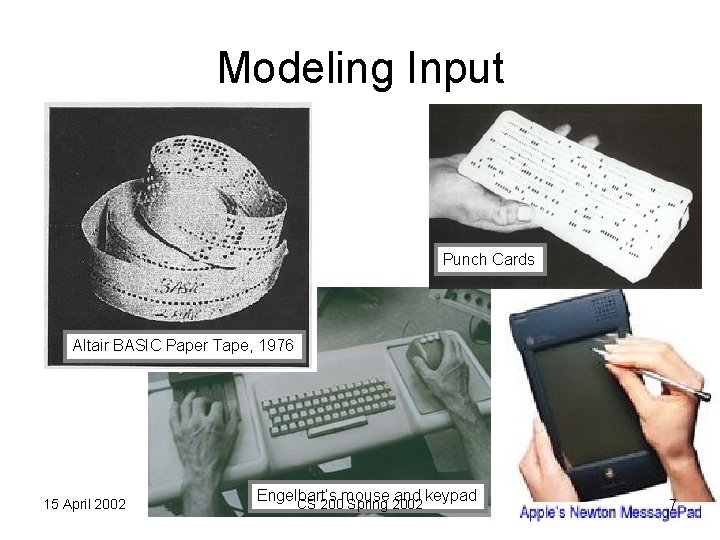
Modeling Input Punch Cards Altair BASIC Paper Tape, 1976 15 April 2002 Engelbart’s mouse and keypad CS 200 Spring 2002 7
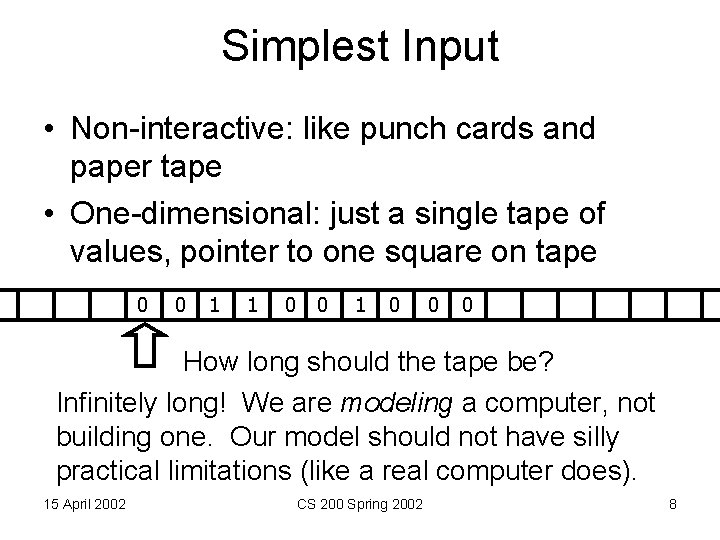
Simplest Input • Non-interactive: like punch cards and paper tape • One-dimensional: just a single tape of values, pointer to one square on tape 0 0 1 1 0 0 0 How long should the tape be? Infinitely long! We are modeling a computer, not building one. Our model should not have silly practical limitations (like a real computer does). 15 April 2002 CS 200 Spring 2002 8
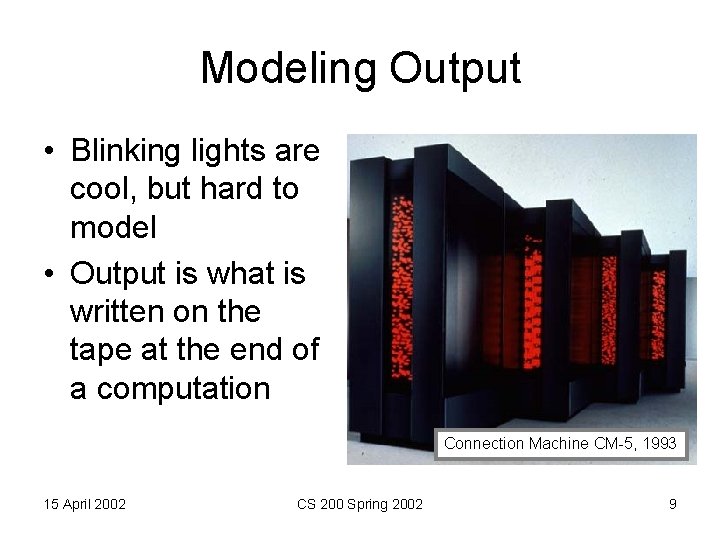
Modeling Output • Blinking lights are cool, but hard to model • Output is what is written on the tape at the end of a computation Connection Machine CM-5, 1993 15 April 2002 CS 200 Spring 2002 9
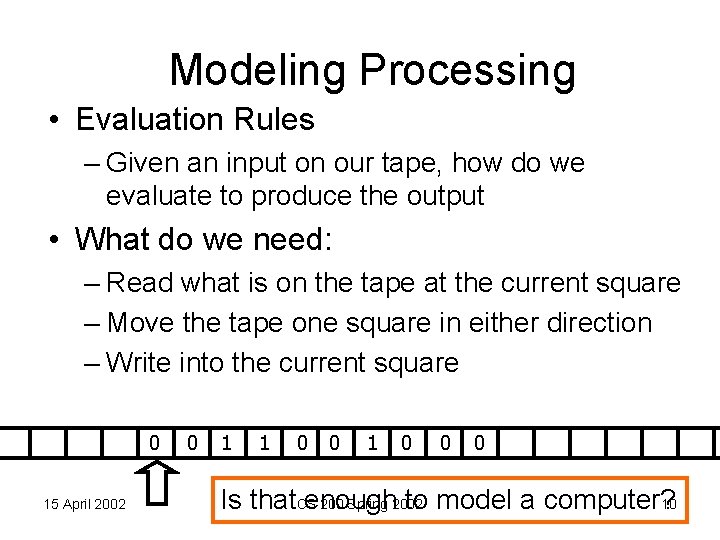
Modeling Processing • Evaluation Rules – Given an input on our tape, how do we evaluate to produce the output • What do we need: – Read what is on the tape at the current square – Move the tape one square in either direction – Write into the current square 0 15 April 2002 0 1 1 0 0 0 200 Spring 2002 10 Is that. CSenough to model a computer?
Modeling Processing • Read, write and move is not enough • We also need to keep track of what we are doing: – How do we know whether to read, write or move at each step? – How do we know when we’re done? • What do we need for this? 15 April 2002 CS 200 Spring 2002 11
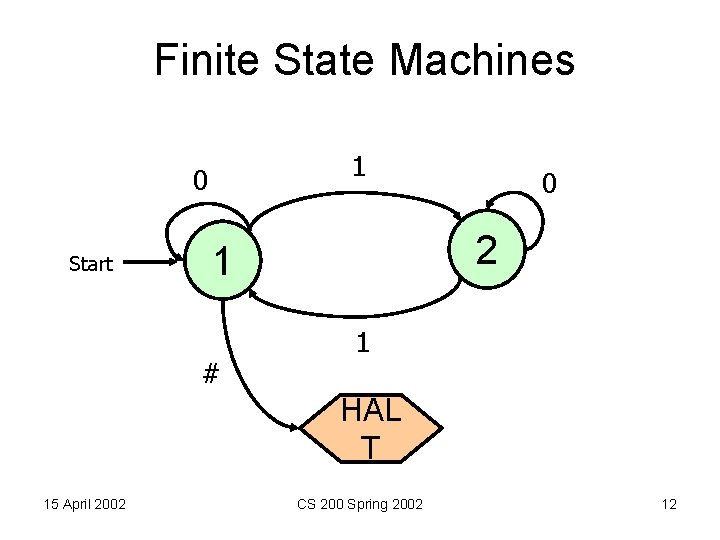
Finite State Machines 1 0 Start 2 1 # 0 1 HAL T 15 April 2002 CS 200 Spring 2002 12
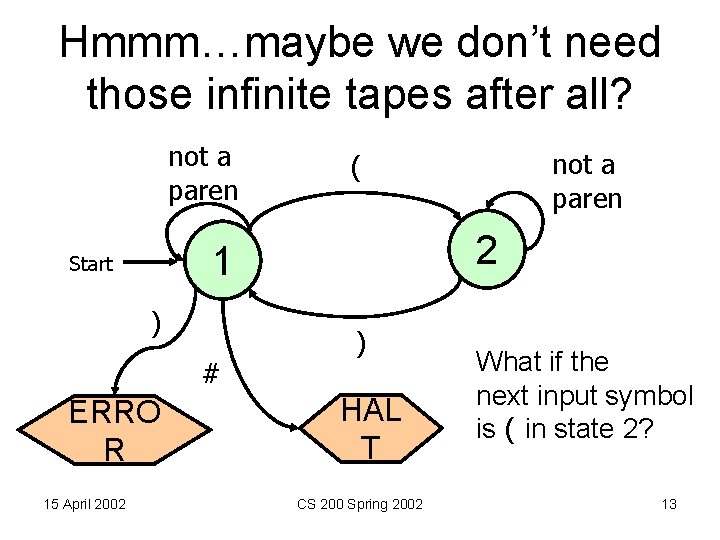
Hmmm…maybe we don’t need those infinite tapes after all? not a paren ) # ERRO R 15 April 2002 2 1 Start not a paren ( ) HAL T CS 200 Spring 2002 What if the next input symbol is ( in state 2? 13
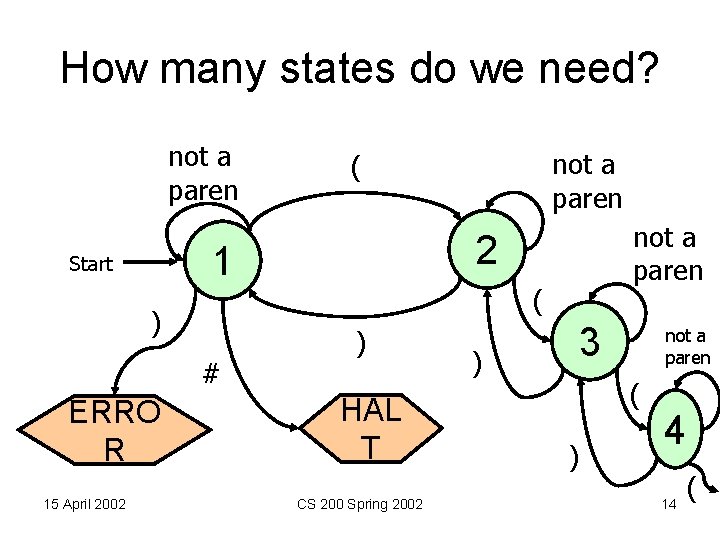
How many states do we need? not a paren ) # ERRO R 15 April 2002 not a paren 2 1 Start not a paren ( ( ) HAL T CS 200 Spring 2002 3 ) not a paren ( ) 4 14 (
Finite State Machine • There are lots of things we can’t compute with only a finite number of states • Solutions: – Infinite State Machine • Hard to describe and draw – Add a tape to the Finite State Machine 15 April 2002 CS 200 Spring 2002 15
FSM + Infinite Tape • Start: – FSM in Start State – Input on Infinite Tape – Pointer to start of input • Move: – Read one input symbol from tape – Follow transition rule from current state • To next state • Write symbol on tape, and move L or R one square • Finish: – Transition to halt state 15 April 2002 CS 200 Spring 2002 16
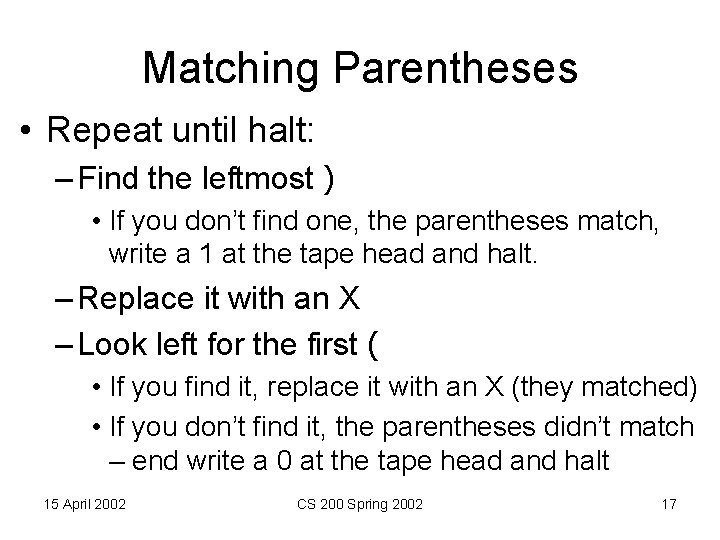
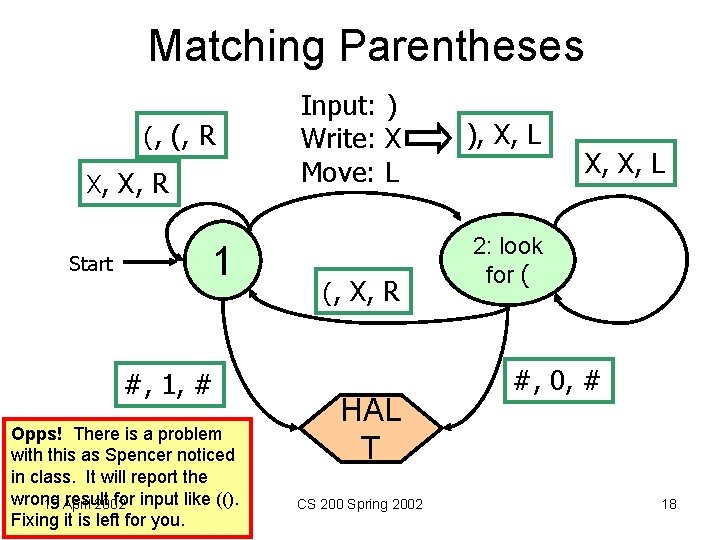
Matching Parentheses • Repeat until halt: – Find the leftmost ) • If you don’t find one, the parentheses match, write a 1 at the tape head and halt. – Replace it with an X – Look left for the first ( • If you find it, replace it with an X (they matched) • If you don’t find it, the parentheses didn’t match – end write a 0 at the tape head and halt 15 April 2002 CS 200 Spring 2002 17
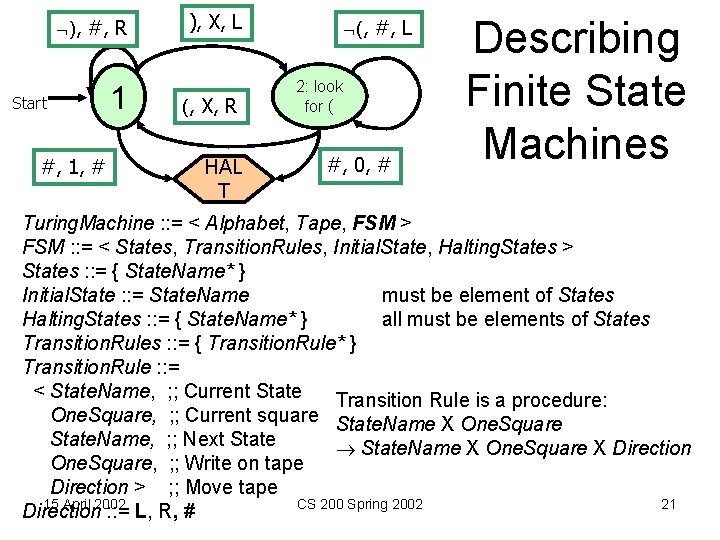
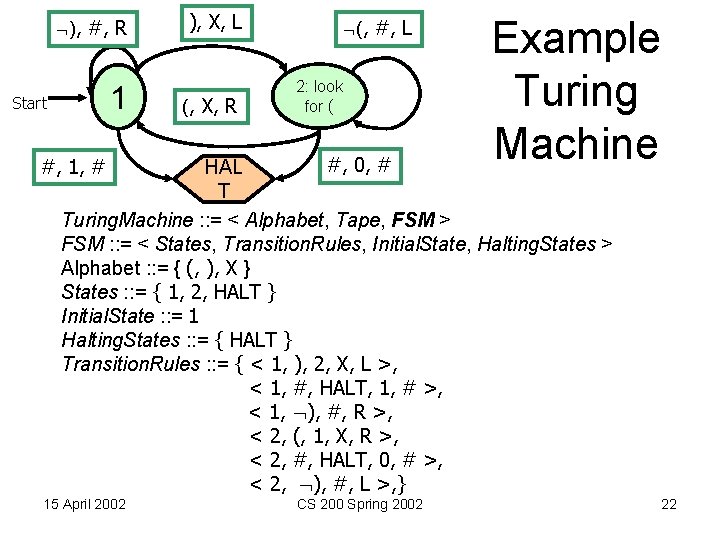
Matching Parentheses (, (, R X, X, R Start 1 #, 1, # Opps! There is a problem with this as Spencer noticed in class. It will report the wrong result for input like ((). 15 April 2002 Fixing it is left for you. Input: ) Write: X Move: L (, X, R HAL T CS 200 Spring 2002 ), X, L X, X, L 2: look for ( #, 0, # 18
Turing Machine • This is a “Turing Machine” • Alan Turing, On computable numbers: With an application to the Entscheidungsproblem, 1936 – Turing developed the machine abstraction to show the halting problem really leads to a contradiction – Our informal argument, depended on assuming we could do if and everything else except halts? 15 April 2002 CS 200 Spring 2002 19
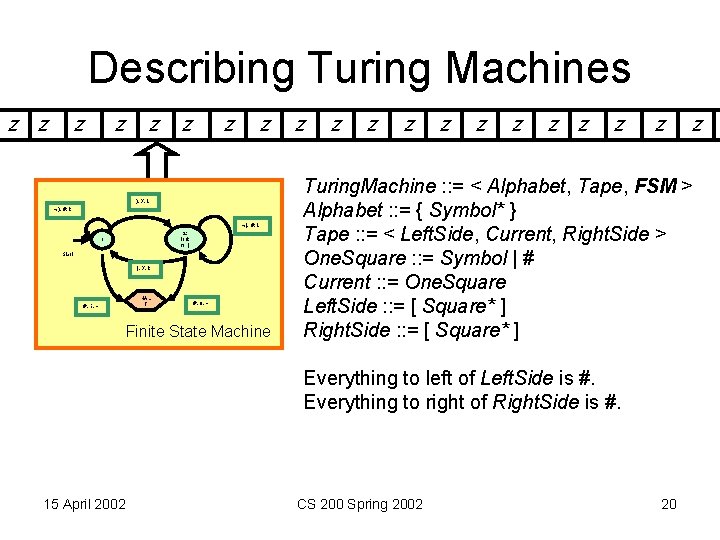
Describing Turing Machines z z z z ), X, L ), #, R (, #, L 2: look for ( 1 Start (, X, R #, 1, - HAL T #, 0, - Finite State Machine z z z Turing. Machine : : = < Alphabet, Tape, FSM > Alphabet : : = { Symbol* } Tape : : = < Left. Side, Current, Right. Side > One. Square : : = Symbol | # Current : : = One. Square Left. Side : : = [ Square* ] Right. Side : : = [ Square* ] Everything to left of Left. Side is #. Everything to right of Right. Side is #. 15 April 2002 z CS 200 Spring 2002 20
), #, R Start #, 1, # 1 ), X, L (, X, R HAL T (, #, L 2: look for ( #, 0, # Describing Finite State Machines Turing. Machine : : = < Alphabet, Tape, FSM > FSM : : = < States, Transition. Rules, Initial. State, Halting. States > States : : = { State. Name* } Initial. State : : = State. Name must be element of States Halting. States : : = { State. Name* } all must be elements of States Transition. Rules : : = { Transition. Rule* } Transition. Rule : : = < State. Name, ; ; Current State Transition Rule is a procedure: One. Square, ; ; Current square State. Name X One. Square State. Name, ; ; Next State. Name X One. Square X Direction One. Square, ; ; Write on tape Direction > ; ; Move tape 15 April 2002 CS 200 Spring 2002 21 Direction : : = L, R, #
), #, R 1 Start ), X, L (, X, R (, #, L 2: look for ( Example Turing Machine #, 0, # HAL T Turing. Machine : : = < Alphabet, Tape, FSM > FSM : : = < States, Transition. Rules, Initial. State, Halting. States > Alphabet : : = { (, ), X } States : : = { 1, 2, HALT } Initial. State : : = 1 Halting. States : : = { HALT } Transition. Rules : : = { < 1, ), 2, X, L >, < 1, #, HALT, 1, # >, < 1, ), #, R >, < 2, (, 1, X, R >, < 2, #, HALT, 0, # >, < 2, ), #, L >, } #, 1, # 15 April 2002 CS 200 Spring 2002 22
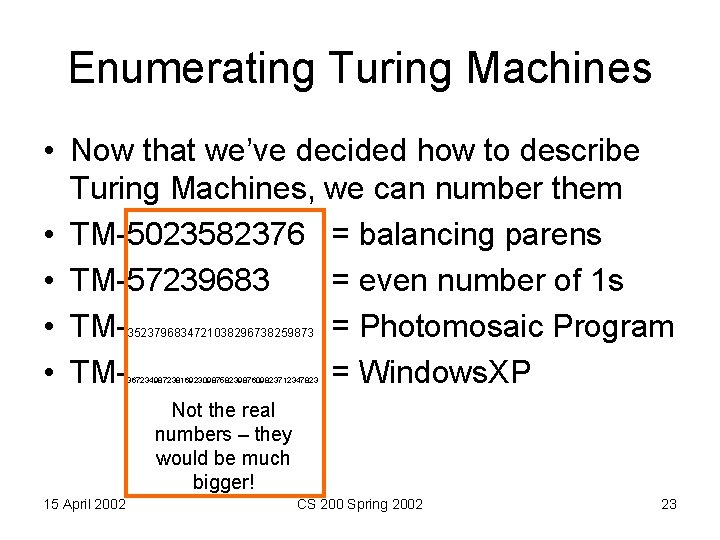
Enumerating Turing Machines • Now that we’ve decided how to describe Turing Machines, we can number them • TM-5023582376 = balancing parens • TM-57239683 = even number of 1 s • TM= Photomosaic Program • TM= Windows. XP 3523796834721038296738259873 3672349872381692309875823987609823712347823 Not the real numbers – they would be much bigger! 15 April 2002 CS 200 Spring 2002 23
Universal Turing Machines 15 April 2002 CS 200 Spring 2002 24
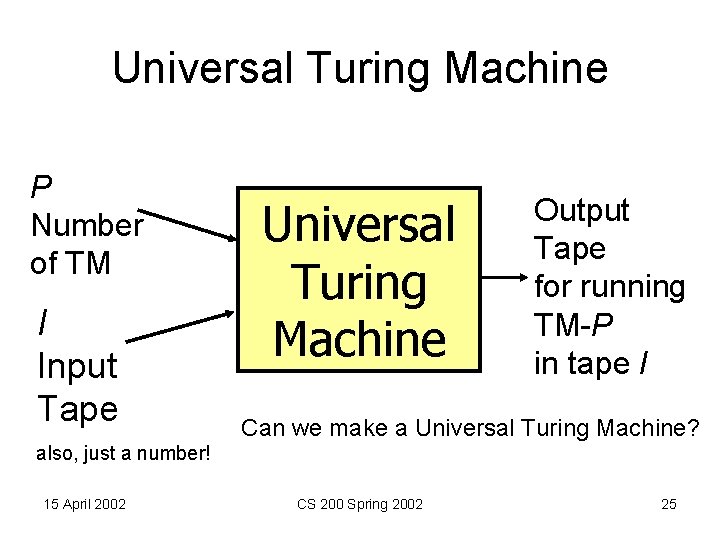
Universal Turing Machine P Number of TM I Input Tape Universal Turing Machine Output Tape for running TM-P in tape I Can we make a Universal Turing Machine? also, just a number! 15 April 2002 CS 200 Spring 2002 25
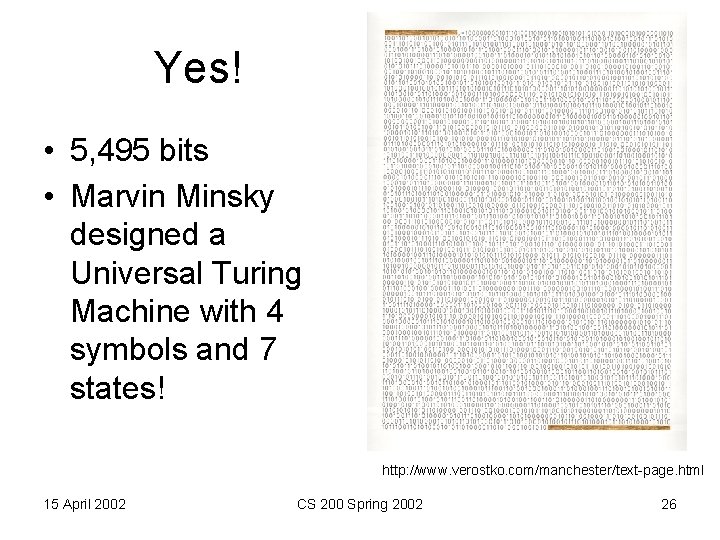
Yes! • 5, 495 bits • Marvin Minsky designed a Universal Turing Machine with 4 symbols and 7 states! http: //www. verostko. com/manchester/text-page. html 15 April 2002 CS 200 Spring 2002 26
Church-Turing Thesis • Any mechanical computation can be performed by a Turing Machine • There is a TM-n corresponding to every decidable problem • We can simulate one step on any “normal” (classical mechanics) computer with a constant number of steps on a TM: – If a problem is in P on a TM, it is in P on an i. Mac, CM 5, Cray, Palm, etc. 15 April 2002 CS 200 Spring 2002 27
Charge • Wednesday, Friday: – Lambda Calculus model of computation – Very different from Turing Machines, but we will show that it is exactly as powerful! • Project Feedback: I will either email you before Wednesday, or return comments on Wednesday 15 April 2002 CS 200 Spring 2002 28